


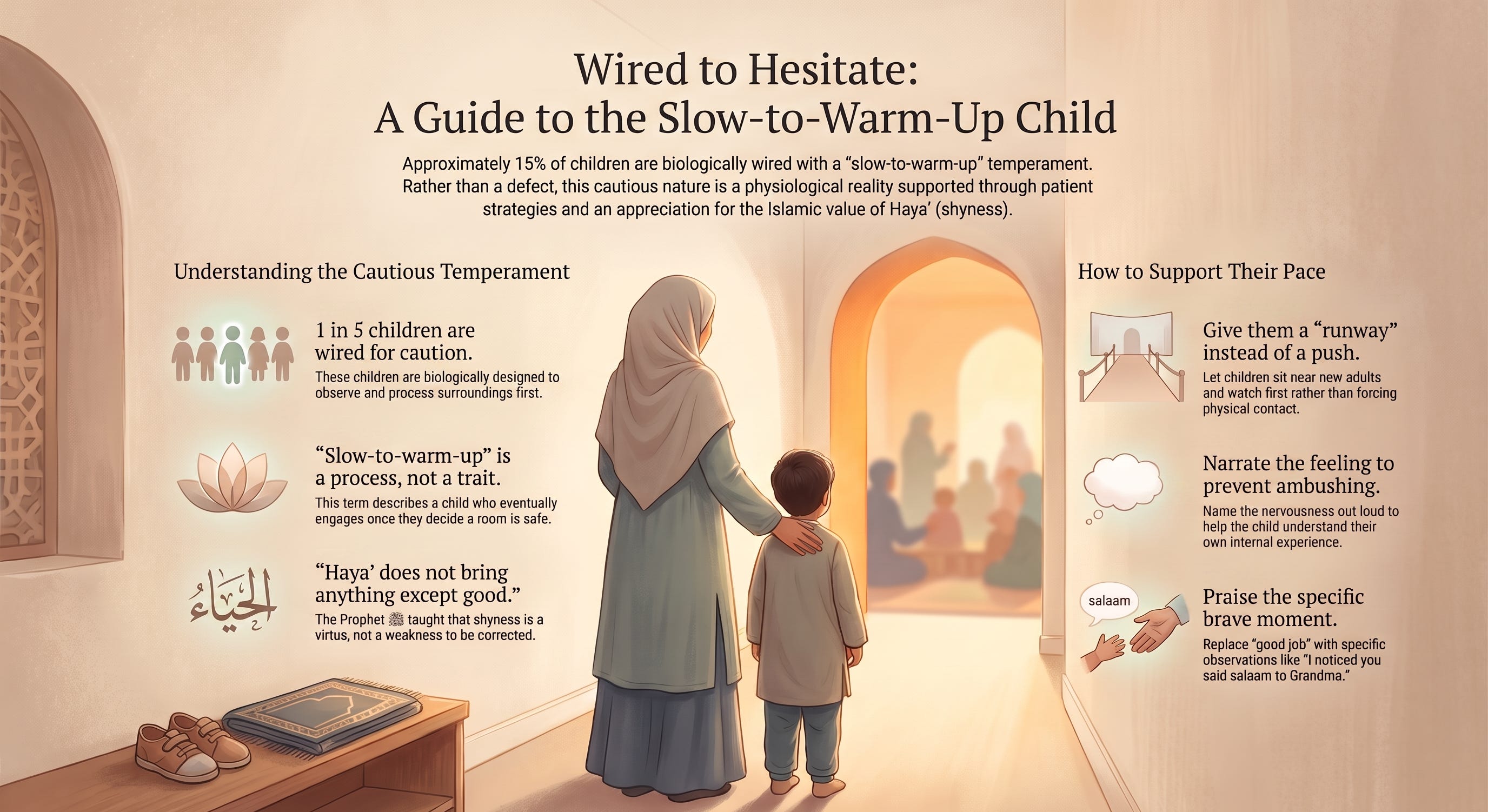
Kagan’s landmark 1988 study found that nearly 15% of children are born wired for caution around new people. [1] Here’s what actually helps, without the shame.
Your daughter presses her face into your shoulder within the first ten seconds of walking into the party.
Your son knows every answer in Qur’an class. He hasn’t said one of them out loud in three weeks.
You smile at the hostess, apologize for your child, and feel that familiar knot in your stomach. Why can’t they just say salaam like a normal kid.
Here’s what I wish someone had told me sooner: your child might not be broken, embarrassed, or badly parented. They might just be one of the roughly 15% of children born with a nervous system that’s wired to hang back first and warm up second. [1] Jerome Kagan tracked children from toddlerhood into their school years and found that this cautious style wasn’t just a phase — for a meaningful number of kids, it held steady, and it showed up in their actual physiology, not just their behavior. [1]
That’s not a parenting failure. That’s biology.
Why This Guide Is Different
Grounded in temperament research, not guesswork. Every strategy here comes from developmental psychology, including Kagan’s foundational work on behavioral inhibition. [1][3]
Built on Sunnah, not just sympathy. This isn’t “don’t worry about it.” It’s the Prophet’s ﷺ own recorded shyness, and a direct hadith on what shyness is worth.
You’ll leave with a tool, not just a feeling. The free Slow-to-Warm-Up Toolkit gives you scripts and a step-by-step approach, not another thing to remember under pressure.
Before You Assume It’s Shyness, Check This
Most of the time, a quiet or clingy child is exactly what they look like: a child with a cautious temperament. But three other things can look like shyness from the outside while being something else entirely, and it’s worth ruling them out first, before you build a whole strategy around the wrong diagnosis.
A child with a language delay often wants to connect — reaching for eye contact, trying to join in — but gets frustrated when others can’t understand them. That frustration can look like withdrawal. A child with hearing loss may seem to ignore people simply because they didn’t fully catch what was said, not because they’re avoiding them. And a child with selective mutism goes completely silent in specific settings, like school, while chatting freely at home. That’s a different pattern than a child who’s simply slow to warm up everywhere.
Quick gut-check: Does your child eventually relax and engage once they’re comfortable, in every setting, given enough time? If yes, you’re almost certainly looking at temperament, not something else. If your child stays silent in one specific place no matter how much time passes, or seems to want connection but can’t quite get there, that’s worth a conversation with your family doctor or your child’s teacher before anything else in this guide.
For the majority of children, though, what you’re looking at is temperament. And once you know that, the whole conversation changes.
The Word Swap That Changes Everything
Shyness is a fairly stable trait: a tendency toward wariness or self-consciousness specifically in new or unfamiliar situations. [2][3] It isn’t defiance, and it isn’t something your child picked up from anywhere. Some children are simply born more reactive to novelty than others.
What surprised me most in the research is how situational it actually is. A child who won’t speak to her aunt at the door might be laughing with her twenty minutes later, once she’s decided, on her own timeline, that the room is safe.
That’s why many specialists now use “slow to warm up” instead of “shy.” [3][4] One phrase describes a fixed trait. The other describes a process that’s already in motion. Children absorb the words said about them, even the ones said over their heads at a family gathering.
When was the last time someone described your child as “just shy” while your child was standing right there?
What Actually Helps, Wherever You Are
Forget splitting this by age for a second. The same three moves work whether your child is two or eight — they just look slightly different depending on how old they are.
Give them a runway, not a push. Don’t march a toddler straight up to an unfamiliar relative for a hug, and don’t spring a class presentation on an eight-year-old with no warning. Let a young child sit near the new adult and watch first. Let an older child rehearse the presentation at home, in front of a friendly, low-stakes audience, before they have to do it for real. Same principle. Different execution.
Narrate the feeling instead of managing it away. With a toddler, that sounds like: “You seem a little nervous because you don’t know everyone yet. Let’s stand together and look around first.” With a school-age child, it sounds more like coaching before the event: “Khala is going to want to talk to you today, but it’s completely fine if you just smile and nod.” Both are the same move — naming what’s coming so it doesn’t ambush them.
But here’s the thing most well-meaning parents get wrong at every age: over-comforting backfires. Long, repeated reassurance can accidentally signal that the situation really is dangerous, which deepens the very clinging or avoidance you’re trying to soothe. [3]
Praise the specific brave moment, not the general effort. “I noticed you said salaam to Grandma, and did you see how happy that made her?” lands in a way “good job” never does, at any age. [4] For an older child, structured activities — sport, scouts, a regular masjid circle — create a built-in reason to interact without the open-ended pressure of unstructured socializing, and coaches who understand quieter temperaments bring these children along gently instead of pushing them into the spotlight. [6]
And at every age: avoid comparing siblings, even gently. When a relative announces “she’s just so shy” as though it’s a problem to solve on the spot, a warm correction helps everyone: “She takes a little while to warm up. Once she’s comfortable, she opens right up.” Your child hears, in real time, that you understand them.
When Patience Isn’t Enough Anymore
Everything above assumes ordinary temperament. Sometimes it’s more than that, and it’s worth knowing the line.
Talk to your child’s doctor if shyness starts blocking daily life: avoiding places they need to go, visible anxiety before ordinary events, telling you they feel lonely but don’t know how to join in, or anxiety about speaking in class that’s affecting their learning. Longitudinal research has found that early, pronounced shy or fearful temperament can predict elevated anxiety symptoms later on. [5] Persistent, significant shyness deserves a conversation, not indefinite patience.
I know it’s hard to remember all of this in the actual moment — standing at a party doorway with a clinging toddler, or watching your eight-year-old freeze up at a family gathering. That’s why I built the free Slow-to-Warm-Up Toolkit — a printable guide with the exact phrases and a step-by-step approach you can use in real time. Keep reading to download it at the end of this article.

The Sacred Trust of Raising a Gentle Soul: What Islam Teaches About Shyness
As Muslim parents, it helps to remember that our children’s temperaments, quiet ones included, aren’t accidents to correct. When I reflect on the story of Musa (peace be upon him) at the well, one detail has stayed with me: when the daughter of the righteous man was sent to invite him, the Qur’an describes her “walking with shyness.” [8] According to Tafsir Ibn Kathir, Umar ibn al-Khattab explained that she covered her face with her garment as she approached, deliberately unlike women who moved through public spaces without any reserve. Her shyness didn’t stop her from doing what needed to be done. She spoke clearly, delivered the message, and later became the one who recommended hiring Musa for his strength and trustworthiness. Shyness and capability sat comfortably together in her.
The Prophet ﷺ himself was described by his own companions as “shier than a veiled virgin girl.” [9] Not as a weakness. As something they loved about him.
And he settled the larger question directly: “Haya’ does not bring anything except good.” [10] What developmental research now describes carefully, as a stable temperament with real physiological roots, the Prophet ﷺ described simply: good, in itself, not a defect waiting to be corrected.
If you’ve read this far, you’re the kind of parent who takes your child’s inner world seriously — not as a problem to fix, but as a temperament to understand. That tells me something beautiful about you.
Inside the Slow-to-Warm-Up Toolkit (one comprehensive PDF, 3 pages):
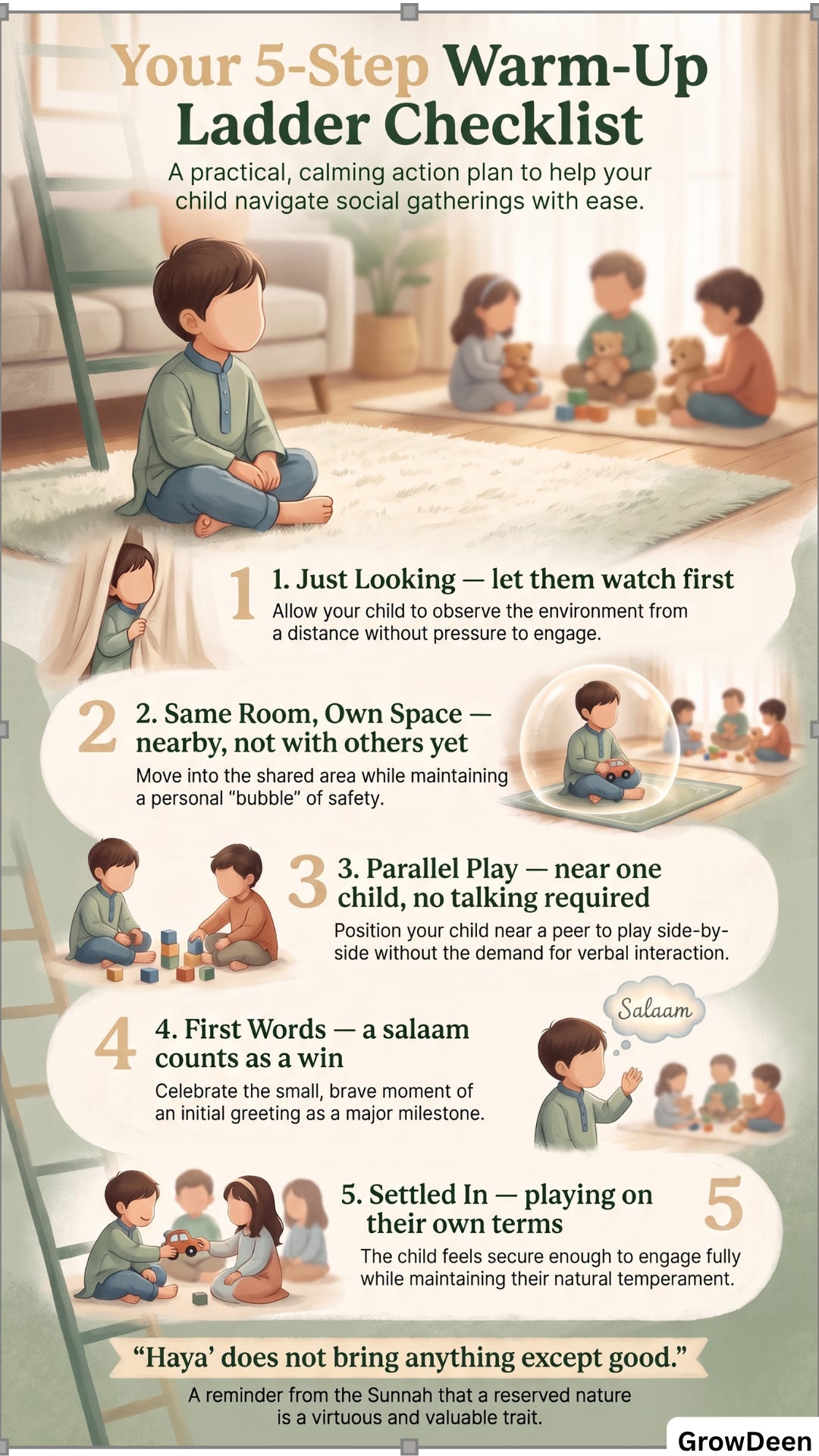
Page 1: The Warm-Up Ladder — A five-step visual guide moving a child from “just watching” to “settled in,” so you have an actual plan the next time a new situation starts to overwhelm them — designed as a card you can keep in your bag or on the fridge.
Page 2: Say This, Not “Good Job” — Eight ready-to-use specific praise phrases for the exact moments that matter, so you’re never standing there fumbling for the right words in front of your child — usable within seconds, any time you need them.
Page 3: The Haya’ Reflection Card — The hadith on shyness bringing nothing but good, with a short reflection connecting it to the Prophet’s ﷺ own described character — something to read before a gathering that usually makes you brace yourself.
This isn’t a PDF to download and forget. It’s built to stay in the places where the hard moments actually happen — your bag, your fridge, your car door pocket.
This toolkit is what every subscriber receives with each article. We cover the full journey of raising Muslim children, all backed by research and rooted in the Sunnah.
If you’re a Muslim parent who wants both evidence-based guidance and Islamic grounding, subscribe for free so future resources arrive before you need them.
Subscribe free for parenting resources backed by both science and Sunnah — guidance so specific, you won’t find it anywhere else. No spam, no clutter, just resources that matter.
Before you close this tab: think of one small thing your child did today that took a little courage, even something tiny. Say it out loud to them tonight, specifically. Not “good job.” The actual thing. That’s it. That’s the whole practice.
May Allah make the quiet ones in our homes feel understood, not corrected, and may He grant us the patience to raise them at their own pace.
Share This With Someone Specific
Think of one person right now: the aunt who keeps apologizing for her son at every family gathering, the friend whose daughter cried through her entire birthday party last month, the mother at the masjid who just said, out loud, “I don’t know what’s wrong with my kid.”
This article could change how they see their child, starting tonight. Share it with them — not because you’re being preachy, but because you know exactly what that knot in the stomach feels like.
Frequently Asked Questions
Q: Is shyness in children something that needs to be fixed?
A: No. Shyness is a normal, often biologically rooted temperament, and researchers estimate close to 15% of children are born with this cautious style. [1] It only needs extra attention if it’s causing real distress or blocking daily life — see “When Patience Isn’t Enough Anymore” above.
Q: At what age does shyness in children usually improve?
A: There’s no fixed timeline. Many children grow noticeably more comfortable in social situations across early and middle childhood, especially with the gradual exposure and specific praise described above, but some children stay more reserved as a lasting part of their temperament. [3]
Q: Should I force my shy child to say hello to people?
A: No. Forcing greetings tends to increase anxiety rather than build confidence. Letting a child watch first, then approach on their own timeline, works far better than pushing them into direct contact before they’re ready.
Q: Is childhood shyness linked to anxiety later in life?
A: Sometimes, but not always. Research shows that early, pronounced fearful or shy temperament can predict higher anxiety symptoms later, which is why persistent, significant shyness is worth mentioning to your child’s doctor rather than assuming it will simply pass. [5]
Q: What’s the difference between shyness and social anxiety?
A: Shyness is a temperament that shows up as caution in new situations and often eases as a child gets comfortable. Social anxiety involves more intense, persistent fear that interferes with daily functioning. If you’re unsure which describes your child, your doctor or your child’s teacher is a good starting point.
Q: How does Islam view a child’s shyness?
A: Positively. The Prophet ﷺ was described by his own companions as shier than a veiled virgin girl, [9] and he said directly that haya’ brings nothing but good. [10] Islam doesn’t treat a shy temperament as a defect to correct.
References
[1] Kagan, J., Reznick, J. S., & Snidman, N. (1988). Biological bases of childhood shyness. Science, 240(4849), 167–171. https://doi.org/10.1126/science.3353713
[2] Bullock, A., Xiao, B., Liu, J., Coplan, R., & Chen, X. (2022). Shyness, parent–child relationships, and peer difficulties during the middle school transition. Journal of Child and Family Studies, 31(1), 86–98. https://doi.org/10.1007/s10826-021-01979-3
[3] Bowker, J. C., Coplan, R. J., Smith, K. A., & Rubin, K. H. (2022). Social withdrawal and shyness. In P. K. Smith & C. H. Hart (Eds.), The Wiley-Blackwell handbook of childhood social development (3rd ed., pp. 503–519). John Wiley & Sons.
[4] Poole, K. L., & Schmidt, L. A. (2019). Smiling through the shyness: The adaptive function of positive affect in shy children. Emotion, 19(1), 160–170. https://doi.org/10.1037/emo0000426
[5] Ver Pault, M., Dai, Y. G., Abel, M. R., Carter, A. S., Henin, A., Kagan, E., Holmén, J., & Hirshfeld-Becker, D. R. (2024). Screening for fearful and shy temperament in toddlers predicts elevated anxiety symptoms: A prospective study. Journal of Child and Family Studies, 33(7), 2110–2120. https://doi.org/10.1007/s10826-024-02878-z
[6] Nguyen, K., Coplan, R. J., Archbell, K. A., & Rose-Krasnor, L. (2021). Coaches’ beliefs about shy children and adolescents in the context of team sports. International Sport Coaching Journal, 8(3), 328–337. https://doi.org/10.1123/iscj.2020-0078
[7] Grady, J. S., & Hastings, P. D. (2018). Becoming prosocial peers: The roles of temperamental shyness and mothers’ and fathers’ elaborative emotion language. Social Development, 27(4), 858–875. https://doi.org/10.1111/sode.12300
[8] Quran, Surah Al-Qasas 28:25 — https://quran.com/28/25 — Tafsir Ibn Kathir: https://quran.com/en/28:25/tafsirs/en-tafisr-ibn-kathir
[9] Sahih al-Bukhari 3562 — Graded: Sahih — https://sunnah.com/bukhari:3562
[10] Sahih al-Bukhari 6117 / Sahih Muslim 37 — Graded: Muttafaqun ‘alayh (agreed upon) — https://sunnah.com/bukhari:6117