
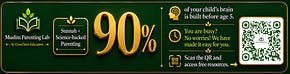

37% of grade 2 children had dysgraphic handwriting; by grade 3 only 6% did (Overvelde and Hulstijn, 2011) [1]. Here is what to do in between.
Your child covered the page with their hand.
You had only leaned over to help. You said it gently, the way the parenting books tell you to. Look, the ‘b’ goes this way, see? And they slid the paper under their arm and said they were finished.
You know that feeling. The small sting of it. You were being helpful and somehow you became the thing they were hiding from.
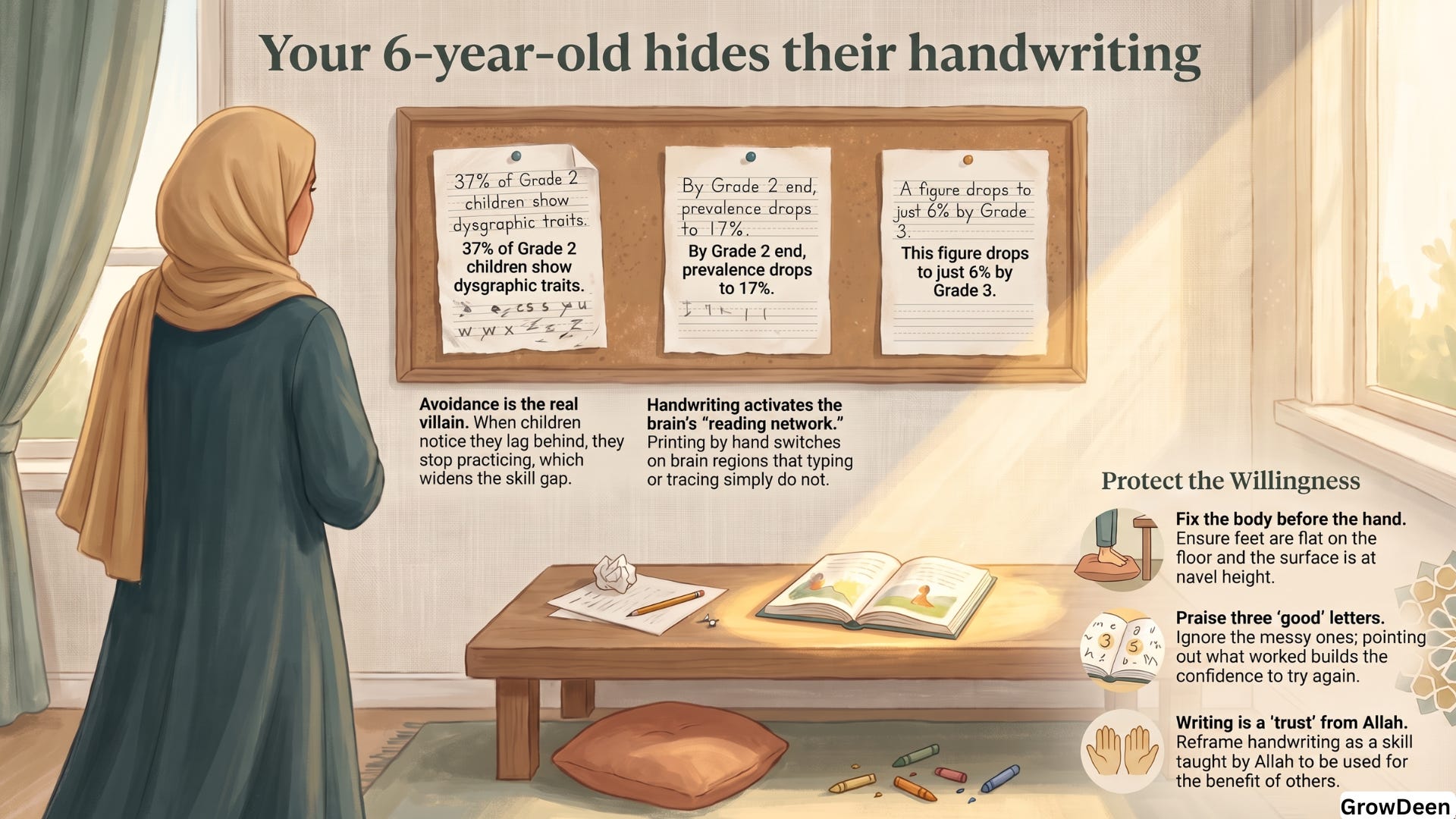
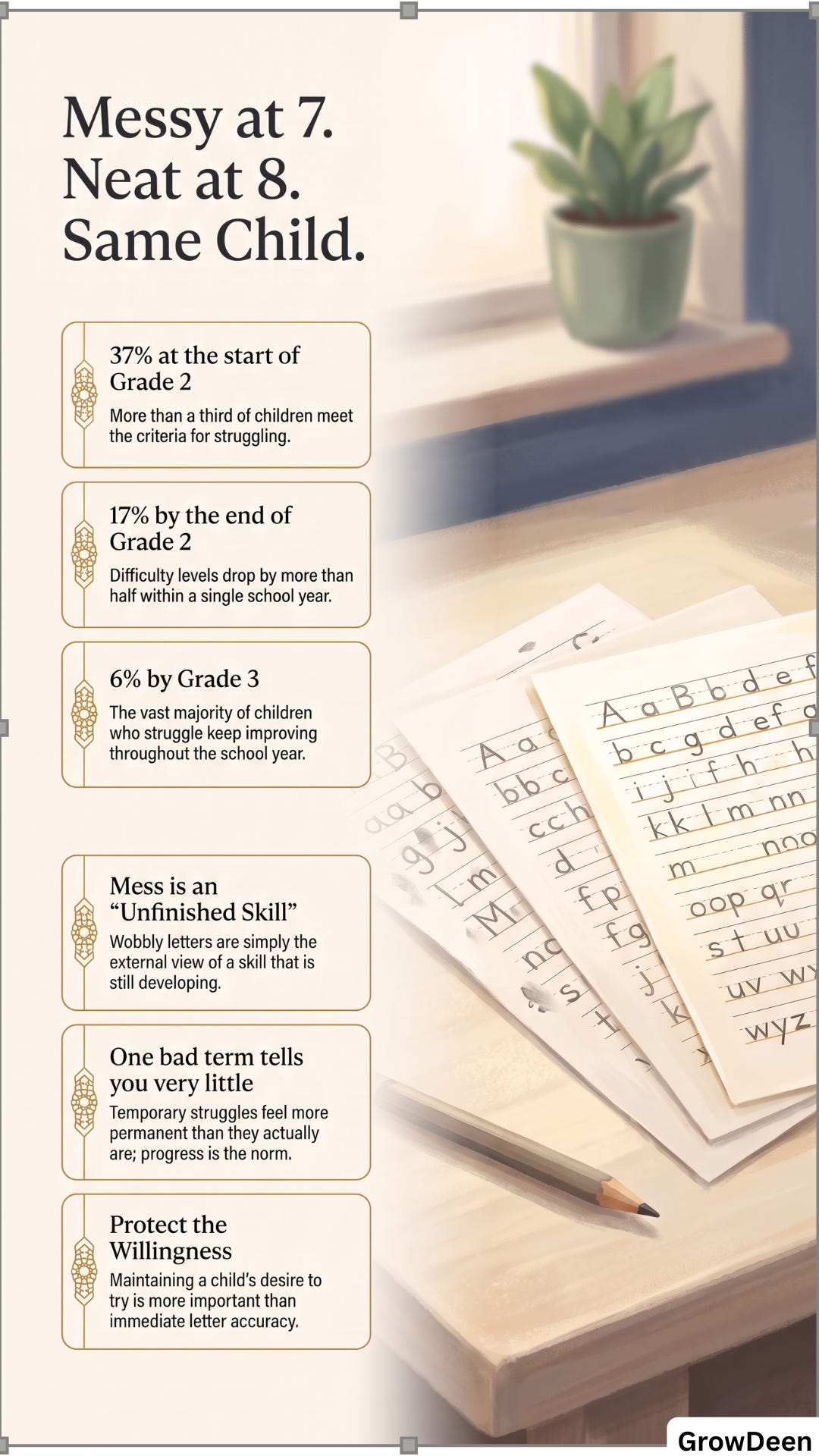
Here is what the research says about the moment you just lived through. In a study that followed primary school children through two full school years, 37% of the grade 2 children met the criteria for dysgraphic handwriting at the first assessment. By the end of that same year it was 17%. By grade 3, 6%. [1] The children who had been struggling kept improving substantially the whole way through.
Read that again. Most of the messy handwriting you are worried about tonight fixes itself.
So here is the question worth carrying through the rest of this article: why will a four year old who can draw a perfect circle refuse, flatly, to write their own name?
Why this guide is different from generic handwriting advice
Current research, named and dated. Every claim here is tied to a specific study or clinical source from 2011 to 2025, including the longitudinal data on how quickly early handwriting difficulty resolves [1] and the prevalence estimates behind it [2].
Islamic framework, not decoration. The Qur’an names writing as a skill Allah taught, and treats the person who has it as owing something to the people who need it. That reframes what you are protecting when you sit beside your child.
A tool, not just information. You get the free Pencil Ready Pack, a three-page printable that turns all of this into a readiness check, a setup card, and a reflection page you can keep where the homework actually happens.
The villain is not your child’s grip
Somewhere along the way most of us absorbed the idea that good handwriting is produced by correction. Spot the wrong letter, name it, show the right one, repeat.
The trouble is what correction costs.
Look at the warning signs clinicians actually watch for in early school years. Slow letter formation. Weak or unusual grip. Messy output. And then this one, which sits differently from the rest: the child who avoids drawing and writing altogether, usually because they have noticed their writing lags behind their classmates’ [2].
Avoidance is a symptom, and it is also an accelerant. A child who stops picking up the pencil gets less practice. Less practice widens the exact gap that worried you. The spiral is quiet and it runs on shame.
Which brings us back to the circle and the name. A circle has no correct version. Nobody has ever leaned over a child’s shoulder and told them their circle was backwards. The moment writing acquires a right answer, it acquires the possibility of being wrong, and that is the moment a child starts calculating whether it is worth trying.
Protect the willingness. The letters will follow.
What is actually happening when a small hand forms a letter
Watch closely next time. The eye plans a shape, the hand tries to execute it, and the two argue for a while. That argument is the skill.
Researchers scanned children who could not yet read while they printed letters, traced them, and typed them. Only printing by hand switched on the reading network that later does the work of recognising words [3]. A Norwegian team recorded 256 channels of brain activity while adults wrote with a digital pen and then typed the same words, and found far wider connectivity across brain regions during handwriting [4].
Now, before you buy anything on the strength of that: other researchers have published a methodological critique of how those connectivity patterns were read, and the participants were university students, not children [5]. The direction of the evidence is consistent. The size of the effect in a five year old is still being argued about. You deserve to know that before someone sells you a programme.
What is less contested is the memory piece. People who took notes by hand recalled more words afterwards than people who used a keyboard [6].
And there is a second thread that surprised me when I first read it. Fine motor skill and language grow together. In preschoolers, fine motor ability was linked to receptive vocabulary, expressive vocabulary, and the ability to tell a story [7]. Early drawing and early writing both predict visual motor integration, the capacity to make the hand carry out what the eye has planned [8].
So the crayon is doing more than you can see. Which is exactly why the willingness to hold it matters more than the accuracy of any single letter.
I know this is a lot to hold in your head at 6pm
Especially when the homework is out, dinner is late, and you are trying to remember whether the chair is the right height or whether you are supposed to be saying something about the green dot.
That is why I put together a free Pencil Ready Pack, a three-page printable you can stick inside a homework folder or on the side of the fridge. It turns everything below into a check you can run in ninety seconds. Keep reading and you can download it at the end.
What the Qur’an teaches about the skill of writing
You are sitting beside a child who is embarrassed about a page of letters. It is hard, in that moment, to feel like this matters beyond a school report.
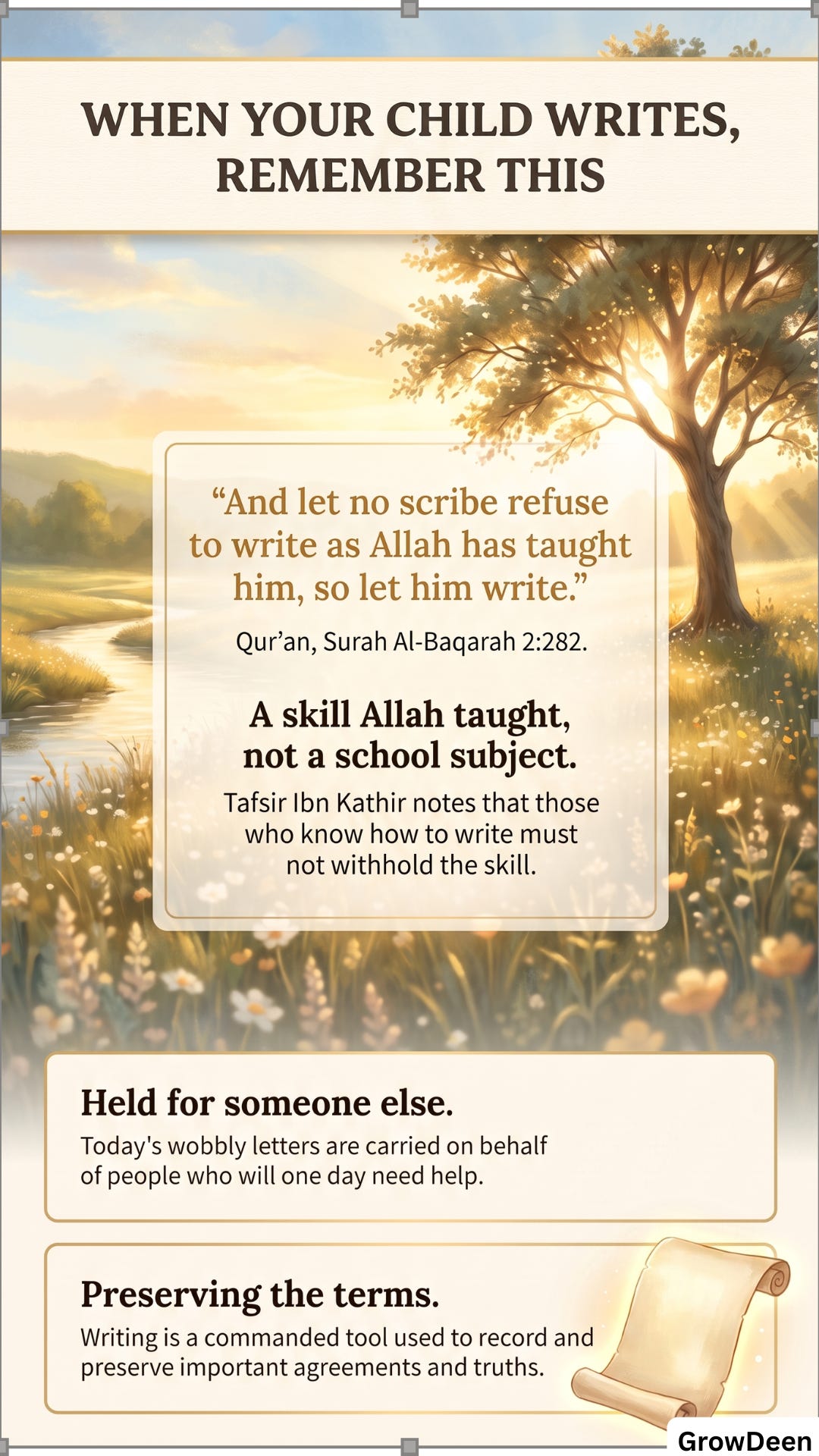
The longest verse in the Qur’an concerns the recording of a debt. Inside it Allah says: “And let no scribe refuse to write as Allah has taught him, so let him write” [Qur’an 2:282] [16]. According to Tafsir Ibn Kathir, the instruction to write the transaction down is a command to record and preserve its terms, and this clause means that whoever knows how to write should not hold back from doing so when they are asked. When you sit with that, the wobbly skill in your child’s hand stops looking like a school subject. It is something Allah taught, held on behalf of people who will one day need it written down.
The Prophet ﷺ treated writing the same way. Abdullah ibn Amr ibn al-’As used to write down what he heard from the Messenger of Allah ﷺ so that he could memorise it. Some of the Quraysh told him to stop. He stopped, mentioned it to the Prophet ﷺ, and was told: “Write, by Him in Whose hand my soul lies, only right comes out from it” [Sunan Abi Dawud 3646, Graded Sahih] [17].
Notice why he was writing. He wrote in order to remember, which is where the memory research landed fourteen centuries later [6]. And notice the answer he was given. Not a correction. One word. Write.
So what does this look like at the kitchen table on a Tuesday?
You change the setup instead of the letters. Here is why: the setup is silent. It improves the writing without ever telling your child that their writing needed improving.
Fix the body before the hand. A stable chair, a surface at about your child’s navel height, feet flat on the floor or on a stool. A child whose feet dangle is bracing their whole trunk, and the hand pays for that.
Break the crayons. Snap chalk and crayons into short stubs for children under five. A stub cannot be held in a fist, so the fingers are forced into a pinch, and the pinch is the ancestor of the pencil grip.
Ask the teacher for the starting-point sheet. Schools teach specific scripts. Practising a different one at home makes work rather than saving it. Write letters lightly yourself, mark the start with a green dot and the finish with a red one, and let your child trace over the top.
Give writing a reason. Two items added to the shopping list. A note for grandparents. An Eid card. A thank you card for the neighbour who sent food. Labels for the kitchen shelves. Home writing activity of this kind predicts children’s emergent writing skills [9], and parental involvement is linked to better writing outcomes later on [10].
Leave an unorthodox grip alone if it works. A study of grade 4 children compared several different pencil grasps after a ten minute copying task and found similar speed and legibility across them [11]. Readiness for formal handwriting can also be assessed properly, with normed tools rather than a parent’s eye [12].
Praise the effort, then name three good letters. Not the ten bad ones. Find the three that worked, point at them, and ask for more like those. This is the whole correction strategy, and it is the hardest line in this article to actually follow.
If your child writes with their left hand
There is no need to move them. Muslim parents often ask about this because of the Sunnah of the right hand, and the established guidance there concerns eating and drinking, where the Prophet ﷺ instructed that the right hand be used [18]. Writing has generally been treated by scholars as a separate matter, and the widely held contemporary position permits writing with the left hand, particularly where forcing a switch would cost a child their fluency. If you want certainty, put the question to a scholar you already learn from.
Practically: tilt the page so the top left corner sits highest, seat your child on the left at a shared table, and encourage a grip a little further up the pencil so they can see what they have just written.
If your child is learning Arabic and English together
Separate the two. A different notebook and a different pencil colour for each tells a young child which set of rules is in play, and naming the direction out loud before starting is worth doing every session for the first few months. Expect reversals for a while, since legibility develops gradually across the early school years [13]. Arabic letters change shape depending on their position in a word, so let the isolated forms become comfortable before the joined ones arrive.
When it is not just a stage
Everything above assumes ordinary development, and most of the time that assumption holds. Between 10% and 30% of children experience real difficulty with writing, with the range that wide because researchers set the threshold differently [2].
Take it to the teacher, then your doctor, if you see slow and effortful letter formation persisting past grade 2, a grip so weak that work cannot be finished in reasonable time, hand-swapping that has not settled, or the avoidance pattern getting worse rather than better. Your doctor may refer you to an optometrist, an audiologist or an occupational therapist, since vision, hearing and attention all show up on the page. A systematic review found that targeted, well chosen practice can improve handwriting [14].
Aids exist and they help: angled writing boards, chunky pencils, pencil grips, paper with bold or raised tactile lines. An occupational therapist will tell you which fits your child. Nothing here replaces medical advice, so follow the people who have actually assessed your child.
Alongside the appointments, keep making du’a. Taking every practical means and then leaving the outcome with Allah is the balance Islam asks of parents, and children can feel which one of those two you are doing.
Do this in the next five minutes
Go find the last thing your child wrote. Do not correct it. Find three letters on that page that came out well, put a small dot next to each one, and tomorrow morning show them and say nothing except that these three are good.
That is the practice. Protect the willingness, and the letters follow.
Get the Pencil Ready Pack
If you have read this far, you are the kind of parent who would rather understand what is happening than just fix the symptom. That tells me something about you.
Inside the Pencil Ready Pack (one comprehensive PDF, 3 pages):
Page 1: The 90-Second Pencil Readiness Check. Seven hand and posture checks with a tick box beside each, plus the specific play fix for whichever one your child cannot do yet, designed as a card you can keep inside the homework folder.
Page 2: The Setup and Response Card. The physical setup measurements on one side and a phrase-swap column on the other, showing what to say instead of the eleven corrections parents reach for automatically, so you can change your handwriting habit in one sitting rather than one lecture.
Page 3: The Scribe’s Reflection. A short reflection page built on Qur’an 2:282 and the narration of Abdullah ibn Amr writing beside the Prophet ﷺ, with a simple practice for Bismillah before writing and what to say after your child’s effort, made to sit near wherever the writing happens.
This isn’t just a PDF to download and forget. It’s a tool designed to stay in the homework folder, where handwriting actually happens.
The Pencil Ready Pack is what every subscriber receives with each article. Muslim Parenting Lab covers the full arc of raising Muslim children, from newborn sleep to school-age learning, all backed by current research and rooted in the Qur’an and Sunnah.
If you want both evidence-based guidance and Islamic perspective in one place, subscribe free so the next resource lands in your inbox before you need it.
Subscribe free for parenting resources backed by both science and Sunnah, guidance you can’t get anywhere else. No spam, no clutter, just resources that matter.
May Allah place barakah in every letter your child forms, and make your patience with the messy ones a means of ease for you both.
Share this with someone who needs it
Think of one person right now. The mother at the masjid who mentioned that homework ends in tears three nights a week. Your sister, who has started saying her son is just not a writer. A friend whose six year old has begun hiding schoolbooks.
This article could take a weight off them tonight. Send it today. You have both been in that chair.
Frequently asked questions
Q: At what age should my child be able to write their name? A: Many children start forming the letters of their own name somewhere between three and five, usually the letters in their name first. Around three, most can copy a circle after watching it drawn, and by four they can draw a person with a few body parts [15]. If your child is four and not there yet, that is still inside the normal range.
Q: Is my child’s messy handwriting a sign of dysgraphia? A: Usually not, and the timing is what tells you. In one longitudinal study, 37% of grade 2 children had dysgraphic handwriting at the first assessment and only 6% still did by grade 3 [1]. A single bad term predicts far less than parents assume. See “When it is not just a stage” above for the signs that warrant a conversation with the teacher.
Q: Should I make my left-handed child write with their right hand? A: No. Forcing a switch can cost a child fluency they have already built. Tilt the page so the top left corner is highest and seat them on the left at a shared table instead. On the Islamic side, the Sunnah of the right hand is established for eating and drinking [18], and scholars have generally treated writing separately.
Q: How do I fix my child’s pencil grip? A: Often you don’t need to. A study of grade 4 children found several different grasps produced similar speed and legibility after a ten minute copying task [11]. If the grip is truly weak and work cannot be finished in reasonable time, that is worth raising with the teacher.
Q: Do handwriting apps work? A: They work as extra practice alongside paper, and only if the app uses the same script the school teaches. Ask the teacher before you buy one.
Q: How long should handwriting practice be at home? A: Five to ten minutes for a preschooler, and stop while your child still wants another turn. Willingness builds the skill. Ten minutes is plenty of it.
Q: My child can draw beautifully but refuses to write. Why? A: Drawing has no correct version, so nothing your child produces can be wrong. Writing does, and the moment a child notices their letters lag behind their classmates’, avoidance often follows [2]. That is the pattern this whole article is built around, and it responds to changed setup far better than to more correction.
References
[1] Overvelde, A., & Hulstijn, W. (2011). Handwriting development in grade 2 and grade 3 primary school children with normal, at risk, or dysgraphic characteristics. Research in Developmental Disabilities, 32(2), 540-548. https://doi.org/10.1016/j.ridd.2010.12.027
[2] Chung, P.J., Patel, D.R., & Nizami, I. (2020). Disorder of written expression and dysgraphia: Definition, diagnosis, and management. Translational Pediatrics, 9(Suppl 1), S46-S54. https://doi.org/10.21037/tp.2019.11.01
[3] James, K.H., & Engelhardt, L. (2012). The effects of handwriting experience on functional brain development in pre-literate children. Trends in Neuroscience and Education, 1(1), 32-42. https://doi.org/10.1016/j.tine.2012.08.001
[4] Van der Weel, F.R., & Van der Meer, A.L.H. (2024). Handwriting but not typewriting leads to widespread brain connectivity: A high-density EEG study with implications for the classroom. Frontiers in Psychology, 14, Article 1219945. https://doi.org/10.3389/fpsyg.2023.1219945
[5] Pinet, S., & Longcamp, M. (2025). Commentary: Handwriting but not typewriting leads to widespread brain connectivity. Frontiers in Psychology, 15, Article 1517235. https://doi.org/10.3389/fpsyg.2024.1517235
[6] Mangen, A., Anda, L.G., Oxborough, G.H., & Bronnick, K. (2015). Handwriting versus keyboard writing: Effect on word recall. Journal of Writing Research, 7(2), 227-247. https://doi.org/10.17239/jowr-2015.07.02.1
[7] Winter, R.E., Stoeger, H., & Suggate, S.P. (2024). Fine motor skills and their link to receptive vocabulary, expressive vocabulary, and narrative language skills. Early Education and Development, 35(4), 853-868. https://doi.org/10.1177/01427237241233084
[8] Pinto, G., & Incognito, O. (2022). The relationship between emergent drawing, emergent writing, and visual-motor integration in preschool children. Infant and Child Development, 31(2), Article e2284. https://doi.org/10.1002/icd.2284
[9] Puranik, C.S., Phillips, B.M., Lonigan, C.J., & Gibson, E. (2018). Home literacy practices and preschool children’s emergent writing skills: An initial investigation. Early Childhood Research Quarterly, 42, 228-238. https://doi.org/10.1016/j.ecresq.2017.10.004
[10] Kelso-Marsh, B., Malpique, A., Davis, H., & Valcan, D. (2025). Motivation matters: The positive influence of parental involvement on children’s writing outcomes. Journal of Writing Research, 17(2), 309-337. https://doi.org/10.17239/jowr-2025.17.02.05
[11] Schwellnus, H., Carnahan, H., Kushki, A., Polatajko, H., Missiuna, C., & Chau, T. (2012). Effect of pencil grasp on the speed and legibility of handwriting after a 10-minute copy task in Grade 4 children. Australian Occupational Therapy Journal, 59(3), 180-187. https://doi.org/10.1111/j.1440-1630.2012.01014.x
[12] Haberfehlner, H., de Vries, L., Cup, E.H.C., de Groot, I.J.M., Nijhuis-van der Sanden, M.W.G., & van Hartingsveldt, M.J. (2023). Ready for handwriting? A reference data study on handwriting readiness assessments. PLOS ONE, 18(3), Article e0282497. https://doi.org/10.1371/journal.pone.0282497
[13] Truxius, L., Sagesser Wyss, J., & Maurer, M.N. (2025). Early handwriting development: A longitudinal perspective on handwriting time, legibility, and spelling. Frontiers in Psychology, 15, Article 1466061. https://doi.org/10.3389/fpsyg.2024.1466061
[14] Hoy, M.M.P., Egan, M.Y., & Feder, K.P. (2011). A systematic review of interventions to improve handwriting. The Canadian Journal of Occupational Therapy, 78(1), 13-25. https://doi.org/10.2182/cjot.2011.78.1.3
[15] Centers for Disease Control and Prevention. Learn the Signs. Act Early: Developmental milestone checklists, 3 and 4 years. https://www.cdc.gov/ncbddd/actearly/milestones/index.html
[16] Qur’an, Surah Al-Baqarah 2:282 — https://quran.com/2/282. Commentary: Ibn Kathir, Tafsir Ibn Kathir, Surah Al-Baqarah 2:282 — https://quran.com/en/2/282/tafsirs/en-tafisr-ibn-kathir
[17] Sunan Abi Dawud 3646, Book of Knowledge. Narrated by Abdullah ibn Amr ibn al-’As — Graded: Sahih — https://sunnah.com/abudawud:3646
[18] Sahih Muslim 2020a, The Book of Drinks. Narrated by Ibn ‘Umar — Graded: Sahih — https://sunnah.com/muslim:2020a