

A 2019 brain-imaging study found that five-month-old infants’ neural responses to face-to-face interaction predicted their language ability more than two years later - more accurately than any other measure tested. [1] Here’s what that means for your toddler tonight.
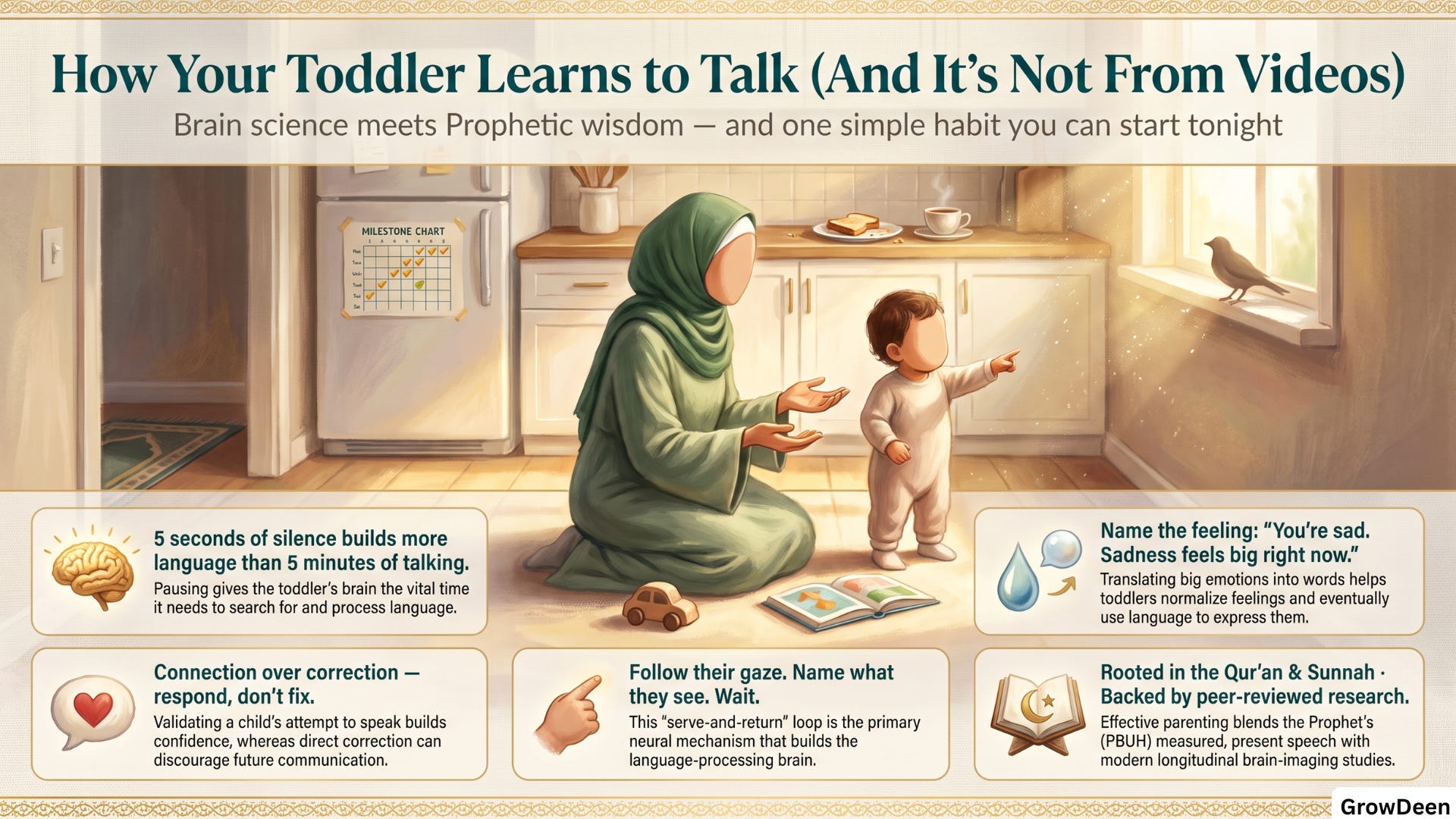
Your toddler just pointed at something.
She made a sound. Looked back at you. Waited.
You probably didn’t think much of it. But in that two-second pause — that tiny gap between her pointing and your response — something was happening in her brain that no app, no video, and no flashcard can replicate. [2]
Here’s what most parents don’t realize: the number of words your toddler hears matters far less than the number of back-and-forth exchanges she has with you. [3] Researchers used to count vocabulary size. Now they count conversational turns. And the science is specific: it’s the pattern of interaction that builds language — not the volume of words.
So if you’ve been worrying about whether you talk to your toddler enough, let me reframe the question. The question isn’t how much you talk. It’s whether you pause long enough to let her talk back.
That changes everything.
Why This Guide Is Different
Grounded in peer-reviewed developmental science. Every recommendation draws from published research by institutions like Harvard’s Center on the Developing Child, the American Academy of Pediatrics, and longitudinal brain-imaging studies — not opinion, not trends. [1,2,3]
Islamic principles woven into the guidance — not bolted on. The Qur’an speaks directly about the weight of words and the sacred trust of raising children. Those teachings appear where they naturally belong in this discussion, because they do belong here.
A printable companion tool you can use tonight. The Toddler Talk Toolkit gives you seven scripted daily moments, a milestone reference, and an authenticated du’a — one PDF, three pages, ready for your fridge or bedside table.
What Your Toddler’s Brain Actually Needs
When researchers put toddlers into brain-imaging scanners during live face-to-face interaction, they found something specific: the child’s brain activated not just in language areas, but across attention, emotional processing, and motor planning regions simultaneously. [4] The whole system engaged at once.
This only happened during responsive interaction. Not during passive listening. Not during screen time. [5]
A video talks at your child. You talk with your child. That difference rewires the brain.
When you say “Oh, you see a bird!” and then wait — genuinely wait — for your toddler to respond, you’re running the exact neural loop that builds language: child initiates, adult responds, child processes, child tries again. Researchers call this serve-and-return. [2] Your toddler’s brain calls it learning.
But here’s something most guides won’t tell you.
The Part That Matters More Than Words
You might expect me to say: use bigger words, narrate more, read more books. Those things help. But the research points somewhere else first.
Emotional safety matters more than vocabulary input. [6]
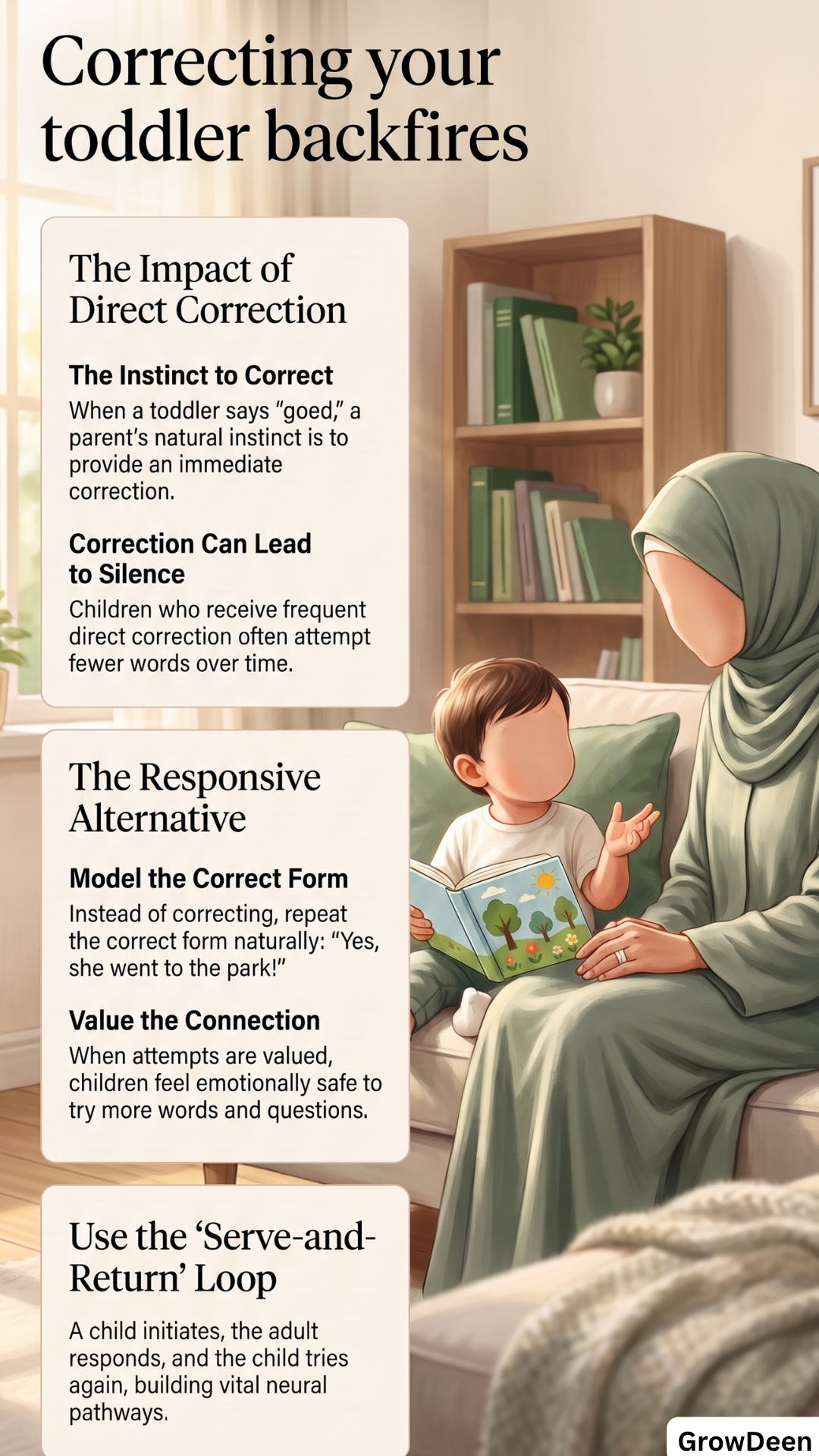
When your toddler says “goed” and you correct them — “No, it’s ‘went’” — something subtle happens. Your child’s brain registers the correction as a small failure. They tried. They got it wrong. Over time, direct correction teaches children to speak less, not more.
When instead you respond naturally — “Yes, she went to the park! You went too!” — your child absorbs the correct form and learns that their attempt was received. That their voice reached you.
Kids who feel their communication attempts are valued try more words. Ask more questions. Keep talking. [6]
Your presence is the lesson.
The Five-Second Gift
There’s one thing you can do that costs nothing and changes everything.
When your toddler attempts a word — any word, any sound — stop what you’re doing. Get to their eye level. Wait five seconds before you respond.
Five seconds.
That gap feels long. Your instinct is to fill it. To supply the word. To move on.
Don’t. In that silence, your child’s brain is searching for language. It’s doing the work. And it’s learning something even more important than vocabulary: that when they speak, someone listens. [7]
When Feelings Don’t Have Words Yet
Your toddler feels frustration, delight, fear, sadness — but doesn’t have the vocabulary to name any of it. So they cry. They hit. They throw themselves on the floor.
This isn’t bad behaviour. It’s a child working with the only tools they have.
Your job is to be the translator.
When the toy breaks and tears come: “Your toy broke. You’re sad. That sadness feels big right now, doesn’t it?”
Three things happen in that sentence: you validate the feeling, you name it, and you normalize it. Over weeks and months, your toddler begins to reach for those words themselves. “I sad.” Then: “Toy broke. I sad.” Then: “I’m sad because my toy broke.” [8]
I know this is a lot to hold in your head — especially at the end of a long day. That’s why I put together the Toddler Talk Toolkit: seven scripted daily moments (breakfast to bedtime), a milestone tracker for 18 months to 3 years, and an Islamic du’a for your child’s voice. One PDF, three pages. Something you can stick on the fridge and actually use tonight.
I’ll share it with you in a moment — keep reading.
The Islamic Dimension
When your toddler makes a sound and waits for you to respond, they’re doing something deeply human. They’re reaching for connection. And that connection — that exchange between two souls — is something Islam takes seriously.
I think about Qur’an 50:18: “Not a word does he utter but there is a watcher by him ready (to record it).” [9] This verse is usually understood as accountability. But there’s a parenting truth inside it: words carry weight. The words you speak to your toddler, and the patience with which you receive theirs, are shaping who they become as speakers.
Aisha رضي الله عنها described the Prophet’s ﷺ speech as so clear and measured that if someone wanted to count his words, they could. [10] He didn’t rush. He didn’t overwhelm. He was present in his speaking.
And when his grandchildren interrupted a sermon — stumbling toward him in front of the entire congregation — he didn’t stay on the minbar until he finished. He came down and picked them up.
Your toddler’s need for your attention is not an interruption. It is the work.
Your presence is the lesson.
Do This Tonight
Pick one moment in your evening routine — dinner, bath, or bedtime. When your toddler makes a sound, points, or tries a word, stop what you’re doing. Get down to their level. Respond with genuine interest. Then wait five full seconds before you say anything else.
One moment. One pause. That’s how language grows.
Share This With Someone Who Needs It
Think of one parent you know who’s quietly worried about their toddler’s speech. Not the parent whose child talks early and easily. The one who’s Googling milestones at 11pm. The one who’s comparing and anxious but hasn’t said anything.
Send them this. Not as advice. As care. Sometimes the most loving thing you can do is show someone that what they’re already doing — being present, noticing their child, responding — is exactly what matters most.
Your Toddler Talk Toolkit
If you’ve read this far, you care deeply about how your child communicates. That tells me something about you.
Inside the Toddler Talk Toolkit (one PDF, three pages):
Page 1: Milestone Tracker & Communication Checklist — What to expect at 18 months, 2 years, and 3 years, with clear markers so you know when development is on track and when to ask for support — designed as a quick-reference card for your fridge or nursery wall.
Page 2: Seven Daily Talking Moments — Scripted words for seven everyday routines (breakfast, getting dressed, car time, bath, wudu, bedtime, and big feelings), each paired with a Sunnah connection — so you can build language and Islamic habit simultaneously without planning a single thing.
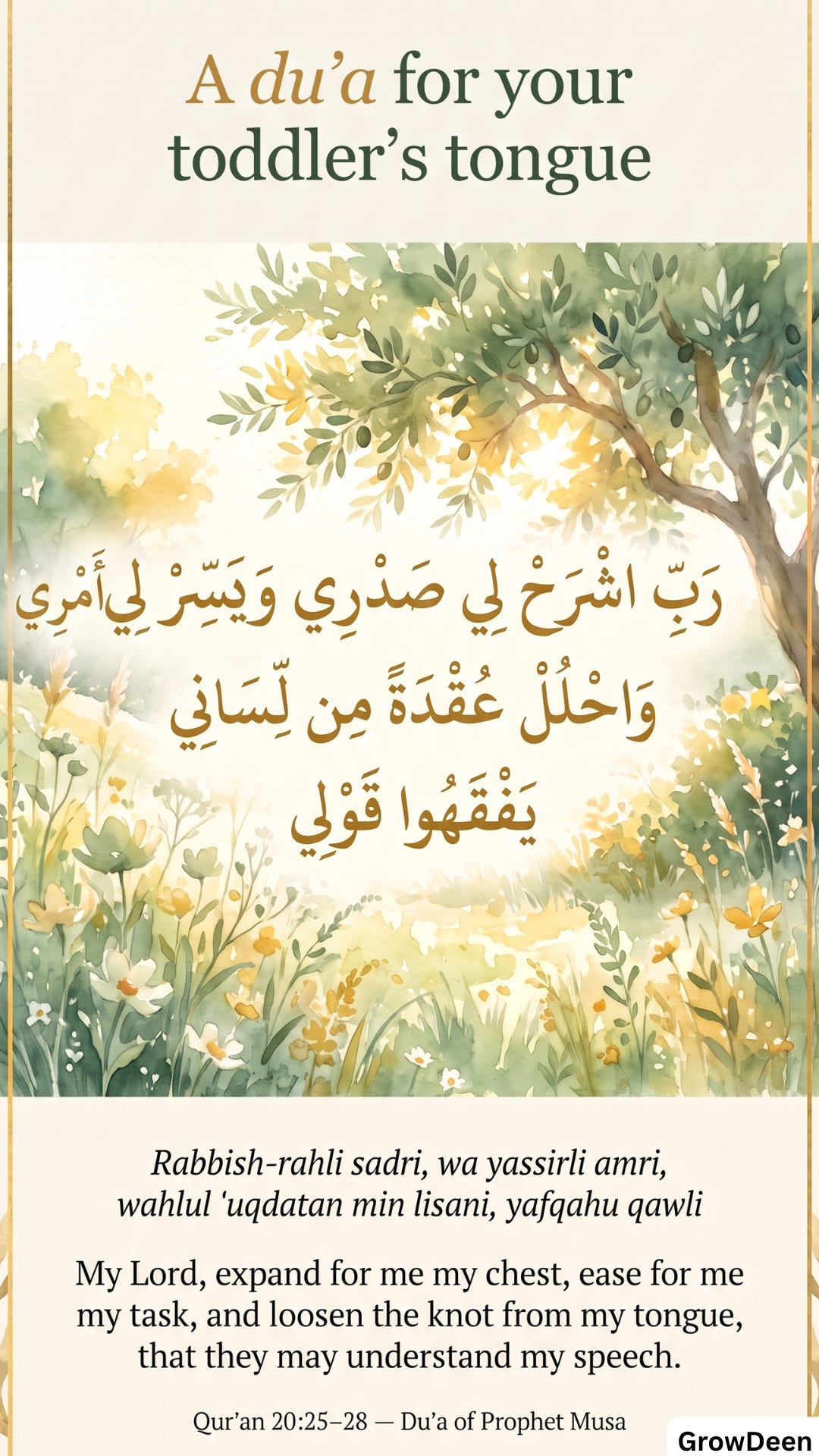
Page 3: A Du’a for Your Child’s Voice — The du’a of Prophet Musa ﷺ for clarity of speech (Qur’an 20:25–28), with Arabic, transliteration, and English translation, plus a parental reflection — something you can recite for your child and return to whenever you need grounding.
This isn’t a PDF to download and forget. It’s designed to stay where you’ll use it — on the fridge, by the bed, in the diaper bag.
This Toddler Talk Toolkit is what every subscriber receives with each article. We cover the full journey of raising Muslim children — from newborns to age eight — all backed by peer-reviewed research and rooted in Islamic wisdom.
If you’re a Muslim parent who wants both evidence-based guidance and Islamic perspective, subscribe free so future resources arrive in your inbox before you need them.
Subscribe free for parenting resources backed by both science and Sunnah — guidance so unique, you literally can’t get it anywhere else. No spam, no clutter, just resources that matter.
FAQ
Q: My toddler is quiet compared to other kids. Should I worry?
Every toddler develops at their own pace, and the range of normal is wide. What matters more than word count is whether your child is trying to communicate — pointing, making sounds, bringing you things. If your toddler doesn’t respond to their name by 18 months, doesn’t follow simple one-word instructions, or has fewer than 50 words by age two, talk to your paediatrician. Early evaluation is always worth doing.
Q: Do speech therapy apps or flashcards help?
They’re not harmful, but they’re not the main driver. Back-and-forth interaction with a responsive adult matters more than any program. [3] Keep apps to under 30 minutes a day if you use them.
Q: Is screen time hurting my toddler’s language?
Passive screen time doesn’t build language the way conversation does. [5] It delivers words without the back-and-forth loop your child’s brain needs. If screens are part of your routine, keep them brief and always choose Islamically suitable, music-free content.
Q: How long before I see progress?
Language development isn’t linear. You might see no change for weeks, then a sudden burst. Consistent responsive interaction compounds over time. Trust the process.
Q: I have multiple children. How do I give each one attention?
You don’t need constant one-on-one time. You need responsive presence in moments you’re already sharing — meals, car rides, bedtime. Your toddler doesn’t need dedicated language sessions. They need to know that when they speak, someone hears them.
Q: Is speaking two languages slowing my toddler down?
No — if your toddler gets consistent, responsive interaction in both languages. Bilingual toddlers may have a slightly smaller vocabulary in each language individually, but their total vocabulary across both languages is typically comparable to monolingual peers. [8] The key is genuine interaction, not passive exposure.
Q: When should I see a speech pathologist?
If your toddler isn’t responding to their name by 18 months, has fewer than 50 words by two years, isn’t putting any words together by two, or has lost language skills they once had — ask for an assessment. Early intervention is remarkably effective, and there’s no downside to checking.
References
[1] Kuhl, P.K., Ramírez, R.R., Bosseler, A., Lin, J.L., & Imada, T. (2024). Infants’ brain responses to social interaction predict future language growth. Current Biology, 34(7), 1523–1531. https://doi.org/10.1016/j.cub.2024.03.020
[2] Harvard Center on the Developing Child. (2018). Serve and return interaction shapes brain circuitry. https://developingchild.harvard.edu/science/key-concepts/serve-and-return/
[3] Romeo, R.R., Leonard, J.A., Robinson, S.T., West, M.R., Mackey, A.P., Rowe, M.L., & Gabrieli, J.D.E. (2018). Beyond the 30-million-word gap: Children’s conversational exposure is associated with language-related brain function. Psychological Science, 29(5), 700–710. https://doi.org/10.1177/0956797617742725
[4] Donnellan, E., Bannard, C., McGillion, M.L., Slocombe, K.E., & Matthews, D. (2019). Infants’ intentionally communicative vocalizations elicit responses from caregivers and are the best predictors of the transition to language. Developmental Science, 23(1), e12843. https://doi.org/10.1111/desc.12843
[5] American Academy of Pediatrics. (2016). Media and young minds. Pediatrics, 138(5), e20162591. https://doi.org/10.1542/peds.2016-2591
[6] Tamis-LeMonda, C.S., Custode, S., Kuchirko, Y., Escobar, K., & Lo, T. (2019). Routine language: Speech directed to infants during home activities. Child Development, 90(6), 2135–2152. https://doi.org/10.1111/cdev.13089
[7] Weisleder, A., & Fernald, A. (2013). Talking to children matters: Early language experience strengthens processing and builds vocabulary. Psychological Science, 24(11), 2143–2152. https://doi.org/10.1177/0956797613488145
[8] Bialystok, E. (2018). Bilingual education for young children: Review of the effects and consequences. International Journal of Bilingual Education and Bilingualism, 21(6), 666–679. https://doi.org/10.1080/13670050.2016.1203859
[9] Quran, Surah Qaf 50:18 — https://quran.com/50/18
[10] Sahih al-Bukhari 3567 — Graded: Sahih — https://sunnah.com/bukhari:3567