

Research shows children may need up to 15 separate exposures to a new vegetable before accepting it [1] most parents give up after 3. This guide walks you through the 7 strategies that actually work, with the Sunnah woven in at every step.
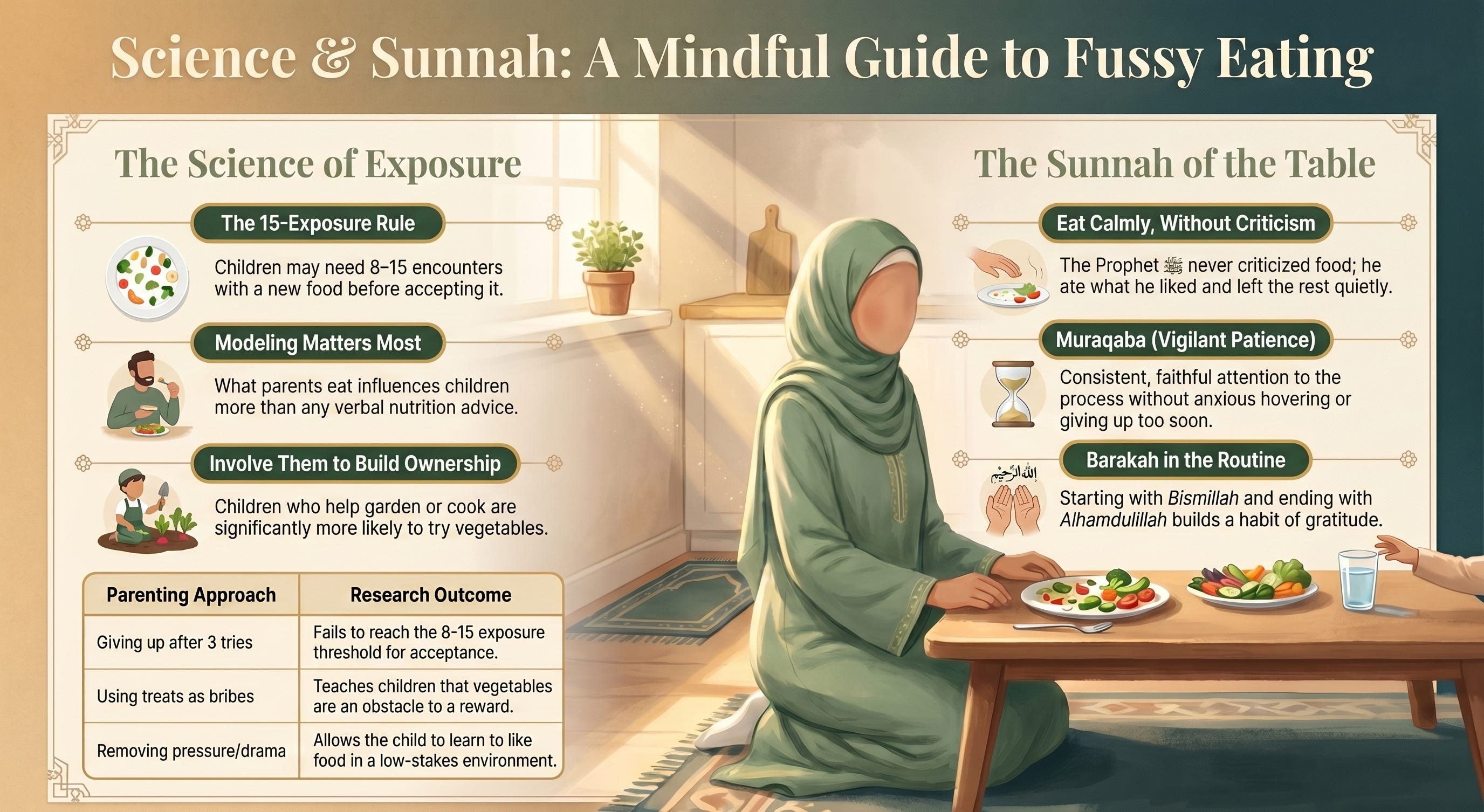
Here is the thing nobody tells you about fussy eaters: refusing is normal.
It is not a phase you missed. It is not a character flaw. It is not a sign that your child will eat plain rice forever. According to research on repeated food exposure, young children are neurologically wired to be cautious about new foods and that caution requires patient, repeated, low-pressure encounters to shift. [1]
You are not failing. You are probably just stopping too soon.
I know that is hard to hear when you have offered roasted courgette for the fourteenth time and it came back untouched. Again. But here is what the science confirms: the moment just before acceptance is often the moment when parents give up.
Keep going. The data is on your side.
Why This Guide Is Different From Generic Eating Advice
Three things set this apart from what you’ll find elsewhere:
Every strategy here comes from peer-reviewed research on child feeding behaviour — not anecdote or trend — specifically drawn from systematic reviews of what actually moves the needle on vegetable intake in under-5s. [2,3]
This isn’t just nutrition guidance. It connects the dinner table to Islamic character-building — because the Prophet’s ﷺ own conduct at the table models exactly what the research recommends, and that’s not a coincidence.
You’ll receive the Veggie Win Companion Pack with this article — a 3-page printable designed to sit on your fridge, not your shelf.
What the Research Says About Getting Children to Eat Vegetables
Modelling Is the Number One Factor
When I studied the data on parental influence and children’s vegetable intake, one finding kept coming up: what parents eat matters more than what parents say. [3]
Children don’t absorb nutrition advice. They absorb what the adults they love choose to put on their plates.
Here’s what that means in practice: sit down, fill your plate with vegetables, and enjoy them. That is not a trivial act. It is the single most research-supported strategy available. [3]
Family meals amplify this effect. The research on meal frequency and vegetable intake in preschoolers shows a significant positive association between how often families eat together and how much fruit and vegetables children consume. [4]
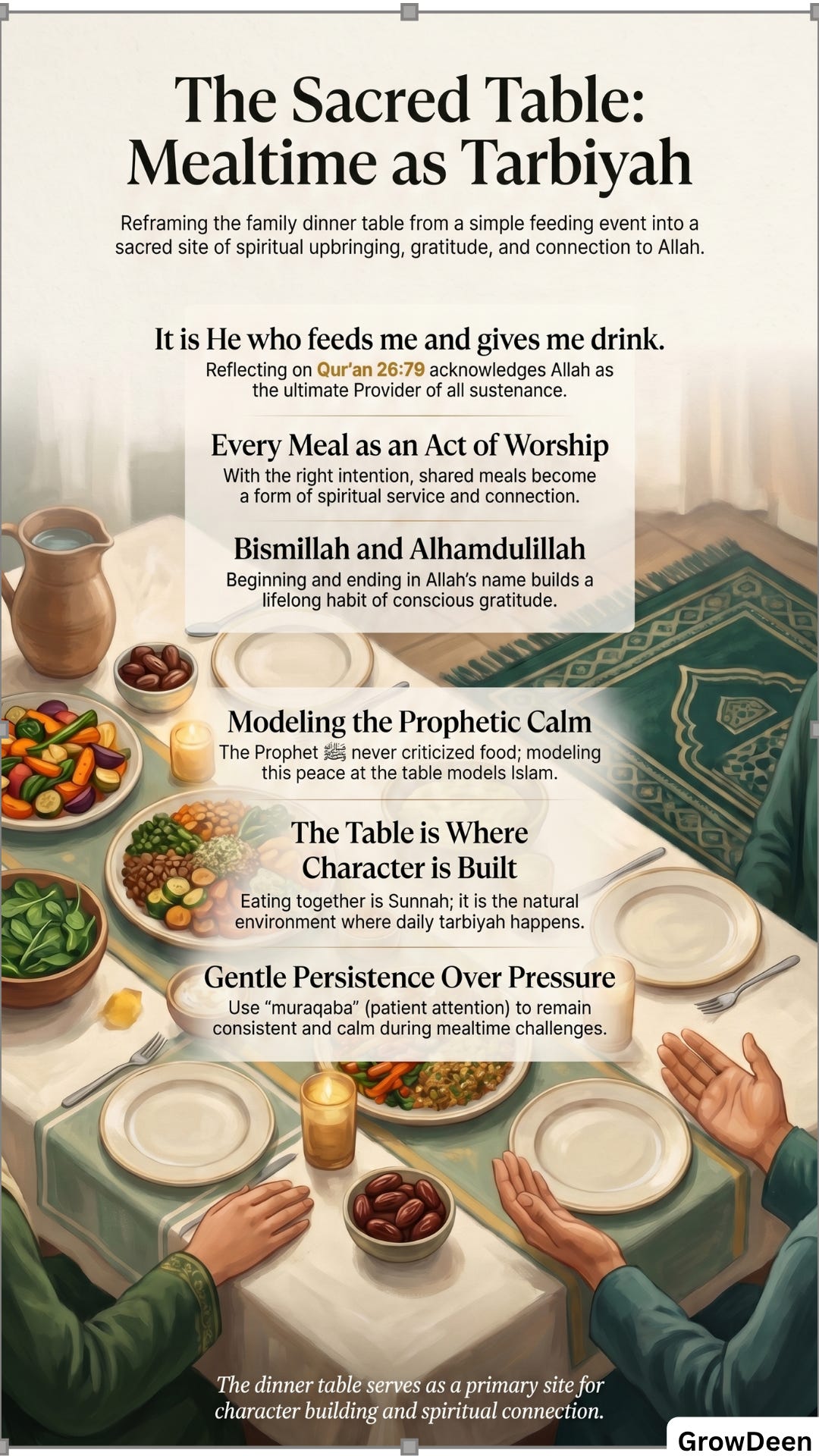
The Islamic mealtime culture — Bismillah at the start, sitting together, Alhamdulillah at the end — is not incidental to this. It is the mechanism.
The 15-Exposure Rule (And Why It Changes Everything)
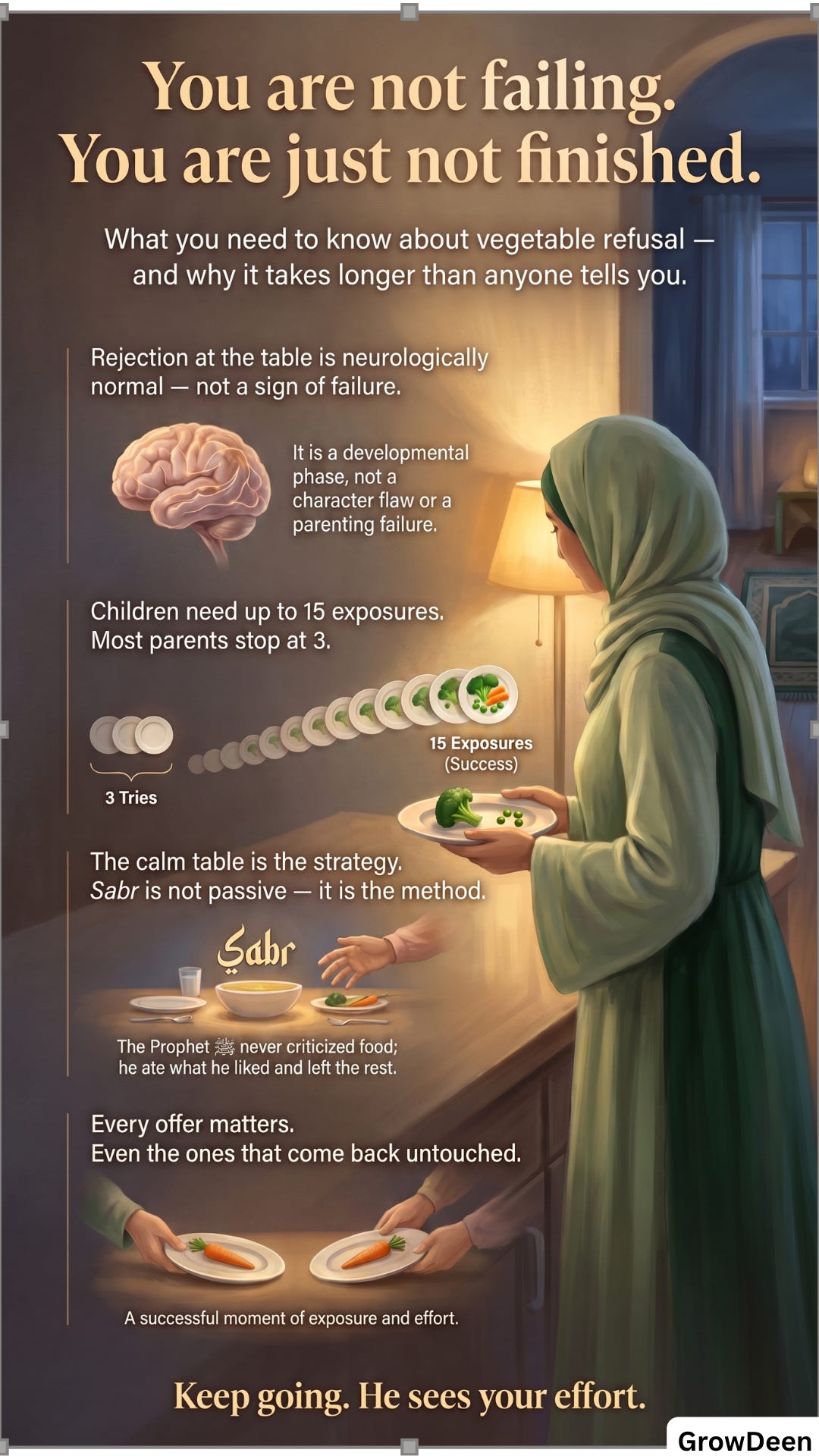
A systematic review of repeated food exposure found that children may need between 8 and 15 encounters with a new food before they begin to accept it and repeated acceptance before they genuinely enjoy it. [1]
Eight to fifteen.
Most parents offer something twice, three times at most, and conclude “they don’t like it.” But liking is learned, not given. And the learning requires patient, low-stakes repetition — a small amount of the new vegetable alongside something already familiar, offered without drama or pressure, removed quietly if refused.
This is the practice. And it takes time.
Here’s the Islamic echo of this: the Arabic concept of muraqaba — vigilant, patient attention — describes exactly the disposition this requires. Not anxious hovering. Not giving up. Just steady, faithful consistency.
Use Praise Carefully
When a child tries a new vegetable, specific praise helps: “I noticed you tasted the broccoli — well done for trying something new.” That kind of concrete acknowledgement reinforces the behaviour. [6]
But keep it proportional. The goal is a child who eats vegetables because they like them and because it is simply part of life — not a child performing for approval. If the atmosphere at the table becomes about your reaction, the food itself gets lost.
And never — never — use treats as a bribe. Research on this is remarkably consistent: rewarding vegetable eating with dessert teaches children that the treat is the desirable item and the vegetable is an obstacle. [6]
Involve Them in Growing and Cooking
Children who help prepare food eat more of it. A 2023 systematic review found that combined gardening and cooking programs produced the strongest and most consistent improvements in vegetable intake among school-age children. [7]
You don’t need a garden. A pot of herbs on the windowsill, a trip to the market where they choose one new vegetable to try, washing and arranging a snack plate — any act of participation builds ownership. And ownership is one of the most powerful motivators available.
Make Vegetables Easy to Reach
Put cut vegetables at eye level in the fridge. Carrot sticks, cucumber batons, capsicum strips. For older children: cherry tomatoes, edamame, roasted chickpeas. When hunger arrives, what is accessible is what gets eaten. [2]
Say Bismillah before each snack. It takes a second. Over years, it shapes something.
Rainbow, Roast, Repeat
Variety provides different nutrients and different chances for something to land. Roasting brings out natural sweetness. Stir-frying keeps colour and crunch. Pureeing into sauces and soups provides gentler introduction for highly resistant children. A vegetable snack plate arranged as a face turns a reluctant two-year-old into an enthusiastic participant.
After eating: Alhamdulillah. Every time, without exception. Gratitude is a habit, and habits are built by repetition.
Blend When Needed — But Don’t Stop There
Pureeing vegetables into familiar dishes is a legitimate short-term strategy. It ensures some intake while the longer work of direct exposure continues. [2]
But it cannot replace visible, recognisable vegetables. Your child cannot learn to love broccoli if they have never seen broccoli. Keep offering it in its actual form alongside whatever else is on the plate. That is the long game.
Something to Make This Easier
I know this feels like a lot to hold — especially on a tired weeknight when dinner is already late and patience is thin. That is exactly why I created the Veggie Win Companion Pack.
It is a free 3-page printable designed to sit on your fridge and actually stay there. Keep reading to find it at the end of this article.
What the Prophet ﷺ Showed Us About Food and the Table
When I reflect on Qur’an 5:88 — “Eat of the lawful and good things which Allah has provided as sustenance for you, and be mindful of Allah in Whom you believe” [8] — I find a verse that speaks to the table not as a site of battle, but as a site of gratitude and care. According to Tafsir Ibn Kathir, this verse commands believers to eat of what is halalan tayyiban (pure and lawful), and Ibn Kathir explains it as establishing a balanced, conscious relationship with Allah’s provision — not ascetic denial, not careless excess, but mindful, grateful engagement with what has been given. [8]
And then there is the Prophet ﷺ himself at the table. Abu Hurairah reported: “The Prophet ﷺ never criticized any food. If he liked it, he ate it; if he disliked it, he left it quietly.” [Sahih al-Bukhari 5409] [9]
Think about what this means for us as parents. No drama. No commentary. No performance of enjoying something, no grimacing at something else. He ate what appealed to him and left the rest without making a moment of it. That is the single most powerful thing a Muslim parent can do at the dinner table. Not a new recipe or a new strategy. Just: stop making food into a battle. Eat the vegetables. Leave the rest quietly. Let your child watch you, again and again.
The research on parental modelling says children’s preferences are shaped by observation. [3] The Sunnah of the Prophet ﷺ is exactly this — calm, gracious, undramatic engagement with food. They are pointing at the same thing.
Your Veggie Win Companion Pack
If you’ve read this far, you’re the kind of parent who takes your child’s nutrition seriously — not as pressure, but as care. That tells me something beautiful about you.
Inside the Veggie Win Companion Pack (one comprehensive PDF, 3 pages):
Page 1: The Vegetable Exposure Tracker — A printable log where you record which vegetables you’ve introduced, how many times your child has encountered each one, and whether they tasted, tried, or enjoyed it — designed as a fridge sheet you update at each meal, so the “15 exposures” principle stops feeling like a burden and starts feeling like a plan.
Page 2: 7 Strategy Quick Reference Card — A single-page, at-a-glance summary of the 7 evidence-based strategies from this article, condensed into one visual you can check on a difficult night when you need a quick reminder of what to try and what to skip.
Page 3: Sunnah Table Practices for Children (Ages 1–8) — A structured Prophetic mealtime routine card for Muslim families, covering five Sunnah practices for the table — saying Bismillah, eating with the right hand, eating calmly and without criticism, saying Alhamdulillah, and the practice of eating together — each explained in one line, with the source hadith noted, so you can read it with your child or use it as a wall reminder.
This is not a PDF to download and forget. It is designed to sit on your fridge — where mealtimes actually happen.
This Veggie Win Companion Pack is what every subscriber receives with each GrowDeen article. We cover the full journey of raising Muslim children — from infancy through adolescence — all backed by scientific research and rooted in Islamic wisdom.
If you’re a Muslim parent who wants evidence-based guidance with an Islamic perspective, subscribe free so future resources arrive in your inbox before you need them.
Subscribe free for parenting resources backed by both science and Sunnah — guidance so unique, you literally can’t find it anywhere else. No spam. No clutter. Just resources that matter.
One Thing to Do Right Now
Tonight at dinner — before you ask “why haven’t you eaten that?” say Bismillah out loud, pick up a vegetable yourself, eat it, and say nothing else.
Just that. That is the practice. That is where it starts.
Think of One Person
Think of one person: the mother in your WhatsApp group who mentioned her four-year-old won’t touch anything green. Your sister who is exhausted by mealtime battles and has quietly started just not offering vegetables anymore. A friend whose toddler only eats beige food and who is starting to worry.
This article could be the thing that gives them permission to slow down and stop forcing it.
Share it with them — not because you want to give advice, but because you care.
Frequently Asked Questions
Q: How many times should I offer a vegetable before giving up?
A: The research suggests 8 to 15 exposures before acceptance becomes likely [1] — so if you have offered something five times and your child still refuses, you are not halfway there yet. Keep offering. Small portions, no pressure, alongside something familiar. See the “15-Exposure Rule” section above for more.
Q: My toddler used to eat vegetables and suddenly stopped. Is this normal?
A: Very normal. Food neophobia (rejection of new or previously liked foods) typically peaks between ages 2 and 4 and then gradually improves. [2] It is not regression or manipulation — it is a developmental phase. The approach is the same: low-pressure continued exposure, calm modelling, no drama.
Q: Is it okay to hide vegetables in sauces and soups?
A: Yes, as a bridge strategy — but not as a replacement. Your child cannot learn to recognise or enjoy a vegetable they have never seen. Always offer vegetables in their visible, recognisable form alongside any hidden versions. Both have a role. [2]
Q: How do I stop mealtime from becoming a battle?
A: The most research-supported shift is removing all pressure to eat and all reaction to refusal. Offer the food. Remove it after 20 minutes without comment. Try again in a few days. The Prophet ﷺ himself never criticised food — he simply ate what he liked and quietly left what he didn’t. [9] That is the model.
Q: Should I make separate meals for fussy eaters?
A: Paediatric feeding specialists generally advise against this. It reinforces the idea that the child controls the menu and removes the exposure opportunity. Serve one family meal with at least one component your child usually accepts, and offer the rest without pressure. [6]
Q: At what age should I be concerned about my child’s vegetable refusal?
A: If the refusal is part of a broader pattern of extremely limited food variety, significant sensory distress around food, weight concerns, or refusal of entire food groups, speak with a paediatrician or paediatric dietitian. Selective eating that causes genuine distress or growth concerns warrants professional assessment.
References
[1] Spill, M.K., Johns, K., Callahan, E.H., et al. (2019). Repeated exposure to food and food acceptability in infants and toddlers: A systematic review. The American Journal of Clinical Nutrition, 109(Supplement 1), 978S–989S. https://doi.org/10.1093/ajcn/nqy308
[2] Nekitsing, C., Blundell-Birtill, P., Cockroft, J.E., & Hetherington, M.M. (2018). Systematic review and meta-analysis of strategies to increase vegetable consumption in preschool children aged 2–5 years. Appetite, 127, 138–154. https://doi.org/10.1016/j.appet.2018.04.019
[3] Vaughn, A.E., Martin, C.L., & Ward, D.S. (2018). What matters most — what parents model or what parents eat? Appetite, 126, 102–107. https://doi.org/10.1016/j.appet.2018.03.025
[4] Caldwell, A.R., Terhorst, L., Skidmore, E.R., & Bendixon, R.M. (2018). Is frequency of family meals associated with fruit and vegetable intake among preschoolers? A logistic regression analysis. Journal of Human Nutrition and Dietetics, 31(4), 505–512. https://doi.org/10.1111/jhn.12531
[5] Holley, C.E., Haycraft, E., & Farrow, C. (2015). ‘Why don’t you try it again?’ A comparison of parent-led, home-based interventions aimed at increasing children’s consumption of a disliked vegetable. Appetite, 87, 215–222. https://doi.org/10.1016/j.appet.2014.12.216
[6] Scaglioni, S., De Cosmi, V., Ciappolino, V., Parazzini, F., Brambilla, P., & Agostoni, C. (2018). Factors influencing children’s eating behaviours. Nutrients, 10(6), 706. https://doi.org/10.3390/nu10060706
[7] Muzaffar, H., Guenther, E., Bosse, O., & Nii-Aponsah, H. (2023). Effectiveness of gardening-only, cooking-only and combined cooking and gardening programs in elementary schools to improve fruit and vegetable intake: A systematic review. Nutrients, 15(13), 3008. https://doi.org/10.3390/nu15133008
[8] The Noble Qur’an. Surah Al-Ma’idah, 5:88. Tafsir Ibn Kathir commentary (5:87–88): Ibn Kathir explains this verse commands believers to eat of what is halalan tayyiban — lawful and pure — using of Allah’s provision with gratitude and balance, neither excessive restriction nor extravagance. https://quran.com/5/88
[9] Sahih al-Bukhari 5409 — Graded: Sahih — https://sunnah.com/bukhari:5409
[10] National Health and Medical Research Council (NHMRC). (2013). Eat for health: Australian dietary guidelines. NHMRC. https://www.eatforhealth.gov.au/sites/default/files/files/the_guidelines/n55a_australian_dietary_guidelines_summary_book.pdf