

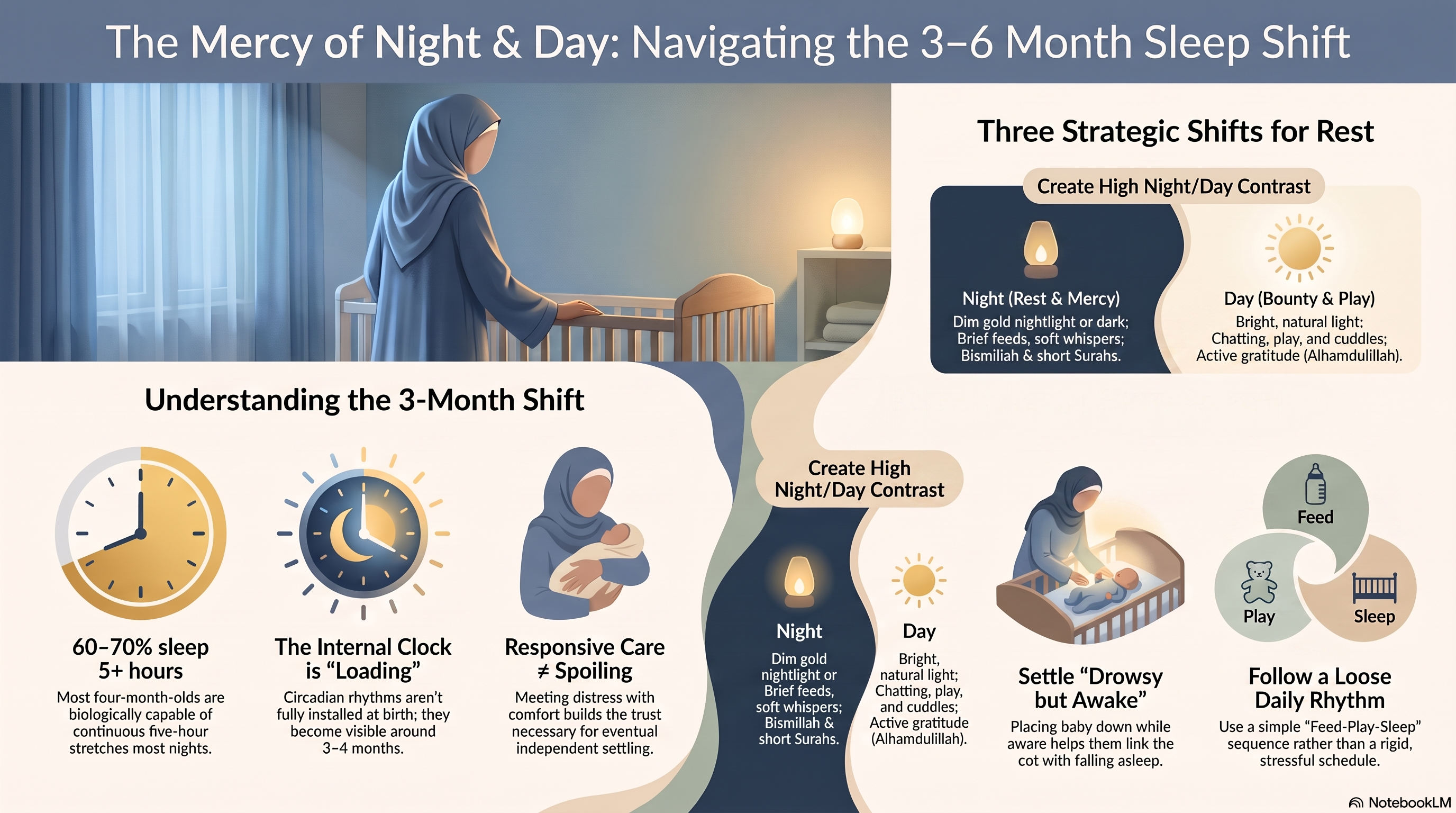
Video-tracked research out of University College London found that 60–70% of four-month-olds sleep continuously for five hours or more, most nights of the week [12]. This guide shows you the three shifts, night/day contrast, drowsy-but-awake settling, and a loose daily rhythm, that support that development instead of fighting it.
3am. Your baby’s crying again. You’re standing there doing the math you’ve done every night this week: how many hours since the last feed, how many since you last actually slept.
Someone at the masjid asked last week if your baby was “sleeping through” yet. You laughed it off. Inside, you wondered if you were doing something wrong.
You’re not. What’s actually happening in your baby’s small, developing brain is more interesting, and more encouraging, than anyone tells you at 3am.
Your Baby Isn’t Broken. Their Clock Is Still Loading.
Here’s what surprised me when I actually read the sleep research instead of just surviving it: your baby’s circadian rhythm, the internal clock that tells a body when to feel sleepy and when to feel alert, is still under construction at this age [7]. It isn’t fully installed at birth. It comes online gradually, and 3–4 months is exactly when that shift starts becoming visible.
That’s not a coincidence. That’s biology catching up to the calendar.
Why This Guide Is Different
Built on actual sleep research, not sleep-training ideology. Every recommendation here draws from peer-reviewed studies on infant circadian development and responsive parenting, not a single guru’s method [7,8,9].
Islamically grounded, not Islamically decorated. This isn’t science with a verse tacked on at the end. The Qur’an’s own framing of night and day as mercy sits at the center of the very first tip below.
You’ll walk away with a printable tool, not just more to remember. The free Night & Day Sleep Companion Pack turns this article into something you can tape to the wall at 3am, because reading advice and using advice are two very different things.
You Cannot Spoil a Four-Month-Old
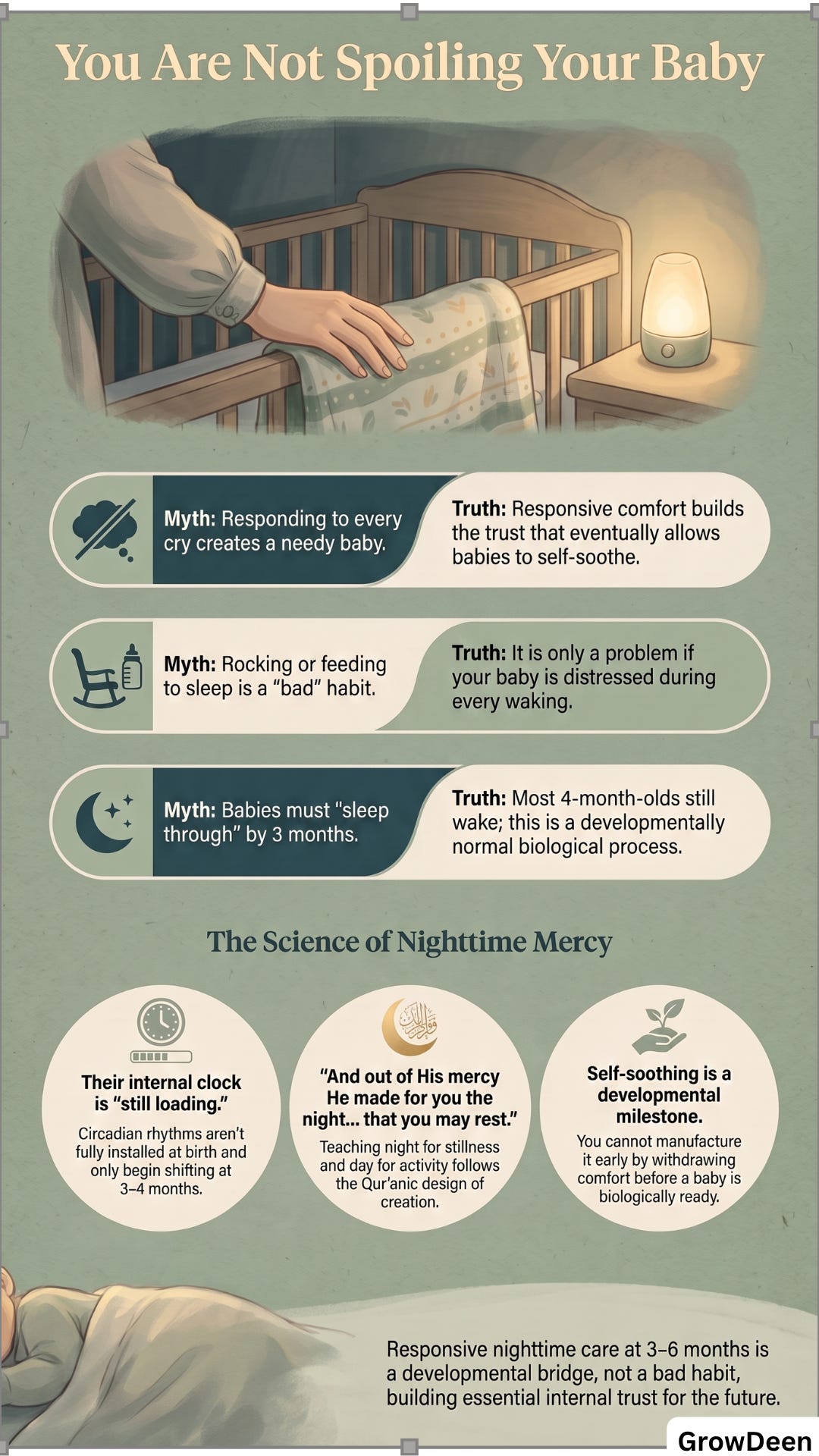
Let me say this plainly, because it gets said backwards constantly: rocking, patting, or murmuring to a baby who’s struggling to settle does not spoil them.
If anything, it’s the reverse. Responsive care at this age, meeting distress with comfort instead of waiting it out, is linked to better sleep outcomes down the road, not worse ones [5,8]. Your baby is learning something in these exchanges: that the world responds. That lesson is part of what eventually lets them settle with less help, not more [9].
The self-settling everyone talks about, a baby stirring at 2am and drifting back off without a sound, shows up once the underlying development is ready. You can’t manufacture it early by pulling comfort away sooner. You can only get in its way.
Shift One: Make Night Actually Feel Like Night
By 3–4 months, most babies are building their longest sleep stretch overnight [7]. A few consistent signals help that shift along:
Keep the room dark, or dimly lit, and quiet through the night.
Use only a dim light for night wake-ups. Save bright light for daytime.
Respond to night cries within a reasonable window, and settle or feed as soon as you’re able.
Keep night feeds in the bedroom, so they stay brief and clearly different from daytime ones.
Keep your own voice and movements soft after dark. Save the chatting and play for daylight.
Here’s the aha moment: this contrast isn’t a modern parenting trick. Allah says: “And out of His mercy He made for you the night and the day, that you may rest therein and seek His bounty, so that you may be grateful.” (Qur’an 28:73). According to Tafsir Ibn Kathir, this verse (read alongside the two before it) makes an almost startlingly practical point: the night’s entire benefit is rest, and the day’s benefits are so numerous the Qur’an doesn’t bother listing them. What you’re teaching your baby, night for stillness, day for everything else, is the actual design of night and day. Centuries before anyone used the word “circadian.”
Shift Two: Drowsy, Not Asleep
This is the tip that trips people up. So slow down here.
Putting your baby to bed while they’re drowsy but still awake helps them link falling asleep with the place they fall asleep in, rather than with being fed or rocked all the way down [8,10]. Here’s why that matters: every sleeper, adults included, surfaces briefly between sleep cycles all night long. A baby who wakes in the same setting they fell asleep in has a real shot at drifting back down alone [9,12]. A baby who fell asleep at the breast and wakes up in a dark, silent cot, understandably, does not.
That’s the entire mechanism behind self-soothing. A brief waking, a familiar environment, a return to sleep without help.
If your baby grizzles after you put them down drowsy, that’s ordinary. Give it a minute or two. But if grizzling turns into real crying, go comfort them. Responsive settling doesn’t have an expiry date at three months [5].
And on sleep associations: everyone has something that helps them fall asleep, being rocked, a dummy, the cot itself. If rocking or feeding to sleep works for your household, there’s nothing wrong with that [8]. It’s only worth revisiting if your baby is regularly distressed on waking and seems to need that exact input restored every time.
Shift Three: A Loose Rhythm, Not a Schedule
Once it feels right, doing things in roughly the same order each day (feed, play, sleep) gives your baby’s day a shape they can start to anticipate [10,11]. A simple version might run: feed, change the nappy, some time on talk and cuddles, then down for sleep once you notice tired signs.
At night, flip that instinct: settle straight back to sleep rather than playing, even if your baby briefly seems bright-eyed.
Here’s what most sleep advice skips: your baby still needs somewhere in the range of 12–16 hours of sleep across the full day and night combined at this age [16]. What feels like an exhausting amount of sleep management on your end is, from your baby’s side, a completely normal amount of actual sleeping.
I know it’s tempting to add elaborate Islamic rituals to a routine you’re already barely holding together. You don’t need to. A soft recitation of a short surah during the wind-down before a nap. A whispered Bismillah as you lay your baby down. That’s the whole ask.
I know this is a lot to hold onto, especially when you’re running on broken sleep yourself. That’s exactly why I put together the free Night & Day Sleep Companion Pack, a printable tool that turns everything above into something you can glance at during a 3am feed instead of trying to remember it. Keep reading, you’ll find the download at the end.
Support Muslim Parenting Lab ❤️
Would you like a share in every good thing that comes from what you fund? Support it with the button below, at any level you choose.
The Prophet ﷺ said whoever sets a good precedent earns its reward and the reward of everyone who follows it. (Sahih Muslim 1017a)
Safe Sleep Doesn’t Bend for Routine
Whatever rhythm you settle into, the physical basics of safe sleep stay fixed. A safe sleep environment measurably lowers the risk of sudden unexpected death in infancy, including SIDS [14]. In practice: back to sleep every time, on a firm and flat surface, in a space clear of loose bedding and soft toys, not overheated, and completely smoke-free.
If something feels genuinely off, heavy sweating, laboured breathing, weeks of extreme difficulty settling, that’s worth a conversation with your child’s doctor. Everything here is meant to sit alongside good medical guidance, never in place of it.

The Spiritual Dimension of Night and Day
When I sit with the verse quoted earlier, “And out of His mercy He made for you the night and the day, that you may rest therein and seek His bounty, so that you may be grateful” (Qur’an 28:73), I think less about theology and more about 3am feeds. Ibn Kathir’s commentary makes something plain: the entire, singular purpose of night in this verse is rest. Not productivity, not achievement. Rest.
That reframes the exhaustion a little. You’re not failing at some invisible sleep-training benchmark. You’re teaching your baby the exact rhythm Allah built into creation itself, long before anyone measured circadian rhythms in a lab.
What’s beautiful is how the science and the spiritual framing land on the same point from two directions: your baby’s biology is wired for night-as-rest, and the Qur’an names night-as-rest as an act of mercy. Saying Bismillah as you settle your baby, and a quiet Alhamdulillah once they’re down, folds that gratitude into a routine that otherwise feels like pure survival. May Allah place barakah in these repetitive, invisible hours of care.
Your Next Five Minutes
Tonight, pick just one shift from this article, maybe the dim light for night wake-ups. Start there. You don’t have to overhaul everything at once.
Think of one person right now: the friend at the masjid who mentioned she’s up every two hours, the sister in your group chat who keeps apologizing for how tired she sounds. This article could ease her mind tonight, not because you’re giving advice, but because you’re passing along something that helped.
The Night & Day Sleep Companion Pack
If you’ve read this far, you’re the kind of parent who wants to understand your baby’s sleep, not just survive it. That tells me something good about you.
Inside the Night & Day Sleep Companion Pack (one comprehensive PDF, 3 pages):
Page 1: Night vs. Day Quick Reference Card — A single-glance, two-column comparison (Night / Day) with the specific action items from this article, dim light vs. bright light, quiet feeds vs. play, quick response vs. active engagement, designed as a card you can keep taped near the changing table or cot.
Page 2: Build Your Baby’s Simple Day Routine — A fillable daily-flow template (Wake → Feed → Play → Tired signs → Sleep, repeated across the day, plus a separate night strip) so you can map your actual baby’s actual rhythm in under 10 minutes, not someone else’s idealized schedule.
Page 3: The Mercy of Night and Day — Qur’an 28:73 in Arabic, transliteration, and translation, with a short reflection connecting the verse to your 3am feed, plus three simple night adab prompts (Bismillah at settling, soft voice and light, Alhamdulillah once your baby is down).
This isn’t a PDF to download and forget. It’s built to live near your baby’s sleep space, where you’ll actually reach for it at 3am.
This companion pack is what every subscriber receives with each article. We cover the full journey of raising Muslim children, from newborns through the school years, backed by research and rooted in Islamic wisdom.
Frequently Asked Questions
Q: What age do babies start sleeping through the night?
A: Video-tracked research shows 60–70% of four-month-olds sleep continuously for five hours or more, most nights [12], though full “sleeping through” varies widely and often isn’t consistent until well past the first birthday. See “Your Baby Isn’t Broken” above for what’s actually developing at this age.
Q: Is it OK to rock or feed my baby to sleep at 3–6 months?
A: Yes. If it works for your family, there’s nothing wrong with it [8]. It’s only worth revisiting if your baby is regularly distressed on waking and needs that exact input restored every single time.
Q: How do I know if my baby is drowsy but not fully asleep?
A: Look for heavy eyelids, slower movements, and less focus on your face or voice, but eyes still open or fluttering. Put them down at that point rather than waiting for full sleep [8,10].
Q: Will letting my baby grizzle for a minute cause harm?
A: No. A minute or two of grizzling while settling is normal and not the same as distressed crying [5]. If it escalates into real crying, go comfort them; responsive settling remains appropriate at this age.
Q: How much sleep does a 3–6 month old actually need?
A: Roughly 12–16 hours across the full 24-hour day, combining night sleep and daytime naps [16]. That number includes every nap, not just the overnight stretch.
Q: What’s the single biggest safe sleep rule at this age?
A: Back to sleep, every time, on a firm flat surface clear of loose bedding, in a space that isn’t overheated or smoke-exposed [14]. This applies regardless of whatever routine or settling method you’re using.
References
[1] Blunden, S., Osborn, J., & King, Y. (2022). Do responsive methods of improving sleep reduce stress in mother/infant dyads compared to extinction interventions? A pilot study. Archives of Women’s Mental Health, 25, 621–631. https://doi.org/10.1007/s00737-022-01224-w
[2] Centre for Community Child Health. (2015). Sleep and the early years. Community Paediatric Review, 23(4). https://www.rch.org.au/uploadedFiles/Main/Content/ccch/CPR-vol23-no4.pdf
[3] Field, T. (2017). Infant sleep problems and interventions: A review. Infant Behaviour and Development, 47, 40–53. https://doi.org/10.1016/j.infbeh.2017.02.002
[4] Gradisar, M., Jackson, K., Spurrier, N. J., Gibson, J., Whitham, J., Williams, A. S., Dolby, R., & Kennaway, D. J. (2016). Behavioral interventions for infant sleep problems: A randomized control trial. Pediatrics, 137(6), e20151486. https://doi.org/10.1542/peds.2015-1486
[5] Hiscock, H., Cook, F., Bayer, J., Le, H. N., Mensah, F., Cann, W., Symon, B., & St James-Roberts, I. (2014). Preventing early infant sleep and crying problems and postnatal depression: A randomized trial. Pediatrics, 133(2), 346–354. https://doi.org/10.1542/peds.2013-1886
[6] Honaker, S. M., & Meltzer, L. J. (2016). Sleep in pediatric primary care: A review of the literature. Sleep Medicine Reviews, 25, 31–39. https://doi.org/10.1016/j.smrv.2015.01.004
[7] Logan, R. W., & McClung, C. A. (2019). Rhythms of life: Circadian disruption and brain disorders across the lifespan. Nature Reviews Neuroscience, 20(1), 49–65. https://doi.org/10.1038/s41583-018-0088-y
[8] Middlemiss, W., Stevens, H., Ridgway, L., McDonald, S., & Koussa, M. (2017). Response-based sleep intervention: Helping infants sleep without making them cry. Early Human Development, 108, 49–57. https://doi.org/10.1016/j.earlhumdev.2017.03.008
[9] Mindell, J. A., Leichman, E. S., DuMond, C., & Sadeh, A. (2017). Sleep and social-emotional development in infants and toddlers. Journal of Clinical Child & Adolescent Psychology, 46(2), 236–246. https://doi.org/10.1080/15374416.2016.1188701
[10] Mindell, J. A., & Williamson, A. A. (2018). Benefits of a bedtime routine in young children: Sleep, development, and beyond. Sleep Medicine Reviews, 40, 93–108. https://doi.org/10.1016/j.smrv.2017.10.007
[11] Öztürk, M., Boran, P., Ersu, R., & Peker, Y. (2021). Possums-based parental education for infant sleep: Cued care resulting in sustained breastfeeding. European Journal of Pediatrics, 180(6), 1769–1776. https://doi.org/10.1007/s00431-021-03942-2
[12] St James-Roberts, I., Roberts, M., Hovish, K., & Owen, C. (2016). Video evidence that parenting methods predict which infants develop long night-time sleep periods by three months of age. Primary Health Care Research & Development, 18(3), 212–226. https://doi.org/10.1017/S1463423616000451
[13] St James-Roberts, I., Roberts, M., Hovish, K., & Owen, C. (2015). Video evidence that London infants can resettle themselves back to sleep after waking in the night, as well as sleep for long periods, by 3 months of age. Journal of Developmental and Behavioral Pediatrics, 36, 324–329. https://doi.org/10.1097/DBP.0000000000000166
[14] American Academy of Pediatrics, Task Force on Sudden Infant Death Syndrome. (2022). Sleep-related infant deaths: Updated 2022 recommendations for reducing infant deaths in the sleep environment. Pediatrics, 150(1), e2022057990. https://doi.org/10.1542/peds.2022-057990
[15] Qur’an, Surah Al-Qasas 28:73 — https://quran.com/28/73 — with Tafsir Ibn Kathir: https://quran.com/en/28/73/tafsirs/en-tafisr-ibn-kathir
[16] Paruthi, S., Brooks, L. J., D’Ambrosio, C., Hall, W. A., Kotagal, S., Lloyd, R. M., Malow, B. A., Maski, K., Nichols, C., Quan, S. F., Rosen, C. L., Troester, M. M., & Wise, M. S. (2016). Recommended amount of sleep for pediatric populations: A consensus statement of the American Academy of Sleep Medicine. Journal of Clinical Sleep Medicine, 12(6), 785–786. https://doi.org/10.5664/jcsm.5866
We combine scientific research with Qur’an and authentic Sunnah, and we cite our sources. Even so, this is general guidance and no substitute for a doctor who can examine your child.