

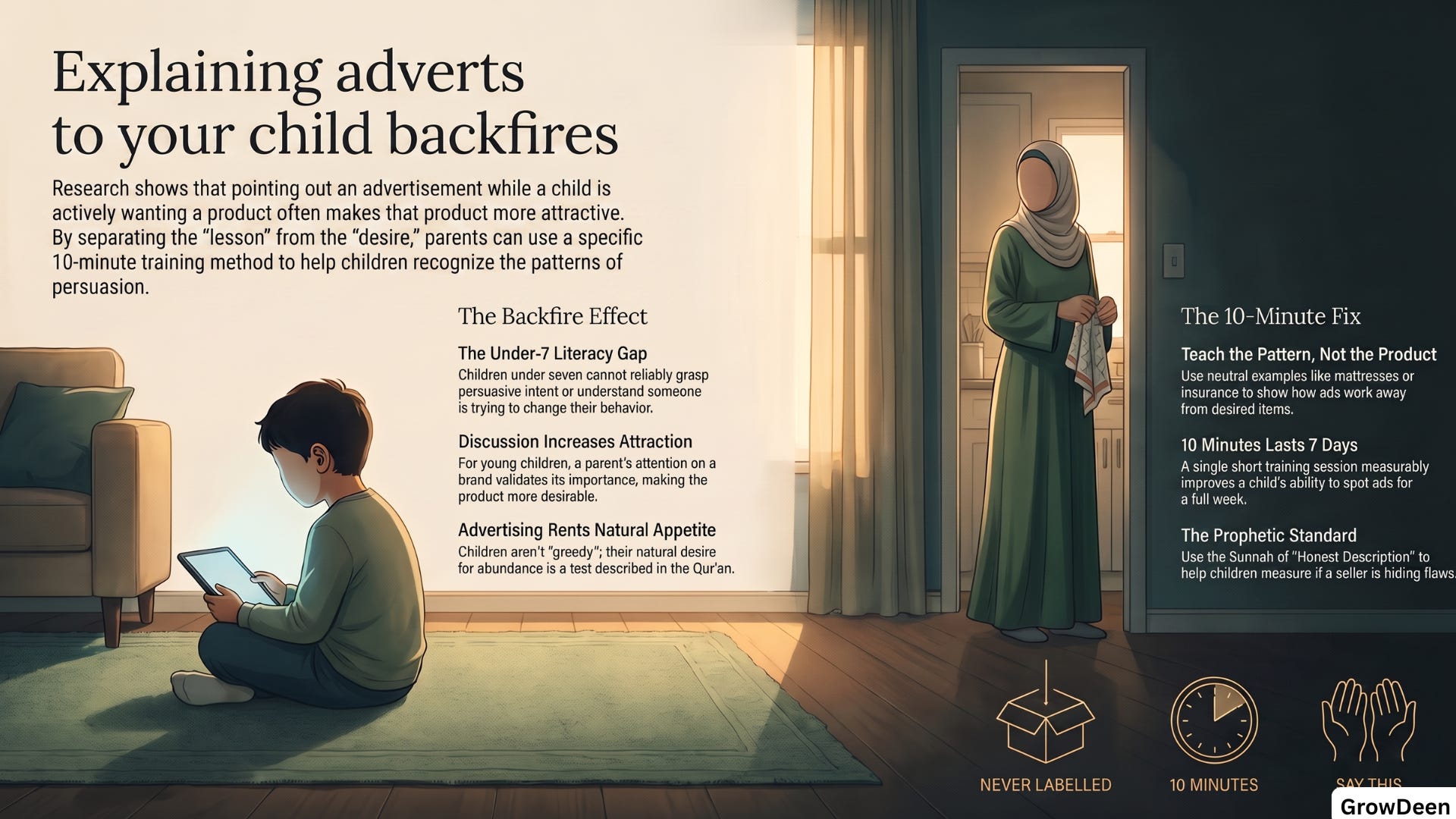
A 2017 experiment found that one 10-minute lesson measurably improved children’s ability to spot hidden advertising, and the effect was still there a full week later. [1] Here is exactly what to say.
Your four-year-old wants the yoghurt in the tube.
Not any yoghurt. That one, in that packaging, from that cartoon. And you do the thing every sensible parenting article tells you to do. You crouch down, you point at the box, and you explain that this is an advert and adverts are made to make us want things.
Your child looks at the box with new interest.
I know that moment. You were not careless, you were not permissive, you did the right thing and it landed sideways, and somewhere underneath the tiredness is a quieter worry: something out there is working on my child faster than I can keep up. Here is the number that reframes it. When paediatricians at the American Academy of Pediatrics reviewed the developmental research, they concluded that children aged seven and under cannot reliably grasp persuasive intent, meaning the understanding that another person is deliberately trying to change what they think and do. Their recommendation was that commercial advertising to children under seven be banned outright. [3]
So the contest was never fair. But that still leaves the strange part, and it is the question I want you to carry through the rest of this article: why does the one thing most parents instinctively do, stopping and explaining the advert, sometimes make a seven-year-old want the product more?
The answer is in the research, and it changes what you should say tonight.
What makes this guide different
Built on experimental evidence, not opinion. The core method comes from a controlled experiment published in the European Journal of Marketing [1], cross-checked against a JAMA Pediatrics meta-analysis of 96 studies [4] and the AAP’s 2020 policy statement [3].
Islamic guidance that does real work. The Qur’an describes the mechanism of displayed abundance, and the Prophet ﷺ left a standard for honest description that your child can hold any advert against. This is not decoration on top of the science.
A script, not a summary. You will get the free Spot the Sell Pack, including the actual words to say in your ten minutes, so you are not left translating research into a conversation on your own.
Why your child wants things, and why almost none of it is their fault
Before the method, one thing has to be cleared out of the way, because it sits underneath most of the guilt parents carry into this topic.
You have probably wondered, quietly, whether your child is a bit greedy. Whether other children ask this much.
They do. And the Prophet ﷺ said something that settles this more kindly than any parenting book: if the son of Adam had a valley full of gold, he would want a second one, and nothing fills the mouth of the son of Adam except the dust of the grave, and Allah relents toward whoever turns back to Him. [14]
Read that as a description rather than a scolding. The appetite for more does not close by itself. Not in your four-year-old, not in your fourteen-year-old, not in you at eleven at night with a shopping app open.
Advertising did not build that appetite. It rents it.
And it rents it at scale. A systematic review and meta-analysis in JAMA Pediatrics pooled 96 studies, 64 of them randomised controlled trials, and found food and drink marketing reliably associated with increases in what children ate, what they chose, what they preferred, and what they asked their parents to buy. [4] An older study of children’s letters requesting toys found the same thing from the other direction: more commercial television watched, more branded items on the list. [5]
Which relocates the whole job. You are not raising a child who stops wanting. You are raising a child who notices the wanting, works out where it arrived from, and still chooses.
That is a skill. Skills are teachable. But before we get to how, you need to see what you are actually up against, because it is almost certainly not what you are picturing.
Where adverts hide now, and why you cannot see them either
If your mental image of advertising is a break between cartoons, the picture is about twenty years out of date.
An unboxing video is play and promotion running on the same track. A child watching an adult slowly reveal a toy is inside an advert with no beginning and no end, and researchers examining this genre describe it as operating in a largely unregulated space. [6] Advergames go further, because your child is not watching, your child is playing. Research comparing advergames with television commercials found that children’s persuasion knowledge behaves differently once the brand is inside the game itself. [7]
Then there is the format most parents underestimate entirely. Someone your child watches daily, whose voice they know, who feels like a friend, holding up a product. Research on influencer marketing to children has examined how familiarity converts into buying [9], and a study of tweens linked exposure to child influencers with materialism and with actually purchasing the promoted products. [10] Analysis of influencer content aimed at young audiences also found sponsorship disclosure frequently inadequate or missing. [11]
Scholars working on advertising literacy make a distinction worth holding onto: recognising an advert and being able to resist one are two different abilities, and embedded formats interfere with both. [8]
Older children carry one more layer that is genuinely invisible. A study of adolescents found real gaps in their understanding of how their own data becomes the adverts they then see. [12] Your teenager can point at an advert. Whether they understand why that one found them is another question.
I know this is a lot to hold in your head, especially when you are already managing bedtime, homework, and a device that seems to be in every room at once. That is exactly why I put together the free Spot the Sell Pack, a printable three-page PDF with the word-for-word lesson script, a game you can play in the car, and one card for the days you need reminding why any of this matters. Keep reading, it is waiting for you at the end.
Now, back to the strange finding, because this is where the article turns.
What the Prophet ﷺ gave us instead of suspicion
There is a verse that names this exact situation, and it surprised me when I first connected it to a screen.
Allah says: “And do not extend your eyes toward that by which We have given enjoyment to some categories of them, being but the splendour of worldly life by which We test them. And the provision of your Lord is better and more enduring.” [13] According to Tafsir Ibn Kathir, Allah is instructing His Prophet ﷺ not to look at the comforts that the people of luxury possess, because it is only short-lived splendour and a feeble bounty being used to test them.
Splendour, arranged, held in front of the eye, functioning as a test.
That is an advert, described fourteen centuries before the first one aired.
But Islam does not stop at the warning, and that matters more than it sounds. A warning alone produces a cynical child, and cynicism is not the same as discernment. So the Prophet ﷺ also gave a standard. He said that when a seller and a buyer are truthful with one another and describe plainly what they are dealing in, their transaction is blessed, and when they lie and conceal, the blessing in it is erased. [15]
Notice what that requires. Not silence about the flaws. Description. Saying the thing that does not help you make the sale.
Hand that to your child and they have something to measure with, rather than something to be afraid of.
Support Muslim Parenting Lab ❤️
Would you rather give a small amount that never stops than a large one you keep postponing? Set a monthly amount you are comfortable with, in a few seconds, using the button below.
The Prophet ﷺ said the deed most beloved to Allah is the most constant, even if little. (Sahih al-Bukhari 6464)
The 10-minute lesson: what to actually say
Now the answer to the question you have been carrying.
Researchers gave children aged seven to eight and ten to eleven a short advertising literacy training session, then showed them product placement either immediately or a week afterwards. A ten-minute session improved their ability to recognise the advertising for both age groups, and the improvement was still measurable seven days later. [1]
Ten minutes. That is the entire intervention.
But a separate study of 180 children under twelve and their parents found something that runs the other way. Older children, aged ten to eleven, were better than seven and eight year olds at detecting both the commercial intent of a brand placement and where it came from. For the older children, parental mediation made no significant difference to how they felt about the brand. For the younger ones, it went backwards: mediation was associated with more positive brand attitudes, not fewer. [2]
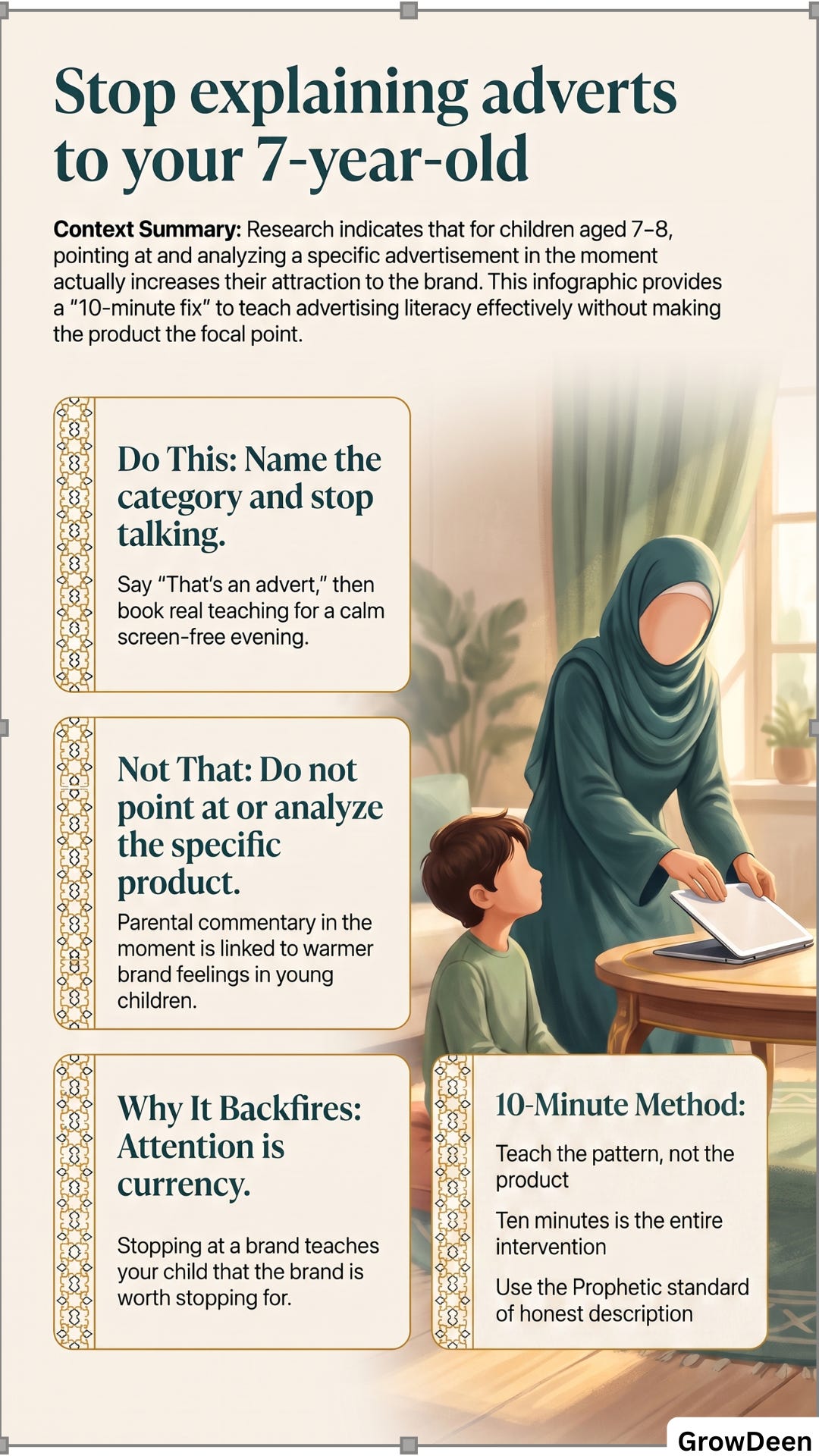
There it is. Pointing at a brand and discussing it can make that brand more attractive to a seven-year-old, because to a young child, the thing the parent stopped and talked about is the thing worth noticing.
Both findings are true, and together they give you the rule:
Teach the pattern, not the product.
A scheduled ten-minute lesson about how advertising works, using examples your child wants nothing from, builds real skill. A running commentary on the thing your child currently wants hands the advertiser your attention for free.
So here is the shape of the ten minutes. Sit down at a calm moment, nowhere near a screen. Explain that some of what we watch is made to sell us something, and that the people who make it are paid when we buy. Show two or three examples from products your child has no interest in, a car, a mattress, a cleaning spray. Ask what the advert is trying to make you feel. Ask whether it says anything the product is not good at. Then leave it. Do not connect it to the yoghurt.
What this looks like at each age
Birth to two. Nothing to teach yet, because no separation exists between advert and content. The work is entirely environmental: what plays, what stays running, what your child sees over your shoulder. You are the gate, and there is no second gate behind you.
Three to six. Name the category, briefly, and stop talking. “That’s an advert.” Then treat the break as a break: screens down, water, wudu, movement, back again.
Seven to eleven. Your ten minutes belong here. This is the age the training research was built on, and the age where the backfire risk makes timing matter most. [1][2]
Twelve to thirteen. Add the machinery. Advertising costs sit inside the price. Product placement is paid. The creators they follow are often sponsored.
Fourteen and over. Add targeting, sponsorship disclosure, and the small print. A phone plan is not twenty-five a month. It is twenty-five a month for twenty-four months, and then whatever sits underneath.

Your free Spot the Sell Pack
If you have read this far, you are the kind of parent who takes your child’s inner life seriously, not out of anxiety, but out of protective love. That tells me something good about you.
Inside the Spot the Sell Pack (one comprehensive PDF, 3 pages):
Page 1: The 10-Minute Lesson Script — the word-for-word conversation from the research above, laid out in five timed segments with the exact questions to ask and three neutral practice examples, so you never have to invent it on the spot. Designed as a read-aloud card you can keep in the kitchen drawer and pull out on a quiet evening.
Page 2: Spot the Sell Bingo — a sixteen-square grid of advertising tactics your child can hunt for and tick off, playable in the car, at the bus stop, or over a weekend, so the pattern gets learned through a game rather than a lecture.
Page 3: The Honest Description Test — the Prophetic standard from Sahih al-Bukhari 2079, with the three questions your child can ask of any advert, and one short reflection for you on the day you feel outmatched. It gives your child something to measure with, and gives them the ethic they will need on the day they are the one selling.
This is not a PDF to download and forget. It is built to sit in the drawer where you will actually reach for it.
The Spot the Sell Pack is what every subscriber receives with each article. Muslim Parenting Lab covers the full journey of raising Muslim children, all backed by peer-reviewed research and rooted in the Qur’an and Sunnah.
Do this in the next five minutes
Open a notes app and write down three products your child has zero interest in. A mattress. A car. Insurance. That is your practice set for the ten minutes, and having it ready is the only reason most parents actually start.
Share this with someone who needs it
Think of the mother you know whose seven-year-old has started asking for things by brand name, and who has been quietly wondering whether she has done something wrong.
She has not. She is missing ten minutes and a script, and you now have both.
Send this to her. What she teaches her child will still be working long after this article is forgotten, and every good thing that comes from it is written for you too.
Questions parents ask
At what age can children understand that adverts are trying to sell them something?
Not as early as most parents assume. The AAP’s review found that children seven and under have limited ability to grasp persuasive intent, and that children from seven to eleven can begin to identify advertising with a parent’s help but still cannot hold it in mind as a commercial system. [3]
Is it bad to talk to my young child about adverts?
Not bad, but the timing matters. In a study of 180 children under twelve, parental mediation was associated with more positive brand attitudes among seven and eight year olds rather than fewer. [2] For young children, name the category briefly and move on. Save the real teaching for a calm moment away from anything they want.
How long does teaching my child about advertising actually take?
About ten minutes. In a controlled experiment, a single short training session improved children’s ability to recognise product placement in both younger and older children, and the effect was still measurable a week later. [1]
Are YouTube unboxing videos advertising?
Functionally, yes. Researchers studying the genre describe it as promotion and play running together in a largely unregulated space, with no visible line where the entertainment stops and the selling starts. [6]
Do influencers really affect what children buy?
Yes. A study of tweens linked exposure to child influencers with materialism and with actually buying the products those influencers promoted [10], and analysis of influencer content for young audiences found sponsorship disclosure frequently inadequate or missing. [11]
What does Islam say about advertising to children?
The Qur’an describes the mechanism directly, warning against extending the eye toward displayed worldly splendour, which Tafsir Ibn Kathir explains as short-lived splendour used as a test. [13] The Prophet ﷺ then gave a standard for honest dealing: truthful description and disclosure bring blessing into a transaction, while lying and concealing erase it. [15] For rulings on a specific situation, ask a trusted scholar.
When should I speak to a doctor about this?
Speak with your doctor or paediatrician if your child seems persistently distressed about what they do not own, if their mood is consistently affected by comparison with others, if they seem anxious about their appearance, or if requests and refusals have become a daily source of conflict at home.
References
[1] De Jans, S., Hudders, L., & Cauberghe, V. (2017). Advertising literacy training: The immediate versus delayed effects on children’s responses to product placement. European Journal of Marketing, 51(11/12), 2156-2174. https://doi.org/10.1108/EJM-08-2016-0472
[2] Hudders, L., & Cauberghe, V. (2018). The mediating role of advertising literacy and the moderating influence of parental mediation on how children of different ages react to brand placements. Journal of Consumer Behaviour, 17(2), 197-210. https://doi.org/10.1002/cb.1704
[3] Radesky, J., Chassiakos, Y.L.R., Ameenuddin, N., & Navsaria, D.; AAP Council on Communications and Media (2020). Digital advertising to children. Pediatrics, 146(1), e20201681. https://doi.org/10.1542/peds.2020-1681
[4] Boyland, E., McGale, L., Maden, M., Hounsome, J., Boland, A., Angus, K., & Jones, A. (2022). Association of food and nonalcoholic beverage marketing with children and adolescents’ eating behaviors and health: A systematic review and meta-analysis. JAMA Pediatrics, 176(7), e221037. https://doi.org/10.1001/jamapediatrics.2022.1037
[5] Pine, K.J., & Nash, A. (2002). Dear Santa: The effects of television advertising on young children. International Journal of Behavioral Development, 26(6), 529-539. https://doi.org/10.1080/01650250143000481
[6] Craig, D., & Cunningham, S. (2017). Toy unboxing: Living in a(n unregulated) material world. Media International Australia, 163(1), 77-86. https://doi.org/10.1177/1329878X17693700
[7] Panic, K., Cauberghe, V., & De Pelsmacker, P. (2013). Comparing TV ads and advergames targeting children: The impact of persuasion knowledge on behavioral responses. Journal of Advertising, 42(2-3), 264-273. https://doi.org/10.1080/00913367.2013.774605
[8] Hudders, L., De Pauw, P., Cauberghe, V., Panic, K., Zarouali, B., & Rozendaal, E. (2017). Shedding new light on how advertising literacy can affect children’s processing of embedded advertising formats. Journal of Advertising, 46(2), 333-349. https://doi.org/10.1080/00913367.2016.1269303
[9] De Veirman, M., Hudders, L., & Nelson, M.R. (2019). What is influencer marketing and how does it target children? A review and direction for future research. Frontiers in Psychology, 10, Article 2685. https://doi.org/10.3389/fpsyg.2019.02685
[10] Rasmussen, E.E., Riggs, R.E., & Sauermilch, W.S. (2021). Kidfluencer exposure, materialism, and U.S. tweens’ purchase of sponsored products. Journal of Children and Media, 16(1), 68-77. https://doi.org/10.1080/17482798.2021.1910053
[11] Livingstone, S., & Rahali, M. (2022). #SponsoredAds: Monitoring influencer marketing to young audiences (Media Policy Brief 23). London School of Economics and Political Science. https://eprints.lse.ac.uk/113644/
[12] Srivastava, S., Wilska, T.A., & Nyrhinen, J. (2023). Awareness of digital commercial profiling among adolescents in Finland and their perspectives on online targeted advertisements. Journal of Children and Media, 17(4), 559-578. https://doi.org/10.1080/17482798.2023.2257813
[13] Qur’an, Surah Ta-Ha 20:131, with Tafsir Ibn Kathir. https://quran.com/20/131
[14] Sahih al-Bukhari 6439; Sahih Muslim 1048. Narrated by Anas ibn Malik. Grade: Muttafaqun Alayhi. https://sunnah.com/bukhari:6439
[15] Sahih al-Bukhari 2079; Sahih Muslim 1532. Narrated by Hakim ibn Hizam. Grade: Sahih. https://sunnah.com/bukhari:2079
We combine scientific research with Qur’an and authentic Sunnah, and we cite our sources. Even so, this is general guidance and no substitute for a doctor who can examine your child.