

A 2009 UCLA study that observed 30 families inside their homes found children doing markedly less housework than either they or their parents believed. [1] The willingness, though, arrives at 18 months. [2] Here is the four-week handover that makes it stick.
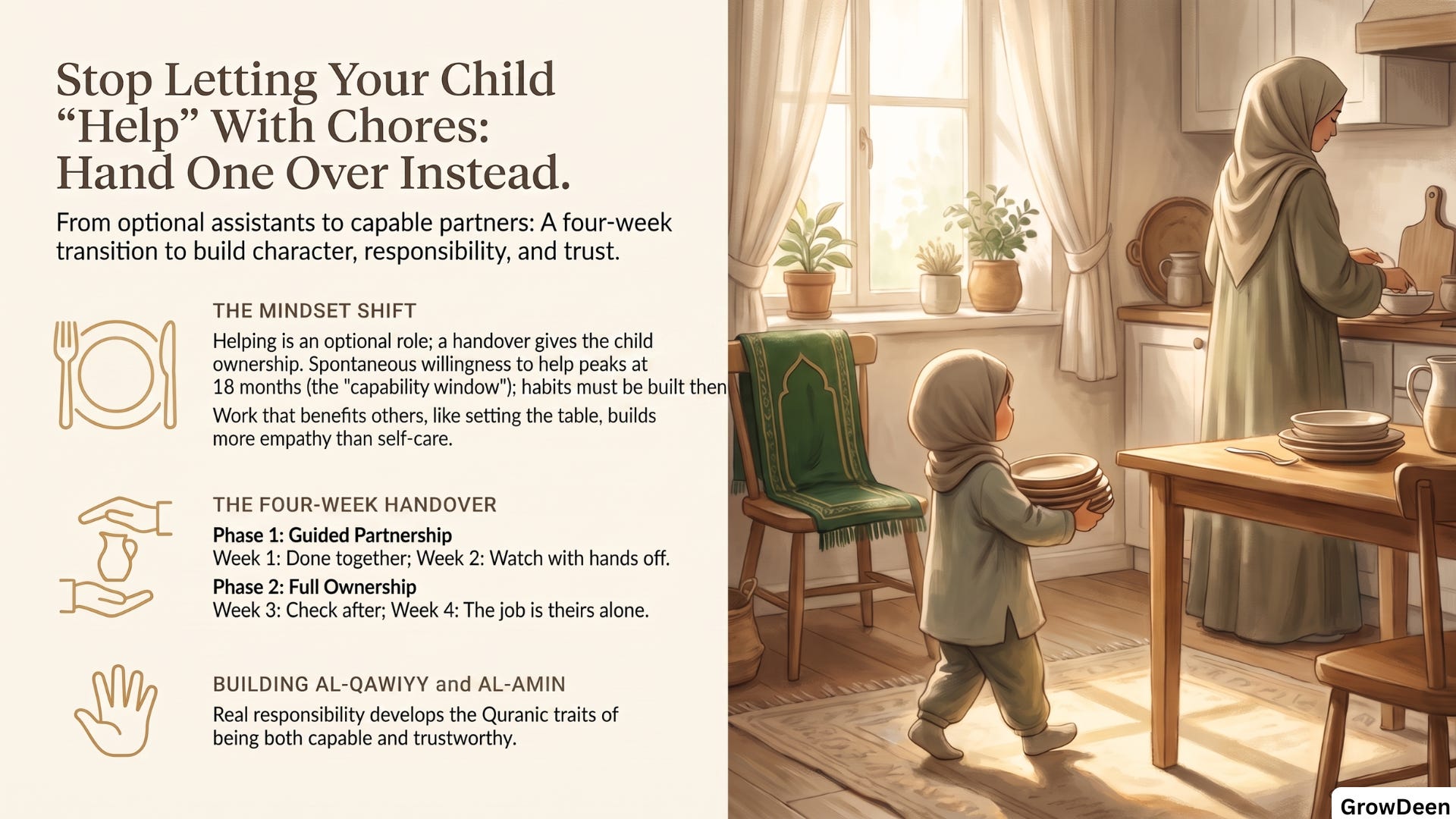
She asked to wash the dishes.
Four years old, dragging the step stool across the kitchen, twenty minutes before Maghrib with dinner half made. You know exactly what that means. Water on the tiles, one plate cleaned in nine minutes, a job that stretches to three times its length.
So you say the reasonable thing. “You can help me.”
And that sentence, said kindly, with the best intentions, is where most of it quietly goes wrong.
I want to be careful here, because I am not about to tell you that you should have let a four year old loose on the sink. Some evenings there is no room for it. What I am saying is that “you can help me” keeps your child in a role they will eventually resign from. Assistant. Optional. Attached to your job, not holding one.
When researchers at UCLA spent time inside 30 households recording what family members actually did, they found something uncomfortable: children were doing considerably less housework than both the children and the parents reported in interviews. [1] Everyone believed the kids were pitching in. The recordings said otherwise.
Here is the question I want you to carry through the rest of this. Why do so many three year olds beg to help, and so many nine year olds have to be asked five times?
What Makes This Guide Different
Every claim is sourced. UCLA’s household observation work, a 1996 study that split chores into two categories with very different effects, and a meta-analysis of 128 reward experiments, all cited so you can check them.
The Islamic frame is not decoration. There is a passage in the Qur’an that names, in two words, exactly what work is supposed to build in a person. Most of us have read past it a dozen times.
You get the tool, not just the theory. The Capable Hands Pack is a free three-page PDF built around the handover, so you can run this on your kitchen counter instead of holding it in your head.
The Problem Hiding Inside the Word “Help”
Think about what “help” actually means when you say it to a child.
It means: this is my job, and you may participate in it. Your role ends when I say so. The standard is mine. The remembering is mine. If you stop, nothing breaks.
Now think about what happens to that arrangement at nine years old, when the novelty has worn off and there is a screen in the house. Nothing breaks. So they stop.
Helping fades. A handover holds.
A handover is different in one specific way: the job leaves your hands. It is theirs. It has a name, a time, and a standard they can meet. If they do not do it, someone notices, because it was not yours to catch.
That distinction sounds small. It is the whole article.
Not Every Chore Builds the Same Child
Now here is the part that genuinely reorganised how I think about this, and I had the research backwards for a long time.
In 1996, researchers split children’s household work into two categories. Self-care work, where the child looks after their own things, and family-care work, where what the child does benefits somebody else. Only routine family-care work was positively associated with concern for others inside the family, and even then, the association showed up only in the older children. There was no relationship between chore type and prosocial behaviour toward a stranger. [3]
Read that again slowly, because the finding is narrower than the version you usually see quoted, and the narrow version is the useful one.
Tidying your own bedroom and setting the table for six are not the same activity. One teaches a child to manage themselves. The other teaches them that other people are in the room.
So if your child currently has exactly one job and it is “keep your room tidy,” you have given them the category that does the least. Add one that lands on somebody else. Setting the table. Refilling the water jug before dinner. Putting out everyone’s prayer mats before Maghrib.
That one swap costs you nothing and changes what the chore is for.
The Pack I Built For This
I know this is a lot to hold in your head at 6pm with a pan on the stove. That is exactly why I put together a free three-page PDF called The Capable Hands Pack. It sorts every common chore into the two categories above, then walks one job through the four-week handover on a single card you can stick on a cupboard door.
You can download it at the end. It is designed to sit in your kitchen, not in your downloads folder.
But before you use it, there is something about timing you should know, because it explains the question I planted earlier.
The Willingness Has an Expiry Date
Your toddler is not being annoying when they crowd you at the sink. They are in the most cooperative window they will ever occupy.
In a now well known set of experiments, infants around 18 months old spontaneously helped an unfamiliar adult who appeared to be struggling with an object. Nobody asked them. Nobody rewarded them. They just did it. [2]
That impulse arrives standard. What happens next is entirely up to the adults in the house.
Toddler helping turns out to be closely tied to how the parent scaffolds it: whether the task gets broken down, narrated, and opened up, or whether the child is simply worked around. [4] And in communities where children are routinely folded into the household’s real work rather than kept clear of it, children show noticeably more spontaneous helpfulness and more anticipation of what needs doing. [5]
Put that beside the UCLA finding and the picture completes itself. The impulse is native. The habit is built. And if nobody builds it during the years the child is volunteering, there is nothing left to fall back on at nine.
That is the answer to the question. Nine year olds have to be asked five times because at three, nobody handed anything over. They were only ever allowed to help.
The Two Words the Qur’an Uses for a Good Worker
You know that flicker of guilt when you shoo a child out of the kitchen because it is faster alone? I want to sit with that for a second, because Islam has something specific to say about it, and it is not what I expected.
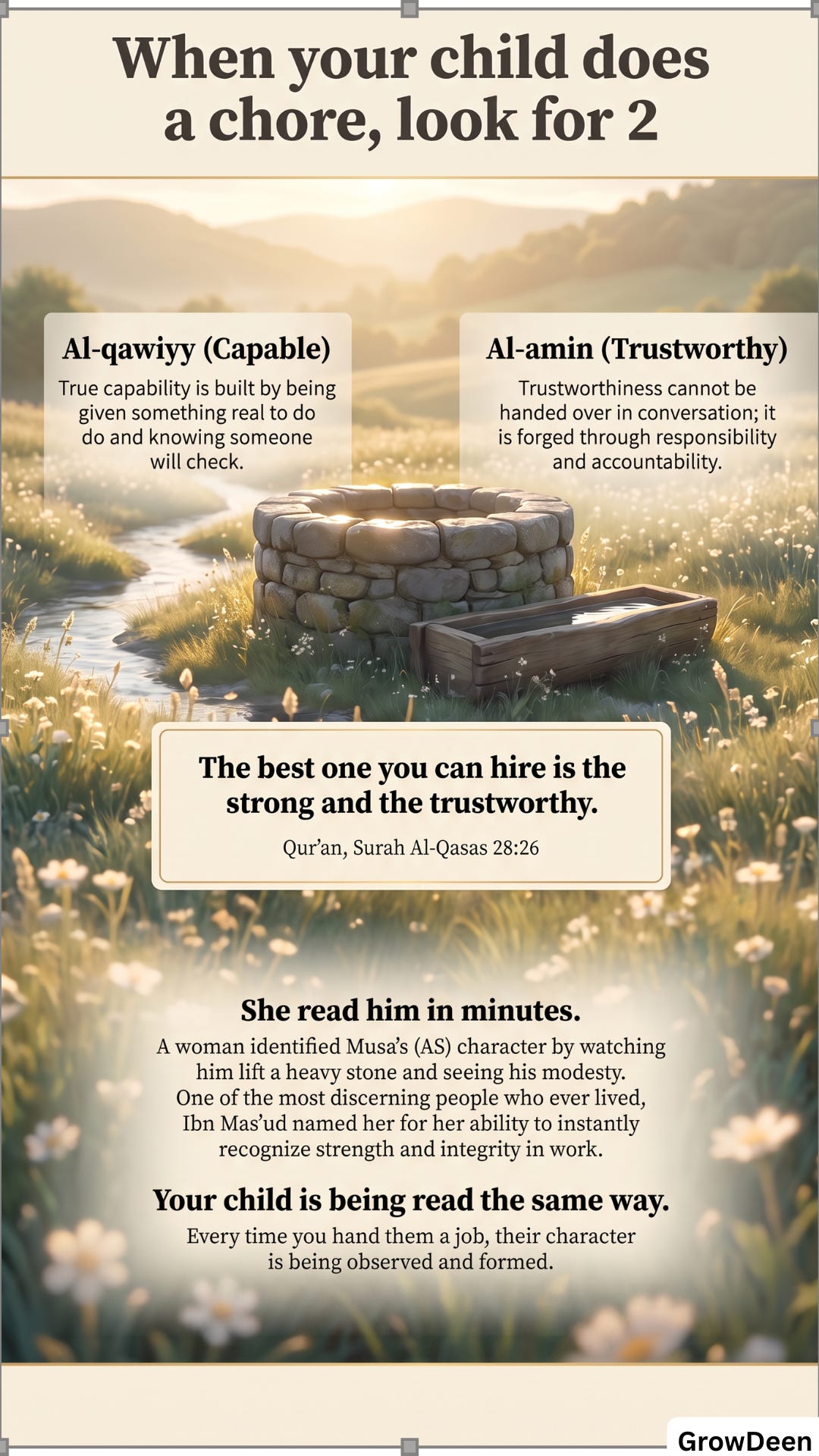
There is a scene in Surah Al-Qasas most of us have read past. Musa (peace be upon him) reaches Madyan, finds two women waiting with their flock, and waters their animals. Afterwards one of them tells her father: “O my father, hire him. Indeed, the best one you can hire is the strong and the trustworthy.” [15]
Two words hold the entire judgement. Al-qawiyy, the capable. Al-amin, the trustworthy.
Tafsir Ibn Kathir preserves how she knew. Ibn Kathir records, from ‘Umar, Ibn ‘Abbas, Qatadah and others, that her father asked her, and she answered by describing two things she had watched: a rock lifted that would take ten men, and a man who asked her to walk behind him rather than ahead. [15] Ibn Kathir quotes ‘Abdullah ibn Mas’ud naming her among the three most discerning people for catching it that fast.
Neither of those qualities can be handed to a child in a conversation. You cannot talk someone into being capable. Household work is one of the very few places a young child can practise both, daily, at stakes that are real but still safe.
And the Prophet ﷺ said: “Nobody has ever eaten a better meal than that which one has earned by working with one’s own hands. The Prophet of Allah, Dawud, used to eat from the earnings of his manual labour.” [17] That narration is about livelihood, not children’s chores, and I will not stretch it further than it goes. But a child who grows up watching housework treated as beneath people has absorbed something Islam does not teach.
Support Muslim Parenting Lab ❤️
Would you like the reward of every parent who acts on what they read here? Fund it with the button below and it is yours.
The Prophet ﷺ said whoever guides to good has a reward like the one who does it. (Sahih Muslim 1893a)
The Four-Week Handover
So what does this actually look like on a Tuesday evening?
Pick one job. Family-care, not self-care. Attach it to something that already happens daily.
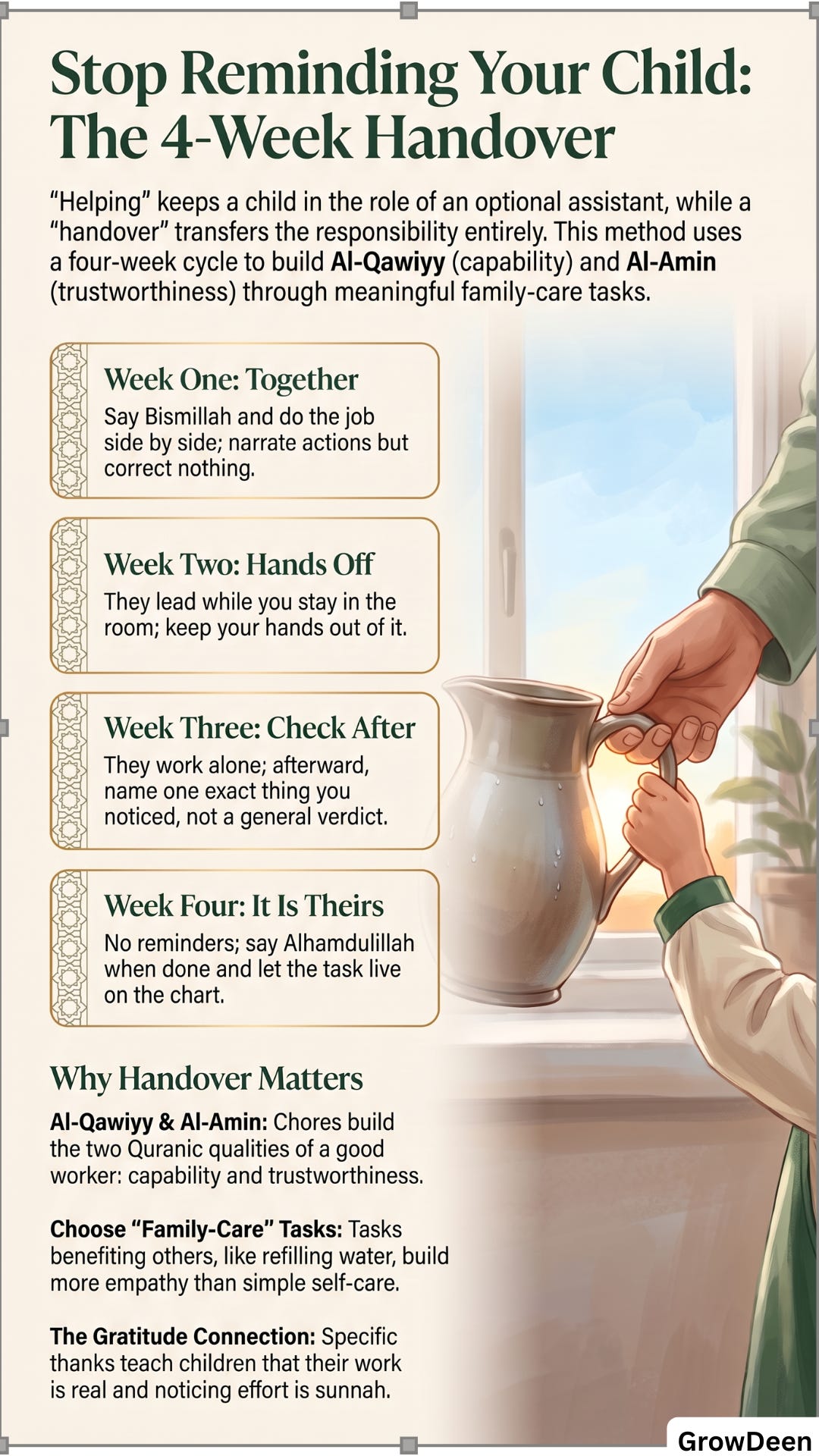
Week one: together. Say Bismillah and do the whole thing side by side. Narrate what you are doing. Do not correct anything.
Week two: you stay, hands off. They lead. You answer questions and keep your hands in your pockets. This week is harder for you than for them.
Week three: you leave, then check. They do it alone. Afterwards you look, and you name one specific thing you noticed.
Week four: it is theirs. No reminders. It lives on the card, not in your mouth. Say Alhamdulillah when it is done.
Then, and only then, add a second job.
Four weeks feels slow. It is roughly four weeks faster than the six years most families spend renegotiating the same argument.
Why the Sentence You Use Decides the Answer
An experimental study published in 2024 compared coercive and assertive ways of asking children to do household tasks, and found that the style of the request measurably changed how the children felt about the chore itself. [8] Same job. Different sentence. Different child.
A few things that hold up:
One instruction, not a paragraph. “Please put the blue cups on the table” is doable. “Can you help tidy up in here” is not, to a five year old.
Name the behaviour, not the child. A major review of the praise research found that praise supports internal motivation when it is sincere and specific, and can undermine it when it is generic or feels controlling. [9] “You put every fork in the right place” does more work than “good girl.”
Thank them. Every time. This is not a soft extra. The Prophet ﷺ said: “Whoever is not grateful to the people, he is not grateful to Allah.” [16]
I find that line lands hardest on the evenings when saying thank you for a half wiped table feels like more effort than wiping it myself. Gratitude toward people is not filed separately from gratitude toward Allah. A thanked child learns two things at once: my work was real, and noticing other people’s effort is simply what we do here.
Should You Pay For It?
Families land in different places and both are defensible. Contributing because you belong here is a legitimate position. So is using pocket money deliberately to teach earning.
But read this first.
When those spontaneously helpful toddlers were given a material reward for helping, they afterwards helped less than children who got only verbal appreciation or nothing at all. [10] A meta-analysis of 128 experiments points the same way: tangible rewards, especially when expected and tied to completing a task, tend to erode internal motivation for the rewarded activity. [11]
So the honest reading is not “never pay.” It is: be careful about pricing the ordinary work of belonging to a family, because belonging is the last thing you want to make conditional. Many families keep basic contribution unpaid and pay only for genuinely extra work.
And if you do promise money, pay it fast and pay it exactly. The Prophet ﷺ said: “Give the worker his wages before his sweat dries.” [18] The narration concerns hired workers, not children, so the ruling does not extend to pocket money. But children feel the principle underneath it acutely. A parent who promises an amount and pays three weeks later after two reminders has taught a lesson. Just not the intended one.
Before You Hand Anything Over: Safety
Expanding responsibility must not expand exposure.
Cleaning products, laundry capsules and chemicals stay locked, out of reach, in their original containers, never decanted into drink bottles or food containers. [14] Capsules in particular are hazardous to young children. Give children water and a cloth, not chemical sprays. Knives, hot surfaces, kettles and ovens stay supervised well past the age your child first asks to use them alone.
If you are unsure whether a task suits your child’s age, ask your paediatrician. If you suspect a child has swallowed or been exposed to any household chemical, contact emergency medical services or your local poison information service immediately, without waiting for symptoms. None of this replaces medical advice.
If your child has additional needs, adapt rather than skip. A systematic review found meaningful gains in chore participation for children and young people with disabilities when tasks were broken into smaller steps, visual supports were used, and the environment itself was modified. [12] An occupational therapist can help you break a specific job down for your specific child.
The Capable Hands Pack
If you have read this far, you are not looking for a tidier house. You are thinking about who your child becomes. That tells me something.
Inside The Capable Hands Pack (one PDF, 3 pages):
Page 1: The Family-Care Sorter — 24 common chores pre-sorted into the two categories that research says do different things, with tick boxes and a simple ratio rule, designed as a laminated card for your kitchen cupboard door.
Page 2: The Handover Card — one card for one job, walking that single chore through all four weeks with space for the date, the standard, and what you noticed, so you can run the handover without holding any of it in your head.
Page 3: Qawiyy and Amin: The Two-Word Card — the two qualities Surah Al-Qasas names in a good worker, what each one actually looks like in a child at three, five and seven, and the exact sentence to say when you catch it happening.
This isn’t just a PDF to download and forget. It’s a tool designed to stay in your kitchen, where you’ll actually use it when you need it most.
This pack is what every subscriber receives with each article. Muslim Parenting Lab covers the full journey of raising Muslim children, from the newborn weeks through the primary school years, all backed by peer-reviewed research and rooted in authenticated Islamic sources.
Do This Before You Close the Tab
Pick the job. Right now, not tonight.
Look around your kitchen and name one family-care task your child could hold. Refilling the water jug. Putting the prayer mats out before Maghrib. Wiping the table after dinner. Say it out loud to them tonight, with a time attached: “From tomorrow, the water jug is yours, before we eat.”
That’s week one. That’s all week one is.
Helping fades. A handover holds. Your child will not remember the evening they learned to fold a towel. They will carry what it taught them anyway: that their hands are useful, that someone counts on them, and that ordinary work is honourable.
May Allah put barakah in the fifteen extra minutes it costs you.
Share This With Someone Who Needs It
Think of one person right now: the sister who told you at the masjid that she does everything herself because it’s faster, the friend whose nine year old has never cleared a plate, the mother who keeps saying she’ll start when the kids are older.
Send this to her today. Not as advice, and not as a comment on her house, but because someone told you once and it changed how you saw a step stool in your kitchen.
Frequently Asked Questions
Q: What age should a child start doing chores?
A: Earlier than most of us think. The willingness to help spontaneously shows up around 18 months. [2] At two and three the point is participation, not a finished job. Real ownership of a task tends to become realistic somewhere around six. See “The Willingness Has an Expiry Date” above.
Q: Should I pay my child for doing chores?
A: You can, but be careful what you attach it to. Rewards reliably reduce internal motivation for the rewarded activity. [11] Most families do better keeping basic family contribution unpaid and paying only for genuinely extra work. If you do promise money, pay it promptly and in full.
Q: What chores are appropriate for a 4 year old?
A: Setting places at the table, sorting clean laundry into piles, matching socks, watering plants, handing you ingredients while you cook, and putting their prayer mat away. Aim for jobs that benefit somebody other than themselves. [3]
Q: My child does chores but only when I nag. What am I doing wrong?
A: Probably nothing wrong, just something incomplete. Nagging means the remembering is still yours. The four-week handover exists to move that last piece across. Once it lives on a chart or a card, the reminding stops being your job.
Q: Do chores actually make children more responsible, or is that just something parents say?
A: The honest answer is that the evidence is associational rather than causal. Chore involvement has been linked to higher self-competency, particularly in children who started young. [6] What is clearer is the mechanism: chores exercise planning, sequencing and self-control, which develop through repeated practice with an adult nearby. [7]
Q: Should boys and girls be given different chores?
A: No. Both need to cook, clean and care for a home. Worth noticing that in the Qur’anic passage above, the two daughters are the ones out doing the family’s outdoor work, and the text passes no comment on it at all. [15]
References
[1] Klein, W., Graesch, A.P., & Izquierdo, C. (2009). Children and chores: A mixed-methods study of children’s household work in Los Angeles families. Anthropology of Work Review, 30(3), 98-109. https://doi.org/10.1111/j.1548-1417.2009.01029.x
[2] Warneken, F., & Tomasello, M. (2006). Altruistic helping in human infants and young chimpanzees. Science, 311(5765), 1301-1303. https://doi.org/10.1126/science.1121448
[3] Grusec, J.E., Goodnow, J.J., & Cohen, L. (1996). Household work and the development of concern for others. Developmental Psychology, 32(6), 999-1007. https://doi.org/10.1037/0012-1649.32.6.999
[4] Hammond, S.I., & Carpendale, J.I.M. (2015). Helping children help: The relation between maternal scaffolding and children’s early help. Social Development, 24(2), 367-383. https://doi.org/10.1111/sode.12104
[5] Coppens, A.D., Alcalá, L., Rogoff, B., & Mejía-Arauz, R. (2016). Children’s contributions in family work: Two cultural paradigms. Advances in Child Development and Behavior, 50, 187-216. https://doi.org/10.1016/bs.acdb.2015.11.003
[6] White, E.M., DeBoer, M.D., & Scharf, R.J. (2019). Associations between household chores and childhood self-competency. Journal of Developmental and Behavioral Pediatrics, 40(3), 176-182. https://doi.org/10.1097/DBP.0000000000000637
[7] Diamond, A. (2013). Executive functions. Annual Review of Psychology, 64, 135-168. https://doi.org/10.1146/annurev-psych-113011-143750
[8] Marici, M., Runcan, R., Cheia, G., & David, G. (2024). The impact of coercive and assertive communication styles on children’s perception of chores: An experimental investigation. Frontiers in Psychology, 15, Article 1266417. https://doi.org/10.3389/fpsyg.2024.1266417
[9] Henderlong, J., & Lepper, M.R. (2002). The effects of praise on children’s intrinsic motivation: A review and synthesis. Psychological Bulletin, 128(5), 774-795. https://doi.org/10.1037/0033-2909.128.5.774
[10] Warneken, F., & Tomasello, M. (2008). Extrinsic rewards undermine altruistic tendencies in 20-month-olds. Developmental Psychology, 44(6), 1785-1788. https://doi.org/10.1037/a0013860
[11] Deci, E.L., Koestner, R., & Ryan, R.M. (1999). A meta-analytic review of experiments examining the effects of extrinsic rewards on intrinsic motivation. Psychological Bulletin, 125(6), 627-668. https://doi.org/10.1037/0033-2909.125.6.627
[12] Laverdure, P., Nemec, E., Johnson, C., & Blake, T. (2021). Evaluating interventions that improve participation in chores in children and youth with disabilities: A systematic review. Journal of Occupational Therapy, Schools and Early Intervention, 14(3), 257-273. https://doi.org/10.1080/19411243.2021.1875384
[13] Rende, R. (2021). Chores: Why they still matter and how to engage youth. The Brown University Child and Adolescent Behavior Letter, 37(6), 1-4. https://doi.org/10.1002/cbl.30545
[14] American Academy of Pediatrics. Poison prevention and treatment tips. HealthyChildren.org. https://www.healthychildren.org/English/safety-prevention/at-home/Pages/Poison-Prevention.aspx
[15] Qur’an, Surah Al-Qasas 28:26 — https://quran.com/28/26 — with Tafsir Ibn Kathir — https://quran.com/en/28:26/tafsirs/en-tafisr-ibn-kathir. Attribution note: the narration of the rock and the walking order is recorded by Ibn Kathir from ‘Umar, Ibn ‘Abbas, Shurayh al-Qadi, Abu Malik, Qatadah and Muhammad ibn Ishaq. The statement regarding the three most discerning people is that of ‘Abdullah ibn Mas’ud, quoted by Ibn Kathir.
[16] Jami’ al-Tirmidhi 1954, narrated by Abu Hurairah — Graded: Hasan Sahih (grading of Imam al-Tirmidhi as shown on the page) — https://sunnah.com/tirmidhi:1954. Parallel narration: Sunan Abi Dawud 4811 — https://sunnah.com/abudawud:4811
[17] Sahih al-Bukhari 2072, narrated by al-Miqdam ibn Ma’dikarib — Graded: Sahih — https://sunnah.com/bukhari:2072
[18] Sunan Ibn Majah 2443, narrated by ‘Abdullah ibn ‘Umar — Graded: Sahih (al-Albani, Sahih Ibn Majah) — https://sunnah.com/ibnmajah:2443
We combine scientific research with Qur’an and authentic Sunnah, and we cite our sources. Even so, this is general guidance and no substitute for a doctor who can examine your child.