

Preschoolers need 10 to 13 hours of sleep. [1] Most bedtime battles at this age come down to timing rather than behaviour.
Three pages. Print it before tonight’s bedtime.
It is 9.40pm and nobody is asleep.
She has been in bed since half past seven. There has been water, the toilet, a question about whether fish sleep, and a negotiation about the hallway light that you lost twenty minutes ago. You are sitting on the stairs doing arithmetic on the hours left before Fajr.
You did everything the articles said. Bath, story, dim lights, calm voice, same order every night. And she is still awake, and you are still out here, and somewhere underneath the tiredness is the thought you would not say aloud: other mothers seem to manage this.
Here is the question to carry through the rest of this piece. If the routine is right and the room is right and the child is loved, why is she still awake at 9.40?
The answer is not about the routine. It is about the hour.
Why This Guide Is Different From The Usual Bedtime Advice
It is built on paediatric sleep research, not on what worked for somebody’s cousin. Every recommendation below is sourced to the American Academy of Sleep Medicine, the World Health Organization, NICE, or peer-reviewed paediatric journals, with the citations left in so you can check them.
It treats your child’s night as part of her tarbiyah, not a logistics problem to be solved before the real parenting starts. The evening you build is where she learns whether the night is safe.
You already have the free Bedtime Shift Card from the top of this page. Three printable pages, including the dated step-down grid that turns the method below into a plan you can stick on the fridge tonight.
The Thing Everyone Does At 7.30pm That Makes It Worse
A child is awake too late. So the parent moves bedtime earlier.
It is the most reasonable response available and it reliably backfires.
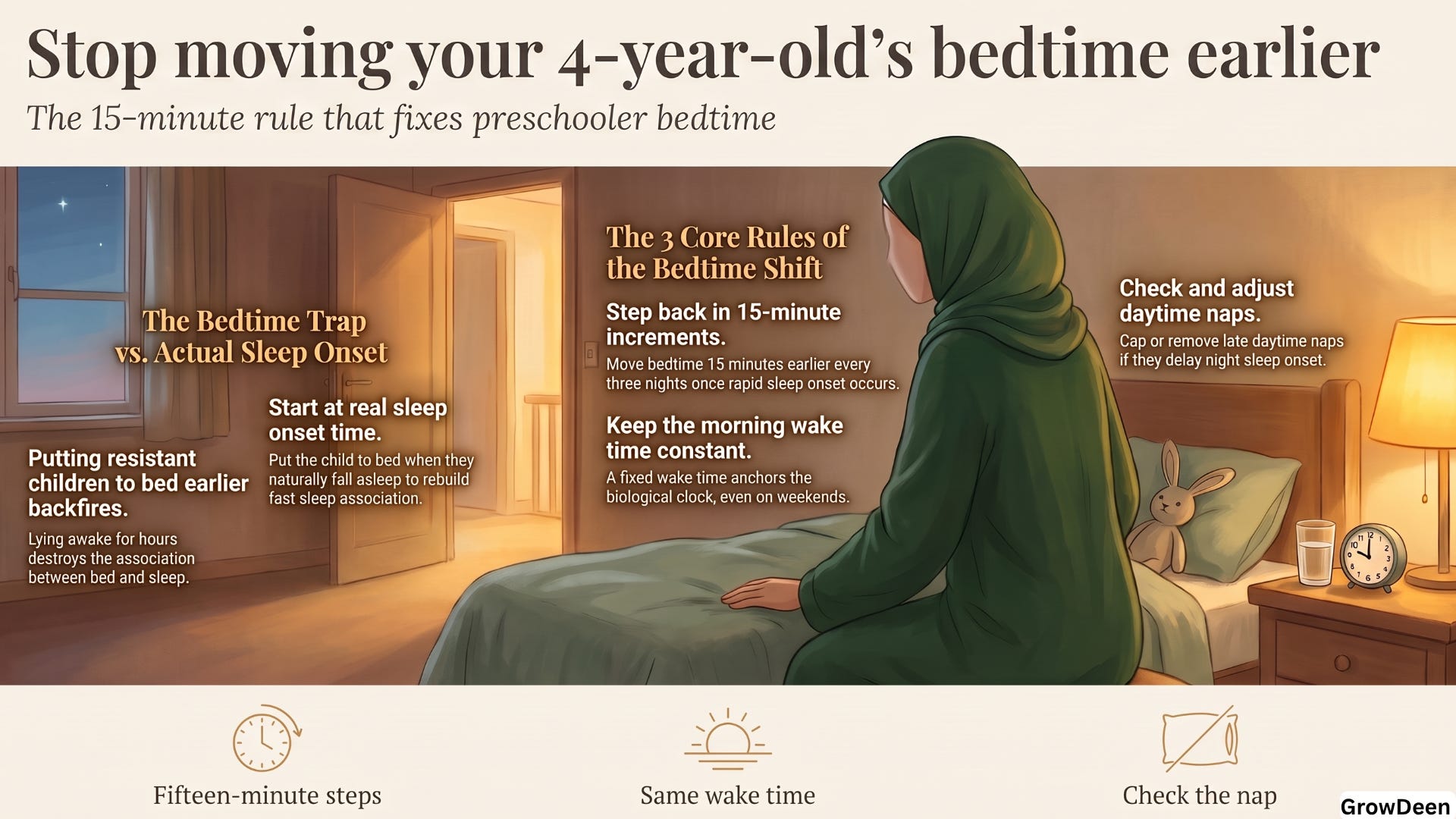
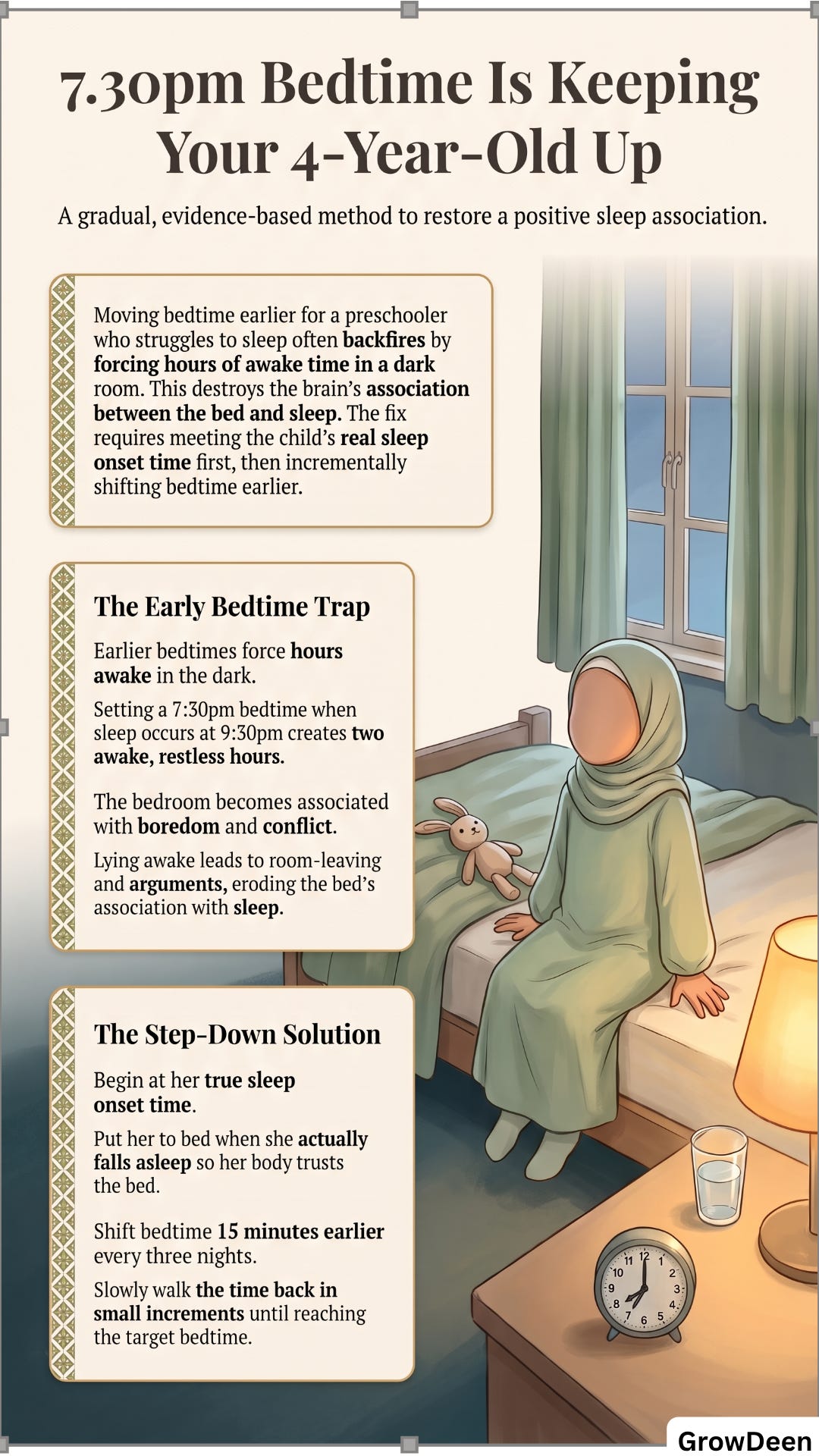
Think about what it asks. Your daughter’s body has settled on falling asleep at around half past nine. You put her in a dark room at half past seven and require her to lie there, alone, not sleepy, for two hours. There is nothing to do in that room. So she gets up. She calls out. She invents reasons to come downstairs, because lying awake in the dark is miserable and she is four.
Within a fortnight something worse has happened. The bed has stopped being the place where sleep happens and become the place where boredom and arguments happen. Sleep researchers have a plain name for this: the bed has lost its association with sleep. Clinical reviews of paediatric sleep problems put routine, environment and a consistent parental response ahead of any medication for exactly this kind of bedtime resistance. [9][15] Sleep medicines are not the answer to a three year old who will not stay in bed.
So the villain in this article is not your child, and it is not you. It is a piece of advice that everybody repeats: when a child will not fall asleep, put her to bed earlier.
What Your Child’s Clock Is Actually Doing Between Three And Five
Something real is changing, and it is not her character.
The nap is going, and it takes the evening with it. This is the largest shift of the preschool years. Australian longitudinal data following children from birth to nine shows daytime sleep falling away steadily across this period, with a wide spread between individual children. [4] A systematic review of napping from birth to five found that beyond the age of two, napping is associated with later night sleep onset, and called the link between napping and shorter night sleep one of the most consistent findings in the field. [3] The authors are careful about this and so should you be. These are observational studies rated low on certainty, and most relied on parents reporting rather than sleep being measured. [3]
The practical version is small and useful. If your four year old sleeps ninety minutes at nursery and then lies awake until ten, the nap is your first suspect. Cap it, move it earlier, or drop it and accept a week of 5pm misery while her body catches up.
The imagination has arrived. At three a child has enough language and memory to replay the whole day in the dark, and enough invention to furnish the space under the bed. Settling takes longer because she is still thinking.
The brakes are not fitted. A three year old can physically leave the bed and has very little capacity to decide not to. That capacity arrives closer to five. Until then, explaining the rule more clearly will not install something that is still being built.
Those three facts together explain most of what parents experience as a good sleeper suddenly going wrong.
And here is the number that matters more than the bedtime. The American Academy of Sleep Medicine recommends 10 to 13 hours of sleep per 24 hours for children aged three to five, naps counted. [1] The World Health Organization gives the same band and adds that bedtimes and wake times should be regular rather than drifting across the week. [2] A separate National Sleep Foundation panel reached a comparable range by a different method. [16]
A child who goes down at 7.30pm and wakes at 5.30am has slept ten hours. A child who goes down at 9pm and sleeps to 8am has slept eleven. The second looks worse written down and is doing better.
The Move That Feels Wrong And Works
So what does this look like at 8pm on a Tuesday?
You start by putting her to bed later.
Behavioural sleep research supports moving gradually rather than imposing the target hour and waiting it out. [6] The method is simple enough to run without help, and it takes two to three weeks.
Find her real sleep onset. For three or four nights, write down the time she actually falls asleep, not the time she went into the room. Say it comes out at 9.35pm.
Start bedtime there. Put her into bed at 9.30. She will fall asleep within about fifteen minutes, because her body is ready. Three nights of that and the bed means sleep again. This is the part that feels like surrender and is not.
Then walk it back. Move bedtime fifteen minutes earlier every three nights or so. 9.15. Then 9.00. Then 8.45. If a step stalls and she is lying awake again, hold at that time for a few extra nights before moving.
Hold the morning absolutely still. Same wake time every day, weekends included, and daylight into her eyes early. The morning end is what anchors the whole clock, and letting her sleep in on Saturday undoes four days of work.
Protect the ninety minutes before. Lights down, voices down, rough play finished. Screens off well before bed rather than right up against it. A 2026 national survey of Australian families found associations between screen use in early childhood and poorer sleep, [7] and WHO guidance for under-fives is no more than an hour of sedentary screen time a day, with less being better. [2]
Three weeks of that will usually move a 9.30 sleeper to 8.00 or earlier. Meet the clock where it is tonight, and it will come to you.
One more thing about the routine itself, because it is doing more work than it looks. In a study of more than 10,000 children, Mindell and colleagues found the relationship between a nightly bedtime routine and better sleep was dose dependent: the more consistently families ran the routine, the sooner children fell asleep, the fewer night wakings they had, and the longer they slept. [5] Four nights beats two. Seven beats four. It does not need to be elaborate. It needs to be the same.
The bed itself still has its Sunnah, and it slots straight into that sameness. The Prophet ﷺ told al-Bara ibn Azib that on going to bed he should perform wudu as he would for prayer, lie on his right side, and say words placing himself in Allah’s care, adding that these should be the last words he speaks. [12] Aisha reported that each night before sleep he ﷺ would cup his hands, recite Surah al-Ikhlas, Surah al-Falaq and Surah an-Nas into them, then wipe over as much of his body as he could, beginning with the head and face, three times. [13] With a four year old the parent does the wiping. Twenty seconds, and it hands an anxious child something physical to hold at the moment the lamp goes off.
I know that is a lot to hold in your head at the end of a long day, especially the counting of nights and the fifteen-minute steps. That is exactly why the free Bedtime Shift Card exists: the dated step-down grid is already drawn, so you fill in four numbers and follow it. The download button is at the top of this page, and there is a full description of what is inside it below.
The Night The Prophet ﷺ Noticed A Boy Was Awake
There is a narration that says nothing about bedtime and everything about how a household treats a small person who is up when he should not be.
Ibn Abbas, still a boy, spent a night at the house of his aunt Maymunah. The Prophet ﷺ prayed Isha, prayed again at home, and slept. Later he woke, and the first thing recorded of him is a question: had the boy slept? Then he stood to pray. Ibn Abbas placed himself on his left, and the Prophet ﷺ moved him round to his right. He prayed, slept again, and went out for Fajr. [14]
Bukhari files this under knowledge rather than sleep, and it carries no instruction about children’s bedtimes. Read it as a parent anyway.
A child is awake at an hour he should not be. He is not scolded. He is not interrogated about why he is out of bed. He is not marched back. He is noticed, he is quietly moved to where he needs to be, and he is allowed to stay inside the rhythm of the night rather than shut outside it.
That is remarkably close to what the behavioural evidence asks of you at the fifth appearance in the doorway: low voice, few words, hands that move the child, no argument offered and none accepted. The mercy and the method arrive at the same place from different directions.
NOTE: Sahih al-Bukhari 247 and 5017 were used in earlier articles in this project. They are repeated here because no authentic alternative carries the bedtime sequence itself, they are framed from a different angle (what a parent does with her hands during a three-week bedtime change, rather than adult night-time protection), and they are paired with Sahih al-Bukhari 117, confirmed fresh to this project.
Support Muslim Parenting Lab ❤️
Would you like the reward of every parent who acts on what they read here? Fund it with the button below and it is yours.
The Prophet ﷺ said whoever guides to good has a reward like the one who does it. (Sahih Muslim 1893a)
When The Clock Is Right And She Still Gets Up
Some children settle beautifully at the correct hour and then appear anyway. That is a learning problem rather than a timing one, and it has its own fix.
Say the expectation once, clearly, and then stop explaining it. Repetition of the rule is a conversation, and a conversation is what she came out for.
When she gets up, walk her back. Low voice, little eye contact, no negotiation, no lecture, no commentary in the morning about how many times it took. Then do it again. And again. The first three nights are the worst of it, and the consistency is the entire treatment.
Make the room give her nothing to come out for. Dim, quiet, not too warm, water already by the bed, the toilet trip already done. Praise in the morning, specifically and out loud. A reward chart works well at this age as long as the prize is your attention rather than sweets.
And ask why. A child who was fine for months and is suddenly unable to stay in bed is usually telling you something she cannot say: a new baby, a house move, something she saw, a worry about nursery. Bedtime is where a preschooler’s stress surfaces first, because it is the first moment all day she is alone with her own mind.
One thing to avoid completely. Do not use frightening stories to keep a child in her room. It is common, it works for about a week, and it buys years of bedtime anxiety.

The Nights That Have Nothing To Do With The Clock
Some nights are not a timing problem at all, and treating them as one will not help.
Night terrors. First part of the night, out of deep sleep. She may sit up, scream, thrash, open her eyes and look straight past you. She is not awake and she is not suffering the way the scene suggests. These belong to the childhood parasomnias and cluster between two and four. [8] Stay calm, keep her safe, and do not wake her or hold her down unless she is about to hurt herself. She will not remember it in the morning. You will remember it in detail, which is the harder half of the arrangement.
Nightmares. Later in the night, out of dreaming sleep, and she wakes frightened and knows exactly why. Tell her it was a dream, tell her she is safe, give her the cuddle. Do not wave the fear away, because at four the dream was real while it lasted.
If these run in your family, that is worth knowing. In a Quebec cohort of 1,940 children, parental history of sleepwalking predicted both sleepwalking and sleep terrors in the children, with risk rising roughly three to seven fold depending on whether one parent or both had walked in their sleep. [17] Information, not a warning.
Sleepwalking. Guide her back rather than waking her. It belongs to the same group as night terrors and is common between four and twelve. [8] The work here is safety: a gate at the stairs, external doors locked and keys out of reach, a clear floor, nothing dangerous on the route to the kitchen.
Bedwetting. Common at this age and not a cause for concern. Avon longitudinal data cited in the NICE bedwetting guidance found 21 per cent of children aged four to five wetting the bed once or twice a week, falling to 8 per cent by nine to ten. [18] Night pants, a night light, a potty within reach, and plain reassurance that you will help. Most children grow out of it with no treatment at all. Do not shame a child for a wet bed. She was asleep, she did not choose it, and the shame costs your household far more than the laundry.
Snoring. This is the one to take seriously. Snoring with a cold passes with the cold. Snoring on most nights when she is well, especially with pauses, gasping or visible effort, can point to obstructive sleep apnoea, one of the common and treatable sleep disorders of childhood. [10][9] Left alone it affects daytime behaviour, attention and growth, and parents often discover afterwards that the irritable, exhausted child they had been managing was simply not breathing well at night.
Twitching and restlessness. Quick jerks of the limbs as she falls asleep are very common. If the movements are repetitive rather than one or two, or continue through the night, mention it. Restless sleep disorder and restless legs syndrome do occur in children, are under-recognised, and iron status is part of that assessment. [11]
When To Involve A Doctor
Book an appointment if she snores most nights when well, stops breathing, gasps or struggles for breath in her sleep, is very sleepy during the day, has repetitive limb jerking through the night, has frequent nightmares alongside daytime anxiety, or if the sleep problem is wearing your household down and nothing you have tried has shifted it.
Children’s sleep problems are among the most common reasons parents seek professional help, which is the reassuring part of that sentence. A child and family health nurse, a doctor, a paediatrician or a psychologist specialising in child sleep can all help. Taking the means and leaving the outcome with Allah is what tawakkul has always meant.
Inside The Bedtime Shift Card
If you have read this far, you are the kind of parent who would rather understand the mechanism than be handed a trick. That tells me something good about how this child is being raised.
Inside the Bedtime Shift Card (one comprehensive PDF, 3 pages):
Page 1: The Three-Week Step-Down Grid — A dated fill-in grid where you write your child’s real sleep onset time, your target bedtime, and the fifteen-minute steps between them, with space to tick off each night and a built-in rule for when to hold a step instead of moving on — designed as a fridge card you can mark with a pen while the kettle boils.
Page 2: Is the Nap Helping or Hurting? — A five-day nap trial sheet with a simple decision rule at the bottom, so you can settle the cap-it, move-it or drop-it question with evidence from your own child instead of guessing — so you can stop relitigating the nap every single afternoon.
Page 3: The Night He Noticed the Boy Was Awake — An Islamic reminder card carrying the narration of Ibn Abbas as a boy, awake in the Prophet’s ﷺ household, and what the Prophet ﷺ did about it, with the three-line response it gives a parent standing in a doorway at 9.40pm.
This is not a PDF to download and forget. It is built to live on the fridge for three weeks, which is exactly how long the change takes.
The Bedtime Shift Card is what every subscriber receives with each article. Muslim Parenting Lab covers the whole arc of raising young Muslim children, from newborn sleep and feeding through behaviour, speech, play and the early years of tarbiyah, all of it backed by peer-reviewed research and rooted in the Qur’an and authentic Sunnah.
Do This Before Tonight
Tonight, do not change the bedtime. Just write down the time she actually falls asleep.
That single number is the one everything else is built on, and you cannot start until you have it. Put a scrap of paper on the landing and note the time. That is the whole task.
May Allah give rest to your children and ease to your evenings, and reward the patience you spend in that dark hallway, which nobody sees but Him.
Share This With Someone Who Needs It
Think of one person right now: the sister at the masjid who mentioned that bedtime has become a two-hour war, the friend whose four year old has just dropped her nap and whose messages have started arriving at eleven at night, your cousin who is expecting again and still has a preschooler who will not stay in bed.
This could give her back an hour of every evening for the rest of the year. Send it to her today, not as advice, but because you know exactly what that hallway feels like.
Frequently Asked Questions
Q: How much sleep does a 4 year old need? A: Ten to 13 hours in every 24, naps included. [1] Count the total rather than judging the bedtime, because a late bedtime with a late wake-up can easily beat an early bedtime with a 5.30am start.
Q: Why does my 4 year old take hours to fall asleep? A: Usually because bedtime is set earlier than her body is ready for, and sometimes because a daytime nap is still holding the clock back. [3] The step-down method in “The move that feels wrong and works” above is the fix.
Q: Should I drop my preschooler’s nap? A: Not automatically. Drop or shorten it if she naps and then lies awake late into the evening, and keep it if she naps and still falls asleep within about twenty minutes at bedtime. Beyond age two, napping is associated with later night sleep onset, [3] but the evidence is observational and your own child’s pattern is better data than any average.
Q: What time should a 3 to 5 year old go to bed? A: Whatever time produces 10 to 13 hours before the wake time she actually needs. [1] There is no single correct clock time, and chasing one is how most families end up with a child lying awake in the dark.
Q: How do I stop my child getting out of bed at night? A: Fix the timing first. If she is settling at the right hour and still appearing, walk her back every time with a low voice, no eye contact and no conversation, and praise her the next morning. Consistency is the treatment, and the first three nights are the hardest. [9][15]
Q: Is it ever right to give a child sleep medicine? A: Not for ordinary bedtime resistance. Clinical reviews place routine, environment and consistent parental response ahead of medication for this age group. [9][15] Anything beyond that is a conversation with your doctor, not a decision to make from an article.
Q: When should I worry about my child’s sleep? A: Snoring most nights when she is well, pauses or gasping, daytime sleepiness, repetitive limb jerking through the night, or frequent nightmares alongside daytime anxiety. [10][11] Any of those is worth a doctor’s appointment rather than another month of waiting.
References
[1] Paruthi, S., Brooks, L.J., D’Ambrosio, C., Hall, W.A., Kotagal, S., Lloyd, R.M., Malow, B.A., Maski, K., Nichols, C., Quan, S.F., Rosen, C.L., Troester, M.M., & Wise, M.S. (2016). Recommended amount of sleep for pediatric populations: a consensus statement of the American Academy of Sleep Medicine. Journal of Clinical Sleep Medicine, 12(6), 785-786.
[2] World Health Organization. (2019). Guidelines on physical activity, sedentary behaviour and sleep for children under 5 years of age. Geneva: WHO.
[3] Thorpe, K., Staton, S., Sawyer, E., Haden, C., & Smith, S. (2015). Napping, development and health from 0 to 5 years: a systematic review. Archives of Disease in Childhood, 100(7), 615-622.
[4] Price, A.H.M., Brown, J.E., Bittman, M., Wake, M., Quach, J., & Hiscock, H. (2014). Children’s sleep patterns from 0 to 9 years: Australian population longitudinal study. Archives of Disease in Childhood, 99(2), 119-125.
[5] Mindell, J.A., Li, A.M., Sadeh, A., Kwon, R., & Goh, D.Y.T. (2015). Bedtime routines for young children: A dose-dependent association with sleep outcomes. Sleep, 38(5), 717-722.
[6] Galland, B.C., & Mitchell, E.A. (2010). Helping children sleep. Archives of Disease in Childhood, 95(10), 850-853.
[7] Pattinson, C.L., Allan, A.C., Edmed, S.L., Thomas, G., Alam, Md.A., Cliff, D., Rossa, K.R., Hayes, N., White, S.L.J., Zabatiero, J., Zhang, Z., & Smith, S.S. (2026). Screen use and sleep in early childhood: A national survey of Australian families. BMC Public Health, 26, Article 1840.
[8] Kotagal, S. (2008). Parasomnias of childhood. Current Opinions in Pediatrics, 20(6), 659-665.
[9] Carter, K.A., Hathaway, N.E., & Lettieri, C.F. (2014). Common sleep disorders in children. American Family Physician, 89(5), 368-377.
[10] Deshpande, P., Salcedo, B., & Haq, C. (2022). Common sleep disorders in children. American Family Physician, 105(2), 168-176.
[11] DelRosso, L.M., Mogavero, M.P., Ferri, R., & Bruni, O. (2022). Restless sleep disorder (RSD): A new sleep disorder in children. A rapid review. Current Neurology and Neuroscience Reports, 22, 395-404.
[12] Sahih al-Bukhari 247. Narrated by al-Bara ibn Azib. Graded: Sahih.
[13] Sahih al-Bukhari 5017. Narrated by Aisha. Graded: Sahih.
[14] Sahih al-Bukhari 117. Narrated by Ibn Abbas. Graded: Sahih.
[15] Hiscock, H., & Davey, M.J. (2012). Sleep disorders in infants and children. Journal of Paediatrics and Child Health, 54(9), 941-944.
[16] Hirshkowitz, M., Whiton, K., Albert, S.M., Alessi, C., Bruni, O., DonCarlos, L., Hazen, N., Herman, J., Katz, E.S., Kheirandish-Gozal, L., Neubauer, D.N., O’Donnell, A.E., Ohayon, M., Peever, J., Rawding, R., Sachdeva, R.C., Setters, B., Vitiello, M.V., Catesby Ware, J., & Adams Hillard, P.J. (2015). National Sleep Foundation’s sleep time duration recommendations: Methodology and results summary. Sleep Health, 1(1), 40-43.
[17] Petit, D., Pennestri, M.-H., Paquet, J., Desautels, A., Zadra, A., Vitaro, F., Tremblay, R.E., Boivin, M., & Montplaisir, J. (2015). Childhood sleepwalking and sleep terrors: A longitudinal study of prevalence and familial aggregation. JAMA Pediatrics, 169(7), 653-658.
[18] National Institute for Health and Care Excellence. (2010). Bedwetting in under 19s (Clinical guideline CG111), citing Avon Longitudinal Study prevalence data.
We combine scientific research with Qur’an and authentic Sunnah, and we cite our sources. Even so, this is general guidance and no substitute for a doctor who can examine your child.