

A 2021 study of 504 toddlers found that imitation explained more of the difference in children’s vocabulary than parental education, birth order, or birth weight combined. [1] Here’s what your 15 to 18 month old is actually learning from you, and the four extra minutes a day that change what they absorb.
You’ve asked four times.
Shoes on. Please put your shoes on. Habibi, shoes. The fourth time comes out sharper than you meant, and your toddler looks at you with an expression that is definitely not guilt, then walks away holding one sock.
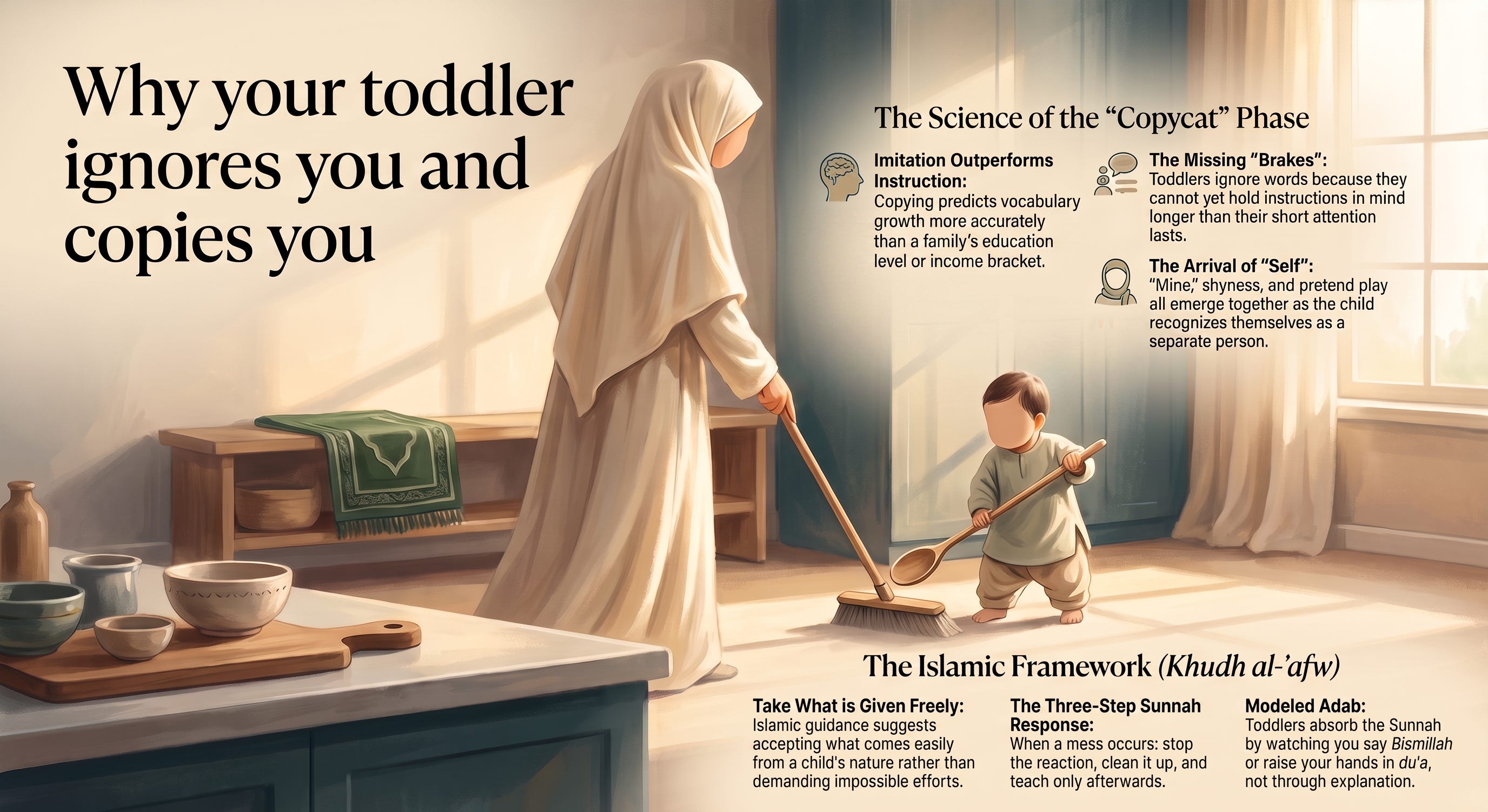
Twenty minutes later you’re sweeping the kitchen. You have said nothing. And there they are beside you, dragging a wooden spoon across the tiles in exactly the arc your broom just made, checking your face to see if you noticed.
You didn’t ask for that. You didn’t teach it. It went in anyway.
Here’s the thing that took me an embarrassingly long time to understand: at this age, the instruction is the weakest tool in your kit, and the thing you did without thinking is the strongest. When researchers in Spain tracked 504 children between 10 and 18 months, they found that pre-linguistic behaviours, especially imitation, explained more of the variation in how many words a toddler could say than the family’s education level or income bracket. [1] Copying is not a charming side effect of this stage.
It’s the engine.
So why does your toddler ignore what you say four times over and then perfectly reproduce something you did once, without being asked? Stay with me. That question has an answer, and it changes what you do at bedtime tonight.
What makes this different from a milestone checklist
Current research, named and dated. Every claim here traces to a specific study or clinical source, from the CDC’s 2022 milestone revisions [2] to longitudinal work on toddler self-awareness running to 2021 [5].
Islamic guidance that fits this exact age. Not general reminders about patience, but a verse and a hadith that speak directly to what you can fairly ask of a sixteen month old.
A printable you’ll actually keep. The free Copycat Quarter Pack goes on your fridge, not in your downloads folder.
Your toddler isn’t defying you, they’re missing a part
Let’s be honest about the thing nobody says out loud. This isn’t really about shoes.
It’s about the knot that shows up in your chest around the fourth repetition. The one that whispers: other people’s children listen. And later, when your toddler snaps at a sibling in a tone you recognise as your own, that knot turns into something heavier.
So here’s what I want you to know first, before any research.
Between fifteen and eighteen months, two things arrive in your child at almost the same moment. Capability and will. Their legs are steady enough to walk and then run. Their fingers are precise enough to lift a crumb off the floor. Their mouth can produce words other people recognise. [2,3] And at the same time, preferences harden into intentions. They don’t want a cup. They want that cup, held by their hand.
What has not arrived is the third piece. The brakes.
A toddler this age cannot hold your instruction in mind longer than their attention lasts, which is not long. They cannot wait. They cannot share. They cannot explain why they’re crying, because they don’t know either. The equipment for all of that is still being built.
Which means the villain here is not your child, and it isn’t you. It’s the instruction reflex: the assumption that a toddler is taught by being told. That assumption turns loving parents into repeaters, and then makes them feel like failures when the repeating doesn’t work.
It was never going to work. Not at this age.
What happened when researchers actually measured the copying
But here’s where it gets interesting.
If instruction is the weak channel at fifteen to eighteen months, something else has to be doing the teaching. And when researchers went looking, the answer was hiding in plain sight.
In that Spanish study of 504 toddlers, the team compared two sets of predictors against how much vocabulary a child had built: family background factors on one side, and the child’s own pre-linguistic behaviours on the other. The pre-linguistic side won, and imitation was one of the strongest single predictors in it. [1] They also found the sharpest acceleration in vocabulary landing around 17 months, right in the middle of this window.
Read that again with your sweeping toddler in mind.
Every time your child copies you, they are not just performing a cute impression. They are running the main learning mechanism they currently have.
And the uncomfortable half of that is also true. They copy the tone you use when you’re depleted. The way you talk about a relative on the phone. The device that comes out mid-conversation. At this age a child cannot be taught adab through explanation. They absorb it by watching, constantly, with no filter for what you meant to be private.
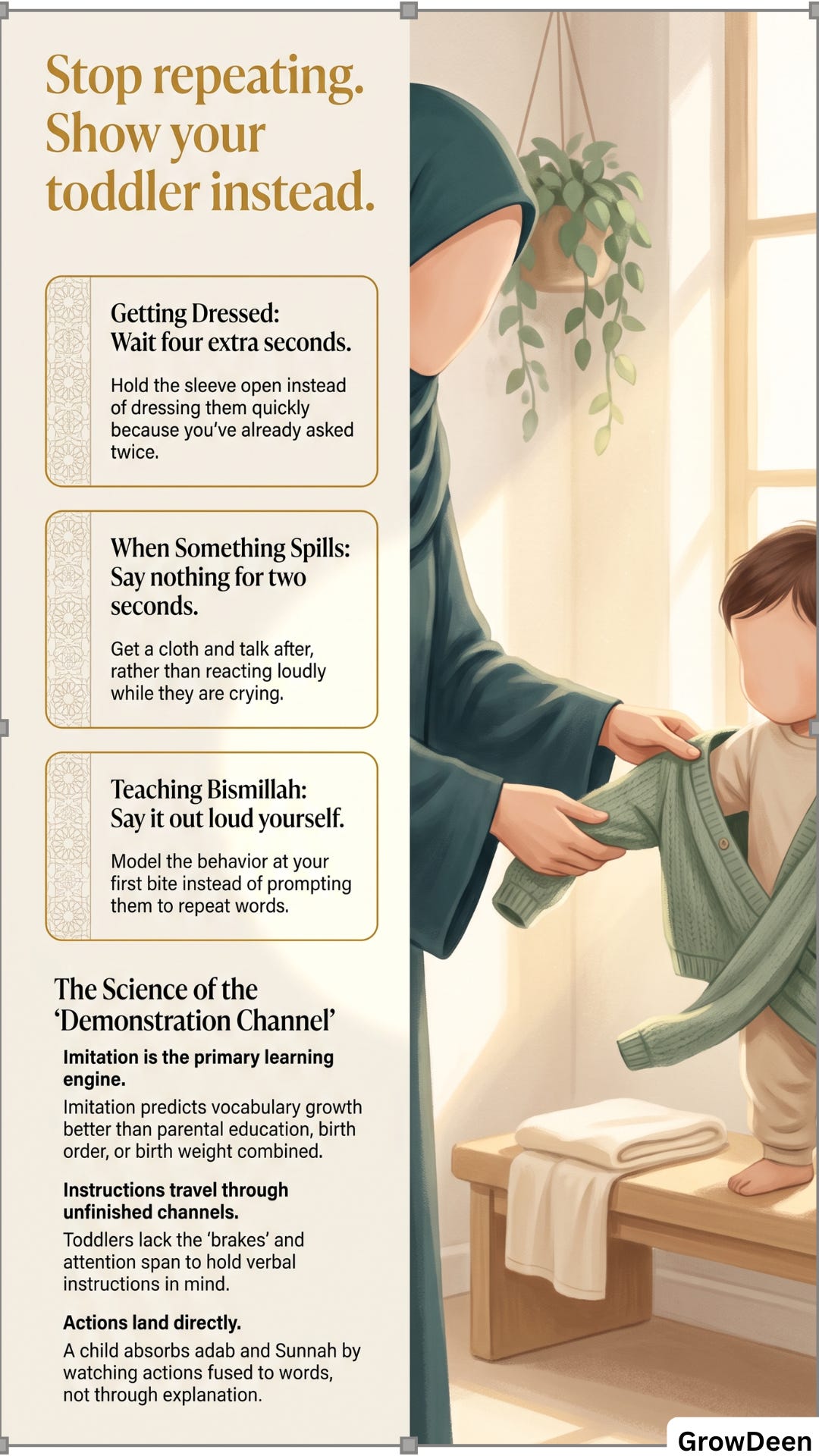
That’s the answer to the question from the opening. The instruction has to travel through a channel your toddler hasn’t finished building. The demonstration goes straight in.
The mirror moment behind every “mine”
Something else is happening this quarter, and it explains three behaviours parents usually treat as separate problems.
You may have noticed your toddler go suddenly shy when an aunt says hello. You may have noticed “mine” arrive with real force. You may have noticed pretend play starting, a toy phone lifted to an ear.
These are the same event.
Researchers test it with the mirror mark task: a spot of colour is placed on a toddler’s face without them noticing, and they’re shown their reflection. A child who reaches for their own cheek instead of the mirror has understood something enormous. That’s me. About 39% of children pass by eighteen months, and the rest follow over the next six months or so. [5]
Here’s what struck me when I read the longitudinal work: self-recognition, the arrival of “me” and “mine,” and the beginning of pretend play develop together across the second year, not as three unrelated skills. [4] So when your sixteen month old grips a toy and says “mine,” that is not selfishness taking root.
That’s a self arriving.
The embarrassment fits the same picture. Toddlers who have developed self-recognition begin showing genuine embarrassment, not just wariness, in situations where attention lands on them. [6] Which is why the cheerful eleven month old buries their face in your shoulder at seventeen months. And separation anxiety belongs to the same family: a child who has grasped they are a separate person has also grasped that you can leave and they cannot follow. [3]
None of it is a problem to fix. All of it is arriving on time.
I know this is a lot to hold in your head at 6pm with dinner half made. That’s why I put together a free printable called the Copycat Quarter Pack, including a card that lays out plainly what your toddler can actually do right now and what isn’t installed yet. Keep reading, it’s yours at the end.
Support Muslim Parenting Lab ❤️
Would you like the most rewarded kind of charity there is? Use the button below now, while you are well, rather than later.
Asked which charity is best, the Prophet ﷺ said the one given while you are healthy, not deferred until death is near. (Sahih al-Bukhari 1419)
Take what they can actually give: the Islamic frame for this year
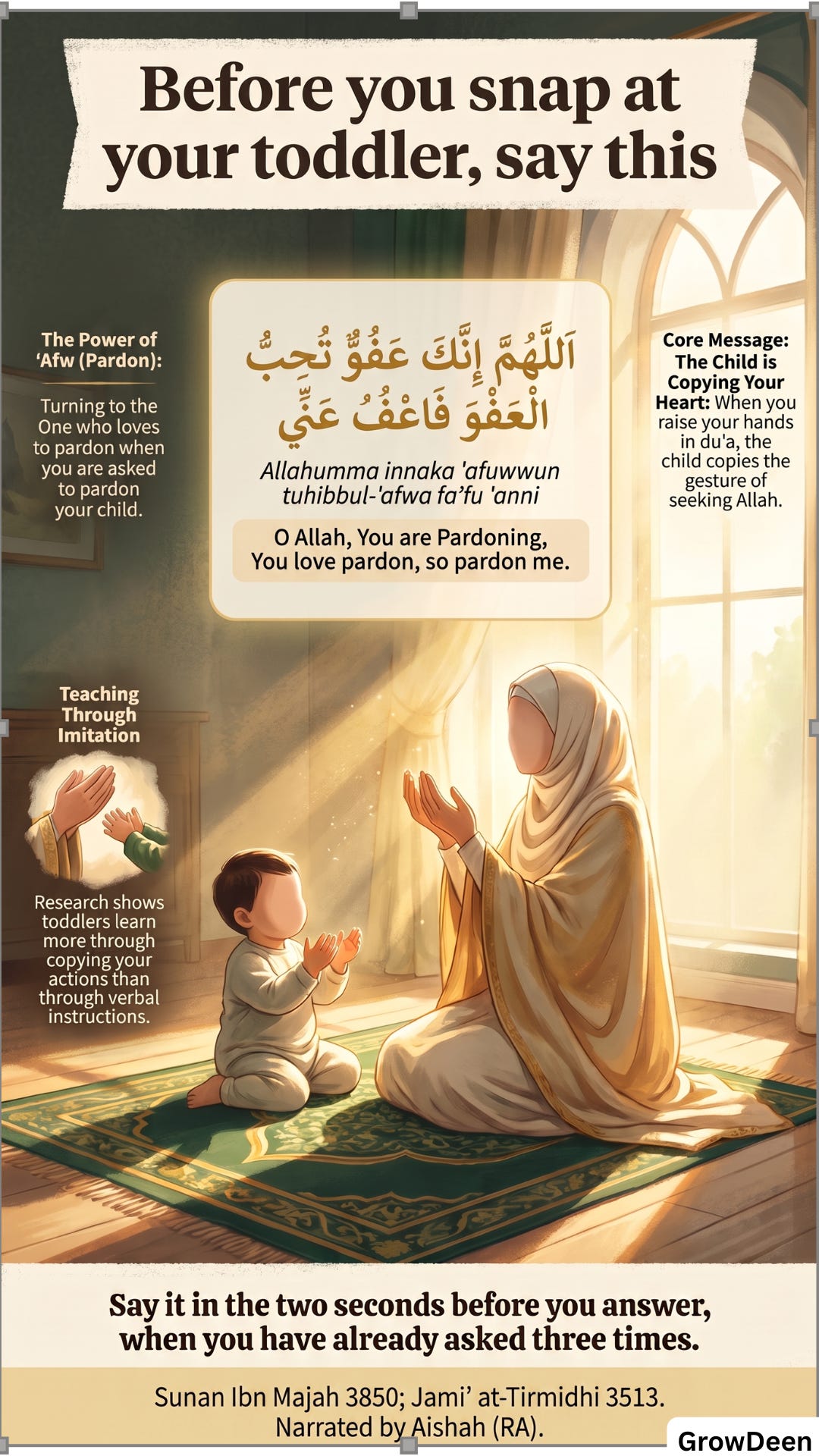
There’s a moment most of us know. You’ve asked, and asked, and something in you is about to go up in temperature, and you can feel it coming before it arrives.
When I reflect on the verse where Allah says, “Take what is given freely, enjoin what is good, and turn away from the ignorant” [12], I keep landing on that opening phrase, khudh al-’afw. According to Tafsir Ibn Kathir, it was revealed concerning people’s character and conduct, reported in Sahih al-Bukhari from Abdullah ibn az-Zubayr (may Allah be pleased with him). Az-Zamakhshari puts the practical sense plainly: accept what comes easily from people’s nature, and do not demand of them efforts too difficult for them.
Now read that with a sixteen month old in front of you.
The Prophet ﷺ showed what it looks like when things go wrong in public. Abu Hurairah (may Allah be pleased with him) narrated that a bedouin urinated inside the masjid and people rushed to seize him. The Prophet ﷺ told them to leave him and to pour water over the place, then said, “You have been sent to make things easy and not to make them difficult.” [13]
Stop the reaction. Clean it up. Teach afterwards.
Some version of that scene runs in your home most weeks. The standard doesn’t move, because the verse continues with “enjoin what is good.” What moves is the temperature.
So what does this look like at 6pm on a Tuesday?
Four extra minutes. That’s the whole strategy.
Let them do the slow version. Hold the sleeve open and wait while they push their own arm through. Hand them the spoon. Let them carry the sock to the basket. It’s inefficient and it’s the entire lesson.
Attach the Sunnah to what already happens. Bismillah out loud at the first bite. Alhamdulillah at the end. Salaam every single time someone comes through the door, whether or not they answer. Right hand for eating. They understand none of the meaning yet, and that’s fine, because the words are going in fused to the actions.
Say what you’re doing while you do it. Cooking, folding, wudu, packing a bag. Then expand whatever they give back. “Ball” becomes “a small blue ball.” “Mama” becomes “yes, I’m your mama.” [7]
Let them move. Global guidance recommends at least 180 minutes of physical activity spread across the day for one to two year olds. [8] That isn’t a class. That’s a toddler being allowed to move.
Make du’a out loud in front of them. The raised hands get copied long before the words are understood.
And one honest caution, because their hands are now precise enough to lift a pebble off the path. Get down at floor level in every room they use and look at what’s within reach from there. It is a completely different room from that angle.
Eight signs worth a doctor’s appointment
You know your child better than any chart does, and that knowledge is worth acting on rather than sitting with at 2am. Speak to a doctor or paediatrician if, between 15 and 18 months, your toddler:
has difficulty seeing or hearing
says no single words
doesn’t follow a simple instruction like “please give me the ball”
doesn’t point, wave, or gesture
doesn’t enjoy eye contact or cuddles with you
isn’t walking independently by 18 months
strongly favours one hand, which usually doesn’t settle until closer to two
has lost a skill they previously had [2,9]
That last one matters most. Losing an acquired skill should always be reviewed rather than watched.
And seeking help early is not a shortfall in tawakkul. The Prophet ﷺ instructed the believers to seek treatment. Using the means Allah put in front of you is part of relying on Him, not an alternative to it.
The part nobody puts on the milestone chart
Here’s something I can’t tell you: whether this quarter will feel manageable for your family. Every household is carrying different weight.
What I can tell you is what the research keeps returning to. What shapes a young child most is the quality of their relationships and the environment they spend their days in. [10,11] You are not adjacent to that environment. You are most of it.
Which makes the unglamorous stuff load-bearing. Sleep when the chance appears rather than when you feel you’ve earned it. Keep your salah as the fixed points of the day, because they’re the only structure in a toddler household that doesn’t negotiate. Accept help. Write down who you can call, and call them before you’re desperate.
And never shake, hit, or verbally abuse a toddler. If you feel yourself reaching the end of what you can hold, put your child somewhere safe, step out, breathe, make wudu if you can get to water. Then call someone. Not coping in a given moment is not a moral failure.
They’re watching, not listening. That’s the whole quarter in four words, and it’s the reason your own steadiness is the curriculum.
Your free Copycat Quarter Pack
If you’ve read this far, you’re the kind of parent who wants to understand your child rather than just manage them. That tells me something.
Inside the Copycat Quarter Pack (one comprehensive PDF, 3 pages):
Page 1: The Can / Can’t Yet Card A plain two-column card showing exactly what a 15 to 18 month old is genuinely capable of right now, and what simply isn’t installed yet, so you stop asking for the impossible and start noticing what’s actually arrived. Designed as a fridge card you can glance at in the middle of a hard moment.
Page 2: The Watched Hour Audit Seven ordinary daily moments with a “what they saw / what to swap” column beside each, so you can spot in under 15 minutes which of your own habits your toddler is currently copying, and change one.
Page 3: Take What They Can Give (Islamic Reflection Card) Qur’an 7:199 and the narration of Abu Hurairah (may Allah be pleased with him) in Sahih al-Bukhari 220, in English with sources, alongside the three-step sequence the Prophet ﷺ used when a mess was made in his own masjid: stop the reaction, clean it up, teach afterwards. Something to keep where you’ll see it on the days it’s hardest.
This isn’t a PDF to download and forget. It’s built to live on your fridge, where the hard moments actually happen.
The Copycat Quarter Pack is what every subscriber receives with each article. We cover the full journey of raising Muslim children, from the newborn weeks through the school years, all backed by peer-reviewed research and rooted in Qur’an and Sunnah.
Do this in the next five minutes
Pick one thing you’ll be doing in front of your toddler tonight and say it out loud as you do it. Bismillah before you eat. Salaam when someone walks in. That’s it. Don’t ask them to repeat it. Just let them watch.
May Allah place barakah in your effort, accept your intention, and make the care you give more protective and more rewarded than it feels in the moment.
Share this with someone who needs it
Think of one person right now: the sister at the masjid who told you her sixteen month old “never listens,” the friend whose voice cracked describing the fourth reminder about shoes, the cousin who’s convinced her toddler’s “mine” phase means she’s raising someone selfish.
Send this to her today. Not as advice, as relief. Sometimes the kindest thing we can do is tell another mother that the thing frightening her is arriving exactly on schedule.
Frequently asked questions
Q: Is it normal for a 16-month-old to not follow instructions? A: Yes, and it’s the most misread behaviour of this whole stage. A toddler this age can hold your instruction in mind roughly as long as their attention lasts, which is very short. [3] Demonstrating is far more effective than repeating. See “Your toddler isn’t defying you” above.
Q: How many words should a 15 to 18 month old say? A: The average is around 50 by eighteen months, but the spread between completely healthy children at this age is enormous, which is exactly why one number should never be read as a verdict. [7] What matters more is whether they point, gesture, and follow simple requests.
Q: When should I worry that my toddler isn’t walking? A: Most walk independently by 15 months, and those who haven’t usually start within the following weeks. If your child isn’t walking on their own by 18 months, book an appointment. [2,9] It’s a review, not an alarm.
Q: Why does my toddler say “mine” all the time? A: Because a self has just arrived. Self-recognition, personal words like “me” and “mine,” and pretend play all develop together in the second year. [4] It isn’t selfishness, and sharing genuinely can’t be taught yet.
Q: Why has my friendly toddler suddenly become shy with visitors? A: Toddlers who have developed self-recognition start showing real embarrassment when attention lands on them. [6] Don’t perform your child for guests or label them shy in front of them. Model the greeting yourself and let them join when the discomfort passes.
Q: How much physical activity does a toddler need each day? A: At least 180 minutes across the day for one to two year olds, at any intensity. [8] It doesn’t need to be structured, it just needs to be allowed.
Q: Is separation anxiety at 16 months a sign of insecurity? A: The opposite. It means your child has understood that they are a separate person and you can leave. [3] Keep goodbyes short, warm, and predictable rather than long and anxious.
References
[1] Serrat-Sellabona, E., Aguilar-Mediavilla, E., Sanz-Torrent, M., Andreu, L., Amadó, A., & Serra, M. (2021). Sociodemographic and pre-linguistic factors in early vocabulary acquisition. Children, 8(3), Article 206. https://doi.org/10.3390/children8030206
[2] Zubler, J.M., Wiggins, L.D., Macias, M.M., Whitaker, T.M., Shaw, J.S., Squires, J.K., Pajek, J.A., Wolf, R.B., Slaughter, K.S., Broughton, A.S., Gerndt, K.L., Mlodoch, B.J., & Lipkin, P.H. (2022). Evidence-informed milestones for developmental surveillance tools. Pediatrics, 149(3), Article e2021052138. https://doi.org/10.1542/peds.2021-052138
[3] Sharma, A., Cockerill, H., & Sanctuary, L. (2022). Mary Sheridan’s from birth to five years: Children’s developmental progress (5th ed.). Routledge.
[4] Lewis, M., & Ramsay, D. (2004). Development of self-recognition, personal pronoun use, and pretend play during the 2nd year. Child Development, 75(6), 1821-1831. https://doi.org/10.1111/j.1467-8624.2004.00819.x
[5] Lewis, M., & Minar, N.J. (2021). Self-recognition and emotional knowledge. European Journal of Developmental Psychology, 19(3), 319-342. https://doi.org/10.1080/17405629.2021.1890578
[6] Lewis, M., Sullivan, M.W., Stanger, C., & Weiss, M. (1989). Self development and self-conscious emotions. Child Development, 60(1), 146-156. https://doi.org/10.2307/1131080
[7] Fenson, L., Marchman, V.A., Thal, D.J., Dale, P.S., Reznick, J.S., & Bates, E. (2007). MacArthur-Bates Communicative Development Inventories: User’s guide and technical manual (2nd ed.). Brookes Publishing.
[8] World Health Organization. (2019). Guidelines on physical activity, sedentary behaviour and sleep for children under 5 years of age. WHO. https://www.who.int/publications/i/item/9789241550536
[9] Carter, R.G., & Feigelman, S. (2020). The second year. In R. Kliegman & J.W. St Geme III (Eds.), Nelson textbook of pediatrics (22nd ed., pp. 158-163). Elsevier.
[10] Center on the Developing Child at Harvard University. (2017, updated 2021). Three principles to improve outcomes for children and families. https://developingchild.harvard.edu/resources/report/three-principles-to-improve-outcomes-for-children-and-families/
[11] National Scientific Council on the Developing Child. (2004). Young children develop in an environment of relationships: Working paper No. 1. Center on the Developing Child at Harvard University. https://developingchild.harvard.edu/resources/working-paper/wp1/
[12] Qur’an, Surah Al-A’raf 7:199 https://quran.com/7/199. Commentary: Ibn Kathir, Tafsir Ibn Kathir, Surah Al-A’raf 7:199 https://quran.com/en/al-araf/199/tafsirs
[13] Sahih al-Bukhari 220 Narrated by Abu Hurairah (may Allah be pleased with him) Graded: Sahih https://sunnah.com/bukhari:220
We combine scientific research with Qur’an and authentic Sunnah, and we cite our sources. Even so, this is general guidance and no substitute for a doctor who can examine your child.
I'm not a parent but a lot of parents really need to read this.
Most parents just give birth and start raising kids based on how they were raised and it shouldn't be so. Parents should make research and try to be the best they can for their kids. Try to raise their kids in the best way.
Jazakallahu khayran for sharing. Allahuma Baarik