

A 2022 meta-analysis in Child Development, covering 39 studies and 3,893 children, found that guided play beat direct instruction on shape knowledge and task switching, and beat free play on spatial vocabulary by the widest margin the researchers measured. [1] This guide shows you the one shift, and the six words, that turn ordinary floor time into that.
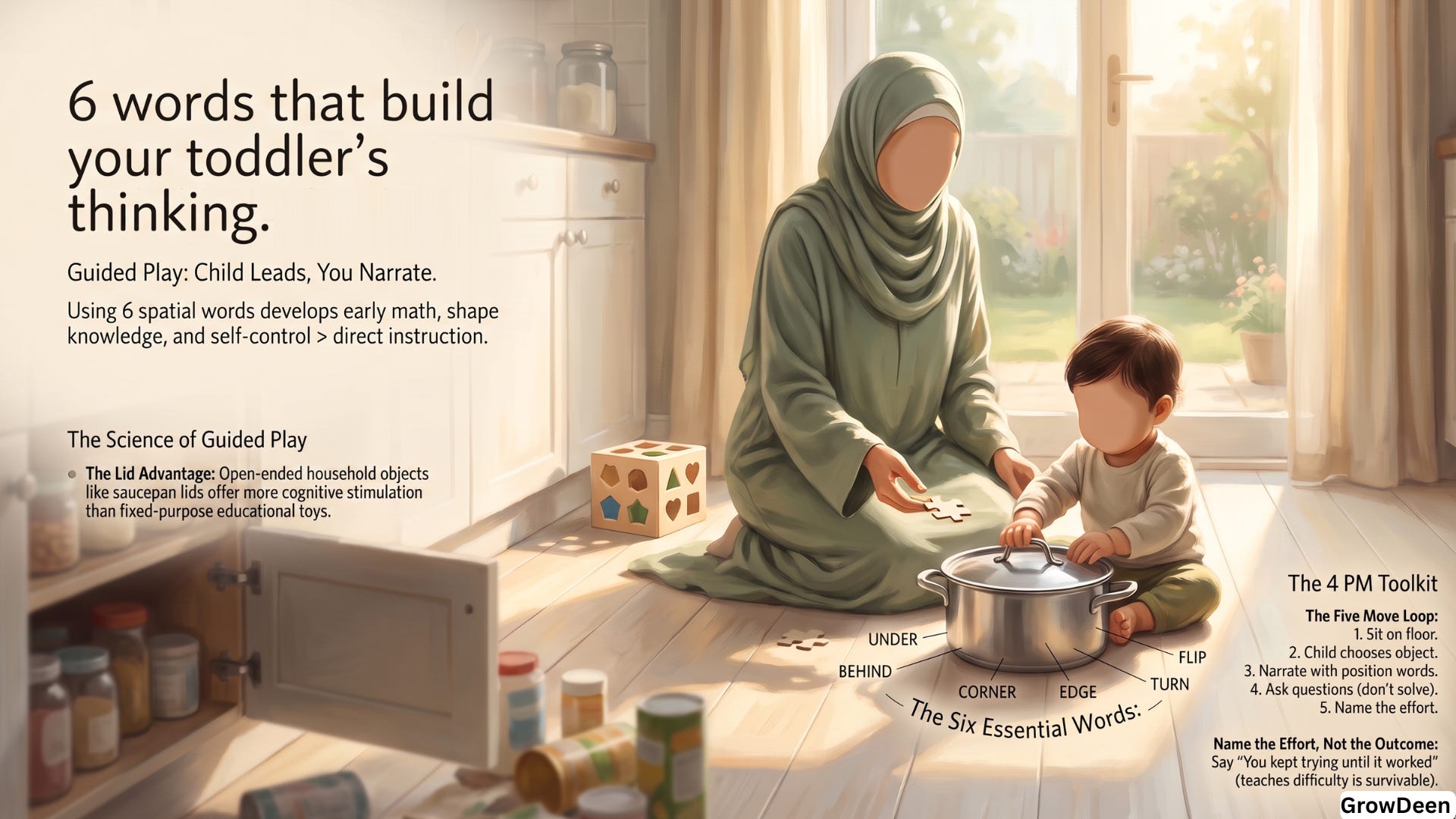
It is 4:15pm and the shape sorter is untouched.
Your toddler has ignored the toy you actually researched. They are on the kitchen floor with a saucepan lid, turning it, dropping it, then turning it the other way to see whether that changes anything. Eleven minutes now. Same lid.
You bought the sorter because a well-meaning aunt said children need stimulation. You put it in front of them. They crawled past it.
The strange part is that the lid is the better toy. And the eleven minutes are not wasted time you should be filling with something more educational.
The problem is somewhere else entirely, and it has a name.
The villain in this story is a false choice. Somewhere along the way, parenting advice split into two camps and left you standing between them. One camp says step back, never interfere, let play be play. The other says be intentional, teach, use the flashcards, buy the developmental toy. Both of them make an ordinary Tuesday afternoon feel like a test you are failing.
Researchers finally settled this in 2022, and the answer was neither camp.
Which leaves one question worth carrying through the rest of this article: if the children who scored higher on a thinking test at four and a half did not have better toys, more lessons, or richer parents, what did they actually have?
Why this guide is different from generic toddler play advice
Real numbers, not vibes. Every recommendation here comes from named research with the effect sizes attached, including a 2022 Child Development meta-analysis [1] and a University of Chicago study that followed 53 children in their own homes from 26 to 46 months [2].
Islamically grounded, not Islamically decorated. The Qur’anic and hadith material sits at the centre of the argument, with the tafsir stated and the limits of the connection named openly.
You get the actual words. Subscribers receive The Guided Play Pocket Guide, a free printable that gives you the exact sentences to say on the floor, so you are not left translating a research finding into speech at 4pm.
What your toddler is actually doing with that lid
They are running an experiment, in the literal sense rather than the cute sense. A toddler who drops the same lid eleven times is testing whether the world behaves the same way twice, and watching each time to check the result [5]. A toddler pouring water between a tall thin cup and a wide short one is studying volume. A toddler jamming a puzzle piece at the wrong hole, turning it, and trying again has just performed trial and error, which is the earliest recognisable form of problem solving [6].
For a mind with no vocabulary to shortcut with, handling the object is the fastest route to a conclusion. That is why they do so much of it.
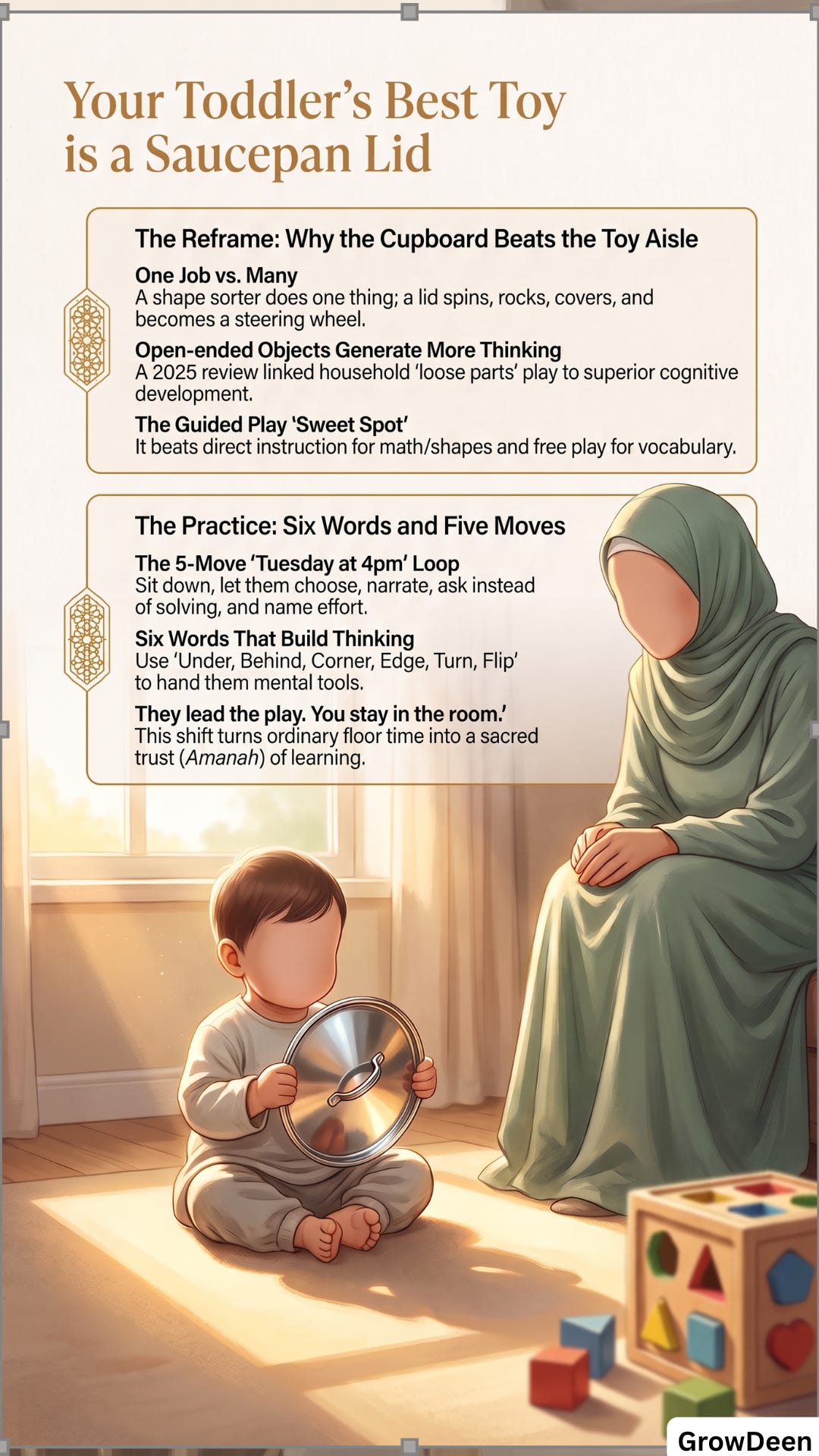
And it explains why the expensive sorter lost to the lid. The sorter does one thing. The lid spins, rocks, reflects, clatters, fits over some pots and not others, and can become a steering wheel by Thursday. A 2025 systematic review of what researchers call loose parts play, meaning open ended objects with no fixed purpose, found consistent links between this kind of child directed play and cognitive development [3].
Your kitchen already contains better equipment than most toy aisles.
But knowing that the lid is fine does not tell you what to do while your child holds it. That is where the two camps failed you.
Should you lead or step back? Researchers tested it
In 2022, a team at Cambridge published a systematic review and meta-analysis in Child Development. They reviewed 39 studies published between 1977 and 2020 and pooled 17 of them, covering 3,893 children aged one to eight [1].
They compared three things. Direct instruction, where the adult decides and teaches. Free play, where the adult stays out of it. And guided play, where the child chooses and directs the activity while an adult stays involved and gently extends it.
Guided play beat direct instruction on early maths skills, on shape knowledge, and on task switching, which is one of the foundations of self control. Against free play, guided play produced its largest advantage of all in spatial vocabulary [1].
Read that as a parent rather than a researcher and it says something quite freeing.
You do not have to teach. You also do not have to disappear. They lead the play. You stay in the room.
That is the whole shift. Your toddler picks the lid. You sit down next to the lid.
Now, what do you say once you are down there? Because “well done” is not it, and the answer turns out to be startlingly specific.
The six words that do more than praise
This next finding should change how you look at an ordinary wooden puzzle.
Researchers at the University of Chicago watched 53 children and their parents at home for 90 minutes, every four months, six times, between 26 and 46 months of age. At four and a half, those children sat a task requiring them to mentally rotate and combine shapes. The ones who had been observed playing with puzzles did better, and that held after controlling for parental education, income, and how much the parents talked overall [2].
So back to the question planted at the top. What did those children have?
Two things, and neither is purchasable.
The first was frequency. Among the children who played with puzzles at all, how often they played predicted how well they scored [2]. Not the price of the puzzle. How many afternoons.
The second was the parent’s language. Spatial words during play were the active ingredient, and harder puzzles pulled more of those words out of parents without anyone planning it [2].
Six to start with: under, behind, corner, edge, turn, flip.
Say them out loud while your child works. That piece goes under the other one. Try turning it. The flat edge sits at the bottom. What is behind you?
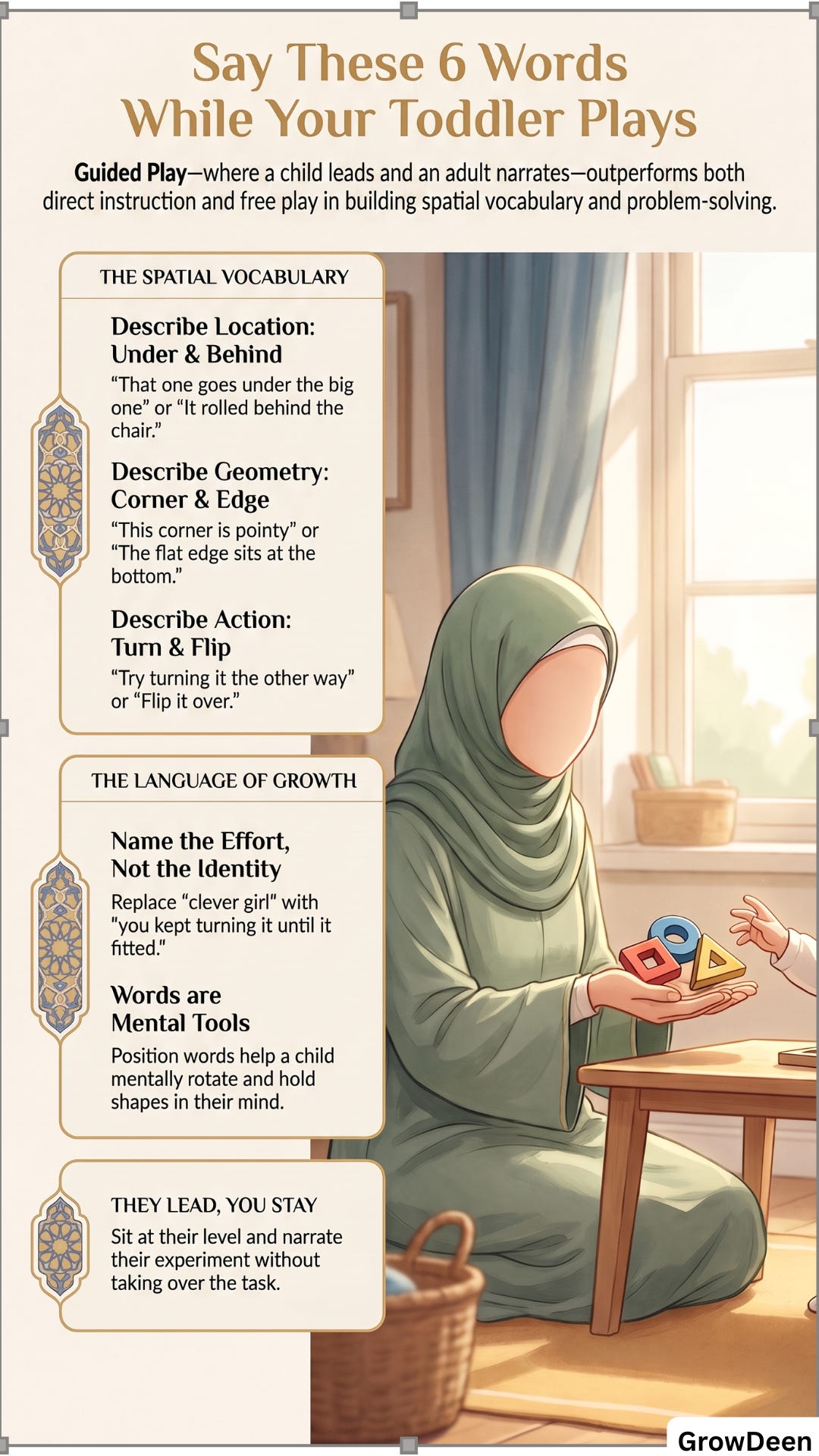
Compare that with what most parents actually say, which is “good job” on repeat. Praise tells your child you are pleased with them. Position words hand them the actual mental tools, the vocabulary a mind uses to hold a shape still and rotate it. A toddler can only think with the words they have been given.
And when they get it, name the effort rather than the outcome. You kept trying different ones until it worked. That teaches a child that difficulty is survivable [5].
That is a lot to hold in your head while a toddler is climbing you. That is why every subscriber gets The Guided Play Pocket Guide free, a printable that puts thirty position words and the exact sentences to say beside them, plus a five move loop for when your child gets stuck. Keep reading and you can download it at the end. It is designed to live on your fridge, where you will actually see it at 4pm.
But there is something underneath all of this that most parenting research does not touch.
The Sacred Trust of a Growing Mind
Somewhere in the eleven minutes with the lid, a quieter worry usually surfaces. Not “is my child behind” but “is any of this actually part of raising them for Allah, or is it just childcare while the real tarbiyah waits until they are older?”
The mind growing inside your toddler is part of the amanah placed in your hands, and the Qur’an treats it that way. Allah turns attention outward, to the ordinary observable world, and then names the faculty He is addressing:
“Indeed, in the creation of the heavens and the earth; the alternation of the day and the night; the ships that sail the sea for the benefit of humanity; the rain sent down by Allah from the skies, reviving the earth after its death; the scattering of all kinds of creatures throughout; the shifting of the winds; and the clouds drifting between the heavens and the earth, in all of this are surely signs for people of understanding.” [13]
According to Tafsir Ibn Kathir, the creatures named there are scattered across the earth in various shapes, colours, uses, and sizes, and everything on that list is a clear sign testifying to Allah’s Oneness, addressed to a people who use their reason [13]. Read the list again slowly. Day becoming night. Rain landing on dead ground. Animals. Wind. Clouds.
Every single item is something a two year old will stop and stare at for a full minute if you let them.
The verse is speaking to adults, and it would be dishonest to pretend otherwise. But the faculty it calls on has to grow somewhere before an adult can use it, and in a small child it grows exactly here, in looking hard at water and ants and a lid catching the light.
The Prophet ﷺ then described what happens to knowledge once it arrives:
The Prophet ﷺ said: “The example of guidance and knowledge with which Allah has sent me is like abundant rain falling on the earth, some of which was fertile soil that absorbed rain water and brought forth vegetation and grass in abundance. (And) another portion of it was hard and held the rain water and Allah benefited the people with it and they utilized it for drinking, making their animals drink from it and for irrigation of the land for cultivation. (And) a portion of it was barren which could neither hold the water nor bring forth vegetation (then that land gave no benefits). The first is the example of the person who comprehends Allah’s religion and gets benefit (from the knowledge) which Allah has revealed through me (the Prophets) and learns and then teaches others. The last example is that of a person who does not care for it and does not take Allah’s guidance revealed through me (He is like that barren land.)” [14]
This narration is about guidance and knowledge of Islam, and its three grounds describe three kinds of people. It sits in the Book of Knowledge, under a chapter on the excellence of the one who learns and then teaches what they have learned [14]. The parenting use here is a stated application, and it should not be dressed up as the narration’s own subject. What follows fairly is that Islam holds the receiver and passer on of knowledge in high regard, and that is a plain description of what you do on a kitchen floor every day, in moments nobody praises you for.
Rain does not decide what the ground does with it. You pour in the words, the attention, the patience, and the du’a, and the growing runs on a timetable you did not set and cannot see from where you are sitting.
What this looks like at 4pm on a Tuesday
Five moves, and none of them take preparation.
Sit down. Not on the sofa. On the floor, at their level.
Let them choose. Whatever is in their hand is the activity now, including the lid.
Narrate in position words. Under, behind, corner, edge, turn, flip. Aim for a running commentary, not a quiz.
Ask instead of solving. When they get stuck: What if the big one goes at the bottom? Wait longer than feels comfortable.
Name the effort. You kept turning it until it fitted.
Islamic habits fold into all five without adding a task. Bismillah as you begin. Alhamdulillah when it works. The right hand when you pass a cup. Ma sha Allah when the tower finally stands. Repeated inside play, these become reflexes rather than rules, which is what tarbiyah looks like at this age.
Three things to stop doing, before the practical part ends. Stop finishing the task for them, because the struggle is the learning. Stop filling every hour, because a toddler with a box of safe ordinary objects and no schedule will invent something [3]. And stop reaching for music based content as the calming option, since Qur’an recitation, gentle adhkar, and spoken rhymes do the same settling work.
Screens deserve their own line. Current guidance recommends no screen time under two apart from video calls with people they know, and for ages two to four the World Health Organization advises no more than one hour of sedentary screen time daily, less being better [9][10]. The reason is mechanical. Very young children show what researchers call a video deficit: give a toddler a word or an action from a live person and they take it up reliably, give them the identical content on a screen and uptake drops sharply [11]. Their minds are built to learn from something that responds. A screen does not respond, which is also why watching beside them and talking about what is on it changes the maths considerably [10].
And go outside. Outdoor play has been linked in recent research to stronger school readiness, and a walk where you stop at the puddle and crouch over the ant is the same guided play loop in a different room [8]. You can say it out loud in words a toddler can hold. Look how Allah made the rain. Alhamdulillah.
One more thing worth knowing before you close this.
When to stop watching and start asking
Ask for an assessment early rather than waiting to see, because early support works better than late support and asking costs nothing. Speak to your doctor or paediatrician if your toddler [12]:
has lost a skill they previously had
is not using any single words by around eighteen months
does not point at things to show you
does not respond to their own name
shows no pretend play by around two years
makes little eye contact, or seems not to hear you
None of these confirms a problem on its own. Every one of them is worth a conversation.
And one more reassurance, which may matter more than the checklist. Fathers are not a supplement in any of this. An Irish study of parent and toddler play talk found that mothers and fathers each shape a toddler’s speech during play in distinct ways, and that both contributions register independently [7]. Fifteen minutes on the rug after work is teaching.
Your free companion pack
If you have read this far, you are the kind of parent who suspects the lid matters. That instinct was right, and it deserves better tools than “good job.”
Inside The Guided Play Pocket Guide (one comprehensive PDF, 3 pages):
Page 1: The Position Words Card. Thirty spatial and position words grouped by play type, each paired with the exact sentence to say out loud, designed as a laminated card you can stick on the fridge or inside a toy box lid.
Page 2: The Five Move Guided Play Loop. A single page showing exactly what to do when your child gets stuck, when to stay quiet, and when to ask, plus a seven day rotation grid so you never repeat the same activity twice in a week, so you can run a proper guided play session in ten minutes without planning it.
Page 3: The Two Reflections Card. Qur’an 2:164 and Sahih al-Bukhari 79 presented side by side in English with their sources, each with a short reflection line connecting it to what your toddler is doing on the floor right now, so the spiritual weight of an ordinary afternoon is written down where you can see it.
This isn’t just a PDF to download and forget. It’s a tool designed to stay on your fridge, where you’ll actually use it when you need it most.
This Guided Play Pocket Guide is what every subscriber receives with each article. Muslim Parenting Lab covers the full span of raising Muslim children, from newborn sleep to school age friendships, all backed by scientific research and rooted in Islamic wisdom.
If you’re a Muslim parent who wants both evidence-based guidance AND Islamic perspective, subscribe for free so future resources arrive in your inbox before you need them.
Subscribe free for parenting resources backed by both science and Sunnah, guidance so unique you literally can’t get it anywhere else. No spam, no clutter, just resources that matter.
Do this in the next five minutes
Go and find whatever your child is holding right now. Sit on the floor beside them and say one position word out loud. Under. That is it. That is the practice.
They lead the play. You stay in the room. That is the whole thing, and it is already within reach this afternoon.
May Allah place barakah in your effort, grant your children understanding, and make the ordinary afternoons count for more than they look like.
Share this with someone who needs it
Think of one person right now: the sister at the masjid who apologised last week because her toddler “just plays with random stuff,” the friend who keeps sending you links to educational toys she cannot afford, the new mother in your family who has started worrying that fifteen minutes on the floor is not enough.
This article could take a weight off them today. Share it as reassurance rather than advice. Sometimes the kindest thing a parent can pass along is permission to stop buying and start sitting down.
Frequently Asked Questions
Q: How do toddlers learn to think? A: Almost entirely through play, and specifically through handling real objects while a warm adult stays nearby and talks. A toddler cannot absorb a concept by being told it, so they test it with their hands instead [4][6]. See “What your toddler is actually doing with that lid” above.
Q: What is guided play, and is it better than free play? A: Guided play means your child chooses and directs the activity while you stay involved and gently extend it. In a 2022 meta-analysis of 39 studies, it beat direct instruction on early maths, shape knowledge, and task switching, and beat free play on spatial vocabulary [1]. So neither extreme wins.
Q: What are the best toys for toddler cognitive development? A: The cheap ones, mostly. Open ended household objects like lids, cups, scarves, pegs, and boxes are linked to cognitive development because a child can decide what they are today [3]. Add one simple puzzle, because puzzle play between 26 and 46 months predicts later spatial skill [2].
Q: How much screen time is safe for a 2 year old? A: The World Health Organization advises no more than one hour of sedentary screen time a day for ages two to four, and less is better, with no screen time under two beyond video calls with people they know [9][10]. Watching beside them and talking about it helps a lot.
Q: My toddler ignores educational toys. Should I be worried? A: Not at all. Toddlers pick what interests them, and interest is what drives learning at this age [4]. The lid, the pegs, and the laundry basket are doing real cognitive work, and your job is to sit down next to whatever they picked.
Q: Is playing with my toddler part of Islamic parenting, or separate from it? A: Part of it. The Qur’an points adults toward close observation of the ordinary created world as the raw material of reason [13], and the mind Allah is growing in your child is part of the amanah in your hands. See “The Sacred Trust of a Growing Mind” above.
Q: When should I speak to a doctor about my toddler’s development? A: Ask early if your child has lost a skill, is not using single words by around eighteen months, does not point to show you things, or shows no pretend play by around two [12]. None of these confirms a problem alone, and early support works better than late support.
References
[1] Skene, K., O’Farrelly, C.M., Byrne, E.M., Kirby, N., Stevens, E.C., & Ramchandani, P.G. (2022). Can guidance during play enhance children’s learning and development in educational contexts? A systematic review and meta-analysis. Child Development, 93(4), 1162-1180. https://doi.org/10.1111/cdev.13730
[2] Levine, S.C., Ratliff, K.R., Huttenlocher, J., & Cannon, J. (2012). Early puzzle play: A predictor of preschoolers’ spatial transformation skill. Developmental Psychology, 48(2), 530-542. https://doi.org/10.1037/a0025913
[3] Cankaya, O., Martin, M., & Haugen, D. (2025). The relationship between children’s indoor loose parts play and cognitive development: A systematic review. Journal of Intelligence, 13(5), Article 52. https://doi.org/10.3390/jintelligence13050052
[4] Bruce, T. (2011). Learning Through Play: For Babies, Toddlers and Young Children (2nd edn). Hodder Education.
[5] Siegler, R.S., Saffran, J., Eisenberg, N., & Gershoff, E. (2020). How Children Develop (6th edn). Worth Publishers.
[6] Berk, L.E. (2013). Child Development (9th edn). Pearson Higher Education.
[7] Quigley, J., & Nixon, E. (2024). Parent-toddler play talk: Toddler speech is differentially associated with paternal and maternal speech in interaction. First Language, 44(1), 23-43. https://doi.org/10.1177/01427237231200436
[8] Zhu, W., Luo, X., Werneck, A.O., Pindus, D., Kramer, L., Kramer, A.F., Hillman, C.H., Herold, F., Zhang, Z., & Zou, L. (2024). Nature and success: Outdoor play is linked to school readiness. Complementary Therapies in Clinical Practice, 57, Article 101895. https://doi.org/10.1016/j.ctcp.2024.101895
[9] World Health Organization (2019). Guidelines on Physical Activity, Sedentary Behaviour and Sleep for Children Under 5 Years of Age. Geneva: WHO.
[10] American Academy of Pediatrics, Council on Communications and Media (2016). Media and young minds. Pediatrics, 138(5), e20162591.
[11] Anderson, D.R., & Pempek, T.A. (2005). Television and very young children. American Behavioral Scientist, 48(5), 505-522.
[12] Centers for Disease Control and Prevention. Learn the Signs. Act Early: Developmental Milestones. https://www.cdc.gov/ncbddd/actearly/milestones/
[13] Qur’an, Surah Al-Baqarah 2:164. Link: https://quran.com/2/164. Tafsir Ibn Kathir: https://quran.com/en/2/164/tafsirs/en-tafisr-ibn-kathir
[14] Sahih al-Bukhari 79, Book of Knowledge, narrated Abu Musa. Graded: Sahih (Muttafaqun Alayhi; also Sahih Muslim 2282). Link: https://sunnah.com/bukhari:79