

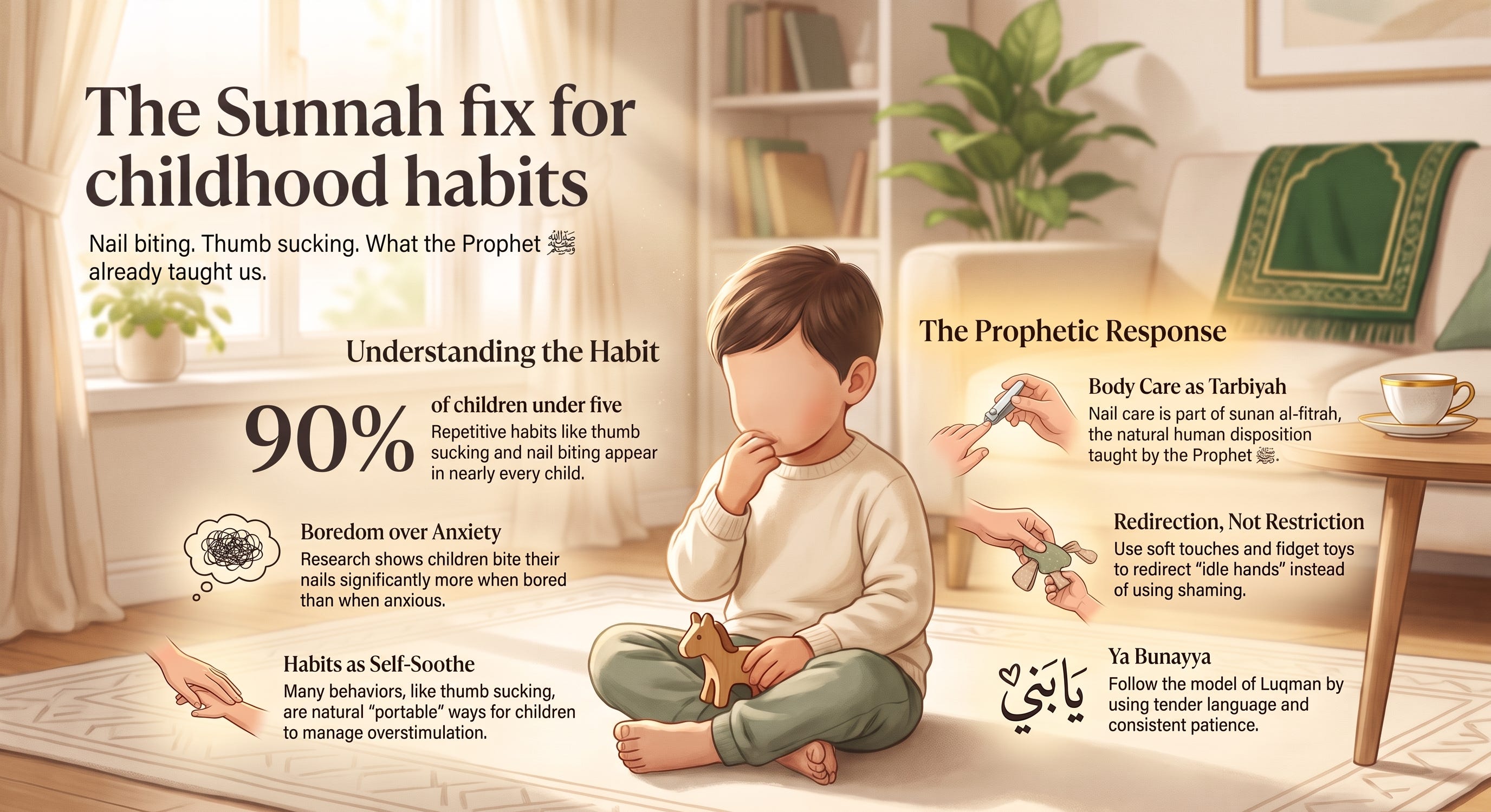
Developmental research shows that over 90% of children under 5 display repetitive habits like thumb sucking, nail biting, or nose picking. [1] This guide shows you why most of these habits are completely normal, what Islam teaches about body care from the Sunnah, and the 3 simple responses that actually work.
Your four-year-old is sitting next to you on the sofa, watching something quietly. You glance over and notice it again: fingers in the mouth. Or nails between teeth. Or a hand twisting through their hair for the third time in five minutes.
You have already asked them to stop. Gently. Then less gently. Then with the kind of tired frustration that makes you feel guilty afterward.
You are not alone in this. And you are not doing anything wrong.
When I looked at the developmental research on this topic, one number stopped me: studies have found that repetitive habits appear in more than 90% of children under five. [1] That is not a minority. That is nearly every child. Thumb sucking, nail biting, nose picking, hair twirling, teeth grinding, chewing on sleeves. These are among the most common behaviours in early childhood, and the science is clear: the vast majority fade on their own without any intervention at all. [2][3]
But here is what surprised me more than the numbers. Islam already has a framework for this. The Prophet ﷺ placed nail care in the very definition of our natural human disposition (the sunan al-fitrah). [4] That means the conversation you are trying to have with your child about their nails, their cleanliness, their body, is not just a parenting task. It is tarbiyah. And it has been mapped out for you.
Why this guide is different from generic parenting advice
Research-backed, not opinion-based. Every recommendation draws on peer-reviewed studies from journals like the Cochrane Database, the American Academy of Pediatrics, and developmental psychology research, not blog posts or personal hunches. [2][3][7]
Rooted in the Sunnah, not just behaviour management. This guide connects childhood habits to the Islamic framework of sunan al-fitrah, tahara, and the Qur’anic model of patient parenting from Surah Luqman, giving your corrections a purpose bigger than “stop doing that.” [4][5]
Includes a free printable companion pack. You will get The Gentle Habits Companion Pack, a 3-page PDF with a Sunnah body care tracker, a do-and-don’t parent reference card, and a when-to-get-help decision guide you can keep on your fridge.
Should you actually be worried?
Probably not. But it helps to understand what is happening.
A habit is a behaviour your child repeats so often it becomes automatic. They may not realise they are doing it. And in most cases, they are doing it for a reason that makes perfect sense from their perspective.
They are calming themselves down. Thumb sucking is one of the first self-soothing behaviours a baby develops. When toddlers outgrow breastfeeding or the bottle, the sucking continues as a portable way to manage tiredness, overstimulation, or emotional discomfort. [3][6] From your child’s point of view, it works brilliantly.
They are bored. Research on nail biting in children found something that surprised the researchers themselves: children bit their nails significantly more when bored than when anxious. [7] Your child chewing on their sleeve in the car is more likely bored than worried.
The habit started for a practical reason and then outlived it. A cold, a blocked nose, a scratchy sore. The child picks or fiddles to deal with the problem. The problem goes away. The habit stays. [1]
They learned it from you. Not a reason for guilt. But worth noticing. If you bite your nails under stress, your child is likely to do the same. Children absorb behaviour from the people closest to them, and habits are no exception. [3][8]
There is one category that deserves closer attention. If your child is pulling out hair to the point of creating bald patches, if a habit appears suddenly and escalates sharply during stressful periods, or if the behaviour is accompanied by sleep disturbance, clinginess, or regression in skills they had already mastered, the habit may be signalling something deeper. [9][10] More on when to seek professional help below.
What Islam teaches about bodies, habits, and patient correction
Here is the part most parenting articles will never give you.
In Islam, your child’s body is an amanah, a trust from Allah placed in your care. Caring for it, keeping it clean, protecting it from harm: these are not preferences. They are responsibilities. And when you gently guide your child away from a habit that causes harm (nails bitten until they bleed, hair pulled until it thins), you are fulfilling that trust.
But Islam goes further than principle. The Prophet ﷺ gave us specific, practical guidance.
The five practices of the fitrah
The Prophet ﷺ described five practices as part of the fitrah, the natural disposition Allah placed in every human being: circumcision, removing pubic hair, clipping the nails, removing armpit hair, and trimming the moustache. [4]
Nail clipping is in that list. For a child who bites their nails, this is not just a health tip. It is a doorway to something bigger. Instead of repeating “stop biting your nails,” you can say: “The Prophet ﷺ taught us to look after our nails. Let’s trim them together.” You turn a correction into an aspiration. You connect a small act to the Prophet ﷺ himself. And you give your child a reason that is bigger than your frustration.
Building a weekly nail-trimming routine, begun with Bismillah, is a small act of worship that also addresses the habit at its root. [4]
Wudu as a habit-breaker
Many childhood habits intersect with hygiene. Nose picking, fingers in the mouth, chewing on objects from the floor. Islam’s emphasis on tahara (cleanliness) gives you a framework that turns hygiene into meaning rather than shame.
A child who practises wudu regularly is already learning the kind of body awareness and hand hygiene that works against many common habits. Washing their hands, face, mouth, and arms multiple times a day builds an automatic care routine that runs alongside, and quietly replaces, the habit.
I know this is a lot to take in, especially when you are managing bedtime routines, school runs, and a child who keeps putting their fingers back in their mouth. That is exactly why I created The Gentle Habits Companion Pack, a free printable PDF with a Sunnah body care tracker, a parent quick-reference card, and a when-to-get-help decision guide. Keep reading to download it at the end of this article. It is designed to stay on your fridge, not add to your mental load.
The 3 responses that actually work (and the ones that make it worse)
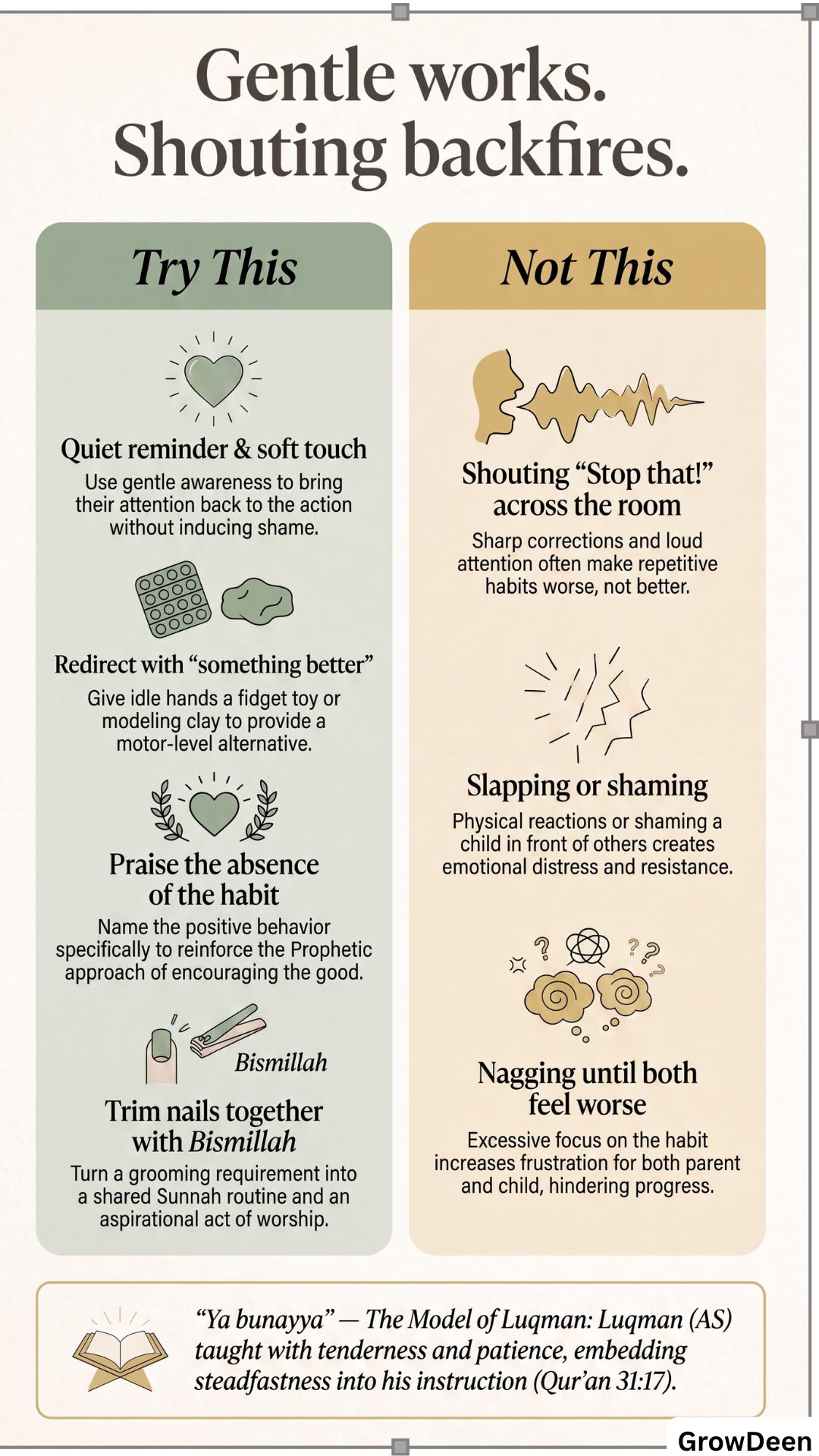
The research on this is unanimous: punishment, shaming, nagging, and drawing excessive attention to a habit all make it worse, not better. [3][7] What works is simpler than you think.
Gentle awareness, not sharp correction. When you see the habit happening, a quiet word or a soft touch on the hand is enough. “Fingers out, sweetheart.” The goal is to bring your child’s attention back to what they are doing, not to make them feel ashamed. [1][3]
Something better for their hands. Many habits are about idle hands. A textured fidget toy during screen time, a piece of modelling clay during quiet moments, or a chewable pendant for children who chew on objects can redirect the behaviour at the motor level. [1][7]
Praise what is going right. Notice when the habit is absent and name it. “I can hear your words so clearly right now because your fingers aren’t in your mouth.” Specific, positive feedback reinforces the behaviour you want to see. [1][11] This aligns with the Prophetic approach: encouraging good rather than only correcting bad.
If your child has paired habits (thumb sucking and hair twirling, for example), focus on one at a time. Habits often share a trigger, and resolving one can reduce the other naturally. [1]
And above all: be patient. Habits take weeks to change. Some take months. That is normal. That is tarbiyah.
When it is time to talk to a professional
Most habits are harmless and temporary. But these are the signs that professional guidance would be helpful:
Thumb sucking beyond age 4 that is affecting teeth or jaw alignment. Talk to your dentist. Prolonged non-nutritive sucking can cause anterior open bite and upper palate narrowing. [3][6][12]
Hair pulling creating bald patches. This may be trichotillomania, a recognised condition that responds well to habit reversal training with a child psychologist. [9][10]
Habits linked to anxiety. If the habit appeared suddenly, intensifies during stress, or comes alongside sleep disturbance, clinginess, or regression, address the underlying anxiety first. Your doctor can refer you to a child psychologist or counsellor. [9]
Any habit causing bleeding, infection, or visible damage. This needs medical attention. [1][9]
Children with additional needs. Autistic children and children with developmental differences may have repetitive behaviours that serve important self-regulatory functions. A psychologist or occupational therapist experienced with additional needs can help you understand which behaviours are supporting your child and which might need gentle modification. [13]
Not sure if what you are seeing is a habit or a tic? The key difference is control. A child can choose (with effort) to stop a habit. A tic is involuntary, sudden, and brief: repeated blinking, facial twitches, shoulder shrugging, throat clearing. If you notice involuntary repetitive movements or sounds, your doctor can assess whether they are tics. [14]
The Islamic framework for patient teaching: what Luqman shows us
When I reflect on Surah Luqman, I am struck by how Luqman does not lecture his son. He does not raise his voice. He says “Ya bunayya” (O my dear son), a word drenched in tenderness. And then he tells him:
“O my son, establish prayer, enjoin what is right, forbid what is wrong, and be patient over what befalls you. Indeed, that is of the matters requiring determination” (Qur’an 31:17). [5]
According to Tafsir Ibn Kathir, Luqman instructs his son to be steadfast in doing good and to bear with patience whatever hardships come along that path. What strikes me for our topic is this: Luqman embeds patience inside the instruction. He knows the two are inseparable. Teaching a child anything, whether it is prayer or nail care or keeping their fingers out of their mouth, requires the parent to accept that the child will forget, slip back, and need gentle reminding again. That is not failure. That is the work.
What is beautiful is how the Sunnah and the developmental research walk hand in hand here: children grow out of habits best when they are met with calm consistency, not force. [5][4]
May Allah grant you the sabr to guide your children gently and the comfort of knowing that this patient, steady work is itself an act of worship.
Your Gentle Habits Companion Pack
If you have read this far, you are the kind of parent who does not just want answers. You want to do this well. That tells me something about you.
I created something to make this easier, because reading an article is one thing and remembering what to do at 6pm on a Tuesday when your child’s fingers are back in their mouth is another.
Inside The Gentle Habits Companion Pack (one comprehensive PDF, 3 pages):
Page 1: My body care routine (Sunnah grooming tracker): A weekly tracker where your child can tick off five Sunnah-based body care habits each day (nail check, hand washing, teeth cleaning, wudu, keeping hands clean). Includes the hadith of the fitrah at the bottom. Designed as a fridge chart your child takes ownership of.
Page 2: Gentle habit helper (parent quick-reference card): A two-column “Try this / Avoid this” card with the seven best responses and the six worst. Includes Luqman’s parenting wisdom at the bottom. Designed to keep in a drawer or stick on the fridge for the moments you need a reminder.
Page 3: When to get help (parent decision guide): A clear checklist of the seven signs that it is time to talk to a professional, each with exactly who to contact. Includes a reassurance box for when none of the signs apply. Designed for parents who want a quick, decisive answer to “should I be worried?”
This is not a PDF to download and forget. It is designed to stay where you need it, when you need it.
This companion pack is what every subscriber receives with each article. Muslim Parenting Lab covers the full journey of raising Muslim children, from newborns to school-age, all backed by research and rooted in the Sunnah.
If you are a Muslim parent who wants both evidence-based guidance and Islamic perspective, subscribe for free so future resources arrive in your inbox before you need them.
You will only hear from us when there is something valuable to share. No spam, no daily emails, just resources that matter.
Your micro-action for tonight
Tonight, sit with your child and trim their nails together. Say Bismillah before you start. Tell them: “The Prophet ﷺ taught us to take care of our nails. This is part of the Sunnah.”
That is it. One small act of worship, one small step toward replacing the habit with something better.
May Allah place barakah in your patience, accept your intention, and make this gentle work more rewarded than it feels in the moment.
Share this with someone who needs it
Think of one person right now: a friend whose child bites their nails and she has tried everything, a sister who gets embarrassed when her toddler picks their nose in front of guests, a mother at the school gate who mentioned her daughter keeps chewing on her sleeves and she does not know what to do.
This article could ease her worry. Share it with her today, not as advice-giving, but as support. Sometimes the most loving thing you can do is share what you wish someone had shared with you.
Frequently Asked Questions
Q: At what age should I worry about thumb sucking?
A: Most children stop on their own by age 4. If your child is still sucking their thumb consistently beyond that and you are concerned about their teeth, that is a good time to talk to your dentist. Prolonged sucking can affect dental alignment. [3][6] For more detail, see “When it is time to talk to a professional” above.
Q: Does nail biting mean my child is anxious?
A: Not necessarily. Research shows that boredom is actually a bigger trigger for nail biting than anxiety. [7] If your child bites their nails mainly during quiet, passive moments (car journeys, screen time), it is more likely a boredom habit than an anxiety signal.
Q: Can I use bitter-tasting nail polish to stop nail biting?
A: You can. Pharmacists sell child-safe formulations. But they work best when combined with positive strategies (Sunnah nail-trimming routine, fidget alternatives, praise) rather than used as a standalone punishment. [3] The polish is a reminder, not a solution on its own.
Q: My child pulls their hair. Is that normal?
A: Hair twirling is common and harmless. Hair pulling that creates bald patches, thinning, or sores is different and may indicate trichotillomania. If you are seeing visible hair loss, it is worth speaking with your doctor, who can refer you to a child psychologist experienced with body-focused repetitive behaviours. [9][10]
Q: What is the difference between a habit and a tic?
A: A habit is something your child can choose to stop (even if it is hard). A tic is involuntary, sudden, and brief: repeated blinking, facial twitches, throat clearing. If you notice movements or sounds your child seems unable to control, your doctor can assess whether they are tics. [14]
Q: Is nose picking harmful?
A: Occasional nose picking is harmless and extremely common. It becomes a concern if it is causing nosebleeds, introducing infections, or interfering with social situations. Teaching your child to use a tissue and washing hands regularly (the wudu connection) is usually enough. [1]
References
[1] Foster, L. (1998). Nervous habits and stereotyped behaviors in preschool children. Journal of the American Academy of Child and Adolescent Psychiatry, 37(7), 711-717. https://doi.org/10.1097/00004583-199807000-00010
[2] Werry, J.S., Carlielle, J., Fitzpatrick, J. (1983). Rhythmic motor activities (stereotypies) in children under five: Etiology and prevalence. Journal of the American Academy of Child Psychiatry, 22(4), 329-336.https://doi.org/10.1016/S0002-7138(09)60667-1
[3] Borrie, F.R., Bearn, D.R., Innes, N., & Iheozor-Ejiofor, Z. (2015). Interventions for the cessation of non-nutritive sucking habits in children. Cochrane Database of Systematic Reviews, 3, CD008694. https://doi.org/10.1002/14651858.CD008694.pub2
[4] Sahih Muslim 258: Graded: Sahih: https://sunnah.com/muslim:258
[5] Qur’an 31:17, Tafsir Ibn Kathir: https://quran.com/31/17
[6] Staufert Gutierrez, D., & Carugno, P. (2023). Thumb sucking. In StatPearls. StatPearls Publishing. https://www.ncbi.nlm.nih.gov/books/NBK556112/
[7] Woods, D., Fuqua, W., Siah, A., Welch, M., Blackman, E., & Sief, T. (2001). Understanding habits: A preliminary investigation of nail biting function in children. Education and Treatment of Children, 24(2), 199-216.
[8] Bandura, A. (1977). Social Learning Theory. Prentice Hall.
[9] Francazio, S.K., Murphy, Y.E., & Flessner, C.A. (2017). Psychological treatment of trichotillomania. In J.S. Abramowitz, D. McKay & E.A. Storch (Eds), The Wiley handbook of obsessive compulsive disorders (pp. 1009-1022). Wiley Blackwell.
[10] American Academy of Child and Adolescent Psychiatry. (2023). Hair pulling (Trichotillomania). Facts for Families, No. 45.
[11] American Academy of Pediatrics. (2019). What’s the best way to discipline my child? HealthyChildren.org. https://www.healthychildren.org/English/family-life/family-dynamics/communication-discipline/Pages/Disciplining-Your-Child.aspx
[12] Bishara, S., Warren, J., Broffit, B., & Levy, S. (2006). Changes in the prevalence of nonnutritive sucking patterns in the first 8 years of life. American Journal of Orthodontics and Dentofacial Orthopedics, 130(1), 31-35. https://doi.org/10.1016/j.ajodo.2004.11.033
[13] Autism Spectrum Australia. (2023). Understanding stimming and repetitive behaviours. https://www.autismspectrum.org.au
[14] Ueda, K., & Black, K.J. (2021). A comprehensive review of tic disorders in children. Journal of Clinical Medicine, 10(11), Article 2479. https://doi.org/10.3390/jcm10112479