

A 2022 meta-analysis of 192 studies covering 708,561 people found the peak age of onset for anxiety disorders is 5.5 years, while the median age of diagnosis is 17. [1] This guide shows you what happens in those missing years, and the one household habit you can change tonight.
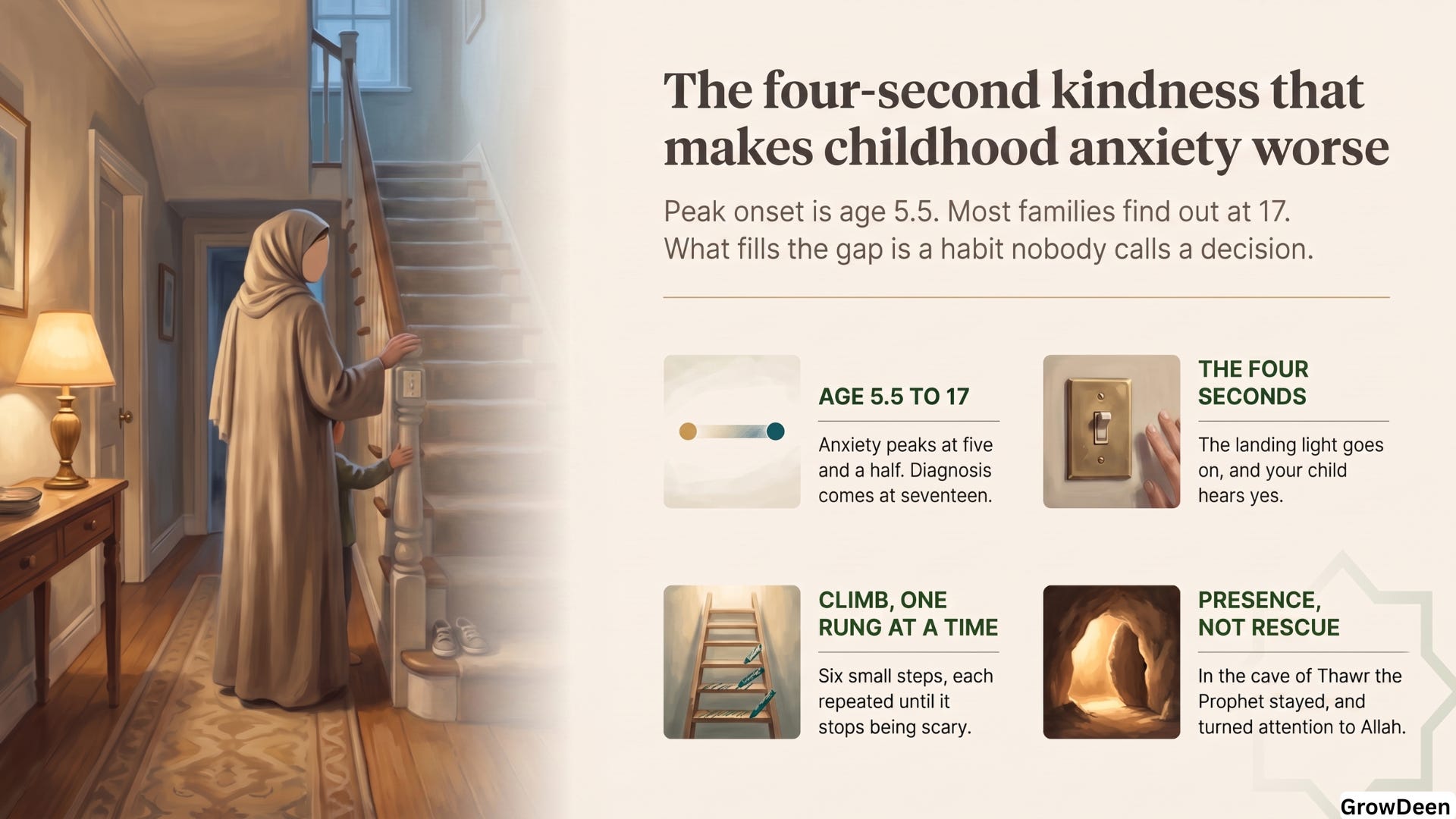
The landing light has been on for six weeks.
Before that, your five year old climbed the stairs alone without thinking about it. Now there is a negotiation at the bottom step every night, and somewhere around the third trip up and down you decided the light was easier than the argument.
You did the kind thing. Every parent reading this has done the kind thing. And you were still lying in bed afterwards wondering whether you had just made it worse, which is the question nobody actually answers for you.
Here is what the research says about that question, and it is not comfortable. When a frightened child avoids the thing they fear and feels immediate relief, their nervous system files a conclusion: that was dangerous, and getting away is what saved me. Researchers call the parent’s side of this family accommodation, and it is one of the main reasons childhood anxiety persists rather than fading. [2][3]
There is a trial I want to come back to later in this article. Researchers randomly assigned 124 anxious children to two treatments. One group of children got therapy. The other group of children got nothing at all, and their parents were coached instead. The second group did just as well. [3] Why that happened is the whole point of what follows.
What Makes This Guide Different
Current research, named and dated. Every claim here traces to a specific source, including a 2022 meta-analysis of 192 studies [1], a Cochrane review [7], and a randomised trial from Yale [3].
Islamic framework, not decoration. The Qur’an contains a scene of one frightened person being calmed by another, and Ibn Kathir’s commentary on it describes almost exactly what the exposure research recommends. [13]
A tool you will actually use. You will get the free Braver Than Yesterday Companion Pack, including a bravery ladder your child fills in themselves and a one-sitting audit of your own rescuing habits.
What Is Your Child Actually Asking When They Refuse the Stairs?
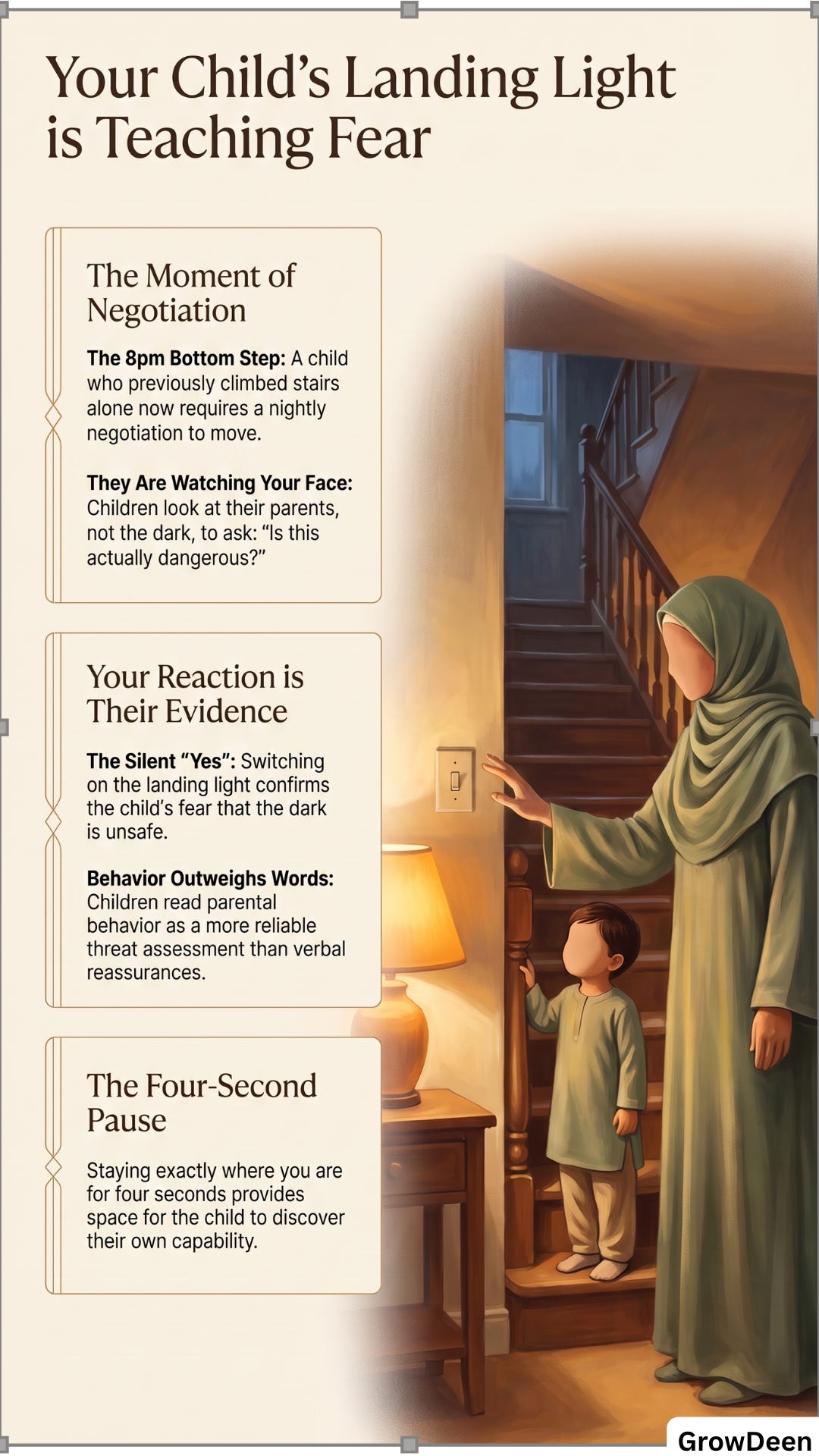
Picture the moment properly. Your child is standing at the bottom step, and they are watching your face more closely than they are watching the dark landing above them.
They are asking a question. Not out loud. The question is: is this actually dangerous?
And whatever you do next is the answer they believe. Switch on the light, and you have said yes. Cross the road away from the neighbour’s dog, and you have said yes. Order for them at the counter because they went silent, and you have said yes.
Here’s why this matters more than any reassurance you give with words. Children read behaviour far more reliably than speech. You can say “there’s nothing to be scared of” while your body is busy removing the thing to be scared of, and only one of those two messages is going to land.
That is the villain of this article. Not your child. Not you. The four-second kindness, done a dozen times a week, each one costing almost nothing, each one quietly confirming the fear.
Your reaction is their evidence.
Why Does a Five Year Old Suddenly Become Afraid of Everything?
Because the imagination has just come online, and imagination is the fuel worry runs on.
Under two, fear needs no imagination at all: separation from you, sudden noise, heights, unfamiliar faces. [2] Between two and five, the dark arrives, and being left alone, and a small concrete worry about getting hurt. Between five and eight the imagination brings company, and the fears turn strange: ghosts, monsters, whatever an older cousin described at a family gathering and then forgot about. Social fear starts here too. Being told off. Tests. Reading aloud. Getting something wrong where other children can see. [2][8]
Now hold that against the number in the subtitle. That 2022 meta-analysis of 192 epidemiological studies found the peak age of onset for anxiety and fear-related disorders is 5.5 years. [1] The median age at which those same conditions get diagnosed is 17. Around one in every fifteen children worldwide meets criteria for an anxiety disorder at any given moment, which makes it the most common mental health condition of childhood. [4]
Read those two ages together. There is a twelve-year gap between when this typically starts and when anyone typically acts on it, and almost the whole gap sits inside the years you are living in right now.
You are not early. You are on time.
Is My Child Just Cautious, or Is This Anxiety?
You already know which child yours is. The one who hangs back at the edge of a family gathering and watches a new room for a long minute before entering it.
Researchers call it behavioural inhibition, and roughly 15% of children show it strongly. [5] A meta-analysis found these children carry a sevenfold increase in the odds of later developing social anxiety disorder. In those studies, 43% of inhibited children eventually met criteria, compared with 12% of children who were not inhibited. [5]
Read that number again from the other side, because this is the part that never makes it into the parenting posts. Fifty-seven percent did not. The majority of cautious children do not go on to develop an anxiety disorder at all.
Temperament sets a starting position. It does not set the destination. What moves a child between those two groups is largely what happens around them in the years before eight, which brings us to the two things you actually control.
And when researchers went looking for the first of them, what they found surprised almost everyone.
Does Childhood Anxiety Come From Genes, or From Parents?
You have probably assumed genes. Most parents do, and then quietly conclude there is nothing to be done about it.
A children-of-twins study drawing on the Twin and Offspring Study of Sweden tested that assumption directly. It compared anxiety in children against anxiety in their parent, and separately against anxiety in their parent’s identical twin. [6] If transmission ran mainly through genes, children should have resembled their twin aunt or uncle nearly as much as their own parent. They did not. The parent-offspring link survived after accounting for shared genes, while the genetic transmission pathway was not a significant contributor to the model. [6]
Let me be honest about the limits, because you deserve that. The children in that study were adolescents, the data were cross-sectional, and some of the effect could run the other way, with an anxious child pulling more anxious responses out of a parent. [6] Take it as one strong piece of evidence, not a settled law.
But sit with what it points at. The flinch when the dog appears. The sharp intake of breath at the top of the slide. The running commentary about everything that might go wrong on the way to a family gathering. Children are extraordinary readers of the adults they love, and they take your threat assessment as the correct one.
This is important: you are not required to feel calm. You are required to behave calmly in front of them. That is a far smaller and more achievable thing than it sounds at 7pm on a hard evening.
Before You Read On
I know this is a lot to hold in your head at 9:30 at night when the whole thing is going to happen again tomorrow. That is exactly why I put together the free Braver Than Yesterday Companion Pack for you, with a bravery ladder your child fills in themselves and a short audit that shows you which of your own rescuing habits to drop first. It is at the end of this article. Keep going, because the next part is the piece most parents get wrong.
How Do You Reduce Rescuing Without Being Cruel?
Nobody is asking you to withdraw help and let your child cope. That is not what the evidence supports and it is not what works.
You are replacing avoidance with graduated approach, which is the active ingredient in the treatments with the strongest evidence base. A Cochrane review of trials in children and adolescents found cognitive behavioural therapy effective for anxiety disorders, and stepped exposure is the engine inside it. [7]
The method is a ladder. Pick one fear. Break it into rungs small enough that the first is only mildly uncomfortable. If the destination is stroking a dog, the ladder might run: look at a photo of a dog, watch a dog from across a park, stand ten metres from a calm dog on a lead, stand two metres away, then touch its back while the owner holds it.
You stay on a rung until it stops producing much of a reaction. Only then do you move up.
Two rules decide whether this works. Never start at the top, because a child overwhelmed on the first attempt fights harder on the second. And do not skip rungs to save time, since the entire mechanism is the accumulation of evidence, and evidence takes repetition.
Tell your child the plan out loud. A four year old can understand “we’re going to practise the easy bit until it’s boring, then try the next bit.” Being let in on the strategy turns them from a subject into a participant and takes the ambush out of it.
Now, remember that trial from the opening. One group of the 124 children received standard cognitive behavioural therapy. In the other group, the children had no therapist contact at all, and their parents alone were coached to respond supportively while systematically reducing their accommodation. The parent-only treatment was noninferior on every primary and secondary anxiety outcome, as rated by independent evaluators, by parents, and by the children themselves. [3]
Children who never met a therapist got better because the adults around them stopped answering yes.
But before the ladder, before the plan, there is a question about what you do while your child is actually afraid. And the clearest answer I know is in a cave.
Support Muslim Parenting Lab ❤️
Think your amount is too small to matter? Give whatever you have with the button below.
The Prophet ﷺ said to shield yourself from the Fire even with half a date. (Sahih al-Bukhari 1417)
What the Prophet ﷺ Did When Someone Beside Him Was Afraid
You know the moment when your child is frightened and you cannot fix the thing frightening them. There is a scene in the Qur’an about exactly that.
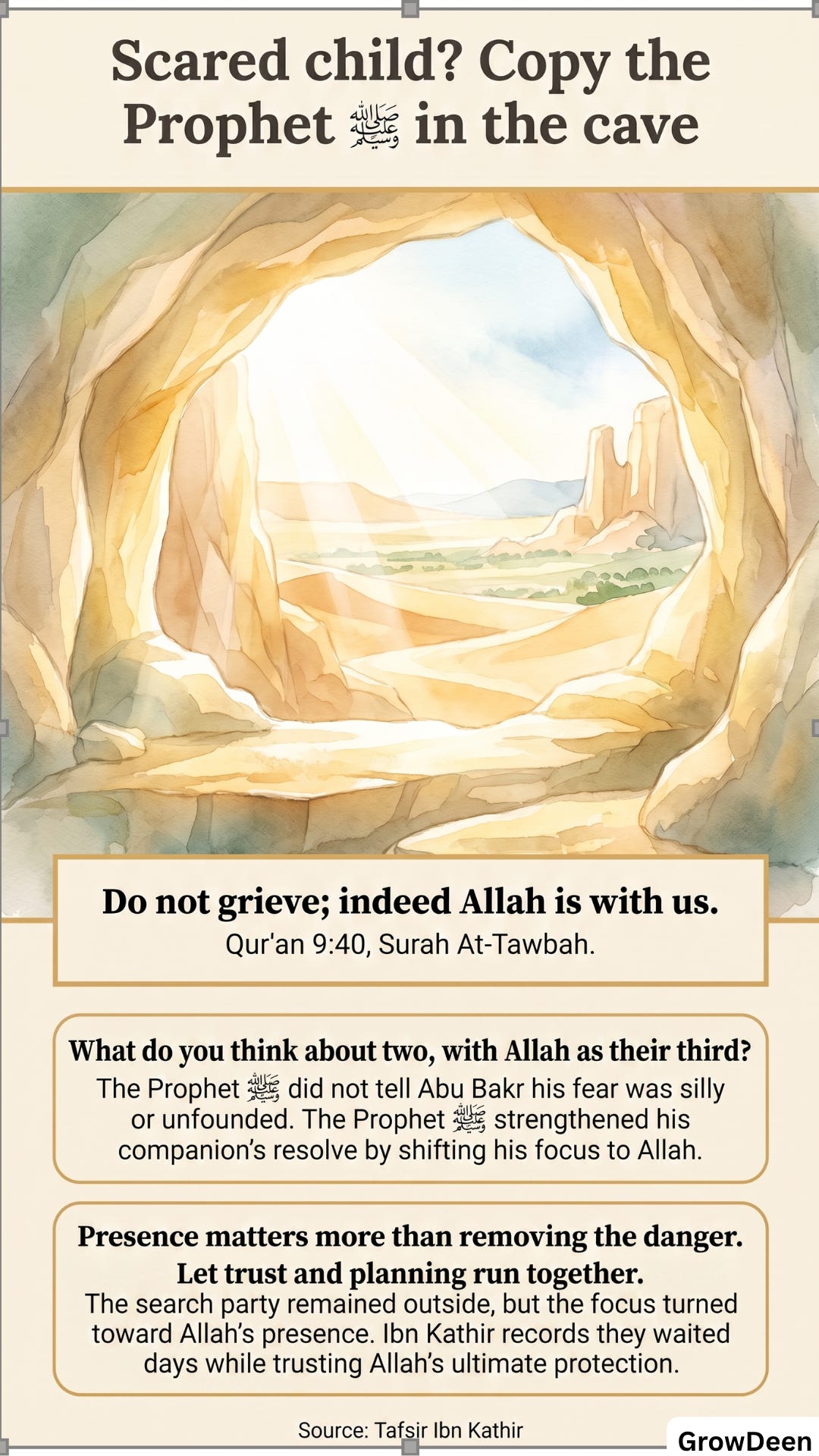
The Prophet ﷺ and Abu Bakr were hidden in the cave of Thawr during the migration to Madinah, with a search party close enough to hear. Ibn Kathir records that Abu Bakr was afraid, and that his fear was for the Messenger ﷺ rather than himself. The Prophet ﷺ, Ibn Kathir writes, kept reassuring him and strengthening his resolve: “O Abu Bakr! What do you think about two, with Allah as their third?” Allah preserved the words: “Do not grieve; indeed Allah is with us.” [Qur’an 9:40] [13]
Notice what is missing. No correction of the fear. No removal of a danger that was completely real. Presence, and a turning of attention toward the One who had brought them both there. Ibn Kathir adds that they waited three days until the pursuers gave up, [13] so the trust and the plan ran together.
Courage is also something you ask for aloud. Sa’d ibn Abi Waqqas taught his sons a set of words the way a teacher drills handwriting, among them Allahumma inni a’udhu bika minal-jubn, O Allah, I seek refuge with You from cowardice, telling them the Messenger of Allah ﷺ used these words at the end of every prayer. [14] You can start that tonight, after Maghrib.
Your reaction is their evidence. So is your du’a.
What Should You Say When Your Child Is Scared?
Six sentences, and the reasoning behind each.
Say the fear back to them. “You don’t like the dark. Lots of people don’t. I’m here.” Naming a feeling accurately does more than reassurance does, and it keeps your child bringing things to you.
Stop saying “there’s nothing to be scared of.” It asks a child to disbelieve their own body, and it teaches them that reporting fear gets them corrected.
Praise the attempt, not the outcome. “You stayed in the room even though it was hard” builds something. “See, that was easy” quietly tells your child their difficulty was imaginary.
Wait a few seconds before stepping in. Most children can manage more than we let them, and the gap you leave is the only place they can discover it.
Drop the label. “She’s the shy one” and “he’s my anxious one,” said often enough within earshot, stop describing behaviour and start describing a person.
Promise only what you can deliver. “The dog definitely won’t come near you” collapses the moment the dog does. Say the true thing: “I will stay right here with you.”
When Should You See a Doctor About Your Child’s Anxiety?
Ordinary fears fade on their own. Speak to a doctor or paediatrician if any of these apply:
The anxiety is stopping your child doing things they want to do, or interfering with friendships, play, school, or family life. [2]
The reaction is far outside what is typical for the age. Separation distress at the start of nursery is expected. The same intensity at nine is not. [8]
The distress is unusually severe, or your child is very hard to settle once it starts.
It has run for weeks and is worsening rather than easing.
Physical symptoms keep appearing with no medical explanation. Severe anxiety occasionally has an underlying medical cause. [8]
Children with anxiety disorders respond well to treatment, which is worth saying plainly to anyone who has been putting off the call. [2][10] Parent-based work is a real alternative where a child refuses to attend sessions. [3] School programmes exist but show modest effects compared with targeted treatment, [11] and screening tools used in general practice can help flag children who need a closer look. [12]
One honest caution about mindfulness apps, which are marketed heavily to worried parents. A meta-analysis of mindfulness-based programmes for children and adolescents found their effect on anxiety to be small. [9] They do no harm. They also will not do what the ladder does.
Taking your child to someone qualified is not a gap in tawakkul. It is the pattern of the cave, where the trust and the careful plan were running together.
Your Free Braver Than Yesterday Companion Pack
If you have read this far, you are the kind of parent who would rather sit with a hard answer than an easy one. That already tells me something about you.
Inside the Braver Than Yesterday Companion Pack (one comprehensive PDF, 3 pages):
Page 1: The Bravery Ladder. A blank six-rung ladder your child fills in and colours with you, plus a worked example and the two rules that decide whether it works, designed as a card you can stick on the back of your child’s bedroom door where they will see their own progress every night.
Page 2: The Four-Second Audit. Twelve statements describing the small rescues almost every parent makes, with a scoring key and a “pick one” line at the bottom, so you can find your own biggest accommodation habit in a single ten-minute sitting rather than guessing at it for months.
Page 3: The Courage Du’a Card. The authenticated du’a Sa’d ibn Abi Waqqas taught his own children, in Arabic with transliteration and English meaning, along with the exact words to use when teaching it, age band by age band, from four years old up to ten. [14]
This isn’t just a PDF to download and forget. It’s a tool designed to live on your child’s bedroom door and in your own pocket, where you will actually reach for it at bedtime.
This companion pack is what every subscriber receives with each article. Muslim Parenting Lab covers the whole span of raising Muslim children from birth through the early school years, all backed by peer-reviewed research and rooted in authenticated Islamic sources.
Your Micro-Action
Tonight, do not fix the ladder or start the audit. Do one thing.
The next time your child is frightened and looks at your face for the answer, count four seconds before you move. That’s it. Four seconds of you staying exactly where you are.
May Allah place barakah in your patience, grant your children courage in the moments that frighten them, and make every steady breath you take beside a scared child heavier on your scale than it feels tonight.
Share This With Someone Who Needs It
Think of one person right now: the cousin whose six year old has started refusing sleepovers, the friend at the masjid whose daughter goes silent whenever an adult speaks to her, the neighbour who mentioned her son will not sleep with his door shut, the sister who said last week that her son cries at the school gate and she has started walking him all the way in.
This article could change what happens in her house tonight. Send it to her, not as advice, but as care. Sometimes the kindest thing we can pass along is the reason something isn’t working.
Frequently Asked Questions
Q: Is anxiety in children normal, or is something wrong with my child?
A: Fear and worry are a normal part of growing up, and what a child fears shifts predictably with age. [2] It stops being ordinary when it interferes with what your child wants to do, or when the reaction is far more intense than other children the same age. Around one in fifteen children worldwide meets criteria for an anxiety disorder at any moment. [4]
Q: At what age does childhood anxiety usually start?
A: Earlier than nearly everyone expects. A 2022 meta-analysis of 192 studies found the peak age of onset for anxiety and fear-related disorders is 5.5 years, though the median age of diagnosis is 17. [1] Those preschool and early primary years are where the difference gets made.
Q: Should I make my anxious child face their fear?
A: Yes, but in small steps you build together, never all at once. Graduated exposure is the active ingredient in the treatments with the strongest evidence. [7] Forcing the biggest step first usually makes the next attempt harder, which is why the ladder in the companion pack starts with a photograph rather than a dog.
Q: Does leaving the light on make my child’s fear of the dark worse?
A: Over time, often yes. Every rescue gives immediate relief and quietly confirms that the thing was dangerous, which is how family accommodation keeps anxiety alive rather than easing it. [3] Reduce it gradually and with your child’s knowledge, not overnight and not as a punishment.
Q: Will my anxious child grow out of it?
A: Many do. Even among children with a strongly cautious temperament, 57% did not go on to develop social anxiety disorder in the studies. [5] But some do not grow out of it, and untreated anxiety at five is the same anxiety nobody diagnoses until seventeen. [1] If it is interfering with daily life, get it looked at.
Q: Can I help my child’s anxiety without taking them to therapy?
A: Often, yes. In a randomised trial of 124 anxious children, a parent-only treatment that reduced accommodation performed as well as standard cognitive behavioural therapy, with the children receiving no therapist contact at all. [3] That said, if your child’s anxiety is severe or worsening, see a doctor rather than managing it alone.
Q: Is there a du’a I can teach my child for fear?
A: Yes. Sa’d ibn Abi Waqqas taught his own sons Allahumma inni a’udhu bika minal-jubn, O Allah, I seek refuge with You from cowardice, reporting that the Messenger of Allah ﷺ used these words at the end of every prayer. [14] The full du’a with Arabic and transliteration is on Page 3 of the companion pack.
References
[1] Solmi, M., Radua, J., Olivola, M., Croce, E., Soardo, L., Salazar de Pablo, G., et al. (2022). Age at onset of mental disorders worldwide: Large-scale meta-analysis of 192 epidemiological studies. Molecular Psychiatry, 27(1), 281-295. https://doi.org/10.1038/s41380-021-01161-7
[2] Creswell, C., Waite, P., & Hudson, J. (2020). Practitioner review: Anxiety disorders in children and young people, assessment and treatment. Journal of Child Psychology and Psychiatry, 61(6), 628-643. https://doi.org/10.1111/jcpp.13186
[3] Lebowitz, E.R., Marin, C., Martino, A., Shimshoni, Y., & Silverman, W.K. (2020). Parent-based treatment as efficacious as cognitive-behavioral therapy for childhood anxiety: A randomized noninferiority study of Supportive Parenting for Anxious Childhood Emotions. Journal of the American Academy of Child and Adolescent Psychiatry, 59(3), 362-372. https://doi.org/10.1016/j.jaac.2019.02.014
[4] Polanczyk, G.V., Salum, G.A., Sugaya, L.S., Caye, A., & Rohde, L.A. (2015). Annual research review: A meta-analysis of the worldwide prevalence of mental disorders in children and adolescents. Journal of Child Psychology and Psychiatry, 56(3), 345-365. https://doi.org/10.1111/jcpp.12381
[5] Clauss, J.A., & Blackford, J.U. (2012). Behavioral inhibition and risk for developing social anxiety disorder: A meta-analytic study. Journal of the American Academy of Child and Adolescent Psychiatry, 51(10), 1066-1075.e1. https://doi.org/10.1016/j.jaac.2012.08.002
[6] Eley, T.C., McAdams, T.A., Rijsdijk, F.V., Lichtenstein, P., Narusyte, J., Reiss, D., Spotts, E.L., Ganiban, J.M., & Neiderhiser, J.M. (2015). The intergenerational transmission of anxiety: A children-of-twins study. American Journal of Psychiatry, 172(7), 630-637. https://doi.org/10.1176/appi.ajp.2015.14070818
[7] James, A.C., Reardon, T., Soler, A., James, G., & Creswell, C. (2020). Cognitive behavioural therapy for anxiety disorders in children and adolescents. Cochrane Database of Systematic Reviews, 11, CD013162. https://doi.org/10.1002/14651858.CD013162.pub2
[8] Sicouri, G., Perkes, I.E., & Hudson, J.L. (2022). Anxiety disorders in children and adolescents. Medicine Today, 23(1-2), 14-21.
[9] Odgers, K., Dargue, N., Creswell, C., Jones, M.P., & Hudson, J.L. (2020). The limited effect of mindfulness-based interventions on anxiety in children and adolescents: A meta-analysis. Clinical Child and Family Psychology Review, 23(3), 407-426. https://doi.org/10.1007/s10567-020-00319-z
[10] Melbourne Children’s Campus Mental Health Strategy Anxiety Guideline Development Group. (2024). Evidence-based clinical practice guideline for anxiety in children and young people (V.1.1). Melbourne Children’s.
[11] Werner-Seidler, A., Spanos, S., Calear, A.L., Perry, Y., Torok, M., O’Dea, B., Christensen, H., & Newby, J.M. (2021). School-based depression and anxiety prevention programs: An updated systematic review and meta-analysis. Clinical Psychology Review, 89, Article 102079. https://doi.org/10.1016/j.cpr.2021.102079
[12] Viswanathan, M., Wallace, I.F., Middleton, J.C., Kennedy, S.M., McKeeman, J., Hudson, K., Rains, C., Schaaf, E.B.V., & Kahwati, L. (2022). Screening for anxiety in children and adolescents: Evidence report and systematic review for the US Preventive Services Task Force. JAMA, 328(14), 1445-1455. https://doi.org/10.1001/jama.2022.16303
[13] Qur’an, Surah At-Tawbah 9:40, with Tafsir Ibn Kathir. https://quran.com/en/9:40/tafsirs/en-tafisr-ibn-kathir
[14] Sahih al-Bukhari 2822, Book 56, Chapter: Seeking refuge with Allah from cowardice. Narrated by ‘Amr bin Maimun Al-Audi. Graded Sahih. https://sunnah.com/bukhari:2822
We combine scientific research with Qur’an and authentic Sunnah, and we cite our sources. Even so, this is general guidance and no substitute for a doctor who can examine your child.