

The CDC’s 2023 milestone data confirms what parents feel before they can name it: by six months, a baby who babbles, reaches deliberately, rolls, and recognises your face above all others is no longer just responding to the world — they are beginning to engage it. [1] This guide explains what’s actually happening in your baby’s brain and body right now and how to respond in a way that’s both research-backed and rooted in Islamic guidance on rahmah.
Something shifts around five months. Not a milestone exactly.
More like a change in the quality of the relationship.
You walk in. Your baby’s whole face changes — mouth opens, arms pump, body wriggles. It’s pure, unfiltered joy, directed entirely at you. And then an unfamiliar face leans in, and your baby turns back, searching for yours.
Here’s what I want you to know: that moment of recognition? That tiny act of choosing you? It took months of consistent response to build it. Every feed, every nappy change, every time you picked them up — you were doing the work. And it shows.
According to the Harvard Center on the Developing Child, the brain builds neural connections faster in the first five years than at any other time in life. [2] The five-to-six month window is one of the most concentrated periods of that growth. What you do in these ordinary moments is not ordinary at all.
Why This Guide Is Different From Generic Baby Development Content
Science you can actually use: Every milestone and recommendation here is drawn from the CDC 2023 data, Harvard developmental research, and Nelson Textbook of Pediatrics — not generic parenting blogs.
An Islamic lens that goes deeper than a single verse: We look at what rahmah, tarbiyah, and the Sunnah actually require of parents right now, at this specific stage.
A free companion pack with tools you’ll use today: The Your Baby’s 5–6 Month Development Pack gives you a printable milestone tracker, floor-time activity cards, and an Islamic rahmah reflection — designed to stay on your fridge, not gather dust in a folder.
Why “Stranger Anxiety” Is Actually Great News
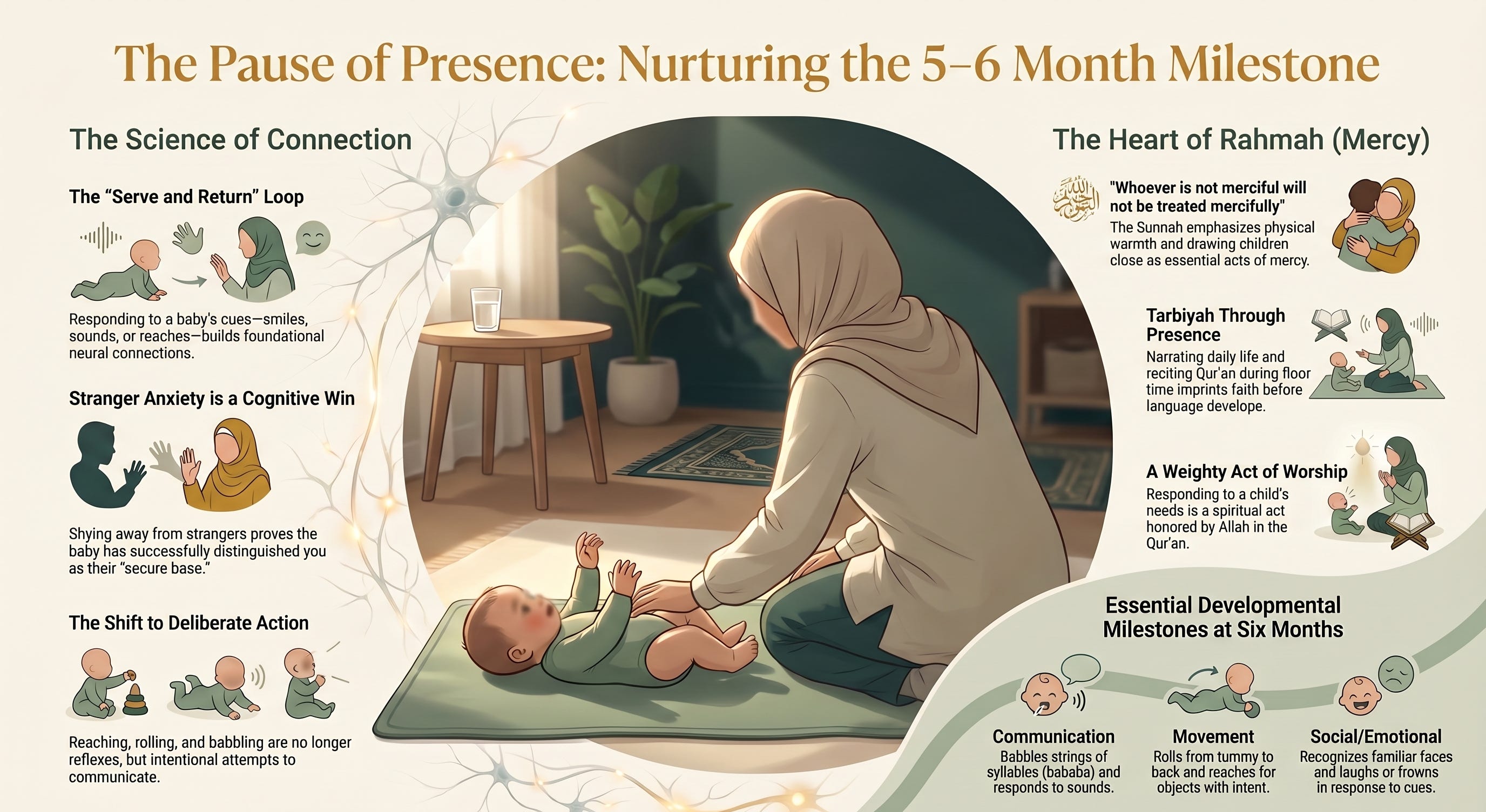
By five months, your baby has built what psychologists call a secure base — a specific, deep bond with the people who care for them most. [3] Stranger anxiety is the visible result. It’s not shyness. It’s not a social problem.
It means your baby has done something cognitively sophisticated: they’ve distinguished you from the rest of the world and placed you in a category of your own.
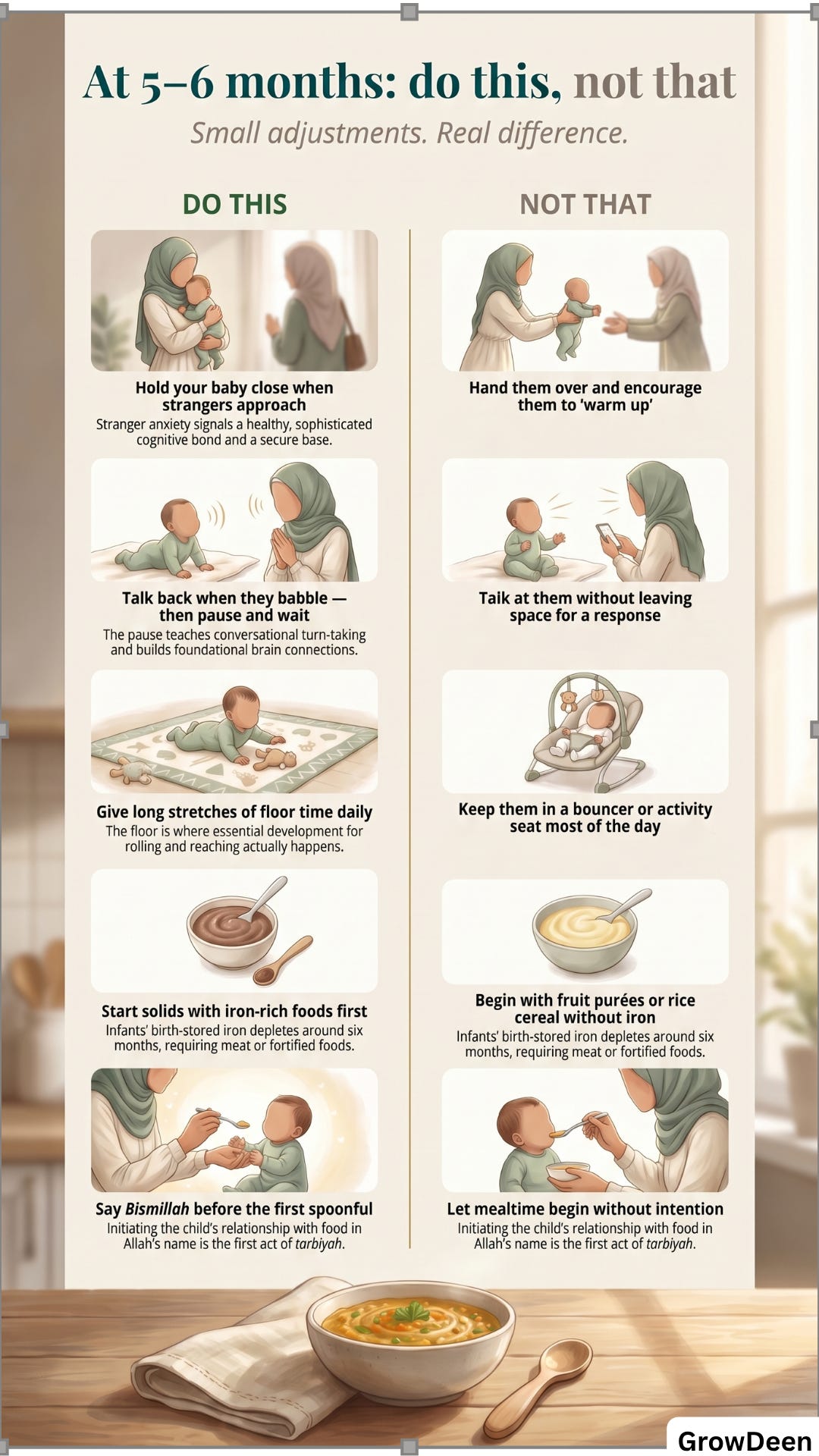
At the masjid, at a family gathering, when an auntie reaches in and your baby freezes — follow your baby’s cue. Hold them. Let them observe from your arms before they decide whether to engage. There is no developmental benefit to pushing a five-month-old toward people before they’re ready. [3]
When I reflect on the hadith where the Prophet ﷺ kissed his grandson Al-Hasan in front of a companion who boasted he had never kissed any of his ten children, the response always stays with me: “Whoever is not merciful to others will not be treated mercifully.” [4] The Prophet ﷺ said this about physical warmth toward children. About closeness. About drawing them in rather than pushing them toward the world before they’re ready.
That is exactly what your baby’s developing nervous system is asking for right now.
What’s Happening Emotionally — And Why It Matters More Than You Think
Your baby can now laugh. A real one — not reflex, not coincidence. A belly laugh at a silly face or a well-timed peek-a-boo.
They can also frown with frustration. Cry with what is clearly genuine upset. The emotional range is expanding fast.
Here’s the thing: when you respond to your baby’s emotional cues — soften your face when they frown, mirror a smile, move quickly when they signal distress — their nervous system learns something foundational. The world responds to me. [2] That learning shapes how they manage difficulty for years ahead.
The Qur’an frames this with even greater weight. “Lower to them the wing of humility out of mercy, and say: My Lord, have mercy upon them as they brought me up when I was small.” [5] Tafsir Ibn Kathir confirms that rabbayānī ṣaghīrān — they raised me when I was little — frames the nurturing of a small child as an act so weighty before Allah that grown children are commanded to invoke divine mercy in return for it. Every time you respond to your baby’s face with your own presence and warmth, you are doing what this verse honours.
Movement: Everything Is Becoming Deliberate
Your baby can now reach for an object with clear intention, grab it, and transfer it hand to hand. [1] Everything goes in the mouth — this is not something to stop, it is how they learn. Supervised texture exploration with safe objects is sensory education.
Rolling typically begins around now. Once it starts, a raised surface is never safe for even a moment of inattention. [6]
Tummy time still matters. Two minutes, four times a day beats ten minutes once. Get on the floor with them. Make it worth their effort.
Limit time in bouncers, activity seats, and car seats used outside the car. The floor is where the development actually happens. [6]
Babbling: The Language Is Already Starting
Strings of syllables — “babababa,” “gagagaga” — are the jaw, tongue, and lips rehearsing the physical movements that will eventually produce speech. [1]
Talk back. Narrate. Pause. That pause teaches turn-taking — the structure underneath every conversation they will ever have. [2]
And fill your home with Qur’an recitation near your baby — during feeds, tummy time, bath time. The understanding comes later. The imprinting starts now. This is tarbiyah before they have language for it.
I know this is a lot to hold in your head — especially when you’re managing feeds, sleep, and everything else. That’s why I’ve created the free Your Baby’s 5–6 Month Development Pack — a printable three-page guide with a milestone tracker, floor-time activity cards, and an Islamic rahmah reflection you can keep on your fridge. Keep reading to download it at the end.
Starting Solids: Around Six Months, If the Signs Are There
The WHO recommends exclusive breastfeeding for the first six months, with complementary foods introduced alongside milk from that point. [7] The signs of readiness:
Sitting with support, head steady
Clear interest in food — reaching, watching intently when others eat
The tongue-thrust reflex has diminished (babies younger than six months push food back out automatically)
Iron is the primary reason solids begin now. A baby’s iron stores from birth start depleting around six months, and breast milk alone cannot meet their needs at this stage. Prioritise iron-rich first foods: well-cooked meat, chicken, fish, iron-fortified cereals. [7]
On allergens: the evidence has shifted. Early introduction of common allergens from around six months reduces allergy risk, not increases it. [8] Talk to your baby’s paediatrician if your baby has severe eczema or significant family history of food allergy before introducing them.
Say Bismillah before the first spoonful. You are beginning your child’s relationship with food. Beginning it in Allah’s name is the most natural thing in the world — and the first act of tarbiyah at the table.
When to See a Paediatrician
Trust your instincts. Do speak to a paediatrician if, by six months, your baby:
Isn’t making eye contact or responding to your face
Isn’t babbling or turning toward sounds
Doesn’t smile or show emotional responses
Isn’t rolling or reaching for objects
Has an eye that consistently turns in or out
Has lost skills they previously had [1]
Early support where it’s needed makes a real difference.
If you’ve read this far…
You’re the kind of parent who doesn’t just scroll past this stuff. You’re trying to understand your baby — not just manage them. That tells me something about you.
Inside the Your Baby’s 5–6 Month Development Pack (one comprehensive PDF, 3 pages):
Page 1: Is My Baby on Track? Your 5–6 Month Milestone Checklist — A two-column reference card covering Communication & Connection milestones and Movement & Play milestones, with brief reassuring notes on each — designed to stay on your fridge and double as a conversation-starter at your next paediatrician visit.
Page 2: 6 Floor-Time Activities for This Week — Six activity cards your baby will actually benefit from right now: Talk Back, Floor Time First, Tummy Time Together, Introduce a New Texture, Follow Their Cue with Strangers, and Respond to Emotions — with specific instructions for each, not just vague suggestions.
Page 3: The Islamic Home at 5–6 Months: Practising Rahmah — An Islamic reflection card anchored by Sahih al-Bukhari 5997 (the Prophet ﷺ on mercy toward children) and Qur’an 17:24, with three short reflection sections on rahmah in response, rahmah in nurturing, and rahmah in presence — so you can see that what you’re already doing, done with intention, is an act of worship.
This isn’t just a PDF to download and forget. It’s designed to stay in your kitchen or on your phone — in the moments when you actually need a reminder of what you’re doing and why it matters.
This pack is what every subscriber receives with each article. We cover the full journey of raising Muslim children — from birth through the teenage years — all backed by current research and rooted in Islamic wisdom.
If you’re a Muslim parent who wants both evidence-based guidance and Sunnah-rooted perspective, subscribe free so future resources reach you before you need them.
Subscribe free for parenting resources backed by both science and Sunnah — guidance so grounded and specific, you genuinely can’t find it anywhere else. No spam. No clutter. Just resources that matter.
Your Micro-Action for Today
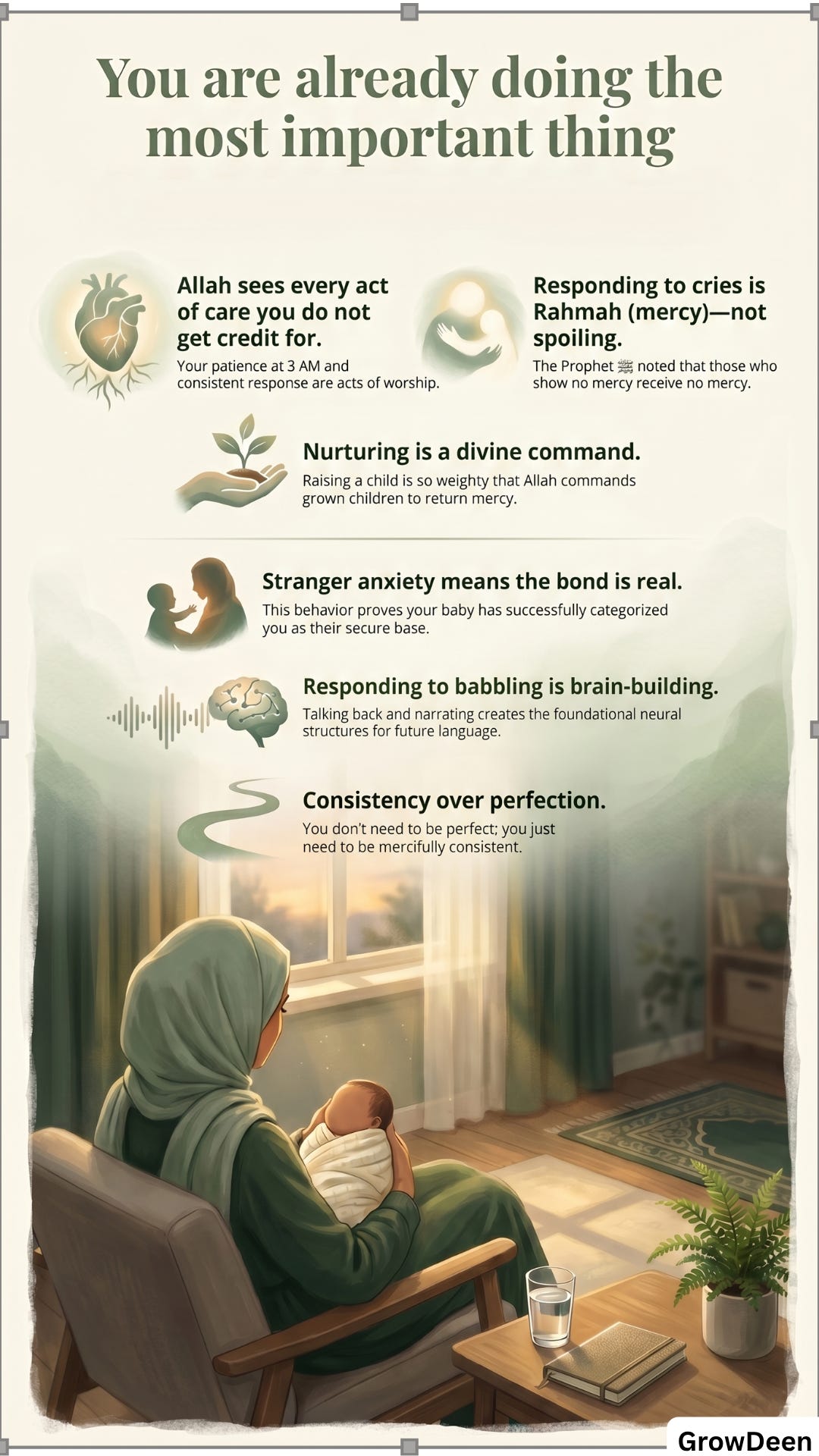
Before you put your phone down: the next time your baby makes a sound — any sound, a coo, a babble, a grunt — respond to it. Out loud. Talk back, pause, wait. Do it once, consciously, and feel what it is. That is serve-and-return. That is brain-building. That is, in Islamic terms, the very act of rahmah the Prophet ﷺ pointed to.
May Allah place barakah in your effort, and make the care you give more protected, more merciful, and more rewarded than it feels in the moment.
Share This
Think of one person right now: your sister who just had her baby two months after yours, the one sending voice notes in the family WhatsApp asking why her baby suddenly cries when the neighbour holds her, the one who thinks something is wrong.
She needs to know stranger anxiety is healthy. Share this article with her today — not as advice, but as relief. Sometimes the most loving thing we can do is pass along the thing that made us exhale.
Frequently Asked Questions
Q: When exactly does stranger anxiety start in babies?
A: Most babies show some degree of stranger awareness from around four to five months, with more visible wariness typically appearing at five to seven months as primary attachments become established. [3] It’s one of the clearest signs that healthy bonding has happened.
Q: Is stranger anxiety worse in breastfed babies?
A: There’s no reliable evidence that feeding method affects stranger anxiety. What does affect it is the strength of primary attachment — which is built through consistent, warm responsiveness regardless of how the baby is fed. [2]
Q: When should I start solids if my baby isn’t showing signs yet?
A: The WHO recommends introducing solids around six months alongside continued breastfeeding or formula. [7] If the signs of readiness aren’t there by six months, speak with your baby’s paediatrician rather than waiting indefinitely — especially because of the iron depletion that begins around this time.
Q: My baby rolled once and hasn’t since. Should I be worried?
A: Not necessarily — rolling is rarely consistent at first. Babies often discover a skill and then seem to forget it briefly. [1] What matters is that the motor patterns are developing. If there’s no rolling or reaching at all by six months, mention it to your paediatrician.
Q: How do I know if my baby’s babbling is normal?
A: Typical babbling at five to six months includes repeated syllables — “bababa,” “mamama,” “gagaga” — said with varied pitch and expression. [1] If your baby makes no vocal sounds beyond crying, or suddenly stops sounds they were making before, that’s worth raising with a paediatrician.
Q: Can I introduce allergens if I’m still breastfeeding?
A: Yes — current guidance from ASCIA and similar bodies recommends introducing common allergens regardless of breastfeeding status, from around six months. [8] The evidence shows early introduction protects against allergy rather than causing it. Talk to your baby’s paediatrician first if there is severe eczema or a strong family history of allergy.
References
[1] Centers for Disease Control and Prevention. (2023). Important milestones: Your baby by six months. CDC. https://www.cdc.gov/ncbddd/actearly/milestones/milestones-6mo.html
[2] Center on the Developing Child at Harvard University. (2021). Three principles to improve outcomes for children and families (2021 update). Harvard University. https://developingchild.harvard.edu/resources/three-principles-to-improve-outcomes-for-children-and-families/
[3] Onigbanjo, M.T., & Feigelman, S. (2024). The first year. In R. Kliegman & J.W. St Geme III (Eds), Nelson Textbook of Pediatrics (22nd edn, pp. 151–156). Elsevier.
[4] Sahih al-Bukhari 5997. Narrated by Abu Huraira. Graded: Sahih (Muttafaqun Alayhi — agreed upon by Bukhari and Muslim). https://sunnah.com/bukhari:5997
[5] Qur’an, Surah Al-Isra 17:24. Tafsir Ibn Kathir verified via: https://quran.com/17/24 | Tafsir: https://quran.com/en/al-isra/23/tafsirs/en-tafisr-ibn-kathir
[6] Sharma, A., Cockerill, H., & Sanctuary, L. (2022). Mary Sheridan’s from birth to five years: Children’s developmental progress (5th edn). Routledge.
[7] World Health Organization. (2023). Infant and young child feeding: Key facts. WHO. https://www.who.int/news-room/fact-sheets/detail/infant-and-young-child-feeding
[8] Australasian Society of Clinical Immunology and Allergy (ASCIA). (2024). How to introduce solid foods to babies for allergy prevention: FAQ. ASCIA. https://www.allergy.org.au/patients/allergy-prevention/ascia-how-to-introduce-solid-foods-to-babies
Fantastic article mashAllah! I really appreciated how everything is backed by science and data.
Do you have anything for 8-12 months yet?