

A BMJ study of 15,781 febrile illnesses in young children found the clinical signs that actually separate routine illness from danger — and it isn’t the number on the thermometer. [1] Here’s the exact list to keep in your head, and how to move fast without losing your footing.
It’s 2 a.m. Your toddler is hot, floppy in your arms, and you’re standing in the hallway asking yourself the question every parent eventually asks: is this normal, or do I need to move right now?
There’s no shame in not knowing. Most childhood illness is loud and dramatic and completely harmless — a screaming, red-faced two-year-old with a fever is usually just... sick. Miserable, but safe.
But a small number of signs mean something different. And the parents who know them cold, before they ever need them, are the ones who don’t waste the ten minutes that sometimes matter most.
When researchers pulled together data from 15,781 febrile illnesses in young children for a landmark BMJ study, one finding stood out: it wasn’t the fever itself that predicted serious illness. It was a specific, learnable cluster of physical signs. [1] That’s genuinely good news. It means you don’t need a medical degree. You need a list — and the confidence to act on it.
Why This Guide Is Different
Built on real clinical data, not fear. Every sign here comes from peer-reviewed research — including a 15,781-case BMJ study and UK national clinical guidance (NICE) [1][4] — not generic “trust your gut” advice with nothing behind it.
The Islamic dimension is load-bearing, not decorative. This isn’t safety tips with a du’a tacked on. It’s built around a real theological question — how do you act with urgency and tawakkul at the same time? — and answers it properly.
You’ll get The Act-Now Companion Pack for free, a printable guide built to live on your fridge or in your phone, for the exact moment you don’t have time to scroll back through this article.
Trust What You’re Noticing (It’s Not “Just Anxiety”)
Here’s something that might surprise you: your instinct is not a soft, secondary input that real medicine ignores.
Clinical guidance in the UK explicitly lists “parental concern about the child” as one of the recognised risk indicators doctors and nurses are trained to weigh, sitting right alongside the physical signs themselves. [4] Your gut isn’t in competition with the clinical picture. It is part of the clinical picture.
You’ve watched this child for weeks, months, or years. You know their normal in a way no one meeting them for the first time possibly could. If something feels wrong and you can’t quite name why — that’s still data. Act on it.
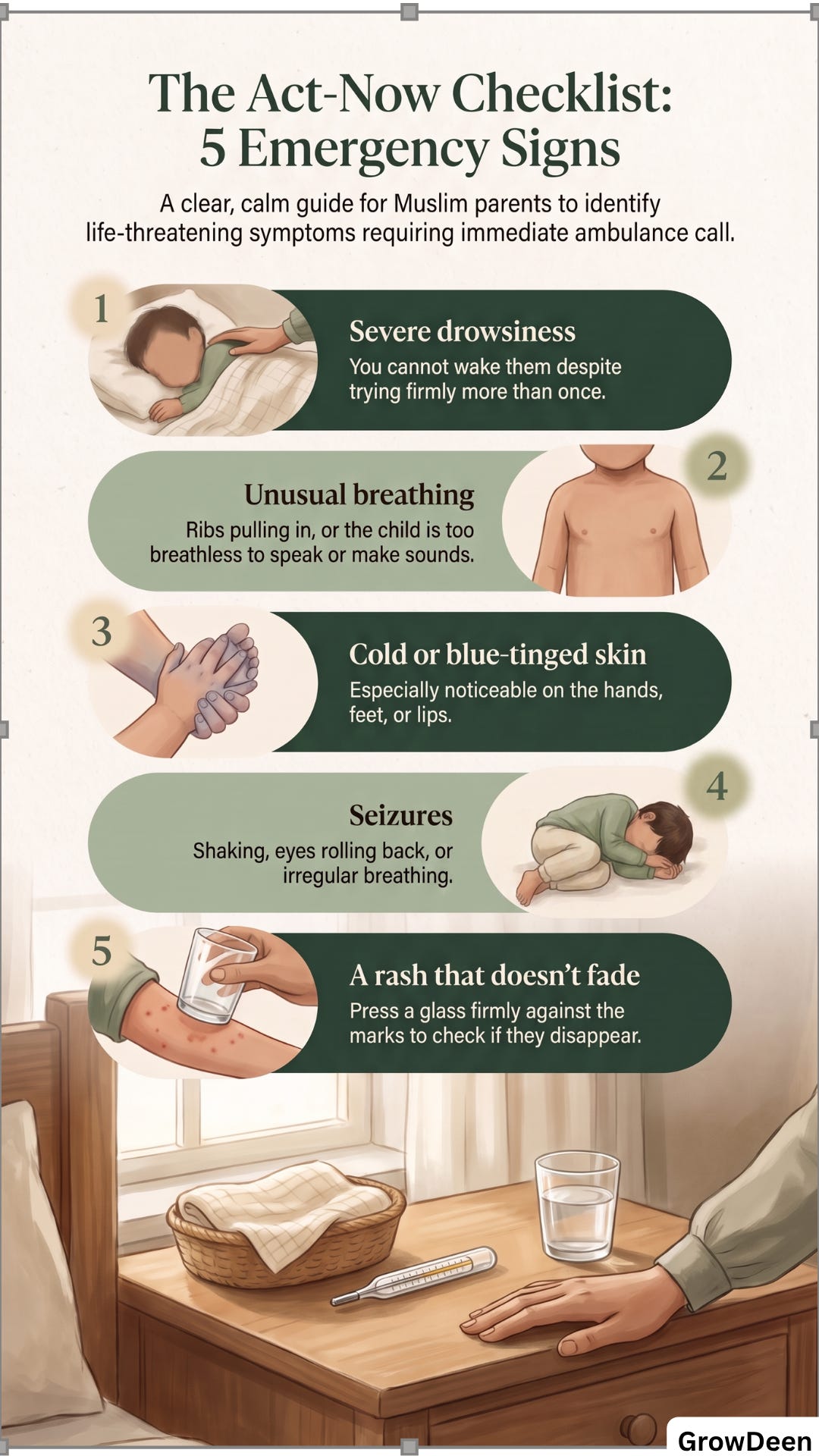
The 5 Signs That Mean: Call an Ambulance
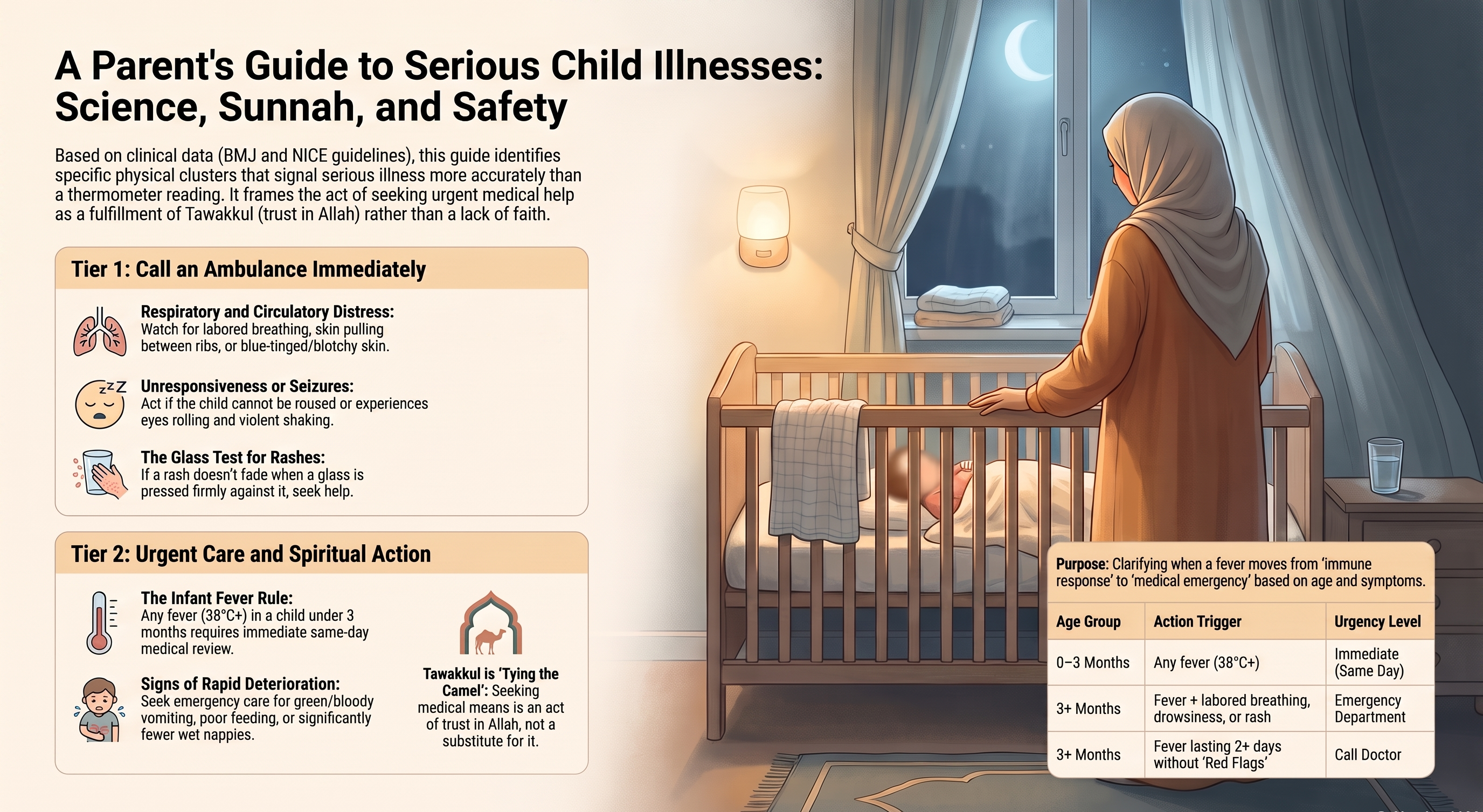
Call your local emergency number (911, 999, 000 — whichever applies to you) and ask for an ambulance if you see:
1. Severe drowsiness or unresponsiveness. Some sleepiness after a feed is normal. A child you cannot rouse, despite trying firmly more than once, is not.
2. Difficulty or unusual breathing. Watch for laboured breathing, the skin between the ribs pulling inward with each breath, a persistent wheeze, or a child too breathless to speak or make sounds.
3. Cold hands or feet, or pale, blotchy, or blue-tinged skin. This can signal poor circulation or low oxygen — sometimes from something as serious as pneumonia. [2]
4. Seizures. Eyes rolling back, violent shaking, irregular breathing. At this age it’s most often a febrile seizure, and children usually recover fully — but it still needs an urgent check, every time. [4]
5. A rash that doesn’t fade under pressure. Press a clear glass firmly against the marks. If they’re still visible through the glass, this can be an early sign of meningococcal infection. This one doesn’t get a “let’s watch it overnight.” [2]
That fourth sign — unresponsiveness — deserves one more sentence, because it’s the easiest to talk yourself out of. It can point to low blood sugar or, less commonly, a brain infection like meningitis. [2] Neither of those is something to sleep on.
The 4 Signs That Mean: Go Straight to Emergency
These don’t need an ambulance necessarily. They do need a hospital, without delay.
1. Persistent irritability, or crying that won’t settle. All babies cry — that’s their whole communication system. A high-pitched, unusual cry, or a child inconsolable no matter what you try, is a different thing.
2. Noticeably less urine than usual — roughly under half their typical number of wet nappies in a day.
3. Poor feeding, or a sudden total lack of interest in feeding.
4. Frequent, blood-stained, or green vomiting — especially with severe stomach pain, or a child who can’t keep fluids down for 12 hours (under age five) or 24 hours (over five). [3]
Here’s the thing about vomiting most parents get wrong: the vomiting itself is often the body doing exactly what it’s built to do — clearing something unwanted. What actually causes harm is what it can lead to. Dehydration. Chemical shifts in a small body that can move faster than you’d expect. [3]
I know this is a lot to hold in your head, especially at 2 a.m. with a hot, unhappy toddler in your arms. That’s exactly why I built a free Act-Now Companion Pack — a printable guide with this entire list formatted for a glance, not a re-read. Keep going, and you’ll get it at the end of this article.
Support Muslim Parenting Lab ❤️
Worried that giving will leave you with less? Give an amount you will not feel, with the button below.
The Prophet ﷺ said charity does not decrease wealth. (Sahih Muslim 2588)
What About Fever Specifically? When Does It Actually Matter?
A fever is a temperature above 38°C, and on its own, it’s not the enemy. It’s the immune system doing its job. [4]
Get medical attention right away — same day, not “let’s see” — if your child has a weakened immune system and develops any fever, or if they’re 0–3 months old and have a fever at all. At that age, even a mild-looking fever gets a medical review, full stop. [4]
Past three months, see a doctor if the fever has lasted two days or more, or comes with laboured breathing, drowsiness, dehydration signs, a stiff neck, sensitivity to light, vomiting, a rash, a febrile seizure, or pain that isn’t easing with medicine. [4][5]
And if none of those boxes are checked, but something still feels off? That’s still worth a phone call. You don’t need to justify a call to a doctor with a checklist.
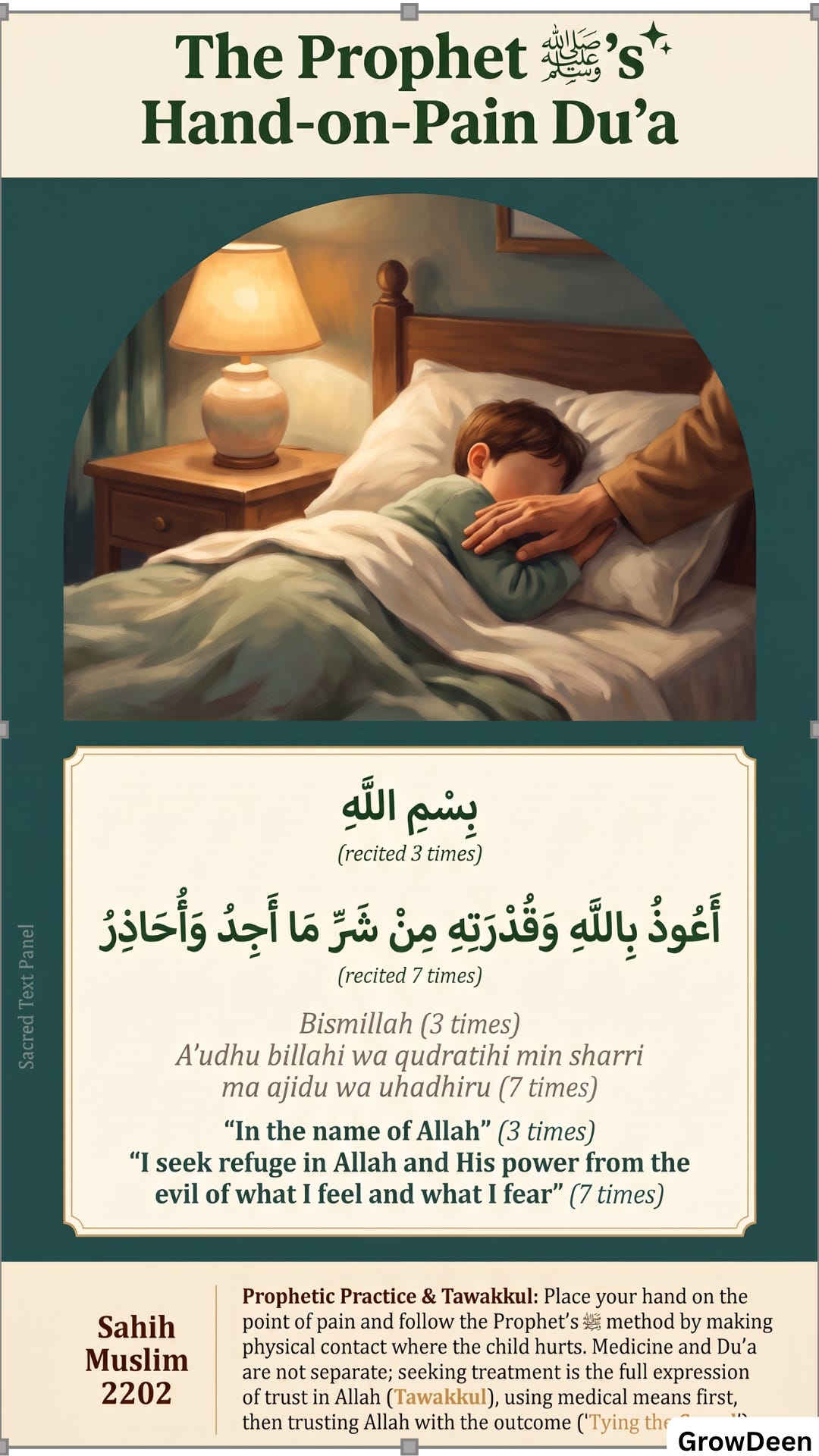
The Islamic Framework for Acting Fast: Tawakkul in a Crisis
There’s a verse I keep coming back to when I think about moments like these — the ones where a parent has to move fast and trust at the same time. Allah says: “And if Allah touches you with adversity, there is no remover of it except Him…” [Quran 6:17] [6]. According to Tafsir Ibn Kathir, this verse establishes that Allah alone brings benefit or lifts harm — no medicine, hospital, or circumstance acts independently of His decree.
Read on its own, that might sound like a case for standing still. It’s the opposite. Because ultimate healing rests with Allah, reaching for the means He placed in this world — a hospital, a doctor, an ambulance — is an act of trust in Him, not a substitute for it. Tawakkul was never about waiting. It’s tying the camel first, then trusting Allah with what happens after.
The Prophet ﷺ knew severe illness personally. Ibn Mas’ud once sat with him during an intense fever and remarked on how high it was. The Prophet ﷺ told him it was as severe as two men’s fever combined, and added that no harm, however small, touches a Muslim without Allah removing some of their sins because of it, “as a tree sheds its leaves” [Sahih al-Bukhari 5647] [7]. There’s something steadying in that. Illness in your child isn’t a sign of Allah’s displeasure. It can carry mercy inside it — while still demanding everything you’ve got as a parent in that moment.
Hold both truths at once: move immediately, without the guilt that sometimes creeps in when parents worry they’re overreacting. And trust, underneath the movement, that you are not carrying this alone.
What to Do — and What Not To
Do keep emergency numbers saved in your phone, and, if you can, written somewhere visible at home. Do make du’a in the car on the way, not instead of driving there. Do trust the instinct that something’s wrong, even without a textbook symptom in front of you.
Don’t wait “to see if it gets better” once an ambulance-level sign is present. Don’t let embarrassment about false alarms slow you down — every parent who’s worked emergency medicine will tell you cautious parents are the easy ones. And don’t rely on a thermometer reading alone; how your child looks and behaves usually tells you more than the number does. [4]
If you’ve read this far, you’re the kind of parent who takes this seriously — not out of anxiety, but out of protective love. That tells me something good about you.
Inside the Act-Now Companion Pack (one comprehensive PDF, 3 pages):
Page 1: The Ambulance-Now Checklist — All five ambulance-level warning signs on one scannable card, with the glass-test rash instructions included — designed as a printable card you can keep on the fridge or saved in your phone’s photo album for a glance in a panic.
Page 2: The Emergency-Department Guide & Fever Decision Chart — The four emergency-level signs plus a simple age-based fever flowchart (0–3 months / over 3 months), so you can decide in under 30 seconds whether tonight is a “call the doctor tomorrow” night or a “go now” night.
Page 3: Tawakkul in a Crisis — An Islamic Reminder Card — A short, printable reflection built around Qur’an 6:17 and the Prophet’s ﷺ own experience of severe fever, plus a simple three-line reminder to say to yourself in the car: act now, trust Allah, you are not alone in this.
This isn’t just a PDF to download and forget. It’s built to live in your phone or on your fridge — exactly where you’ll need it, at exactly the hour you’ll need it.
This companion pack is what every subscriber receives with each article. We cover the full journey of raising Muslim children — from newborns through the school years — all backed by research and rooted in Sunnah-rooted wisdom.
Before you keep scrolling, do this: save your local emergency number in your phone right now, under a name you’ll actually search for at 2 a.m. — something like “EMERGENCY — CALL FIRST.” I’ll wait.
May Allah place barakah in your watchfulness, ease your fear in the moments that call for speed, and make the care you give more protective and more rewarded than it ever feels in the moment.
Share This With Someone Who Needs It
Think of one person right now: the friend at the masjid with a newborn who still texts you at odd hours asking “is this normal,” a sister whose toddler just started daycare and is catching every bug going around, someone in your family WhatsApp group who’s never had to think about febrile seizures until now.
This could be the difference between ten wasted minutes and ten minutes that mattered. Share it with them today — not because you’re being dramatic, but because you care. Sometimes the most loving thing we can do is pass along exactly what to watch for, before anyone needs it.
Frequently Asked Questions
Q: What’s the difference between calling an ambulance and going to the emergency department myself?
A: The five ambulance-level signs (drowsiness, breathing trouble, cold/blue skin, seizures, a non-fading rash) mean the situation can deteriorate in minutes, so paramedics on the way matters. The four emergency-level signs still need urgent hospital care, just not necessarily an ambulance en route. See “The 5 Signs” and “The 4 Signs” sections above for the full lists.
Q: My baby has a fever but seems otherwise fine. Do I need to worry?
A: Not necessarily — fever alone rarely means serious illness, and it’s actually a sign the immune system is working. [4] The exception is age: under 3 months old, any fever gets a same-day medical review regardless of how the baby otherwise seems.
Q: How do I actually do the “glass test” for a rash?
A: Press a clear drinking glass firmly against the rash or spots. If the marks are still visible through the glass — meaning they haven’t faded under the pressure — seek emergency care immediately. This can be an early sign of meningococcal infection. [2]
Q: Is a febrile seizure dangerous long-term?
A: Most children recover completely from febrile seizures with no lasting effects. [4] That said, any first seizure still needs an urgent medical check to confirm what’s happening — you don’t get to skip that step just because febrile seizures are usually benign.
Q: I feel like I’m always the “paranoid parent” at the doctor’s office. How do I know when I’m overreacting?
A: You’re probably not. Clinical guidelines explicitly count parental concern as a genuine risk indicator, not a nuisance factor. [4] If something feels wrong and you can’t name why, that instinct is still worth acting on — worst case, you get reassurance, which is never wasted.
Q: Does making du’a instead of rushing to the hospital show more trust in Allah?
A: No — and this is worth being direct about. Islamic scholarship is clear that seeking medical treatment is part of tawakkul, not separate from it. [6] The Prophet ﷺ himself experienced severe illness and never treated seeking help as a lack of faith. Make du’a on the way, not instead of the way.
References
[1] Craig, J.C., Williams, G.J., Jones, M., Codarini, M., Macaskill, P., Hayen, A., Irwig, L., Fitzgerald, D.A., Isaacs, D., & McCaskill, M. (2010). The accuracy of clinical symptoms and signs for the diagnosis of serious bacterial infection in young febrile children: Prospective cohort study of 15,781 febrile illnesses. BMJ, 340, Article c1594. https://doi.org/10.1136/bmj.c1594
[2] Van den Bruel, A., Haj-Hassan, T., Thompson, M., Buntinx, F., & Mant, D. (2010). Diagnostic value of clinical features at presentation to identify serious infection in children in developed countries: A systematic review. The Lancet, 375(9719), 834–845. https://doi.org/10.1016/S0140-6736(09)62000-6
[3] Sullivan, J.E., & Farrar, H.C. (2011). Fever and antipyretic use in children. Pediatrics, 127(3), 580–587. https://doi.org/10.1542/peds.2010-3852
[4] National Institute for Health and Care Excellence (NICE). (2019, updated 2021). Fever in under 5s: Assessment and initial management [NG143]. https://www.nice.org.uk/guidance/ng143
[5] Barbi, E., Marzuillo, P., Neri, E., Naviglio, S., & Krauss, B.S. (2017). Fever in children: Pearls and pitfalls. Children, 4(9), Article 81. https://doi.org/10.3390/children4090081
[6] Quran, Surah Al-An’am 6:17 — https://quran.com/6/17 — Tafsir Ibn Kathir: https://quran.com/6/17/tafsirs/en-tafisr-ibn-kathir
[7] Sahih al-Bukhari 5647 — Graded: Sahih — https://sunnah.com/bukhari:5647
We combine scientific research with Qur’an and authentic Sunnah, and we cite our sources. Even so, this is general guidance and no substitute for a doctor who can examine your child.