


Clinical research shows up to 60% of infants rock, roll, or bang their heads at bedtime by 9 months old [2]. Here’s what’s actually happening, and the simple changes that keep it safe.
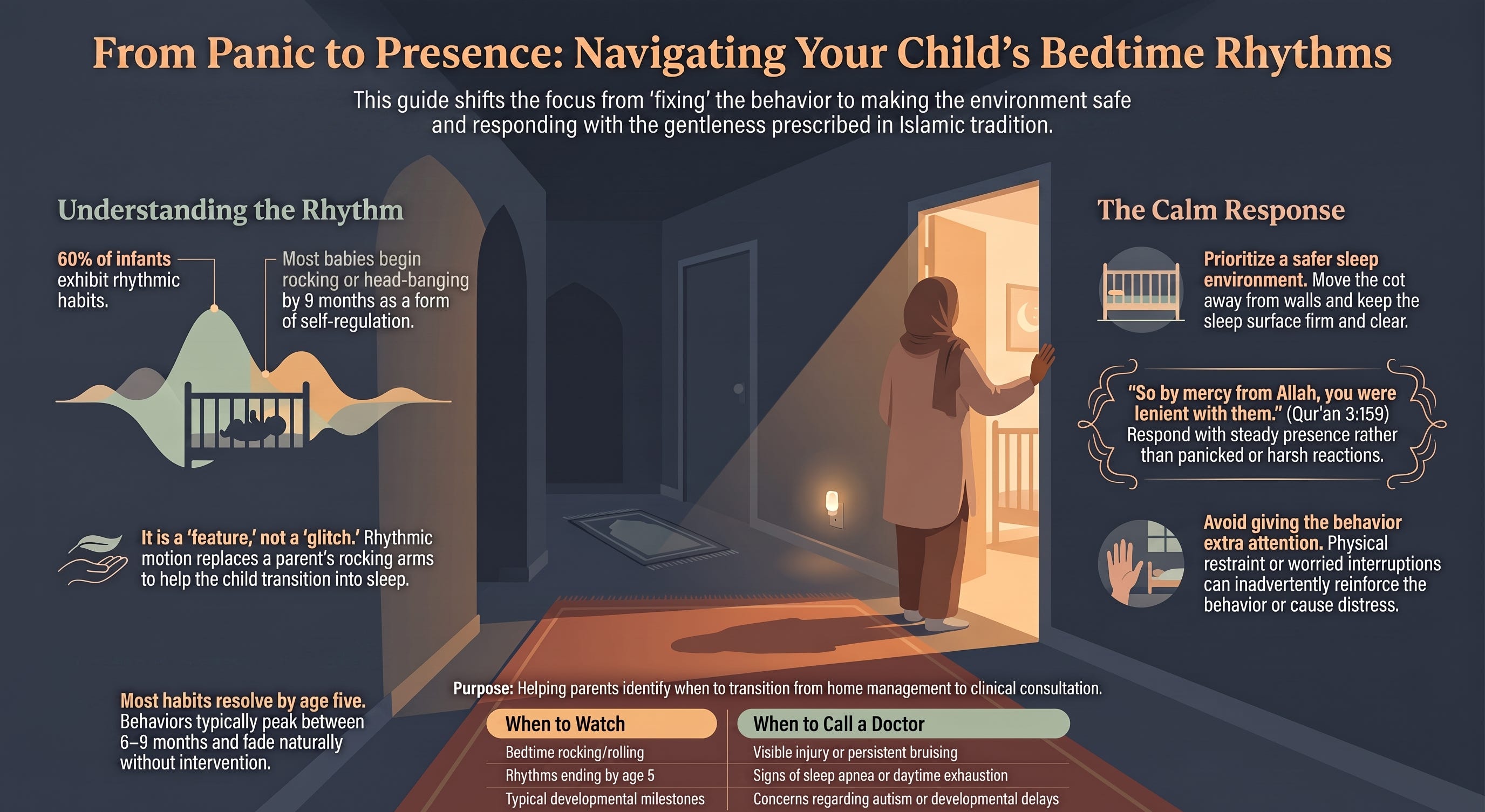
You walk past the nursery and hear it before you see it. A steady thump, thump, thump, coming from the cot. You push the door open and find your toddler up on hands and knees, rocking hard enough to shake the rail, forehead meeting the mattress in a rhythm that looks — for one panicked second — like something’s very wrong.
It isn’t.
You were careful. You babyproofed the outlets, you researched the mattress firmness, you did everything the checklists told you to do. And still, this is the one thing nobody warned you about.
Here’s the number that changed how I think about it: according to research published in Paediatrics and Child Health, up to 60% of infants are rocking, rolling, or banging their heads at bedtime by the time they’re 9 months old [2]. Not a handful of unusual babies. More than half.
Why This Guide Is Different
Backed by real sleep medicine research, not guesswork. Every claim here comes from peer-reviewed clinical literature published between 2012 and 2023 — not forum advice or secondhand tips.
Grounded in Islamic wisdom, not bolted onto it. This isn’t safety tips with a verse pasted at the end. It’s about the specific mercy Allah calls a parent to bring into a midnight room.
You get a free Calm Rocking Nights Companion Pack — a printable reference for exactly this moment, not another thing to remember.
Rhythm as Regulation: Why Babies Do This
Here’s what surprised me most in the research: this isn’t a glitch in your child’s development. It’s closer to a feature.
The rhythmic motion — the rocking, the rolling, the steady thud of a forehead against a mattress — appears to work the same way your rocking arms or a slow lullaby once did. It’s regulation through rhythm [2]. As babies grow and start connecting cause and effect, some simply take over that soothing job themselves. Their own body becomes the thing that used to belong to your arms.
This shows up in a few recognizable forms:
Rocking on hands and knees, forehead tapping the headboard or cot rail with each swing
Sitting up and banging the back of the head steadily against a solid surface
Lying face-down, pressing head and chest rhythmically into the mattress
Rolling the head or whole body side to side, sometimes humming along with the motion
Body-rocking tends to show up first, often around 6 months old. Head-rolling and head-banging usually follow a bit later, closer to 9 months [3]. And the form isn’t fixed — a child banging their head at their first birthday might switch to rolling by age two [3]. Most children have left the whole thing behind by around age five [1].
Make the Space Safer. Don’t Try to Stop the Motion.
Here’s the instinct almost every parent has, and here’s why it doesn’t work: trying to physically hold a rocking child still. It doesn’t calm them down. It usually just turns a self-soothing moment into a wrestling match.
What actually helps is changing the environment, not fighting the behavior.
Move the bed or cot away from walls, bedside tables, and anything hard or sharp nearby — a hard swing shouldn’t be able to connect with furniture. If your child has moved to a bed, putting the mattress directly on the floor, away from walls, cuts down both the bruising risk and the noise. And pay attention to how long your child is lying awake before actually falling asleep — too much unoccupied time in bed tends to make rocking and head-banging more frequent, so a steady, unhurried wind-down routine that flows more directly into sleep genuinely helps.
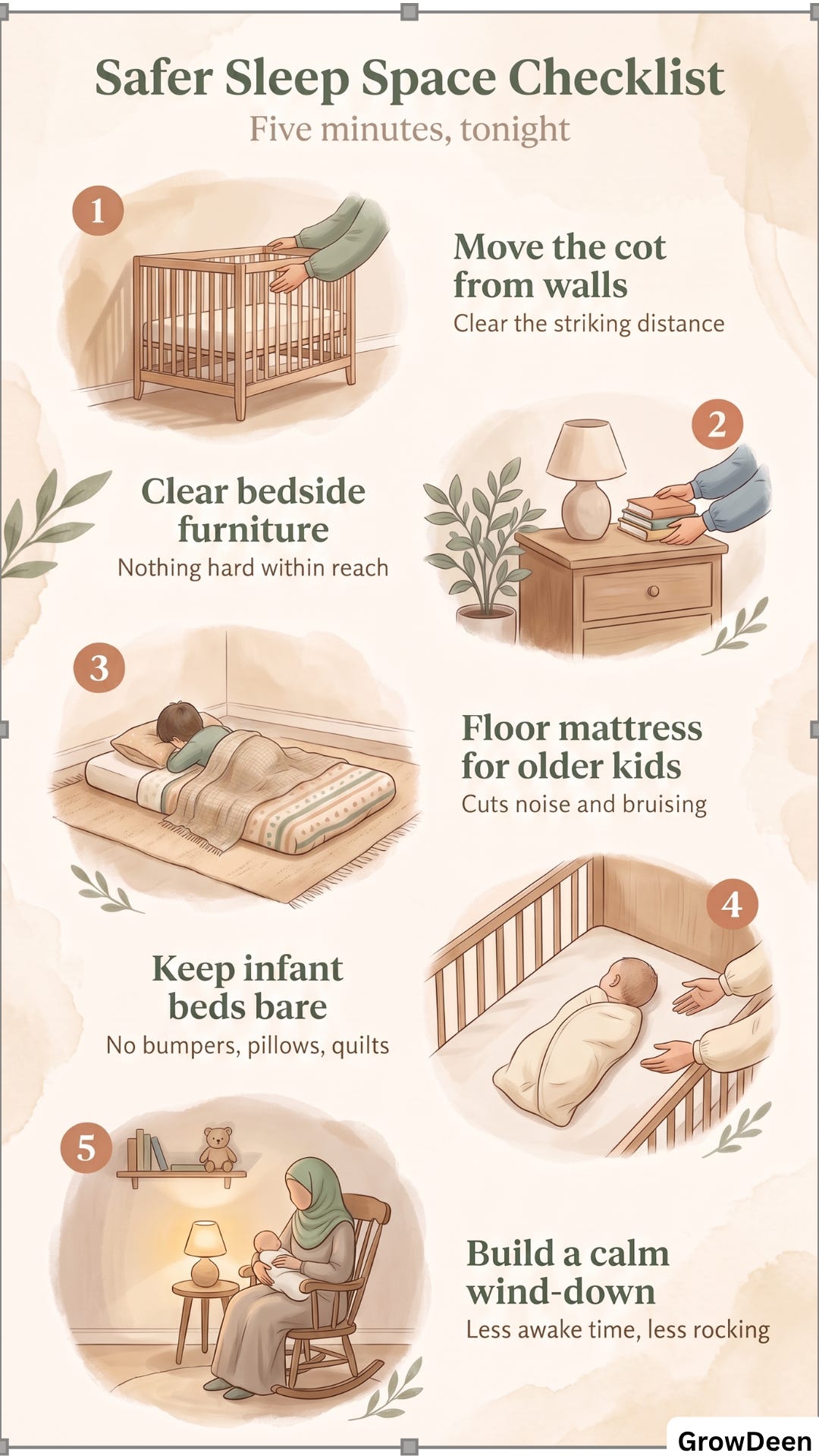
Here’s the counterintuitive part: try not to give the behavior extra attention. If your child senses that rocking or banging reliably pulls a worried parent into the room, they may do it more — not out of manipulation, but because your closeness is itself calming, and children learn fast what earns that closeness.
For babies under 12 months specifically, keep the sleep space clear regardless of any rocking — no bumpers, pillows, quilts, or soft toys. A firm, flat, uncluttered surface, baby on their back, remains the safest setup and meaningfully lowers the risk of sudden unexpected death in infancy, including SIDS [4].
I know this is a lot to hold onto while you’re already running on broken sleep yourself. That’s exactly why I put together something you can actually use in the moment — I’ll tell you about it in a minute.
The Islamic Framework for a Frightening Midnight Moment
There’s a particular reaction almost every parent has the first time they see this: the urge to grab the child, stop the motion, make it not be happening. I understand that instinct completely. I also want to gently push back on it.
Allah says of the Prophet ﷺ, “So by mercy from Allah, you were lenient with them. And if you had been rude in speech and harsh in heart, they would have disbanded from about you” [Qur’an 3:159] [7]. When I sat with this ayah, something clicked. According to Tafsir Ibn Kathir, this gentleness wasn’t incidental to the Prophet’s ﷺ character — it was a mercy Allah specifically placed within him, and Ibn Kathir notes plainly that harshness in its place would have pushed people away rather than kept them close.
I think about that standing over a rocking cot at midnight. A frightened or sharp reaction doesn’t make the rocking stop. It just adds tension to a moment where your child was already trying, in their own clumsy way, to calm themselves.
What this asks of you isn’t complicated. It’s the same disposition described in the ayah — steady instead of harsh, present instead of panicked. A parent who responds with a soft voice and a safer room is living closer to that mercy than one who reacts with visible fear. Some families find it grounding to have gentle adhkar or quiet Qur’an recitation playing low during the wind-down hour, less as a fix for the rocking and more as a way of keeping the whole room — and the parent standing in it — calm. What strikes me is how naturally the research and this teaching line up: a calmer environment reduces how often the behavior happens, and this ayah says a calmer disposition is the very mercy Allah built into how people, including small, half-asleep people, respond to us.
I Made You Something for This Exact Moment
I know 11pm doorway-panic isn’t the time to reread an article. That’s why I put together the Calm Rocking Nights Companion Pack — a printable guide built for the moment itself, not the moment after. Keep reading and you’ll find it waiting at the end of this piece.
When to Talk to a Doctor
Most children who are thriving during the day, and who only rock or bang their heads while settling at night, don’t need medical attention. It’s still worth a conversation with your child’s doctor or paediatrician if:
There’s visible injury. Head-banging can leave red marks, mild bruising, or a thickened patch of skin. Usually harmless — but persistent or worsening marks are worth mentioning.
Your child snores or seems unusually tired during the day. A doctor can check for anything else disrupting sleep, like obstructive sleep apnoea.
Something about your child’s overall wellbeing concerns you. Rocking and head-banging can sometimes intensify during periods of stress or anxiety.
Your child is autistic or has other developmental needs. The behavior can be more intense in some children with developmental delay, autism, or vision impairment. It’s rarely harmful, but a specialist can offer tailored guidance.
If you do plan to raise it with a doctor, filming a short video of an episode beforehand helps them far more than a verbal description alone.
When It Has a Clinical Name
Occasionally, rocking, rolling, or head-banging becomes intense enough to seriously disrupt sleep or cause real injury. At that point, it has a specific name: sleep-related rhythmic movement disorder. It’s estimated to affect around 1% of babies and toddlers [1][5][6] — and like the far more common, milder version of this behavior, it tends to ease with age rather than worsen.

The Calm Rocking Nights Companion Pack
There’s a particular kind of tired that comes from standing in a doorway at midnight, watching your child rock themselves to sleep, wondering if you’re supposed to be doing something about it. I didn’t want to leave you with just an article for that moment — I wanted to leave you with something you could actually reach for.
Inside the Calm Rocking Nights Companion Pack (one comprehensive PDF, 3 pages):
Page 1: “Is My Child’s Rocking Normal?” Quick Reference Card — An instant-reassurance checklist plus a simple age guide (6 months, 9 months, 5 years) — designed as a card you can keep on your phone or pinned near the nursery for the exact moment you need it.
Page 2: Safer Sleep Space Setup Checklist — A practical, tick-box list for making the bed or cot safer tonight, so you can walk into the nursery and make every change in under five minutes.
Page 3: Responding with Gentleness — An Islamic Reflection Card — A short reflection built around Qur’an 3:159 on gentleness over harshness, written for the parent standing in the doorway, not the child in the cot.
This isn’t a PDF to download and forget. It’s built to live on your phone or your fridge — wherever you’ll actually reach for it at 11pm.
This companion pack is what every subscriber receives with each article here. We cover the full arc of raising Muslim children — grounded in research, held together by Islamic wisdom.
If you want both of those in your inbox before you need them, subscribe for free.
You’ll only hear from us when there’s something worth your time — no spam, no daily clutter, just guidance that’s genuinely hard to find anywhere else.
One Thing to Do Right Now
Before you keep scrolling: go check what’s next to your child’s bed or cot. Move anything hard, sharp, or breakable at least an arm’s length away. Right now. It takes ninety seconds and it’s the single highest-value thing in this whole article.
May Allah place barakah in your effort tonight, and make your calm the thing your child feels first.
Someone You Know Needs This Tonight
Think of one person right now — the tired parent at the masjid who mentioned their toddler’s been “banging their head like crazy” and looked embarrassed saying it out loud, or your sister who texted you a shaky video at 1am asking if this is normal.
This article could turn their fear into a plan. Share it with them tonight — not because you’re lecturing, but because you remember what that doorway moment felt like before you knew any of this.
Frequently Asked Questions
Q: Is head-banging in toddlers normal?
A: Yes — for most toddlers, it’s a common self-soothing behavior, not a sign of illness or distress. Up to 60% of infants show some form of rhythmic movement by 9 months old [2]. For the full picture of what’s typical and what’s not, see “Rhythm as Regulation” above.
Q: What age does rocking or head-banging usually start and stop?
A: Body-rocking tends to begin around 6 months, with head-rolling or head-banging following around 9 months [3]. Most children stop entirely by around age five [1].
Q: Should I stop my child from rocking or banging their head?
A: Trying to physically stop the motion usually doesn’t work and can add distress to a moment your child is using to calm down. Focus on making the space safer instead — see “Make the Space Safer” above for exact steps.
Q: Can head-banging cause brain damage?
A: In typically developing children who only do this at bedtime, serious injury is rare, and this behavior is not associated with brain damage. Mild bruising or a thickened skin patch on the forehead can occur and is usually harmless [1].
Q: Is rocking or head-banging a sign of autism?
A: Not on its own — the vast majority of children who rock or bang their heads at bedtime are typically developing. That said, the behavior can be more intense and more likely to occur during the day in some autistic children or children with other developmental needs, which is worth mentioning to a paediatrician if you’re noticing other signs [1].
Q: When should I take my child to a doctor about this?
A: See a doctor if there’s visible injury, if your child snores or seems unusually tired during the day, or if you have broader concerns about their wellbeing. A short video of an episode is genuinely helpful for that appointment.
References
[1] Del Rosso, L.M., Cano-Pumarega, I., & Anguizola, S.S. (2021). Sleep-related rhythmic movement disorder. Sleep Medicine Clinics, 16(2), 315–321. https://doi.org/10.1016/j.jsmc.2021.02.007
[2] Haywood, P., & Hill, C. (2012). Rhythmic movement disorder: Managing the child who head-bangs to get to sleep. Paediatrics and Child Health, 22(5), 207–210. https://doi.org/10.1016/j.paed.2012.02.010
[3] Gwyther, A.R., Walters, A.S., & Hill, C.M. (2017). Rhythmic movement disorder in childhood: An integrative review. Sleep Medicine Reviews, 35, 62–75. https://doi.org/10.1016/j.smrv.2016.08.003
[4] Mindell, J.A., & Owens, J.A. (2015). A clinical guide to paediatric sleep: Diagnosis and management of sleep problems (3rd ed.). Wolters Kluwer.
[5] Laganiere, C., Pennestri, M.H., Rassu, A.L., Barateau, L., Chenini, S., Evangelista, E., Dauvilliers, Y., & Lopez, R. (2020). Disturbed nighttime sleep in children and adults with rhythmic movement disorder. Sleep, 43(12), 1–8. https://doi.org/10.1093/sleep/zsaa105
[6] Joels, H., Benny, A., Sharpe, A., Postigo, B., Joseph, B., Piantino, C., Marshall, A., Hewertson, V., & Hill, C.M. (2023). Sleep related rhythmic movement disorder: Phenotypic characteristics and treatment response in a paediatric cohort. Sleep Medicine, 112, 21–29. https://doi.org/10.1016/j.sleep.2023.09.020
[7] Qur’an, Surah Ali ‘Imran 3:159 — https://quran.com/3/159 (Tafsir Ibn Kathir: https://quran.com/ali-imran/159/tafsirs/en-tafisr-ibn-kathir)