

A 2018 review in Sleep Medicine Reviews found that up to 95% of parents already keep some kind of bedtime routine [1] and a 2024 JAMA Pediatrics study of over 9,000 adolescents found that screen use in the hour before sleep still predicted worse sleep disturbance a full year later [8]. Here’s what actually works, at every age, and why the order matters more than the activities.
There’s a specific kind of tired that comes from bedtime not working. Not your child’s tiredness. Yours.
It’s 8:47pm. The story has somehow requested a sequel. There is an urgent, previously unmentioned thirst. Someone’s sock feels “wrong.”
You were careful. You did the bath, the books, the whole thing — and you’re still standing in a doorway at 9:15 negotiating with a six-year-old about the metaphysics of “just one more minute.” I know that feeling, and I’m not here to tell you to simply try harder.
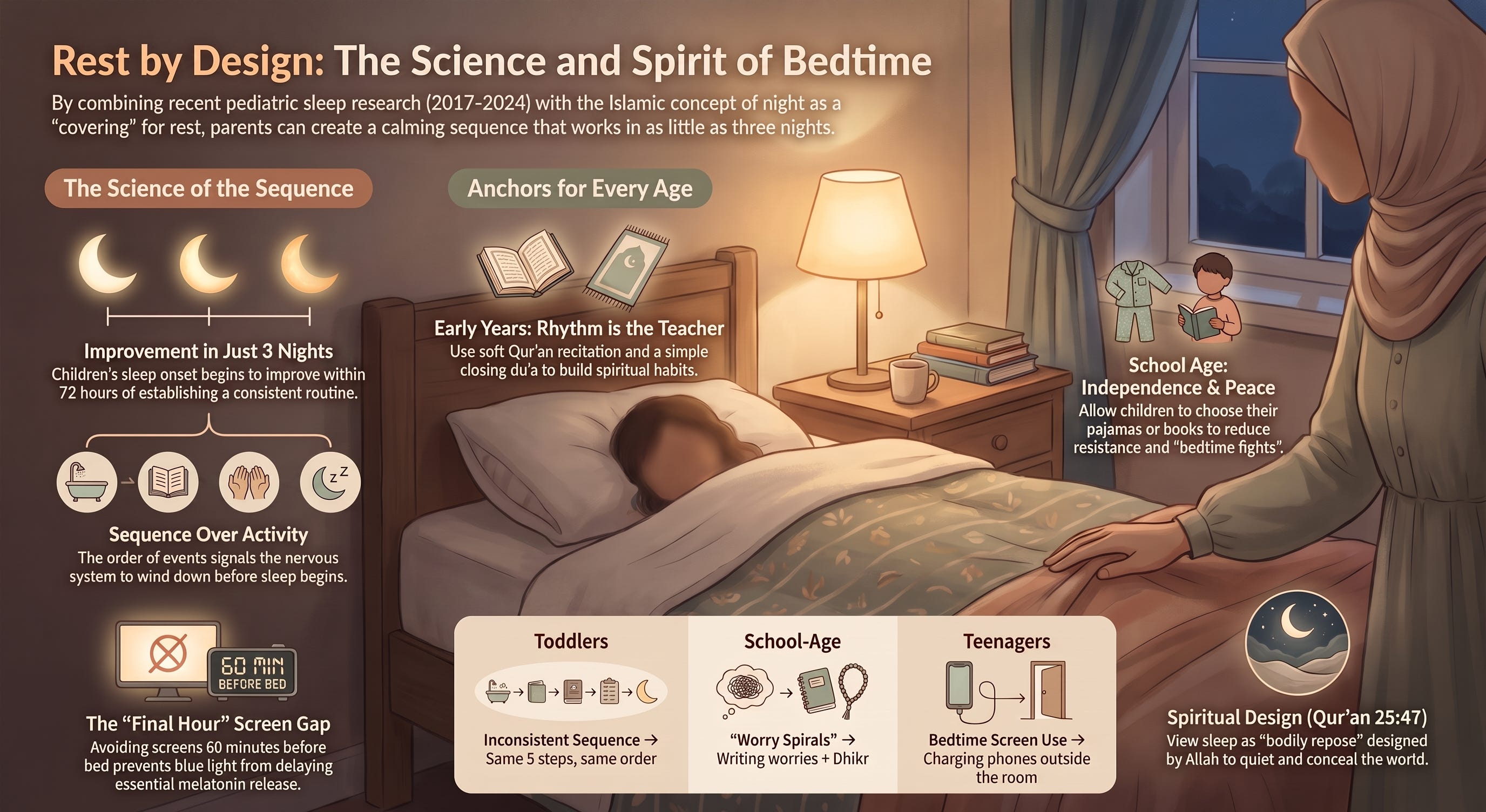
Here’s what changed things for me: consistency matters far more than the specific activities do. When Mindell and Williamson reviewed the research in 2018, they found that somewhere between 81% and 95% of parents already have some version of a bedtime routine [1] — and that children’s sleep onset actually starts improving within the first three nights of one becoming consistent [1]. Not weeks. Nights.
Why This Guide Is Different
Backed by current sleep research, not folk wisdom. Every recommendation here draws on peer-reviewed pediatric sleep studies from 2017–2024, including fresh 2024 data on teen screen use and sleep [1–8].
Built around Islamic rhythm, not bolted onto it. This isn’t safety tips with a du’a tacked on at the end — it’s grounded in the Qur’an’s own description of night and sleep as something Allah designed with intention.
Comes with an actual tool, not just advice. You’ll get The Steady Night Routine Pack — a fill-in planner and age-by-age reference card, free, to print and keep where bedtime actually happens.
What a Bedtime Routine Is Actually Doing
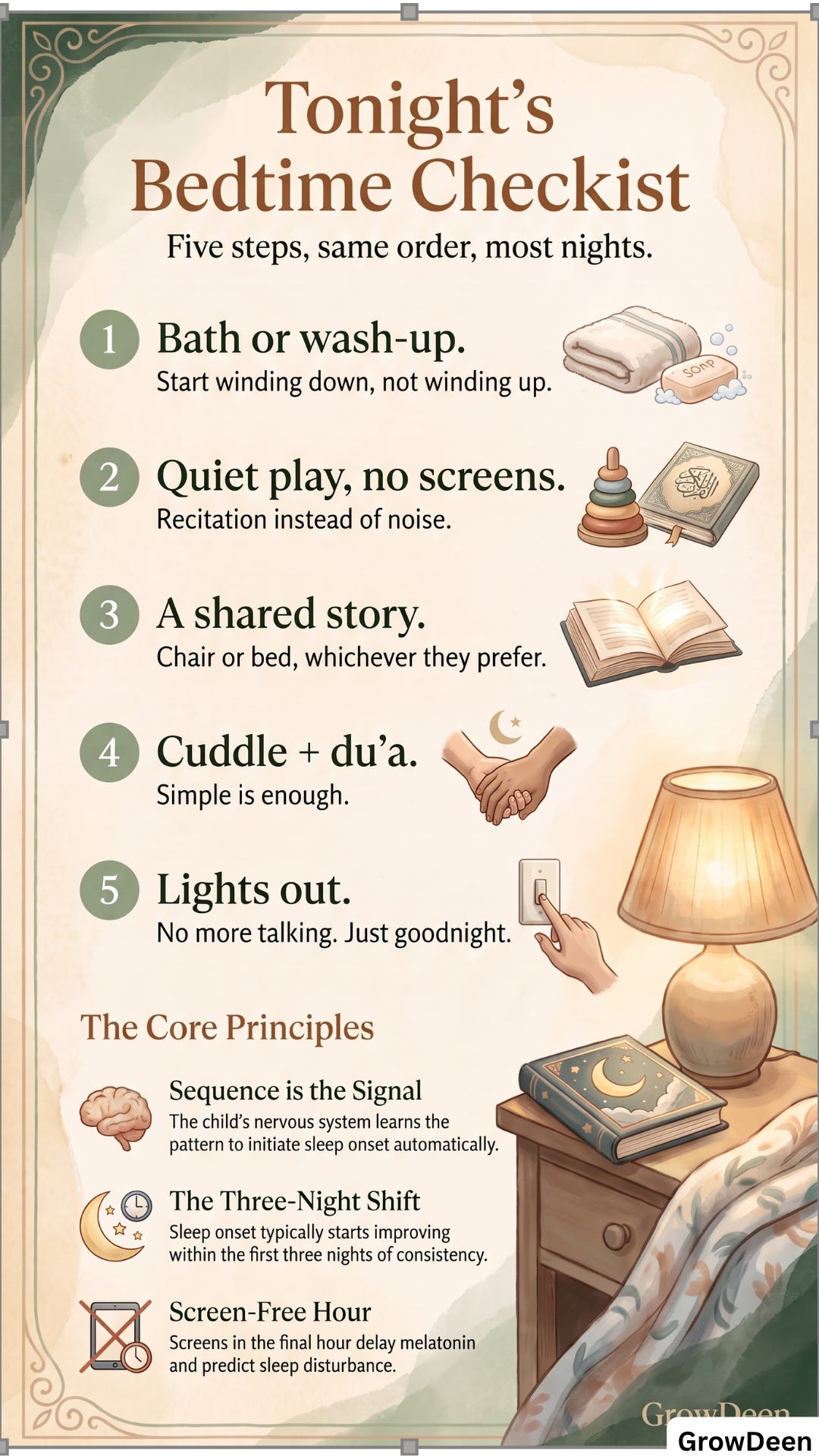
A bedtime routine is embarrassingly simple in concept: the same handful of things, in the same order, most nights. Bath, story, bed. Or dinner, quiet play, teeth, du’a, lights out.
Here’s the part most parents miss. It’s not the activities doing the work. It’s the sequence.
A child’s nervous system learns the pattern and starts winding down before you’ve said “time for bed” — because step four means step five is coming, and step five means sleep [1][4]. Skip the routine, and you’re asking a child to locate “tired enough to comply” purely through internal sensation. If you’ve ever tried reasoning a four-year-old into anything using only their own self-awareness, you already know how that goes.
Babies, Toddlers, and Preschoolers: Where the Routine Does Most of the Work
At this age, your child isn’t reasoning their way into sleepiness. The sequence itself is the signal, which takes the pressure off you to somehow “convince” a two-year-old that it’s bedtime.
A version that starts about 20 minutes before bedtime, right after dinner and a bath, might look like this:
Quiet play, 15–20 minutes. Blocks, a puzzle, low conversation. This is an easy spot to swap music or singing for something many Muslim households already lean toward: soft Qur’an recitation playing in the background, or a parent reciting gently while the child settles.
A shared story. An Islamic picture book, a simple retelling from the Seerah, one of the stories of the Prophets. Chair or bed, whichever your child prefers.
Into bed.
Cuddle, goodnight kiss, a short du’a together. It doesn’t need to be elaborate — asking Allah for a peaceful night and a good morning is enough.
A clean close. No more stories. No more talking. Goodnight, dim the light, leave.
Same routine, same rough bedtime, most nights, weekends included where you can manage it. Give it a few weeks and you’ll typically see fewer settling struggles, fewer “one more thing” calls after lights out, and — almost as a side effect — a calmer last twenty minutes of the day for everyone [4][6]. Most paediatric guidance supports starting a gentle version of this from around three months old, run alongside whatever else your family is doing to help sleep along [3][6].
One thing worth naming directly for Muslim parents: this is also the age where a child absorbs rhythm before they absorb meaning. They won’t understand why you say Bismillah or a short du’a every night for a long while yet. That’s fine. The repetition is doing the teaching. Meaning tends to arrive later, once the habit already has somewhere to land.
School-Age Children: More Independence, Same Backbone
More independence here — a child who brushes their own teeth, picks their own pyjamas, maybe wants a say in the routine itself, which is worth allowing. A routine your child helped shape is one they’re less likely to fight you on.
A workable shape for this age:
Homework before dinner, schedule permitting, so the evening stays unrushed.
Bath or shower.
A calm activity — drawing, a quiet game, reading. Keep the hour before bed screen-free; children who wind down without one tend to fall asleep noticeably faster [5][7].
A shared story in bed — read by you, or increasingly, read to you.
Cuddle, goodnight, and a du’a. This is a good stretch of years to teach a du’a your child will eventually carry with them, not just recite alongside you.
Lights out.
But here’s the thing about anxious kids at this age: two ordinary tools help more than most parents expect. Writing the worry down before the light goes off. And slow, deliberate breathing. Neither replaces actually talking through what’s bothering them during the day — but paired with a few quiet minutes of dhikr, or a du’a said softly once the worry’s been named, both give a spinning mind somewhere to land instead of somewhere to spiral.
Pre-Teens and Teenagers: Looser Schedule, Same Backbone
Routines loosen here, and they should. A part-time job, a heavier homework load, sport, a friend who texts at 9:15 — bedtime moves around more than it used to, and fighting that is mostly a losing battle.
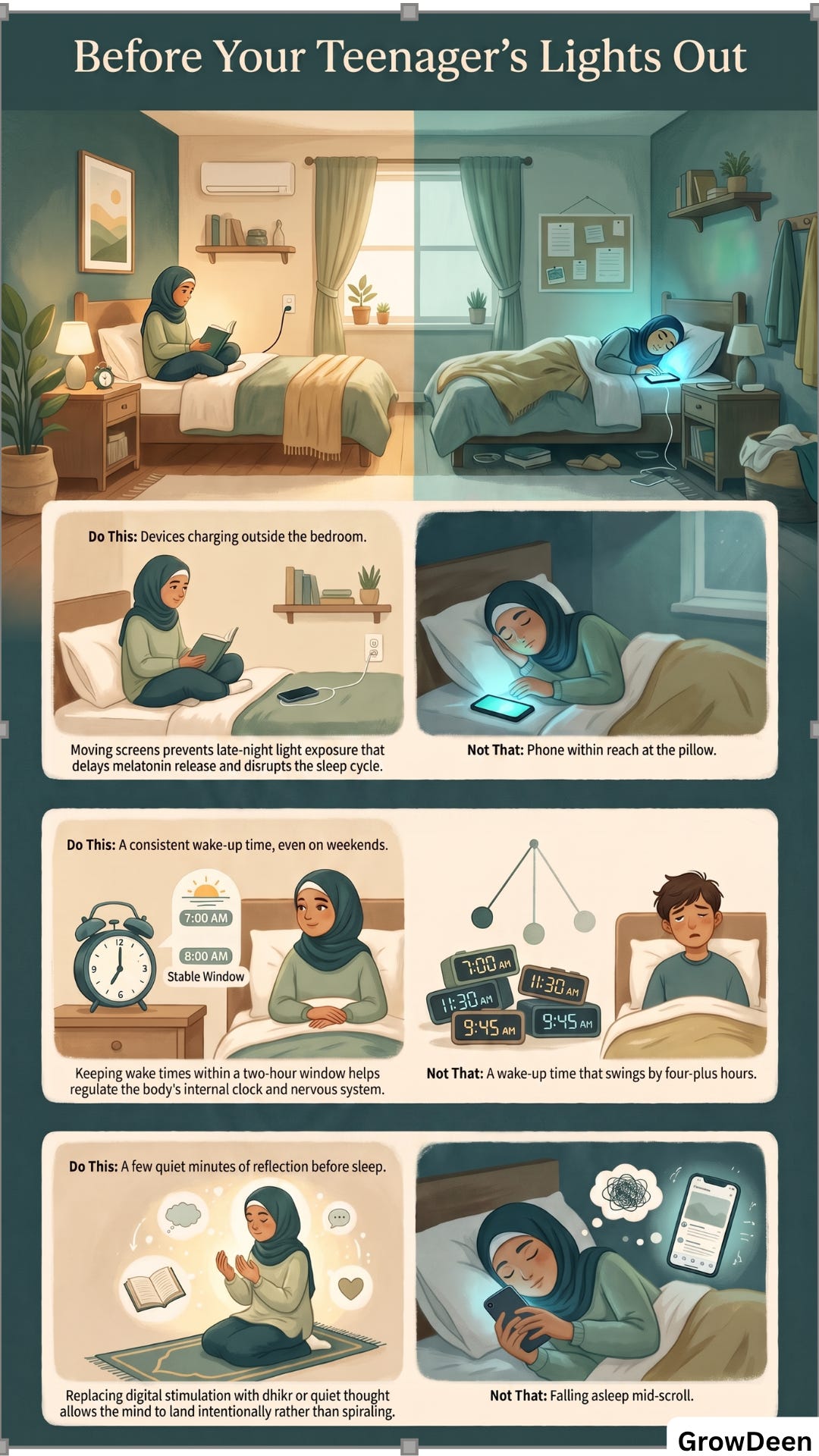
What still helps, even on a looser schedule, is the same short sequence at the end of the night: devices away, shower, some reading or quiet reflection, then sleep. Let your teenager have real input into what actually relaxes them. Some want silence. Some want to talk through their day first. Pretending there’s one right answer for every teenager tends to backfire.
Two things matter more than almost anything else at this age: keeping weekday and weekend wake-up times within about two hours of each other, and getting real daylight and movement during the day [2].
Screens in the hour before bed are worth avoiding here too — and the evidence for why has gotten considerably stronger recently. A 2024 study following more than 9,000 early adolescents found that bedtime screen use specifically — texting, social media, video, gaming — predicted worse sleep disturbance a full year later, independent of how much screen time happened during the rest of the day [8]. It isn’t just the total hours. It’s what’s happening in the window right before sleep, when screen light delays melatonin release and pushes the whole cycle later.
I know what you might be thinking: my teenager will never give up their phone at bedtime. Fair. Nobody’s asking for a phone confiscation policy here. Even moving the charging spot outside the bedroom, or agreeing on a “devices down” time twenty minutes before lights out, measurably helps — small, negotiated change, not an all-or-nothing rule.
This is also the age where a nightly pause for reflection — a few minutes of Qur’an, a short dhikr, simply sitting with the day for a moment before sleep — can do for a teenager what a bedtime story did for them at five. It won’t look the same, and shouldn’t be made to. But the underlying shape, ending the day with something intentional rather than falling asleep mid-scroll, is worth protecting rather than letting it quietly fall away as your child gets older.
I know this is a lot to hold in your head, especially on the nights you’re running on fumes yourself. That’s exactly why I built The Steady Night Routine Pack — a fill-in planner and age-by-age card you can keep wherever bedtime actually happens in your house. Keep reading, it’s waiting for you at the end of this.
Support Muslim Parenting Lab ❤️
Would you rather give a small amount that never stops than a large one you keep postponing? Set a monthly amount you are comfortable with, in a few seconds, using the button below.
The Prophet ﷺ said the deed most beloved to Allah is the most constant, even if little. (Sahih al-Bukhari 6464)
What to Avoid
Don’t reorder the routine night to night — the order is the point, not what’s inside it. Don’t let bedtime creep later in small, unnoticed increments; it happens gradually enough that most families don’t clock it until they’re an hour off from where they started. Keep stimulating screens and loud games out of the final hour. And don’t let the closing du’a or dhikr become a rushed afterthought tacked onto a chaotic evening — the slowness at the close is part of what makes the whole thing work.
When to Actually Worry
Most bedtime resistance improves within a few weeks of consistency. If your child is still fighting sleep hard after a month of a steady routine, waking frequently without resettling, snoring heavily, or dragging through the day despite what looks like enough hours of sleep, that’s worth a conversation with a doctor or paediatrician — not something to keep waiting out on your own.
Rest by Design: What the Qur’an Says About Night and Sleep
I keep coming back to how much of parenting is really just cooperating with something Allah already built, rather than fighting it. When I read the verse where Allah says, “And it is He who has made the night for you as clothing and sleep [a means for] rest, and has made the day for rising” [Qur’an 25:47] [9], I don’t read it as poetic language about sleep. I read it as a description of design.
According to Tafsir Ibn Kathir, the night is described as a covering — something that quiets and conceals the world the way a garment covers the body — and sleep itself is genuine bodily repose, set in direct contrast to the day, which is a rising to renewed activity. Nothing accidental about that pairing.
So when I’m negotiating a bedtime routine with an exhausted toddler, or a teenager who wants ten more minutes on their phone, I try to remember I’m not manufacturing sleep out of nothing. I’m helping a child recognise a rhythm that was already written into how they’re made.
That’s also why a bedtime routine sits so naturally alongside a bit of remembrance. If the night itself is something Allah shaped with intention, then closing it with a du’a or a few quiet minutes of Qur’an isn’t an extra step bolted onto sleep hygiene. It’s honest recognition of what the night already is. The research on consistency and the Qur’anic description of night as rest are pointing at the same thing, from different directions: predictability at the end of the day isn’t a trick. It’s alignment with something already true.
If you’ve read this far, you’re the kind of parent who takes bedtime seriously — not as a battle to win, but as something worth doing right, for your child’s sake and your own sanity. That tells me something good about you.
Inside The Steady Night Routine Pack (one comprehensive PDF, 3 pages):
Page 1: Build Your Family’s Bedtime Routine — A fill-in-the-blank timeline builder with five slots (20 min before, 15 min before, 10 min before, 5 min before, lights out), so your family designs its own sequence instead of following a generic one — designed as a card you can stick to the fridge or a bedroom wall.
Page 2: Age-by-Age Quick Reference — Three stacked cards covering babies/toddlers/preschoolers, school-age children, and pre-teens/teens, so you can glance at exactly what changes as your child grows without re-reading the whole article — usable in under a minute at 8pm when you actually need it.
Page 3: Rest by Design — The Qur’an 25:47 reflection card connecting the practice of a nightly routine to the Islamic understanding of night and rest, with the verse, its source, and a short reflection you can read to yourself or your older child before bed.
This isn’t just a PDF to download and forget. It’s a tool designed to stay on your fridge or in your phone’s photos — where you’ll actually use it at 8:47pm, not just admire it once.
This Steady Night Routine Pack is what every subscriber receives with each article. We cover the full journey of raising Muslim children — from newborns to teenagers — all backed by research and rooted in Islamic wisdom.
Tonight, pick just ONE piece of this to start with — maybe the closing du’a. You don’t have to overhaul bedtime all at once. Start there.
May Allah place barakah in your effort, accept your intention, and make the quiet minutes you give your child each night more protective, more merciful, and more rewarded than they feel in the moment.
Share This With Someone Who Needs It
Think of one person right now: the exhausted parent at the masjid who confided that bedtime is a nightly battle, your sister who’s tired of the “five more minutes” negotiation, a friend whose WhatsApp messages sound exactly like yours did a year ago.
This article could ease their evening. Share it with them today — not as advice-giving, but as support. Sometimes the most loving thing we can do is pass along what actually worked for us.
Frequently Asked Questions
Q: What age should I start a bedtime routine?
A: Most paediatric guidance supports starting a gentle version around 3 months old, alongside whatever else your family is doing to help sleep along [3][6]. It doesn’t need to be elaborate at that age — even a short, consistent sequence helps.
Q: How long does it take for a bedtime routine to actually work?
A: Sooner than most parents expect. Research shows sleep onset starts improving within the first three nights of a consistent routine, with fuller benefits like fewer night wakings and less bedtime resistance developing over a few weeks [1][4].
Q: My toddler fights the routine itself. What am I doing wrong?
A: Probably nothing — toddlers push on structure because that’s developmentally normal, not because the routine has failed. Letting them choose small things within the fixed order (which book, which pyjamas) often reduces the fight without abandoning the sequence. See “Babies, Toddlers, and Preschoolers” above for the full breakdown.
Q: Is it okay to change the order of the routine sometimes?
A: Try not to, even though it’s tempting when you’re short on time. The order is what your child’s nervous system is actually responding to — changing it undermines the predictability that makes the whole thing work.
Q: Should teenagers still have a bedtime routine?
A: Yes, just a looser one. What matters most at this age is keeping weekday and weekend wake-up times within about two hours of each other and avoiding screens in the final hour before sleep — a 2024 study of over 9,000 adolescents found bedtime screen use predicted worse sleep disturbance a year later [2][8].
Q: How do I include du’a in bedtime without it feeling forced?
A: Keep it short and consistent rather than elaborate. A simple du’a asking for a peaceful night, said the same way every night as the last step before lights out, tends to stick far better than something longer that changes each time.
References
[1] Mindell, J.A., & Williamson, A.A. (2018). Benefits of a bedtime routine in young children: Sleep, development and beyond. Sleep Medicine Reviews, 40, 93–108. https://doi.org/10.1016/j.smrv.2017.10.007
[2] Agostini, A., & Centofanti, S. (2021). Normal sleep in children and adolescence. Child and Adolescent Psychiatric Clinics, 30(1), 1–14. https://doi.org/10.1016/j.chc.2020.08.011
[3] Field, T. (2017). Infant sleep problems and interventions: A review. Infant Behavior and Development, 47, 40–53. https://doi.org/10.1016/j.infbeh.2017.02.002
[4] Fiese, B.H., Cai, T., Sutter, C., & Bost, K.K. (2021). Bedtimes, bedtime routines, and children’s sleep across the first 2 years of life. Sleep, 44(8), Article zsab045. https://doi.org/10.1093/sleep/zsab045
[5] Larsen, K.L., & Jordan, S.S. (2021). Factors associated with consistent bedtime routines and good sleep outcomes. Children’s Health Care, 51(2), 139–162. https://doi.org/10.1080/02739615.2021.1981331
[6] Tsai, S.Y., Lee, C.C., Tsai, H.Y., & Tung, Y.C. (2022). Bedtime routines and objectively assessed sleep in infants. Journal of Advanced Nursing, 78(1), 154–164. https://doi.org/10.1111/jan.14968
[7] Castiglione‐Fontanellaz, C.E., Schaufler, S., Wild, S., Hamann, C., Kaess, M., & Tarokh, L. (2023). Sleep regularity in healthy adolescents: Associations with sleep duration, sleep quality, and mental health. Journal of Sleep Research, 32(4), Article e13865. https://doi.org/10.1111/jsr.13865
[8] Brosnan, B., Haszard, J.J., Meredith-Jones, K.A., Wickham, S.R., Galland, B.C., & Taylor, R.W. (2024). Screen use at bedtime and sleep duration and quality among youths. JAMA Pediatrics, 178(11), 1147–1154. https://doi.org/10.1001/jamapediatrics.2024.2914
[9] Qur’an, Surah Al-Furqan 25:47 — https://quran.com/25/47. Graded: N/A (Qur’anic verse). Tafsir Ibn Kathir.
We combine scientific research with Qur’an and authentic Sunnah, and we cite our sources. Even so, this is general guidance and no substitute for a doctor who can examine your child.