


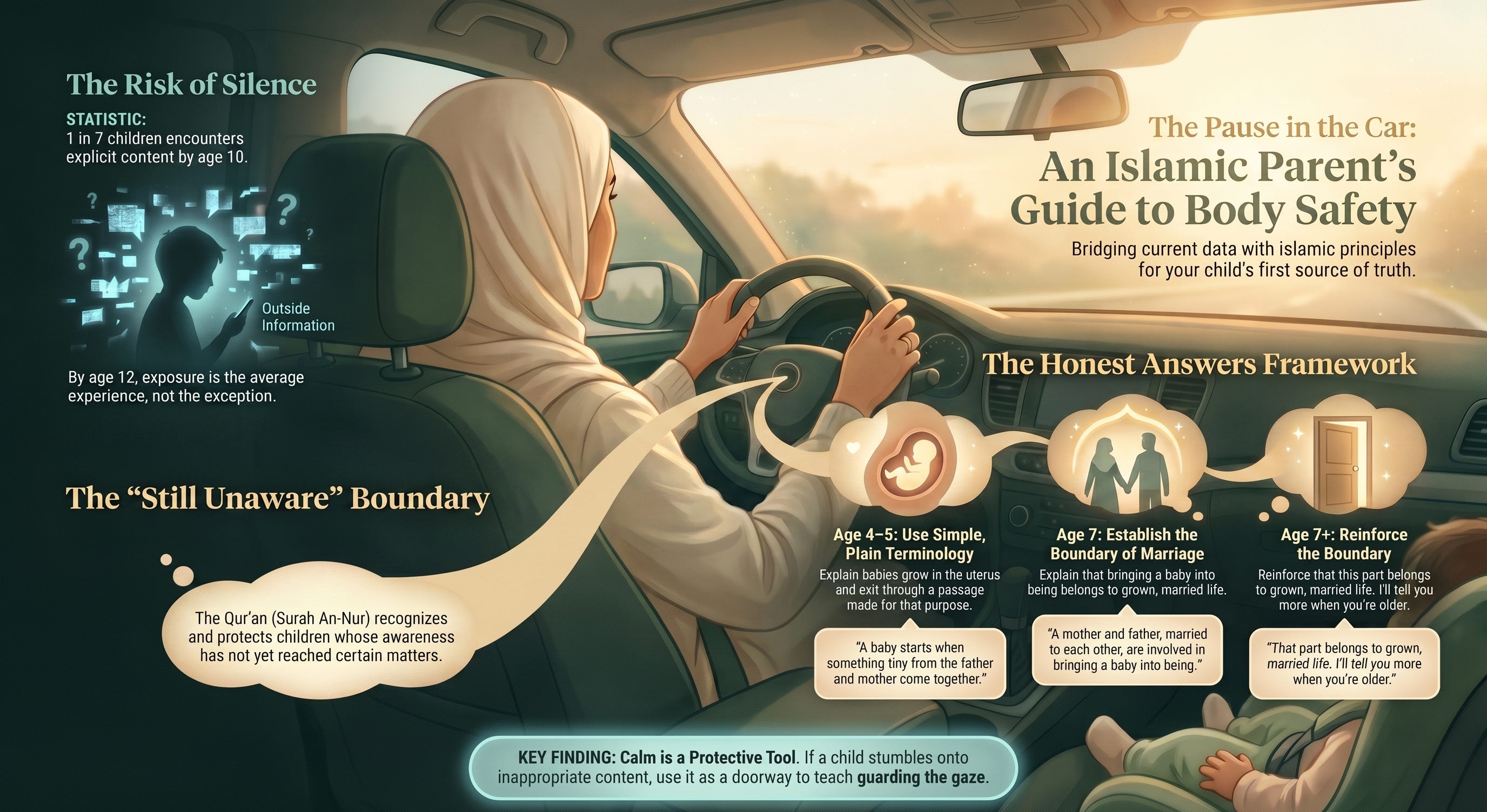
A Common Sense Media survey of over 1,300 young people found that 1 in 7 children has already encountered explicit content online by age 10. The average age of first exposure is 12. [1] This guide gives you the exact words for every age from 4 to 8 — before that window closes.
Talking to your child about bodies and where babies come from is one of those conversations most parents quietly hope to keep postponing. It feels too soon. It feels uncomfortable. And somewhere in the back of every parent’s mind is a worry that sounds a lot like: if I bring this up, am I actually introducing something my child isn’t ready for yet?
That instinct comes from love. But here is the truth that changes the calculation: your silence on this topic doesn’t mean your child won’t encounter it. It only means that when they do — through a classmate’s question, something they glimpse on a screen, or an older child’s commentary at school — they will face it without a single word from you to anchor them. The gap you leave doesn’t stay empty. It gets filled. And in this age, what fills it is rarely the understanding, the Islamic framing, or the calm that you would have brought yourself. As Muslim parents, we are not just raising children — we are planting seeds of taqwa and haya that will shape who they become. That work cannot be left to chance, or to whoever gets there first.
Your seven-year-old asks the question in the car, of course. Not at a planned moment, not when you’ve rehearsed something. Right there, between school pickup and the grocery store: “But how do babies actually get made?” Sometimes it’s prompted by a pregnant aunt, a classmate’s comment, something overheard at school. The question takes many forms. But the freeze it produces in every parent is almost identical.
You have about four seconds to respond. Most parents either freeze, deflect, or say far more than the question asked for.
You’re not failing if this catches you off guard. Nobody hands you a script for this moment, and the fear of saying the wrong thing keeps a lot of good, caring parents quiet for years longer than they mean to be.
Here’s the number that sharpened how I think about that silence. Common Sense Media’s nationally representative survey of over 1,300 young people found that 1 in 7 children has already been exposed to explicit content online by age 10 — and by age 12, the average child has encountered it, not the exception. [1] That is an elementary school statistic, not a teenager one. The conversation about bodies, boundaries, and what Islam says about guarding the gaze no longer has a comfortable “when they’re older” option. Staying quiet doesn’t protect children. Calm, age-appropriate, ongoing conversation does.
Why This Guide Is Different
Backed by current data, not guesswork. Two separate systematic reviews confirm that parent-led body-safety conversations measurably improve children’s protective knowledge and skills. [4,5]
Islamically grounded, not borrowed. The boundaries taught here trace directly to the Qur’an and the Prophet’s ﷺ own words — not a Western framework dressed up afterward in Islamic vocabulary. [8,9]
A script you can actually use. You’ll get The Honest Answers Card Set, a free printable with the exact wording for every age and every hard follow-up question.
How Do I Answer “Where Do Babies Come From?” At Age 4 or 5
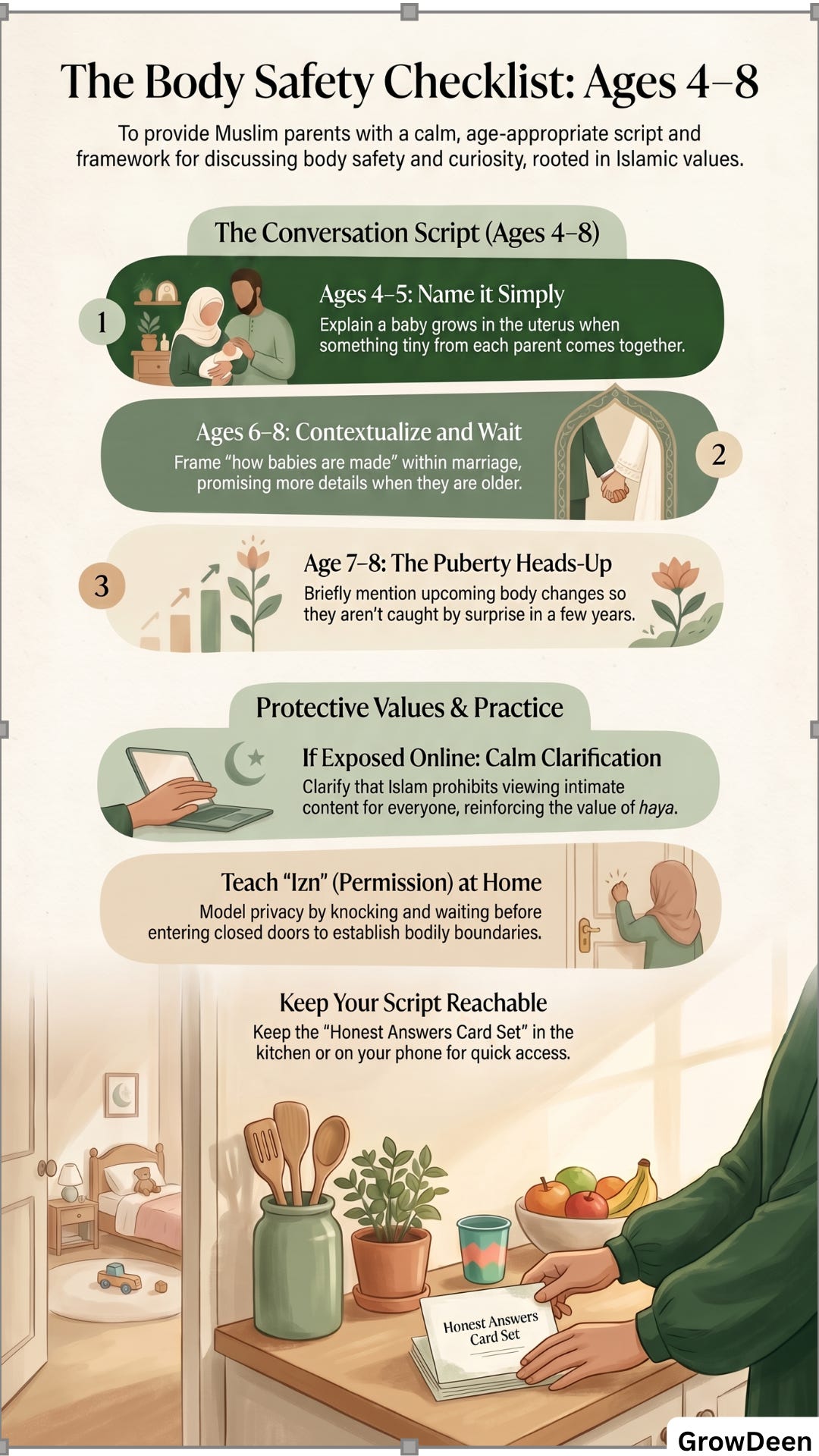
A simple, true answer is the whole answer here. A baby grows inside the mother, in a place called the uterus, and it starts when something tiny from the father and something tiny from the mother come together. If your child asks how it gets out, “through a passage made for exactly that, when the baby’s ready” closes the loop completely.
The AAP’s own guidance backs this up directly: at this age, children need proper, plain terminology, not euphemisms, and they rarely need more detail than the question itself asked for. [3] You don’t owe the question more than it asked for.
What Do I Say When a 7-Year-Old Asks How Babies Are Made
This is the one parents dread. There’s a clean way through it that doesn’t need a single anatomical word: a mother and father, married to each other, are involved in bringing a baby into being. If your child pushes further, and some will, you can say it plainly: “That part belongs to grown, married life. I’ll tell you more when you’re older and it’s actually time.”
That isn’t a dodge. Here’s what surprised me when I looked into this from an Islamic angle: the Qur’an names children who are “still unaware” as a category worth protecting. [8] You’re not inventing a boundary. You’re following one that was already drawn.
This age is also a fair moment to mention, briefly, that bodies change as children grow. Puberty can start as early as age 8 for girls and 9 for boys [6], so a two-sentence heads-up now makes the real conversation land far softer later, instead of catching your child by surprise.
My Child Encountered Something Inappropriate Online. What Now?
Sometimes a question about bodies is really a child processing something they stumbled across, not curiosity at all. If that happens, panic is the wrong response. Calm is the protective one.
Make sure your child knows they are not in trouble. Ask what they actually saw. Then use it as a doorway: explain that in Islam, looking at private parts or intimate content is something Allah has prohibited for everyone — not only for children, but for every adult too, without exception and without any age at which it becomes permissible. This is not a rule your child will eventually grow out of. The Qur’an commands all believers to guard their gaze as an act of taqwa, and what they stumbled across is precisely what that command exists to protect against. [8] Framed that way, turning away becomes a value your child is inheriting, not a restriction they are waiting to outgrow.
What Should I Avoid Saying
Don’t let embarrassment stand in for an answer. “We’ll talk about that later,” followed by never talking about it again, teaches a child the subject is shameful and you’re not the one to ask. Don’t explain past what was actually asked, either.
And don’t quietly outsource this to a school programme or a relative. Your child will remember exactly who they could ask, and who they couldn’t.
When Does This Need a Doctor or Counsellor, Not Just Me
If your child discloses something that worries you, or shows knowledge that doesn’t add up with anything they could have picked up at home, talk to your child’s doctor or a qualified counsellor. Only about 1 in 4 children who experience abuse disclose it at all during childhood. [2] That number is exactly why the everyday version of this conversation matters so much. It’s what makes the harder version possible, if it ever comes.
I know remembering the right words in the actual moment — not three hours later in the shower when the perfect phrasing finally arrives — is the hard part. That’s why I made the Honest Answers Card Set, a free printable with the exact phrasing for every age band and every follow-up question your child might throw at you. Keep reading. You’ll be able to download it in a moment.
The Sacred Trust of Bodily Boundaries: What Islam Already Teaches Our Children
Sometimes, as Muslim parents, we worry we’re borrowing something foreign when we teach our kids about private boundaries — like we’ve taken a Western framework and dressed it up in Islamic language afterward. We haven’t. Allah addressed this directly, long before anyone coined the term “body safety.”
In Surah An-Nur, believers are told to lower their gaze and guard their private parts, and the verse goes further, naming an exception for “children who are still unaware” of such matters. [8] According to Tafsir Ibn Kathir, this isn’t a throwaway phrase. The ayah is explicitly carving out a category for children whose awareness hasn’t reached that point yet. The idea that what a child needs to know shifts with their development was already sitting inside the ayah.
The Prophet ﷺ made the boundary itself even plainer: “A man should not look at the private parts of another man, and a woman should not look at the private parts of another woman.” [9] No exception carved out for family. No softening for closeness. It’s a flat rule, and that’s exactly what makes it something a seven-year-old can actually hold onto.
What strikes me is how precisely this overlaps with what child-safety researchers now recommend on their own. Islam simply got there first.
Inside The Honest Answers Card Set
If you’ve read this far, you’re the kind of parent who takes this seriously — not as paranoia, but as protective love. That tells me something good about you.
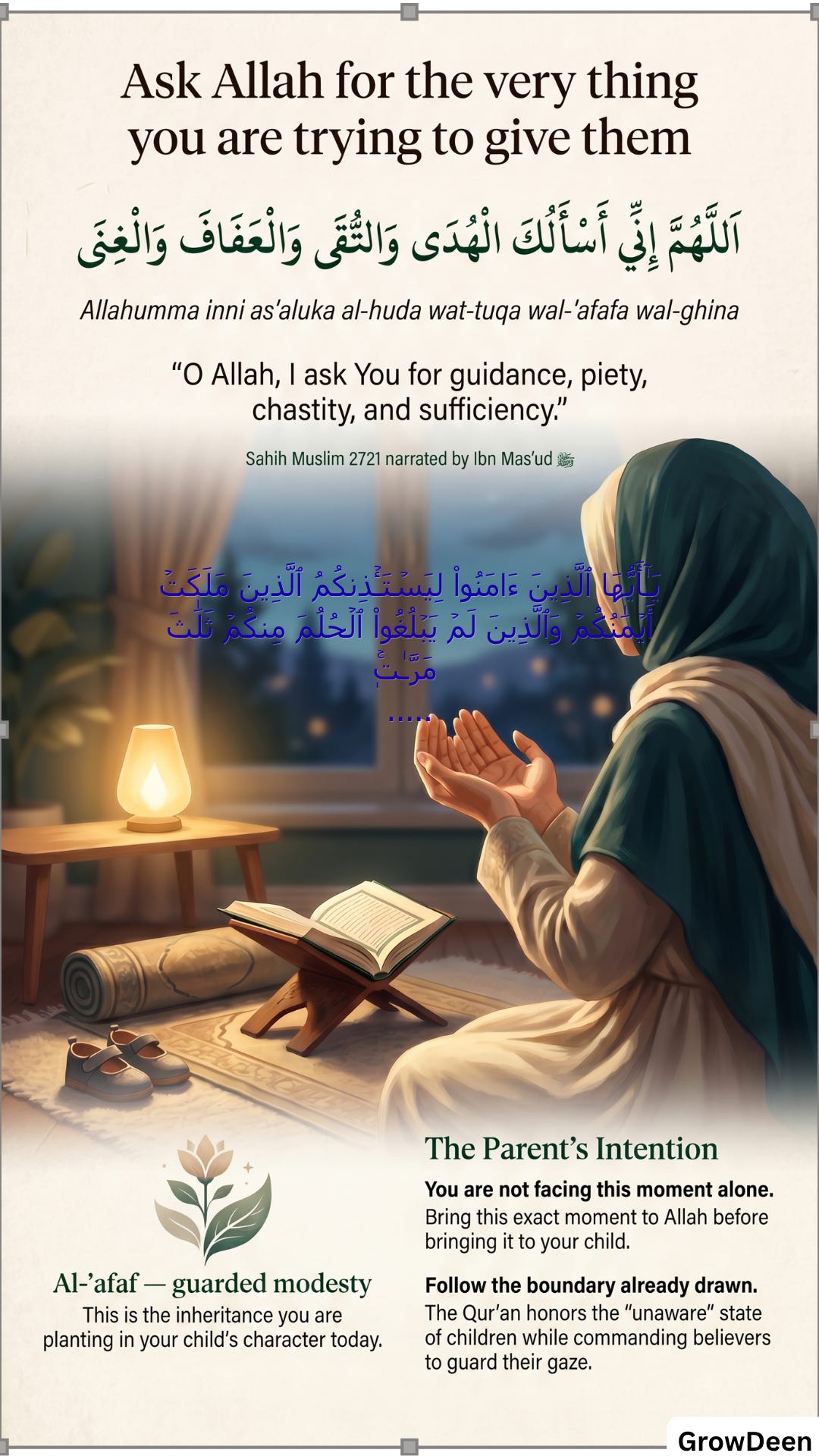
Inside The Honest Answers Card Set (one comprehensive PDF, 3 pages):
Page 1: What Do I Actually Say? A script card organised by age band, 4 to 5 and 6 to 8, with the exact phrasing for the moment the question lands. Designed to be kept taped inside a kitchen cabinet or saved as a phone photo for the car.
Page 2: Calm, Not Alarm. A simple flowchart for the higher-stakes moments — explicit content exposure or a concerning disclosure — so you have a clear path forward when panic makes thinking straight hard.
Page 3: A Du’a and a Practice for Protecting This Child. The du’a for guidance, piety, chastity, and sufficiency from Sahih Muslim — with full Arabic, transliteration, and meaning — plus a short practical guide to teaching izn, asking permission, at home.
This isn’t a PDF to download and forget. It’s built to stay in your kitchen or your phone, where you’ll actually reach for it when the moment hits.
This card set is what every subscriber receives with each article. We cover the full journey of raising Muslim children, all backed by research and rooted in Islamic wisdom.
If you want both evidence-based guidance and an Islamic framework, subscribe for free so future resources reach you before you need them.
You’ll only hear from us when there’s something worth sharing. No daily emails, no spam, just resources that matter.
Before you keep going about your day: pick one phrase from this guide, just one, and say it out loud to yourself once. Not for your child. For you. So it’s already familiar the next time the question lands without warning.
May Allah place barakah in your effort, accept your intention, and make the care you give more protective than it ever feels in the moment.
Share This With Someone Who Needs It
Think of one person right now: the sister at the masjid who told you, half laughing and half not, that her son just asked something she had no idea how to answer.
This article could hand her the exact words she’s missing. Share it with her today — not as advice-giving, but as the kind of support you’d want yourself.
Frequently Asked Questions
Q: At what age should I start talking to my child about bodies and boundaries?
A: Earlier than most parents think. By age 2 or 3, children can understand simple, plain language about which parts of their body are private. The questions just get more specific from there.
Q: What if I say the wrong thing?
A: You probably will, at least once, and that’s fine. Children remember whether you stayed calm and came back to the topic, not whether your wording was perfect the first time.
Q: Is it okay to use the word “vagina” or “penis” with a young child?
A: Yes. Correct, plain names remove confusion later and make it easier for a child to describe what hurts or what happened, to you or to a doctor, if they ever need to. [3]
Q: My child asked how babies are made in front of relatives. What do I do?
A: Answer briefly and calmly in the moment — “that’s something grown-ups know” — and continue the fuller conversation privately later. Don’t let embarrassment turn into a scolding.
Q: How do I bring up puberty before my child actually starts asking?
A: A short, low-pressure mention around age 7 or 8 — “your body is going to start changing in a few years, and that’s normal” — is enough, especially since puberty itself can start as early as 8. [6]
Q: Should I worry if my child seems very curious about bodies?
A: Curiosity about bodies at this age is ordinary development, not a warning sign. What matters more is whether your child knows the boundaries and feels safe coming to you with questions.
References
[1] Common Sense Media. (2023). Teens and Pornography. https://www.commonsensemedia.org/press-releases/new-report-reveals-truths-about-how-teens-engage-with-pornography
[2] Prevent Child Abuse America. (2025). Child Sexual Abuse Prevention. https://preventchildabuse.org/what-we-do/child-sexual-abuse-prevention/
[3] American Academy of Pediatrics, HealthyChildren.org. (2023). When & How to Talk With Your Child About Sex. https://www.healthychildren.org/English/ages-stages/preschool/Pages/Talking-to-Your-Young-Child-About-Sex.aspx
[4] Frontiers in Public Health. (2022). Effectiveness of school-based child sexual abuse intervention among school children in the new millennium era: Systematic review and meta-analyses. https://pmc.ncbi.nlm.nih.gov/articles/PMC9355675/
[5] ScienceDirect. (2024). The effectiveness of school-based child sexual abuse prevention programmes among primary school-aged children: A systematic review. https://www.sciencedirect.com/science/article/pii/S266637402400030X
[6] Nemours KidsHealth. (2024). Talking to Your Child About Puberty. https://kidshealth.org/en/parents/talk-about-puberty.html
[7] Government of Western Australia, Department of Health. (2019). Talk soon, talk often. Government of Western Australia.
[8] Quran, Surah An-Nur 24:30–31 — https://quran.com/24/30 / https://quran.com/24/31 (Tafsir Ibn Kathir)
[9] Sahih Muslim 338a — Graded: Sahih — https://sunnah.com/muslim:338a
[10] Sahih Muslim 2721 — Graded: Sahih — https://sunnah.com/muslim:2721
Thank you so much for thisss!