

Research from the Harvard Center on the Developing Child shows that babies form up to 1 million new neural connections every second in the first year of life. [1] This guide shows you exactly how to make the most of those moments — from 3 to 12 months — through science, Sunnah, and daily practice.
Your baby smiled at you this morning. You smiled back. That was it.
And just like that — in a fraction of a second — something changed in your baby’s brain.
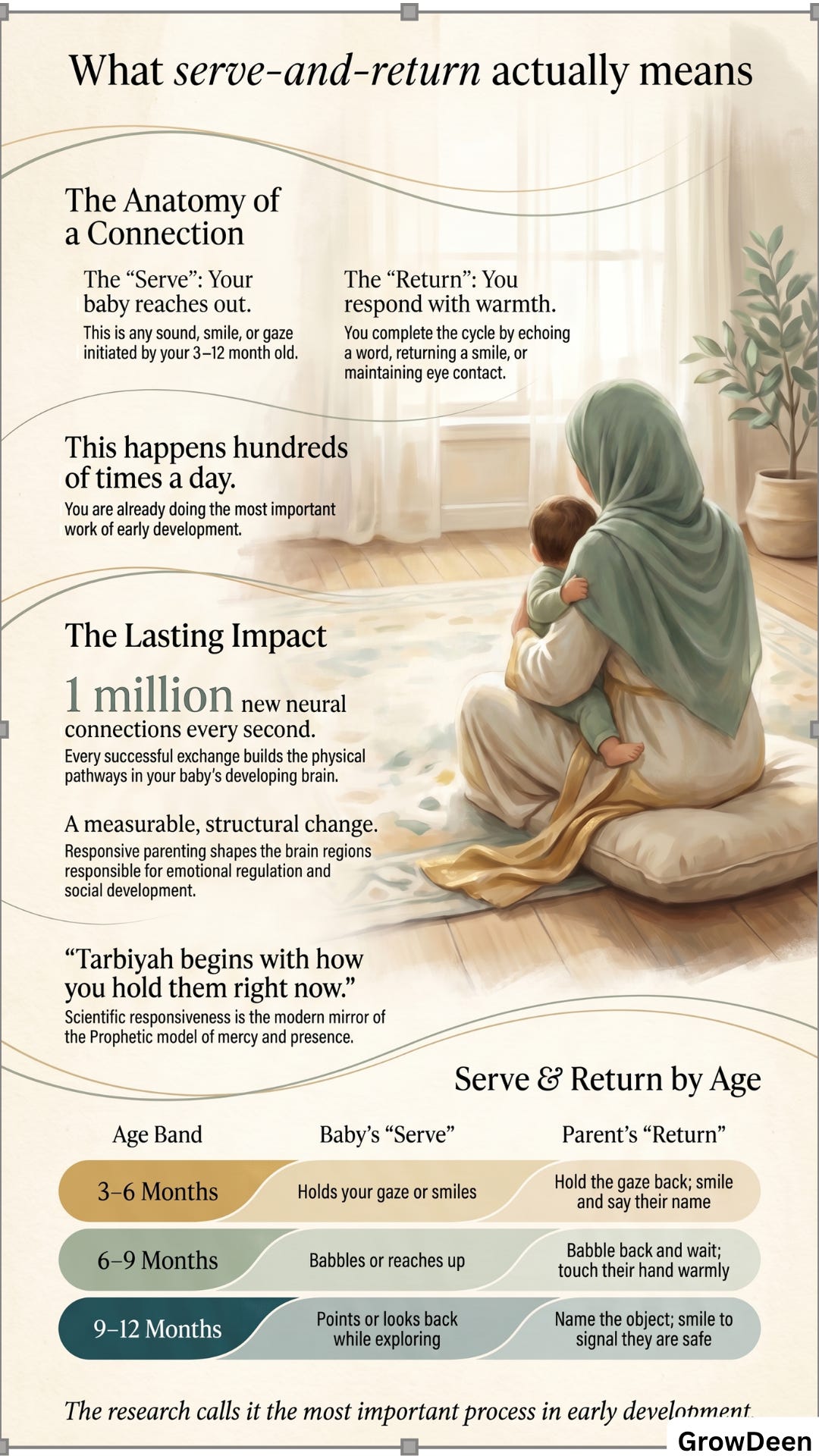
I know that sounds dramatic. But when I studied the research from the Harvard Center on the Developing Child, one idea stopped me completely: every time your baby reaches out with a sound, a smile, or a gaze, and you respond, you are literally strengthening neural pathways in their developing brain. [1] They call it serve and return. And it turns out, the ordinary things you do a hundred times a day — catching your baby’s eye, echoing their sounds, picking them up — are the most neurologically significant moments of their first year. [2]
Here’s what I mean: a study published in the Journal of the American Academy of Child and Adolescent Psychiatry found that sensitive, responsive parenting in infancy is directly linked to measurable differences in children’s brain structure — including the regions responsible for emotional regulation and social development. [3] Not a vague link. A measurable, structural one.
You are shaping a brain. Every smile you return. Every cry you answer. Every face-to-face moment in a nappy change.
Why This Guide Is Different From Generic Parenting Advice
Every strategy is backed by peer-reviewed research, including a 2023 synthesis from the Harvard Center on the Developing Child and a 2015 neuroscience study from the Journal of the American Academy of Child & Adolescent Psychiatry. [1,3]
This is Islamic parenting — not just positive parenting. We connect each stage of bonding to Prophetic example and the concept of amanah, because the bond you build isn’t just developmental. It’s spiritual.
You’ll receive the free Baby Bond Building Pack — a printable guide with age-specific bonding ideas and a du’a card for raising connected children. Keep reading to download it at the end.
What “Bonding” Actually Means (and Why It’s Built, Not Born)
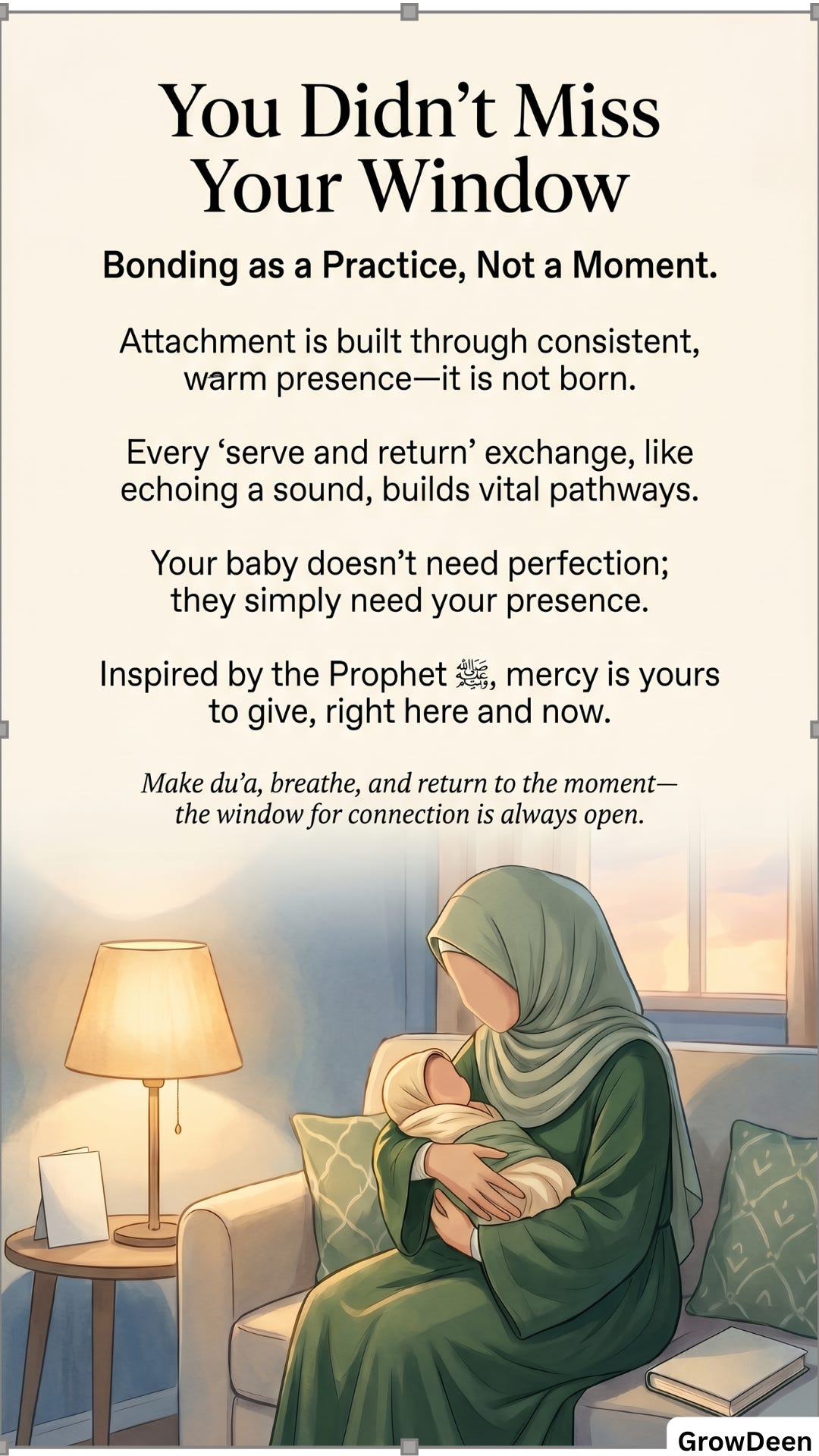
A lot of parents worry they didn’t bond with their baby immediately. Let me say this clearly: bonding is not a moment. It is a practice.
Bonding is the emotional connection you build through repeated, loving responses to your baby — feeds given with attention, cries answered with patience, eye contact held a second longer than necessary. Attachment — the inner sense of security your baby develops toward you — is what forms as a result of that practice over time. [4]
The two are not the same. And both take time.
Here’s the part that surprised me most when I first read it: the quality of your responsiveness in these months matters more than the quantity of activities you do. You don’t need classes, flashcards, or programmes. You need presence. Repeated, warm, consistent presence. [2]
What’s Actually Happening at Each Stage — and How to Respond
3–6 Months: Your Baby Has Found Their Voice
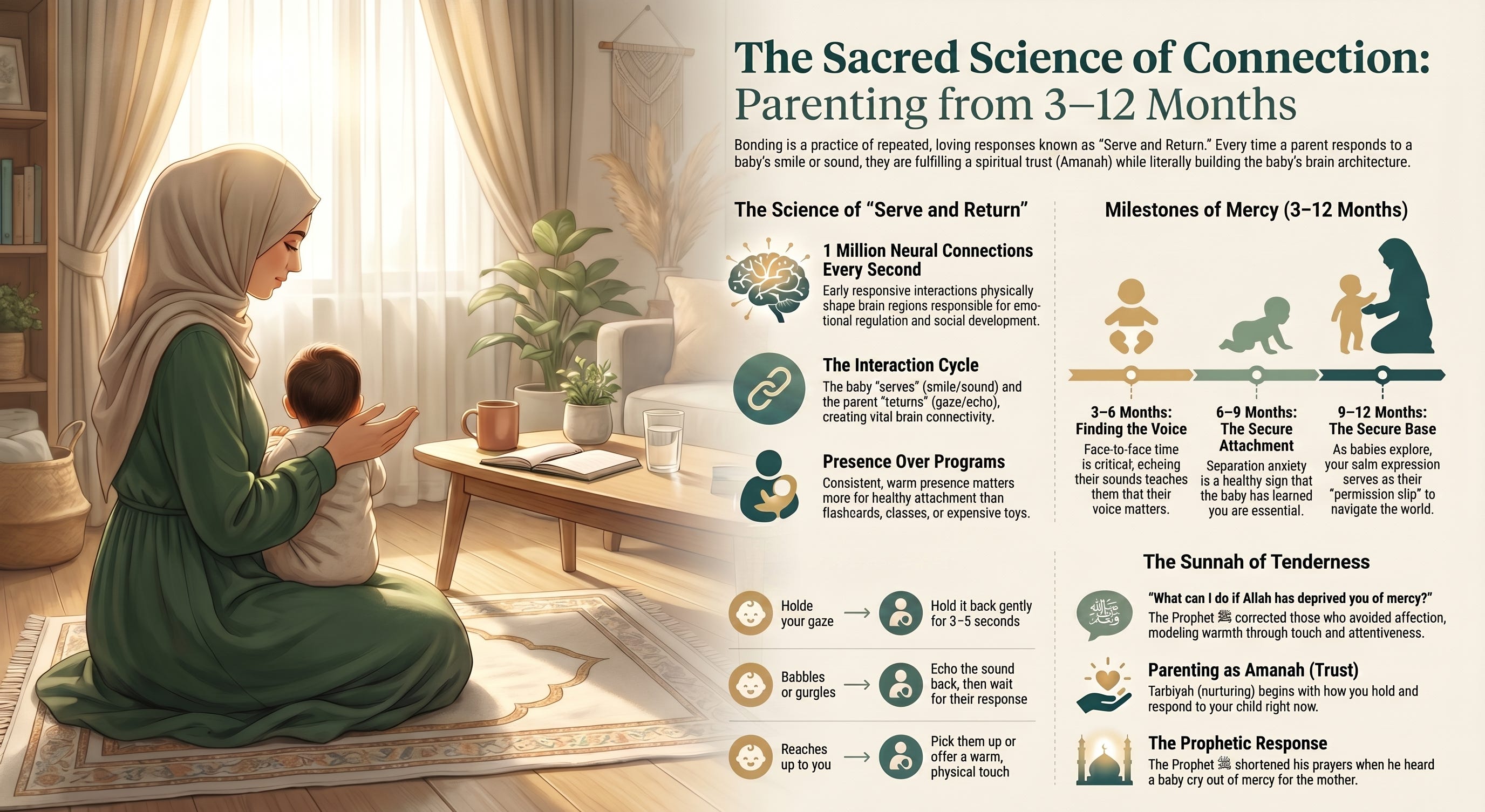
By 3 months, your baby is looking for you. Not just for food — for connection. They will hold your gaze with a focus that feels almost deliberate. By 5 months, the squeals and gurgles begin — early attempts at actual conversation. Research on early language input shows that the back-and-forth exchanges you have with your baby at this age directly predict their language development — and brain connectivity — years later. [5]
What to do: Face-to-face time is everything. Sit them in your lap, look gently into their eyes, speak softly. When they make a sound, echo it back. Wait for a response. This simple exchange teaches them that their voice has effect — that the world responds to them. That lesson lasts a lifetime.
When they’re overwhelmed: hold them close, speak calmly. You might recite a short surah quietly or repeat a gentle dhikr in rhythm. The Prophet ﷺ shortened his prayer when he heard a baby cry, out of consideration for the mother. [6] That same attentiveness belongs in our homes too.
6–9 Months: They’re Coming to You
Crawling. Reaching. Following you across the room with astonishing focus.
Around 6–7 months, separation anxiety arrives. Many parents find this exhausting. Here’s the reframe: it means your baby has learned you matter. That is not clinginess. That is healthy attachment forming exactly as it should. [4]
When you can’t pick them up immediately — say their name warmly from across the room. “I see you. I’m coming.” Your voice across the room is still a response. And response is everything.
9–12 Months: Exploring — But Always Watching You
Your baby is mobile now. Their world is bigger. But here’s what most people don’t realise: you are still the centre of it.
Developmental researchers describe this as the secure base effect. [4] Your baby ventures out to explore, then looks back. Your face tells them whether to continue or retreat. A calm expression is their permission slip. This is how much your presence matters — even when you’re just sitting in the same room.
Follow their interests. When they hold up a block, say “MashaAllah! What did you find?” When they look at the sky, offer a quiet “SubhanAllah.” These are not lessons yet. They are seeds.
Before You Keep Reading — A Note About the Baby Bond Building Pack
I know this is a lot to absorb, especially when you’re already managing feeds, naps, and everything else. That’s why I created the free Baby Bond Building Pack — a 3-page printable with age-specific bonding ideas, a serve-and-return quick reference, and a Prophetic bonding practice card with an authenticated du’a. Keep reading to download it at the end — it’s designed to live on your fridge or nursery wall, not your to-do list.
What the Sunnah Showed Us About This
When I read the hadith that Aisha (may Allah be pleased with her) narrated about the Prophet ﷺ, something settled in me. Desert Arabs came to him and said: we do not kiss our children. He looked at them and said: “What can I do if Allah has deprived you of mercy?” [Sahih Muslim 2317] [7]
He kissed his children and grandchildren. He shortened prayers when babies cried. He carried children through his salah. His whole body language around children was one of mercy, tenderness, and presence.
That is not incidental. It is the prophetic model of what bonding looks like — warmth expressed through touch, attentiveness, and the willingness to be tender without apology.
And then this: Allah says in Surah At-Tur, “And those who believe and whose offspring follow them in faith — to them shall We join their offspring.” [Qur’an 52:21] [8] Ibn Kathir explains this as Allah’s grace — children elevated to their parents’ ranks in Paradise when they follow them in faith. The bond you build in these months is the very first chapter of that longer story. Tarbiyah doesn’t begin with school. It begins with how you hold them right now.
The science and the Sunnah are pointing at the same thing: our children need our presence, our mercy, and our responsive attention. And when we give it — even imperfectly, even exhausted — we are fulfilling an amanah that matters far beyond this year.
The Baby Bond Building Pack — Your Free Gift
If you’ve read this far, you’re the kind of parent who takes connection seriously — not as a box to tick, but as a relationship to build. That tells me something beautiful about you.
Inside the Baby Bond Building Pack (one comprehensive PDF, 3 pages):
Page 1: The Bond-by-Month Reference Card — A month-by-month quick reference covering the 3–12 month window: what your baby is doing this month, what they need from you, and one specific bonding idea to try this week. Designed as a card you can pin to your nursery wall or refrigerator door.
Page 2: Serve-and-Return Made Simple — A single-page visual showing exactly what serve-and-return looks like at each stage — your baby’s “serve” (smile, sound, reach, crawl) paired with your ideal “return” — so you can respond confidently even on low-sleep days. No long explanations. Just the exchange, mapped clearly.
Page 3: The Prophetic Presence Card — An authenticated du’a for the wellbeing of your children, with Arabic text, transliteration, and meaning, plus one specific practice from the Sunnah — what the Prophet ﷺ did to build connection with the children in his care — framed simply so you can begin today.
This isn’t just a PDF to download and forget. It’s a tool designed to live in your nursery — where you’ll actually use it when you need it most.
Every GrowDeen subscriber receives a companion pack like this with each article. We cover the full journey of raising Muslim children — from newborns through to the teenage years — backed by research and rooted in Islamic wisdom.
If you’re a Muslim parent who wants both evidence-based guidance AND Islamic perspective, subscribe free so future resources arrive before you need them.
Subscribe free for parenting resources backed by both science and Sunnah — guidance so unique, you literally can’t find it anywhere else. No spam, no clutter, just resources that matter.
One Thing You Can Do Right Now
The next time your baby makes a sound — any sound — echo it back. Then wait. That is a complete serve-and-return exchange. That is neuroscience happening in real time. That is tarbiyah beginning.
You don’t need to do it perfectly. You just need to do it.
May Allah place barakah in every ordinary moment between you and your baby, accept your intention in every tired response, and make the connection you build now a foundation that carries them — and you — into Jannah.
Share This With Someone Who Needs It
Think of one person right now: a sister who just had her first baby and is spending every nap time worrying whether she’s doing enough, a friend from the masjid whose baby just turned 3 months and who confided she doesn’t feel connected yet, a new mother in your family who is exhausted and questioning everything she does.
This article could ease something she’s been carrying alone. Share it with her today — not as advice, but as company. Sometimes the most loving thing we can do is say: you’re not the only one, and here’s what I found.
Frequently Asked Questions
Q: What is the difference between bonding and attachment in babies?
A: Bonding is what you, as the parent, do and feel — the warmth, responsiveness, and care you bring. Attachment is what your baby develops toward you over time as a result. [4] Both build gradually, and neither happens in a single moment. For more, see “What ‘Bonding’ Actually Means” above.
Q: What if I didn’t feel an immediate bond with my baby after birth?
A: That is far more common than anyone admits. Bonding is a practice, not an event — it builds through thousands of small, repeated interactions across the first months. If feelings of disconnection persist or are accompanied by low mood, speak with your doctor. Postnatal depression is common and responds well to support.
Q: How do I know if my baby is securely attached?
A: A securely attached baby tends to use you as a safe base — they explore away from you and return, look to you for reassurance in unfamiliar situations, and settle more easily when you respond to their distress. [4] These behaviours become more visible from around 6–9 months onward.
Q: Is it possible to spoil a baby under 12 months by responding too quickly?
A: No. Research consistently shows that responsive caregiving in infancy builds security, not dependency. [2] Picking up a crying baby, responding to sounds, and maintaining close physical contact in the first year supports healthy development — it does not create problematic patterns.
Q: What is “serve and return” and why does it matter so much?
A: Serve and return is the term researchers use for the back-and-forth exchanges between a caregiver and a baby — your baby “serves” with a smile, sound, or gesture, and you “return” with a response. Harvard’s Center on the Developing Child describes this as one of the most important processes for building brain architecture in early childhood. [1,2]
Q: At what age does separation anxiety usually peak in babies?
A: Separation anxiety typically begins around 6–7 months and can peak anywhere between 9 and 18 months. [4] It is a healthy sign of developing attachment — not a problem to solve. Warm, consistent responses and predictable routines help babies navigate it.
References
[1] Harvard Center on the Developing Child. (2023). Serve and return: How it shapes brain architecture.https://developingchild.harvard.edu/science/key-concepts/serve-and-return/
[2] Komanchuk, J., Letourneau, N., Duffett-Leger, L., & Cameron, J.L. (2023). History of ‘serve and return’ and a synthesis of the literature on its impacts on children’s health and development. Issues in Mental Health Nursing, 44(5), 406–417. https://doi.org/10.1080/01612840.2023.2192794
[3] Kok, R., Thijssen, S., Bakermans-Kranenburg, M.J., Jaddoe, V.W.V., Verhulst, F.C., White, T., van IJzendoorn, M.H., & Tiemeier, H. (2015). Normal variation in early parental sensitivity predicts child structural brain development. Journal of the American Academy of Child and Adolescent Psychiatry, 54(10), 824–831. https://doi.org/10.1016/j.jaac.2015.07.009
[4] Bornstein, M. (2012). Parenting infants. In M.H. Bornstein (Ed.), Handbook of Parenting: Vol. 1 (2nd ed., pp. 3–43). Lawrence Erlbaum Associates. https://doi.org/10.4324/9781410612137
[5] Romeo, R.R., Leonard, J.A., Robinson, S.T., West, M.R., Mackey, A.P., Rowe, M.L., & Gabrieli, J.D.E. (2018). Beyond the 30-million-word gap: Children’s conversational exposure is associated with language-related brain function. Psychological Science, 29(5), 700–710. https://doi.org/10.1177/0956797617742725
[6] Sahih al-Bukhari 709 — The Prophet ﷺ shortening prayer upon hearing a baby cry. Graded: Sahih. https://sunnah.com/bukhari:709
[7] Sahih Muslim 2317 — Aisha (may Allah be pleased with her) narrates: Bedouins asked the Prophet ﷺ if he kisses his children. He said yes. They said they do not. He replied: “What can I do if Allah has deprived you of mercy?” Graded: Sahih. https://sunnah.com/muslim:2317
[8] Qur’an, Surah At-Tur 52:21. https://quran.com/52/21