


Bedtime calling-out affects 42% of three-year-olds. [1]
Printable. For the third time they call out.
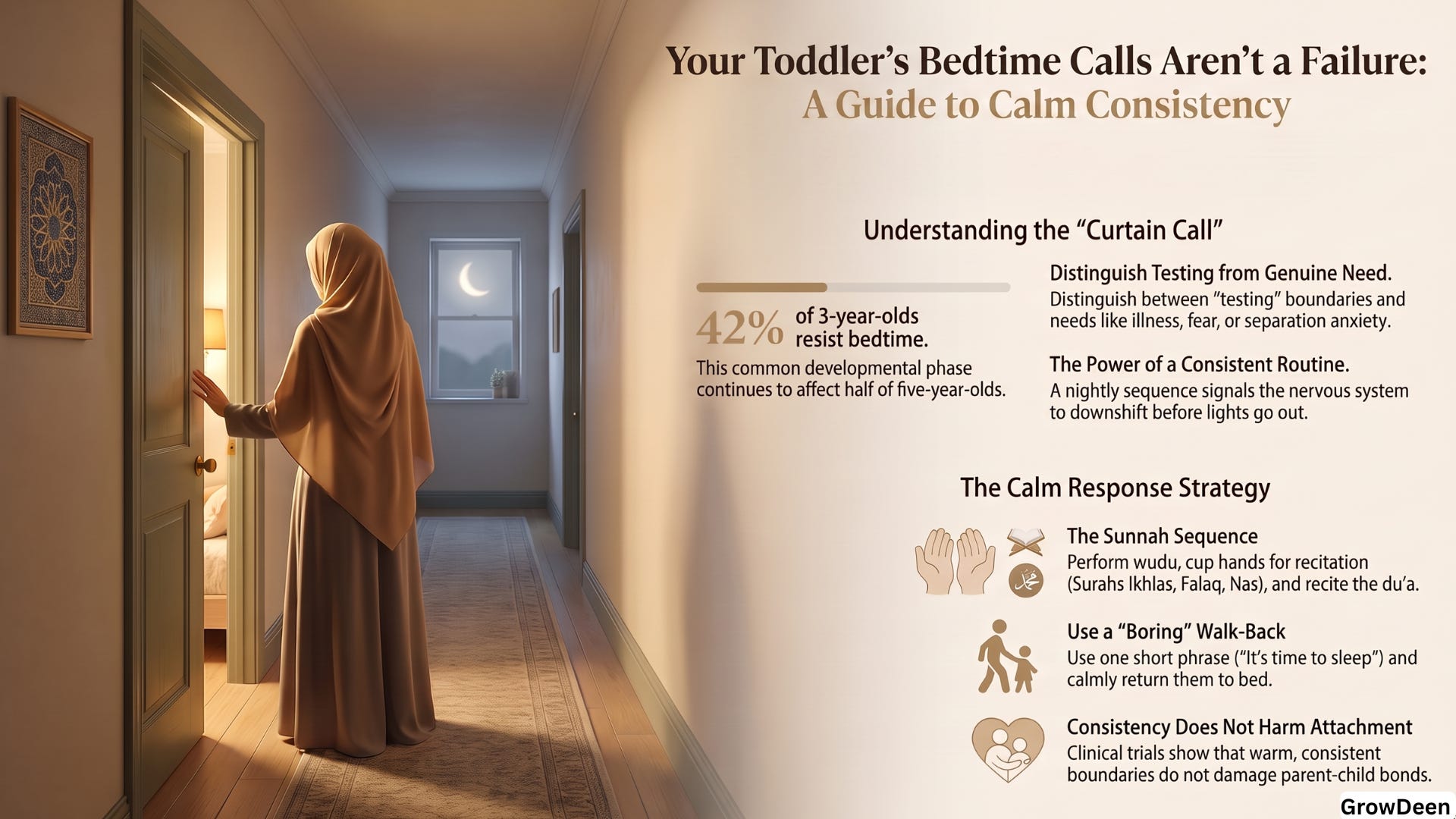
The third “Mama” comes at 8:52pm. Then a small thud. Then bare feet in the hallway, again.
The bedtime routine went exactly right tonight. Bath, wudu, the short recitation, the bedtime du’a, lights out, right on schedule. And somehow bedtime is still not over. There is a familiar tightening that shows up right about now, somewhere between the second request for water and the third trip back to the bedroom door.
This is not a sign anything was done wrong. Researchers who study this call it a “curtain call,” and it is strikingly common: one well-cited longitudinal study found that bedtime calling-out and resistance shows up in roughly 42% of three-year-olds, up from 14% of infants and continuing to affect half of five-year-olds [1]. Nearly half the families with a young child are living some version of this exact hallway scene.
Here is the part most sleep advice skips entirely: the parents who get curtain calls to stop fastest are, almost without exception, doing less than everyone else. Not less love. Less drama. That distinction is where this guide is going, and it happens to be the same distinction the Prophet ﷺ made about gentleness centuries before anyone studied it.
Why This Guide Is Different
Built on current sleep research, not folklore. Every recommendation here comes from peer-reviewed developmental sleep science, including a 2016 randomized trial that directly tested whether behavioral consistency harms attachment [13].
Rooted in the Sunnah of sleep, not tacked onto it. This is not safety advice with a du’a added at the end. Wudu, the bedtime dhikr, and the protection du’a for a frightened child are treated as part of the actual routine, because they are.
You already have the free Calm Return Companion Pack from the top of this page — a three-page printable that turns tonight’s article into a decision guide you can use at 9pm without re-reading anything.
What’s Actually Happening at 8:52pm
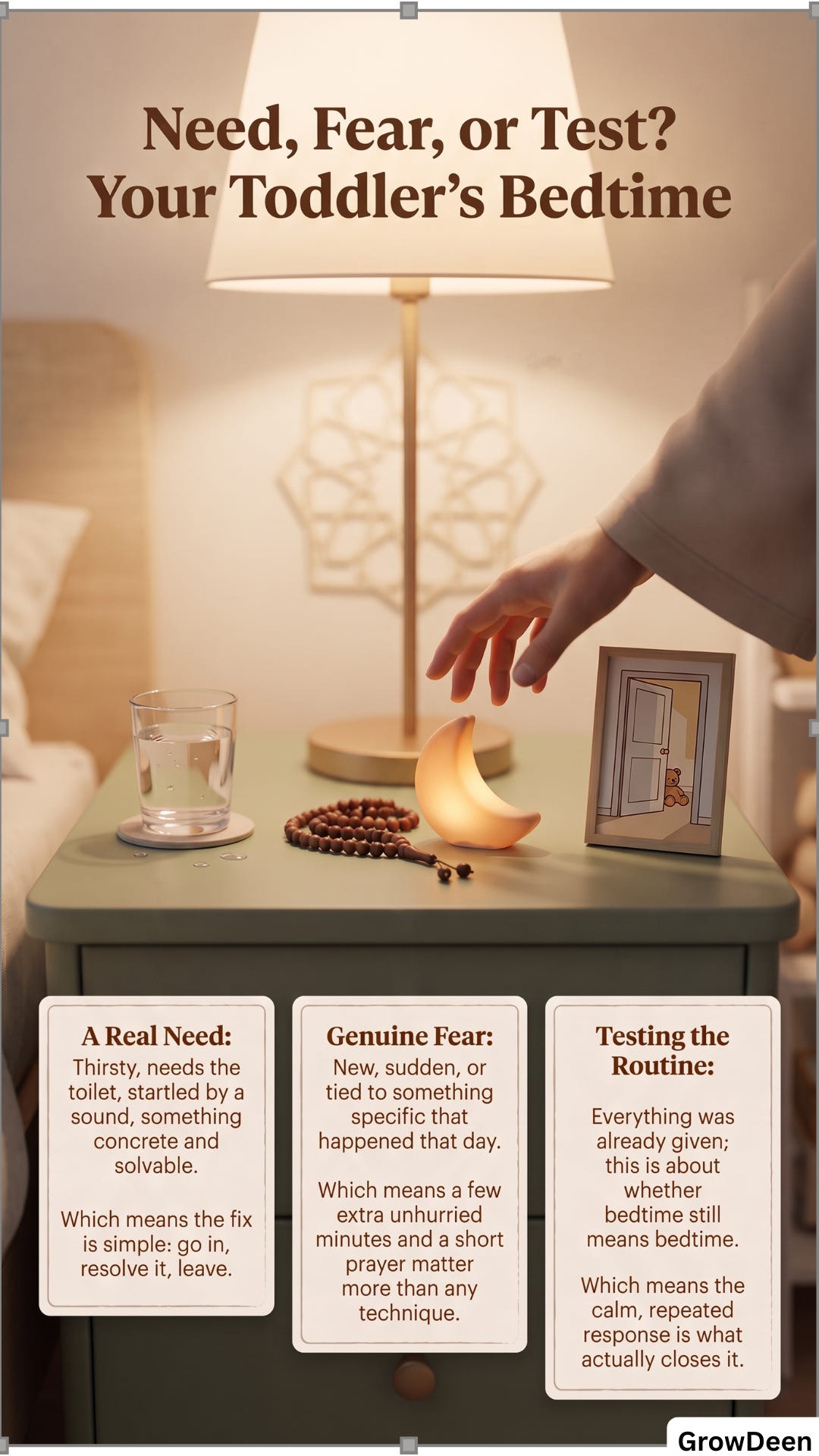
Start with the question every parent standing in that hallway is actually asking: is this testing, or is this a genuine need.
Both happen, and they look almost identical from the doorway. Some children call out or leave their beds because something real is wrong: the toilet, a drink they truly didn’t get, a noise that startled them. Others are doing something developmentally ordinary that has nothing to do with defiance. Separation anxiety tends to intensify from around six to seven months and often resurfaces at bedtime well into the toddler years [5]. A child who just learned to climb out of a cot may be practicing that skill at the worst possible hour, simply because it is new and irresistible. Illness, travel, a growth spurt, or a change at home can unsettle a routine that had been working fine the week before [3].
Reading the specific child on the specific night matters more than any universal rule. A child frightened of the dark needs something different from a child testing whether “bedtime” really means bedtime tonight. Both need something different again from a child adjusting to a new sibling, a new caregiver, or a recent move.
If the cause is a genuine need, the response is simple: go in, sort it out, leave once it’s resolved. A child who is unwell, needs the toilet, or was startled by a sound should not be met with a delay. Fear and strong separation anxiety deserve a slightly different response too. If it’s new, intense, or tied to a specific event, that’s worth raising with a doctor or family health nurse [4]. A few extra minutes of connection before lights out, closed with a short, unhurried du’a, tends to do more than any technique that comes after it.
But when a child simply wants company, and keeps testing whether the routine holds, this is where most of the exhaustion actually lives.
The Routine That Does Almost All the Work
Here’s the part backed by the strongest evidence in the whole sleep literature: a consistent bedtime routine is the single most effective tool available for reducing bedtime resistance and curtain calls, and it beats every trick, hack, or one-off strategy parents try instead [6].
It works for a simple, physical reason. A routine tells a child’s body, night after night, that sleep is the next thing to happen. That signal lets the nervous system downshift before the lights even go off, instead of trying to downshift after.
Two things make the biggest difference inside that routine. First, timing: a child who takes longer than thirty minutes to fall asleep may simply be going to bed before their body is ready, and shifting bedtime closer to their natural sleep onset, then nudging it fifteen minutes earlier every few nights, tends to outperform forcing an earlier bedtime all at once [7]. Second, the last hour: loud play and screens in the hour before bed work directly against everything the rest of the routine is trying to accomplish [8]. A last check before lights out, drink, toilet, teeth, a hug, closes the loop.
None of this needs to be presented to a toddler as a list of rules to follow. It becomes the shape of the evening instead.
The Sunnah Sequence Sleep Researchers Would Recognize
Here’s what surprised the researchers who study bedtime routines, if they ever looked at this: the sequence they arrived at through trial data is close to identical to the one taught fourteen centuries earlier.
The Prophet ﷺ taught wudu before lying down, performed the same way as before prayer. He would dust the bedding and say: “In Your name, my Lord, I lie down, and in Your name I rise. If You take my soul, have mercy on it, and if You send it back, protect it as You protect Your righteous servants” (Sahih al-Bukhari 6320, Sahih Muslim 2714) [9]. Before sleeping, he would cup his hands, recite Surah al-Ikhlas, al-Falaq, and an-Nas into them, then wipe his hands over whatever parts of his body he could reach, beginning with his head and face (Sahih al-Bukhari 5017) [10].
That sequence, wudu, recitation, du’a, lights out, is not a separate spiritual add-on sitting next to the “real” bedtime routine. It is the routine. Bath, wudu together, a short recitation, the bedtime du’a, then lights out, in that order, every night.
For a child who is truly afraid at night rather than simply testing limits, the Prophet ﷺ used to seek Allah’s protection over his grandsons Hasan and Husayn with these words: “I seek refuge for you both in the perfect words of Allah, from every devil, every poisonous creature, and every harmful, envious eye” (Sahih al-Bukhari 3371) [11]. Said quietly over a frightened child, or taught to an older toddler to say for themselves, it gives them something concrete to hold on to, not just a reassurance to repeat back.
What to Actually Say and Do When the Door Opens Again
So what does this look like at 8:52pm on a Tuesday, specifically.
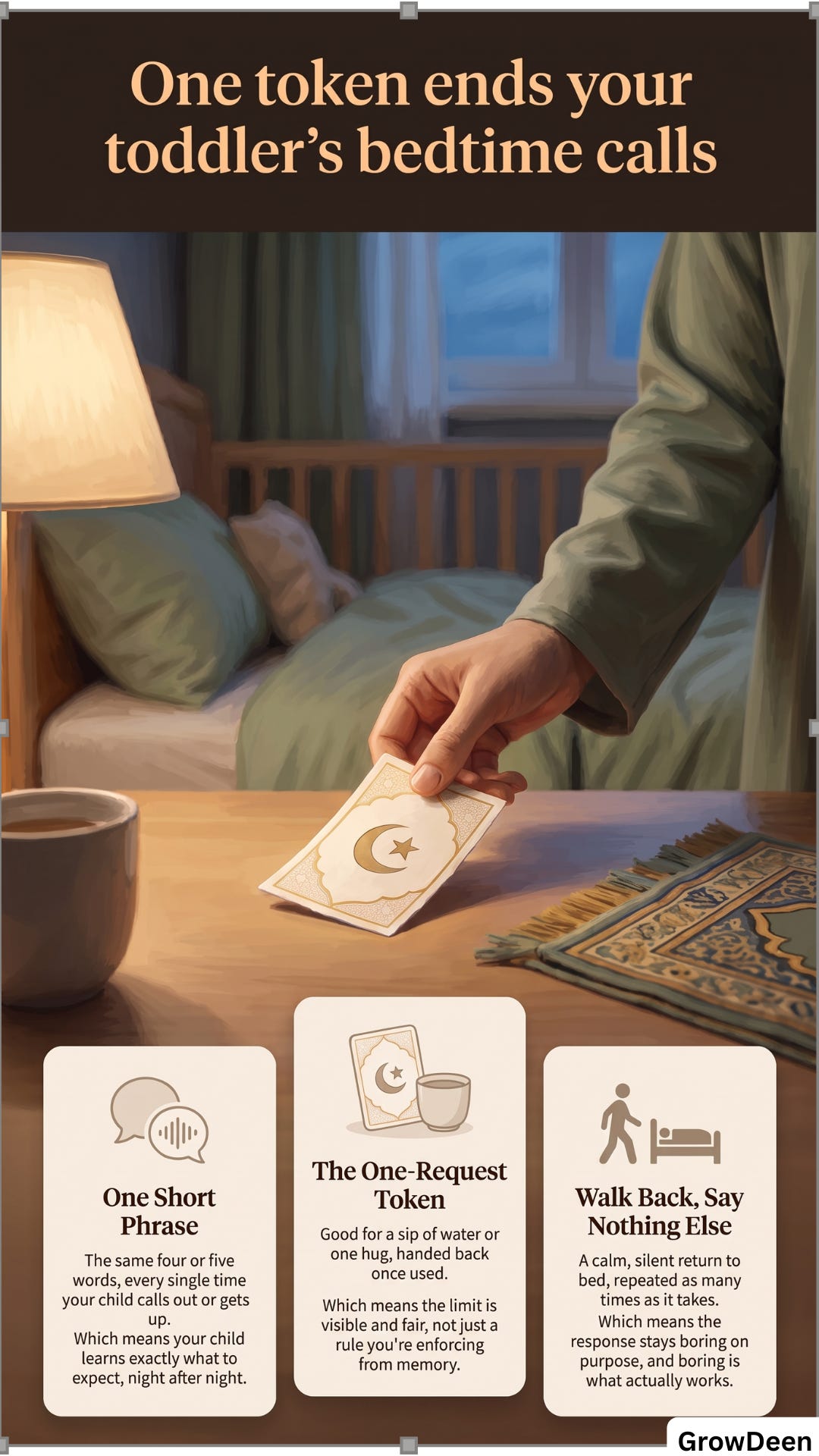
If the child calls out, the reply is short: “I’m here, it’s time to sleep.” Nothing more. Going back in with a second book or a second drink once the child already has what they need does not close the loop, it reopens it.
If the child gets out of bed, the words stay short too: “It’s time to sleep, please stay in bed,” followed by a calm walk back to the room without conversation or irritation, however many times that takes in one night. For some children, the door opens repeatedly for several nights running before the pattern breaks [2]. That is not failure. That is what the pattern breaking looks like from the inside.
There is a hadith that applies here more directly than it might first appear. The Prophet ﷺ said: “Make things easy and do not make them difficult” (Sahih al-Bukhari 69, Sahih Muslim 1734) [12]. He said it in a different context originally, but the principle travels well: bedtime does not need to become a contest of wills. A firm, low-drama return, repeated without heat, resolves faster than one delivered in frustration, almost every time.
A one-request token works well for some families. At bedtime, hand over a token good for exactly one reasonable ask, a sip of water or a final hug, which gets handed back once used. Unused, it trades the next day for something small. Anything outside the agreement, staying up later, for instance, costs the token with nothing exchanged.
But Won’t Being Less Responsive Hurt the Bond?
This is the question underneath all the others, and it deserves a direct answer instead of a reassuring shrug.
A randomized controlled trial published in Pediatrics assigned infants to graduated check-in routines, gradual bedtime shifting, or general sleep education, then measured parent-child attachment a year later using the standard laboratory assessment researchers use for exactly this question. Neither behavioral approach showed any negative effect on attachment security, child stress hormones, or later emotional and behavioral outcomes, compared with the control group [13].
Consistency delivered with warmth is not withdrawal. It only looks like withdrawal from the doorway at 9pm. The data says otherwise, and so, as it turns out, does the Sunnah.
What to Skip Entirely
Skip the long negotiations at the door. Skip the extra drink, book, or company once the child already has what they need. Skip scolding on the walk back to bed. A response that is almost boring in its calmness beats an emotional one nearly every time, because children are often testing for a reaction, and a flat, steady reply gives them nothing to push against.
And if the child gets very upset anyway, cries hard, flushes red, falls apart completely when the running-in doesn’t happen, that is a normal reaction to a changed routine, not evidence the approach has failed. Comfort the child the way you would in daylight hours, warmly and without fuss, then once they’ve settled, remind them gently it’s time to sleep, say goodnight, and step out again. If this continues past a couple of weeks, or the intensity itself is worrying, a conversation with a doctor or family health nurse is worth having, with referral to a sleep specialist available if needed [4].
Know this before it happens: it is difficult to remember every response option at 9pm with a crying toddler at the door and no energy left to think clearly.
That’s exactly why the Calm Return Companion Pack exists, a printable decision guide built for the moments when the article you read three days ago isn’t available to reread. The download button is at the top of this page, and there's a full description of what's inside it below.
Steadiness in the Dark: What the Qur’an and the Sunnah Add
There is not a verse that names bedtime curtain calls directly, but the Qur’an offers a principle that fits the hour unusually well. Allah describes sending As-Sakinah, tranquility, into anxious hearts: “It is He who sent down tranquility into the hearts of the believers so that they would increase in faith along with their faith” (Qur’an 48:4) [14]. According to Tafsir Ibn Kathir, this sakinah descended on the believers at a moment of real tension, settling hearts that had every reason to feel unsettled. Standing calm in a dark hallway at midnight and asking Allah for that same steadiness draws on exactly this concept, even though the verse itself was revealed in a very different setting.
The Prophet ﷺ connected steadiness of temperament directly to gentleness. He said: “He who is deprived of gentleness is deprived of all good” (Sahih Muslim 2592) [15]. Nothing in that hadith is limited to daytime interactions. Managing a sixth trip back to a child’s bed without raising a voice is rifq, gentleness, practiced in one of the settings where it is hardest to hold onto.
Sleep research and this Prophetic instruction point the same direction, unforced. Steady, unhurried handling settles a child faster than an anxious one does. Responding to a hard night with calm rather than frustration is a small, repeated act of the same gentleness the Prophet ﷺ said carries all good with it.
Every parent standing in that hallway is managing more than the moment in front of them. Knowing what to do at 8:52pm is only useful if it’s easy to reach at 8:52pm, not three articles deep in a browser tab.
Inside The Calm Return Companion Pack (one comprehensive PDF, 3 pages):
Page 1: “Why They’re Calling Out” Tonight: a one-glance decision guide sorting the most common bedtime calls into genuine need, fear, or testing, with the exact short phrase to use for each, designed as a card you can keep taped inside the bedroom door.
Page 2: The One-Request Token & Consistency Tracker: a printable token plus a seven-night tracker, so the pattern breaking becomes visible instead of feeling endless, built to help you notice progress even on the nights it doesn’t feel like there’s any.
Page 3: Steadiness in the Dark: the protection du’a for a frightened child in Arabic, transliteration, and translation, alongside the Sunnah bedtime sequence in a short, checkable order: wudu, recitation, du’a, lights out.
This isn’t a PDF to download once and forget. It’s built to live on the fridge or the nightstand, exactly where the 8:52pm moment actually happens.
This Companion Pack is what every subscriber receives with each article. The full range of topics covers the whole arc of raising Muslim children, from infancy through the teenage years, all grounded in current research and Sunnah practice.
For guidance that treats both evidence and Islamic wisdom as non-negotiable, subscribing means future resources arrive before the next hard night, not after it.
Guidance backed by both science and Sunnah, sent only when there is something worth sending, no spam, no daily noise, just what actually matters.
One Thing to Try Tonight
Pick one piece of this, not all of it. Tonight, at lights out, use exactly one short phrase for the walk-back, the same four or five words, every single time. Nothing else changes yet. Just the sentence, repeated, flat, calm.
May Allah place barakah in the effort, accept the intention behind it, and make tonight’s patience more protective and more rewarded than it feels in the moment.
Someone You Know Needs This Tonight
Think of one person right now: the mother at the masjid who mentioned bedtime has become a nightly battle, a sister whose voice sounded thin with exhaustion the last time bedtime came up, a friend whose late-night messages keep circling back to the same hallway standoff.
This article could ease tonight for them specifically. Share it today, not as advice-giving, but as the kind of support that says someone else has already walked through this exact hour.
Frequently Asked Questions
Q: Why does my toddler keep calling out after I already said goodnight? A: Usually one of three things: a genuine unmet need, a developmental stage like separation anxiety, or simple testing of whether the routine holds. Separation anxiety commonly resurfaces at bedtime well into the toddler years [5]. See “What’s Actually Happening at 8:52pm” above for how to tell the difference.
Q: Is it normal for a two or three-year-old to climb out of bed repeatedly? A: Yes. Curtain calls affect an estimated 42% of three-year-olds, and the behaviour often continues for a stretch of nights before it resolves, even with a good routine in place [1][2].
Q: Will being consistent, not going in every single time, damage my bond with my child? A: A 2016 randomized controlled trial found no negative effect on attachment security, child stress levels, or later emotional outcomes from consistent behavioral sleep approaches [13]. Warmth and consistency are not opposites.
Q: How long does it usually take for curtain calls to stop? A: It varies by child, but many families see the pattern break within one to two weeks of a truly consistent response, sometimes faster. Some children test the boundary hardest in the first few nights before it eases [2].
Q: What if my child seems truly scared, not just testing me? A: Go in, comfort them, and stay a few extra minutes before lights out. The protection du’a taught by the Prophet ﷺ for Hasan and Husayn is worth saying quietly over a frightened child [11]. If fear is new, intense, or tied to a specific event, mention it to a doctor or family health nurse [4].
Q: When should I actually see a doctor about this? A: If calling out or bed-leaving continues for weeks despite a steady routine, if fear is sudden or severe, or if a child seems anxious or withdrawn beyond what feels typical for their age, a paediatrician or family health professional can help rule out anything beyond an ordinary developmental stage [4].
References
[1] LeBourgeois, M.K., Wright, K.P., Jr., LeBourgeois, H.B., & Jenni, O.G. (2013). Dissonance between parent-selected bedtimes and young children’s circadian physiology influences nighttime settling difficulties. Mind, Brain, and Education, 7(4), 234-242. https://doi.org/10.1111/mbe.12032
[2] Honaker, S.M., & Meltzer, L.J. (2014). Bedtime problems and night wakings in young children: An update of evidence. Paediatric Respiratory Reviews, 15, 333-339. https://doi.org/10.1016/j.prrv.2014.04.011
[3] Williamson, A.A., Mindell, J.A., Hiscock, H., & Quach, J. (2019). Child sleep behaviors and sleep problems from infancy to school-age. Sleep Medicine, 63, 5-8. https://doi.org/10.1016/j.sleep.2019.05.003
[4] El Rafihi-Ferreira, R., Lewis, K.M., McFayden, T., & Ollendick, T.H. (2019). Predictors of nighttime fears and sleep problems in young children. Journal of Child and Family Studies, 28(2), 941-949. https://doi.org/10.1007/s10826-019-01332-9
[5] Newton, A.T., Honaker, S.M., & Reid, G.J. (2020). Risk and protective factors and processes for behavioral sleep problems among preschool and early school-aged children: A systematic review. Sleep Medicine Reviews, 52(4), Article 101303. https://doi.org/10.1016/j.smrv.2020.101303
[6] Mindell, J.A., & Williamson, A.A. (2018). Benefits of a bedtime routine in young children: Sleep, development and beyond. Sleep Medicine Reviews, 40, 93-108. https://doi.org/10.1016/j.smrv.2017.10.007
[7] Cooney, M.R., Short, M.A., & Gradisar, M. (2018). An open trial of bedtime fading for sleep disturbances in preschool children: A parent group education approach. Sleep Medicine, 46, 98-106. https://doi.org/10.1016/j.sleep.2018.03.003
[8] Fiese, B.H., Cai, T., Sutter, C., & Bost, K. (2021). Bedtimes, bedtime routines, and children’s sleep across the first 2 years of life. Sleep, 44(8), 1-9. https://doi.org/10.1093/sleep/zsab045
[9] Sahih al-Bukhari 6320; Sahih Muslim 2714
[10] Sahih al-Bukhari 5017
[11] Sahih al-Bukhari 3371
[12] Sahih al-Bukhari 69; Sahih Muslim 1734
[13] Gradisar, M., Jackson, K., Spurrier, N.J., Gibson, J., Whitham, J., Williams, A.S., Dolby, R., & Kennaway, D.J. (2016). Behavioral interventions for infant sleep problems: A randomized controlled trial. Pediatrics, 137(6), e20151486. https://doi.org/10.1542/peds.2015-1486 [14] Qur’an 48:4 [15] Sahih Muslim 2592