

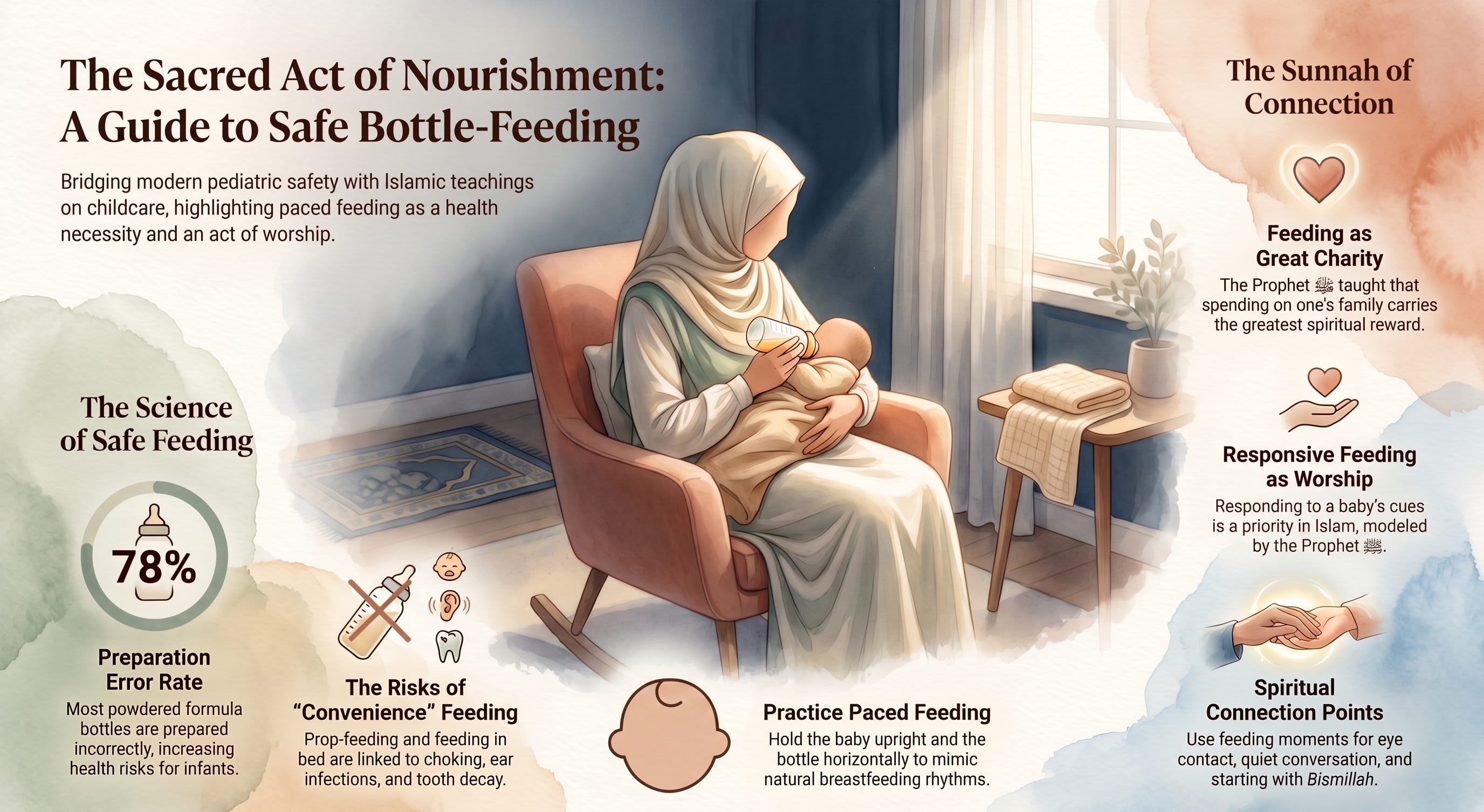
A 2024 review by the National Academies of Sciences found that up to 78% of powdered formula bottles are prepared incorrectly. [1] This guide shows you how to bottle-feed safely, read your baby’s cues, and turn every feed into a moment of connection and worship.
3 AM. The bottle’s warming. Your baby’s fussing. You’re so tired you can barely see straight, and somewhere in the fog you’re wondering: am I doing this right?
You are. The fact that you’re even asking says something about the kind of parent you are.
But here’s what I wish someone had told me earlier: bottle-feeding isn’t just about getting milk into a baby. It’s about how you hold them, how you pace the feed, and how you respond when they stop drinking. When I studied the CDC’s 2026 guidance on bottle-feeding, what stood out wasn’t the obvious advice. It was this: prop feeding, bed-feeding, and forcing a baby to finish a bottle are all linked to choking, ear infections, and tooth decay. [1] Preventable risks. Fixable habits.
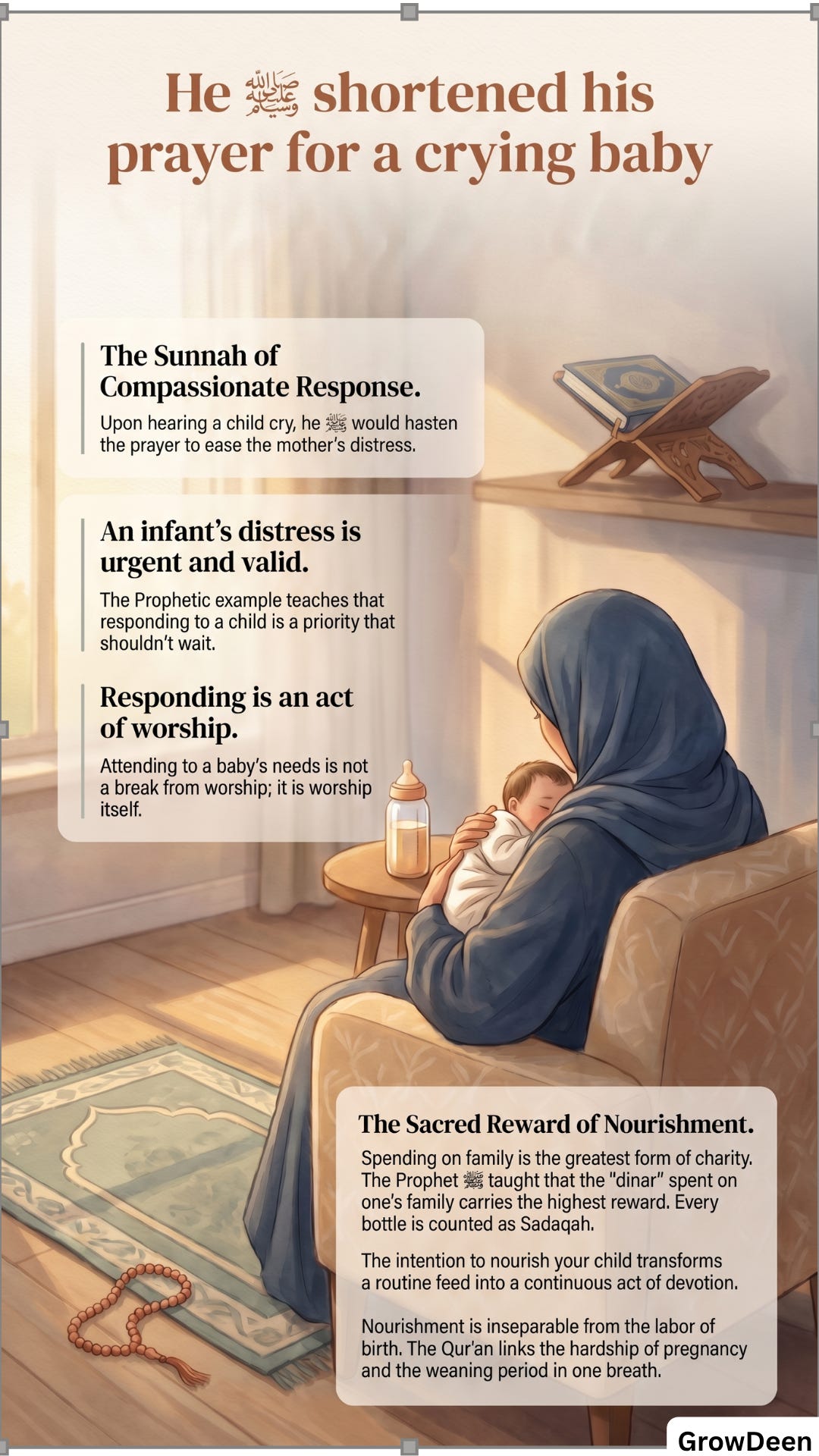
And in Islam, the Prophet ﷺ once shortened his prayer because he heard a baby crying. [2] He didn’t ignore the need. He responded. That’s the standard for how seriously we should take our babies’ cues, even during feeding.
Why This Guide Is Different From Generic Bottle-Feeding Advice
Current research, not recycled tips. Every recommendation draws from the CDC (2026), the AAP (2022), and a 2024 peer-reviewed study on paced bottle-feeding. [1,3,5]
Islamic framework built in. This isn’t just technique. Feeding your child is sadaqah, and this guide shows you how Qur’an and Sunnah frame every bottle as an act of worship. [4]
A free printable companion pack. You’ll get the Safe Bottle-Feeding Companion Pack — a 3-page PDF you can keep in your kitchen, not just read and forget.
How to Hold and Feed Your Baby Safely
Get comfortable. Cradle your baby close, on a gentle incline — not flat on their back. This position supports safe swallowing and keeps milk from pooling toward their ears. When a baby drinks lying flat, fluid can enter the Eustachian tube and cause a middle ear infection. [7]
Touch the teat against your baby’s lips. Wait for them to open their mouth. Don’t push it in.
Tilt the bottle so milk fills the neck and small air bubbles rise through the liquid. This reduces swallowed air and the discomfort that comes with it. Halfway through, pause. Try a burp. Then offer the rest.
Here’s the part most people skip: talk to your baby during feeds. Make eye contact. Say a quiet Bismillah. These aren’t extras. Research shows that holding, cuddling, and talking during feeds supports attachment and brain development. [3] And the Prophet ﷺ taught that spending on your family carries the greatest reward of all forms of charity. [4] Every feed counts.
But what if your baby drinks too fast?
What Is Paced Bottle-Feeding? (And Why It Matters More Than You Think)
If your baby gulps the bottle down in minutes, or if they’re usually breastfed and struggling with the faster flow, paced feeding changes the game.
You hold your baby more upright. You keep the bottle nearly horizontal. You pause every few minutes. It mimics the natural rhythm of breastfeeding and gives your baby time to recognise when they’re full.
A 2024 study in Early Human Development found that paced feeding led to significantly slower feeding rates and longer meal durations, with no reduction in total milk intake. [5] Parents using paced feeding were also more responsive to their baby’s cues.
Why does this matter? Because research in Pediatrics shows that bottle-fed infants are more likely to finish the bottle regardless of satiation, compared to babies who breastfeed directly. [6] Paced feeding helps your baby develop the ability to stop when they’ve had enough. That’s a skill that serves them for life.
5 Bottle-Feeding Risks Every Parent Should Know
Prop feeding. Using a blanket or pillow to hold a bottle in your baby’s mouth is dangerous. It raises the risk of choking, suffocation, and overfeeding. [1] Always hold your baby during feeds.
Bottle in bed. A baby lying flat with a bottle can aspirate milk, develop ear infections, or suffer early tooth decay. [7] The CDC warns specifically against this. [1]
Forcing the finish. If your baby turns away or stops sucking, they’re done. Don’t force the rest. Babies regulate their own intake. [1]
Leftover milk. Throw away any unfinished bottle within one hour. Bacteria from your baby’s mouth enter the milk during feeding. [1]
Teat flow mismatch. Too slow, and your baby tires before getting enough. Too fast, and they gulp and gag. Test the flow: hold the bottle upside down. Steady drip, not a pour.
I know this list can feel like a lot. But here’s the thing: once these habits are in place, they’re automatic.
I know remembering all of this during feeds — especially the middle-of-the-night ones — isn’t easy. That’s why I created a free Safe Bottle-Feeding Companion Pack — a printable guide with a step-by-step feeding checklist, a bottle safety reference, and an Islamic feeding reminder you can keep in your kitchen. Keep reading to download it at the end — it’s designed to make every bottle a little more confident.
The Sacred Trust of Feeding Your Baby: What Qur’an and Sunnah Teach Us
When I read Surah Al-Ahqaf, one phrase stopped me. Allah says: “His mother carried him with hardship and gave birth to him with hardship, and his gestation and weaning period is thirty months.” [Quran 46:15] [8]
Thirty months. Allah mentions carrying and feeding in one breath — as though the labour of nourishment is inseparable from the labour of birth. According to Tafsir Ibn Kathir, this verse establishes the mother’s physical sacrifice and the child’s right to be cared for during their most dependent months. [8]
And the hadith that grounds me most: the Prophet ﷺ said, “When I stand for prayer, I intend to prolong it, but on hearing the cries of a child, I cut it short, as I dislike to trouble the child’s mother.” [Sahih al-Bukhari 707] [2]
In the middle of worship, he prioritized a baby’s distress. That tells us everything about how Islam views the needs of infants. Responding to them isn’t a distraction from worship. It is worship.
Your Free Safe Bottle-Feeding Companion Pack
If you’ve read this far, you’re the kind of parent who takes feeding seriously — not as worry, but as love. That tells me something beautiful about you.
Inside the Safe Bottle-Feeding Companion Pack (one comprehensive PDF, 3 pages):
Page 1: Step-by-Step Feeding Checklist — An 8-step visual guide from hand washing to burping, with safe positioning reminders — designed as a wipe-clean card to keep inside your kitchen cupboard or stuck to the fridge.
Page 2: Bottle Safety Quick-Reference Card — A clear, colour-coded guide covering teat flow testing, bottle-in-bed risks, storage and discard timelines, and when to call your doctor — so you can check at a glance during any feed.
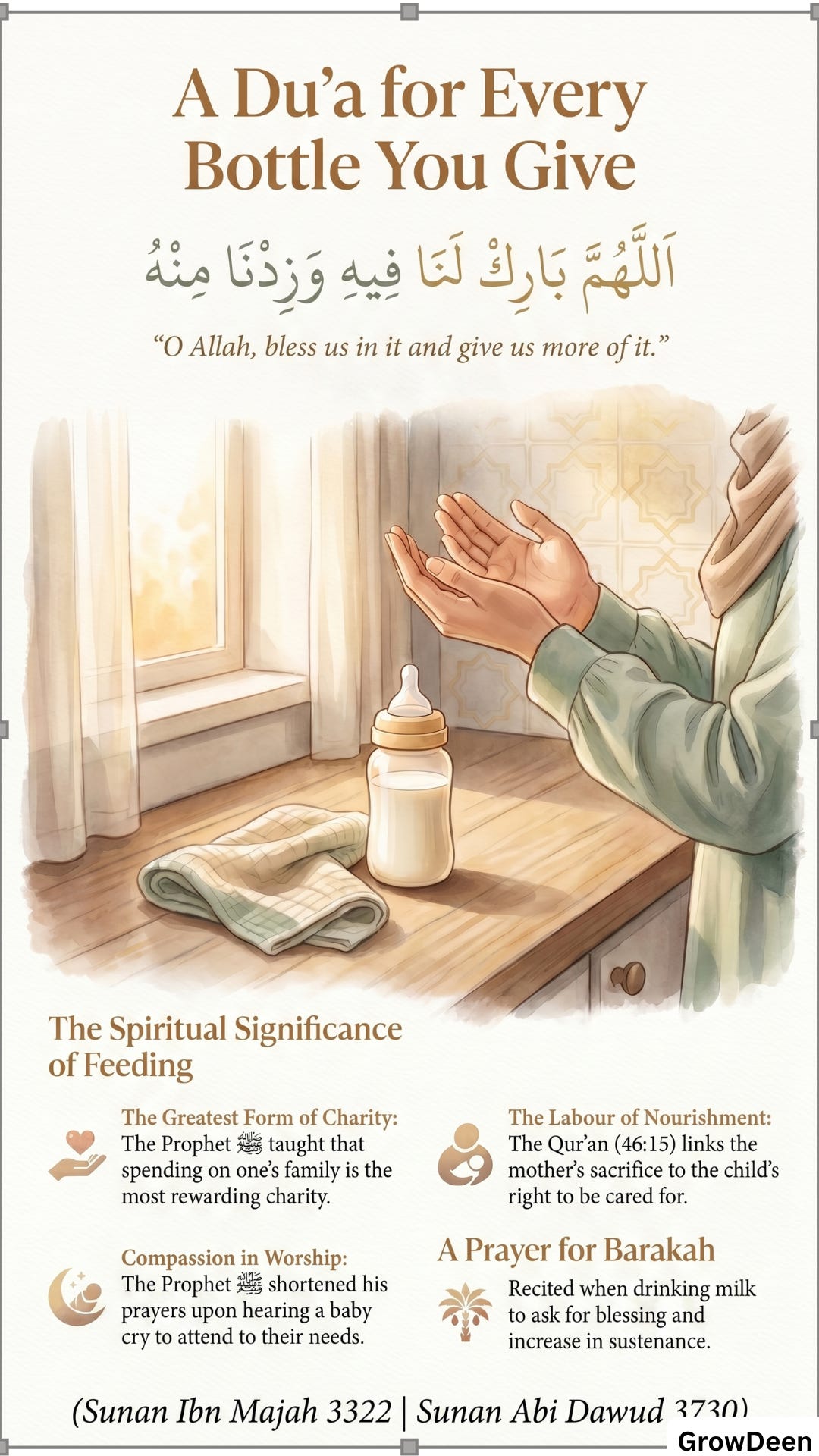
Page 3: Feeding as Worship — An Islamic Reminder Card — A beautiful reminder built around the du’a for drinking milk (Allāhumma bārik lanā fīhi wa zidnā minhu) with Arabic text, transliteration, and translation, alongside the hadith that spending on your family is the greatest charity [4] — designed to keep near your feeding area to remind you that every bottle is counted.
This isn’t just a PDF to download and forget. It’s a tool designed to stay in your kitchen — where you’ll actually use it when you need it most.
This Safe Bottle-Feeding Companion Pack is what every subscriber receives with each article. We cover the full journey of raising Muslim children, backed by scientific research and rooted in Islamic wisdom.
If you’re a Muslim parent who wants both evidence-based guidance AND Islamic perspective, subscribe for free so future resources arrive in your inbox before you need them.
Subscribe free for parenting resources backed by both science and Sunnah — guidance so unique, you literally can’t get it anywhere else. No spam, no clutter, just resources that matter.
One Small Action You Can Take Right Now
Tonight, before the next feed, check the teat on your baby’s bottle. Hold it upside down. Is it dripping steadily, or pouring? That one-minute check is the simplest thing you can do to make feeds safer and more comfortable for your baby. Start there.
May Allah bless what you feed your child, and make every bottle a source of health, strength, and barakah.
Share This With Someone Who Needs It
Think of one person right now: the new mother in your family who’s been asking questions about bottle-feeding. Your sister-in-law whose baby is just a few weeks old. A friend who’s going back to work soon and starting to express milk.
This article could make their feeds safer and calmer. Share it with them today — not as advice-giving, but as support. Sometimes the most loving thing we can do is pass along what we’ve learned.
Frequently Asked Questions
Q: How do I know if my baby is getting enough milk from the bottle? A: Look for at least 6 wet nappies a day after the first week, steady weight gain, and a settled, alert baby between feeds. If you’re worried, your doctor can check growth and help you adjust. [3]
Q: Can I switch between breastfeeding and bottle-feeding? A: Yes, many families do. Paced bottle-feeding helps babies transition more smoothly because it mimics the rhythm of breastfeeding. [5] A lactation consultant can help if your baby is struggling.
Q: Is it safe to warm a bottle in the microwave? A: No. Microwaves heat unevenly and can create hot spots that burn your baby’s mouth. Warm bottles by placing them in a bowl of warm water instead. [1]
Q: How long can a prepared bottle sit out before it’s unsafe? A: No more than one hour once your baby has started drinking from it. Bacteria from your baby’s mouth enter the milk during feeding. [1] Unstarted formula at room temperature should be used within two hours.
Q: When should I switch from a bottle to a cup? A: Start introducing a cup around 6 months, and aim to wean off the bottle by 12 months. This protects dental health and supports healthy eating habits. [3]
Q: What should I do if my baby keeps refusing the bottle? A: Try a different teat shape or flow rate, a quieter environment, or let someone else offer it. Some babies just need time. If refusal continues for several days and you’re concerned about intake, speak with your doctor. For more, see the section on bottle refusal above.
References
[1] Centers for Disease Control and Prevention (CDC). (2026). About Feeding From a Bottle. Infant and Toddler Nutrition. Retrieved from https://www.cdc.gov/infant-toddler-nutrition/bottle-feeding/index.html
[2] Sahih al-Bukhari 707. The Prophet ﷺ said: “When I stand for prayer, I intend to prolong it, but on hearing the cries of a child, I cut it short, as I dislike to trouble the child’s mother.” Also reported in Sahih Muslim 470 (Muttafaqun Alayhi).
[3] Meek, J.Y., & Noble, L. (2022). Policy Statement: Breastfeeding and the Use of Human Milk. AAP Section on Breastfeeding. Pediatrics, 150(1), e2022057988. https://doi.org/10.1542/peds.2022-057988
[4] Sahih Muslim 995. “Of the dinar you spend in the cause of Allah, a dinar you spend on freeing a slave, a dinar you give in charity to a needy person, and a dinar you spend on your family — the greatest in reward is the one you spend on your family.”
[5] Ventura, A.K., Drewelow, V.M., & Richardson, T.N. (2024). Does paced bottle-feeding improve the quality and outcome of bottle-feeding interactions? Early Human Development, 199, 106181. https://doi.org/10.1016/j.earlhumdev.2024.106181
[6] Li, R., Fein, S.B., & Grummer-Strawn, L.M. (2010). Do Infants Fed From Bottles Lack Self-Regulation of Milk Intake Compared With Directly Breastfed Infants? Pediatrics, 125(6), e1386–e1393. https://doi.org/10.1542/peds.2009-2549
[7] Cleveland Clinic. (2022). Risks of Bottle Feeding in Bed. Retrieved from https://health.clevelandclinic.org/babies-and-bottles-in-bed
[8] Qur’an, Surah Al-Ahqaf 46:15. Tafsir Ibn Kathir explains that this verse establishes the mother’s physical sacrifice during pregnancy, childbirth, and nursing, and emphasises the child’s right to nourishment during their most dependent months.
[9] Sunan al-Tirmidhi 1905. The Prophet ﷺ mentioned three supplications that are not rejected, among them the supplication of a parent. (Graded Sahih)
[10] National Academies of Sciences, Engineering, and Medicine. (2024). Challenges in Supply, Market Competition, and Regulation of Infant Formula in the United States. Washington, DC: The National Academies Press.
[11] Tham, R., Bowatte, G., Dharmage, S.C., et al. (2015). Breastfeeding and the risk of dental caries: A systematic review and meta-analysis. Acta Paediatrica, 104(S467), 62–84. https://doi.org/10.1111/apa.13118