

Is an early birth on your mind, or already here? The free Early Arrival Pack holds the warning signs and the questions to ask.
PREGNANCY & POSTPARTUM · 18 MIN READ
It is 2:40 in the morning. The house is quiet, and she is counting.
Not contractions. The last four weeks. The box she lifted onto the kitchen counter. The argument with her sister. The stairs she took fast because the elevator was slow.
If I had not lifted that box, would she still be safe inside me?
You are not the only mother who has made this list in the dark. Often, the list has no answer in it. Your love is looking for a job, and this guide gives it one.
This guide brings together scientific research and the Qur'an and authentic Sunnah. You'll see what is known, what to ask your team, and how to set the list down.
The Short Answer
Right for you? You are pregnant and worried about early labor, or your baby came before 37 weeks.
What's probably happening: In about half of preterm births, no reason is found. Your mind keeps searching anyway.
Keep safe: Before 37 weeks, one sign of preterm labor is enough to call. Do not wait to see if it settles.
Try tonight (2 minutes): Open a note on your phone. Write one question for tomorrow's ward round.
You'll know it's working when: you walk into the round holding a question. Guilt coming back on a hard night is not failure.
Get help if: before 37 weeks, you have regular tightenings, leaking fluid, bleeding, pelvic pressure or cramps. Call your doctor, midwife or hospital now; in an emergency, call your local emergency number.
The rest of this guide explains why, and what to do if it does not work.
How to Read This Guide
3 minutes: The Short Answer above is enough for tonight.
7 minutes: The Short Answer, then Knowledge in Practice and If Things Don't Go to Plan.
The whole guide: read on for the scientific research, the Qur'an and Sunnah, and the References.
To share: the bold lines and the pull quotes are made to be shared.
To listen: open this guide in the free Substack app and tap Listen.
Inside This Guide
The search for a cause feels like love. Asking the next question is love that can help.
Myth Check: "If I Think Hard Enough, I'll Find What I Did"
What this belief gets right. Some things do raise the chance of an early birth. A previous preterm birth, twins or more, a short cervix, infections and high blood pressure are among them. [1] Diabetes is on the list too, and sometimes a condition such as pre-eclampsia makes an early birth the safer choice for mother and baby. [2,3]
Being underweight or having obesity before pregnancy, and less than 6 months between a birth and the next pregnancy, also raise the chance. [1]
What the evidence says. In about half of preterm births, no reason is found, even when mother and baby were otherwise healthy. [4] The NICHD, the US national institute for child health, says the cause of spontaneous preterm labor is usually not known. [3]
Across countries, preterm birth rates run from 4% to 16% of births. [2] Around 65% of preterm births in 2020 were in sub-Saharan Africa and southern Asia. The WHO links these high numbers to poor maternal health and malnutrition. [5] Those numbers describe whole countries, shaped by their health care and food supply.
Read this way, a risk list is a map of where care should be focused. It is not a verdict on one mother's week.
Why This Happens
"Did I do this?"
The NICHD describes the causes of preterm labor as numerous, complex and only partly understood. [3] Some babies come early after labor starts on its own. Others are delivered early on purpose, because a condition like pre-eclampsia makes waiting less safe. [3]
The 2am audit assumes two things: that a cause exists, and that you can find it from memory. In about half of preterm births, the cause is not known to anyone. [4]
There is a second cost. Every hour spent on a lifted box is an hour not spent on questions that change what happens next. Some of those questions only work within a window of days. [6]
"Why do they keep asking how many weeks?"
Gestational age is how far along the pregnancy was, in weeks and days, counted from the first day of the last period. Doctors use it to judge a newborn's risks. [7]
Preterm means born before 37 completed weeks. The WHO uses three groups. Extremely preterm is under 28 weeks. The next group covers 28 to under 32 weeks. Moderate to late preterm is 32 to 37 weeks. [2]
Babies born from 34 weeks 0 days to 36 weeks 6 days are called late preterm. That name replaced "near-term" on purpose, to reflect their higher risk. [7] Compared with term babies, they are more likely to have trouble keeping warm, low blood sugar, breathing problems and jaundice. They are also more likely to return to hospital for jaundice or feeding difficulties. [8]
A baby born at 36 weeks and 6 days is preterm, however big she looks in the photograph. An early dating ultrasound helps fix the weeks, which is one reason the WHO advises at least 8 pregnancy check-ups, starting before 12 weeks. [2]
"Is she small because she is behind?"
Low birth weight means a birth weight under 2,500 g (5.5 lb), whatever the gestation. [9] Doctors also compare weight with gestational age. [7] That is where the phrase "appropriate for gestational age" comes from.
Many preterm babies are small for a plain reason: they left before the last weeks of growth. Ask whether "appropriate for gestational age" applies to your baby. It means her size fits the weeks she had.
Where she is cared for also follows the weeks. Babies born before 32 weeks do better when they are born in a hospital with a higher-level neonatal intensive care unit (NICU). [10] A special care nursery looks after babies born from 32 weeks who are moderately ill with problems expected to settle. [10]
The question that helps is not what you did. It is what gestation they are treating your baby as.
What the Scientific Research Shows
The strongest evidence here looks forward, at what helps from today.
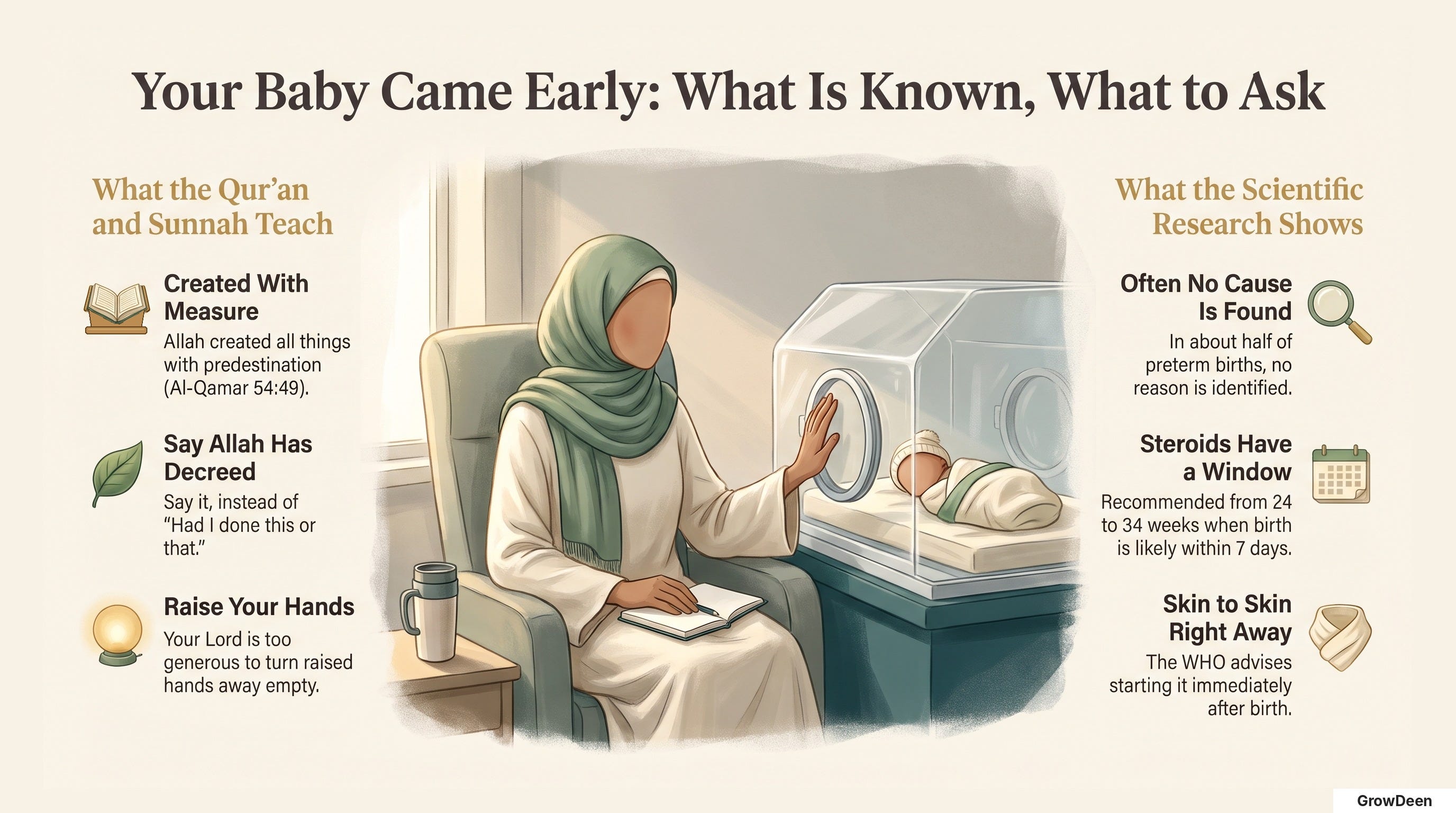
Steroids before birth. From 24 to 34 weeks, the WHO recommends steroid injections for women likely to give birth in the next 7 days. It should be given even if the full course may not be finished. [6] The conditions include being able to assess gestational age accurately. A single repeat course is recommended when at least 7 days have passed and birth again looks likely. Steroids are not recommended for a planned cesarean (C-section) at 34 weeks 0 days to 36 weeks 6 days. [6] Your team will follow its own country's guideline, which may differ in the details.
Skin to skin straight away. The WHO now advises skin to skin contact, called kangaroo mother care, immediately after birth, with no first period in an incubator. Starting at once saves more lives, lowers infections and low body temperature, and improves feeding. [11] In a hospital it can start before the baby is stable. The exceptions are a baby who cannot breathe alone after resuscitation, is in shock or needs a ventilator. The baby is secured to the chest with a binder that keeps the airway open, and monitoring continues. [12]
The mother gives it whenever possible; when she cannot, fathers and other family members can. Babies who need intensive care should be in units where family can be present 24 hours a day. [12]
Your milk. A mother's own milk is first choice for a preterm baby. Donor human milk is the best alternative, and fortified preterm formula is used where there is no donor milk bank. [11] The same guidance calls for parental leave and for policies that give these families financial and workplace support. [11]
Who this rests on: the WHO's global guidelines (2022; no review date given). Where the earliest babies are born rests on the American Academy of Pediatrics (US, 2012). [6,10,12]
How strong this is: Strong. These are official guidelines built on systematic reviews of trials.
The years after. Babies born earlier carry a higher chance of later difficulties. In one Australian study, children born at 22 to 23 weeks had a higher risk of major disability at age 8. They were compared with children born at 24 to 27 weeks and at term. [13] Who was studied: all extremely preterm births and term-born children in Victoria, Australia, in 1991 to 1992, 1997 and 2005. Ethnicity and family income are not given in the study summary, which says results were adjusted for social risk. Disability was the outcome measured. How strong this is: Suggestive (cohort studies in one state).
Place matters too. In high-income countries, almost all babies born at or before 32 weeks survive, and fewer than 10% of extremely preterm babies die. [2] The WHO says every preterm baby should be followed up after going home, ideally through home visits by trained health workers. [12]
What we do not know yet: why about half of preterm births happen. No study has yet tested any of this with Muslim families.
What this means for you: the cause may stay unknown, but the steps that help are known, and you can ask for them.
What the Qur'an and Sunnah Teach
Somewhere in the first days, many parents of a preterm baby ask the same thing. Did something I did bring this on?
إِنَّا كُلَّ شَىْءٍ خَلَقْنَـٰهُ بِقَدَرٍ
Indeed, all things We created with predestination.
Al-Qamar 54:49 · Sahih International [14]
Text. Ibn Kathir explains that the scholars of the Sunnah used this verse to show that Allah created all things with their measure before they existed. He knew everything that would happen before it happened. [15] Ibn Kathir then cites this hadith:
Allah's Messenger ﷺ said: "Allah ordained the measures (of quality) of the creation fifty thousand years before He created the heavens and the earth, as His Throne was upon water."
Sahih Muslim 2653b · sunnah.com [16]
Text. In the same passage, Ibn Kathir cites an authentic hadith that speaks to the 2am list. The Prophet ﷺ told the believer to seek Allah's help and not to give in to weakness. He said not to say, "Had I done this or that, this or that would have happened," when something hard happens. He said to say instead, "Allah has decreed this, and He does as He wills." [15,26]
Our reflection. Set that beside a NICU admission form. The week your baby arrived sat inside Allah's measure before this pregnancy began. The same hadith tells you to seek help and keep going. What the Sunnah asks you to drop is the "if only".
That leaves what can still be done every day, from a chair beside an incubator.
The Prophet ﷺ said: "Your Lord is munificent and generous, and is ashamed to turn away empty the hands of His servant when he raises them to Him."
Sunan Abi Dawud 1488 · Sahih (Al-Albani) · sunnah.com [17]
Our reflection. Raise your hands there, in your own words, on the visits when you have nothing eloquent to say. You are asking the One who already set the measure. His Prophet ﷺ described Him as too generous to send those hands back empty.
For a question of deen about your own situation, ask your local imam or a local scholar, and share the details with him.
You take the means. Allah holds the measure.
The Lab Verdict
The science: in about half of preterm births no reason is found. The steps that help are well known: steroids before birth, skin to skin straight after, and your milk. (Strong)
The Qur'an and authentic Sunnah: Allah created all things with measure. The Prophet ﷺ taught the believer to seek Allah's help and to drop the "had I done this or that".
Where they meet: the science adds that the cause often stays hidden, while the steps that help are clear. The Sunnah adds what to do with the unknown: leave the measure with Allah, and seek His help. Together, they turn your hours from "if only" to the next step.
So at home: stop auditing yourself, and start asking them.
Knowledge in Practice: Stop Auditing, Start Asking
Knowing why the list has no answer is half the work. The other half is what you do with the hours it was taking.
If you can only do one thing, do step 1. It is enough.
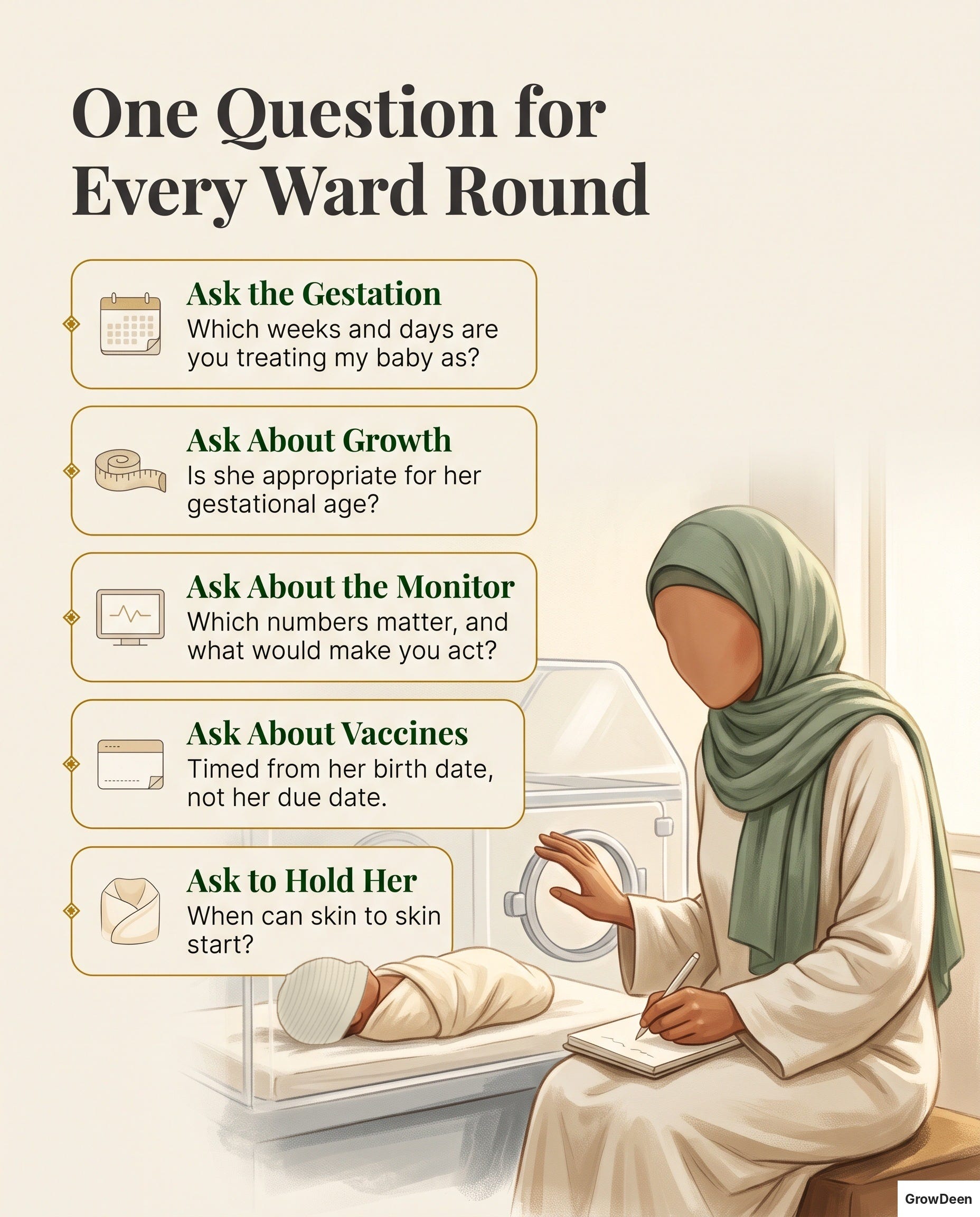
1. Write one question before each ward round (2 minutes). One written question is easier to carry than five remembered ones, on four hours of sleep. Write the answers down too.
Say this: pick one line a day, and ask it in the language you are most comfortable in. Ask for an interpreter if you need one.
"What gestation are you treating my baby as, in weeks and days?"
"Is my baby's growth appropriate for that gestational age?"
"Who is my baby's lead doctor, and which nurse is looking after her today?"
"Which numbers on the monitor matter, and what reading would make you act?"
"What vaccination schedule will she follow, counted from her birth date?"
"What follow-up appointments are booked, and what is each one looking for?"
The vaccine question matters. Preterm babies are vaccinated by their chronological age, counted from the real birth date, not from the due date. [18,19] Some of the earliest babies are advised extra doses. Some vaccines also have strict age limits with no catch-up, such as rotavirus in Australia. [19] Ask for the schedule in writing.
Instead of: "Did I do something to cause this?" Try: "What is the plan for today, and what should I watch for?"
2. If you are still pregnant, learn the six signs (5 minutes, once). Before 37 weeks, call your doctor, midwife or hospital straight away if you notice any one of these: [20,21]
Contractions or tightening of the belly every 10 minutes or more often. Painless tightening still counts.
A change in vaginal discharge, including leaking fluid or any bleeding.
Pressure low in the pelvis, as though the baby is pushing down.
A low, dull backache.
Cramps that feel like a period.
Belly cramps, with or without diarrhea.
Some tightenings through the day are normal in pregnancy. Six or more in one hour is not, and frequent tightenings may start to open the cervix. [20] When you call, do not wait an hour to see if it settles. Say how many weeks pregnant you are and which signs you have. While you wait, write down the time of each tightening.
If you are not sure whether what you feel counts, call anyway. Feeling that something is off is reason enough. A trip that ends in reassurance costs an evening.
Say this to the person on the phone: "I am 31 weeks pregnant. I have had tightenings every 10 minutes for the last hour."
3. If you get a warning, ask the questions that only work before the birth (10 minutes). Some preterm labors slow or stop, and medicines can sometimes delay birth for up to 48 hours to give steroids time. [21] Every extra day gives your baby more time to mature.
Say this to the doctor: "Am I eligible for steroid injections for my baby's lungs, and when would the first dose be given?"
"Should I be transferred to a hospital with a neonatal intensive care unit?"
"Can a breast pump be brought to me within the first hours after the birth?"
"Can skin to skin start right after birth, rather than after a time in an incubator?"
"Who do I call tonight if anything changes, and what is that number?"
If your hospital does not have the right care for an early baby, your doctor may suggest moving you to one that does. [21] If your baby is born first and needs to move, ask whether a parent can travel with her. Ask, too, whether you can transfer to the same hospital.
4. After the birth, give the two things only you can give (every visit). Skin to skin and your milk are part of your baby's care. [11]
Say this to the nurse: "Can I hold her skin to skin today? If not, what would need to change?"
Expressing milk for a baby who cannot feed at the breast yet is hard, repeated work. Ask the unit for a pump, a quiet space and help with the first sessions.
Make It Work in Your Home
Your husband works long shifts, or you are doing this on your own? Keep the question note on one shared phone list, so whoever reaches her bedside can ask it.
Other children at home? Ask one relative to cover school drop-off and pickup on ward-round days. The round is the hour that changes the plan.
The hospital is far, and there is no car? Ask the unit staff what travel help, parking support and parent rooms they have.
Grandparents who are not Muslim? The questions in step 1 are the same for every family. Share them as they are.
Say this to your husband: "Can you come to one ward round this week? Here is the question I want us to ask."
Say this to your mother or mother-in-law: "Mama, you have carried this family through hard weeks before. Will you bring us meals this week, so I can spend my hours at her bedside?"
The family question: ask yourself, "Who can give me twenty minutes of rest this week?"
Try It Seven Times
Any seven ward rounds in the next week or two. One written question each time. Seven is a starting goal, not a magic number. Check each one off and add one word for how the answer felt. Tell us in the comments which question opened things up. We'd love to know.
One written question, asked out loud, is the whole practice.
If Things Don't Go to Plan
If you called and were sent home: that is the system working. Call again if any sign comes back.
If an answer does not land: ask again, or ask, "Can you draw that for me?" Asking twice is normal.
If you start doubting yourself: Should I have seen the signs sooner? Signs are clearer looking back. Seeing them late is not neglect.
If the guilt keeps coming back: use the words in A Du'a for This, then go back to step 1. One question is a way out of the loop.
If your baby came before you could ask anything: start with question one in step 1. The week-one list works on any day.
And you? Your body is healing from a birth, and your sleep is broken. Tell your doctor or midwife how you are feeling, including low mood or worry that will not lift. Telling them is how help starts.
Who to turn to: your doctor or midwife for you; your baby's doctor or pediatrician, and the unit's nurses, for your baby. In an emergency, call your local emergency number. For questions of deen, ask your local imam or a local scholar, and share the details with him.
Support Muslim Parenting Lab ❤️
Would you like the reward of every parent who acts on what they read here? Fund it with the button below and it is yours.
The Prophet ﷺ said whoever guides to good has a reward like the one who does it. (Sahih Muslim 1893a)
Your Companion Pack: The Early Arrival Pack
Free to download: three printable pages, made for a fridge door and a hospital bag.
Phone Tonight: the six signs of preterm labor with the thresholds that matter, what to do as you call, and a blank line for your hospital's number.
The Ask List: the questions to ask before the birth, from steroids to who to call tonight. Then the questions for the first week on the unit, from gestation to follow-up.
Written Before You Were Worried: the verse and the hadith from this guide, with three short lines for the nights beside the incubator.
Parents Also Ask
What causes premature birth?
In about half of preterm births, no reason is found. [4] Known risks include a previous preterm birth, twins or more, a short cervix, infections, high blood pressure and pre-eclampsia. [1,3] Myth Check explains more.
Is it my fault that my baby was born early?
Often, nobody can name a cause, and a risk list is not a verdict on you. Text: the Qur'an says Allah created all things with measure, and the Sunnah teaches the believer not to say "had I done this or that". [14,15,26] For your own situation, ask your local imam or a local scholar, and share the details with him.
What are the first signs of preterm labor?
Before 37 weeks, watch for tightenings every 10 minutes or more often, a change in discharge, leaking fluid or bleeding. Pelvic pressure, a low dull backache, period-like cramps, and belly cramps with or without diarrhea count too. [20,21] Six or more tightenings in an hour is a reason to call. Step 2 has the full list.
Can preterm labor be stopped?
Sometimes. For about 3 in 10 women, preterm labor stops on its own. [21] If it does not, medicines can sometimes delay birth for up to 48 hours, which can give steroids time to work. [21]
Should I lie down and drink water if I have contractions?
Call first. Bed rest does not help prevent preterm birth, and evidence that drinking extra fluids helps is lacking. [22,23] Your doctor or midwife needs to check you.
Are a premature baby's vaccines timed from the due date?
No. In most cases, preterm babies are vaccinated at the same age as term babies, counted from the real birth date. [18] Some of the earliest babies are advised extra doses, so ask for the schedule in writing. [19]
Will my premature baby have developmental delays?
The earlier the birth, the higher the chance of later difficulties. [13] That is why the WHO says every preterm baby should be followed up after going home. [12] Ask what follow-up is booked and what each visit checks.
Final Reflection
Dear parent,
You are reading this at an hour when most people are asleep. That shows how much you love this baby.
The list you made came from love. Often, nobody can tell why a baby comes early, and that includes you. Not knowing is not a failure on your part.
You do not need to fix everything this week. Tonight, do step 1. Write one question. Make your niyyah that asking is care for the amanah Allah gave you.
Often, nobody can tell you why your baby came early. You can still ask what happens next.
A Du'a for This
For you:
قَدَرُ اللَّهِ وَمَا شَاءَ فَعَلَ
Qadaru-llāhi wa mā shā'a fa'al
"Allah did that what He had ordained to do."
Sahih Muslim 2664 · sunnah.com [26]
In your own words: "O Allah, place strength in my baby's body and barakah in her years, and give me patience at her side."
With your child: Sabbiḥ-isma rabbika-l-a'lā, "Exalt the name of your Lord, the Most High." (Al-A'la 87:1) [24]
Say it softly beside the incubator, over a baby who cannot speak yet.
Share the Khayr
If you know a mother sitting beside an incubator tonight, or a sister pregnant again after an early birth, send this to her. The Prophet ﷺ said that one who guides to something good has a reward like the one who does it. [25]
Tell us in the comments: which question opened things up on your ward round? We'd love to know.
Parents Also Read
Parents who read this guide also found these helpful.


References
[1] Eunice Kennedy Shriver National Institute of Child Health and Human Development. What are the risk factors for preterm labor and birth? NICHD.
[2] World Health Organization. (2023). Preterm birth: key facts. WHO fact sheet.
[3] Eunice Kennedy Shriver National Institute of Child Health and Human Development. What causes preterm labor and birth? NICHD.
[4] Society of Obstetricians and Gynaecologists of Canada. Preterm labour. Pregnancyinfo.ca.
[5] World Health Organization. (2023). 1 in 10 babies worldwide are born early, with major impacts on health and survival. WHO news release.
[6] World Health Organization. (2022). WHO recommendations on antenatal corticosteroids for improving preterm birth outcomes. Geneva: WHO.
[7] Engle, W.A. (2006). A recommendation for the definition of "late preterm" (near-term) and the birth weight-gestational age classification system. Seminars in Perinatology, 30(1), 2–7.
[8] Engle, W.A., Tomashek, K.M., Wallman, C., & Committee on Fetus and Newborn. (2007). "Late-preterm" infants: a population at risk. Pediatrics, 120(6), 1390–1401.
[9] World Health Organization. (2014). Global nutrition targets 2025: low birth weight policy brief. Geneva: WHO.
[10] American Academy of Pediatrics, Committee on Fetus and Newborn. (2012). Levels of neonatal care. Pediatrics, 130(3), 587–597.
[11] World Health Organization. (2022). WHO advises immediate skin to skin care for survival of small and preterm babies. WHO news release.
[12] World Health Organization. (2022). WHO recommendations for care of the preterm or low-birth-weight infant. Geneva: WHO.
[13] Marks, I.R., Doyle, L.W., Mainzer, R.M., Spittle, A.J., Clark, M., Boland, R.A., Anderson, P.J., & Cheong, J.L. (2024). Neurosensory, cognitive and academic outcomes at 8 years in children born 22-23 weeks' gestation compared with more mature births. Archives of Disease in Childhood: Fetal and Neonatal Edition, 109(5), 511–518.
[14] Qur'an, Al-Qamar 54:49. Translation: Sahih International.
[15] Tafsir Ibn Kathir on Al-Qamar 54:49.
[16] Sahih Muslim 2653b.
[17] Sunan Abi Dawud 1488. Graded: Sahih, by Al-Albani.
[18] Centers for Disease Control and Prevention. Special situations: vaccination of preterm infants. General Best Practice Guidelines for Immunization.
[19] Melbourne Vaccine Education Centre, Murdoch Children's Research Institute. (2024). Preterm and low birthweight infants. MVEC.
[20] Eunice Kennedy Shriver National Institute of Child Health and Human Development. What are the symptoms of preterm labor? NICHD.
[21] American College of Obstetricians and Gynecologists. Preterm labor and birth. ACOG patient FAQ.
[22] Eunice Kennedy Shriver National Institute of Child Health and Human Development. What treatments are used to prevent preterm labor and birth? NICHD.
[23] American College of Obstetricians and Gynecologists. (2016). Practice Bulletin No. 171: Management of preterm labor. Obstetrics & Gynecology, 128(4), e155–e164.
[24] Qur'an, Al-A'la 87:1. Translation: Sahih International.
[25] Sahih Muslim 1893a.
[26] Sahih Muslim 2664.
We combine scientific research with Qur’an and authentic Sunnah, and we cite our sources. Even so, this is general guidance and no substitute for a doctor who can examine your child.
Sources & confidence
The hadith in this guide are from Sahih Muslim and Sunan Abi Dawud. Health guidance follows the WHO, the NICHD, ACOG, the AAP and the CDC. Checked October 2026. Found a source that looks wrong? Email us at info@growdeen.com.
Words in this guide
preterm (premature) birth (scientific term): a birth before 37 completed weeks of pregnancy.
gestational age (scientific term): how far along a pregnancy was, in weeks and days.
late preterm (scientific term): born from 34 weeks 0 days to 36 weeks 6 days.
appropriate for gestational age (scientific term): a baby whose size fits the weeks they had.
low birth weight (scientific term): a birth weight under 2,500 g (5.5 lb).
NICU, neonatal intensive care unit (scientific term): a hospital unit for sick or early newborns.
special care nursery (scientific term): a unit for babies who need less intensive care.
signs of preterm labor (scientific term): the warning signs listed in step 2.
ward round (scientific term): the daily visit when the care team reviews each baby.
kangaroo mother care (scientific term): skin to skin contact, with the baby held on a parent's chest.
antenatal corticosteroids, or steroid injections (scientific term): medicine given before birth to help a baby's lungs.
tocolytics (scientific term): medicines that may delay birth for a short time.
chronological age (scientific term): age counted from the real birth date.
qadar (Islamic term): Allah's decree and measure.
tafsir (Islamic term): explanation of the Qur'an.
du'a, or doa (Islamic term): supplication.
niyyah (Islamic term): intention.
amanah (Islamic term): a trust.
barakah (Islamic term): blessing.
khayr (Islamic term): good.
sadaqah jariyah (Islamic term): ongoing charity.
ﷺ (Islamic term): "peace and blessings be upon him", said after the Prophet's name.
cesarean, also caesarean or C-section (country word): a birth by surgery.