

Nobody can tell you why it happened. In roughly 50% of premature births the cause is never identified, and 13.4 million babies arrived before 37 weeks in 2020 [1,2].
Print it before the hospital bag is packed.
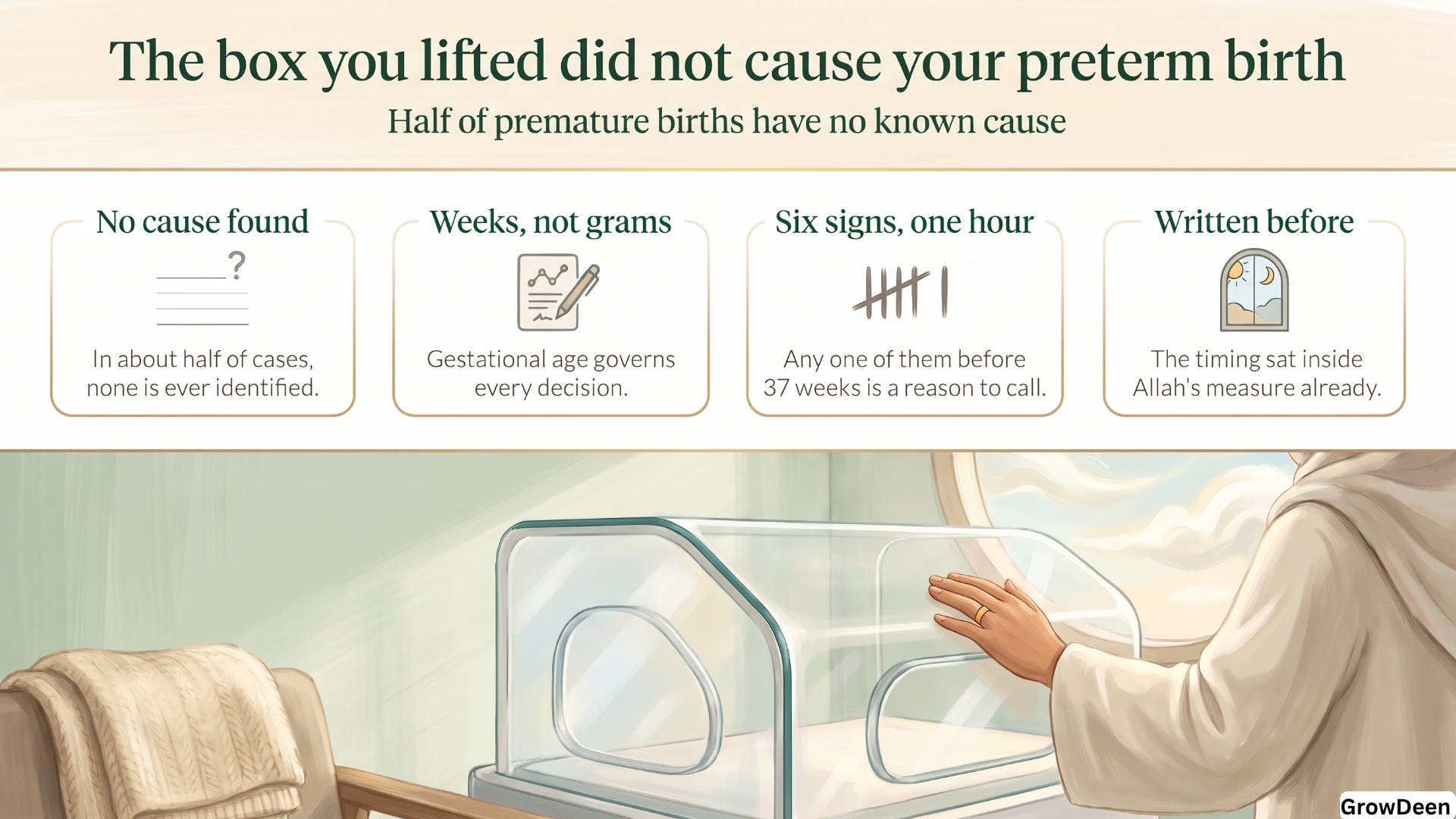
It was 2:40 in the morning when she started counting.
Not contractions. The past four weeks. The box she lifted onto the kitchen counter. The argument with her sister. The two flights of stairs she took quickly because the lift was slow. Somewhere in that list, she is certain, is the thing she did.
You already know this scene, either because you are in it now or because you were in it and never said so out loud. And here is where the expected answer fails. Every instinct says that if she searches carefully enough she will find the cause and understand what happened. In about half of all premature births there is no cause to find. Not for her, not for her obstetrician, and not for the neonatologist who will care for her baby for the next eight weeks [1].
The Sentence That Runs On A Loop At Three In The Morning
Most articles about premature birth begin with the baby. This one begins with the mother, because her first question is almost never clinical.
Did I do this.
That sentence deserves a direct answer rather than a sympathetic one. In roughly half of preterm births, the cause is not identified by anyone [1]. Not undisclosed, not withheld by a careful doctor, not buried in a file she has not been shown. Not known. Medicine has been working on this for decades and still cannot name a mechanism in half of these pregnancies.
Hold that against the self-audit for a moment. The audit assumes a cause exists and that she is capable of locating it from memory. Both halves of that assumption fail in about one case in two.
There is a second thing the audit does, and it is the real cost. Every hour spent reconstructing a lifted box is an hour not spent on the questions that change what happens next. And some of those questions have a closing window measured in days rather than weeks, which is the part nobody mentions at the bedside.
Why The Risk List Reads Like An Indictment
Somebody will show her a list. It may be a leaflet, a search result, or a relative with a theory.
The list is real. A previous preterm birth raises the likelihood. So do conditions of the womb or cervix, fibroids or a cervix that opens too early among them, and carrying twins or more. So do maternal conditions where delivering early is the safer course for both of them, pre-eclampsia being the clearest case. Diabetes, high blood pressure and other long-term conditions raise it too [1].
Then there is a second group, associated with early birth without being a cause in any individual pregnancy: smoking and vaping, alcohol and other drug use, inadequate nourishment, sustained heavy physical strain, high stress, anxiety or low mood, being well above or below a healthy weight, little antenatal care, and being under 17 or over 35 [1].
Read as a verdict, that list is devastating. Read correctly, it is a map of where care gets concentrated, and most of the territory on it belongs to a medical team rather than to a mother’s willpower. Preterm birth rates run between 4% and 16% of births depending on the country, and around 65% of early births occur in sub-Saharan Africa and southern Asia [1,2]. Those gaps track health systems, nutrition and access to antenatal care far more closely than they track individual choices.
Which is the reason the next section exists. Everything in it is something a parent can act on, and none of it requires knowing the cause.
The Number That Runs Every Decision, And Why She Is Rarely Given It First
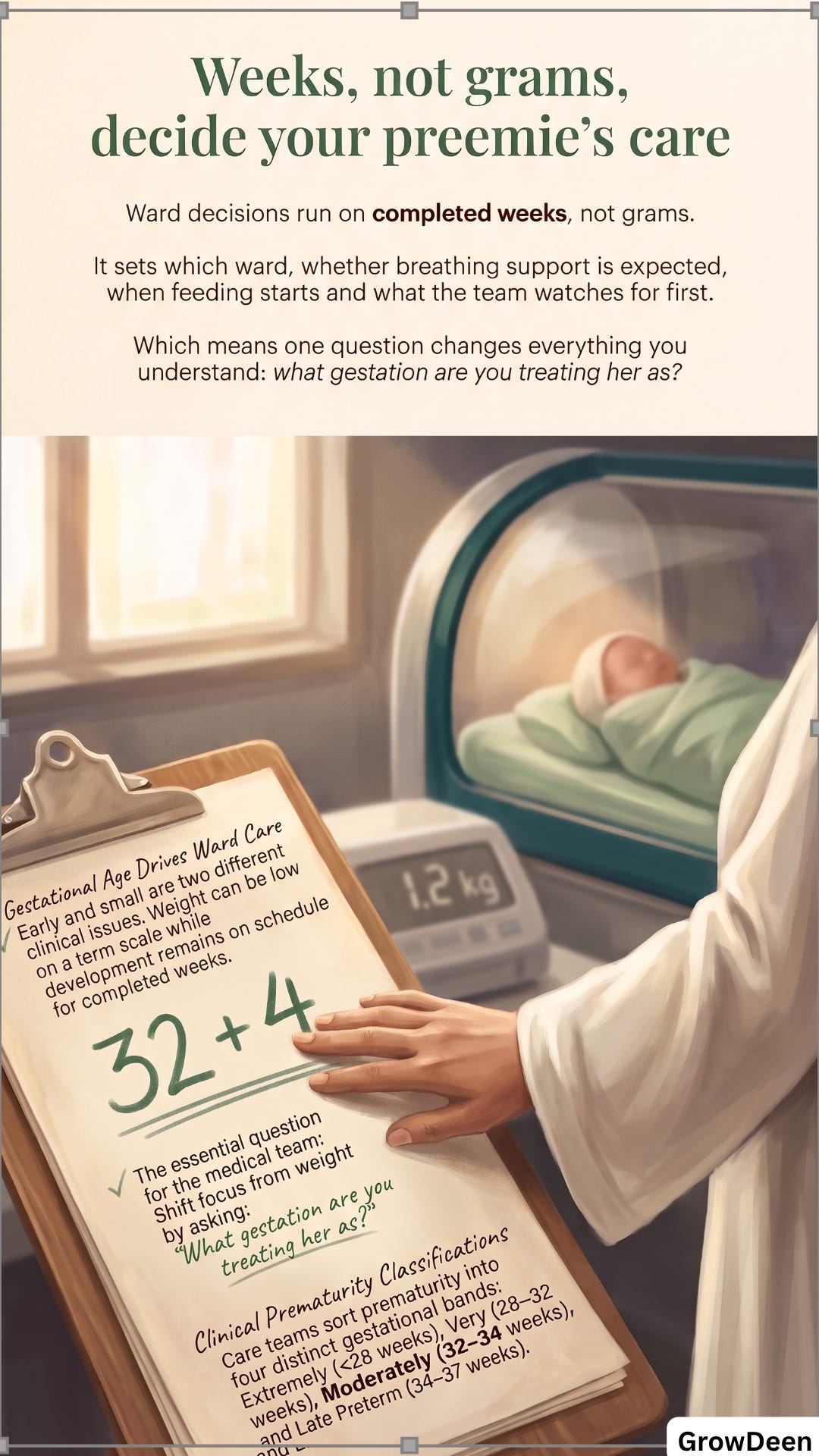
Parents are usually told a birth weight. The number that actually governs care is a different one.
Gestational age means the weeks and days the baby completed in the womb, counted from the first day of the last menstrual period. Nearly every decision descends from it. Which ward the baby is admitted to. Whether breathing support is expected. When feeding can start. What the team watches for in week one and stops watching for in week six.
Clinicians sort preterm babies into four bands by completed weeks [1]:
Extremely preterm, before 28 weeks
Very preterm, 28 to 32 weeks
Moderately preterm, 32 to 34 weeks
Late preterm, 34 to 37 weeks
Babies from 37 weeks are term. Most born before 32 weeks need help breathing and are cared for in a neonatal intensive care unit, usually shortened to NICU. Babies further along may go to a special care nursery instead.
The late preterm band is worth a sentence of its own. It was added to clinical practice deliberately, because babies born between 34 and 37 weeks pass for small term babies while still carrying raised risks of feeding difficulty, jaundice and unstable temperature, and that resemblance had been getting them watched less closely than they needed [3]. A baby born at 36 weeks and 6 days is preterm, whatever they look like in the photograph.
An early dating ultrasound produces the most accurate figure, which is the practical reason antenatal care is recommended from before 12 weeks, with a minimum of eight contacts across the pregnancy [1]. The scan that feels like a formality in month two is the thing that makes month eight legible.
So the first question at the cotside is not how much does she weigh. It is what gestation are we treating her as.
Early And Small Are Two Different Problems
These two get folded together constantly, and separating them removes a great deal of unnecessary fear.
Low birth weight means a baby weighs considerably less than expected for their gestational age. A baby can be preterm, or low birth weight, or both.
Most preterm babies are small for an uncomplicated reason: they left before the final stretch of pregnancy in which babies lay down the bulk of their weight. Their weight is low on a term scale, while their development matches the weeks they actually completed. The phrase to listen for is “appropriate for gestational age.” Ask whether it applies, because it means the baby is on schedule for their own timeline rather than behind on somebody else’s.
That distinction is also the first of several things that are easy to grasp at the bedside and impossible to recall a week later on four hours of sleep.
I know that is a lot to hold while you are also learning to work a breast pump and read a monitor. That is why there is a free Early Arrival Pack, a three-page printable carrying the preterm labour warning signs, the questions to ask before and after the birth, and an Islamic reflection page for the hard nights. The download button is at the top of this page, and there is a full description of what is inside it below. It is built to live on a fridge door and in a hospital bag, not in a downloads folder.
If You Get A Warning, This Is What The Window Is For
Some early births announce themselves. Where that happens, several things only work beforehand, which makes the warning genuinely useful rather than merely frightening.
Where preterm birth looks likely within the next seven days, between 24 and 34 weeks of gestation, a course of steroid injections is recommended to mature the baby’s lungs before delivery [5]. Four details are worth carrying into that conversation. The course should be started even when there is a chance it will not be finished before the birth. A single repeat course is recommended where at least seven days have passed and birth now looks likely within the week. It is not recommended for a planned caesarean between 34 weeks 0 days and 36 weeks 6 days. And it should not be given routinely where gestational age cannot be established by ultrasound [5]. If nobody has raised steroids, raise them.
Transfer is the second thing. Babies expected before roughly 32 weeks are generally delivered in hospitals with a NICU, and those units cluster in larger cities, so families in regional or remote areas are often moved before the birth. That is disruptive and considerably safer than moving a newborn afterwards. Where a baby is born somewhere without a NICU and needs one, a specialised newborn transport service moves them by road or air, staffed by a doctor and a nurse trained in transporting small and sick babies. One parent can often travel alongside. If the mother is not well enough to travel, ask about transferring to the receiving hospital’s maternity unit afterwards, and ask what parent accommodation exists.
Third, and easily forgotten in the noise: ask for a breast pump within the first hours after the birth, not the first days.
Before the warning signs themselves, one more thing is worth knowing about what happens in the minutes after delivery, because current guidance changed it recently.
The Two Things Only You Can Give
Both are now classified as treatment rather than comfort, which is a shift worth understanding, because it changes what a parent is entitled to ask for.
The first is skin to skin contact, known as kangaroo mother care. The World Health Organization recommends starting it immediately after birth, with no initial period in an incubator, because beginning straight away saves more lives, lowers infection and hypothermia, and improves feeding [6,7]. In a health facility it can begin before the baby is clinically stable, unless the baby cannot breathe spontaneously after resuscitation, is in shock, or needs mechanical ventilation [6]. The baby is secured firmly against the chest with a binder that keeps the airway open, and monitoring continues throughout. Where the mother cannot provide it, fathers, partners and other family members can. Babies needing intensive care should be in units where family can be present around the clock [6]. If a unit’s practice differs from any of that, it is a reasonable thing to ask about rather than accept in silence.
The second is milk. A mother’s own milk is first choice for a preterm baby. Where it is unavailable, donor human milk is next best, and fortified preterm formula is used where no donor milk bank exists [6]. Expressing for a baby who cannot yet feed at the breast is hard, repetitive work that often starts within hours of delivery and continues through every night after. The same guidance goes further than the cotside, calling for parental leave, for employer and government policies that give these families adequate financial and workplace support, and for home visits by trained health workers [6]. Where any of that exists, use it.
Both of those are means. Which raises the question the mother asked at two in the morning, and this is where it gets its real answer.
Support Muslim Parenting Lab ❤️
Would you like the reward of every parent who acts on what they read here? Fund it with the button below and it is yours.
The Prophet ﷺ said whoever guides to good has a reward like the one who does it. (Sahih Muslim 1893a)
What Islam Says About The Week Your Baby Arrived
Somewhere in the first days, nearly every parent of a preterm baby arrives at the same question. Why did this happen, and did something I did bring it on?
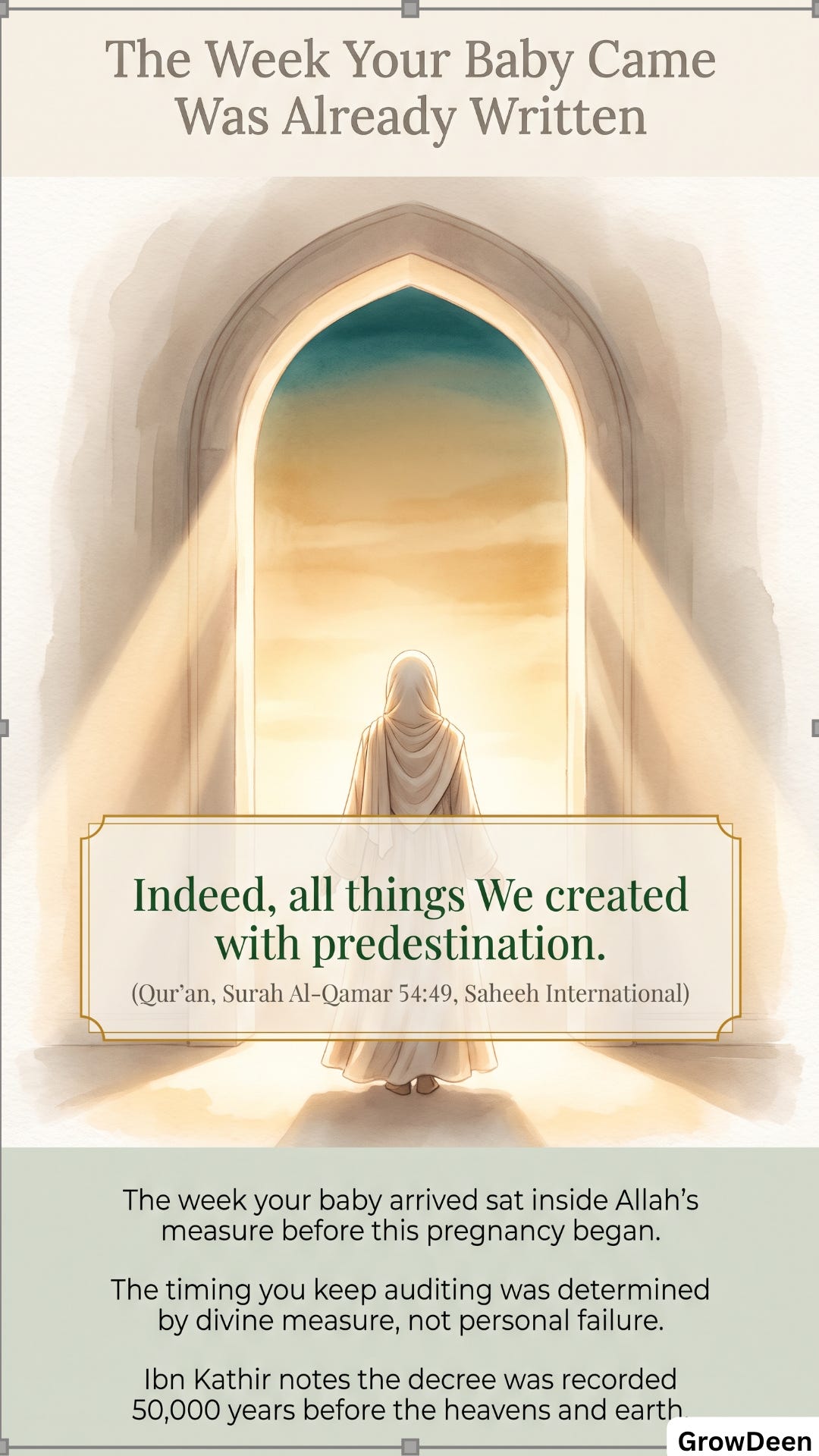
Allah says, “Indeed, all things We created with predestination” [11]. Tafsir Ibn Kathir explains that Allah created everything by a measured decree, that He knew what would occur before it occurred, and he cites the narration that the measurements of creation were recorded fifty thousand years before the heavens and the earth were made [12]. He notes that the Imams of the Sunnah used this verse to answer those who denied divine decree.
Set that beside a NICU admission form and something settles. The week your baby arrived sat inside Allah’s measure before the pregnancy began. It is not the verdict on a lifted box or a long day spent standing.
Which leaves what can still be done, every single day, from a plastic chair beside an incubator. The Prophet ﷺ said, “Your Lord is munificent and generous, and is ashamed to turn away empty the hands of His servant when he raises them to Him” [13].
So raise them there, in your own words, out loud, on the visits when you have nothing eloquent to say. You are not addressing a reluctant giver. You are addressing the One who already set the measure, and who is described in His Prophet’s ﷺ own words as too generous to send those hands back empty.
That is the release. What follows is the redirection: stop auditing yourself, and start asking them.
Signs That Mean Phone Tonight
If you are still pregnant, or pregnant again after an early birth, this is the part to photograph.
Early labour signs are often subtle and several overlap with ordinary late-pregnancy discomfort. Contact your midwife, doctor or hospital straight away if, before 37 weeks, you notice any of the following [4]:
Contractions or tightening of the abdomen every 10 minutes or more often
A change in vaginal discharge, including leaking fluid or any bleeding
Pressure in the pelvis, as though the baby is bearing down
A low, dull backache
Cramping that feels like period pain
Abdominal cramps, with or without diarrhoea
Scattered tightenings across a day are normal in pregnancy. Six or more within an hour is not, and frequent tightening can start to open the cervix [4]. Call also when nothing specific is wrong and something still feels off, because feeling unwell without being able to name why is itself worth a phone call. A trip that ends in reassurance costs an evening.
Some preterm labours can be slowed or stopped. While a baby is growing well and getting what they need, every additional day inside is worth having.
What The Team Is Tracking, And The Question That Opens It Up
Ward rounds stop being opaque once you know what the staff are actually watching.
Breathing comes first, since most babies born before 32 weeks need support with it, and lungs are the organ most directly shortchanged by an early exit [1]. Temperature control follows, because preterm babies carry little body fat and lose heat quickly, which is part of why immediate skin to skin contact matters so much [6,7]. Feeding is third, moving from drips to tube feeds to the breast as suck and swallow coordination arrives on its own schedule. Infection, jaundice and the heart and bowel each carry their own observations.
The question that opens all of it: what does that number on the monitor mean, and what would make you act on it. Ask it again when the answer does not land. A parent who can read the monitor is the person most likely to notice a change first, and staff are generally glad of that.
The Years After, And The Schedule Nobody Explains
Most premature babies survive, and survival has improved as neonatal medicine has advanced [8].
Two factors shape the odds. How mature the baby was at birth is the first, since every completed week helps. Access to the right care is the second, which is why delivery in a specialist maternity centre with a NICU makes such a difference at the earliest gestations [8].
Most preterm babies go on to develop much as term babies do. The longer the pregnancy ran, the lower the likelihood of concerns. Late preterm babies carry a very small chance of health or developmental concerns compared with term babies. Moderately and very preterm babies carry a higher chance than late preterm babies. Extremely preterm babies carry the highest chance, and even among them, severe difficulties are uncommon [8,9].
Two practical things belong here. Babies born very early are usually enrolled in a developmental follow-up programme, and home visits by trained health workers are recommended for families caring for a preterm or low birth weight baby [6]. Use both, because support for hearing, vision, feeding and movement works best started early rather than after a delay is confirmed.
The second surprises almost everyone. Vaccinations for preterm babies are timed by chronological age, counted from the actual date of birth rather than from the original due date, and timeliness matters because it shortens the window in which a vulnerable baby has no protection [10]. Some extremely and very preterm babies are recommended additional doses, and a few vaccines carry firm age cut-offs with no catch-up afterwards [10]. Ask for the schedule in writing.
Your Free Early Arrival Pack
If you have read this far, you are the kind of parent who would rather hold hard information than comfortable vagueness. That tells me something about how you are going to handle the next few weeks.
Inside the Early Arrival Pack (one comprehensive PDF, 3 pages):
Page 1: Phone Tonight: The Preterm Labour Signs Card — All six warning signs with the thresholds that matter, the six-contractions-in-an-hour rule, what to do in the hour before you call, and a blank line for your hospital’s number written in your own hand. Designed as a fridge-door card for a pregnant woman, or for a sister who is pregnant now.
Page 2: The Ask List: Before the Birth and in Week One — The exact questions to put to a medical team, split into the two windows where they work: before the birth (steroids, transfer, a pump in the first hours, who to call) and the first week on the unit (gestation being treated, appropriate for gestational age, named consultant, monitor thresholds, vaccination schedule from the date of birth). Carries the line “Stop auditing yourself. Start asking them.” so you can see what the page is for at a glance.
Page 3: Written Before You Were Worried — The Qur’anic verse and the authentic narration from this article, set out in English with their sources, alongside three short lines on what they mean for a parent sitting beside an incubator at 3am. Built to be taped inside a cupboard door or kept in a hospital bag.
This isn’t just a PDF to download and forget. It’s a tool designed to stay on your fridge and in your hospital bag, where you’ll actually use it when you need it most.
This Early Arrival Pack is what every subscriber receives with each article. We cover the full journey of raising Muslim children, all backed by scientific research and rooted in Islamic wisdom.
If you’re a Muslim parent who wants both evidence-based guidance and Islamic perspective, subscribe for free so future resources arrive in your inbox before you need them.
Subscribe free for parenting resources backed by both science and Sunnah, guidance so specific you literally can’t get it anywhere else. No spam, no clutter, just resources that matter.
Do This Before You Close The Tab
Open your phone, start a new note, and write one sentence: the question you want answered on tomorrow’s ward round. One question, not five. That note is the whole practice. Stop auditing yourself, start asking them.
May Allah place strength in your baby’s body and barakah in their years, and reward every night you have spent awake beside them.
Share This With Someone Who Needs It
Think of one person right now: the cousin whose baby shower turned into a hospital visit, the friend who has stopped answering messages because she is at the unit twelve hours a day, the sister who is 30 weeks pregnant and quietly terrified after her first birth came early.
This article could take one weight off them tonight, the one where they believe they caused it. Share it with them today, not as advice, but as company. Sometimes the most loving thing we can do is hand someone the information that lets them stop blaming themselves.
Frequently Asked Questions
Q: What counts as a premature birth?
A: Any birth before 37 completed weeks of pregnancy. A baby born at 36 weeks and 6 days is premature and will be cared for as one. Doctors then sort prematurity into four bands, from late preterm at 34 to 37 weeks down to extremely preterm before 28 weeks [1]. For what each band actually triggers in the ward, see “The number that runs every decision” above.
Q: What causes premature birth?
A: In about half of cases nobody knows [1]. Known contributors include a previous preterm birth, conditions of the womb or cervix, carrying twins or more, pre-eclampsia, diabetes and high blood pressure. A second group of factors is associated with early birth without causing it in any individual pregnancy.
Q: Can premature labour be stopped?
A: Sometimes it can be slowed or halted, which is why getting assessed quickly matters so much. Even where it cannot be stopped, the time bought is used for steroid injections that mature the baby’s lungs, recommended between 24 and 34 weeks when birth looks likely within seven days [5].
Q: What are the first signs of premature labour?
A: Contractions every 10 minutes or more often, a change in vaginal discharge including leaking fluid or bleeding, pelvic pressure as though the baby is bearing down, a low dull backache, period-like cramping, and abdominal cramps with or without diarrhoea [4]. Six or more contractions in an hour is the threshold to call. The full list with thresholds is on Page 1 of the free pack.
Q: Will my premature baby be developmentally delayed?
A: Most premature babies go on to develop much as term babies do, and the longer the pregnancy ran, the lower the likelihood of concerns. Late preterm babies carry a very small chance compared with term babies. Even among extremely preterm babies, severe health and developmental difficulties are uncommon [8,9].
Q: Should my premature baby’s vaccinations be delayed?
A: No. Vaccines are timed from your baby’s actual date of birth rather than their due date, and some extremely and very preterm babies are recommended extra doses. A few vaccines have firm age cut-offs with no catch-up, so ask your baby’s team for the schedule in writing [10].
References
[1] World Health Organization. Preterm birth (fact sheet).
[2] World Health Organization. (2023). 1 in 10 babies worldwide are born early, with major impacts on health and survival.
[3] Engle, W.A. (2006). A recommendation for the definition of “late preterm” (near-term) and the birth weight-gestational age classification system. Seminars in Perinatology, 30(1), 2-7.
[4] Eunice Kennedy Shriver National Institute of Child Health and Human Development. What are the symptoms of preterm labor?.
[5] World Health Organization. (2022). WHO recommendations on antenatal corticosteroids for improving preterm birth outcomes.
[6] World Health Organization. (2022). WHO recommendations for care of the preterm or low-birth-weight infant.
[7] World Health Organization. (2022). WHO advises immediate skin to skin care for survival of small and preterm babies.
[8] Morgan, A.S., Mendonça, M., Thiele, N., & David, A.L. (2022). Management and outcomes of extreme preterm birth. BMJ, 376, e055924.
[9] Marks, I.R., Doyle, L.W., Mainzer, R.M., Spittle, A.J., Clark, M., Boland, R.A., Anderson, P.J., & Cheong, J.L. (2024). Neurosensory, cognitive and academic outcomes at 8 years in children born 22-23 weeks’ gestation compared with more mature births. Archives of Disease in Childhood: Fetal and Neonatal Edition, 109(5), 511-518.
[10] Melbourne Vaccine Education Centre, Murdoch Children’s Research Institute. Preterm infant immunisation.
[11] Qur’an, Surah Al-Qamar 54:49 (Saheeh International).
[12] Ibn Kathir. Tafsir Ibn Kathir (abridged), commentary on Surah Al-Qamar 54:49.
[13] Sunan Abi Dawud 1488, narrated by Salman al-Farsi. Graded: Sahih (al-Albani).
We combine scientific research with Qur’an and authentic Sunnah, and we cite our sources. Even so, this is general guidance and no substitute for a doctor who can examine your child.