


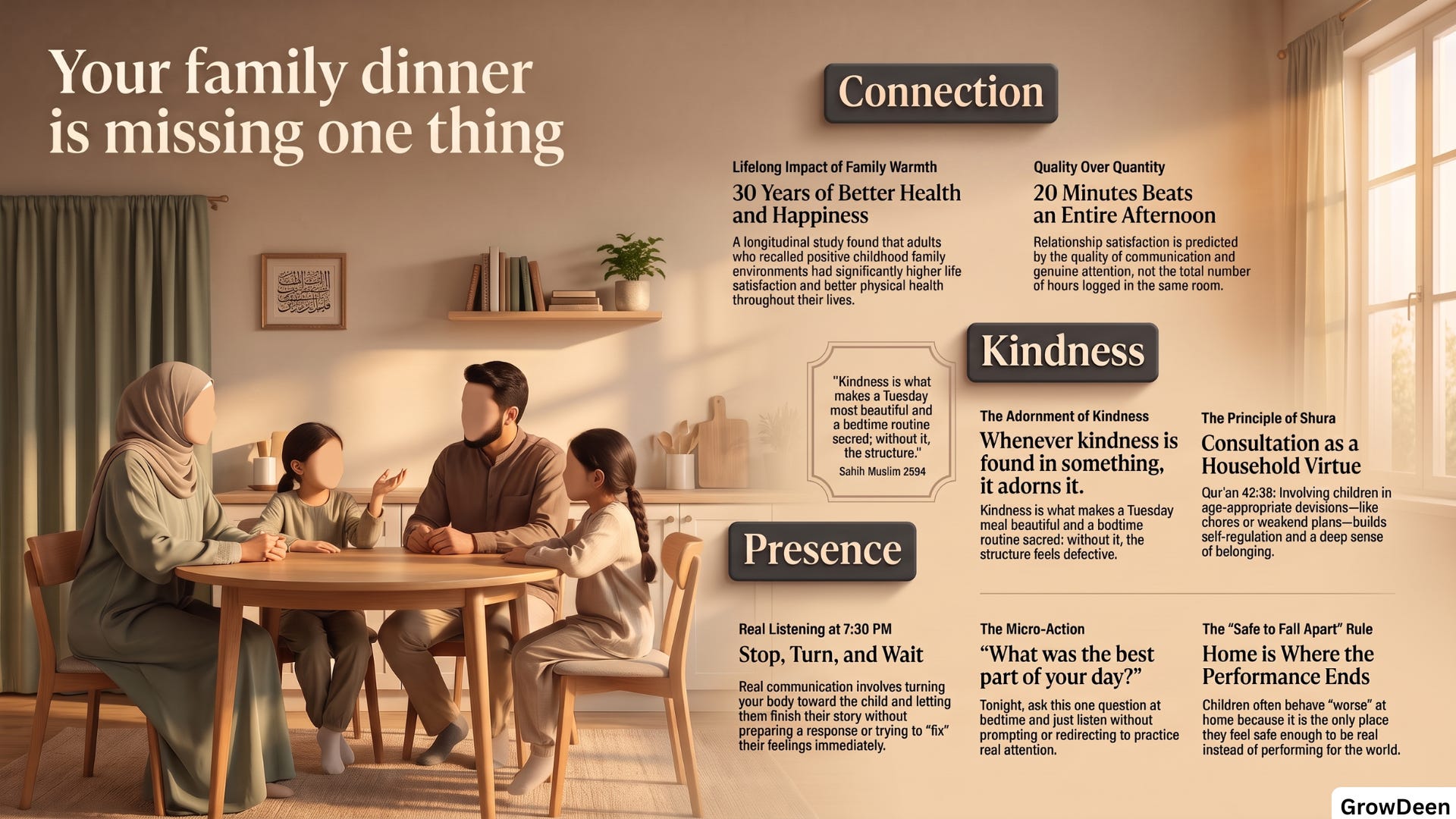
A 30-year study tracking families from early childhood to midlife found that adults who recalled positive family environments during childhood had significantly better physical health and higher life satisfaction and the effects lasted across their entire adult lives. [1]
You gave them a hug this morning.
You dropped everything when your daughter wanted to show you her drawing. You asked your son about school. You sat together for dinner — no phones, exactly like the parenting books say.
And still, somehow, it felt like everyone was just going through the motions.
You know what I mean. The hug was real, but your mind was already on tomorrow’s list. The conversation at dinner lasted about ninety seconds before someone spilled something and the moment evaporated. You did everything “right.” So why did the evening still feel… hollow?
Here is the part most parenting advice gets wrong. Connection is not a box you check. And the families that feel the warmest, the most deeply bonded? They are not the ones with the most elaborate routines or the most Instagram-worthy family activities.
They are the ones who figured out something simpler. And it is hiding in the moments you keep rushing past.
Why does your child behave so differently with you than with everyone else? There is a reason, and it is connected to everything in this article. I will come back to it.
What Makes This Guide Different From Generic Parenting Advice
Research-grounded, not opinion-based. Every recommendation draws on peer-reviewed studies from the last five years, including a landmark 30-year longitudinal study on family wellbeing. [1]
Islamically integrated, not bolted on. The Qur’an and Sunnah are woven into every section, not relegated to a separate “Islamic perspective” box at the bottom. This is what Islamic parenting content should look like.
Comes with a free printable resource. The Family Connection Cards companion pack gives you a physical tool to keep in your kitchen — not just information, but something you will actually use.
The Myth of the Big Gesture
There is a belief — quiet, persistent, almost invisible — that family connection is built through big moments. The holiday trip. The birthday party. The screen-free Saturday you planned for weeks. And those things are lovely when they happen. But they are not what holds a family together.
A 2020 study on parent-child relationship satisfaction found that what mattered most was not the amount of time spent together but the quality of communication during that time. [5] Parents who engaged in genuine conversation, affection, and shared activities reported significantly higher relationship satisfaction than parents who simply logged more hours in the same room.
Put differently: twenty minutes of actual attention beats an entire afternoon of being physically present but mentally somewhere else.
And this is where most of us get stuck. Not because we do not care, but because ordinary life moves so fast that the windows for real connection close before we notice they were open.
The Windows You Keep Walking Past
Picture your morning. Breakfast. Getting dressed. Walking to the car or the school gate. Inside those thirty minutes are at least three natural openings for connection, and they pass without anyone noticing.
The walk to school. Bath time. The ten minutes after Maghrib when the house finally settles. The conversation that starts at bedtime, right when you are already exhausted and want to leave the room.
These are not inconveniences. They are the infrastructure of your family’s emotional life.
Research confirms that family mealtimes — even brief, imperfect ones — strengthen relational bonds and improve communication patterns. [6] Not because of the food. Because sitting together, face to face, without screens, does something to the people in the room that no amount of planning or scheduling can replicate.
The Prophet ﷺ understood this. He did not build connection with his family through elaborate events. He mended his own shoes at home. He helped with household work. He played with his grandchildren during ordinary moments, not staged ones. His home was a place he actively invested in, not a place he occupied between obligations.
Kindness adorns everything it touches.
That is not a platitude. It is a hadith. The Prophet ﷺ said: “Whenever kindness is found in something, it adorns it, and whenever it is removed from something, it makes it defective.” [7]
Sit with that word. Adorns. Not improves. Not helps. Adorns. It means that the Tuesday evening meal becomes genuinely beautiful when the tone at the table is warm. The bedtime routine becomes sacred when the words are gentle. And when kindness gets pulled out — when impatience or sarcasm or distraction replaces it — the same routine feels defective. Something essential is missing, even if everything else is technically in place.
This is why the perfectly executed evening still felt empty. The structure was there. The kindness was not.
What Listening Actually Looks Like at 7:30pm
Most families talk. Not all families communicate. The difference is whether the conversation leaves people feeling closer or more distant afterwards.
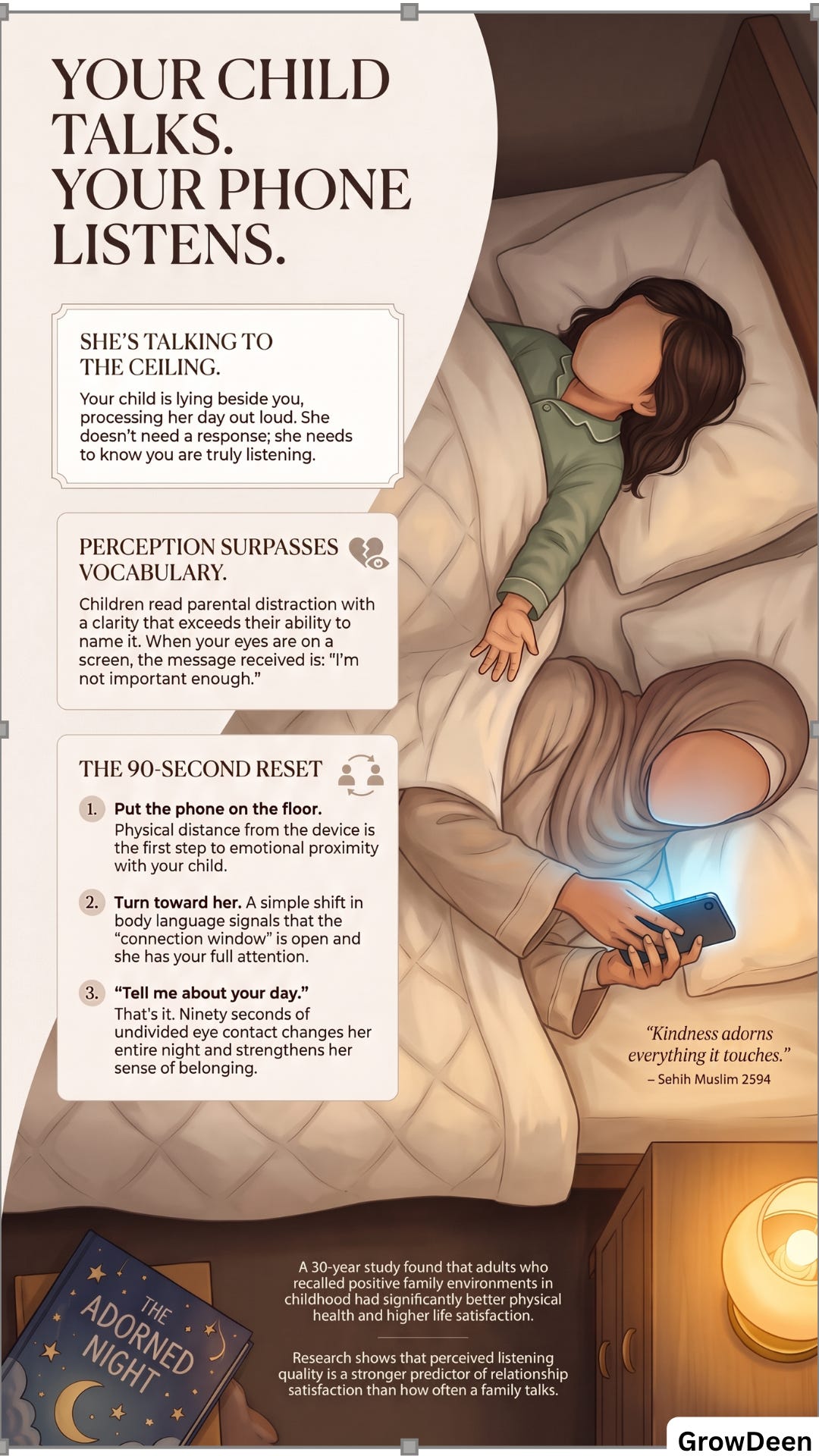
Research on family communication found that perceived listening quality was a stronger predictor of relationship satisfaction than frequency of conversation. [8] Families where members felt genuinely listened to were happier than families who simply talked more.
What does real listening look like in a house with small children?
It looks like stopping what you are doing. Turning your body toward the child. Not preparing your response while they are still speaking. Letting them finish, even when the story takes four times longer than it needs to.
It looks like making space for difficult feelings. When your child is angry or frightened, the instinct is to fix it: “There’s nothing to be scared of.” “Don’t cry.” But that can teach them that parts of their inner world are not welcome here. A better response often sounds like: “I can see you’re really upset. I’m here.”
And it looks like being ready for the moments you did not plan. Young children open up in the bath, in the dark at bedtime, in the back seat of the car. These conversations arrive at inconvenient times. They are also, almost always, the most honest ones.
But here is what most parents do not realise about communication at home.
I know this is a lot to hold in your head, especially in the middle of a regular Tuesday. That is why I created the Family Connection Cards — a free printable companion pack with a visual reference for the 7 daily connection windows and a family meeting starter kit. Keep reading to download it at the end of this article.
Why Including Your Children Changes Everything
There is a verse in the Qur’an that usually gets discussed in the context of community governance, but it applies just as powerfully inside the home:
“...and whose affair is [determined by] consultation among themselves...” — Qur’an 42:38 [10]
According to Tafsir Ibn Kathir, this verse places shura — mutual consultation — alongside prayer and charitable giving as a defining quality of believers. [10] The home is the first place a child encounters this principle. When you ask your five-year-old, “What should we do this weekend?” or your seven-year-old, “How should we divide the chores?” you are not giving up authority. You are practising a Qur’anic virtue.
And the research supports this. Families who adopt collaborative problem-solving — where every member has a voice and decisions are worked through together — report higher quality of life, even during periods of financial or emotional strain. [9]
Children who participate in household decisions develop stronger self-regulation and a sense of agency. [4] They are not just following rules. They feel ownership over the standards because they helped shape them.
A two-year-old putting toys away. A four-year-old setting the table. A six-year-old weighing in on the weekend plan. The task is not the point. The belonging is.
Kindness adorns everything it touches. Including the way you run your household.
The Family Story That Holds Everything Together
Remember the question from the opening? Why your child behaves differently with you than with everyone else?
It is because your home is where they feel safe enough to fall apart. The school version of your child is performed. The home version is real. That is not a problem. That is a sign your relationship is working.
And one of the most powerful ways to strengthen that sense of belonging is something deceptively simple: telling your family’s story.
Research on family narratives suggests that children who know their family story — where they came from, what their family has been through, how they fit into something larger — tend to have stronger self-identity and greater emotional resilience. [11]
Tell your children about when they were babies. About their grandparents. About the funny things that happened at Eid when they were two. These stories build continuity. They anchor a child in something bigger than the current moment.
And say what you feel. Out loud. “I love you.” “I’m proud of you.” “Jazakallahu khayran for helping today.” Do not assume your child knows. Say it at bedtime. Say it when nothing special has happened. That is when it means the most.
When Connection Starts to Break Down
Strong families are not families without problems. They are families that notice when something is off and act on it.
If you see persistent conflict, a child withdrawing emotionally, communication becoming tense, or a general sense that the household feels disconnected, pay attention. Speaking with a family counsellor, a paediatrician, or a trusted Islamic scholar is an act of care, not failure. The Islamic principle of taking the means applies here. You would not ignore a physical illness in your child. Relational health deserves the same seriousness.

The Companion Pack You Can Keep in Your Kitchen
If you have read this far, you are the kind of parent who takes family connection seriously. Not as a trending topic, but as something your children will carry with them for the rest of their lives. That tells me something beautiful about your intentions.
Inside the Family Connection Cards (one comprehensive PDF, 3 pages):
Page 1: The 7 Everyday Connection Windows — A visual reference card mapping seven ordinary daily moments (morning routine, school run, mealtimes, after-school, wudu time, post-Maghrib, bedtime) to specific conversation prompts and connection opportunities — designed as a fridge-door reference you can glance at during the moments that matter.
Page 2: The Family Shura Starter Kit — A step-by-step guide for running age-appropriate family meetings based on the Qur’anic principle of shura, with sample discussion questions by age group (3-4, 5-6, 7-8), a simple decision-making template, and a family agreements section — so you can start including your children in household decisions this week.
Page 3: “Kindness Adorns Everything” Reflection Card — The full hadith (Sahih Muslim 2594) with its English translation, source reference, and a reflection prompt parents can return to when patience runs thin — a reminder to place on the fridge, the bedside table, or inside a planner.
This is not just a PDF to download and forget. It is a tool designed to stay in your kitchen — where family life actually happens.
This Family Connection Cards pack is what every subscriber receives with each article. We cover the full journey of raising Muslim children — from newborns to school-age — all backed by research and rooted in Islamic wisdom.
If you are a Muslim parent who wants both evidence-based guidance AND an Islamic framework for raising your children, subscribe for free so future resources arrive in your inbox before you need them.
Subscribe free for parenting resources backed by both science and Sunnah — guidance so unique, you literally cannot get it anywhere else. No spam, no clutter, just resources that matter.
Your Micro-Action for Tonight
Tonight at bedtime, ask your child one question: “What was the best part of your day?” Then wait. Do not prompt. Do not redirect. Just listen.
That is your practice. One question. One moment of real attention. Start there.
May Allah make our homes places of mercy, connection, and peace. May He give us the patience to listen and the wisdom to speak with kindness.
Share This With Someone Who Needs It
Think of one person right now: the mother at the masjid who mentioned that her family never sits together anymore. The friend whose WhatsApp messages are always about how tired she is and how disconnected her household feels. The sister who is doing everything she can but still feels like something is missing.
This article could change her evening tonight. Share it with her — not as advice, but as care. Sometimes the most loving thing we can do is pass along what finally helped us see things differently.
Frequently Asked Questions
Q: How much quality time do I actually need to spend with my child each day? A: Less than you think — but it has to be real. Even 15 minutes of fully present, device-free attention can strengthen your bond more than hours spent in the same room while distracted. [5] The key is not the clock. It is whether your child feels seen.
Q: What if my child does not want to talk to me? A: That is developmentally normal, especially as children approach their pre-teen years. Do not force it. Stay available through everyday moments — cooking together, walking, sitting nearby. Connection does not always look like conversation. Sometimes it looks like quiet presence.
Q: How do I get my family to eat together when everyone’s schedule is different? A: Start small. Even three shared meals a week makes a measurable difference. [6] It does not have to be dinner. Breakfast or a weekend lunch counts. The point is being together, face to face, without screens.
Q: Is it really okay to involve young children in family decisions? A: Absolutely — with age-appropriate boundaries. A three-year-old can choose between two dinner options. A seven-year-old can weigh in on weekend plans. Research shows that children who participate in household decisions develop stronger self-regulation and a sense of agency. [4] You are not giving up authority. You are building their capacity.
Q: What does Islam say about positive family relationships? A: Islam places family bonds at the centre of a believer’s life. The Qur’an praises mutual consultation (shura) as a defining quality of believers [10], and the Prophet ﷺ taught that kindness adorns everything it touches. [7] Building a warm, connected home is not separate from worship — it is part of it.
Q: How do I know if my family needs professional help? A: If you notice persistent conflict, a child withdrawing emotionally, or communication becoming consistently tense, it is worth speaking with a family counsellor or paediatrician. Seeking help is not failure — it is the Islamic principle of taking the means (al-akhdh bil-asbab) in action.
References
[1] Ramos, M.C., Cheng, C-H.E., Preston, K.S.J., Gottfried, A.W., Guerin, D.W., Gottfried, A.E., Riggio, R.E., & Oliver, P.H. (2022). Positive family relationships across 30 years: Predicting adult health and happiness. Journal of Family Psychology, 36(7), 1216–1228. https://doi.org/10.1037/fam0000983
[2] Butler, N., Quigg, Z., Bates, R., Jones, L., Ashworth, E., Gowland, S., & Jones, M. (2022). The contributing role of family, school, and peer supportive relationships in protecting the mental wellbeing of children and adolescents. School Mental Health, 14, 776–788. https://doi.org/10.1007/s12310-022-09502-9
[3] Bornstein, M.H. (2019). Parenting infants. In M.H. Bornstein (Ed.), Handbook of parenting: Vol. 1: Children and parenting (3rd edn, Chapter 1). Routledge. https://doi.org/10.4324/9780429440847
[4] Lindert, J., Arndt, S., Cook, N., Bain, P.A., & Kawachi, I. (2025). Positive and negative family relationships correlate with mental health conditions — A systematic review and meta-analysis. Public Health Reviews, 46, Article 1607381. https://doi.org/10.3389/phrs.2025.1607381
[5] Aloia, L.S. (2020). Parent–child relationship satisfaction: The influence of family communication orientations and relational maintenance behaviors. The Family Journal, 28(1), 83–89. https://doi.org/10.1177/1066480719896561
[6] Marks, L.D., Kelley, H.H., Dollahite, D.C., Kimball, E.R., & James, S. (2023). Family dinners and family relationships following the initial onset of the COVID-19 pandemic. Marriage & Family Review, 59(2), 95–120. https://doi.org/10.1080/01494929.2022.2137874
[7] Sahih Muslim 2594. Narrated by ‘A’ishah: The Messenger of Allah ﷺ said: “Whenever kindness is found in something, it adorns it, and whenever it is removed from something, it makes it defective.” — Graded: Sahih — https://sunnah.com/muslim:2594
[8] Wang, N., Roaché, D.J., & Pusateri, K.B. (2019). Associations between parents’ and young adults’ face-to-face and technologically mediated communication competence: The role of family communication patterns. Communication Research, 46(8), 1171–1196. https://doi.org/10.1177/0093650217750972
[9] Schrodt, P., Witt, P.L., & Shimkowski, J.R. (2024). Economic strain and quality of life among families with emerging adult children: The contributions of family rituals and family problem-solving communication. Family Process, 63(3), 1319–1335. https://doi.org/10.1111/famp.12884
[10] Qur’an, Surah Ash-Shura 42:38 — https://quran.com/42/38. Tafsir Ibn Kathir: This verse describes the believers who conduct their affairs through mutual consultation (shura), placing it alongside prayer and charitable spending as a defining quality of believers.
[11] Duke, M.P., Lazarus, A., & Fivush, R. (2008). Knowledge of family history as a clinically useful index of psychological well-being and prognosis: A brief report. Psychotherapy: Theory, Research, Practice, Training, 45(2), 268–272. https://doi.org/10.1037/0033-3204.45.2.268
[12] Hobson, N.M., Schroeder, J., Risen, J.L., Xygalatas, D., & Inzlicht, M. (2018). The psychology of rituals: An integrative review and process-based framework. Personality and Social Psychology Review, 22(3), 260–284. https://doi.org/10.1177/1088868317734944