

The American Academy of Pediatrics reviewed 75 studies and found that 67% linked corporal punishment with negative developmental outcomes [1]—yet many Muslim parents still believe harshness equals discipline. Here’s the science-backed, Islamic approach that builds character without breaking spirits.
The mother’s voice is sharp. “How many times do I have to tell you?”
Her three-year-old is crying now, shrinking back. The toy truck lies between them on the floor. He had thrown it at his sister. She knows she needs to address it. But something about this moment—her raised voice, his trembling lip, the fear in his eyes—feels wrong.
She thinks: There has to be a better way.
Here’s what I’ve learned from both child development research and Islamic scholarship: there is.
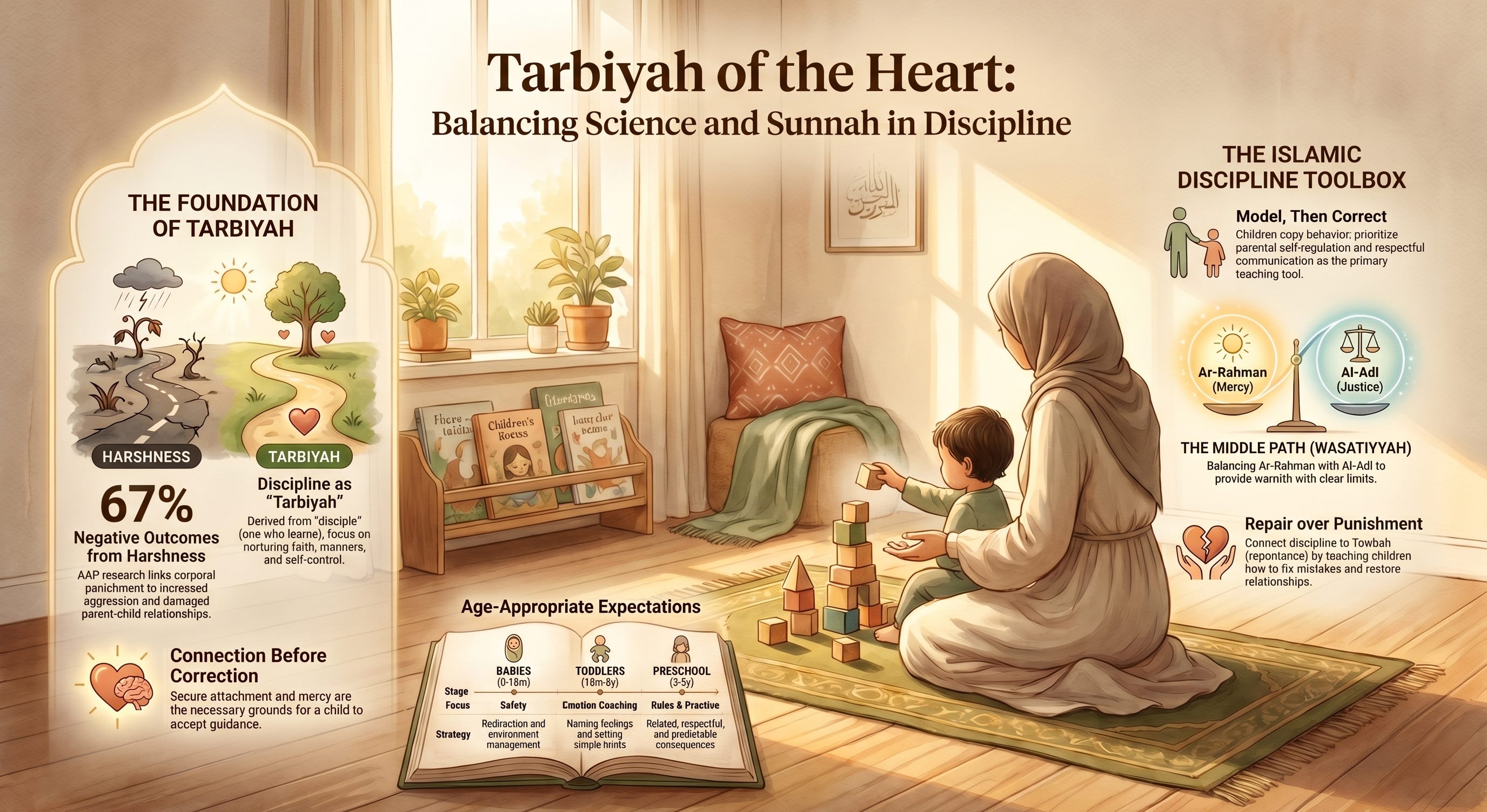
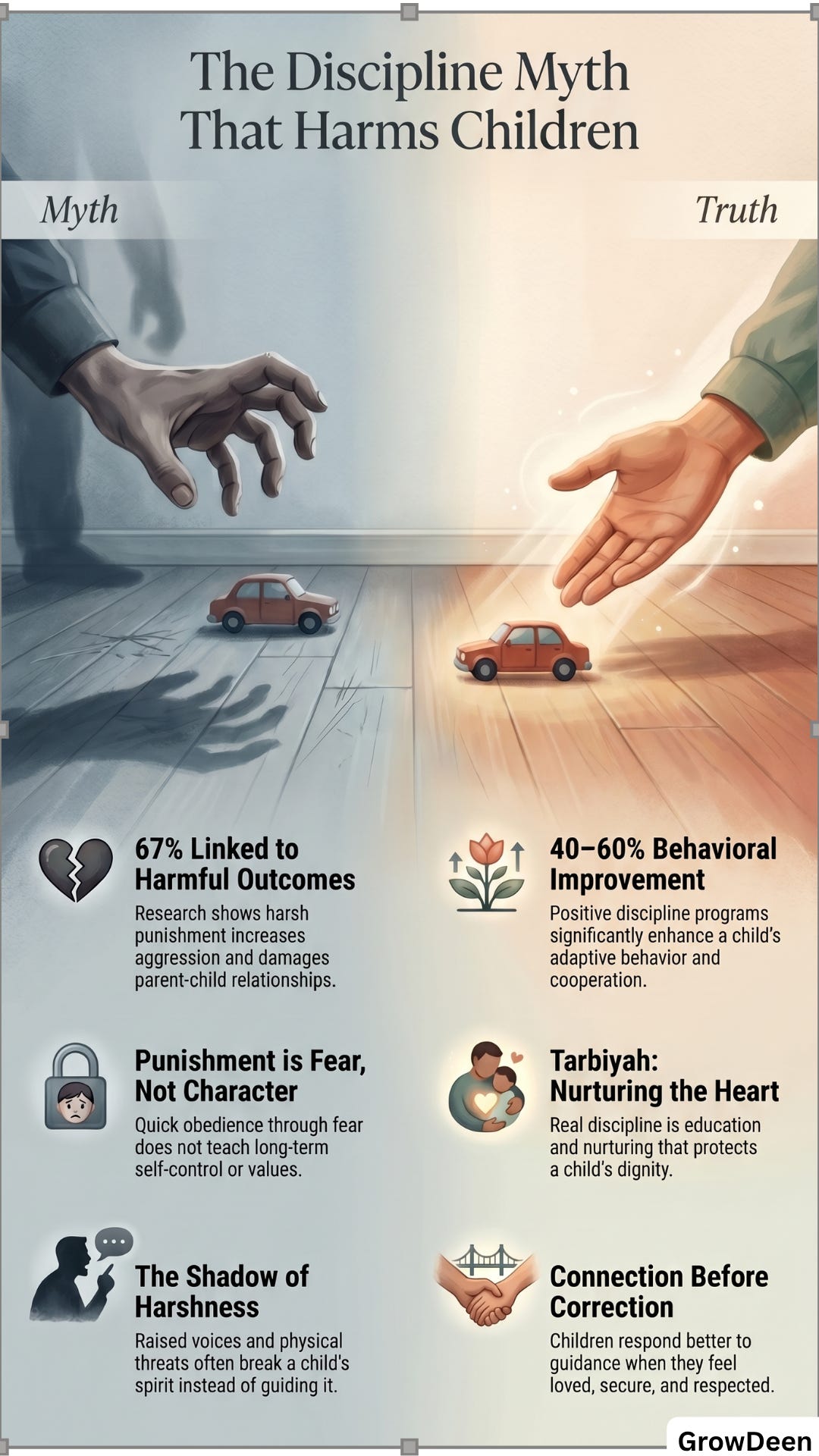
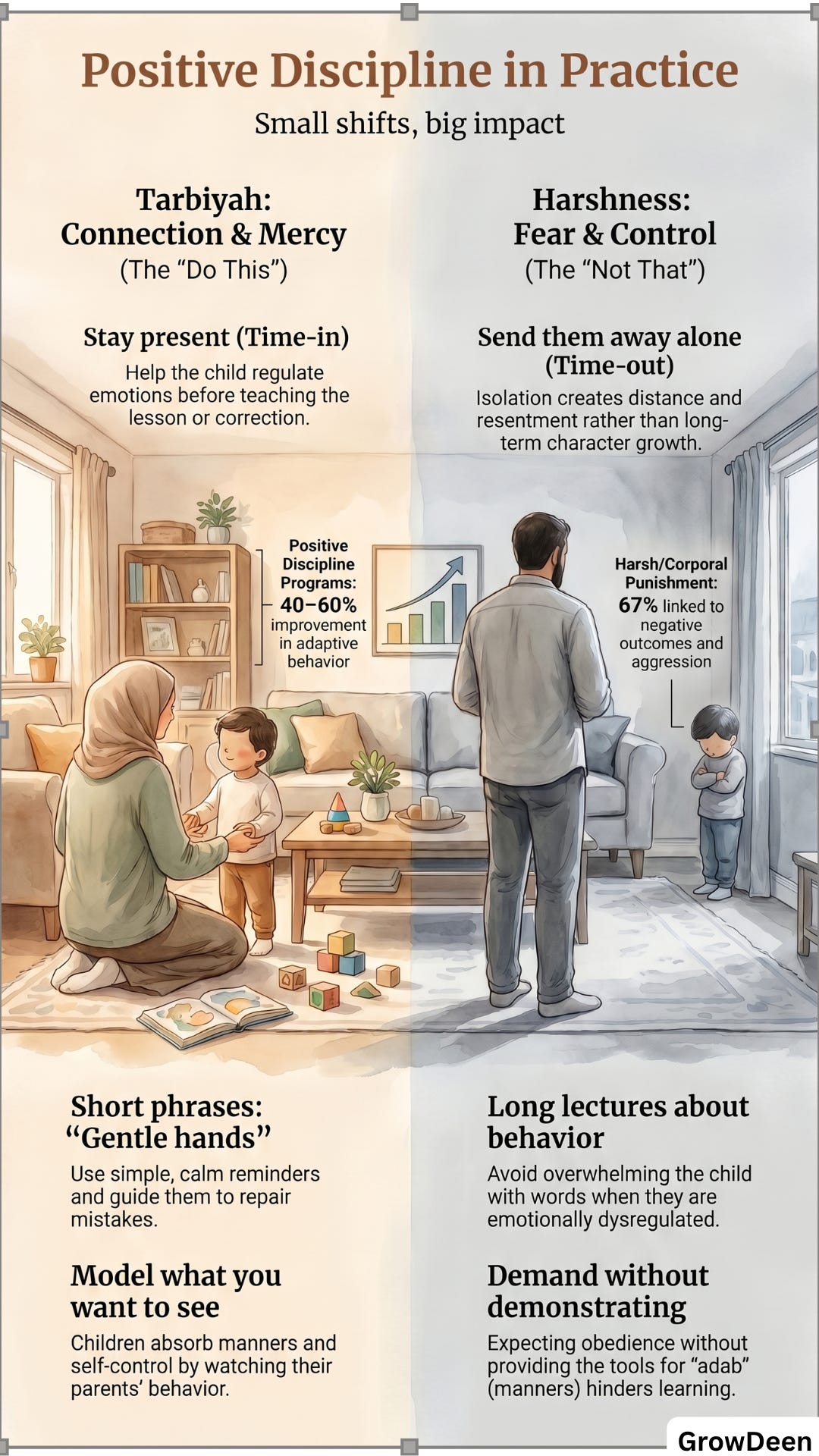
When the American Academy of Pediatrics reviewed decades of research in 2018, they found something striking. Of 75 studies examining corporal punishment, 67% showed associations with negative outcomes—increased aggression, mental health problems, and damaged parent-child relationships [1]. Meanwhile, positive discipline programs demonstrate 40-60% improvement in child adaptive behavior [4].
The science is clear. Islam has always been clear. Real discipline is not about control. It’s about tarbiyah—nurturing the child’s heart, character, and relationship with Allah through mercy, boundaries, and wisdom.
Why This Guide Is Different
This isn’t another parenting article telling you to “stay calm” without showing you how. Here’s what makes this different:
Research-backed and Islamic. Every strategy is grounded in child development science (AAP, CDC) and Islamic principles of tarbiyah—showing you that mercy and firmness aren’t opposites, they’re partners.
Age-specific guidance. What works for babies (redirection) differs from what works for preschoolers (natural consequences) and school-age children (repair and responsibility)—this guide breaks it down clearly for each stage.
Free practical toolkit. At the end, you’ll get the Positive Discipline Toolkit for Muslim Homes—reference cards, Islamic phrases, and age-appropriate consequence guides you can use tonight.
What Discipline Actually Means (It’s Not Punishment)
Most people hear “discipline” and think punishment. But the word comes from disciple—one who learns.
Children aren’t born knowing how to share, wait patiently, speak kindly, or manage big emotions. These are skills learned through years of modeling, reminders, practice, correction, and emotional support from caring adults.
Positive discipline asks:
“What is my child learning right now?”
“What skill is still developing?”
“How can I correct this behavior without crushing my child’s spirit?”
From an Islamic lens, this is tarbiyah. Parents aren’t just stopping bad behavior—they’re cultivating adab (manners), self-control, mercy, truthfulness, and awareness of Allah.
Allah commands in Surah At-Tahrim:
يَا أَيُّهَا الَّذِينَ آمَنُوا قُوا أَنفُسَكُمْ وَأَهْلِيكُمْ نَارًا
“O you who have believed, protect yourselves and your families from a Fire...” [Quran 66:6]
According to Tafsir Ibn Kathir, this protection includes teaching children faith, manners, and righteous conduct. Ali ibn Abi Talib explained this verse to mean: “Teach them and discipline them” [10].
That’s tarbiyah. Not harsh punishment, but education and nurturing that protects children in this life and the Hereafter.
The Foundation: Connection Before Correction
Here’s something that changed how I parent: children respond better to guidance when they feel loved and secure.
Research in attachment-based parenting shows that warm, responsive caregiving helps children develop trust, cooperation, and emotional regulation [6]. Recent studies confirm that secure parent-child attachment significantly influences children’s socio-emotional adjustment through enhanced emotion regulation [5].
This doesn’t mean letting children do whatever they want. It means the parent-child relationship is the ground in which healthy discipline grows.
A child who feels loved accepts correction more easily.
A child who feels constantly criticized becomes fearful, resentful, or sneaky.
The Prophet ﷺ embodied this. When he kissed his grandson Al-Hasan ibn Ali, a man remarked, “I have ten children and I’ve never kissed any of them.” The Prophet ﷺ responded:
“Whoever does not show mercy will not be shown mercy.” [Sahih al-Bukhari 5997, Sahih Muslim 2318]
Mercy isn’t the opposite of discipline. Mercy is the heart of discipline done well.
Why Physical Punishment Isn’t the Answer
Some parents use physical punishment because they want quick obedience. But quick fear is not the same as long-term character.
The AAP explicitly recommends avoiding spanking, hitting, slapping, insulting, humiliating, or shaming children. These approaches don’t teach self-control and are linked with harmful outcomes [1].
The Canadian Journal of Psychiatry published a 2022 study finding associations between lifetime spanking or slapping and negative adolescent physical health, mental health, and behavioral outcomes [3].
Islamically, we must not confuse authority with harshness. The goal is not to break the child. The goal is to guide the child.
A Muslim child should learn:
“My parents have limits.”
“My parents are serious about those limits.”
“My parents are safe.”
“Wrong actions can be repaired.”
“Allah loves good character.”
What to Do Instead: Age-by-Age Guidance
Babies (0-18 months): Safety and Redirection, Not Discipline
Babies don’t understand rules or consequences. Their behavior is exploration and communication.
A baby pulls hair, grabs glasses, throws food, or crawls toward danger. This isn’t disobedience—it’s curiosity and sensory learning.
For babies, guidance means:
Keep the environment safe. Move dangerous items away. Use short phrases: “Gentle hands.” Redirect immediately. Show the correct action. Repeat calmly.
Example:
Baby pulls your hair.
Say: “Gentle hands.”
Open the baby’s hand softly.
Model gentle touching.
Say: “Gentle, mashAllah.”
Your calm repetition teaches more than words ever could.
Toddlers (18 months-3 years): Emotion Coaching and Simple Limits
Toddlers understand some words and limits, but they have immature self-control. They hit, scream, throw, refuse, bite, or collapse in frustration because their emotions are bigger than their ability to manage them.
CDC guidance for toddlers recommends giving attention and praise for positive behavior, teaching acceptable ways to express upset feelings, and using consistent routines [2].
Use this pattern:
Name the limit. Name the feeling. Stop unsafe behavior. Offer a better action. Stay present.
Example:
“You are angry. I cannot let you hit. Gentle hands. You can stomp your feet here. I am with you.”
Weave in Islamic phrases naturally:
“Bismillah, try again.”
“Allah loves gentle hands.”
“Let’s say sorry and fix it.”
Preschoolers (3-5 years): Rules, Practice, and Consequences
Around age 3, children begin understanding simple rules and consequences. They’re learning that behavior affects others.
Family rules should be short and clear:
We speak kindly.
We use gentle hands.
We tell the truth.
We listen when someone says stop.
We respect the Qur’an and Islamic books.
Positive discipline programs show that parent training and consistent strategies improve parenting and child adaptive behavior [4]. The goal is helping the child practice better behavior.
For preschoolers, consequences should be:
Related to the behavior. Calmly given. Short. Predictable. Respectful. Never humiliating.
Example:
If blocks are thrown → blocks are put away temporarily.
If a child spills intentionally → the child helps clean.
If a child hurts a sibling → the child helps repair: “Check if he’s okay. Say sorry. Bring him a tissue.”
This teaches responsibility and accountability.
School-Age Children (6-8 years): Responsibility and Repair
By school age, children understand rules better, but they still need reminders, coaching, and consistent follow-through.
Involve them in creating family expectations:
“What should our rule be for screen time?”
“How can we speak when we’re angry?”
“What helps us get ready for salah on time?”
This builds ownership.
School-age children benefit from natural and logical consequences:
If homework is rushed carelessly → they redo the messy part.
If they speak rudely → they practice saying it respectfully.
If they misuse a privilege → the privilege pauses.
If they hurt someone → they repair the harm.
Islamically, this connects discipline with tawbah (repentance) and islah (repair): returning to the right path, fixing what was broken, doing better.
Praise the Behavior You Want to Grow
Children often repeat behavior that gets attention. If parents only notice shouting, hitting, or refusing, children learn that negative behavior is the quickest path to attention.
Catch good behavior early:
“You waited patiently.”
“You told the truth even though it was hard.”
“You helped your sister.”
“You remembered Bismillah.”
CDC guidance encourages specific praise because it helps children understand which behavior is worth repeating [2].
Praise should be sincere and specific, not exaggerated.
Instead of: “You are the best child ever.”
Say: “You tried hard to calm down. That took strength.”
This builds character, not ego.
I know this is a lot to remember, especially when you’re exhausted and your child is melting down. That’s why I created the Positive Discipline Toolkit for Muslim Homes—a printable guide with age-specific strategies, Islamic phrases, and quick reference cards. Keep reading to download it at the end—it’s designed to stay with you in the moments when you need it most.
The Islamic Discipline Toolbox: Practical Strategies
1. Model First
Children copy more than they obey.
If parents shout constantly, children learn shouting.
If parents apologize when wrong, children learn repair.
If parents pray, make du’a, and speak respectfully, children absorb that atmosphere.
2. Use Short Reminders
Long lectures don’t work with young children.
Say: “Gentle hands.” “Try again.” “Feet on the floor.”
3. Give Choices Within Limits
“You may wear the blue shirt or the green shirt.”
“You may walk beside me or hold my hand.”
The parent sets the boundary. The child gets appropriate choice.
4. Use Time-In Before Time-Out
Many young children need help calming down before they can learn.
Time-in means staying near, helping them regulate, then teaching.
“You are very upset. Sit with me. We will breathe. Then we will fix it.”
5. Repair After Mistakes
Teach children how to make things right:
Say sorry. Return the toy. Help clean. Check on the person hurt. Try the words again. Make du’a for better behavior.
6. Connect Behavior to Allah Gently
Avoid making Allah sound terrifying for every mistake.
Instead: “Allah loves honesty.” “Allah loves gentle people.” “Allah loves those who say sorry and try again.”
This builds love and accountability together.
The Islamic Perspective: Tarbiyah as Sacred Trust
In Islam, raising children is not merely a worldly responsibility—it’s a sacred trust, an amanah, and an act of worship.
The Prophet Muhammad ﷺ taught:
“Whoever does not show mercy to our young ones, or acknowledge the rights of our elders, is not one of us.” [Sunan Abu Dawud 4943, graded Sahih]
This establishes a clear principle: showing mercy to children—through affection, patience, gentle correction, and warmth—is a defining characteristic of the Muslim community.
The Prophet ﷺ never modeled harshness toward children. He carried his granddaughter Umamah on his shoulders during prayer. He shortened his prayer when he heard a baby crying. He played with children and corrected them with kindness.
This is the Prophetic standard for tarbiyah.
Balancing Mercy and Firmness
Some parents mistakenly believe mercy means having no boundaries. Others believe discipline requires harshness.
Islam rejects both extremes.
Allah describes Himself with both mercy (Ar-Rahman, Ar-Raheem) and justice (Al-Adl). Parents must balance compassion with clarity, warmth with limits.
A child needs to know:
“My parents love me deeply.”
“My parents have clear expectations.”
“My parents will correct me when I’m wrong.”
“My parents will not humiliate or harm me.”
This is wasatiyyah—the balanced middle way Islam teaches in all matters.
When Parents Are Struggling
Every parent loses patience sometimes. If behavioral challenges are affecting family life, or if you feel overwhelmed, persistently angry, or afraid of hurting your child, seek professional help.
Speak with a doctor, counselor, pediatrician, family therapist, or qualified parenting professional.
Getting support is not failure. It’s responsible, courageous parenting.
Positive parenting interventions have been widely studied and can help families build practical behavior strategies [7].
Final Reminder: The Middle Path
Positive discipline is not permissive parenting. It’s not letting children do whatever they want.
It’s also not shouting, hitting, threatening, or shaming.
Positive discipline is the middle path:
Warmth with limits.
Mercy with firmness.
Rules with relationship.
Correction with dignity.
Islamic discipline should raise children who don’t only “behave” when watched, but gradually learn to choose good because they understand it, practice it, and love what pleases Allah.
A child guided with mercy and consistency learns:
“I am loved.”
“I am responsible.”
“My actions matter.”
“I can repair mistakes.”
“My parents are safe.”
“Allah loves good character.”
That is discipline rooted in both science and Sunnah.
Your Free Positive Discipline Toolkit for Muslim Homes
If you’ve read this far, you’re the kind of parent who takes tarbiyah seriously—not as control, but as sacred trust. That tells me something beautiful about you.
Inside the Positive Discipline Toolkit for Muslim Homes (one comprehensive PDF, 3 pages):
Page 1: Calm Discipline Phrase Cards — 24 ready-to-use phrases organized by situation (tantrum, sibling conflict, defiance, cleanup resistance) with both secular and Islamic versions—designed as printable cards you can keep on your fridge or in your pocket for moments when you’re too exhausted to think clearly.
Page 2: Age-Appropriate Consequences Guide — A simple reference chart showing what consequences work for each age (babies, toddlers, preschoolers, school-age), how to deliver them calmly, and what to avoid—so you never have to guess what’s appropriate in the heat of the moment.
Page 3: Islamic Tarbiyah Reminders & Du’as — Prophetic guidance on mercy in parenting, du’as for patience during difficult moments, and short Islamic phrases you can teach your children to help them self-regulate (Bismillah before trying again, Alhamdulillah after calming down)—so discipline becomes an act of worship, not just behavior management.
This isn’t just a PDF to download and forget. It’s a tool designed to stay on your fridge, in your phone, in your diaper bag—where you’ll actually use it when you need it most.
This Positive Discipline Toolkit is what every subscriber receives with each article. We cover the full journey of raising Muslim children—from newborns to school-age—all backed by scientific research and rooted in Islamic wisdom.
If you’re a Muslim parent who wants both evidence-based guidance AND Islamic perspective, subscribe for free so future resources arrive in your inbox before you need them.
Subscribe free for parenting resources backed by both science and Sunnah—guidance so unique, you will like it, inshaAllah. No spam, no clutter, just resources that matter.
One Small Shift You Can Make Today
Before bed tonight, try this: when your child makes a mistake, pause. Take one breath. Instead of raising your voice, lower it.
Say: “I see you’re having a hard time. Let’s fix this together.”
That’s it. One shift. One breath. One moment of choosing connection before correction.
Notice what changes.
May Allah grant us patience in parenting, mercy in our hearts, and wisdom in guiding the souls entrusted to us. May He make our children among the righteous and make our homes places of peace, love, and remembrance of Him. Ameen.
Share This With Someone Who Needs It
Think of one person right now: the exhausted mother at the masjid who confided that discipline feels like a daily battle, your sister whose voice you hear getting sharper with her toddler, a friend whose WhatsApp messages reveal the same struggles you had last year.
This article could ease their burden. Share it with them today—not as judgment, but as support. Sometimes the most loving thing we can do is share what finally helped us parent with both firmness and mercy.
Frequently Asked Questions
What if my toddler doesn’t listen to gentle redirection?
Toddlers aren’t being defiant when they don’t listen—they’re testing limits to understand how the world works. Consistency is key. Use the same short phrase every time (”Gentle hands”), follow through with the same calm action (redirect their hand), and repeat 10, 20, 50 times if needed. It’s not failing. It’s teaching. Their brain is learning patterns through repetition.
Is positive discipline the same as permissive parenting?
No. Permissive parenting has no boundaries. Positive discipline has clear, firm boundaries delivered with warmth and respect. The difference: permissive says “do whatever you want,” positive discipline says “here’s the limit, here’s why it matters, here’s how we fix it when you cross it.” Boundaries protect children. The delivery protects the relationship.
How do I discipline without yelling when I’m exhausted?
Lower your voice instead of raising it. Exhausted brains default to the loudest response, but lowering your voice forces your nervous system to regulate and makes your child lean in to hear you. Also: it’s okay to say “Mama needs a minute” and step into the bathroom for three deep breaths. That pause is discipline too—you’re modeling self-regulation.
What does Islam say about spanking or physical discipline?
The Prophet ﷺ never hit children. When scholars discuss the hadith about “discipline” at age 10 regarding prayer, classical commentators clarify this means a light tap that doesn’t cause pain or humiliation—more symbolic than punitive. The overwhelming emphasis in Islamic texts is on mercy, patience, and teaching. Modern research confirms what Islam taught: physical punishment harms development without teaching better behavior.
My child is aggressive toward siblings. What should I do?
Address it immediately but calmly. Stop the behavior physically (block the hit, hold their hand), name it (”You’re angry but I can’t let you hurt your brother”), validate the emotion (”I see you’re upset”), teach the replacement (”Use your words: ‘I’m angry’”), and require repair (”Check if he’s okay. Say sorry”). Repeat this sequence every time. Aggression decreases when children learn better ways to express big feelings.
Can positive discipline work for strong-willed children?
Yes. Strong-willed children aren’t “bad”—they’re persistent, determined, and intense. Those traits become assets when channeled well. Positive discipline works because it respects their autonomy (choices within limits), engages their logic (natural consequences), and builds cooperation instead of power struggles. The key: don’t try to break their will, guide it. Strong-willed children need clear boundaries delivered with respect, not force.
How long does it take to see results with positive discipline?
Immediate change: you’ll feel less guilty and more connected right away. Behavioral change: 2-4 weeks of consistent practice for toddlers, 4-8 weeks for preschoolers and school-age children. The timeline depends on your consistency, your child’s age and temperament, and the specific behavior. But here’s the truth: positive discipline isn’t a quick fix. It’s a long-term investment in your child’s character, emotional regulation, and relationship with you—and with Allah.
References
[1] American Academy of Pediatrics. AAP recommends positive discipline rather than physical punishment. The AAP recommends avoiding spanking, hitting, slapping, insulting, humiliating, or shaming children and using positive discipline strategies instead.
[2] Centers for Disease Control and Prevention. Positive Parenting Tips: Toddlers 2–3 Years Old and Essentials for Parenting Toddlers and Preschoolers. CDC guidance includes praise, routines, clear instructions, and teaching acceptable ways to express emotions.
[3] Fortier, J., Stewart-Tufescu, A., Salmon, S., MacMillan, H. L., Gonzalez, A., Kimber, M., Duncan, L., Taillieu, T., Davila, I., Struck, S., and Afifi, T. (2022). Associations between lifetime spanking/slapping and adolescent physical and mental health and behavioral outcomes. Canadian Journal of Psychiatry, 67(4), 281–289.
[4] Carroll, P. (2021). Effectiveness of positive discipline parenting program on parenting style and child adaptive behavior. Child Psychiatry and Human Development.
[5] Wang, Y., et al. (2024). Parent-child attachment and adolescent socio-emotional adjustment through emotion regulation. Frontiers in Psychology.
[6] Juffer, F., Bakermans-Kranenburg, M. J., and van IJzendoorn, M. H. (Eds.). (2013). Promoting Positive Parenting: An Attachment-Based Intervention. Routledge.
[7] Sanders, M. R. (2012). Development, evaluation, and multinational dissemination of the Triple P–Positive Parenting Program. Annual Review of Clinical Psychology, 8, 345–379.
[8] UNICEF. How to discipline your child the smart and healthy way. UNICEF describes positive discipline as an approach that builds relationships and teaches responsibility, cooperation, and self-discipline without violence.
[9] Sahih al-Bukhari 5997 and Sahih Muslim 2318. The Prophet ﷺ taught that the one who does not show mercy will not be shown mercy.
[10] Qur’an, Surah At-Tahrim 66:6. Ibn Kathir explains that Ali ibn Abi Talib said protecting your family means “Teach them and discipline them.”
[11] Sunan Abu Dawud 4943, graded Sahih. The Prophet ﷺ said, “Whoever does not show mercy to our young ones, or acknowledge the rights of our elders, is not one of us.”