

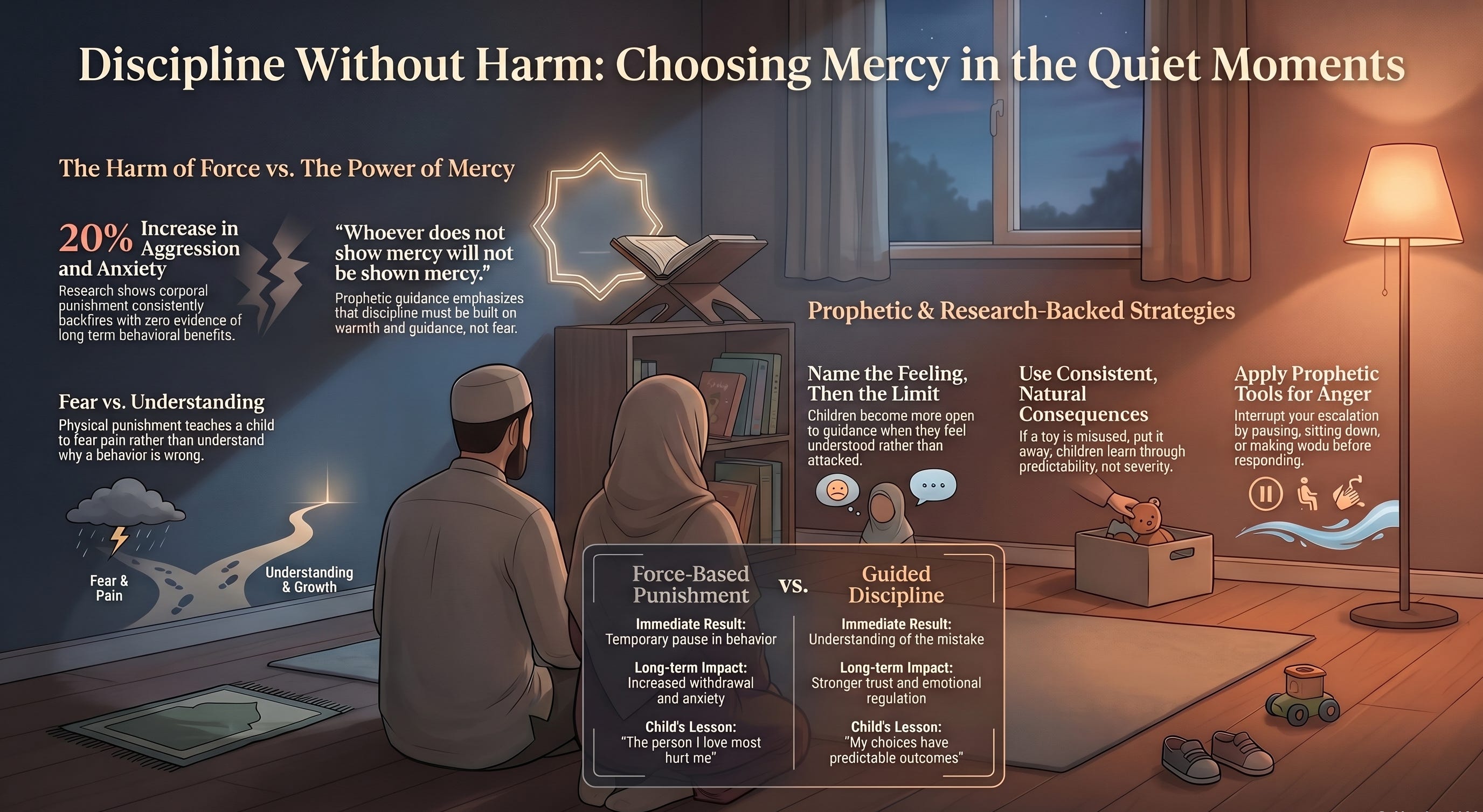
A 2023 systematic review of over 50 studies found that children who experience corporal punishment show up to 20% higher rates of aggression and anxiety - with zero evidence of long-term behavioural benefit. [1] This guide shows you what the research and Islamic guidance agree actually works and gives you a free printable Discipline Companion Pack to keep you grounded in your hardest parenting moments.
I want to tell you something that I wish someone had said to me plainly: the moment you smacked your child and immediately felt that sinking feeling — that feeling was right. Not because you’re a bad parent. But because something in you already knew there had to be a better way.
Most of us weren’t handed a different set of tools. We were parented the way we’re parenting. The cycle is real, and it runs deep.
But here’s what stopped me in my tracks when I looked into the research: smacking doesn’t just not work — it actively makes the problem worse. [1,7] The behaviour might pause for a minute. But underneath? The child has learned to fear, not to understand. And that difference matters more than almost anything else in how they grow up.
Why This Guide Is Different From Generic Parenting Advice
It’s built on current research. Every recommendation draws from peer-reviewed studies and guidelines from the American Academy of Pediatrics — not opinions or trends.
It takes your Deen seriously. This isn’t Islamic principles versus science. They’re pointing at the same thing. And understanding that changes everything.
You’ll get a free Discipline Without Harm Companion Pack — a printable 3-page guide designed to stay with you through the hard moments, not just sit in your downloads folder.
Does Smacking Actually Change Behaviour? Here’s What the Research Says
The honest answer is no. Not in any lasting way.
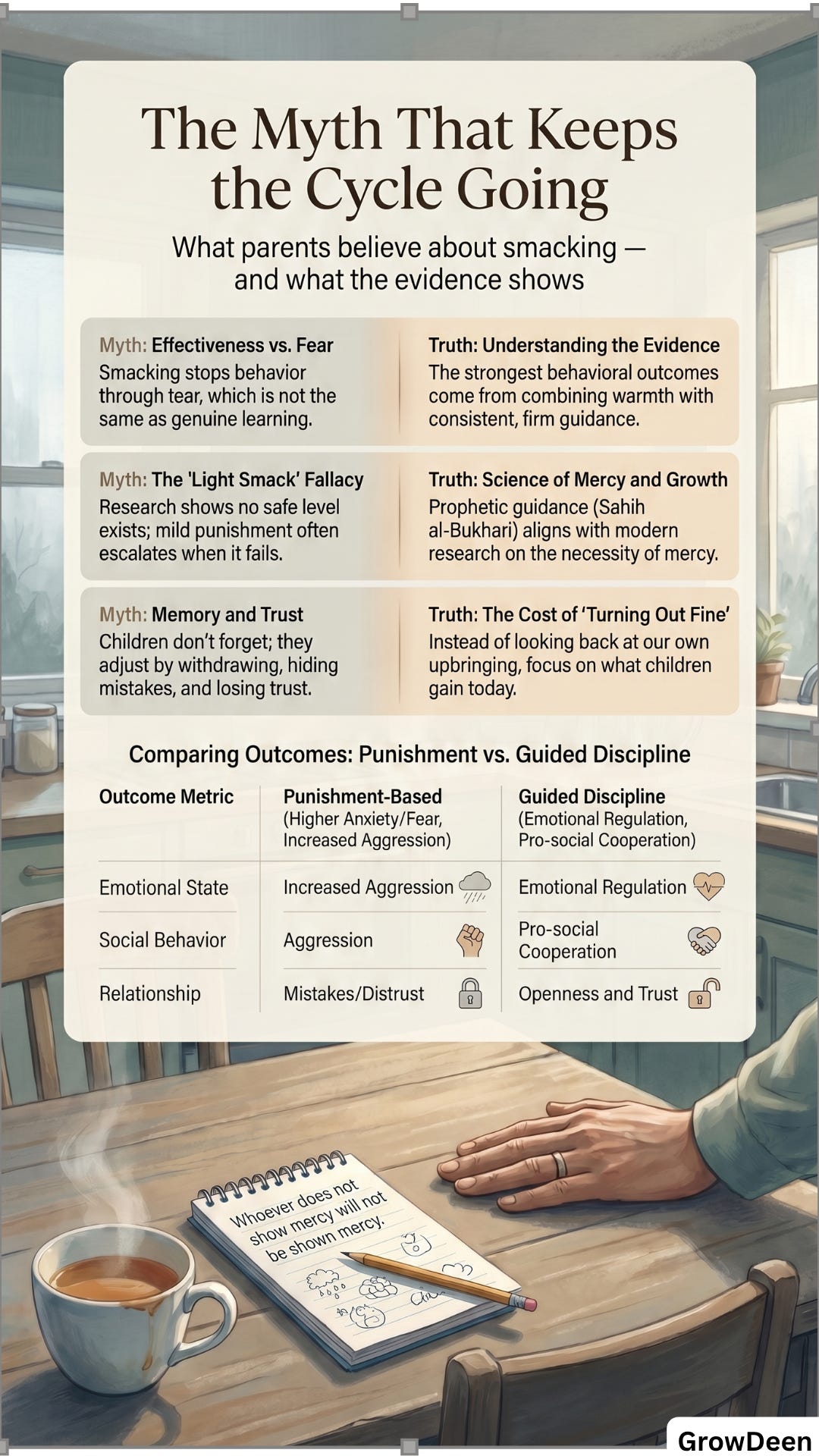
When I went through the 2023 systematic review — which pulled together data from more than 50 studies across multiple countries — what stood out wasn’t just that corporal punishment doesn’t work. It’s that it backfires. [1] Children who are regularly smacked are more likely to become aggressive. More anxious. Less likely to come to their parents when something goes wrong. [1,5]
Here’s why: a smacked child has learned to respond to pain and fear, not to understanding. They may stop the behaviour in front of you. But they haven’t learned why it was wrong, what they should do instead, or how to manage the feeling underneath it.
And that’s exactly the problem.
The American Academy of Pediatrics reviewed the evidence in 2018 and came to a clear position: corporal punishment — any of it — causes harm and should be stopped. [7] This isn’t a soft, cautious recommendation. It’s a firm one, backed by decades of research.
But here’s something most parenting articles won’t tell you: the parents who continue to use physical punishment aren’t villains. They’re often exhausted, unsupported, and genuinely trying. They just haven’t been offered something better. That’s what this is.
What Corporal Punishment Does to the Relationship and Why That’s the Real Loss
The behaviour might be the presenting issue. But the relationship is what’s actually at stake.
When a child is smacked, they don’t think: “I understand now what I did wrong.” They think — or rather, they feel “The person I love most hurt me.” That gap between your intention and their experience doesn’t close on its own. [1,5]
Over time, children who live with the unpredictability of physical punishment start to withdraw. They hide mistakes. They stop sharing what’s really going on. They manage their parent’s emotions instead of developing their own. That’s the opposite of what any of us actually want.
You’re not just trying to stop a behaviour. You’re trying to raise a person who trusts you. These strategies — the ones that actually work — are built on that.
What Works Instead: 5 Research-Backed Strategies
I know this is a lot to hold when you’re already running on low. That’s exactly why I’ve created the free Discipline Without Harm Companion Pack — a printable guide you can stick on your fridge or save to your phone, so you have it when the moment actually arrives. Keep reading to download it at the end.
1. Name the feeling before you address the behaviour.
This one surprised me most when I read the research. Children who feel understood become dramatically more open to guidance than children who feel attacked. [6] Try: “I can see you’re really angry. That makes sense. And we still don’t hit.” Two things can be true.
2. Give calm, clear instructions — not escalating reactions.
Your nervous system is contagious. When you stay steady, your child’s brain has a chance to settle too. [6] Tell them what you want them to do, not just what you don’t. “Hands stay by your body” lands differently than “Stop hitting.”
3. Use consistent, proportionate consequences.
If a toy is misused, it’s put away. If words are unkind, the conversation pauses. Not as punishment — as natural connection between choices and outcomes. [1,11] The key word is consistent. Children learn from predictability far more than from severity.
4. Rebuild every time — without dragging it out.
After a hard moment, reset. Fully. Don’t carry it forward into the afternoon. Instead, watch for the moment when your child gets it right — waiting their turn, being kind to a sibling without being asked — and name it. “I noticed that. That took patience.” [6]
5. Teach Islamic tools for managing big feelings.
The Prophet ﷺ gave us a specific prescription for anger: sit if you’re standing, lie down if you’re still angry, make wudu. [12] Teach your child a simplified version of this. “When you feel that big feeling rising, say A‘ūdhu billāhi min ash-shayṭān ir-rajīm, and let’s try again.” These aren’t just spiritual tools — they’re emotional regulation anchors.
What the Prophet ﷺ Showed Us About Raising Children With Mercy
When I first came across this hadith, I stopped and read it three times.
A companion saw the Prophet ﷺ kissing his grandson Al-Hasan. He said: “I have ten children and I have never kissed any of them.” The Prophet ﷺ looked at him and replied: “Whoever does not show mercy will not be shown mercy.” [Sahih al-Bukhari 5997, Sahih Muslim 2318] [8]
Not one of those ten children. Not one kiss. And the Prophet ﷺ wasn’t gentle about his response.
According to Tafsir Ibn Kathir on Surah At-Tahrim 66:6, when Allah commands believers to “protect yourselves and your families from the Fire” [9], the companions explained this as: teach them, discipline them, help them to act on it. [9] The discipline Allah calls us to is built on guidance and warmth — not force and fear.
What moved me most is that the science and the Sunnah are pointing at exactly the same thing. Warm, consistent, mercy-filled presence isn’t just spiritually beautiful. It’s what the research says works. Both are telling us: our children don’t need to be afraid of us to behave well. They need to trust us.
May Allah make us parents whose mercy our children feel every single day.
Your Free Discipline Without Harm Companion Pack
If you’ve read this far, you’re the kind of parent who takes this seriously — not because you’re looking to be perfect, but because you actually care about getting it right. That already tells me something about you.
Inside the Discipline Without Harm: The Muslim Parent’s Practical Guide (one comprehensive PDF, 3 pages):
Page 1: The “Hard Moment” Quick-Reference Card — A calm, clear guide for when your child’s behaviour pushes you to your limit: what to say, what not to say, what to do with your own emotions first. Designed as a card you can keep on your fridge or phone — so you have it in the moment it’s actually needed, not after.
Page 2: Age-by-Age Discipline Guide (18 months–12 years) — What typical difficult behaviour looks like at each stage, why it’s happening developmentally, and the most effective response for that age. Because what works for a 2-year-old is not what works for a 9-year-old and knowing the difference saves everyone’s sanity.
Page 3: Du’as and Islamic Anchors for the Hard Parenting Moments — Authentic du’as for parents during moments of overwhelm and anger, including the Prophetic guidance for managing anger (Sunan Abi Dawud 4782) [12], with Arabic text, transliteration, and English meaning. Plus a short Prophetic reminder to display where you’ll see it when the moment arrives.
This isn’t a PDF to download and forget. It’s a tool designed to stay in the spaces where parenting is actually hard — your kitchen, your bedroom, your phone — where you’ll reach for it when you need it most.
This Companion Pack is what every subscriber receives with each article. At Muslim Parenting Lab, we cover the full journey of raising Muslim children, all backed by scientific research and rooted in the Qur’an and Sunnah.
If you want evidence-based Islamic parenting guidance delivered to your inbox before you need it, subscribe for free below.
Subscribe free for parenting resources backed by both science and Sunnah — guidance so unique, you literally can’t find it anywhere else. No spam, no clutter. Just resources that matter.
Before You Move On — A 2-Minute Action
Tonight, when a difficult moment happens — and it will — try just one thing: before you respond, take one breath and say “A‘ūdhu billāhi min ash-shayṭān ir-rajīm” silently. That’s it. You don’t need to do everything in this article at once. Start there. That pause is everything.
If This Helped You, Think of One Person
Think of one parent right now: the mother in your WhatsApp group who confided last week that she lost her temper again and felt terrible about it, the father at the masjid who grew up being smacked and doesn’t know what else to do, the sister who is carrying so much guilt about how she handled last night.
This article could give them something they’ve been looking for. Share it with them today — not as advice, but as care. Sometimes the most loving thing we can do is pass along knowledge at exactly the right moment.
Frequently Asked Questions
Q: Is smacking ever okay if it’s just a light tap? A: The research doesn’t support a “safe” level — even infrequent, mild physical punishment is associated with higher rates of anxiety and aggression in children over time. [1,7] The American Academy of Pediatrics recommends eliminating it entirely. [7] For what to do instead in those heated moments, see “What Works Instead” above.
Q: My child responds to nothing except physical discipline. What am I supposed to do? A: I hear this a lot, and it’s worth sitting with: often, what looks like “nothing works” is actually “I haven’t been consistent long enough with the alternatives yet.” Behaviour change takes weeks, not days. [6] It’s also worth speaking with a paediatrician or child psychologist — sometimes there are developmental factors that change the picture entirely.
Q: What does Islam actually say about physical discipline? I’ve heard the hadith about prayer and ten-year-olds. A: This is one of the most misunderstood areas. The hadith about encouraging prayer by age 7 and disciplining by age 10 refers to structured religious accountability — and classical scholars consistently emphasised that any discipline must be controlled, minimal, and never on the face or head. Many contemporary scholars advise that modern understanding of child development makes non-physical approaches both more effective and more aligned with the prophetic spirit of mercy. Consult a trusted scholar for specific guidance. [8,9]
Q: How do I stay calm when my child is screaming and I’m already exhausted? A: You probably can’t — not perfectly, and not every time. The goal isn’t to never feel the anger rising. The goal is to have a two-second pause between the feeling and the response. That’s what “A‘ūdhu billāhi min ash-shayṭān ir-rajīm” is for. That’s what the Prophetic guidance on managing anger is for — sit, then lie down, then make wudu. [12] Small physical shifts genuinely interrupt the emotional escalation. Start there.
Q: At what age can I start using consequences with my child? A: Natural and logical consequences work from around age 3 onwards. For children under 3, redirection, distraction, and calm co-regulation — simply being a steady presence — are the most effective tools. [1] Removal of privileges isn’t recommended until age 6.
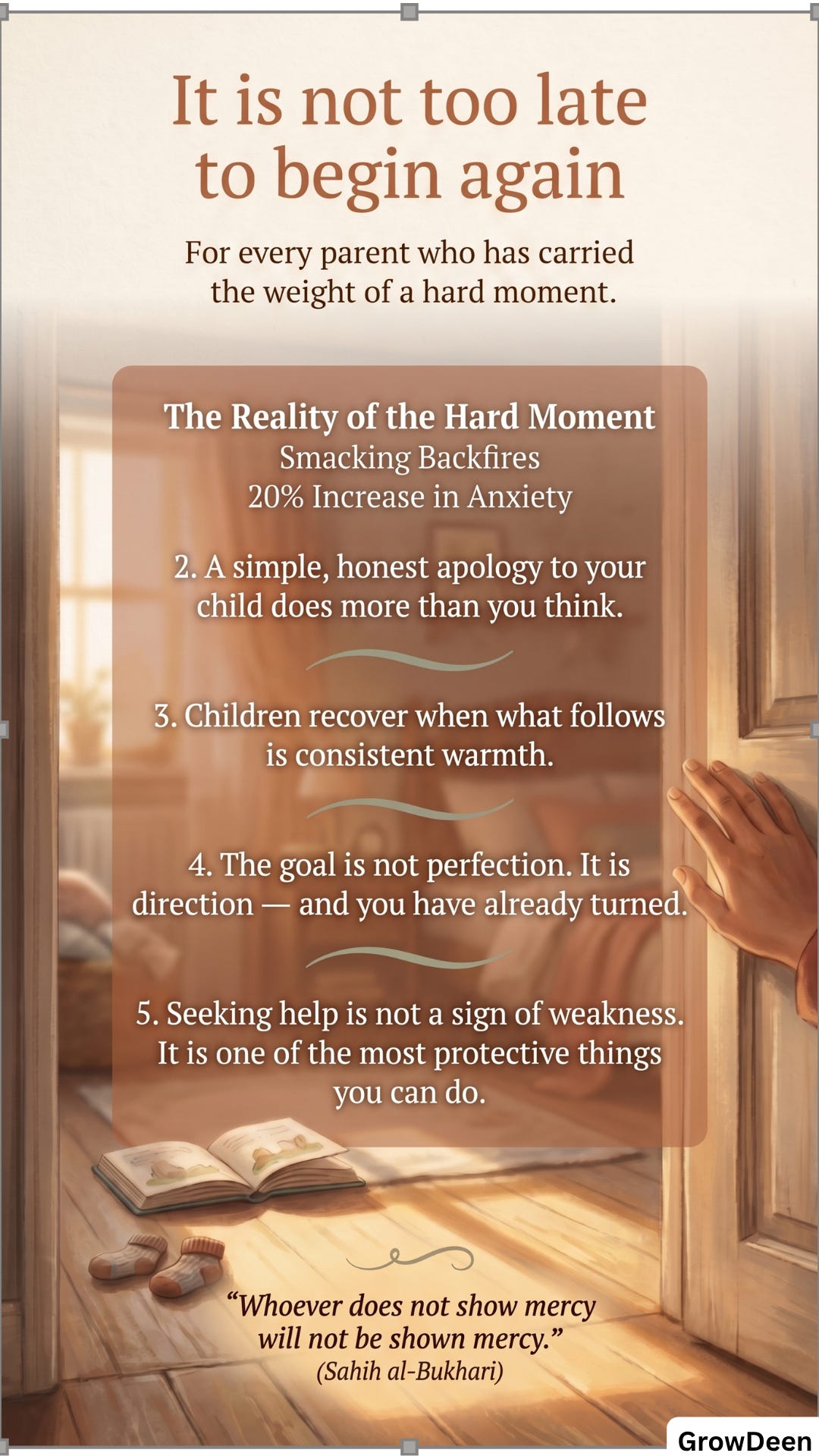
Q: What if I’ve already been smacking my child for years? Is the relationship damaged permanently? A: No. Repair is always possible, and the fact that you’re asking this question is itself a form of it. A genuine, simple acknowledgement — “I’m sorry I hurt you. That wasn’t right.” — does more than you might think. [1] Children are remarkably resilient when they experience consistent warmth going forward. It is never too late to begin again.
References
[1] Avezum, M.D.M. de M., Altafim, E.R.P., & Linhares, M.B.M. (2023). Spanking and corporal punishment parenting practices and child development: A systematic review. Trauma, Violence, & Abuse, 24(5), 3094–3111. https://doi.org/10.1177/15248380221124243
[2] Cuartas, J. (2023). Corporal punishment and child development in low- and middle-income countries. Child Psychiatry and Human Development, 54(6), 1607–1623. https://doi.org/10.1007/s10578-022-01362-3
[3] Johnson, A.M., Hawes, D.J., Eisenberg, N., Kohlhoff, J., & Dudeney, J. (2017). Emotion socialization and child conduct problems: A comprehensive review and meta-analysis. Clinical Psychology Review, 54, 65–80. https://doi.org/10.1016/j.cpr.2017.04.001
[4] Dadds, M.R., & Tully, L.A. (2019). What is it to discipline a child: What should it be? American Psychologist, 74(7), 794–808. https://doi.org/10.1037/amp0000449
[5] Pinquart, M. (2017). Associations of parenting dimensions and styles with externalizing problems of children and adolescents. Developmental Psychology, 53(5), 873–932. https://doi.org/10.1037/dev0000295
[6] Hawes, D.J., & Tully, L.A. (2020). Parental discipline and socialization in middle childhood. In S. Hupp & J. Jewell (Eds), Encyclopedia of child and adolescent development. Wiley-Blackwell. https://doi.org/10.1002/9781119171492.wecad236
[7] American Academy of Pediatrics. (2018). Effective discipline to raise healthy children. Pediatrics, 142(6), e20183112. https://doi.org/10.1542/peds.2018-3112
[8] Sahih al-Bukhari 5997; Sahih Muslim 2318. Hadith: “Whoever does not show mercy will not be shown mercy.” Muttafaqun Alayhi (agreed upon by al-Bukhari and Muslim).
[9] Qur’an, Surah At-Tahrim 66:6. See Tafsir Ibn Kathir commentary as cited in SeekersGuidance.org and Alim.org: Ali ibn Abi Talib’s explanation — “Teach them and discipline them.”
[10] Sunan Abi Dawud 4943. Hadith: “Whoever does not show mercy to our young ones, or acknowledge the rights of our elders, is not one of us.” Graded Sahih by Al-Arna’ut.
[11] Roffey, S. (2021). Childhood. In B. Grenville-Cleave et al. (Eds), Creating the world we want to live in (pp. 23–37). Routledge.
[12] Sunan Abi Dawud 4782. Hadith on managing anger — the Prophet ﷺ advised sitting when angry, lying down if the feeling persists, and making wudu. Graded Hasan.
[13] Sunan al-Tirmidhi 3895. Hadith: “The best of you are those who are best to their families.” Graded Sahih.