

Peer-reviewed occupational therapy research from Rodger and Brown (2006) and Case-Smith and O’Brien (2015) identifies age five as the typical point at which a child dresses independently, with the underlying skills built through a specific teaching sequence most parents never learn. [1][2]
It is 8:15 in the morning.
Your three-year-old is on the floor. One leg is in the trouser hole. The other leg is trying to join it. The waistband is bunched around a knee. There is a shoe on the wrong foot and a jumper with the neck opening pulled halfway across the wrong side of a small furious head.
You have twelve minutes before you need to leave for the masjid, the school run, or the appointment you cannot be late for. You crouch down, take a breath, and reach for the trouser. And you have done this before. You have done this every morning this week. You did it every morning last week. You are starting to wonder if your child will ever get dressed without you doing most of it.
Here is what almost no parenting book tells you: your child probably will not learn to get dressed by watching you dress them. There is a method underneath the ordinary skill of getting dressed, and it runs in the opposite direction from the one most parents instinctively use. [1][3]
Why this guide is different from generic dressing advice
Backed by developmental research, not opinion. Every method here is drawn from peer-reviewed occupational therapy literature (Rodger and Brown, 2006; Dunn Klein, 1995; Case-Smith and O’Brien, 2015) and from age norms published by the American Academy of Pediatrics and the CDC. [1][2][3][4][6]
Sunnah-rooted, not Sunnah-added. The Islamic adab of dressing is woven into an ordinary morning, not stapled on at the end. Qur’an 16:81 sits under the routine, not beside it. [7]
A tool to keep, not just an article to read. The free Small Hands Dressing Pack turns the method into a printable visual you can tape inside your wardrobe. Keep reading. It is at the end.
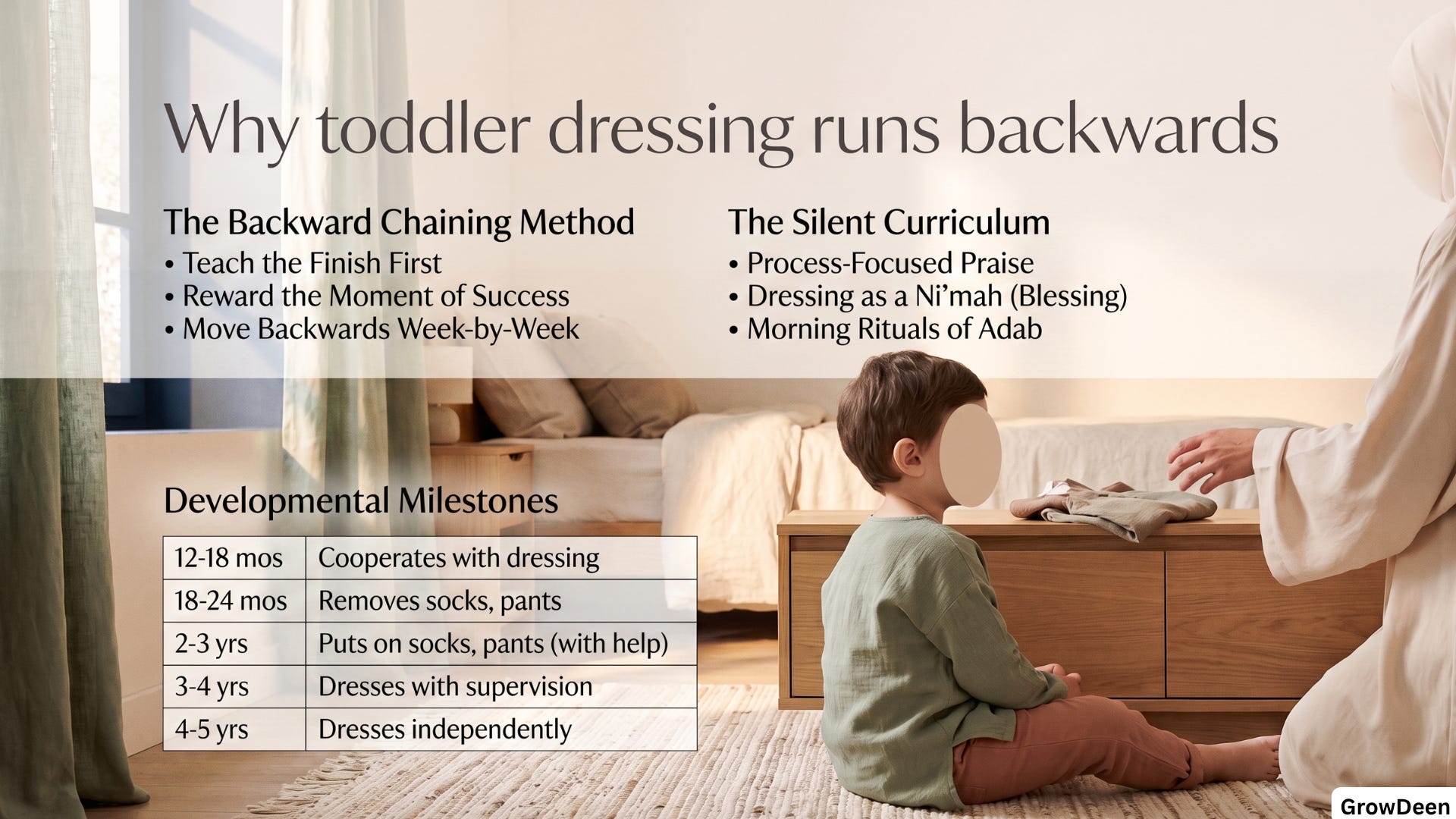
The method most parents never learn: backward chaining
There is a name for the teaching sequence that works. Occupational therapists call it backward chaining. [1][3]
Backward chaining is the opposite of how a parent normally teaches. You do not start at step one and try to get the child to complete step one on their own. You do the opposite. You do steps one through five yourself. Then you pause. You let the child do step six. That is it.
Once the child can do step six with no help, you stop one step earlier. You do steps one through four. The child does steps five and six. Then you stop earlier again. Then earlier again. Over weeks and months, you work backwards through the sequence, one step at a time, until the child is doing the whole task alone.
Why does this work when the front-to-back method almost never does?
Because the reward is at the end. The satisfying part of putting on shorts is not finding them in the drawer or figuring out which way round they go. The satisfying part is the pull-up to the waist. The moment of “it is on.” A small child needs that moment of success to want to keep trying. If you make them slog through the boring front-loaded steps before they ever get to the satisfying finish, they give up before they get there. And they should.
Teach the finish. The beginning will follow.
What this actually looks like at 7am on a Tuesday
Say the task is putting on a pair of elastic-waist trousers. The full task, broken into small steps, looks something like this:
Find the trousers in the drawer.
Face them the right way round.
Hold the waistband with two hands.
Push one leg through a leg hole.
Push the other leg through the other leg hole.
Pull the trousers up to the waist.
Backward chaining works like this. In week one, you do steps one through five. The child sits or stands where you have positioned them, feet already through the leg holes, waistband at the knees. You say, “You do the last part.” The child pulls the trousers up. They look at you with a small, real smile. You say, “You put your trousers on.”
In week three, you do steps one through four. The waistband is in the child’s hands, one leg through, one leg to go. You wait. They push the second leg through. They pull up. They did two steps by themselves. You name what they did specifically. “You pushed your leg through the hole and pulled the trousers up.” That kind of praise, the kind that names the exact behaviour, matters more than “good girl” or “clever boy” because it tells the child what they did to earn the acknowledgement. It is well-supported in the developmental research: a five-year longitudinal study by Gunderson and colleagues at Stanford, University of Chicago, and NYU tracked over 50 families and found that specific, process-focused praise given to toddlers at 14 to 38 months predicted a stronger belief at age seven or eight that ability grows through effort. [8]
By month three or four, depending on the child, you might be down to holding the trousers out with the front facing forward, and the child doing everything else. By month six, you are handing them the trousers and watching. By month nine, they are opening the drawer.
None of it is fast. None of it feels like a breakthrough. It is small, quiet, patient work. And it produces a child who dresses themselves by age five, on the developmental timeline the peer-reviewed research would predict. [1][2][4]
The silent curriculum inside a small task
There is a reason occupational therapists give dressing so much attention. Getting dressed is not one skill. It is a dozen skills, running at the same time, inside a single ordinary task. [2]
Pulling on a pair of shorts is fine motor work: the small pincer movements of the fingers around a waistband. It is gross motor work: standing on one leg to feed the other into a trouser leg. It is motor planning: holding a sequence in mind and executing it in the right order. It is working memory: keeping track of what comes next. It is language: hearing “arm through the sleeve” and knowing which body part matches which word. It is body schema: front from back, inside from outside, left shoe from right shoe. It is executive function: staying with a fiddly task instead of giving up when the sleeve gets stuck.
Erik Erikson, writing in the 1950s and 1960s, named the toddler years the stage of autonomy versus shame and doubt. The small child in this window needs to master ordinary tasks with their own hands. How the adults around them respond to those attempts shapes whether the child grows up feeling capable or feeling constantly corrected. [9]
Dressing sits inside that window. A child who is helped through this stage with warmth and patience is being handed one of the earliest experiences of “I did that.” A child rushed through it, or scolded for getting a jumper on backwards, receives a different early lesson entirely.
That is the internal weight of a task that looks external. It is not really about the shorts.
The Small Hands Dressing Pack, and why it is worth the download
There is a lot of moving parts in the backward-chaining method. Which garments to start with. Which steps to break down first. What to say and not to say. Which milestones to expect at which age. Keeping all of that in your head at 7:14 in the morning while a toddler wrestles with a sock is a lot to ask of any parent.
That is why the free Small Hands Dressing Pack exists. It is a printable three-page PDF designed to sit inside the wardrobe door or on the back of the bedroom door where dressing actually happens. It turns the method into a visual you can glance at instead of remember. Keep reading. It is at the end of the article, ready to download.
The Islamic framework for dressing: ni’mah, adab, and the seeds of haya’
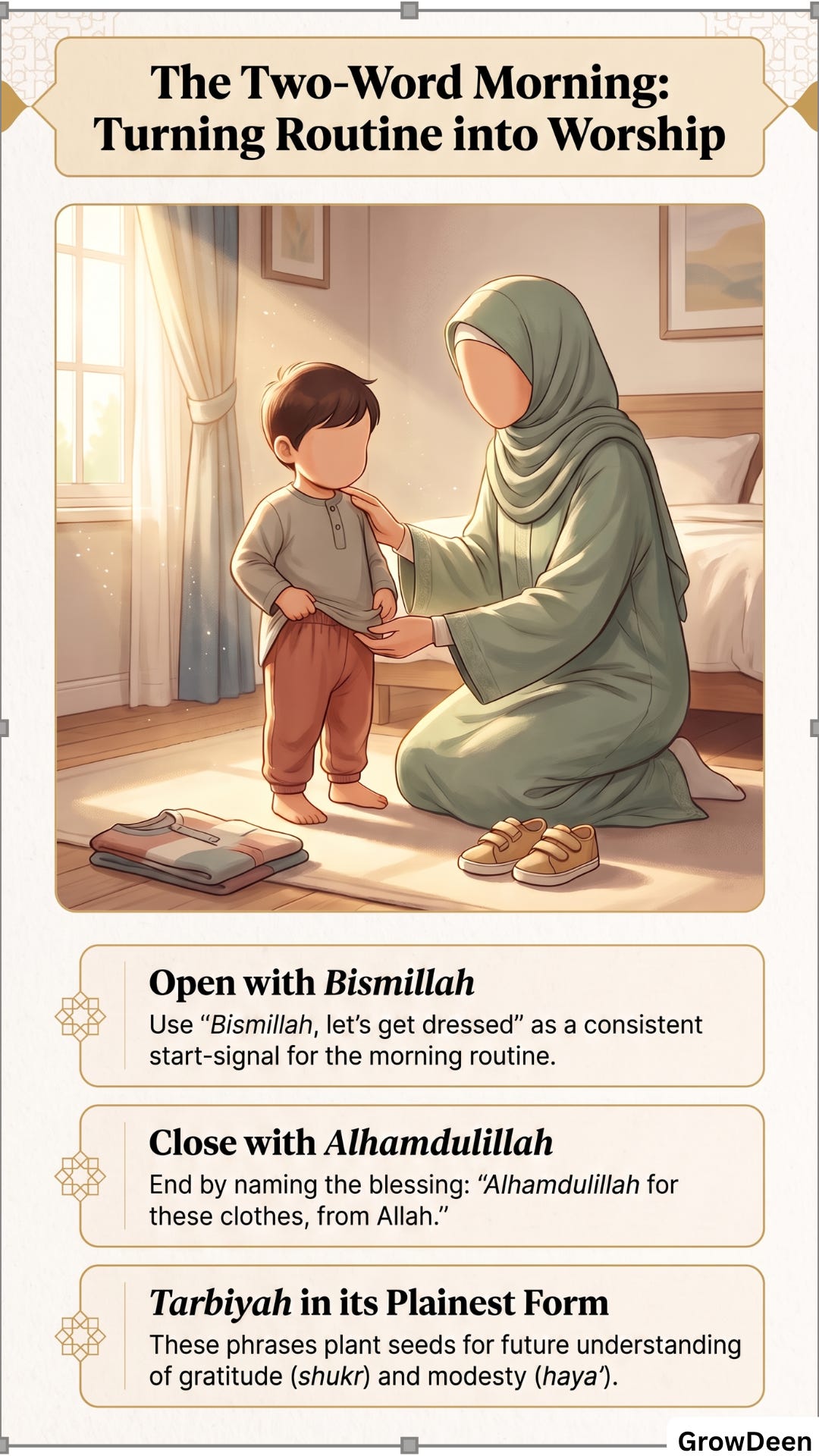
Picture the moment at the end of the routine, when the trousers are on and the jumper is finally the right way round. A Muslim mother, aunt, or father is looking at a small child who has just done a small thing well. What passes between them in that moment can be tarbiyah, quietly, if the frame is set.
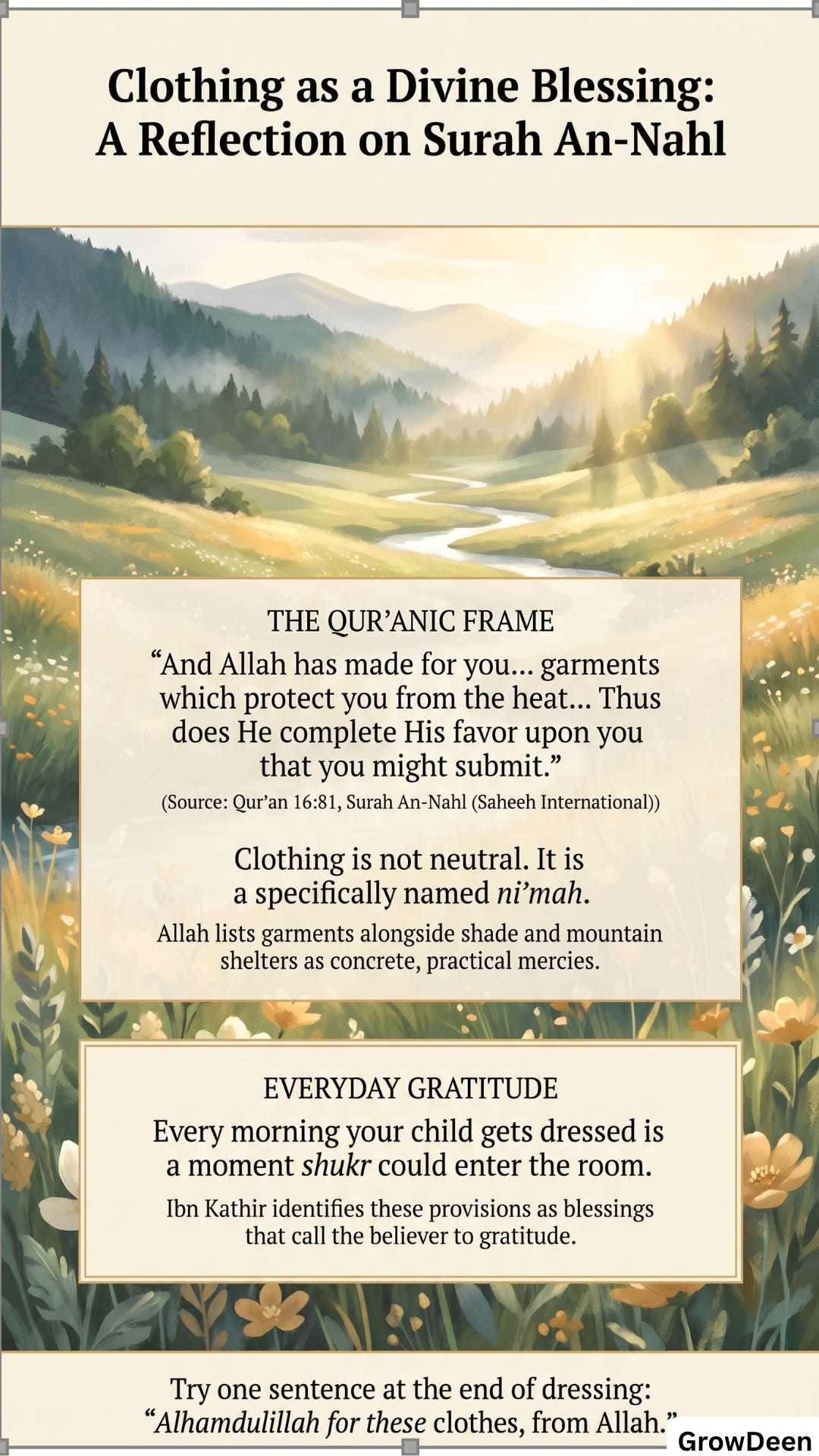
Allah names clothing in the Qur’an as one of His specific blessings to human beings. In Surah An-Nahl, in a verse enumerating His practical mercies, He says, “And Allah has made for you, from that which He has created, shadows and has made for you from the mountains, shelters and has made for you garments which protect you from the heat and garments which protect you from your [enemy in] battle. Thus does He complete His favor upon you that you might submit [to Him].” [Qur’an 16:81, Surah An-Nahl — Saheeh International] [7]
According to Tafsir Ibn Kathir, this verse lists concrete practical mercies alongside shade and mountain shelters, and closes with a call to gratitude and submission. Clothing, in the Qur’anic frame, is not a spiritually neutral necessity. It is a specific gift meant to move the believer toward shukr.
That framing changes what happens at 7:14. A single sentence said out loud, once, in language a child can hold: “Alhamdulillah, Allah gave us clothes to keep us warm.” No lecture. No sit-down. Repeated across the mornings of a childhood, it puts an early spiritual meaning into an ordinary act. That meaning is the ground on which the child will one day understand satr al-awrah, haya’ as dignity, and the modest dress that Muslims wear as an act of worship.
May Allah put barakah in these small daily moments and raise our children to carry His ni’mah with dignity and gratitude.
Support Muslim Parenting Lab ❤️
Would you like the most rewarded kind of charity there is? Use the button below now, while you are well, rather than later.
Asked which charity is best, the Prophet ﷺ said the one given while you are healthy, not deferred until death is near. (Sahih al-Bukhari 1419)
What your child can actually do today
Every child develops at their own pace. The list below is a rough map, drawn from AAP and CDC milestone data and cross-checked against occupational therapy sources. [4][6] Wide variation is normal.
Around 1 year. Holds an arm out for a sleeve. Puts a foot up for a shoe. Pushes an arm through a sleeve or a leg through trousers when the opening is offered. Pulls off socks and shoes.
Around 2 years. Takes off an unfastened coat by themselves. Takes off shoes when the laces are undone. Helps push down elastic-waisted trousers. Finds the armholes in a t-shirt.
Around 2 and a half years. Pushes down elastic-waisted trousers by themselves. Tries to put on socks with a struggle around the heel. Puts on a front-buttoned shirt without doing up the buttons. Unbuttons large buttons.
Around 3 years. Puts on a t-shirt with a little help. Puts on shoes without fastening them, often on the wrong feet, which is fine at this stage. Puts on socks with some heel confusion. Pulls up and pushes down trousers by themselves. Unzips and zips without joining or separating the zipper. Takes off a t-shirt on their own. Buttons large front buttons.
Around 4 years. Takes off a t-shirt without help. Buckles shoes or a belt. Joins a jacket zipper and zips it up. Puts on socks the right way. Puts on shoes with little help. Knows the front and back of a garment.
Around 4 and a half years. Steps into trousers and pulls them up in one motion. Threads a belt through the loops of the trousers.
Around 5 years. Dresses without help or supervision. Puts on a t-shirt or jumper the right way most times.
Tying shoelaces is a skill most five-year-olds are still working on. It usually settles between five and seven.
The rushed morning question
Nobody teaches a new skill at 8:15 on a Tuesday. The child cannot learn under time pressure. The parent cannot teach under time pressure. Both parties end the morning tired and slightly resentful of each other, and nothing has been gained.
A few small moves change the shape of the morning:
Choose clothes the night before, together. Two options on the chair, chosen while there is time. In the morning, the child picks between the two. No decision, no delay.
On rushed mornings, do not teach. On rushed mornings, do the whole task and get out of the door. Save teaching for the weekend, the after-nursery hour, or the pre-bath undressing routine. A child cannot backward-chain their way into learning while a parent is watching the clock.
Build a cheerful transition. Say “Bismillah, let’s get dressed” every morning. Repeated across the years of childhood, this becomes the child’s cue that dressing has started. It is a small verbal habit, and it doubles as an early Islamic practice of beginning an ordinary action with the name of Allah.
When to speak with a doctor or a paediatric occupational therapist
Most children learn to dress themselves within the normal range set out above. Some benefit from extra support. It is worth speaking to your doctor or a paediatric occupational therapist if your child is well past five and still cannot dress independently, if they visibly struggle with the fine motor tasks (buttons, zips) or the gross motor tasks (balancing to pull on trousers) required for their age, if they have strong sensory reactions to the feel of clothes on the skin beyond normal childhood dislike of an itchy jumper, or if they have been diagnosed with a developmental condition and you would like specific strategies. [5]
Autistic children and children with other developmental profiles often benefit from visual sequence cards, motor breaks between steps, and pre-planned clothing to reduce sensory unpredictability in the morning. [10] These are ordinary strategies that many families find useful even with no specific diagnosis.
Seeking this help early is not a sign that anything has gone wrong. It is a sign that a parent is paying attention.
Your free companion pack: The Small Hands Dressing Pack
If you have read this far, you are the kind of parent who takes small daily habits seriously, not as extra work, but as the material tarbiyah is actually made of. That is a beautiful thing to notice about yourself.
Inside the Small Hands Dressing Pack (one comprehensive PDF, three pages):
Page 1: The Backward Chaining Card. A visual guide showing the four most common dressing tasks (trousers, t-shirt, jumper, velcro shoes) broken into steps, with a clear marker for the last step your child does first. Designed as a wardrobe-door card you can stick inside the door of your child’s bedroom wardrobe, where dressing actually happens.
Page 2: The Dressing Milestone Tracker. A tick-box tracker covering ages one to five, one page for the whole span, so you can see at a glance which skills your child has settled and which are still coming. Nothing to fill in daily. Just a quiet reference you can update once a month.
Page 3: The Ni’mah of Clothing Reflection Card. A single-page reflection on Qur’an 16:81, English only, with a source line and a two-sentence parent note about how to introduce shukr for clothing into an ordinary morning. Designed for the fridge or the child’s bedroom wall.
This is not a PDF to download and forget. It is designed to sit inside the wardrobe door and the bedroom, where the method it teaches actually gets used.
The Small Hands Dressing Pack is what every subscriber receives with each article. Muslim Parenting Lab by GrowDeen Education covers the full arc of raising Muslim children from birth through age eight, always with peer-reviewed developmental research on one side and authenticated Sunnah on the other.
Do this in the next five minutes
Open the wardrobe door in your child’s bedroom. Choose one garment they wear most days, a jumper or a pair of trousers, and break the task of putting it on into five or six small steps in your head. Tomorrow morning, do all the steps except the last one. Say, “You do the last part.” That is the whole method. Start there.
May Allah put barakah in your effort, accept your intention, and make the small teaching moments you invest today more protective and more rewarded than they feel in the moment.
Share this with someone who needs it
Think of one person right now. The mother in your family whose three-year-old still needs full help every morning and who quietly feels she should have taught this by now. The friend whose autistic four-year-old struggles with sensory dressing and who has never heard the phrase “backward chaining.” The sister whose mornings are a battle and who told you last week she does not know why.
This article could change the shape of their week. Share it with them today, not as advice, but as care. Sometimes the most loving thing a Muslim can do for another Muslim is pass along a small method that quietly makes a hard morning easier.
Frequently asked questions
Q: At what age should my child be able to dress themselves?
A: The occupational therapy literature and AAP milestone data both place full independent dressing at around age five, with wide normal variation. [1][2][4] For the full age-by-age breakdown of what most children can do at each stage, see “What Your Child Can Actually Do Today” above.
Q: What is the best way to teach a toddler to get dressed?
A: Backward chaining. The parent does most of the task and the child completes only the last step, then over weeks the parent stops one step earlier, then earlier again, working backwards until the child does the whole task alone. [1][3] It is the method occupational therapists use with children and it works because the satisfying reward of finishing sits at the end of the task.
Q: My 4-year-old still cannot dress themselves. Should I be worried?
A: Not automatically. Many four-year-olds still need help with fiddly tasks like fastenings and getting shirts the right way round, and full independence typically settles at five. [1][2] If the child is well past five, has strong sensory difficulty, or has visible fine or gross motor difficulty, speaking to your doctor or a paediatric occupational therapist is the right next step. [5]
Q: Is there a specific Islamic way to get dressed?
A: Yes. The Sunnah is to begin with the right side when putting on clothes and to begin with the left when removing them. There is a specific du’a the Prophet ﷺ taught for putting on clothes, and Islamic families weave the adab of shukr (Alhamdulillah for the ni’mah of clothing) and the beginning of satr (covering what is private) into the daily routine from toddlerhood. The Qur’anic frame is set out in Qur’an 16:81. [7]
Q: Should I teach my child to dress themselves before nursery or school?
A: Where possible, yes. Nurseries and early school settings expect children to manage basic dressing (coats, shoes, sometimes changing for PE) with growing independence, and a child who has practised at home is less overwhelmed on their first weeks. The backward chaining method built into the day at home is the most reliable way to get there without pressure.
Q: My child hates the feel of certain clothes. What should I do?
A: Sensory sensitivity to clothing is common and often normal. Try soft, tagless, cotton fabrics. Cut out labels. Choose loose fits and wide necks. If the reaction is strong, persistent, and interfering with daily life, speak to your doctor or a paediatric occupational therapist about whether a full sensory assessment would help. [5][10]
References
[1] Rodger, S., & Brown, G.T. (2006). I can do it: Developing, promoting and managing children’s self-care needs. In S. Rodger & J. Ziviani (Eds.), Occupational therapy with children: Understanding children’s occupations and enabling participation (1st ed., pp. 200-221). Wiley-Blackwell.
[2] Case-Smith, J., & O’Brien, J.C. (2015). Occupational therapy for children and adolescents (7th ed.). Elsevier.
[3] Kumar, A., & Deepika, S. (2021). Effect of visual cues in upper body dressing for non-communication children. International Journal of All Research Education and Scientific Methods, 9(10), 1017-1023.
[4] American Academy of Pediatrics. (2023). Developmental milestones: 2 to 5 year olds. HealthyChildren.org.
https://www.healthychildren.org
[5] Haegele, A. (2021). Occupational therapy for children and adolescents. In J. Bahm (Ed.), Movement disorders of the upper extremities in children (pp. 117-128). Springer, Cham. https://doi.org/10.1007/978-3-030-53622-0_10
[6] Centers for Disease Control and Prevention. (2024). Milestone moments: Learn the signs, act early. CDC Developmental Milestones. https://www.cdc.gov/ncbddd/actearly/milestones/index.html
[7] Qur’an, Surah An-Nahl 16:81. English translation: Saheeh International. Tafsir insight verified via Tafsir Ibn Kathir (Abridged), Surah An-Nahl, ayah 81. https://quran.com/16/81 · Tafsir: https://quran.com/en/16/81/tafsirs/en-tafisr-ibn-kathir
[8] Gunderson, E.A., Gripshover, S.J., Romero, C., Dweck, C.S., Goldin-Meadow, S., & Levine, S.C. (2013). Parent praise to 1- to 3-year-olds predicts children’s motivational frameworks 5 years later. Child Development, 84(5), 1526-1541.
[9] Erikson, E.H. (1963). Childhood and society (2nd ed.). W.W. Norton.
[10] Dunn Klein, M. (1995). Pre-dressing skills (Rev. ed.). Pearson Education Limited.
We combine scientific research with Qur’an and authentic Sunnah, and we cite our sources. Even so, this is general guidance and no substitute for a doctor who can examine your child.