

The AAP and WHO both confirm that variety — not any single super food — is the most powerful nutritional strategy for children under 3. [1] Here’s what that looks like in practice, through both a scientific and Sunnah lens.
Your baby has had the same three puréed vegetables for three weeks. Your toddler has decided the only acceptable food is bread. You’re doing everything you can, and somehow the question “am I feeding them right?” won’t leave you alone.
I know that feeling. And I want to share something that reframed it completely for me.
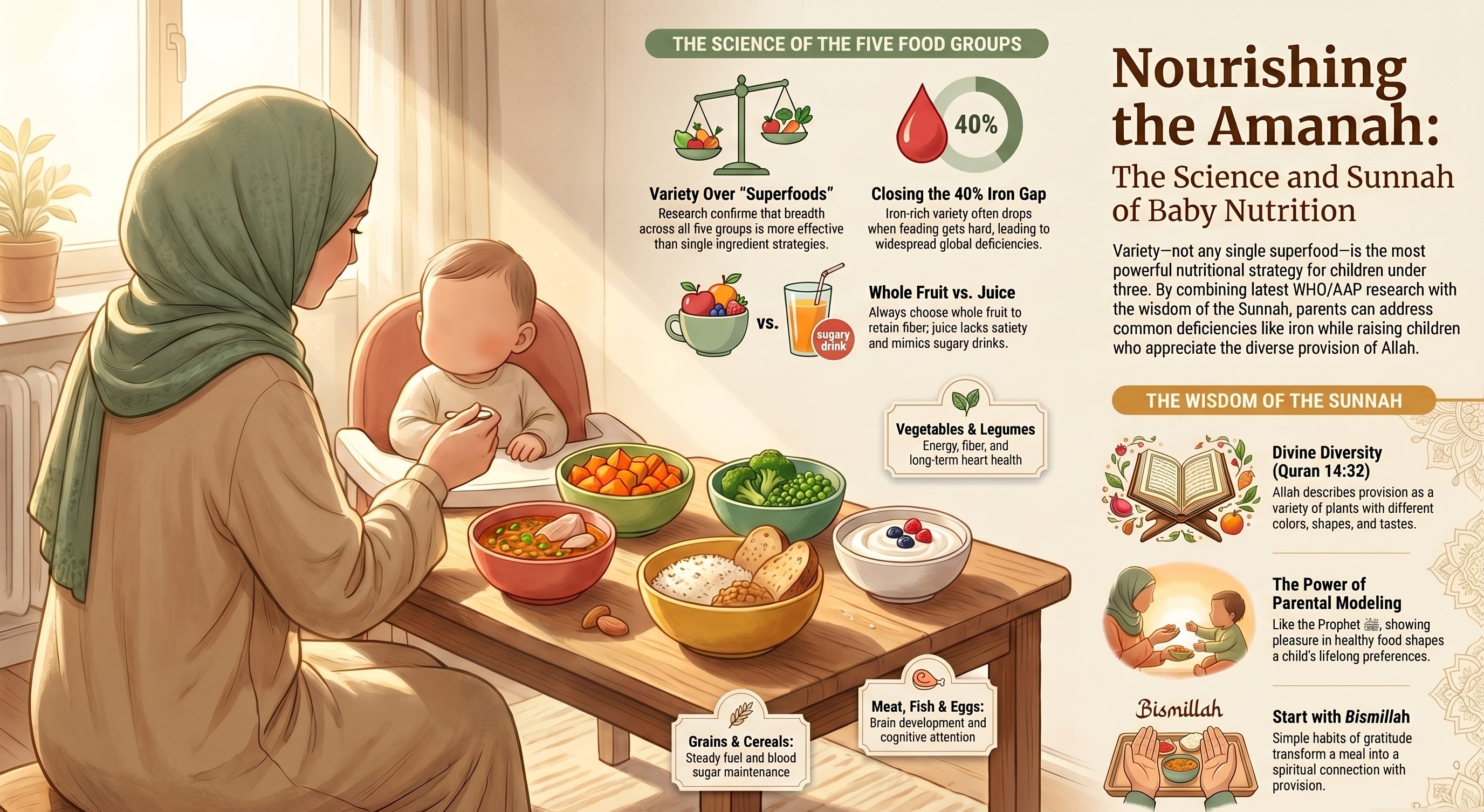
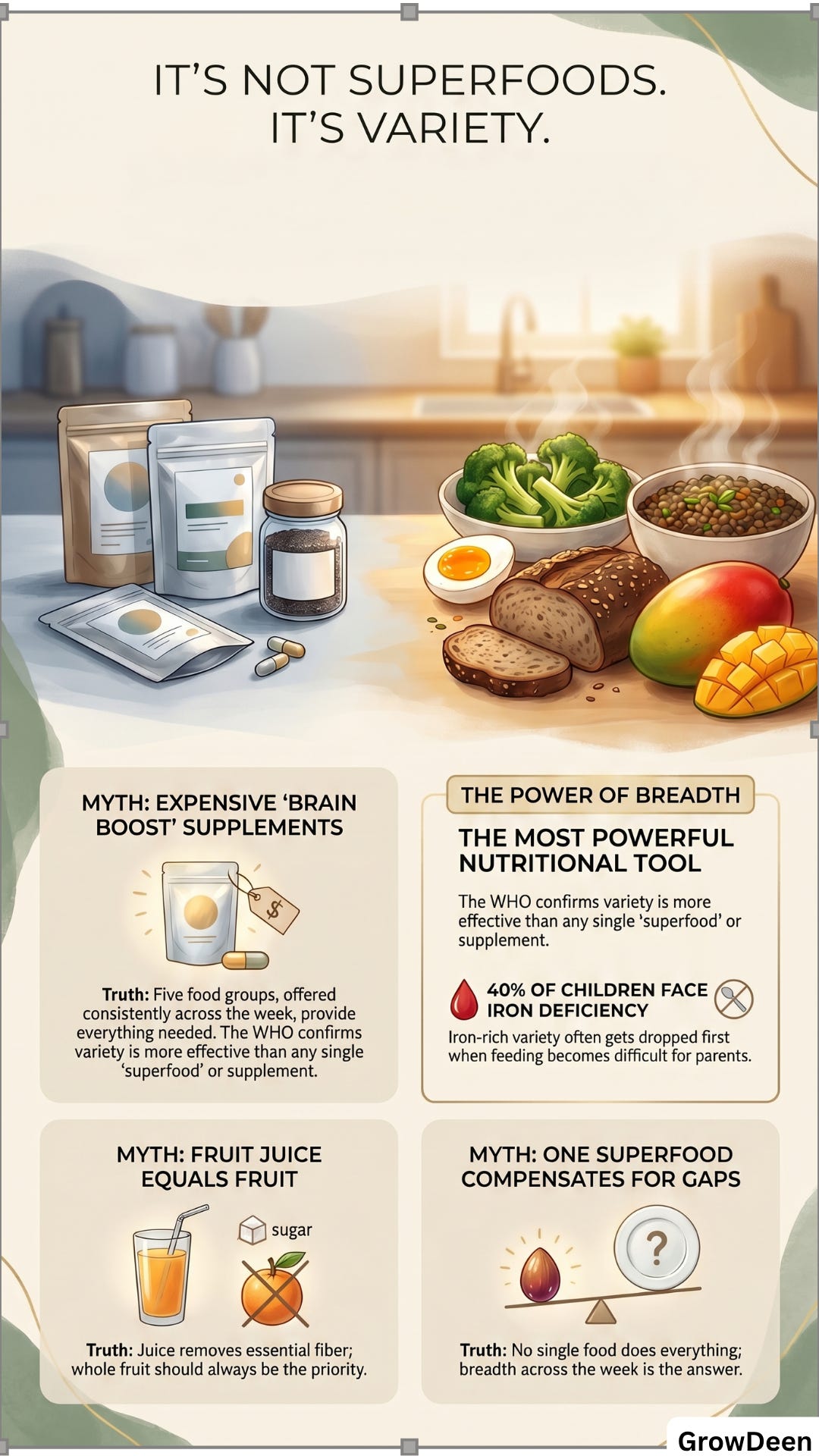
When I went through the WHO’s 2023 complementary feeding guidelines, one finding landed differently than I expected: approximately 40% of children under five globally are iron deficient — not because their parents aren’t trying, but because iron-rich variety gets dropped first when feeding gets hard. [1] The statistic isn’t there to scare you. It’s there because it’s fixable. And this guide shows you how.
The answer, according to the research, isn’t a specific superfood or supplement. It’s variety across five food groups, offered consistently from six months onwards. [2] That’s it. That’s the whole article.
Why This Guide Is Different From Generic Baby Nutrition Advice
Both the science and the Sunnah, together. Every recommendation here draws from current peer-reviewed research (WHO, AAP, published journals) and authenticated Islamic sources — not one or the other.
It’s about what your child’s body actually needs, not about Instagram-worthy meals or fussy parenting trends. Practical, honest, and grounded in evidence.
You’ll receive a free Growing Table Companion Pack — a printable 3-page PDF with a food variety tracker, age-by-age quick guide, and an authenticated mealtime du’a card your family can actually use.
The Food Groups — Why All Five?
Here’s the thing: no single food does everything a growing body needs.
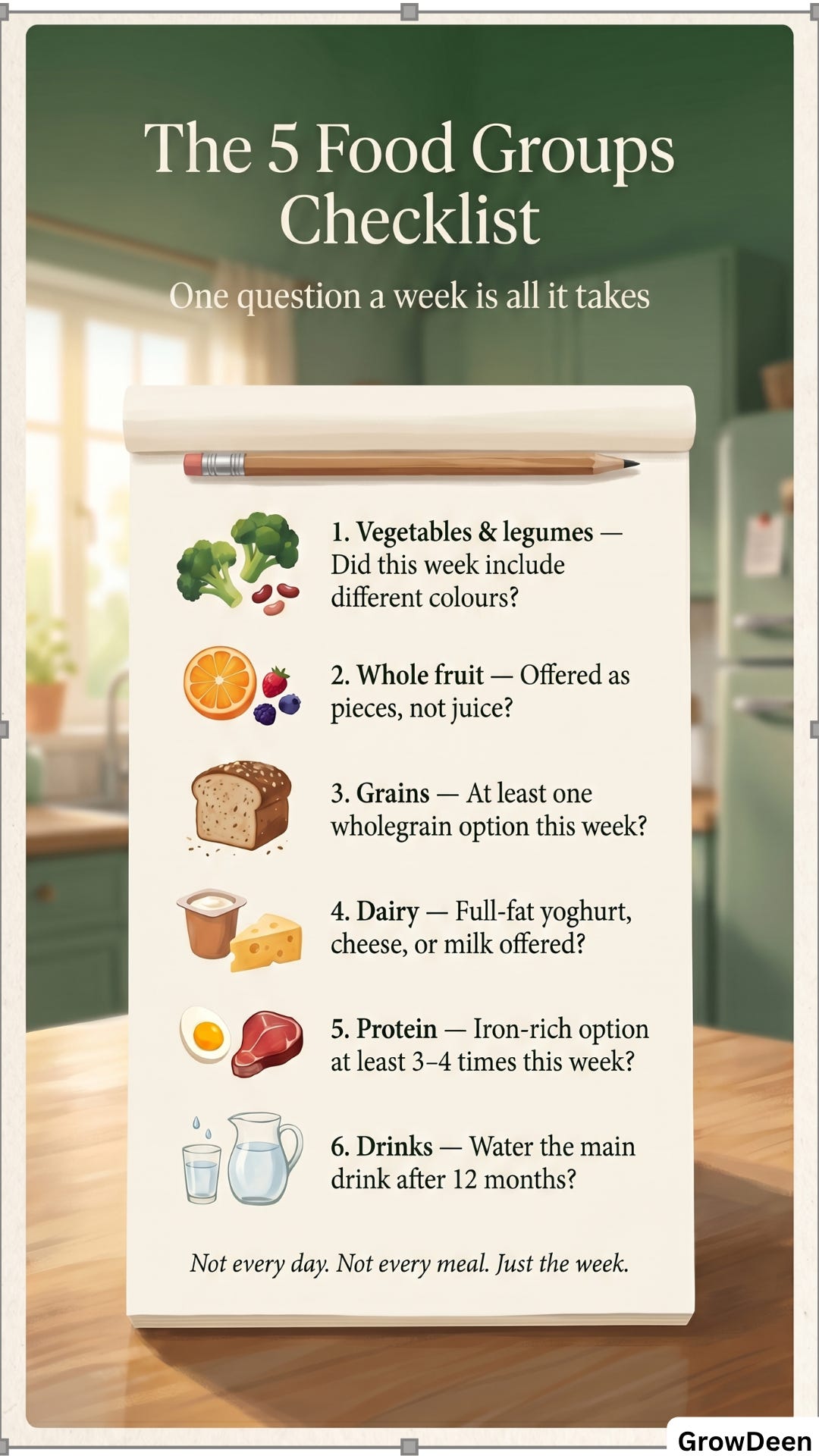
Different food groups carry different nutrients — not just different vitamins, but different building blocks for bone, brain, muscle, and immune function that work best when combined. [3] The goal isn’t one perfect meal. It’s breadth across the week.
Vegetables and legumes might be the most under-served food group in modern family diets. They provide energy, vitamins, minerals, antioxidants, fibre, and hydration — and research consistently links early vegetable variety to reduced long-term risk of heart disease and certain cancers. [4]
Colour matters more than you might think. Orange vegetables have different phytonutrients than dark greens. Red is different from white. Rotating colours is one of the simplest nutritional strategies available. [4]
Legumes — lentils, chickpeas, kidney beans — deserve their own mention. Affordable, iron-rich, protein-dense, and easy to prepare from six months.
Fruit is usually the easiest group to introduce. But here’s what most parents don’t realise: whole fruit and fruit juice are not the same thing. Juice removes the fibre that slows sugar absorption and promotes satiety. [7] A toddler drinking juice regularly is consuming something nutritionally closer to a sweet drink than a piece of fruit. Whole fruit. Always whole fruit.
Grains and cereals are the body’s primary fuel. But not all grains are equal. Wholegrain options — oats, brown rice, wholegrain bread — release energy slowly, maintaining steadier blood sugar and keeping children fuller for longer. [8] Higher-GI refined grains (white bread, sugary cereal) lead to faster hunger and energy dips. Many traditional Muslim family staples are naturally excellent here: barley soup, lentil rice, wholegrain flatbreads.
Dairy provides the calcium and protein young children need for bone and muscle development. [3] The key milestones: dairy foods (yoghurt, cheese) can start at six months, but breastmilk or formula remains the primary drink until 12 months. After 12 months, full-fat cow’s milk can become the main drink. Full-fat — not reduced fat — until age two. Growing children need that fat for brain development. [9]
Meat, fish, eggs, and plant-based proteins carry the nutrients most critical for your child’s brain. Iron deficiency — affecting an estimated 40% of children under five globally — directly impairs cognitive development and attention. [1, 10] Red meat and legumes are excellent sources, and pairing iron-rich foods with vitamin C (orange slices with lentils, lemon over chickpeas) significantly boosts absorption. [11] Oily fish twice a week provides omega-3s strongly linked to brain development and language acquisition. [12]
For families on vegetarian or vegan diets: it’s entirely possible, but requires careful planning around iron, zinc, B12, and omega-3. Please work with a paediatrician or dietitian. [9]
I know this is a lot to hold onto, especially on the days when getting anything into your toddler feels like a victory. That’s exactly why I created a free Growing Table Companion Pack — a printable 3-page PDF with a weekly variety tracker, an age-by-age quick reference card, and a mealtime du’a card your family can use every day. Keep reading to download it at the end.
Drinks: The Short Version
Water after 12 months. Full stop.
Fruit juice — even 100% — is high in sugar and trains children toward sweetness as a default. [7] Caffeinated drinks (tea, coffee, chocolate milk, energy drinks) impair calcium absorption and are not appropriate for young children. [13] Sweetened milks, flavoured waters, cordials, and soft drinks: occasional at most.
What the Prophet ﷺ Showed Us About Food and Variety
The Sacred Trust of the Table: What Qur’an 14:32 Teaches About Nourishing Our Children
As Muslim parents, we carry something that goes beyond nutrition charts and food groups. We carry an amanah.
When I reflect on the verse in Surah Ibrahim — where Allah says He sends down rain and brings forth “a variety of vegetation, fruits and plants of different colours, shapes, tastes, scents and uses” as provision for us [Qur’an 14:32] — what strikes me is that word: variety. According to Tafsir Ibn Kathir, this passage describes Allah’s favours — gifts specifically designed and diversified for the sustenance of His servants. [1] The variety isn’t a nice detail. It’s the point.
Then there is a narration from Anas ibn Malik that I think about often. He accompanied the Prophet ﷺ to a meal at a tailor’s house, and he watched the Prophet ﷺ actively seek out and eat the pieces of gourd from around the dish. Anas said: “Since that day I have liked to eat gourd.” [Sahih al-Bukhari 5379] [6]
A Companion changed his food preferences for life — not because he was told to, but because he watched the Prophet ﷺ eat something with visible pleasure. Our children are watching us the same way.
What the research on parental food modelling and the Sunnah are both pointing toward is the same truth: our children eat what they see the people they love eating. When we choose vegetables with gratitude, say Bismillah before a meal of lentils, and say Alhamdulillah after — we’re shaping more than their diet. We’re shaping their relationship with provision itself. May Allah put barakah in what we feed our families and in what we eat together.
Your Growing Table Companion Pack (Free Download)
If you’ve read this far, you’re the kind of parent who takes your child’s well being seriously — not as pressure, but as love. That’s why we have designed a special companion pack for you! Inside the Growing Table Companion Pack (one PDF, 3 pages):
Page 1: The Weekly Variety Tracker — A simple grid where you log what food groups your baby or toddler ate each day across the week, colour-coded by group — so you can see at a glance where the gaps are, without having to remember everything in your head. Designed as a printable you can stick on the fridge.
Page 2: Age-by-Age Food Guide (6 months–3 years) — A compact quick-reference card showing key developmental milestones by age (when to introduce what, texture guidance, choking reminders, drink transitions) — so you’re not searching back through articles when you need a fast answer.
Page 3: Rizq Tayyib Du’a Card — The Prophetic morning du’a the Prophet ﷺ recited after every Fajr prayer: “O Allah, I ask You for beneficial knowledge, wholesome provision, and accepted deeds” (Sunan Ibn Majah 925 — Sahih) — with Arabic, transliteration, and English meaning, plus a short note on how to use it as a daily intention before planning your family’s meals.
This isn’t just a PDF to download and forget. It’s a tool designed to stay on your fridge — where you’ll actually use it when you need it most.
This Growing Table Companion Pack is what every subscriber receives with each article. We cover the full journey of raising Muslim children — from newborns through school age — all backed by research and rooted in Islamic wisdom.
If you’re a Muslim parent who wants both evidence-based guidance and an Islamic perspective, subscribe free so future resources reach your inbox before you need them.
Subscribe free for parenting resources backed by both science and Sunnah — guidance so unique, you rarely find it anywhere else. No spam. No clutter. Just resources that matter.
One Small Thing
Tonight at dinner — say Bismillah before the first bite and Alhamdulillah after the last. That’s it. You don’t have to do everything at once. Start there. That habit, built into your child’s earliest meals, is worth more than you think.
Share This With Someone Who Needs It
Think of one person right now: a new mother in your family who’s anxiously googling whether her baby is eating enough, a sister whose toddler has decided to eat only one food this week, a friend who mentioned feeling overwhelmed at mealtimes and not knowing if she’s doing it right.
This article could ease her mind. Share it with her today — not as advice, but as care. Sometimes the most loving thing we can do is pass along what helped us see things more clearly.
Frequently Asked Questions
Q: When should I start giving my baby solid food?
A: The WHO and AAP both recommend starting complementary foods at around 6 months, alongside continued breastmilk or formula. [1, 9] Not before 4 months, and ideally not much later than 6. For more detail, see the age-by-age guide above.
Q: How much food does my baby actually need in the first weeks of solids?
A: Much less than you’d expect — think a teaspoon or two at a time, once or twice a day. The goal at first is introduction, not quantity. Milk remains the primary source of nutrition until 12 months. [9]
Q: My toddler only wants to eat the same 3 foods. Is that normal?
A: Very. Research shows that toddlers need between 10 and 15 exposures to a new food before they’ll reliably accept it. [2] Keep offering, don’t pressure, and eat the foods yourself. Modelling is more powerful than any persuasion technique.
Q: Can babies under 12 months have cow’s milk?
A: Small amounts in cooking are fine from six months. But cow’s milk should not replace breastmilk or formula as the main drink before 12 months. [9] After 12 months, full-fat pasteurised cow’s milk is suitable as a main drink.
Q: Is it safe to raise a toddler on a vegetarian or vegan diet?
A: Yes, but it requires careful planning. The main risks are deficiencies in iron, zinc, B12, and omega-3 fatty acids — all critical for brain and body development. A paediatrician or dietitian can help you build a safe, complete plan. [9]
Q: What drinks should I avoid giving my baby or toddler?
A: Avoid fruit juice (even 100%), all caffeinated drinks (tea, coffee, hot chocolate), sweetened milks, cordials, sports drinks, and soft drinks. Water after 12 months is the goal. [7, 13]
References
[1] World Health Organization (WHO). (2023). Complementary Feeding: Guiding Principles for Appropriate Complementary Feeding of Breastfed Children 6–24 Months of Age. WHO. https://www.who.int/publications/i/item/9789241513067
[2] Birch, L.L., & Doub, A.E. (2014). Learning to eat: Birth to age 2 years. American Journal of Clinical Nutrition, 99(3), 723S–728S. https://doi.org/10.3945/ajcn.113.069047
[3] National Health and Medical Research Council (NHMRC). (2013). Eat for Health: Australian Dietary Guidelines. NHMRC.
https://www.eatforhealth.gov.au
[4] Nicklas, T.A., O’Neil, C.E., & Fulgoni, V.L. (2020). Nutrient intake, introduction of baby cereals and other complementary foods in the diets of infants and toddlers from birth to 23 months. AIMS Public Health, 7(1), 123–147. https://doi.org/10.3934/publichealth.2020012
[5] Mahmood, L., Flores-Barrantes, P., Moreno, L.A., Manios, Y., & Gonzalez-Gil, E.M. (2021). The influence of parental dietary behaviors and practices on children’s eating habits. Nutrients, 13(4), 1138. https://doi.org/10.3390/nu13041138
[6] Sahih al-Bukhari 5379. Narrated by Anas ibn Malik. Book 70 (Kitab al-At’ima). Graded Sahih. https://sunnah.com/bukhari:5379
[7] Devenish, G., Golley, R., Mukhtar, A., Begley, A., Ha, D., Loc, D., & Scott, J.A. (2019). Free sugars intake, sources and determinants of high consumption among Australian 2-year-olds. Nutrients, 11(1), 161. https://doi.org/10.3390/nu11010161
[8] Adolphus, K., Lawton, C.L., Champ, C.L., & Dye, L. (2016). The effects of breakfast and breakfast composition on cognition in children and adolescents: A systematic review. Advances in Nutrition, 7(3), 590S–612S. https://doi.org/10.3945/an.115.010256
[9] American Academy of Pediatrics (AAP). (2022). Feeding & Nutrition: Your Baby’s First Year. HealthyChildren.org. https://www.healthychildren.org/English/ages-stages/baby/feeding-nutrition
[10] World Health Organization (WHO). (2023). Nutritional Anaemias: Tools for Effective Prevention and Control. WHO. https://www.who.int/publications/i/item/9789241513067
[11] Hallberg, L., Brune, M., & Rossander, L. (1989). The role of vitamin C in iron absorption. International Journal for Vitamin and Nutrition Research, 30, 103–108.
[12] Innis, S.M. (2008). Dietary omega-3 fatty acids and the developing brain. Brain Research, 1237, 35–43. https://doi.org/10.1016/j.brainres.2008.08.078
[13] Blaine, R.E., Kachurak, A., Davison, K.K., Klabunde, R., & Fisher, J.O. (2017). Food parenting and child snacking: A systematic review. International Journal of Behavioral Nutrition and Physical Activity, 14, Article 146. https://doi.org/10.1186/s12966-017-0593-9
[14] The Noble Qur’an. Surah Ibrahim (14:32). Tafsir Ibn Kathir: “He also sends down rain from the sky and, in its aftermath, brings forth a variety of vegetation, fruits and plants of different colours, shapes, tastes, scents and uses.” Verified via Quran.com.
[15] Sunan Abi Dawud 5073 / Sahih Ibn Hibban, Hadith 861. “Allahumma ma asbaha bi min ni’matin aw bi-ahadin min khalqika, faminka wahdaka la sharika laka, falakal-hamdu walakash-shukr.” Graded Hasan. https://sunnah.com/abudawud:5073