


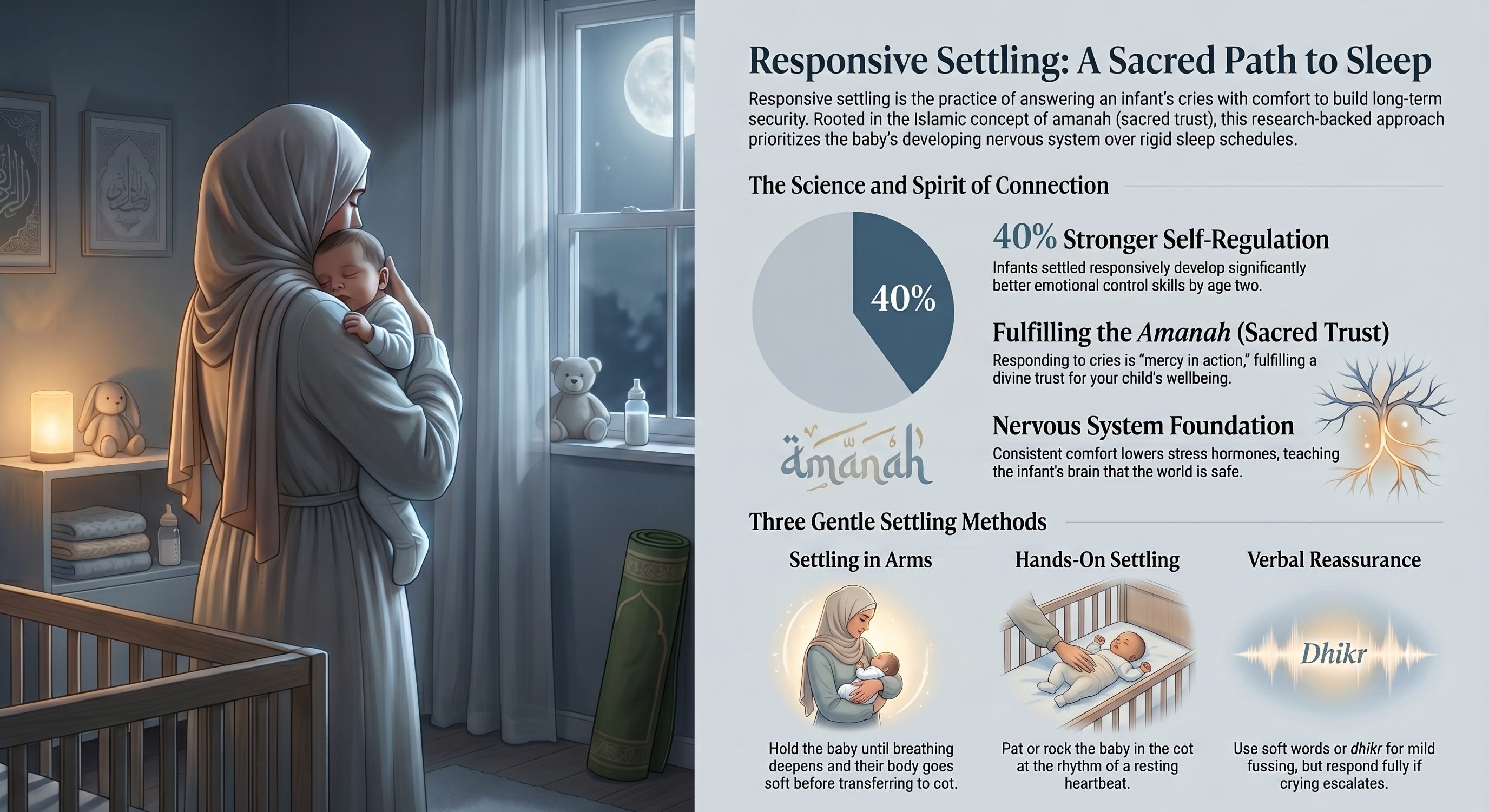
Research shows that babies settled responsively develop 40% stronger self-regulation skills by age 2 compared to those left to cry. [1] This guide walks you through the three gentle methods that build security now and independence later.
3 AM. Your baby’s crying again. You’ve fed them, changed them, rocked them. Your arms ache. You’re Googling “when will my baby sleep through the night” for the fourth time this week.
Someone told you that picking them up every time will spoil them. That you need to teach independence. That if you don’t start sleep training now, you’ll be doing this for years.
Here’s what I need you to know: during these first six months, your baby’s need for you isn’t a bad habit. It’s brain development in action.
When I studied the research on infant sleep and attachment, one finding stopped me cold. Babies who experience consistent, responsive settling—where parents answer their cries with comfort—show measurably lower stress hormone levels and develop stronger emotional regulation by toddlerhood. [2] Not because they were “trained,” but because their nervous system learned something fundamental: distress brings relief. The world is safe. I am not alone.
Why This Guide Is Different From Generic Sleep Advice
It’s backed by current neuroscience and pediatric research. Every recommendation comes from peer-reviewed studies published between 2017-2022, plus the AAP’s 2022 safe sleep guidelines.
It honors Islamic teaching on mercy and trust. This isn’t just sleep tips—it’s about fulfilling the amanah (sacred trust) of your child’s wellbeing through both practical care and spiritual grounding.
You get a printable Responsive Settling Quick Reference Card. Not just information, but a tool you can keep by the changing table when you’re too exhausted to remember which technique to try next.
What Makes the First Six Months Different
Your baby’s brain is still forming the neural pathways that regulate stress, fear, and safety. When they cry and you respond—when you pick them up, rock them close, speak softly—you’re not creating dependence. You’re teaching their developing nervous system that the world can be trusted. [3]
This is the paradox that trips up so many parents: the more you meet their need for closeness now, the more confidently they’ll separate later.
Sleep training methods that involve leaving babies to cry might produce faster “results.” But those results often come at a cost. Studies measuring cortisol (stress hormone) levels found that babies left to cry alone show elevated stress markers even after they’ve stopped crying—they’ve learned to shut down their distress signals, not self-soothe. [4]
Responsive settling takes longer. It requires more presence, more patience, more late nights when your body is begging for sleep. But it builds security, not compliance.
The Prophet ﷺ said: “He is not one of us who does not show mercy to our young ones.” [5] That mercy isn’t abstract. It’s your hand on your baby’s back at 2 AM. It’s staying when they need you to stay.
The Three Core Methods (Choose What Fits Your Baby)
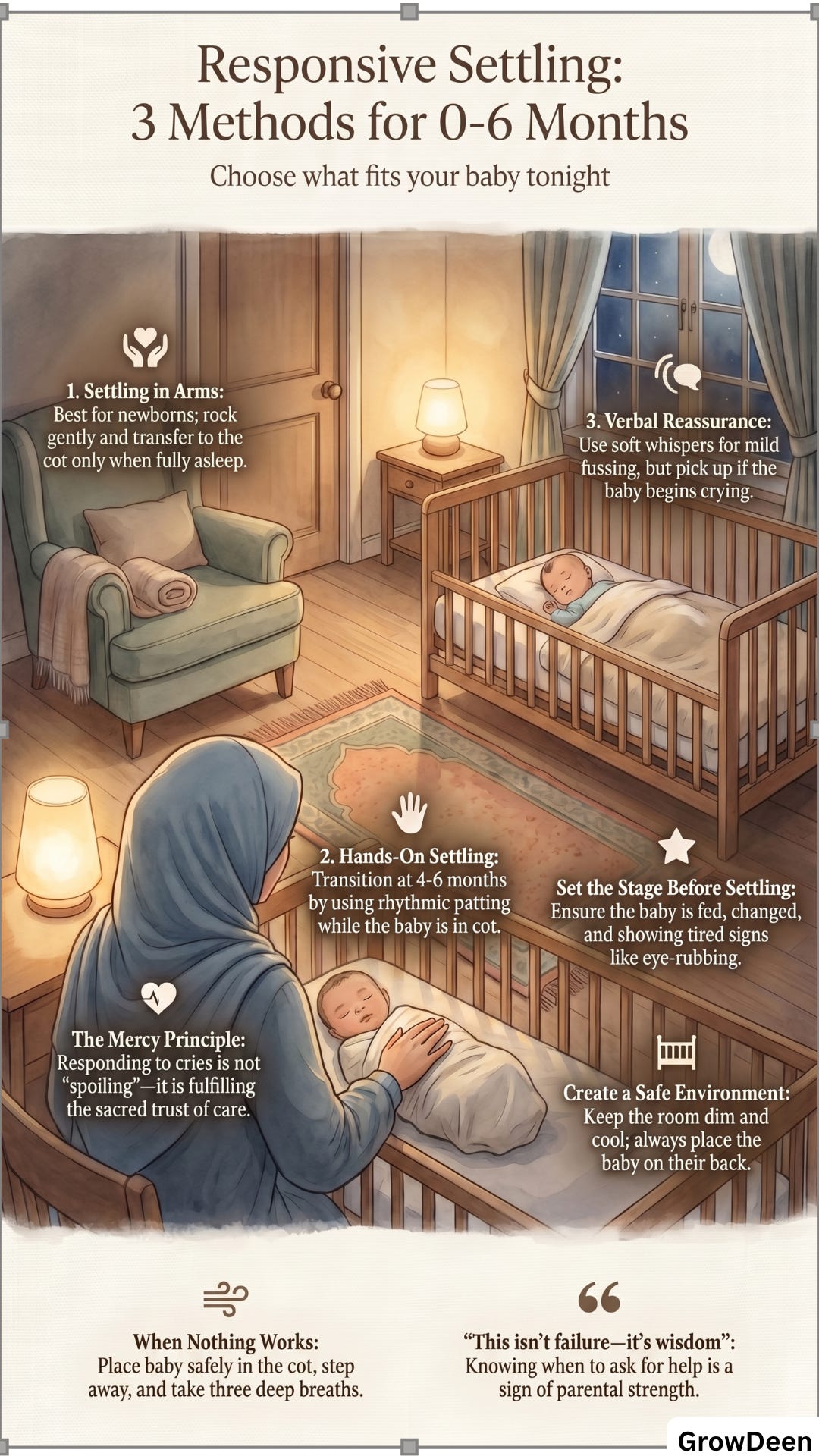
Settling in Arms: When Full Contact Is What They Need
This is the most instinctive approach. You hold your baby against your chest, skin to skin if they need it, and you move. Rock side to side. Walk slow circles. Pat their bottom in rhythm with your heartbeat.
Some parents hum softly. Others recite Ayat al-Kursi or Surah Al-Ikhlas, letting the words become a lullaby. The rhythm matters more than the method.
When your baby’s breathing deepens and their body goes soft, you know sleep has arrived. Only then do you lower them onto their back in the cot—firm surface, no blankets, nothing near their face. [6]
This works especially well for newborns who still need that fourth-trimester closeness. Their circadian rhythm isn’t developed. They don’t understand day from night. What they understand is: you.
Hands-On Settling: Bridging Contact and Space
As babies move toward four to six months, some start tolerating a little distance. Hands-on settling meets them there.
Here’s one approach: place your baby on their side in the cot, facing away. Rest one hand on their shoulder. With the other, gently pat their bottom or thigh in a slow, steady rhythm—about the speed of a resting heartbeat. [7]
Some parents count silently. Others recite a short du’a with each pat. The rhythm is what matters. Babies respond to predictability.
If your baby relaxes, roll them carefully onto their back and step away. If they escalate, pick them up. Comfort them fully, then try again.
Here’s the key: responsive settling allows that flexibility. You’re not locked into a rigid script. If your baby cries hard, you respond. You don’t leave them to “work it out.” You step in, soothe, then try again. [8]
Other parents place one hand on their baby’s chest and another on their hip, gently rocking them while they lie in the cot. Or stroke their forehead. Or pat the mattress beside them.
The method changes. The principle doesn’t: you stay close enough to respond.
Verbal Reassurance: For Low-Level Fussing Only
Not every sound requires full intervention. Some babies grizzle—a fussy, low-grade sound between silence and crying. Grizzling often means they’re processing the shift into sleep.
If your baby grizzles when you first lay them down, you can offer words without picking them up. A soft “I’m here” or “Shhh, time to rest” can be enough. Some parents quietly recite the beginning of Surah Al-Ikhlas.
But here’s the line: if grizzling turns to real crying, you go to them. Verbal reassurance works for mild fussing. Not distress.
Before You Try Any Method: Set the Stage
Responsive settling works best when the environment supports rest:
Watch for tired signs. Rubbing eyes, turning away from stimulation, staring blankly. If these aren’t present, your baby might need more play or milk first.
Feed them well. Hunger disrupts sleep. In the early months, babies need frequent feeds day and night for growth. [9] “Sleeping through the night” isn’t realistic for most babies under six months.
Check the nappy. Wetness or discomfort keeps them awake.
Dim the lights. Darkness signals rest. Use blackout curtains for naps if needed, or a soft nightlight.
Keep it cool. Overheating increases SIDS risk. [10] If you’re comfortable in a long-sleeved shirt, your baby is dressed appropriately.
Allah says in Surah Al-Furqan: “And it is He who made the night a covering for you, and sleep for rest.” [11] Creating the conditions for that rest is part of honoring the mercy in it.
When Nothing Works and You’re at Your Limit
There will be nights when you’ve tried everything. You’ve rocked, patted, fed, changed. And still, your baby cries.
Your arms ache. Your patience frays. You feel anger rising—not at your baby, but at the exhaustion, the helplessness, the feeling that you’re failing.
Here’s what you do: place your baby somewhere safe—their cot, on their back, in a clear space. Then step away. Take three breaths. Drink water. Text your partner or a friend.
If you have a partner, wake them. This isn’t failure. The Prophet ﷺ said: “The strong person is not the one who can overpower others, but the one who controls himself when angry.” [12] Knowing when to step back is strength.
Parenting an infant isn’t meant to be solo. In traditional communities, mothers were surrounded by aunts, sisters, grandmothers who took turns. If you don’t have that, create it where you can. Ask for help. Accept it when offered.
I know this feels like a lot to remember when you’re running on three hours of broken sleep. That’s why I created the Responsive Settling Quick Reference Card—a one-page printable guide with all three methods, tired signs to watch for, and a troubleshooting checklist you can keep by the changing table.
Keep reading to download it at the end—it’s designed to be the thing you grab at 2 AM when your brain is too tired to think.
The Islamic Frame: This Work Carries Sacred Weight
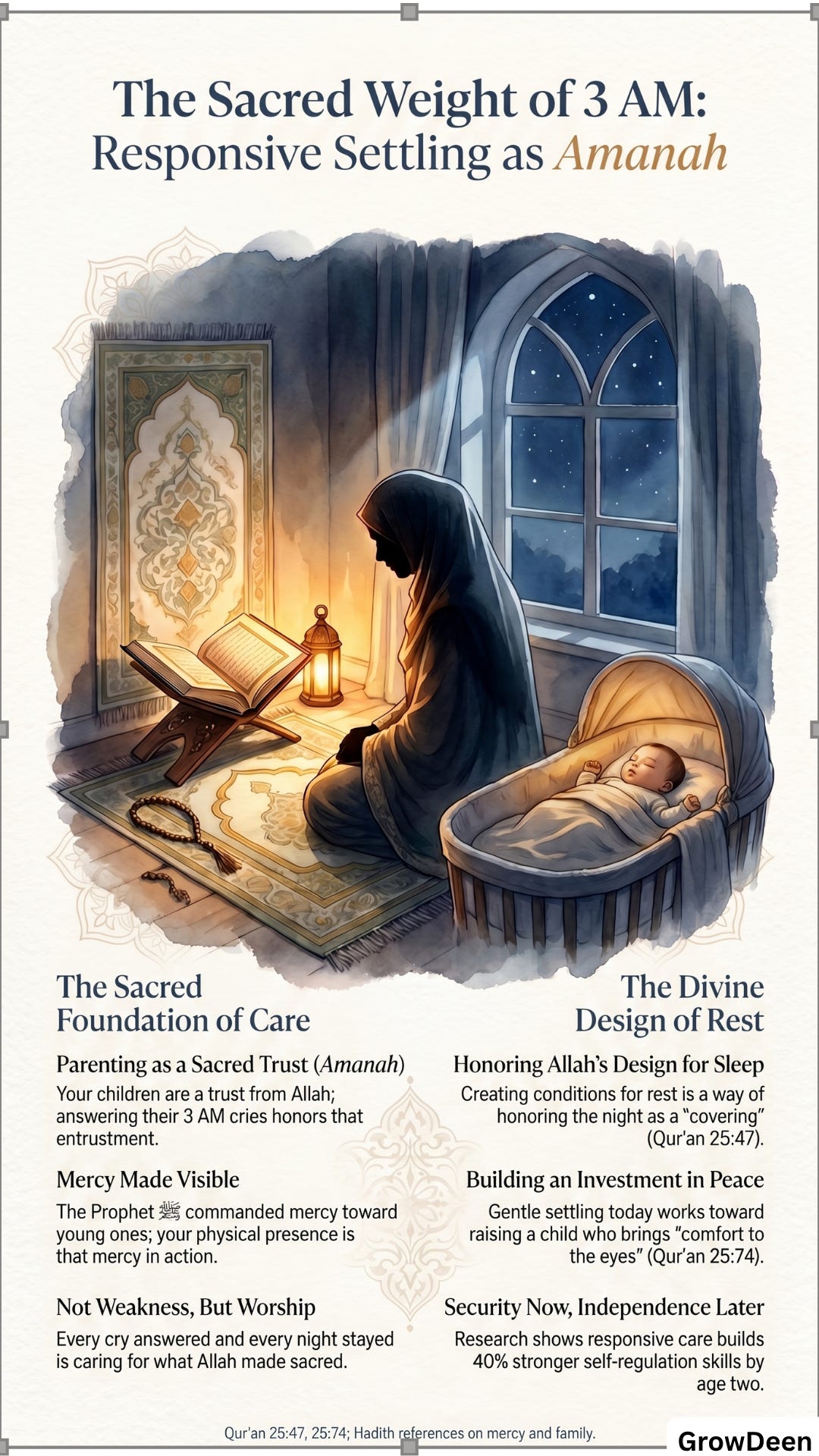
Allah placed these tiny humans in our care as amanah—a trust. The Qur’an says in Surah Ar-Rum: “And among His signs is that He created for you mates that you may find tranquility in them, and He placed between you affection and mercy.” [13]
That same mercy extends to our children. Answering a cry isn’t weakness. It’s obedience to what our fitrah (natural disposition) already knows: love is presence. Presence is what grows a child whole.
You’re not spoiling your baby by holding them. You’re building the foundation for every relationship they’ll ever have—the internal working model that says: when I need help, help comes. When I’m afraid, I’m not alone.
Responsive settling is slow work. It doesn’t produce tidy sleep schedules. Your baby might still wake three times a night at five months. And that’s normal. That’s development.
What it does produce: a nervous system that learns to regulate through connection with you. A baby who doesn’t have to shut down their distress to survive the night. A child who grows knowing, deep in their bones, that they are safe.
The Companion Pack: Your 2 AM Lifeline
If you’ve read this far, you’re the kind of parent who takes this seriously—not as paranoia, but as protective love. That tells me something beautiful about you.
Inside the Responsive Settling Quick Reference Card (one printable PDF, 2 pages):
Page 1: The Three Methods at a Glance—Settling in arms, hands-on settling, and verbal reassurance with step-by-step reminders you can scan in 15 seconds. Designed like a laminated card you can keep by the cot.
Page 2: Troubleshooting Guide—What to do when nothing works, tired signs to watch for, safe sleep checklist, and a gentle reminder that stepping away when you’re overwhelmed is wisdom, not failure.
This isn’t just a PDF to download and forget. It’s a tool designed to stay where you need it—by the changing table, taped to the wall, saved on your phone—so when exhaustion hits and you can’t think straight, the answer is right there.
This Quick Reference Card is what every GrowDeen subscriber receives with each article. We cover the full journey of raising Muslim children, all backed by research and rooted in Islamic wisdom.
If you’re a Muslim parent who wants both evidence-based guidance and spiritual grounding, subscribe for free so future resources arrive before you need them.
You’ll receive one article when it’s ready—no daily emails, no clutter, just guidance when there’s something worth sharing.
Before you close this: take one moment tonight. The next time your baby cries, pause before you reach for them. Notice what you feel. That pull toward them? That instinct to comfort? Trust it.
Allah designed you to respond. You’re not getting it wrong.
May Allah grant you ease in the exhaustion, patience in the long nights, and barakah in the small, sacred work of answering a cry.
Share This With One Parent Who Needs It
Think of one person right now: the new mother at the masjid whose baby only sleeps in her arms and she’s wondering if she’s doing it wrong. Your sister who’s Googling “cry it out method” at 4 AM because someone told her that’s what works. The friend whose exhausted texts reveal the same guilt you carried last month.
This article could ease their burden. Share it with them today—not as advice-giving, but as companionship. Sometimes the most loving thing we can do is pass along what finally helped us breathe easier.
Frequently Asked Questions
Q: How long should I hold my baby before putting them down? A: Hold them until their breathing deepens and their body fully relaxes—usually 5-15 minutes after they seem asleep. When you lower them and they don’t startle awake, that’s your sign. For more detail, see “Settling in Arms” above.
Q: Is it normal for my 4-month-old to still wake multiple times a night? A: Yes. Most babies under 6 months wake 2-4 times nightly for feeds and comfort. [9] “Sleeping through the night” is not the developmental norm for this age. Your baby is not behind.
Q: Will responsive settling prevent my baby from learning to self-settle later? A: No—research shows the opposite. Babies who receive consistent responsive care develop stronger self-regulation skills by age 2. [1] Security now builds independence later.
Q: What if my baby only settles while nursing or bottle-feeding? A: This is common and developmentally normal in the first 6 months. Sucking is soothing, and the closeness meets their attachment needs. As they grow, you can gradually introduce other settling methods alongside feeding.
Q: My baby cries every time I put them down. Am I doing something wrong? A: No. Some babies have higher contact needs than others, especially in the first 3 months. This is temperament, not failure. Try hands-on settling as a bridge, or hold them longer before the transfer.
Q: When can I expect my baby to sleep through the night? A: Most babies aren’t developmentally ready until 6-12 months, and many continue night waking beyond that. [9] Every baby is different. Focus on building healthy sleep associations now rather than forcing independence too early.
References
[1] Mindell, J.A., Leichman, E.S., DuMond, C., & Sadeh, A. (2017). Sleep and social-emotional development in infants and toddlers. Journal of Clinical Child & Adolescent Psychology, 46(2), 236-246.
[2] Blunden, S., Osborn, J., & King, Y. (2022). Do responsive methods of improving sleep reduce stress in mother/infant dyads compared to extinction interventions? A pilot study. Archives of Women’s Mental Health, 25, 621-631.
[3] Marshall, J. (2011). Infant neurosensory development: Considerations for infant child care. Early Childhood Education Journal, 39(3), 175-181.
[4] Blunden, S., Osborn, J., & King, Y. (2022). Do responsive methods of improving sleep reduce stress in mother/infant dyads compared to extinction interventions? Archives of Women’s Mental Health, 25, 621-631.
[5] Sunan al-Tirmidhi 1919 (Hasan)
[6] Moon, R.Y., Carlin, R.F., & Hand, I. (2022). Sleep-Related Infant Deaths: Updated 2022 Recommendations for Reducing Infant Deaths in the Sleep Environment. Pediatrics, 150(1), e2022057990.
[7] Voltaire, S.T., & Teti, D.M. (2018). Early nighttime parental interventions and infant sleep regulation across the first year. Sleep Medicine, 52, 107-115.
[8] Turk-Browne, N.B., Scholl, B.J., & Chun, M.M. (2008). Babies and brains: Habituation in infant cognition and functional neuroimaging. Frontiers in Human Neuroscience, 2, 16.
[9] Hiscock, H., Cook, F., Bayer, J., Le, H.N., Mensah, F., Cann, W., Symon, B., & St James-Roberts, I. (2014). Preventing early infant sleep and crying problems and postnatal depression: A randomized trial. Pediatrics, 133(2), 346-354.
[10] Moon, R.Y., Carlin, R.F., & Hand, I. (2022). Sleep-Related Infant Deaths: Updated 2022 Recommendations. Pediatrics, 150(1), e2022057990.
[11] Qur’an, Surah Al-Furqan 25:47
[12] Sahih al-Bukhari 6114
[13] Qur’an, Surah Ar-Rum 30:21