

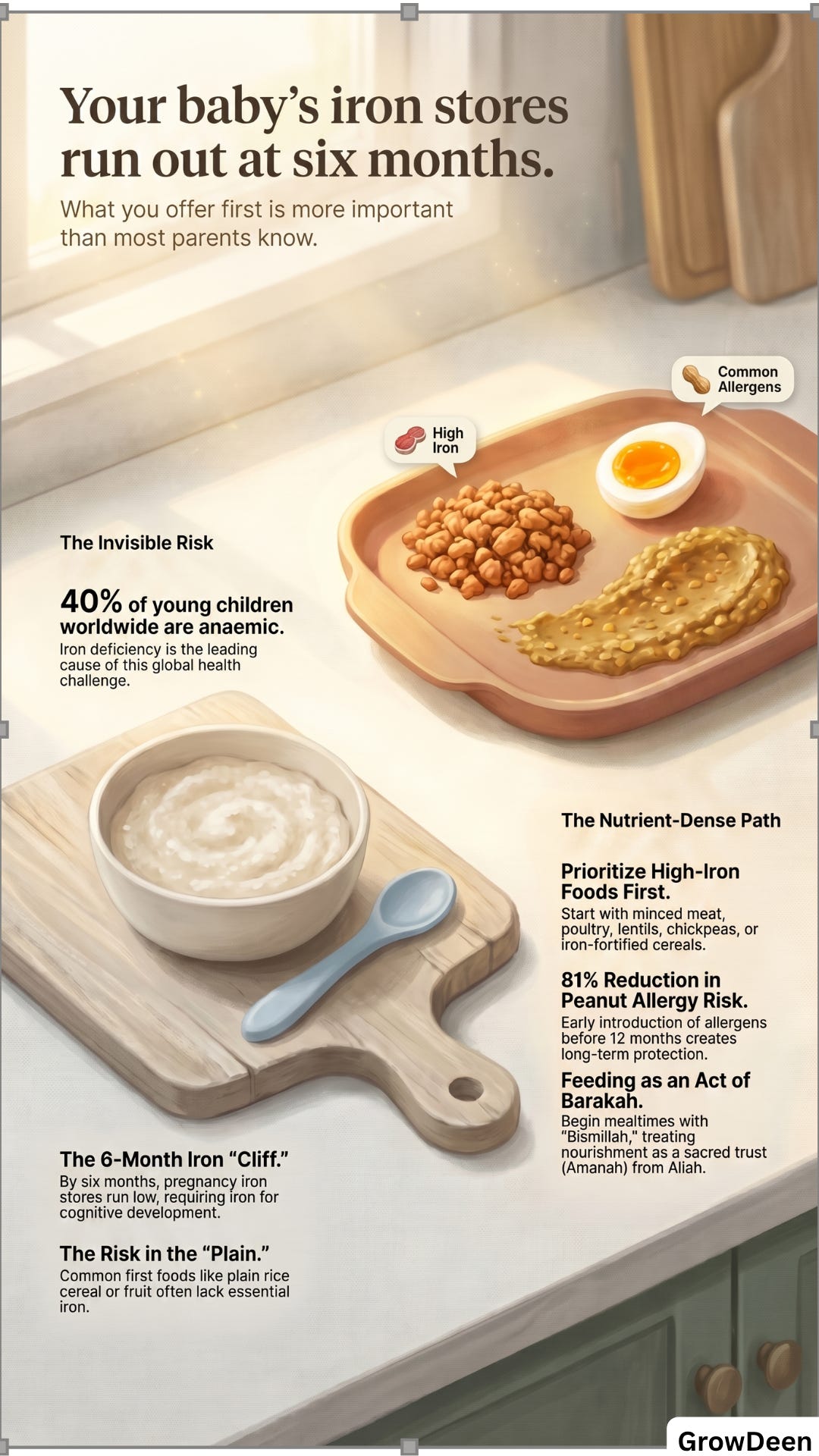
The WHO estimates that 40% of children aged 6–59 months worldwide are anaemic and iron deficiency is the leading cause. [1] Meanwhile, the landmark LEAP study found that early allergen introduction can reduce peanut allergy risk by 81%. [2] This guide shows you exactly which foods to offer first, when to introduce allergens, and how to make mealtimes an act of barakah.
Here is something that surprised me when I first looked into this: the order of your baby’s first foods matters more than most parents think.
It is not really about purees versus baby-led weaning. It is not about whether you start with carrots or sweet potato. The thing that actually changes outcomes for your baby’s health? Starting with iron-rich foods from day one — and introducing allergens early, not late.
I know. That second one probably goes against what you have heard. It went against what I had heard too.
But here is what the research shows: when I studied the WHO’s 2021 global anaemia data, the number was hard to ignore — roughly 40% of young children worldwide are affected by anaemia, and iron deficiency is the primary driver. [1] At the same time, the LEAP trial demonstrated that early introduction of peanut products reduced allergy risk by 81%. [2] These are not small numbers. They change how we think about first foods entirely.
If you are a Muslim parent who wants to get this right — with both science and barakah on your side — keep reading.
Why This Guide Is Different From Generic Feeding Advice
Research-backed, not opinion-based. Every recommendation draws from the ESPGHAN (2017), AAP (2024), WHO, and the landmark LEAP allergy study — not parenting blogs or outdated guidelines. [1][2][3]
Islamic framework woven in. This is not just about nutrients. It is about feeding your baby as an act of amanah, beginning with Bismillah and grounded in gratitude for what Allah has placed in the earth. [5]
A free companion pack designed for real life. You will get a printable Starting Solids Companion Pack — a first foods tracker, allergen introduction log, and mealtime du’a card — tools that save you time instead of adding to your mental load.
When Is Your Baby Ready for Solids?
Most babies show signs of readiness around six months. The AAP recommends exclusive breastfeeding for six months, then gradual introduction of complementary foods. [3]
Look for these signs: good head and neck control, sitting upright with support, interest in food, and the loss of the tongue-thrust reflex. Do not start before four months — your baby’s gut is not ready yet. [4]
And if your baby is five and a half months and reaching for your plate? Or six and a half months and not interested? Both are normal. Trust the signs your baby gives you. Take the means and place your trust in Allah — tawakkul and effort together.
Which Foods Should Come First? (This Is Where Most Parents Go Wrong)
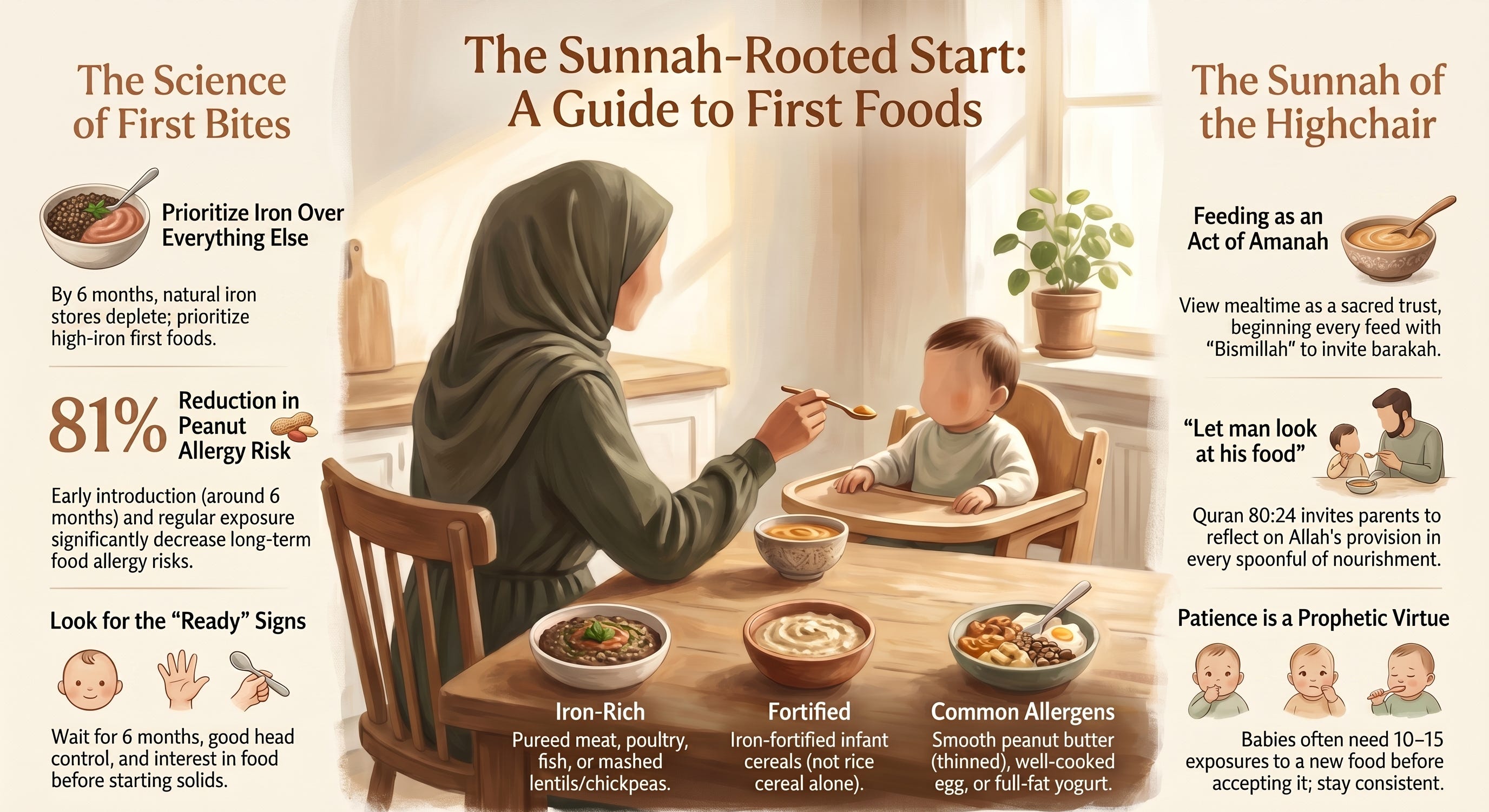
Iron-rich foods should be your baby’s very first solids. Not fruit. Not rice cereal alone. Iron.
By six months, your baby’s iron stores from pregnancy are running low. [3] Their growing brain needs iron now — it is essential for cognitive development and immune function. [1]
Start with these:
Pureed or minced meat, poultry, or fish
Iron-fortified infant cereal
Cooked and mashed lentils, chickpeas, or beans
Well-cooked egg (mashed, not runny)
Then add vegetables, fruits, grains, and full-fat dairy. The AAP confirms there is no required order beyond prioritising iron. [3][6]
Here is something else that helps: babies often need 10 to 15 exposures to a new food before they accept it. [4] So if your baby makes a face at broccoli on day one, do not give up. Keep offering. Patience is part of the process.
How to Introduce Allergens Safely (And Why Earlier Is Better)
This is the part that changed how I think about first foods.
For years, parents were told to delay allergenic foods. The research now shows the opposite. The LEAP study found an 81% reduction in peanut allergy when peanut products were introduced before 12 months and consumed regularly. [2] Follow-up data showed this protection lasts into adolescence. [7]
Introduce these from around six months:
Smooth peanut butter mixed into puree (never whole peanuts)
Well-cooked egg
Wheat-based foods (bread, roti, pasta, naan)
Full-fat yoghurt and cheese
Soy products like tofu
Fish
Introduce one allergen at a time, a few days apart. Once introduced without reaction, keep it in the diet regularly. [2][8]
If your baby has severe eczema or a family history of food allergy, speak with your doctor or allergist first.
I know this is a lot to keep track of — especially when your baby is six months old and you are running on broken sleep. That is exactly why I created the free Starting Solids Companion Pack — a printable guide with a first foods tracker, allergen introduction log, and mealtime du’a card. Keep reading to get it at the end of this article.
The Sacred Trust of Feeding Your Child: What the Qur’an and Sunnah Teach About Food
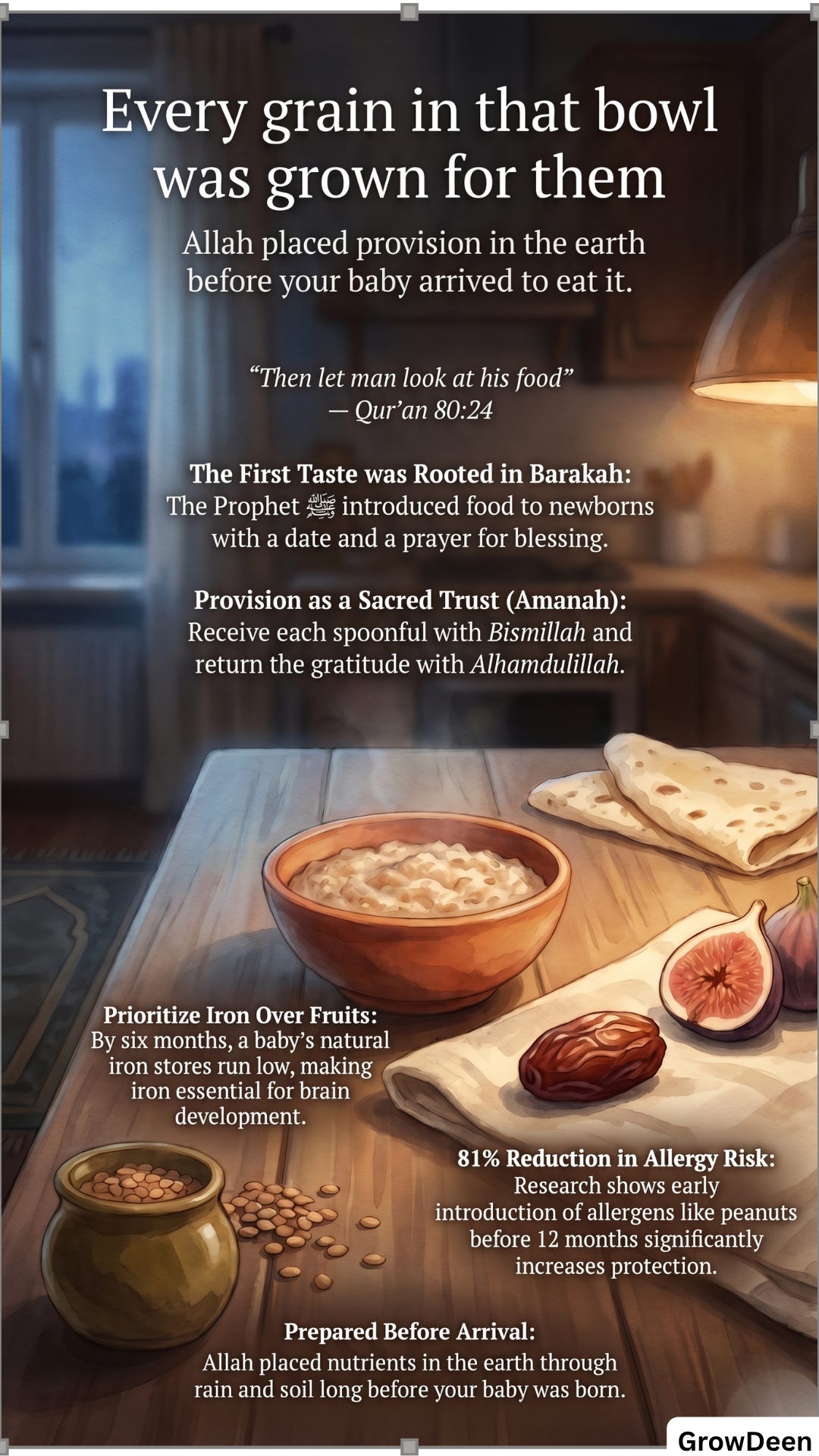
When I think about introducing solids, I keep returning to a passage in the Qur’an: “Then let man look at his food — how We poured down water in torrents, then split the earth in clefts, and caused grain to grow therein, and grapes and fresh vegetation, and olives and dates, and fruits and fodder — provision for you.” [Quran 80:24–32] [5]
According to Tafsir Ibn Kathir, this passage invites us not just to eat, but to reflect — to see the chain of mercy behind every grain and fruit. [9] When you place that first spoonful of mashed pumpkin on your baby’s tongue, you are introducing them to what Allah has grown from the earth for their nourishment.
And the Prophet ﷺ himself modelled this. When Abu Musa brought his newborn son, the Prophet ﷺ “named him Ibrahim, did tahnik for him with a date, invoked Allah to bless him, and returned him to me.” [Sahih al-Bukhari 5467] [10] The Prophetic way of introducing food to a child began with du’a for barakah. Every feed can begin the same way.
Your Baby’s First Solids Companion Pack
If you have read this far, you are the kind of parent who does not just wing it — you want to get this right, with both knowledge and intention. That already says something beautiful about you.
Inside the Starting Solids Companion Pack (one comprehensive PDF, 3 pages):
Page 1: First Foods Quick-Start Guide — A visual reference showing exactly which iron-rich foods to start with, what textures to offer at 6, 8, and 12 months, and a month-by-month meal progression chart — designed as a fridge-door reference you will use daily.
Page 2: Allergen Introduction Tracker — A simple one-page log where you record each allergen introduced, the date, and any reactions — so you never lose track of what your baby has tried. Includes the 7 common allergens with safe serving suggestions.
Page 3: Bismillah at the Highchair — Islamic Mealtime Routine for Babies — The Sunnah of tahnik, the du’a before eating (Bismillah), the du’a for drinking milk (Allahumma barik lana fihi wa zidna minhu), and the du’a after eating — with full Arabic, transliteration, and translation. Plus a simple 3-step Islamic mealtime routine you can start today.
This is not a PDF you download and forget. It is a tool designed for your kitchen wall, your phone, and the moments when you need a quick answer at the highchair.
This Starting Solids Companion Pack is what every subscriber receives with each article. We cover the full journey of raising Muslim children — from newborns to school-age — all backed by research and rooted in Islamic wisdom.
If you are a Muslim parent who wants evidence-based guidance with Islamic perspective, subscribe for free so future resources arrive in your inbox before you need them.
You will only hear from us when there is something valuable to share — no spam, no daily emails, just resources that matter.
One Small Action
Before your next feed — whether milk or solids — say Bismillah out loud. Just once. Your baby hears it. And that is how the habit begins.
May Allah bless your family’s table, nourish your children with what is pure and wholesome, and accept every messy, exhausted, loving effort you make at that highchair. Ameen.
Think of one person right now: a friend whose baby is approaching six months and does not know where to start, a sister-in-law who has been asking about first foods, a mother at the masjid who mentioned she is confused about when to introduce allergens.
This guide could give them clarity at exactly the right moment. Share it with them today — not as advice-giving, but as care. Sometimes the most loving thing we can do is pass along what we wish someone had shared with us.
Frequently Asked Questions
Q: Can I start solids before 6 months?
A: Not before 4 months — your baby’s digestive system is not ready yet. [4] Between 4 and 6 months, watch for the developmental signs I described above. Most babies hit them around 6 months, but speak with your doctor if you are unsure.
Q: What is the best first food for my baby?
A: An iron-rich food — pureed meat, iron-fortified cereal, or mashed lentils. Not fruit, not rice cereal alone. [3] Iron is what your baby’s brain needs most at this stage.
Q: Do I need to give my baby water when they start solids?
A: From 6 months, you can offer small sips of cooled boiled water in a cup at mealtimes. [3] But breastmilk or formula still provides most of their hydration until 12 months.
Q: Should I avoid giving my baby peanut butter?
A: The opposite. Current guidelines recommend introducing smooth peanut butter (mixed into puree) from around 6 months. The LEAP study showed this reduces peanut allergy risk by 81%. [2] If your baby has severe eczema, check with your doctor first.
Q: How many times should I offer a food before giving up?
A: Research suggests babies need 10 to 15 exposures to a new food before accepting it. [4] That first face of disgust does not mean they hate it — it means it is new. Keep offering gently without pressure.
Q: Is honey safe for babies?
A: No — never before 12 months. Honey can contain bacteria that cause infant botulism, which is dangerous for young babies. [4] Wait until after their first birthday.
References
[1] World Health Organization (WHO). (2021). Anaemia in children aged 6–59 months: Global prevalence estimates. WHO Global Health Observatory. https://www.who.int/data/gho/data/indicators/indicator-details/GHO/prevalence-of-anaemia-in-children-under-5-years-(-)
[2] Du Toit, G., Roberts, G., Sayre, P.H., et al. (2015). Randomized trial of peanut consumption in infants at risk for peanut allergy. The New England Journal of Medicine, 372(9), 803–813. https://doi.org/10.1056/NEJMoa1414850
[3] American Academy of Pediatrics (AAP). (2024). Starting solid foods. HealthyChildren.org. https://www.healthychildren.org/English/ages-stages/baby/feeding-nutrition/Pages/Starting-Solid-Foods.aspx
[4] Fewtrell, M., Bronsky, J., Campoy, C., et al. (2017). Complementary feeding: A position paper by ESPGHAN. Journal of Pediatric Gastroenterology and Nutrition, 64(1), 119–132. https://doi.org/10.1097/MPG.0000000000001454
[5] The Noble Qur’an. Verses cited: Quran 80:24–32 (Surah ‘Abasa — Allah’s provision of food from the earth).
[6] U.S. Department of Agriculture & U.S. Department of Health and Human Services. (2020). Dietary Guidelines for Americans, 2020–2025. 9th Edition.
https://www.dietaryguidelines.gov
[7] Du Toit, G., et al. (2024). Early peanut introduction for allergy prevention: Follow-up to adolescence. NEJM Evidence. DOI: 10.1056/EVIDoa2300311
[8] Togias, A., Cooper, S.F., Acebal, M.L., et al. (2017). Addendum guidelines for the prevention of peanut allergy in the United States. World Allergy Organization Journal, 10(1), 1–18. https://doi.org/10.1186/s40413-016-0137-9
[9] Tafsir Ibn Kathir, commentary on Surah ‘Abasa (80), verses 24–32.
[10] Sahih al-Bukhari 5467. Narrated by Abu Musa al-Ash’ari. Graded Sahih. Verified at Sunnah.com: https://sunnah.com/bukhari:5467
[11] Coulthard, H., Harris, G., & Emmett, P. (2009). Delayed introduction of lumpy foods affects food acceptance at 7 years. Maternal & Child Nutrition, 5(1), 75–85. https://doi.org/10.1111/j.1740-8709.2008.00153.x