

The WHO 2005 report on diarrhoea treatment put a number to it that I haven’t been able to shake: globally, diarrhoea kills over 500,000 children under five every year and in nearly every case, the cause of death is not the illness itself. It’s dehydration. [1] This guide shows you what to actually watch for, what to do in the first 24 hours, and how Islam frames the act of caring for a sick child — with a free printable companion pack at the end.
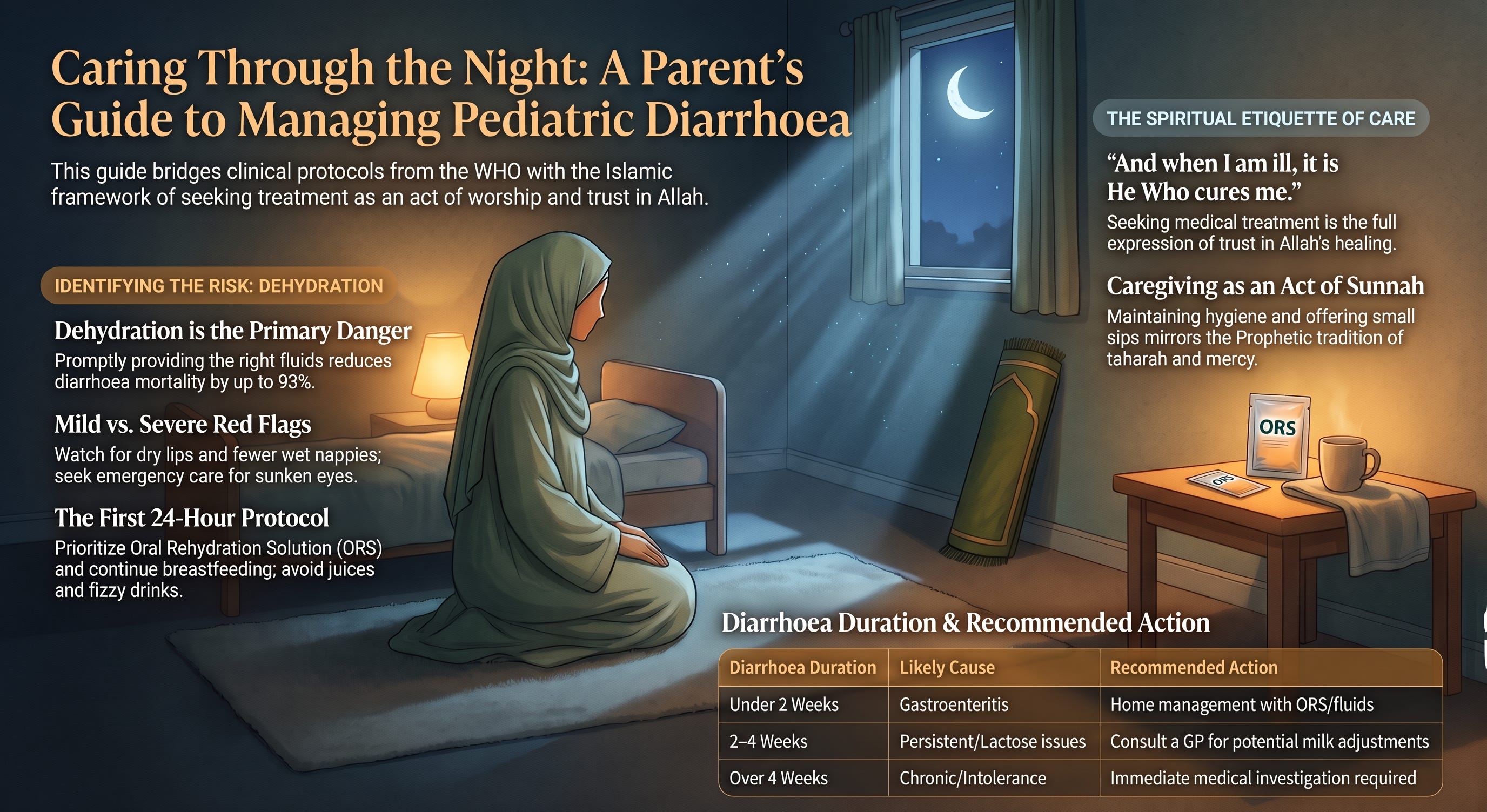
Most parents, when their child gets diarrhoea, are worried about the wrong thing.
The diarrhoea isn’t the danger. Loose, frequent stools are unpleasant. They’re exhausting. They come at inconvenient times and they smell terrible. But they don’t cause harm on their own. What causes harm is what happens alongside them — the quiet, invisible loss of fluids and salts that the body depends on.
That’s the thing to watch for.
Dehydration can move fast in young children, especially infants. And the early signs are easy to miss when you’re tired and managing a sick toddler at 3 AM.
I’m not sharing this to frighten you. I’m sharing it because once you know what to look for, this becomes manageable. The data backs that up: when children are given the right fluids promptly, diarrhoea mortality drops by up to 93%. [2] That’s an enormous number for something as simple as giving the right liquid at the right time.
Why This Guide Is Different From Generic Diarrhoea Advice
Research-backed, not generic: Every recommendation comes from WHO, AAP, and Royal Children’s Hospital clinical guidelines — not outdated “rice water” advice you might find in parenting forums.
Islam woven in, not bolted on: This guide connects the prophetic framework of seeking treatment and trusting in Allah to the practical steps you’re already taking — because these aren’t separate things.
The companion pack does the heavy lifting: You’ll get a free printable Sick Child Companion Pack at the end — a 3-page PDF with a dehydration signs checklist, a when-to-call-the-doctor guide, and an Islamic adab card for caring for a sick child.
First: What Diarrhoea Actually Is (And When Duration Matters)
Diarrhoea means stools that are significantly looser, more watery, or more frequent than normal — four or more times a day, or noticeably different from your child’s usual pattern. [3]
Here’s the piece most parents don’t know: the length of the illness tells you more than the severity.
Short-term diarrhoea (under 2 weeks) is almost always gastroenteritis — a gut infection from a virus, bacteria, or parasite. It usually passes on its own. [4]
Persistent diarrhoea (2–4 weeks) sometimes follows a stomach bug. The gut lining, still healing, temporarily struggles to digest lactose. Your doctor may suggest lactose-free milk during this period. [5]
Chronic diarrhoea (over 4 weeks) warrants investigation. It could point to food intolerance, coeliac disease, irritable bowel syndrome, or a parasitic infection like Giardia. [6]
And then there’s toddler’s diarrhoea — a category of its own. Some young children have frequent loose stools with no identifiable cause, yet they grow and develop perfectly normally. No treatment is needed; reassurance usually is. [7]
But in every case, the management principle is the same: fluids, fluids, fluids.
What Dehydration Actually Looks Like
Children under five worldwide experience an average of three diarrhoeal episodes per year. [1] In most cases, they lose fluid faster than they’re taking it in. Your job is to spot the early signs before they become serious.
Watch for these signs of mild to moderate dehydration:
Fewer wet nappies or trips to the bathroom than usual
Dry lips and tongue
No tears when crying
More tired or quieter than normal
These are the signs that mean go now — hospital, not GP:
No urination for many hours
Sunken eyes
Cold hands and feet
Extremely pale, grey, or mottled skin
Difficult to rouse or unusually drowsy
Rapid breathing [1]
Severe dehydration in a young child can move from ‘concerning’ to ‘critical’ quickly. Do not wait. Trust your gut.
What to Do at Home: The Essentials
Give the right fluid — not just any fluid
Water alone doesn’t replace the salts and electrolytes lost through diarrhoea. Oral rehydration solution (ORS) — available as sachets from any pharmacy — is specifically designed to restore both. It is the WHO-recommended first-line treatment for diarrhoeal fluid loss in children, and the evidence behind it is some of the strongest in paediatric medicine. [2]
Offer small sips frequently, especially if your child is also vomiting.
If you’re breastfeeding, keep going. Breast milk gives your baby hydration and immune support simultaneously — do not stop during illness. [8]
Avoid fruit juice, cordials, and fizzy drinks. They can make diarrhoea worse, not better. [9]
Food: don’t overthink it
Your child may not feel hungry. That’s normal for a day or so. But don’t withhold food for more than 24 hours — there’s no evidence that fasting during diarrhoea helps, and it delays recovery. [10] When they’re ready, offer what they usually eat.
On anti-diarrhoea medicines
Here’s something that surprises a lot of parents: over-the-counter anti-diarrhoea medications are not recommended for children. The evidence for benefit is weak; the potential for harm is not. [11] Always ask your pharmacist or doctor before giving any medication to a child with diarrhoea.
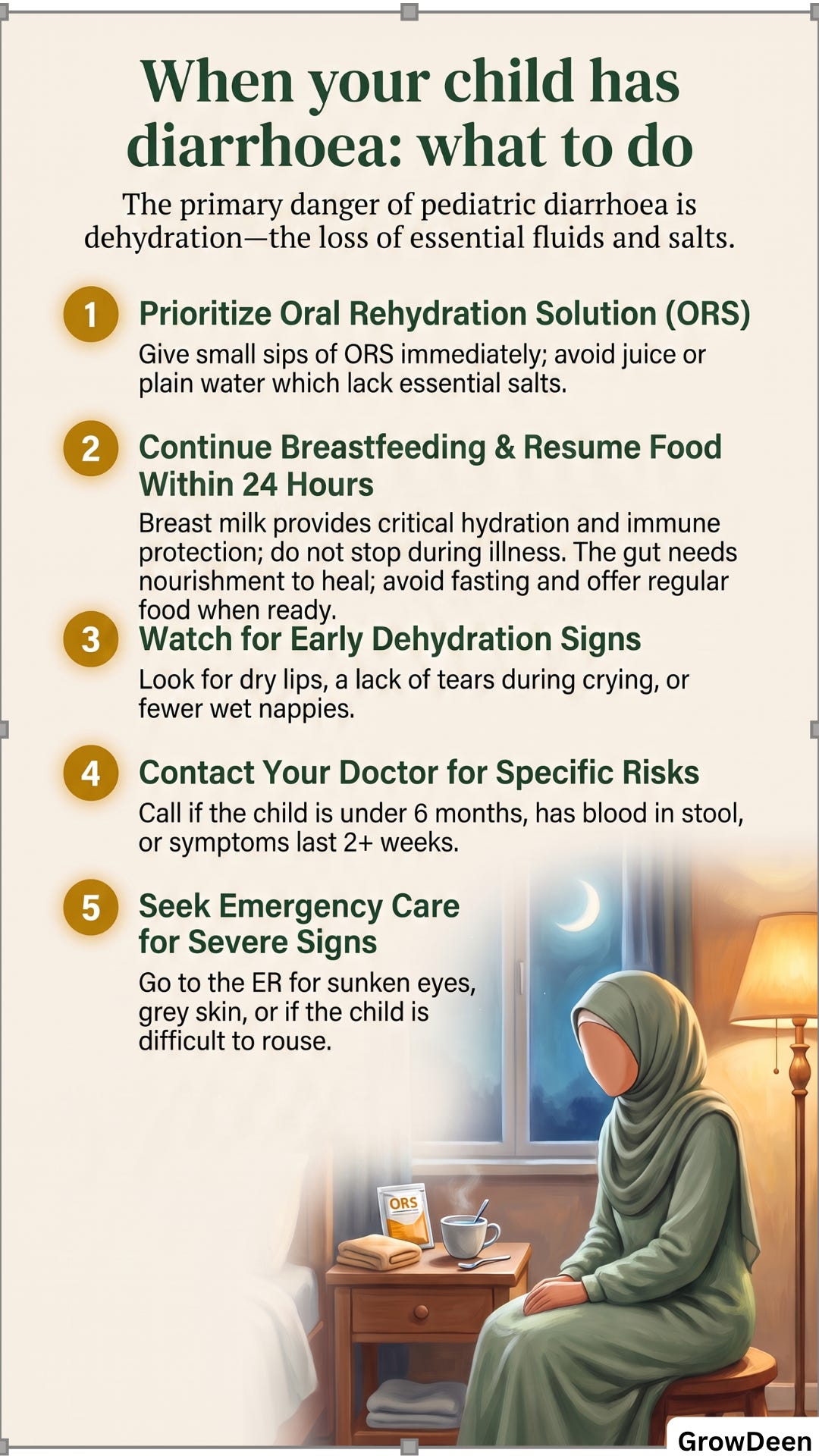
🗂 Before the end of this article, I want to give you something practical.
I know that absorbing all of this while managing a sick child is a lot. That’s exactly why I’ve created a free Sick Child Companion Pack — a 3-page printable PDF with a dehydration signs card, a when-to-call-the-doctor guide, and an Islamic adab card for caring for a sick child with Sunnah-rooted intention. Keep reading — it’s at the end of this article, ready for you to download.
Support Muslim Parenting Lab ❤️
Would you like one parent, somewhere, to be guided because of you? Fund the articles that reach them, with the button below.
The Prophet ﷺ said one person guided through you is better for you than red camels, the greatest wealth of that time. (Sahih al-Bukhari 3701)
When to Call the Doctor (And When to Go to Emergency)
Call your doctor or paediatrician if:
Your child is under 6 months old with diarrhoea (always — don’t wait)
Diarrhoea has lasted more than 2 weeks
There is blood in the stool
Your child is losing weight
Go to emergency immediately if:
Your child cannot keep any fluids down and has severe stomach pain
They are unusually drowsy, difficult to rouse, or appear very unwell
Any signs of severe dehydration are present
Skin is pale, grey, or mottled [4]
You know your child better than any checklist. If something feels wrong, that matters.
What Islam Teaches Us About Caring for a Sick Child
There is something in the way Islam frames illness that I find quietly steadying.
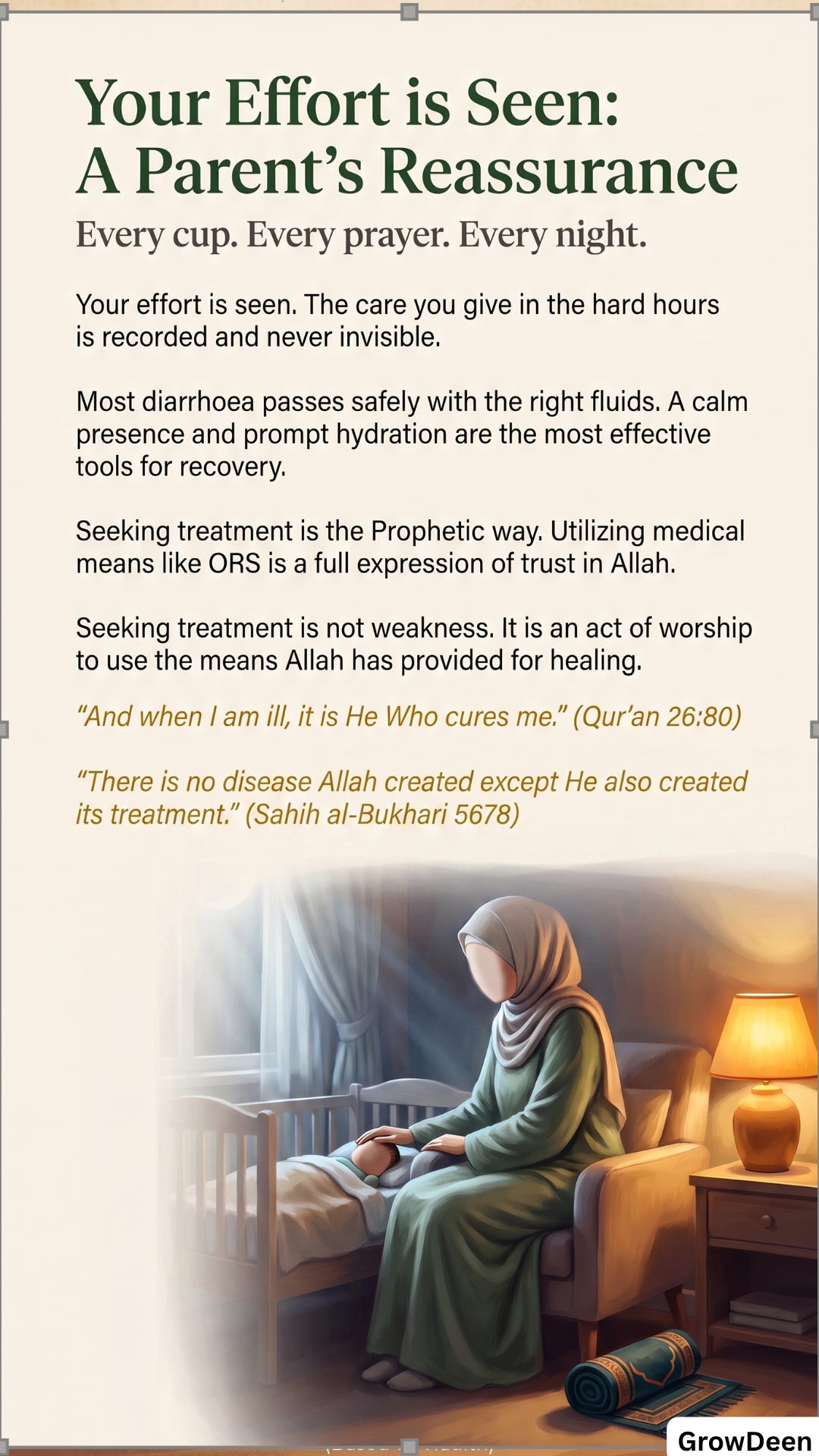
When Prophet Ibrahim ﷺ described his relationship with Allah, he said: “And when I am ill, it is He Who cures me.” [Qur’an 26:80] [12] According to Tafsir Ibn Kathir, this verse carries a beautiful piece of Islamic etiquette — Ibrahim attributed the illness to himself, while attributing the cure entirely to Allah, including through “the means that may lead to recovery.” The medicine, the ORS, the paediatrician — these are the means. Allah is the One who heals through them.
The Prophet ﷺ confirmed this directly: “There is no disease that Allah has created, except that He also has created its treatment.” [Sahih al-Bukhari 5678] [13] Seeking that treatment — researching it, giving ORS at 3 AM, calling the doctor — is not a failure of tawakkul. It’s the full expression of it.
And the handwashing that infection control recommends? It mirrors the Sunnah of taharah perfectly. When we teach our children to wash their hands as part of their Islamic adab, we are building a habit that protects their bodies and their deen — inseparable, as they were always meant to be.
Your Micro-Action
Go check your medicine cupboard right now. Do you have ORS sachets? If not, put them on your shopping list today. You don’t want to be looking for them at midnight when your child is already unwell.
Closing
May Allah grant your children swift healing, grant you the patience to care for them through the hard nights, and make every act of care you give — every sip of ORS, every worried prayer — a means of reward and barakah. Ameen.
Share This With Someone Who Needs It
Think of one person right now: the new mother in your WhatsApp group who just posted that her baby has been sick for three days, the sister whose toddler has been in and out of illness this winter, the friend who asked you just this week what she should be giving her child for a stomach bug.
This guide could give her clarity when she’s exhausted and worried. Share it with her today — not as advice-giving, but as care. Sometimes the most loving thing we can do is pass on what we know.
The Sick Child Companion Pack — Download Now
If you read this far, you’re the kind of parent who takes their child’s health seriously, not as anxiety, but as love. That tells me something about you.
Inside the Sick Child Companion Pack (one PDF, 3 pages):
Page 1: Dehydration Signs Reference Card — A clear, colour-coded visual showing mild, moderate, and severe dehydration signs at a glance — designed as a laminated card you can stick inside your medicine cupboard door, so it’s right there when you need it most and not buried in a browser tab.
Page 2: When to Call the Doctor — A Decision Guide — A simple yes/no flowchart: “My child has diarrhoea → What to check first → When to call → When to go to emergency.” No more second-guessing at midnight — just clear, calm guidance designed to cut through the panic.
Page 3: Islamic Adab for Caring for a Sick Child — A beautiful, printable tarbiyah card covering five Sunnah-rooted practices parents can embody and model when their child is unwell: saying Bismillah before giving medicine, making du’a while holding your child, the adab of reciting Qur’an in the sick room, the practice of taharah during illness, and the Prophetic teaching on patience and reward. Anchored by Qur’an 26:80 and Sahih al-Bukhari 5678 — authenticated references you can trust.
This isn’t a PDF to download and forget. It’s designed to live inside your medicine cupboard, where it will actually be useful.
This Sick Child Companion Pack is what every subscriber at Muslim Parenting Lab receives with each article. We cover the full journey of raising Muslim children — newborn health, child development, Islamic lifestyle, and everything in between — backed by peer-reviewed research and rooted in authentic Islamic guidance.
Frequently Asked Questions
Q: How do I know if my child is dehydrated?
A: The early signs are fewer wet nappies or trips to the bathroom, dry lips, no tears when crying, and being more tired than usual. If your child has sunken eyes, cold hands and feet, very pale or grey skin, or is unusually drowsy and hard to rouse — that’s severe dehydration and needs emergency care immediately. For the full sign-by-sign breakdown, see “What Dehydration Actually Looks Like” above.
Q: What should I give my child to drink when they have diarrhoea?
A: Oral rehydration solution (ORS) from a pharmacy is the best option — it replaces both fluid and electrolytes. [2] Plain water alone doesn’t replenish the salts lost through diarrhoea. Avoid juice, cordials, and fizzy drinks — they can worsen symptoms. [9] If you’re breastfeeding, keep going without stopping.
Q: Should I stop feeding my child solid food when they have diarrhoea?
A: Not for long. A day of reduced appetite is normal, but don’t withhold food for more than 24 hours. Current evidence doesn’t support prolonged fasting during diarrhoeal illness. [10] Offer whatever they feel like eating when they’re ready — there’s no need to restrict to “bland” foods.
Q: When should I take my child to hospital for diarrhoea?
A: Go immediately if your child shows signs of severe dehydration (sunken eyes, cold extremities, grey skin, extreme drowsiness), cannot keep any fluids down with severe stomach pain, or appears very unwell. For children under 6 months, always see a doctor promptly for any episode of diarrhoea — don’t wait. See “When to Call the Doctor” above for the full guide.
Q: Can I give my child anti-diarrhoea medicine from the pharmacy?
A: Generally, no — not without checking with a doctor or pharmacist first. Over-the-counter anti-diarrhoea medications are not recommended for children, as the evidence for their effectiveness is weak and there are potential risks in young children. [11] Ask your pharmacist before giving anything.
Q: How long does diarrhoea in children normally last?
A: Short-term diarrhoea from a stomach bug usually resolves within 1–2 days and is fully gone by 2 weeks. [4] If diarrhoea continues beyond 2 weeks, see a doctor — this moves into ‘persistent’ territory and may need investigation. Anything beyond 4 weeks is chronic diarrhoea and definitely needs medical assessment.
References
[1] World Health Organization. (2005). The Treatment of Diarrhoea: A Manual for Physicians and Other Senior Health Workers (4th rev. edn). WHO. https://www.who.int/publications/i/item/9241593180
[2] Atia, A.N., & Buchman, A.L. (2009). Oral rehydration solutions in non-cholera diarrhea: A review. American Journal of Gastroenterology, 104(10), 2596–2604. https://doi.org/10.1038/ajg.2009.329
[3] Viegelmann, G.C., Dorji, J., Guo, X., & Lim, H.Y. (2021). Approach to diarrhoeal disorders in children. Singapore Medical Journal, 62(12), 623–629. https://doi.org/10.11622/smedj.2021234
[4] Kotloff, K. (2019). Acute gastroenteritis in children. In R. Kliegman et al. (Eds), Nelson Textbook of Paediatrics (21st edn, pp. 2012–2033). Elsevier.
[5] Hardikar, W., Bannister, L., & Gibb, S. (2020). Gastroenterology. In K. Harding, D. Mason & D. Efron (Eds), Paediatric Handbook (10th edn, pp. 253–267). Wiley-Blackwell.
[6] Shankar, S., & Rosenbaum, J. (2020). Chronic diarrhoea in children: A practical algorithm-based approach. Journal of Paediatrics and Child Health, 56(7), 1029–1038. https://doi.org/10.1111/jpc.14986
[7] Shankar & Rosenbaum, 2020 [see ref. 6].
[8] World Health Organization. (2022). Breastfeeding: Key Facts. WHO. https://www.who.int/news-room/fact-sheets/detail/breastfeeding
[9] American Academy of Pediatrics. (2017). Fruit juice in infants, children, and adolescents: Current recommendations. Pediatrics, 139(6). https://doi.org/10.1542/peds.2017-0967
[10] Brumbaugh, D. et al. (2022). Gastrointestinal tract. In M. Bunk et al. (Eds), Current Diagnosis and Treatment: Pediatrics (26th edn, Chapter 21). McGraw-Hill Education.
[11] The Royal Children’s Hospital Melbourne. (2020). Clinical Practice Guidelines: Gastroenteritis. https://www.rch.org.au/clinicalguide/guideline_index/Gastroenteritis/
[12] Qur’an, Surah Ash-Shu’ara 26:80. Tafsir Ibn Kathir — verified via quran.com. https://quran.com/26/80
[13] Sahih al-Bukhari 5678 — Graded: Sahih. https://sunnah.com/bukhari:5678
We combine scientific research with Qur’an and authentic Sunnah, and we cite our sources. Even so, this is general guidance and no substitute for a doctor who can examine your child.