

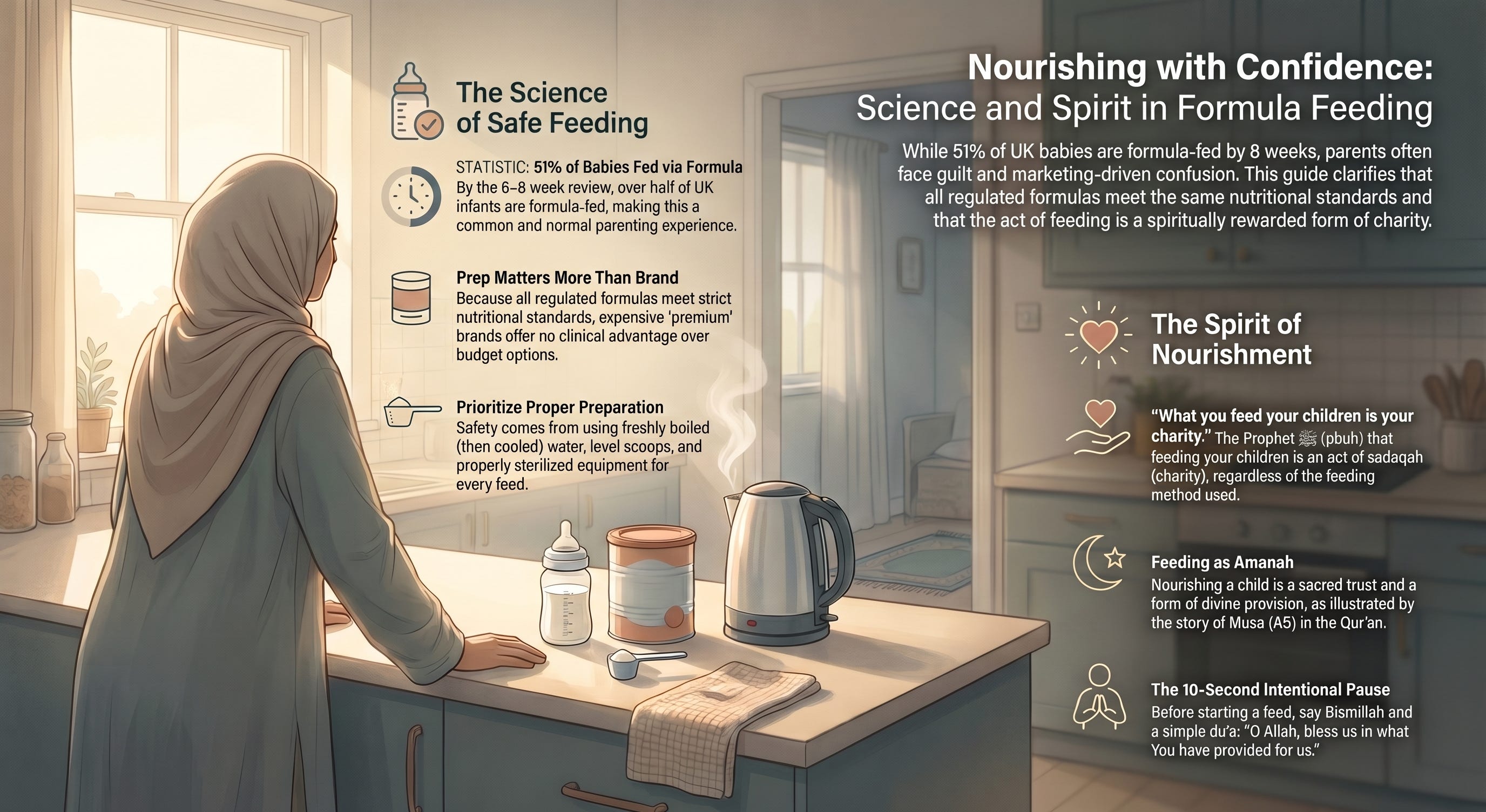
51% of babies in the UK are formula-fed by 6–8 weeks of age yet most parents still feel uncertain about whether they’ve chosen the “right” brand. [1] This guide cuts through the marketing noise and shows you what actually matters when feeding your baby formula safely.
Here’s something that might surprise you.
The formula you’re spending twice as much on? Nutritionally, it’s almost certainly identical to the one half the price sitting next to it on the shelf. I know that feels counterintuitive — because the packaging is different, the claims are louder, and that premium price tag feels like evidence of something real.
It isn’t.
When I studied the Australian NHMRC’s infant feeding guidelines alongside the research on formula marketing, what struck me was how consistently the evidence said the same thing: every regulated commercial formula meets strict nutritional standards and is safe for healthy babies. [2] The premium brands aren’t better. They’re just louder.
And if you’re feeding your baby formula right now, you already belong to a much larger community than you might think. According to Public Health Scotland’s 2023/24 data, 51% of babies are formula-fed by their 6–8 week review. [1] You’re not doing something unusual. You’re doing something millions of parents do every single day and doing it thoughtfully already means more than any brand on the tin.
Why This Guide Is Different From Generic Formula Advice
It’s built on current evidence, not marketing claims. Every recommendation here comes from peer-reviewed research and major paediatric health organisations — not formula company literature. [2, 3]
It integrates Islamic wisdom alongside the science. This isn’t just a feeding guide — it’s a reminder that feeding your baby is an act of amanah, one the Prophet ﷺ called sadaqah in his own words.
You’ll get a free Formula Feeding Confidence Pack — a 3-page PDF with a formula comparison guide, a safe preparation checklist, and authenticated du’as for feeding time — the practical tools to keep on your phone or kitchen counter.
The One Thing That Actually Matters: Preparation, Not Brand
Here’s the thing most formula guides don’t say clearly enough.
The brand matters far less than how you prepare it.
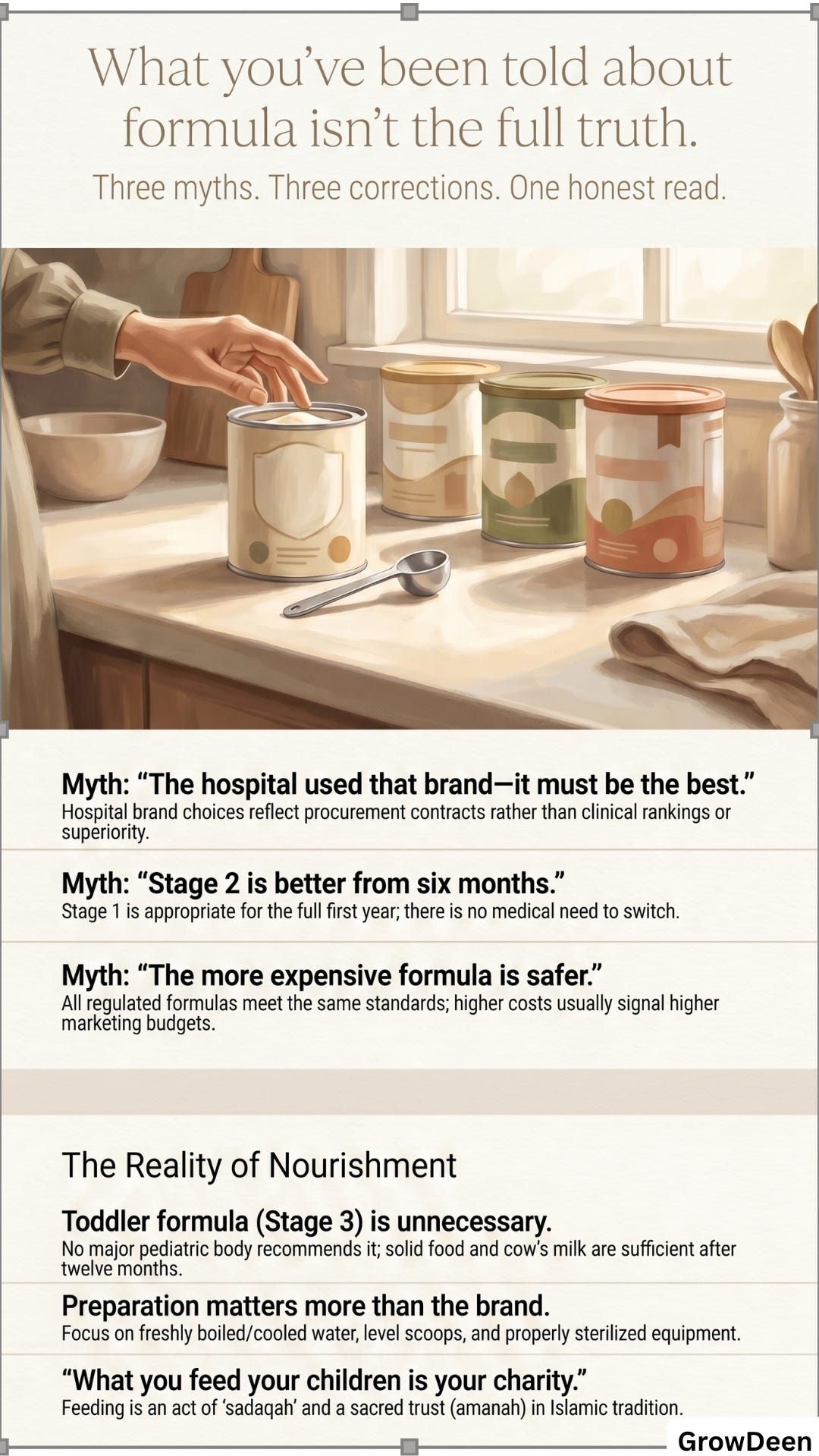
All regulated cow’s milk-based formulas contain the nutritional building blocks babies need — protein adjusted for infant kidneys, vitamins, minerals, essential fats. [2] What varies is the marketing. A hospital using a particular brand isn’t endorsing it clinically; it reflects procurement agreements. [3] An extra ingredient on the label doesn’t mean it functions in your baby’s body the way it would in breastmilk. [4]
What does make a real difference? Using freshly boiled water that’s cooled to the right temperature. Measuring scoops accurately — one level scoop, not heaped. Sterilising equipment properly. Preparing feeds just before you need them. These things matter. The logo on the tin, for a healthy baby, does not.
Stage 1 or Stage 2 — Do You Actually Need to Switch?
No. And I wish someone had said this more directly.
Stage 1 formula is nutritionally appropriate from birth through twelve months. Stage 2, marketed from six months onward, is not superior. The NHMRC and paediatric health organisations are consistent on this: there is no medical need to change from Stage 1 at any point in the first year. [2]
Stage 2 exists because formula companies can market it. That’s essentially it.
If you’ve been using Stage 1 and your baby is growing well, tolerating feeds, and developing normally — stay where you are.
When You Actually Need a Special Formula
Most babies never need one. But for a small number of infants, standard cow’s milk-based formula isn’t appropriate and when that’s the case, a doctor’s assessment comes first. Always. [5]
Cow’s milk protein allergy: If your baby has a confirmed diagnosis, an extensively hydrolysed formula is what doctors recommend when breastfeeding isn’t possible. Partially hydrolysed “HA” formulas are not the same thing — they’re not suitable for confirmed allergy. [5]
Reflux: Prethickened anti-reflux formulas exist, but they shouldn’t be the first response to a baby who spits up. Almost all babies spit up — it’s developmental, not a formula problem. If reflux is genuinely affecting weight gain or comfort, speak with your doctor before switching anything. [6]
Homemade formula: a hard no. Bone broth, raw milk, evaporated milk, condensed milk — none of these are safe substitutes. [2] They lack the precise nutritional balance infants require and can cause real harm.
I know this is a lot to hold onto — especially at 3am when you’re measuring scoops with one eye open. That’s exactly why I put together the free Formula Feeding Confidence Pack — a printable 3-page PDF covering formula types, safe preparation steps, and du’as for feeding time. Keep reading to download it at the end of this article.
What the Prophet ﷺ Taught About Feeding Your Children
I want to sit with this for a moment, because I think it changes something.
There’s a hadith narrated by Al-Miqdam ibn Ma’di Karib in which the Prophet ﷺ said:
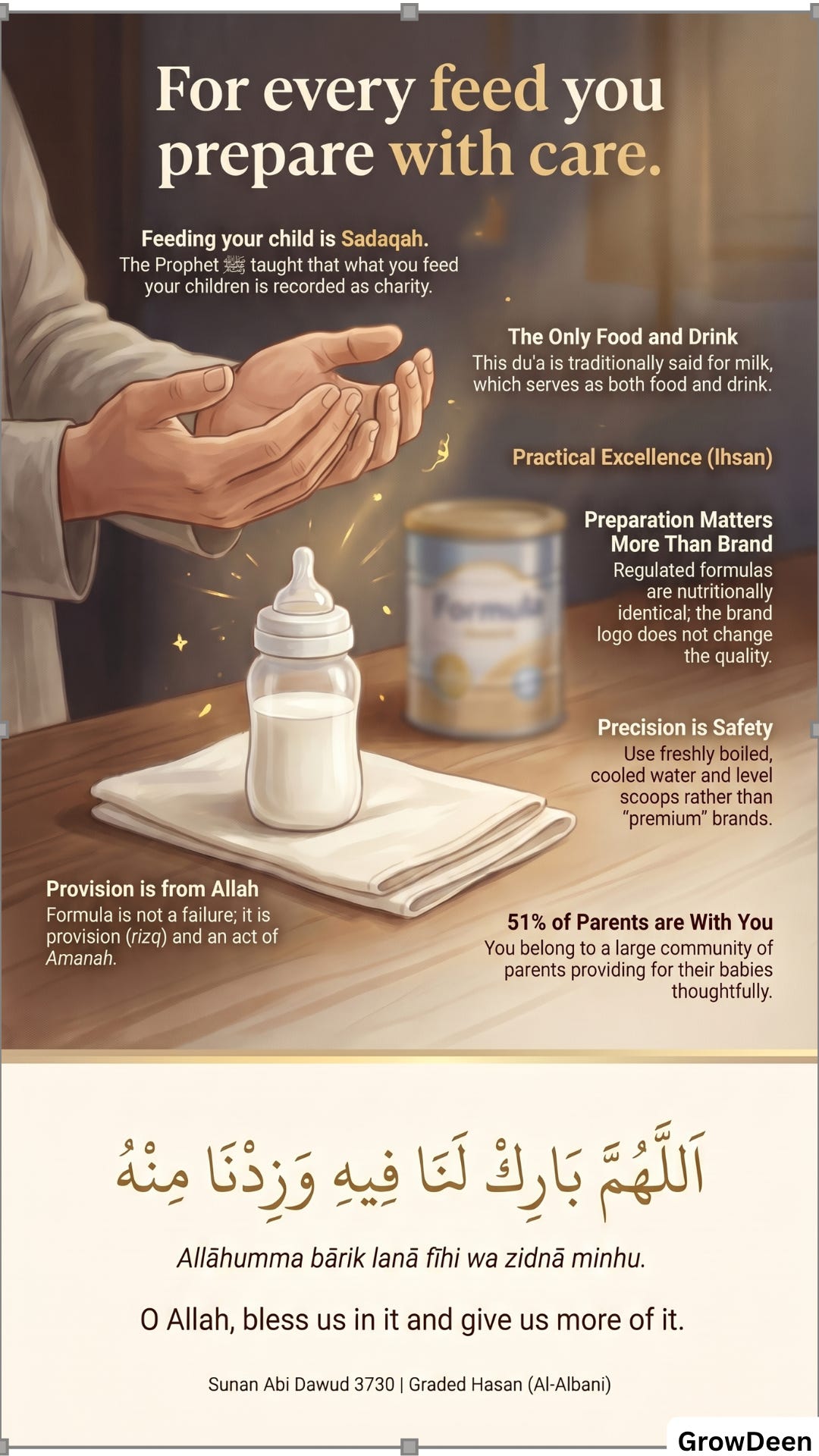
“What you feed yourself is your charity, what you feed your children is your charity, what you feed your wife is your charity.” [Al-Adab al-Mufrad, 82 — Graded Sahih by Al-Albani] [7]
He called it sadaqah. Not metaphorically — the same word used for charity given to those in need. Every bottle you prepare, every feed you offer — he said that counts.
There’s also something deeply consoling in a Qur’anic story for parents whose feeding journey looked different from what they imagined. In Surah Al-Qasas, the infant Musa (peace be upon him) refused every wet nurse brought to him — by divine arrangement — until he was returned to his own mother. Ibn Kathir explains this in his tafsir: it was Allah’s way of ensuring the child received the nourishment Allah had designated for him. [8]
“And We had already forbidden foster suckling mothers for him, until she said: Shall I direct you to a household who will rear him for you, and look after him in a good manner?” [Qur’an 28:12] [8]
The nourishment of a child is not outside Allah’s sight. The alternative, the workaround, the imperfect arrangement that still works — these are not failures. They are provision.
Say Bismillah before every feed. That’s enough.
After Twelve Months: Formula Stays on the Shelf
At twelve months, formula’s job is done.
Toddler formula — Stage 3 — is a marketing category, not a nutritional one. No major paediatric health body recommends it. [2] Once a child has completed their first year, nutrition should come primarily from a varied diet of solid food, with full-fat cow’s milk as a drink from that point.
Start transitioning to an open cup from around six months. Aim to retire the bottle once the first year is complete — it also supports healthy dental development.
📄 The Formula Feeding Confidence Pack — Your Free Resource
If you’ve read this far, you’re the kind of parent who takes your baby’s feeding seriously — not with anxiety, but with care. That tells me something beautiful about you.
Inside the Formula Feeding Confidence Pack (one comprehensive PDF, 3 pages):
Page 1: Formula Type Comparison Guide — A clean, neutral comparison table covering Standard Cow’s Milk, HA/Partially Hydrolysed, Extensively Hydrolysed, and Soy-Based formulas — with clear columns showing what each formula is for, who it suits, and who it does not suit. Includes a footer note confirming that Stage 1 is appropriate from birth through 12 months and that no paediatric body recommends Stage 2 or toddler formula. Designed to be screenshotted and kept on your phone, or printed and kept in a kitchen drawer — so you’re never standing confused in the formula aisle again.
Page 2: Safe Formula Preparation Checklist — An 8-step visual checklist with tick boxes and brief “Why this matters” notes under the most critical steps — covering hand-washing, water temperature, correct scoop measurement, sealing and cooling, and safe storage times. Includes a warning strip at the bottom: never use boiling water directly on powder, and never use bottled mineral water. Designed to be laminated and stuck inside a kitchen cupboard door, or saved as a phone lock-screen image for night feeds.
Page 3: Du’as for Feeding Time — Two authenticated prophetic supplications with Arabic text, transliteration, English translation, and verified hadith sources. Du’a 1 is Bismillah — to say before every feed (Sunan Abi Dawud 3767, graded Sahih). Du’a 2 is the specific du’a the Prophet ﷺ taught for milk: Allāhumma bārik lanā fīhi wa zidnā minhu — to say after every feed (Sunan Ibn Majah 3322, graded Hasan). The Prophet ﷺ said this is the only food or drink that serves as both nourishment and drink — so this is the only food supplication where we ask for more of the same, not something better. Ready to screenshot and use immediately.
This isn’t just a PDF to download and forget. It’s a tool designed to stay on your phone or your kitchen counter — where you’ll actually use it when you need it most, including at 3am.
This Formula Feeding Confidence Pack is what every subscriber receives with each article. MPL covers the full arc of raising Muslim children — from newborns through school age — weaving current medical research with authentic Islamic guidance. If that’s the kind of support you want in your inbox, subscribe for free.
Subscribe free for parenting resources backed by both science and Sunnah — guidance so unique you literally can’t get it anywhere else. No spam, no noise, just resources that matter.
Your Micro-Action for Tonight
Next time you prepare a feed, pause for 10 seconds before you start. Check: is your water freshly boiled and cooled? Is your scoop level, not heaped? Is the bottle properly sterilised?
That’s it. That’s the whole practice. The brand in your hand is already fine.
A Closing Du’a
Allāhumma bārik lanā fīhi wa zidnā minhu. O Allah, bless us in it and give us more of it.
Say this over your baby’s bottle. Say it when you’re exhausted at 3am. Say it when the formula tin feels like evidence of something you got wrong.
It isn’t.
Share This With Someone Who Needs It
Think of one person right now: a new mother in your family who confessed she feels guilty about formula feeding, a pregnant sister who’s anxious about what she’ll do if breastfeeding doesn’t work, a friend whose WhatsApp messages have been full of formula brand comparisons at midnight.
This article could ease that weight. Share it with them today — not as advice, but as reassurance. Sometimes the most caring thing we can do is pass on knowledge that replaces guilt with clarity.
Frequently Asked Questions
Q: Is expensive formula better for my baby than a cheaper brand? A: No — every regulated formula on the shelf meets the same nutritional standards. [2] Price reflects marketing budgets, not nutritional quality. For the full breakdown, see “The One Thing That Actually Matters” above.
Q: Can I switch from Stage 1 to Stage 2 formula at 6 months? A: You can, but there’s no medical reason to. Stage 1 is nutritionally appropriate for the full first year, and no paediatric health organisation recommends switching. [2] If your baby is doing well on Stage 1, stay with it.
Q: How long can I keep a prepared formula bottle before throwing it out? A: Prepared formula should be used within 2 hours at room temperature, or within 24 hours if stored in the back of the refrigerator. [9] Never reheat a bottle your baby has already drunk from.
Q: My baby seems gassy and unsettled — should I switch formula? A: Not automatically. Gas and unsettledness in the first few months are very common regardless of feeding method — they’re often related to your baby’s developing digestive system, not the formula itself. Speak with your doctor before changing brands. [2] Switching frequently can make things harder, not easier.
Q: Is soy formula safe for babies? A: Soy formula is considered safe when there’s a genuine medical or religious reason to avoid cow’s milk-based products, but it should only be used under medical supervision. [10] It does not reduce allergy risk and is not a general first choice for healthy babies.
Q: When should I stop formula and move to cow’s milk? A: Formula is not needed once a baby has completed their first twelve months. From that point, full-fat cow’s milk is an appropriate drink alongside a varied diet of solid foods. Toddler formula is not recommended by paediatric health organisations — it’s a marketing product, not a medical one. [2]
References
[1] Public Health Scotland. (2024). Infant feeding statistics: Financial year 2023 to 2024. https://publichealthscotland.scot/publications/infant-feeding-statistics/infant-feeding-statistics-financial-year-2023-to-2024/
[2] National Health and Medical Research Council (NHMRC). (2012). Infant Feeding Guidelines: Information for Health Workers. NHMRC. https://www.nhmrc.gov.au/about-us/publications/infant-feeding-guidelines-information-health-workers
[3] Belamarich, P.F., Bochner, R.E., & Racine, A.D. (2016). A critical review of the marketing claims of infant formula products in the United States. Clinical Pediatrics, 55(5), 437–442. https://doi.org/10.1177/0009922815589913
[4] Jasani, B., Simmer, K., Patole, S.K., & Rao, S.C. (2017). Long chain polyunsaturated fatty acid supplementation in infants born at term. Cochrane Database of Systematic Reviews 2017, 3, CD000376. https://doi.org/10.1002/14651858.CD000376.pub4
[5] Australasian Society of Clinical Immunology and Allergy (ASCIA). (2020). Infant Feeding and Allergy Prevention Clinical Update. ASCIA. https://www.allergy.org.au/hp/papers/infant-feeding-and-allergy-prevention-clinical-update
[6] Kwok, T.C., Ojha, S., & Dorling, J. (2017). Feed thickener for infants up to six months of age with gastro-oesophageal reflux. Cochrane Database of Systematic Reviews 2017, 12, CD003211. https://doi.org/10.1002/14651858.CD003211.pub2
[7] Al-Miqdam ibn Ma’di Karib reported: The Messenger of Allah ﷺ said, “What you feed yourself is your charity, what you feed your children is your charity, what you feed your wife is your charity.” Al-Adab al-Mufrad lil-Bukhari, Hadith 82. Graded Sahih by Al-Albani. https://sunnah.com/adab:82
[8] Qur’an, Surah Al-Qasas (28:12). Ibn Kathir. Tafsir Ibn Kathir, commentary on Surah Al-Qasas, verses 7–13.
[9] Centers for Disease Control and Prevention (CDC). (2024). How to prepare and store powdered infant formula. https://www.cdc.gov/nutrition/infantandtoddlernutrition/formula-feeding/preparing-formula.html
[10] Vandenplas, Y., Castrellon, P.G., Rivas, R., Gutiérrez, C.J., Garcia, L.D., Jimenez, J.E., Anzo, A., Hegar, B., & Alarcon, P. (2014). Safety of soya-based infant formulas in children. British Journal of Nutrition, 111(8), 1340–1360. https://doi.org/10.1017/S0007114513003942