

Grapes rank third among foods that fatally choke children under 5 (Archives of Disease in Childhood, 2017). [15] A 2016 randomized trial in Pediatrics found 35% of babies gagged or choked between six and eight months, whatever the feeding method. [1] Here are the six cuts that change the odds.
A grape is not a dangerous food.
A whole grape is a dangerous shape. So is a coin of sausage, a stick of raw carrot, and a spoonful of nut butter lifted straight from the jar.
You already know grapes get cut. Almost every parent does. What far fewer know is why, and that gap is where the trouble starts, because a rule you have memorised only protects you from the foods on the list. It does nothing for the thousand foods that are not.
Look at the number in that subtitle again. In the BLISS trial, researchers tracked 206 babies and found that 35% gagged or choked at least once between six and eight months, and the rate was statistically indistinguishable between babies who fed themselves and babies who were spoon fed. [1] The feeding method was never the variable.
Something else was.
And here is the question worth carrying through the rest of this article: why do the same two or three foods keep appearing in serious choking reports when every one of them is a food paediatricians actively recommend? The answer is not about the foods at all, and once you see it, you will never look at a chopping board the same way.
Why This Guide Is Different
Built on the actual trial data, not the fear. The BLISS randomised controlled trial (Pediatrics, 2016) and twenty years of ALSPAC follow-up data sit underneath every recommendation here. [1][4][5]
Rooted in the Sunnah of the table. Eating with the hands is how the Prophet ﷺ ate, and there is adab attached to doing it well. [11]
A free Safe Shapes Companion Pack. A printable cutting card and a gag-versus-choke identifier you can stick inside a kitchen cupboard door, so the answer is where the decision actually happens.
What Actually Blocks a Child’s Airway
Picture the moment you dread. Your child in the highchair, a piece of something in their fist, and the sudden silence.
That silence is the clue, and it points straight at the mechanism.
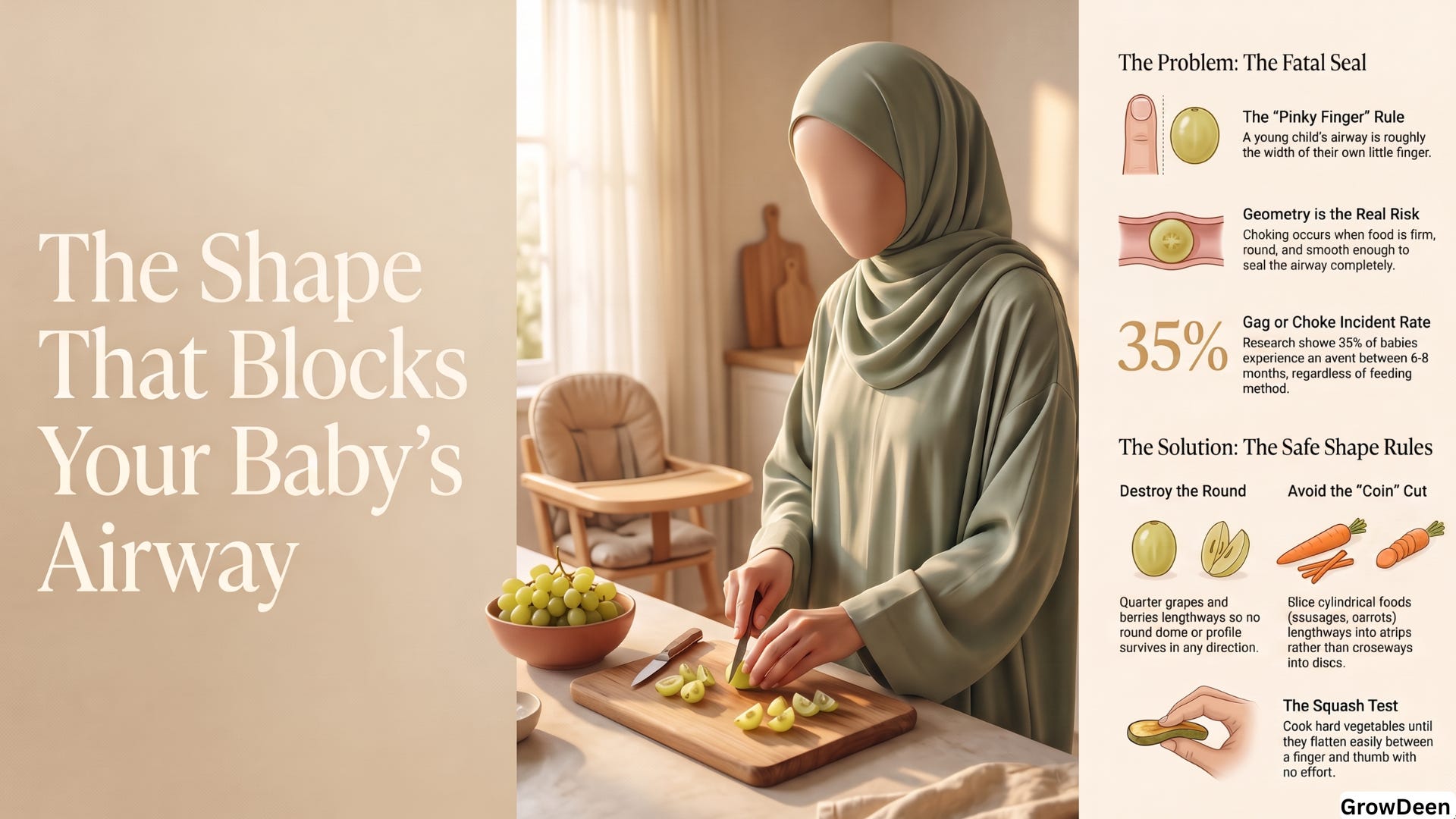
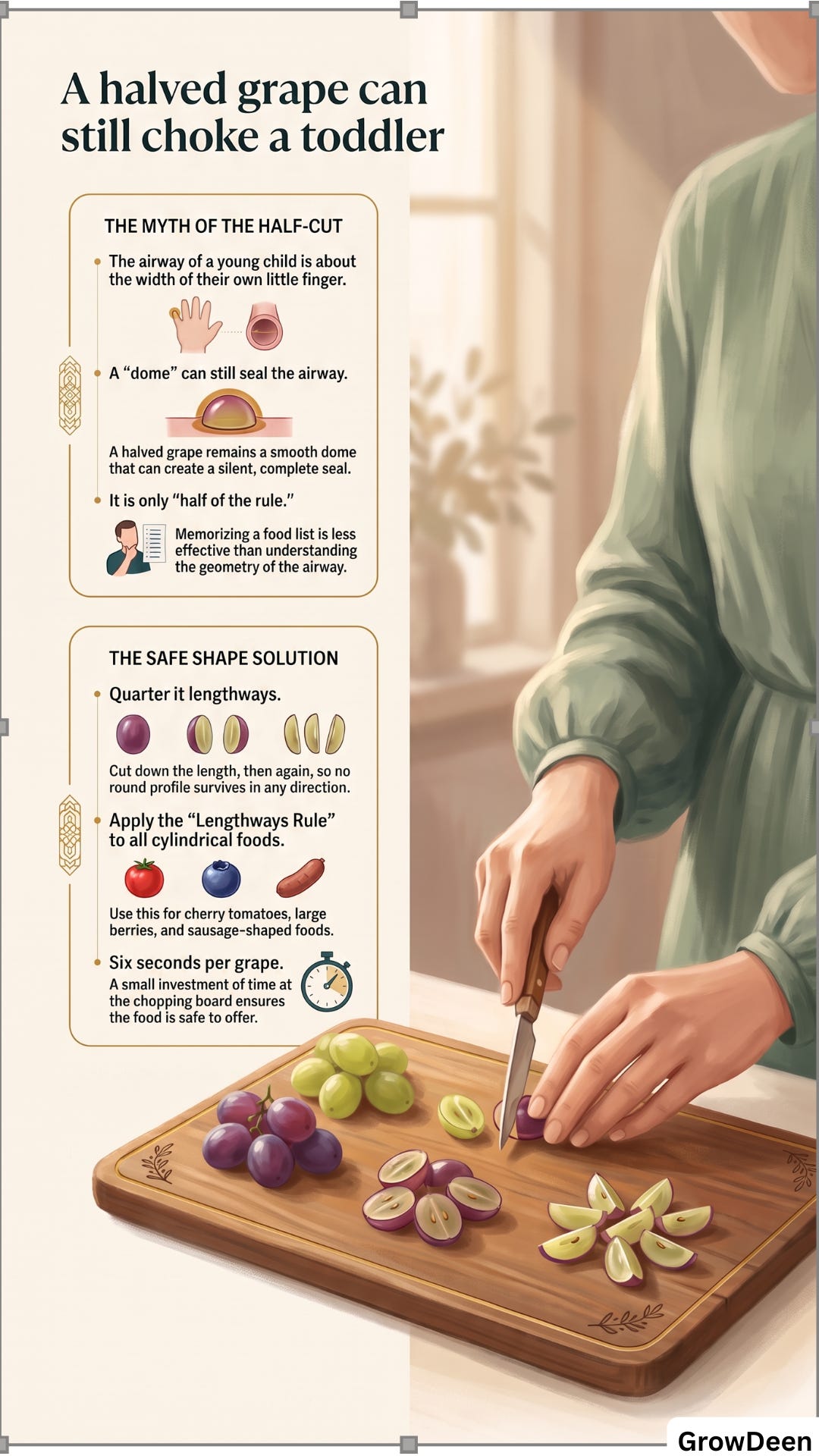
A young child’s airway is roughly the width of their own little finger. A piece of food becomes dangerous when it is close to that width, firm enough to hold its form under pressure, and round or smooth enough to seal the opening completely rather than partially. [2] A partial block still lets air past. A complete seal does not, and that is why choking is silent.
None of this is theoretical. Food accounts for more than half of all fatal choking incidents in children under five, and grapes rank third among the foods responsible, behind hot dogs and sweets. [15] The physicians who documented that finding also explain why a grape is so hard to recover once it is in: its smooth surface forms a tight seal against the airway wall, and removing it usually requires specialist equipment that is almost never on hand while ordinary first aid is being attempted. [15] Of the three children whose cases they describe, two died. Both had been eating whole grapes.
Now run the recommended-foods list through that filter.
A whole grape is almost exactly airway width, firm, smooth, and round. A slice of sausage cut crossways is a perfect disc of the same diameter. A stick of raw carrot is hard enough that a child with four teeth cannot break it down. Popcorn is irregular and light enough to be inhaled. A lump of nut butter is sticky enough to cling.
Every one of these is a food a dietitian would happily recommend. Geometry is what they share.
Paediatric guidance names the same high risk group consistently: whole grapes and small round fruit, nuts and seeds, popcorn, hard raw vegetables, hard sweets, sticky confectionery, and any cylindrical food left in coin shaped slices. [2][3] Read that list again and notice how many of them stop being dangerous the moment somebody picks up a knife.
The Six Cuts
Here is the practical core of this article. Six preparation rules that cover almost every food a young child will meet.
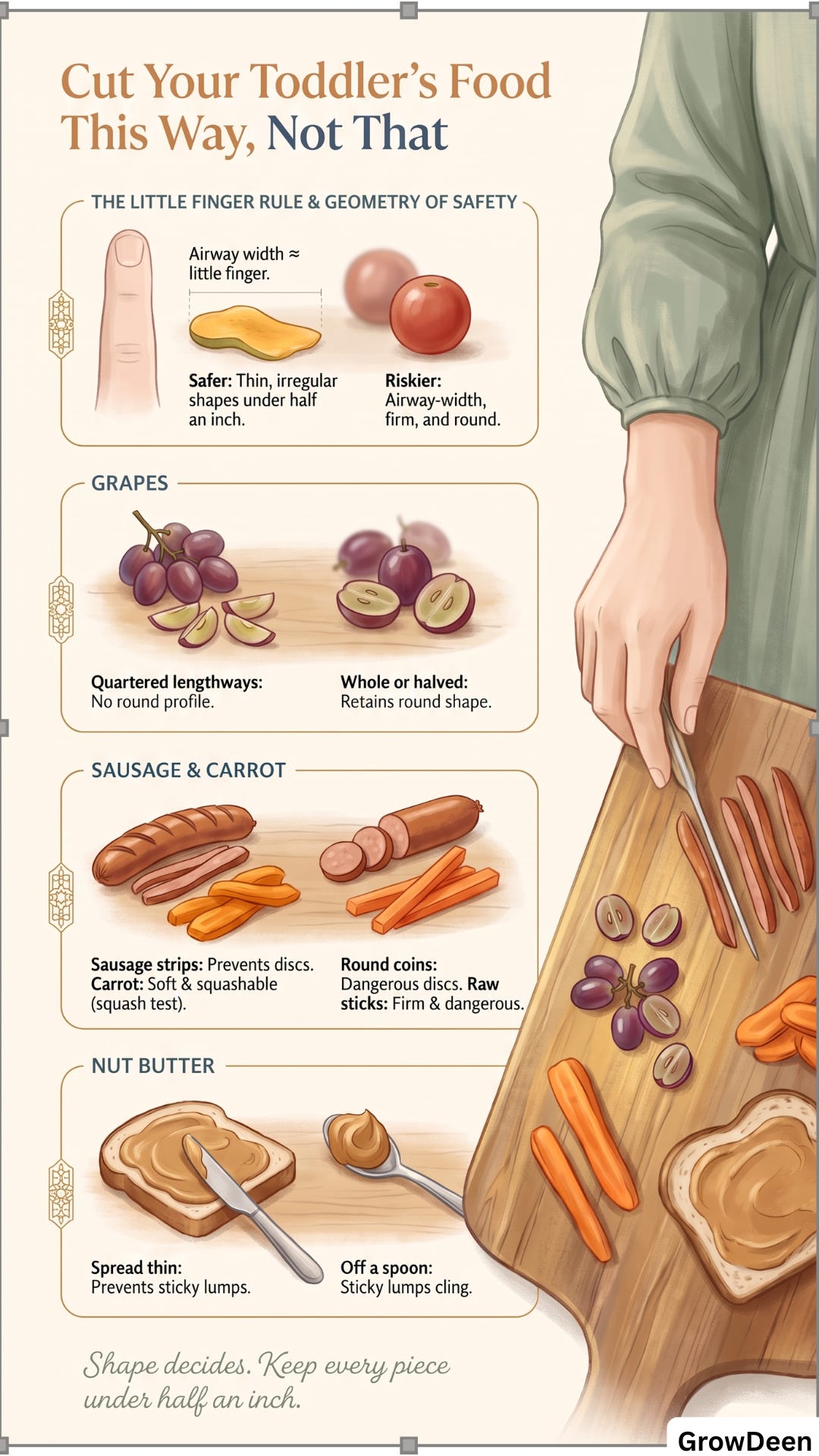
1. Destroy the round. Quarter grapes, cherry tomatoes and large berries lengthways, so no round profile survives in any direction. Halving leaves a dome, which is still the wrong shape.
2. Cut cylinders lengthways first. Sausage shaped foods get sliced down the length, then across into short strips. You should never end up holding a disc.
3. Use the squash test on anything hard. Cook vegetables until a piece flattens between your finger and thumb with almost no effort. That test is more reliable than any cooking time, because it measures the thing that actually matters.
4. Spread sticky, never spoon it. Nut butter goes on thin. Keep whole nuts away from young children entirely and use ground nuts or a smooth butter instead.
5. Debone before you cook. Bones in fish and chicken are far easier to find raw than they are on a plate under a toddler’s hand.
6. Half an inch, and no more. While chewing is still developing, keep pieces to around half an inch in any direction. [3] When you are unsure, cut smaller.
Two conditions sit underneath all six. Your child sits upright to eat, every single time, with no food in a moving pram or car and none while lying back. And an adult stays within arm’s reach for the whole meal. An older sibling does not count, because a meaningful share of choking incidents begin with an older child kindly handing a younger one something they should not have. [2]
The Fear That Cuts Both Ways
Now for the part nobody warns you about.
The same fear that keeps a grape whole in some households keeps the purees coming in others. A parent who cannot tell which foods are safe often solves the problem by avoiding texture altogether. It feels like caution. It is the more expensive mistake of the two.
The Avon Longitudinal Study of Parents and Children tracked thousands of British families and sorted infants by when they first ate lumpy, chewy food. Roughly one in five did not meet it until after nine months. By fifteen months, that group had more reported feeding difficulties and was eating noticeably less of the family’s own food. [4]
The same children were followed up at seven years old. They still ate fewer fruits and fewer vegetables across every category the researchers measured, and their parents reported more refusal and more fussiness at the table. [5]
Seven years is a long time for a nine month decision to keep showing up.
Two honest caveats, because tired parents deserve them. This is observational data, so it shows a pattern rather than proving a cause. And it is no verdict on any individual child. Plenty of children who met texture late eat everything now.
What the finding does support is a change in default. Waiting does not remove the difficult stage. It relocates it into an older child who is more able to refuse and more capable of remembering.
There is a physical reason for that, and it explains a great deal. In a young infant, the gag reflex triggers very far forward on the tongue, which is a protective design for a mouth that cannot yet chew. With oral practice, that trigger point migrates backward, which is what eventually lets a child move food around the mouth without gagging. [6] The migration is driven by experience. A mouth that has only ever managed smooth puree keeps its forward trigger point, so the eleven month old meeting texture for the first time will gag harder, with more distress, than the eight month old would have.
So the knife does two jobs at once. It makes the food safe enough to offer, and it makes the food textured enough to teach.
Something to Make This Easier
Nobody remembers six cutting rules at half past five on a Tuesday with two things burning on the stove.
That is exactly why the free Safe Shapes Companion Pack exists. It is a printable set built to live inside a kitchen cupboard door, showing the wrong shape and the right shape side by side for the foods parents most often get wrong. Keep reading to download it at the end.
Support Muslim Parenting Lab ❤️
Worried that giving will leave you with less? Give an amount you will not feel, with the button below.
The Prophet ﷺ said charity does not decrease wealth. (Sahih Muslim 2588)
What the Qur’an Says About the Fruit Your Hands Did Not Make
You have just spent several minutes reading about knives, airways and cutting boards. It can start to feel like the whole thing rests on you.
There is a passage that says otherwise, with unusual precision.
Allah says: “There is a sign for them in the dead earth: We give it life, producing grain from it for them to eat. And We have placed in it gardens of palm trees and grapevines, and caused springs to gush forth in it, so that they may eat from its fruit, which they had no hand in making. Will they not then give thanks?” [Qur’an 36:33 to 35] [12]
Grain, dates and grapes. Read any list of first finger foods and you are reading that verse back.
According to Tafsir Ibn Kathir, the phrase wa ma ‘amilathu aydihim means that none of this came from human effort or strength, but only from Allah’s mercy, a reading he attributes to Ibn Abbas and Qatadah. [12] He then records a second reading, favoured by Ibn Jarir al-Tabari, in which the same words also mean that people eat from what their own hands have planted and tended. [12]
Both readings sit in the same tafsir, and between them they describe you at that chopping board. The provision is Allah’s. The washing and the cutting is yours.
Safety lives in the cut, not the list. And the cut is the small part that was given to you.
The Sunnah of the Hand at the Table
There is one more reason to stop apologising for the mess.
Abdullah ibn Ka’b narrated from his father, Ka’b ibn Malik, that the Messenger of Allah ﷺ used to eat with three fingers, and when he had finished, he licked them. [11] That narration sits in a chapter of Sahih Muslim concerned entirely with the etiquette of hands at a meal.
Most modern parenting material treats hand eating as a stage to be endured until cutlery arrives. Islam frames it very differently. The Prophet ﷺ, whose manners were the finest of all creation, ate with his fingers throughout his life.
So when your one year old presses a fistful of rice into their mouth and then studies their own fingers with total concentration, the job ahead is refinement rather than removal. Right hand. Bismillah at the start. Alhamdulillah at the end. Nothing wasted.
Gagging Is Loud. Choking Is Silent.
Before the practical timeline, the distinction that matters most at the table.
A gagging child coughs, splutters, goes red, waters at the eyes, and usually pushes the food back out at the front without help. Stay seated. Stay calm. Putting your fingers into the mouth is what turns a gag into an emergency.
A choking child makes no sound at all. No cough, no cry, sometimes a colour change before anything else registers.
Gagging in this age band is close to universal and is supposed to happen while a child learns. [1] Every adult who feeds a child under four should be able to deliver back blows and chest thrusts for an infant, and the older child equivalent. It is one short evening of training and it belongs ahead of any highchair purchase on your list.
What to Offer, Roughly by Age
Six to eight months. Grasp is a whole fist, so food must be long. A strip that fits in a closed fist with a usable length sticking out is the only geometry that works. Cooked vegetable batons, wedges of ripe pear, fingers of toast with a thin spread. Very little will be swallowed, and that is the expected result.
Nine to twelve months. Most babies begin picking things up between thumb and index finger somewhere around now, with a wide band of normal on either side. [8][9] Small pieces become useful. Chopped hard boiled egg, pasta shapes a small hand can hold, soft cooked meat and fish. Iron matters most in this window, because stores laid down before birth are running low. [10]
Twelve to eighteen months. Family food, cut down. Sandwiches on wholegrain bread, vegetable sticks with hummus or a yoghurt dip, pikelets with pumpkin or grated courgette in the batter. Cutlery appears and is used badly for a long while. Hands stay the primary tool.
Two years and beyond. Close to everything the household eats, with the shape rules still applying until at least four. Whole nuts and popcorn stay off the list longer than most families expect. [2]
One more thing worth knowing. The WHO’s 2023 complementary feeding guideline makes responsive feeding a formal recommendation, and states plainly that implementation requires caregivers to have the time to be present while a young child self feeds and the resources to absorb the food loss that self feeding produces. [7] An international health body has written into a formal guideline that a certain amount of dropped dinner is a required input. Remember that on the days when the floor looks the way it looks.
Track breadth rather than volume. Trial work on structured self feeding measured how wide a range of foods infants would accept, not how much of any single meal disappeared. [14] In the first year, milk is still carrying most of the nutritional load, and the meal is mainly a lesson.
Your Safe Shapes Companion Pack
If you have read this far, you are the kind of parent who wants to understand the reason and not just follow the rule. That tells me something good about you.
Inside the Safe Shapes Companion Pack (one comprehensive PDF, 3 pages):
Page 1: The Safe Shapes Cutting Card. Twelve common foods shown twice, once in the shape that causes harm and once in the shape that does not, with the half inch guide and the squash test printed alongside. Designed as a card you can tape inside a kitchen cupboard door, at eye level, where the cutting actually happens.
Page 2: Gag or Choke? The 10-Second Identifier. A side by side card showing what you see, what you hear and what to do for each, plus the infant and child first aid sequence written in plain steps, so you can tell the difference in the two seconds you will actually have.
Page 3: The Fruit Your Hands Did Not Make, a Mealtime Reflection Card. Qur’an 36:33 to 35 with the Tafsir Ibn Kathir explanation written for parents, alongside a short reflection on what belongs to Allah and what belongs to you at the table, designed to be read once and remembered on hard days.
This isn’t just a PDF to download and forget. It’s a tool designed to stay in your kitchen, where you’ll actually use it when you need it most.
This Safe Shapes Companion Pack is what every subscriber receives with each article. We cover every stage of raising Muslim children, all backed by scientific research and rooted in Islamic wisdom.
One Small Thing, Right Now
Open your fridge. Find the grapes, the cherry tomatoes, or whatever small round thing is in there. Take one out and quarter it lengthways, so you can see what the finished shape looks like in your own hand.
That is the whole skill. Sixty seconds, once, and your hands will remember it.
And when it feels like too small a thing to matter, remember Maryam, told in her weakest hour to shake the trunk of the palm tree herself so the dates would fall. [Qur’an 19:25] Tafsir Ibn Kathir renders the instruction plainly: grab the trunk and shake it toward yourself, and Allah blessed her with food and drink in that way. [13] The provision was already settled. The reaching was still hers.
May Allah place barakah in what you feed your family, protect the small bodies He has entrusted to you, and reward every quiet, unglamorous act of care that nobody but Him sees.
Share This With Someone Who Needs It
Think of one person right now: the friend whose baby is about to turn six months and who has not thought about any of this yet, the sister-in-law who still purees everything because she is frightened of choking, the cousin whose toddler eats whole grapes from a lunchbox every single day without anyone noticing.
This article could protect their child. Send it to them today, not because you are being preachy, but because you care. Sometimes the most loving thing we can do is pass along the one detail nobody told us either.
Frequently Asked Questions
Q: When can my baby start finger foods?
A: Most babies are ready from around six months, once they can sit upright with support and bring things to their mouth. Start with long soft strips that clear the top of a closed fist, because a young baby grips with the whole hand and cannot yet pinch. [8]
Q: Do I have to cut grapes for a 3 year old, or is that only for babies?
A: Keep cutting them. Paediatric guidance keeps whole grapes and other round firm foods off the menu for children under four, because the airway is still small enough for a whole grape to seal it completely. [2] Quarter them lengthways, not in half.
Q: My baby gags on every new food. Should I stop?
A: No, and this is the question that worries parents most. Gagging is loud, protective and near universal at this age, and 35% of babies in the BLISS trial gagged or choked at least once between six and eight months regardless of feeding method. [1] Choking, by contrast, is silent. See “Gagging Is Loud. Choking Is Silent.” above for how to tell them apart in the moment.
Q: Is baby-led weaning more dangerous than spoon feeding?
A: The BLISS randomised controlled trial found no statistically significant difference in choking events between the two approaches. [1] What the same trial did find is that high proportions of babies in both groups were being offered foods that carry a real choking risk, which puts the focus back on preparation rather than method.
Q: How late is too late to introduce lumpy textures?
A: Aim to have chewy, lumpy food in the diet before nine months where you can. Children introduced after that point showed more feeding difficulties at fifteen months and were still eating fewer fruits and vegetables at seven years old. [4][5] If you are already past that window, start this week rather than waiting for a calmer month.
Q: What size should the pieces actually be?
A: Around half an inch in any direction while chewing is still developing, and smaller when you are unsure. [3] For hard vegetables, cook them until a piece flattens between your finger and thumb before you cut.
Q: Is eating with hands acceptable in Islam, or should I move my child to cutlery quickly?
A: Eating with the hands is the practice of the Prophet ﷺ, who ate with three fingers and licked them when he had finished. [11] There is no rush toward cutlery. The work is teaching the adab that goes with it: right hand, Bismillah before, Alhamdulillah after.
References
[1] Fangupo, L.J., Heath, A.M., Williams, S.M., Erickson Williams, L.W., Morison, B.J., Fleming, E.A., Taylor, B.J., Wheeler, B.J., & Taylor, R.W. (2016). A baby-led approach to eating solids and risk of choking. Pediatrics, 138(4), e20160772. https://doi.org/10.1542/peds.2016-0772
[2] American Academy of Pediatrics. Choking prevention for babies and children. HealthyChildren.org. https://www.healthychildren.org/English/health-issues/injuries-emergencies/Pages/Choking-Prevention.aspx
[3] United States Department of Agriculture, Team Nutrition. Choking prevention for children birth to 4 years.
[4] Northstone, K., Emmett, P., Nethersole, F., & the ALSPAC Study Team. (2001). The effect of age of introduction to lumpy solids on foods eaten and reported feeding difficulties at 6 and 15 months. Journal of Human Nutrition and Dietetics, 14(1), 43 to 54. https://doi.org/10.1046/j.1365-277x.2001.00264.x
[5] Coulthard, H., Harris, G., & Emmett, P. (2009). Delayed introduction of lumpy foods to children during the complementary feeding period affects child’s food acceptance and feeding at 7 years of age. Maternal & Child Nutrition, 5(1), 75 to 85. https://doi.org/10.1111/j.1740-8709.2008.00153.x
[6] Harris, G., & Mason, S. (2017). Are there sensitive periods for food acceptance in infancy? Current Nutrition Reports, 6(2), 190 to 196. https://doi.org/10.1007/s13668-017-0203-0
[7] World Health Organization. (2023). WHO guideline for complementary feeding of infants and young children 6 to 23 months of age. Geneva: WHO. https://www.ncbi.nlm.nih.gov/books/NBK596430/
[8] Centers for Disease Control and Prevention. Learn the signs. Act early: developmental milestones. https://www.cdc.gov/ncbddd/actearly/milestones/
[9] Cleveland Clinic. Finger to thumb: what to know about the pincer grasp. https://health.clevelandclinic.org/pincer-grasp
[10] Williams Erickson, L., Taylor, R.W., Haszard, J.J., et al. (2018). Impact of a modified version of baby-led weaning on infant food and nutrient intakes: the BLISS randomized controlled trial. Nutrients, 10(6), 740. https://doi.org/10.3390/nu10060740
[11] Sahih Muslim 2032c, narrated by Abdullah ibn Ka’b from his father Ka’b ibn Malik. The Book of Drinks, Book 36, Hadith 172. Graded Sahih. https://sunnah.com/muslim:2032c
[12] The Noble Qur’an, Surah Ya-Sin 36:33 to 35. Tafsir Ibn Kathir (Abridged), commentary on the group 36:33 to 36:36. https://quran.com/en/36:36/tafsirs/en-tafisr-ibn-kathir
[13] The Noble Qur’an, Surah Maryam 19:25 to 26. Tafsir Ibn Kathir, commentary on 19:24 to 26. https://quran.com/en/maryam/25/tafsirs
[14] Morison, B.J., Heath, A.M., Haszard, J.J., et al. (2018). Impact of a modified version of baby-led weaning on dietary variety and food preferences in infants. Nutrients, 10(8), 1092. https://doi.org/10.3390/nu10081092
[15] Lumsden, A.J., & Cooper, J.G. (2017). The choking hazard of grapes: a plea for awareness. Archives of Disease in Childhood, 102(5), 473 to 474. https://doi.org/10.1136/archdischild-2016-311750
We combine scientific research with Qur’an and authentic Sunnah, and we cite our sources. Even so, this is general guidance and no substitute for a doctor who can examine your child.