

New research published in Pediatrics by Zubler et al. (2022) confirms that 9–10 months is one of the most milestone-dense windows in the entire first year — with babies typically reaching up to 12 distinct developmental markers across movement, language, and social development in just these eight weeks. [1] This guide explains what those milestones actually mean, how to support them, and what the Prophet ﷺ modelled about meeting your baby in this exact season of their life.
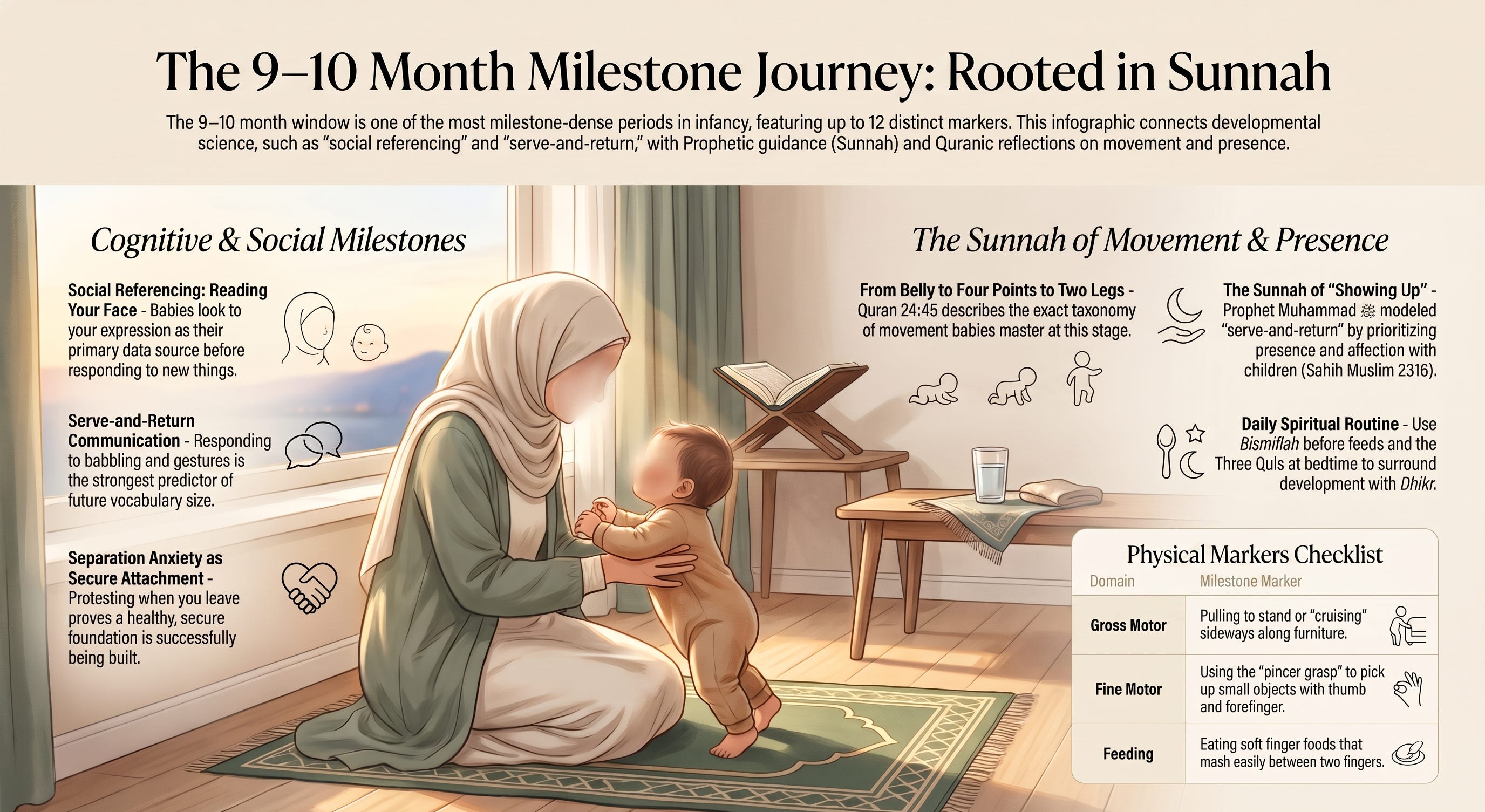
Picture this. Your baby is on the floor. Something new catches their eye — a shadow, a sound, your hand reaching into their space. They pause. Then they turn and look directly at your face.
They are not looking for the object. They are looking for your reaction to the object.
If your face is curious and calm, they will reach for it. If your face is alarmed, they will pull back. In this split second, your expression is their entire information system about whether the world is safe.
This is called social referencing, and it is one of the most striking things that emerges at 9–10 months. [2] Your baby is not just looking at you. They are reading you. And what they see in your face shapes how they understand everything around them.
You are doing more than you realise. And you have been doing it all along.
Why This Guide Is Different From Generic Baby Milestone Lists
Every milestone is anchored in both peer-reviewed developmental research and Islamic tarbiyah — drawing from Zubler et al.’s 2022 AAP milestone evidence base [1], Ainsworth’s foundational attachment research [2], and verified Prophetic guidance, because the two are not in conflict — they are in conversation.
The Islamic framework woven through this article is not decoration. Qur’an 24:45 and Sahih Muslim 2316 [3, 4] speak directly to what is happening in your baby’s body and your role as their parent — not as metaphor, but as explanation.
You’ll get the free 9–10 Month Growth Pack — a printable three-page guide covering milestone markers, seven serve-and-return play prompts, and a Prophetic tarbiyah intentions card — because understanding this stage is only half of it.
What Your Baby Can Actually Do at 9–10 Months
They are communicating constantly — just not in words yet.
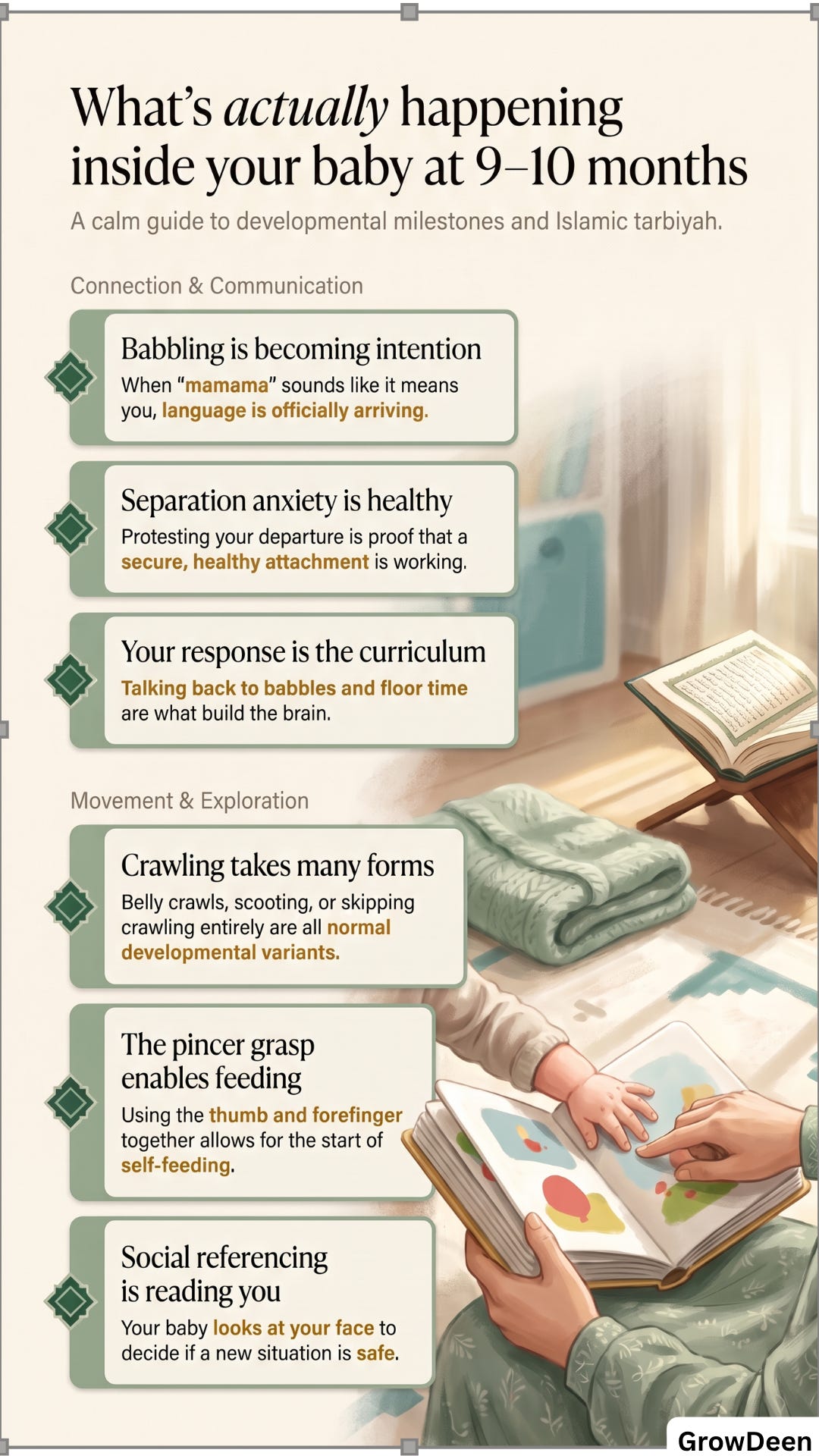
Babbling has been happening for months. But around nine to ten months, it shifts. The strings of sound — mamama, dadada, bababa — start to carry meaning. Some babies will use “mama” and genuinely mean their mother. [1] But the real communication is happening everywhere simultaneously: in the deliberate point, the arm raised to be picked up, the head shake for “no,” the hand pushed away from a food they’ve decided they don’t want.
What the research is clear about: responding to your baby’s vocalisations — actually turning toward them, echoing the sound, adding a word — is one of the strongest predictors of their vocabulary size at age two. [5] Not a toy. Not a class. Your response. That’s the mechanism.
They are watching your face to decide how to feel.
Social referencing — your baby looking at your face for an emotional signal before responding to something — is one of the most important cognitive leaps at this stage. [2] When your baby falls and looks at you before crying, or glances at you before touching something new, they are reading your expression as data.
Here’s what that means practically: your calm is a parenting tool. Your steadiness genuinely helps them recover, explore, and trust. This doesn’t mean performing false cheerfulness — it means your real emotional regulation matters, and it’s worth protecting.
They are separating — and that discomfort is the proof something is working.
Separation anxiety typically peaks somewhere between 9 and 18 months. [2] When your baby cries as you leave the room, or protests when a well-meaning relative tries to hold them, they are not being difficult. They are showing you that they have formed a strong, secure attachment — and that attachment is the foundation everything else is built on.
The research on this is not ambiguous. Secure attachment in infancy is linked to better emotional regulation, social competence, and cognitive development across childhood and beyond. [2] The protest you’re managing right now is a long-term investment paying off.
They are on the move — in whatever way works for them.
By 9–10 months, most babies are crawling — belly-crawling, hands-and-knees, commando, bottom-shuffling — whatever style they’ve adopted. Many are pulling to stand. Some are cruising sideways along furniture. A handful may be taking first steps. All of these are normal variants. [1]
The pincer grasp — picking up small objects between thumb and forefinger — is developing or refining at this stage too. [1] This is what makes self-feeding with soft finger foods possible. Everything offered must be soft enough to mash between two adult fingers before it goes on the tray.
The Qur’an and Your Crawling, Climbing Baby
When I look at the 9–10 month milestone picture — belly to four points to two legs — and then read Qur’an 24:45, something about it makes me stop.
Allah says:
“And Allah has created every living creature from water — of them are those that crawl on their bellies, those that walk on two legs, and those that walk on four. Allah creates what He wills; indeed, Allah is over all things competent.” [Quran 24:45] [3]
According to Tafsir Ibn Kathir, this verse is demonstrating Allah’s complete power to create all creatures in their different forms and ways of moving — from one substance. Ibn Kathir names those walking on two legs as humans and birds; those crawling on their bellies as snakes; those on four as cattle. [3]
Your 9–10 month old is moving through this exact taxonomy. From belly, toward four points, toward two legs. Every session of floor play is a small piece of that journey.
It is not just a milestone chart. It is a sign.
Now that you have a fuller picture of what your baby can do at this stage — what’s happening in their communication, their movement, their emotional world, and the Islamic lens through which all of it makes deeper sense — let me share something that parents at this stage consistently tell me they wish they had from the beginning.
The 9–10 Month Growth Pack is a free, printable three-page guide that puts the most essential parts of this guide in a format you can keep on your fridge, your kitchen table, or your phone. A milestone reference card. Seven serve-and-return play prompts. And a Prophetic tarbiyah intentions card that turns the hadith below into three daily practices you can carry into floor time. Download it at the end of this article.
The Sunnah of Going to Your Child
Anas ibn Malik رضي الله عنه reported:
“I have never seen anyone more kind to one’s family than Allah’s Messenger ﷺ, and Ibrahim was sent to the suburb of Madinah for suckling. He used to go there and we accompanied him. He entered the house, and it was filled with smoke as his foster-father was a bricksmith. He took him (his son Ibrahim) and kissed him and then came back.” [Sahih Muslim 2316] [4]
Read that again and notice what it says. The house was filled with smoke. The Prophet ﷺ went anyway. He went to a working man’s house, in inconvenient conditions, not for any occasion — simply because Ibrahim was there, and Ibrahim was his son.
He took him. And he kissed him.
Here’s what I find remarkable when I hold this next to the developmental science: the research on what actually builds a baby’s brain doesn’t describe elaborate programmes or carefully planned activities. It describes what researchers call serve-and-return — the simple, repeated back-and-forth between parent and child where the parent shows up, responds, and comes back. [6]
The Prophet ﷺ showed us what that looks like, in a smoky house on the outskirts of Madinah, 1,400 years before the research had language for it.
At 9–10 months, the science and the Sunnah are pointing at exactly the same thing: go to your baby. Respond when they call. Come back. That’s the curriculum.
A Practical Islamic Routine for This Stage
Morning: Assalamu alaikum when they wake. Bismillah before every feed, Alhamdulillah after. Get on the floor and meet them at eye level.
During the day: Narrate everything. “We’re going to the kitchen — bismillah.” “Look at the light — Allah made our eyes to see it.” Recite Qur’an nearby. Al-Fatiha, Al-Ikhlas, Surah Ad-Duha said softly during floor play costs you nothing and deposits something in your baby’s auditory system that Arabic classes at age five cannot replicate.
Bedtime: The three quls, blown gently. Ayat al-Kursi. A hand on the chest. A quiet du’a. The routine doesn’t have to be perfect. It has to be consistent — because your baby is learning that this is how their days end, surrounded by the names of Allah.
The 9–10 Month Growth Pack
If you’ve read this far, you are the kind of parent who takes your baby’s development seriously — not as worry, but as love. That is exactly why I made this.
Inside the 9–10 Month Growth Pack (one comprehensive PDF, 3 pages):
Page 1: At-a-Glance Milestone Reference Card — A clean, printable checklist of 9–10 month developmental markers across five domains — movement, communication, social and emotional, fine motor, and feeding — with a “when to speak with your paediatrician” section. Designed to be kept on your fridge so you can check in without Googling at midnight.
Page 2: Serve-and-Return Play Prompt Cards — 7 specific, named play ideas for this exact age, each with a one-line note explaining the developmental reason and a brief Islamic framing. For the days when you want to engage but your brain is too tired to think of what to do — pick one card and go.
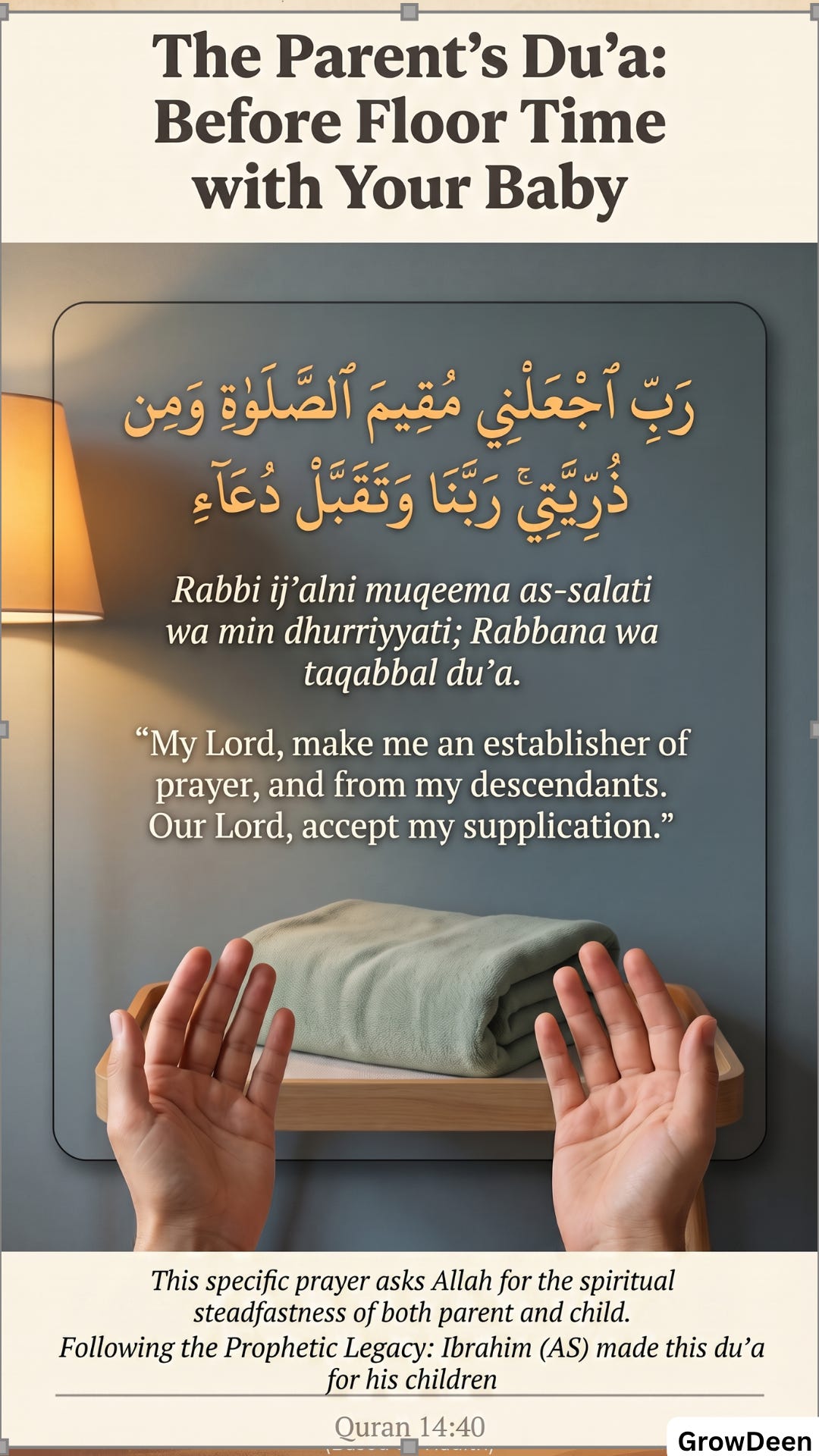
Page 3: “The Sunnah of Showing Up” Tarbiyah Intentions Card — The complete hadith of Sahih Muslim 2316 with the Prophet ﷺ visiting his son Ibrahim, rendered in Arabic with transliteration and translation, alongside three Prophetic tarbiyah intentions for this developmental stage and a parent du’a to make before floor time.
This isn’t a PDF to download and file away. It is designed to stay somewhere you can see it — on the fridge, on the table, on your phone — for the ordinary Tuesday afternoons when you need the reminder.
This 9–10 Month Growth Pack is what every subscriber receives with each article in the series. We cover the full journey month by month from birth through toddlerhood — every article peer-reviewed and Sunnah-rooted, no generic parenting advice anywhere in it.
If you’re a Muslim parent who wants both evidence-based guidance and Islamic wisdom woven together, subscribe free so the next guide arrives before you need it.
Subscribe free — no spam, no daily emails. Just one article at a time, with a companion pack attached, covering the parenting journey from newborn to school age.
One Thing. Tonight.
Tonight, when you go to your baby — whether that’s to settle them, to feed them, or just to check in — notice the moment they look up and find your face. Stay in that moment for two breaths before you do anything else. That look they give you is what 9–10 months is built on.
That is the serve-and-return. That is the Sunnah. That is enough.
Share This With One Parent Who Needs It
Think of one person right now: a mother in your family group who mentioned that her baby has started crying every time she leaves the room and she doesn’t know what she’s doing wrong. A friend whose 9-month-old isn’t pulling to stand yet and she’s spiralling quietly about it. A sister who loves her baby fiercely but feels like she never knows if she’s doing enough.
This article doesn’t add to their load. It tells them that what they’re already doing — showing up, responding, being there — is the most important thing. Share it with them today.
Frequently Asked Questions
Q: Is it normal for my 9-month-old not to be crawling yet?
A: Yes — crawling is not a compulsory milestone. Some babies go straight from sitting to pulling to stand and never crawl in the traditional hands-and-knees way. [1] What matters is that your baby is moving and showing interest in getting places. If they can sit independently, transfer objects between hands, and show engagement with you and their environment, they are likely on track. Always mention specific concerns to your paediatrician.
Q: My baby cries hysterically when I leave the room. Is this separation anxiety and is it normal?
A: Yes, and yes. Separation anxiety peaks between 9 and 18 months, and its intensity at this stage is completely normal. [2] It’s actually a sign of healthy attachment — your baby has learned that you exist when you’re gone, and they love you enough to protest. Keep separations brief and predictable, always say goodbye rather than disappearing, and return reliably. The anxious phase does pass.
Q: How much should my 9–10 month old be babbling?
A: At this age you should be hearing extended strings of babbling — mamama, dadada, bababa — regularly. [1] Some babies at this stage may be using one or two sounds with genuine intentional meaning. If your baby is not babbling at all by 10 months, or has stopped babbling after doing it previously, mention this to your paediatrician at your next visit.
Q: When do babies say their first real word?
A: Most babies produce their first recognisable word somewhere between 9 and 14 months, though this varies widely. [1] What matters more right now than the first word is the communication happening before it — the babbling, the gestures, the pointing, the joint attention. These are the true foundations of language, and they are already well underway.
Q: My baby only wants me. They cry with everyone else. How do I handle this at family gatherings?
A: This is stranger anxiety and separation anxiety working together, and it is developmentally healthy. [2] What helps: give your baby time to observe a visitor from the safety of your arms before any transfer happens. Stay in sight when someone else holds them. Don’t force the interaction. Most babies warm up considerably when they can see their primary caregiver nearby and aren’t being passed around against their will. Gentle, slow introductions honour both the attachment and the relationship.
Q: Is it safe to give my 9–10 month old finger foods?
A: Yes — the key is texture. Everything offered as a finger food must be soft enough to mash between two adult fingers before it goes on the tray. [7] Good starting options: soft-cooked vegetables, ripe banana, avocado, small pieces of well-cooked egg, soft pasta. Avoid whole grapes, raw carrots, whole blueberries, and anything hard, sticky, or round at this stage. Breastmilk or formula remains the primary nutrition source throughout the first year.
References
[1] Zubler, J.M., Wiggins, L.D., Macias, M.M., Whitaker, T.M., Shaw, J.S., Squires, J.K., Pajek, J.A., Wolf, R.B., Slaughter, K.S., Broughton, A.S., Gerndt, K.L., Mlodoch, B.J., & Lipkin, P.H. (2022). Evidence-informed milestones for developmental surveillance tools. Pediatrics, 149(3), Article e2021052138. https://doi.org/10.1542/peds.2021-052138
[2] Ainsworth, M.D.S., Blehar, M.C., Waters, E., & Wall, S.N. (2015). Patterns of Attachment: A Psychological Study of the Strange Situation (Classic Ed.). Psychology Press.
[3] Quran, Surah An-Nur 24:45 — https://quran.com/24/45 | Tafsir: Ibn Kathir. QuranX.com. Retrieved June 2026 from https://quranx.com/Tafsirs/24.45
[4] Sahih Muslim 2316, The Book of Virtues — Graded: Sahih — https://sunnah.com/muslim:2316
[5] Gros-Louis, J., West, M.J., & King, A.P. (2014). Maternal responsiveness and the development of directed vocalisation in social interactions. Infancy, 19(4), 385–408. https://doi.org/10.1111/infa.12054
[6] Center on the Developing Child at Harvard University. (2021). Three principles to improve outcomes for children and families (2021 update). Harvard University. https://developingchild.harvard.edu/resources/report/three-principles-to-improve-outcomes-for-children-and-families/
[7] National Health and Medical Research Council (NHMRC). (2012, updated 2015). Infant feeding guidelines: Information for health workers. NHMRC. https://www.nhmrc.gov.au/about-us/publications/infant-feeding-guidelines-information-health-workers