


A 2018 review of early childhood behavior found transitions among the single most common triggers for challenging behavior in young children, not because kids are being difficult, but because the skill of shifting attention on demand is still under construction at that age [1]. One study on toddler temperament found children lower in natural self-regulation struggled hardest at exactly these moments, especially once a screen was involved [2].
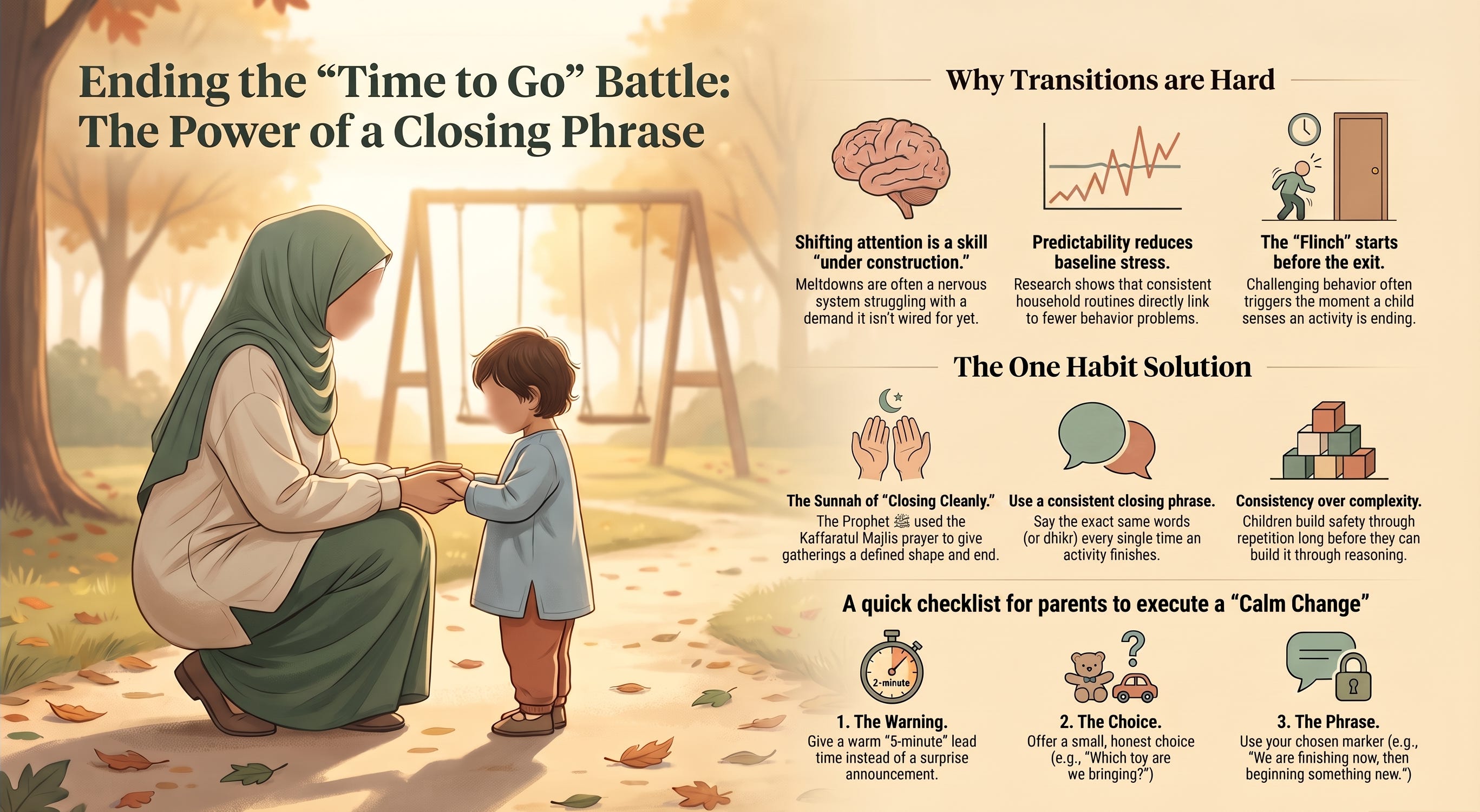
Your three-year-old isn’t fighting you at the park exit. Watch closely and you’ll see the real battle at the park begins the exact moment your child senses the transition is coming, not when you actually reach the exit.
That flinch. That sudden “no.” That small body going rigid before you’ve even said the word “home.”
Here’s the part that actually changes things: your child’s meltdown at “we’re leaving now” isn’t defiance in disguise. It’s a small nervous system doing its best with a demand it hasn’t yet built the wiring for.
Why This Guide Is Different
One idea, not seven. Most transition advice hands you a checklist. This one hands you a single, repeatable habit that does most of the work by itself.
Built on a rhythm you already live. Instead of importing a foreign parenting technique, this approach borrows directly from the five-times-daily structure already built into salah.
Backed twice over. Every claim here is grounded in peer-reviewed child development research and in an authentic, Hasan Sahih-graded hadith, not one or the other.
Why five daily prayers might be the most useful parenting model you already have
Most parenting advice about transitions gives you seven things to try. This one gives you one: a closing phrase, said the same way every single time an activity ends. Research on early childhood behavior backs it, and so, as it happens, does something Muslims already do five times a day without thinking twice about it.
The Habit Islam Already Gave You
I keep coming back to this: Islam never treated moving from one thing to another as a minor detail. It built an entire structure of worship around it.
“Indeed, prayer has been decreed upon the believers a decree of specified times.” [Qur’an 4:103]
When I sat with Ibn Kathir’s explanation of this verse, one phrase stood out: kitaban mawqutan, salah as an obligation tied to fixed hours, the same way Hajj is tied to its season [6]. Not left to convenience. Not left to mood. Five separate stops and starts, every day, for a lifetime. A Muslim child grows up inside that rhythm before they can even explain what a rhythm is.
There’s a smaller piece of this that I find genuinely useful as a parent, and it’s the one I want you to actually take from this article. Near the end of his life, the Prophet ﷺ began closing gatherings with a short spoken phrase before rising:
“Subhanaka Allahumma wa bihamdika, ash-hadu an la ilaha illa anta, astaghfiruka wa atubu ilayk.”
(”Glory be to You, O Allah, and praise. I bear witness there is no god but You. I seek Your forgiveness and I turn to You in repentance.”)
A companion asked him why he’d started saying something he hadn’t said before. He explained it served as atonement for whatever had passed in that sitting [Sunan Abi Dawud 4859; Jami’ at-Tirmidhi 3433, graded Hasan Sahih by Imam Tirmidhi] [7].
Nothing dramatic happened in that gathering. It’s just an ordinary ending, given words, given a shape. One thing closed cleanly before the next began.
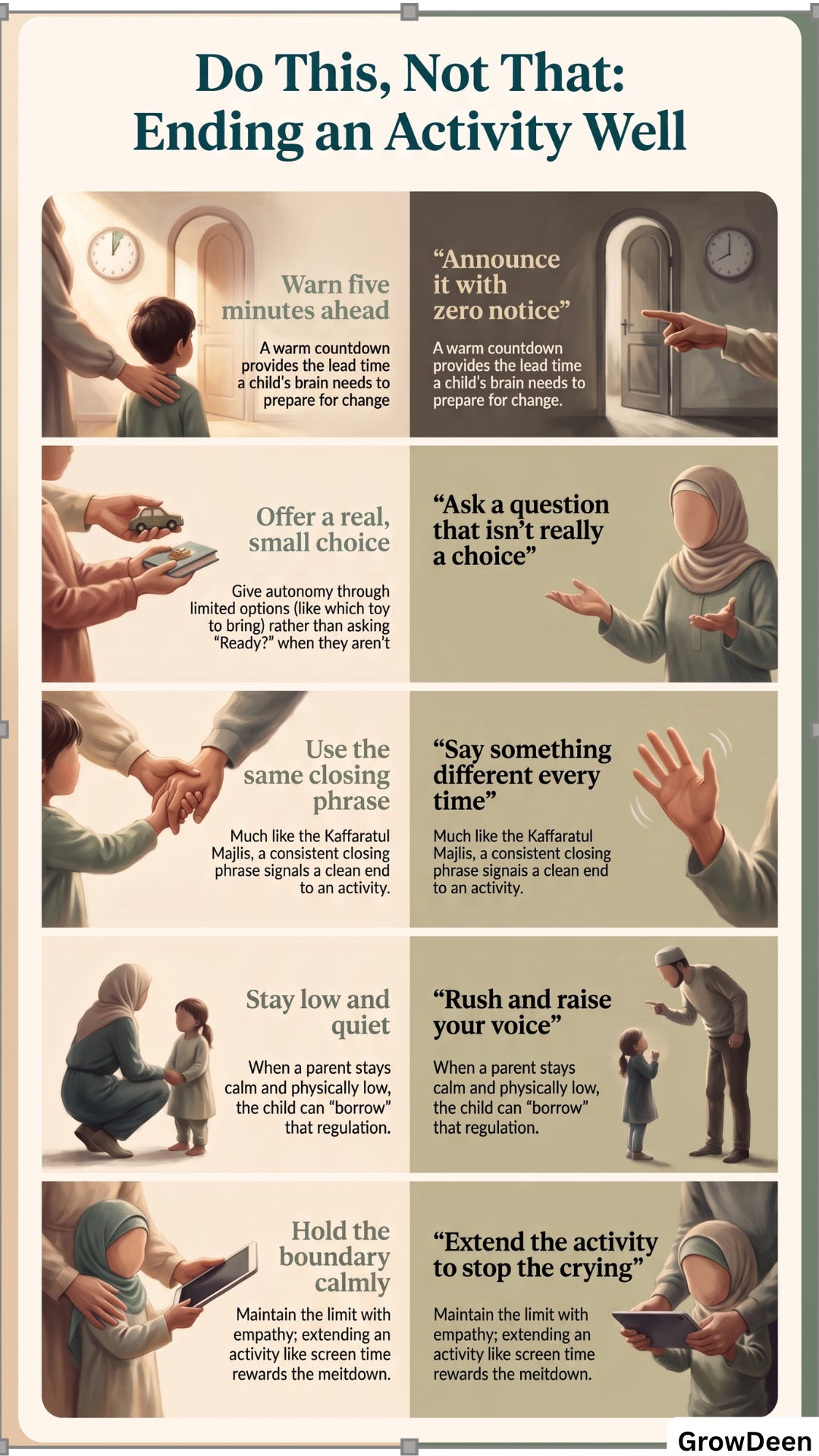
You can’t teach your toddler that Arabic overnight. But the principle underneath it travels perfectly into a Tuesday afternoon at the park. Give every transition the same short marker, every time. A phrase. A few words of dhikr. Even just “we’re finishing now, and then we begin something new,” said identically each time. Children build their sense of safety on repetition long before they build it on reasoning, and this is a repetition Islam already handed us.
What strikes me most is how neatly this lines up with the research. Predictability lowers a child’s baseline stress before a hard moment even arrives, according to a 2020 study on household routines and child behaviour [3]. The Sunnah has been saying the same thing since the seventh century, through five fixed prayers and one small closing phrase for every sitting a person leaves.
I’ll be honest about something too: I know “just add a phrase” sounds almost too simple to matter. I felt that resistance myself the first time I read the Kaffaratul Majlis hadith and thought, that’s it? But the point was never complexity. The point was consistency, which is exactly what a young nervous system runs on.
I’ve created a free printable that turns this into something you can actually use today, not just read about. Keep going, it’s waiting for you at the end of this article.
What This Actually Looks Like at Home
You already know the moments that go badly: leaving somewhere fun, ending screen time, bath to bed, packing away toys.
Give a real warning, not a surprise. “Five more minutes, then it’s time for wudu.” A countdown said with warmth does more work than an announcement with zero lead time.
Offer a small, honest choice. “We’re leaving for the masjid in a minute, which toy is coming?” Keep it small, two shirts and not the whole drawer, and don’t pretend a choice exists when it doesn’t. “Would you like to start now?” implies an option that isn’t really there.
Teach the missing skill separately. A child who hasn’t practised shoes yet will fight “time to leave” far harder than one who has. Build that skill on a slow afternoon, away from the pressure of an actual departure.
Use the closing phrase, every time. This is the one habit worth building first.
Stay steady if it goes badly anyway. Get low, say their name gently, keep your voice down. Your calm is, quite literally, something your child can borrow until their own settles.
One caution worth naming directly: if a meltdown does happen, don’t extend the activity you were trying to end. Screen time is the obvious trap. You can hold full understanding of the feeling and a boundary that doesn’t move, at the same time.
If a child’s distress during transitions is extreme, prolonged, or paired with other developmental or communication concerns, a conversation with a doctor or qualified child development professional is worth having [4][5]. That’s not a sign something’s gone wrong. It’s stewardship of the amanah, handled the way stewardship should be.

Your Free Companion Pack: The Calm Change Toolkit
If you’ve read this far, you’re the kind of parent who wants a real answer, not just sympathy for a hard stage. That already tells me something about you.
Inside The Calm Change Toolkit (one comprehensive PDF, 3 pages):
Page 1: The Two-Minute Warning Script — Four of the hardest transitions, each with an exact five-minute phrase, a one-minute phrase, and a closing phrase already written out for you — designed as a card you keep on the fridge, so you’re never scrambling for the right words mid-meltdown.
Page 2: The Seven-Day Transition Tracker — A simple daily check-in where you track one chosen transition per day: did you warn, did you use the closing phrase, did you offer a choice — so you can watch the habit take hold in under a week instead of guessing whether it’s working.
Page 3: The Kaffaratul Majlis Reflection Card — The full story of the Prophet’s ﷺ habit of closing a gathering with words, in plain English, plus the line to say with your own child at the end of a transition — something you can start using with them the very same day.
This isn’t a PDF to download and forget. It’s built to live on your fridge, where you’ll actually reach for it when things go sideways at 5pm.
This Calm Change Toolkit is what every subscriber receives with each article. We cover the full journey of raising Muslim children, all backed by scientific research and rooted in Islamic wisdom.
If you’re a Muslim parent who wants both evidence-based guidance and Islamic perspective, subscribe for free so future resources arrive in your inbox before you need them.
Subscribe free for parenting resources backed by both science and Sunnah, guidance so specific you won’t find it anywhere else. No spam, no clutter, just resources that matter.
Do This in the Next Five Minutes
Pick the one transition in your house that goes worst right now. Write down a single closing phrase you’ll say every time it ends, starting today. That’s it. That’s the whole start.
May Allah place barakah in your effort, accept your intention, and make the small, repeated things you do for your children count for more than they feel like they do in the moment.
Share This With One Person
Think of one person right now: the mother at the masjid who mentioned, almost in passing, that leaving anywhere with her toddler has become dreaded. A sister whose WhatsApp status is a photo of a meltdown mid-parking lot. Your own sibling who’s said “I don’t know why he fights every single change lately.”
This article could make one part of their day noticeably lighter. Share it today, not as advice-giving, but as the kind of thing you’d actually want someone to send you.
Frequently Asked Questions
Q: Why does my toddler have a meltdown every time we have to leave somewhere?
A: It’s rarely defiance. Young children have limited ability to hold “later” in mind and a still-developing capacity for self-regulation, so a sudden stop to something enjoyable genuinely registers as distressing [1]. Warning and a consistent closing routine both help.
Q: How do I stop transition tantrums without giving in?
A: Give a real warning before the transition, keep a consistent closing phrase, and stay calm yourself. Avoid extending the activity as a way to calm the tantrum down, since that teaches the meltdown works. For the full approach, see “What This Actually Looks Like at Home” above.
Q: Is it normal for a 4-year-old to still struggle with transitions?
A: Yes. Self-regulation around shifting attention continues developing well past the toddler years, and children with lower natural self-regulation take longer to build this skill [2]. Consistency, not age alone, is what moves things forward.
Q: What is a good phrase to use to end an activity with kids?
A: Anything short and repeated exactly the same way works, whether that’s a simple sentence like “we’re finishing now” or a phrase of dhikr your family uses specifically for that purpose. The Kaffaratul Majlis hadith is a good model: brief, consistent, spoken the same way every time [7].
Q: Do routines actually reduce toddler behaviour problems, or is that just a parenting myth?
A: It’s backed by research. A 2020 study on household chaos and child behaviour found predictable daily structure directly linked to fewer behaviour problems in young children [3].
Q: Should I use screen time to calm my child down during a hard transition?
A: It’s best avoided as a regular strategy. Giving more screen time to end a meltdown can accidentally teach a child that resisting a transition gets them what they wanted in the first place.
Q: When should I be concerned about my child’s reaction to transitions?
A: If the distress is extreme, doesn’t ease with consistency over time, or comes alongside other developmental or communication concerns, it’s worth speaking with a doctor or child development professional [4][5].
References
[1] Butler, A.M., & Ostrosky, M.M. (2018). Reducing challenging behaviors during transitions. YC Young Children, 73(4), 12-19.
[2] Coyne, S.M., Shawcroft, J., Gale, M., Gentile, D.A., Etherington, J.T., Holmgren, H., & Stockdale, L. (2021). Tantrums, toddlers and technology: Temperament, media emotion regulation, and problematic media use in early childhood. Computers in Human Behavior, 120, Article 106762.
[3] Larsen, K.L., & Jordan, S.S. (2020). Organized chaos: Daily routines link household chaos and child behavior problems. Journal of Child and Family Studies, 29(4), 1094-1107.
[4] Harvard Center on the Developing Child. (2021). Supportive relationships and active skill-building strengthen the foundations of resilience.
https://developingchild.harvard.edu
[5] Lequia, J., Machalicek, W., & Rispoli, M.J. (2012). Effects of activity schedules on challenging behavior exhibited in children with autism spectrum disorders: A systematic review. Research in Autism Spectrum Disorders, 6(1), 480-492.
[6] Qur’an, Surah An-Nisa 4:103, with Tafsir Ibn Kathir.
[7] Sunan Abi Dawud 4859; Jami’ at-Tirmidhi 3433. Graded Hasan Sahih by Imam Tirmidhi.