


A review spanning 77 parent-training programs found that how an instruction is worded predicts a child’s cooperation more reliably than almost anything else parents try. [1] This guide shows you the exact wording shift, and the Prophetic habit behind it, that gets kids cooperating without a raised voice.
Picture this: shoes need to go on, and they haven’t. Once, asked nicely. Twice, asked again. By the third time, the voice creeping in isn’t nice anymore. It’s the voice. Every parent knows the voice.
Here’s what most of us never quite learn: the problem usually isn’t repetition itself. It’s that most of what gets said to a child in that moment isn’t actually an instruction. It’s somewhere between a question, a complaint, and a plea.
Why This Guide Is Different
It doesn’t stop at “be clearer.” Most parenting advice on this topic ends at “use clear language.” This guide names the exact structural confusion, request versus instruction, that causes most of the daily friction in the first place, and shows precisely how to fix it.
The science and the Sunnah are placed side by side, not bolted together. Rather than adding an Islamic quote onto secular parenting tips, this guide traces how a fourteen-hundred-year-old command about speech and a modern review of 77 parent-training programs arrive at nearly the same conclusion, and shows why that convergence matters.
Every tip comes with the exact wording, not just the concept. Instead of “use positive language,” this guide gives the literal phrase swap, ready to use the next time an instruction needs repeating.
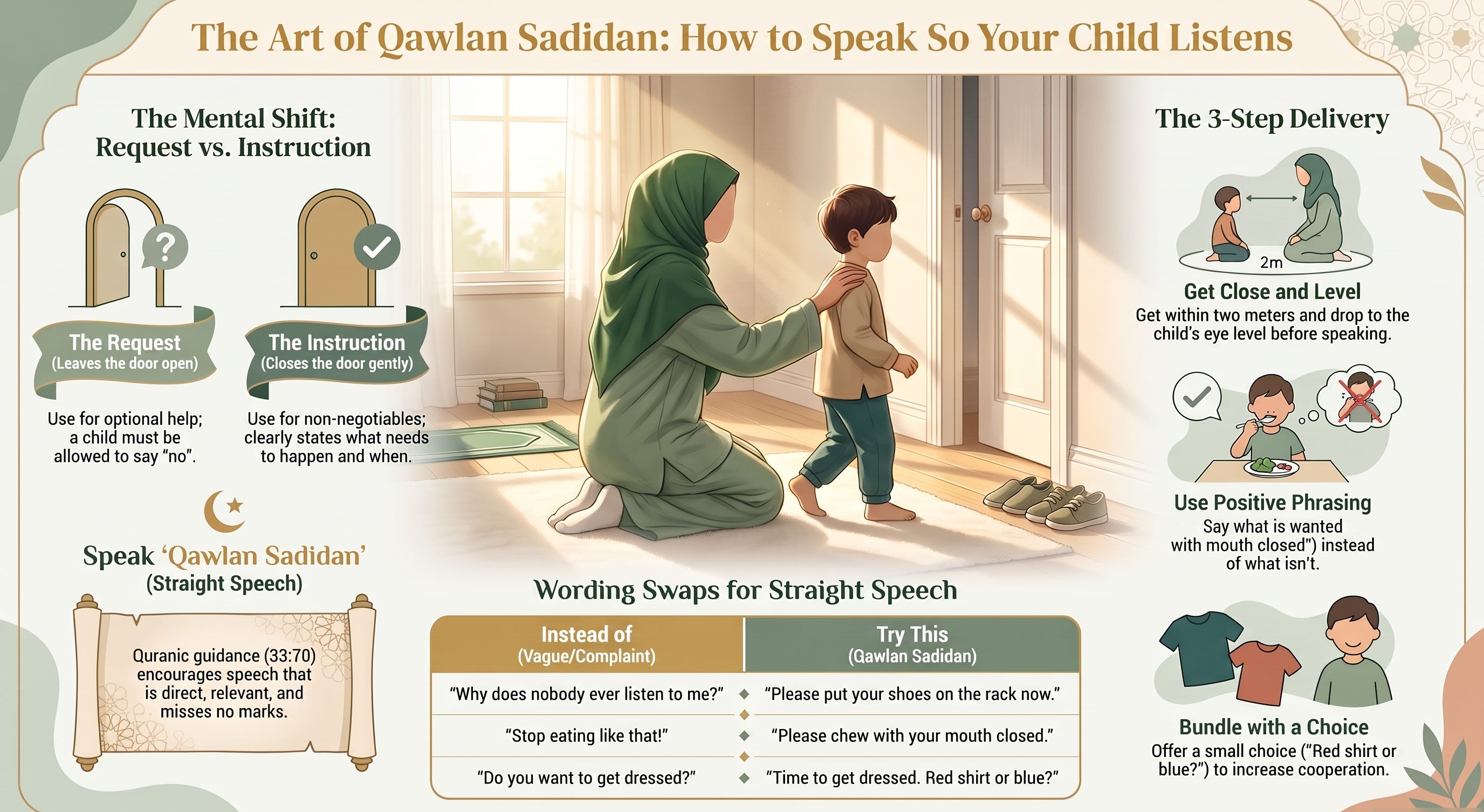
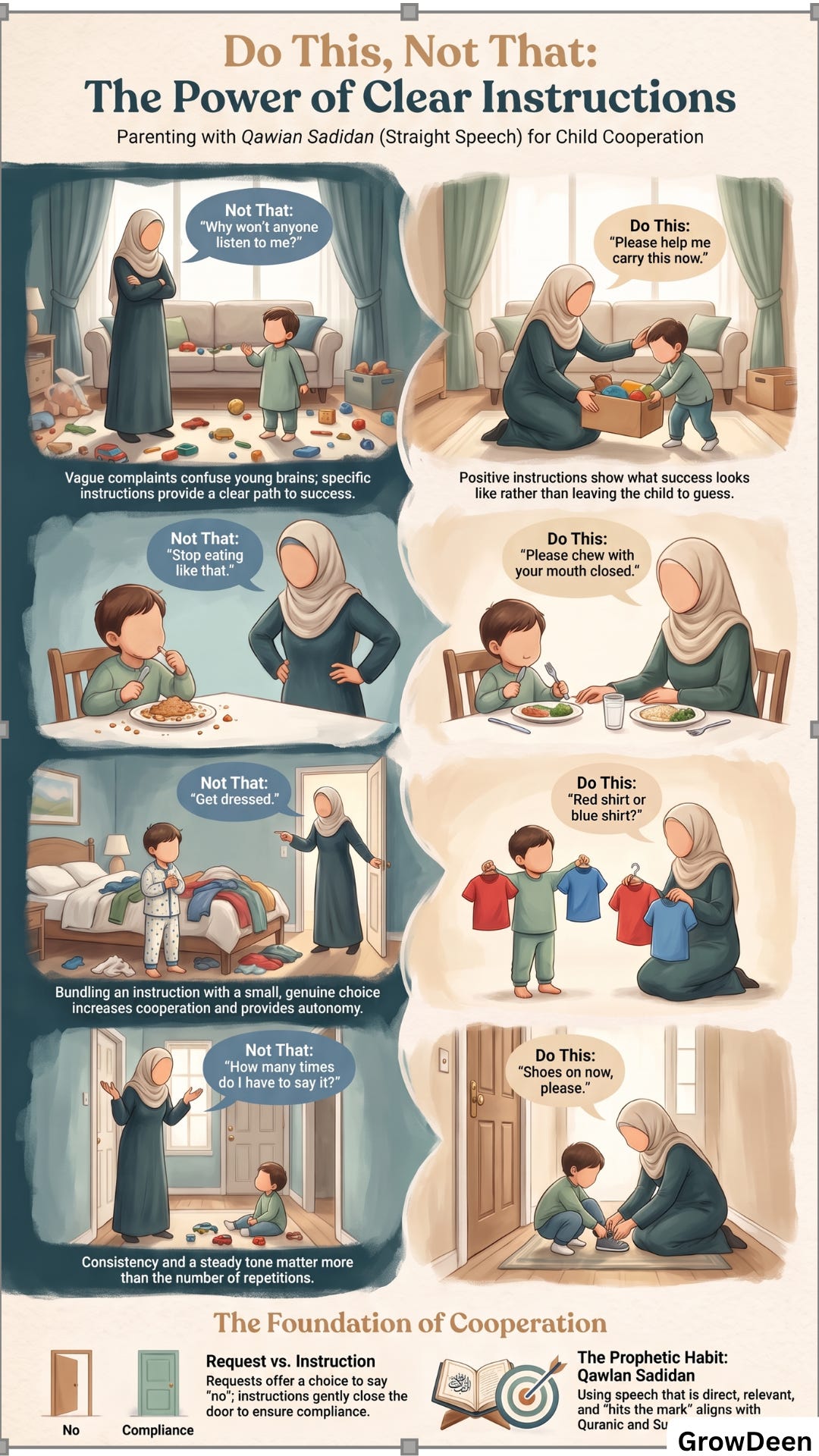
“Why does nobody ever listen to me around here?”
Say that to a four-year-old and watch nothing happen. Not because the child is being difficult. Because nothing specific was actually asked for, and a young child’s brain genuinely doesn’t know what to do with that.
This one distinction, request versus instruction, changes almost everything about how cooperation actually works in a home.
Why “Just Say It Clearly” Isn’t as Simple as It Sounds
A request leaves the door open. “Would you help me carry these bags in?” The child can say no. That has to be genuinely fine, or it was never really a request.
An instruction closes the door, gently. “Please carry this bag in with me now.” No vote. The child knows exactly what to do and when.
Both belong in a home. The trouble starts when the two get blurred. When “why won’t anyone help me” stands in for an actual instruction, the child isn’t ignoring anyone. They’re confused, and confusion doesn’t look that different from defiance from across the room.
Instructions carry real weight for safety: “Hold my hand, we’re crossing now.” Requests matter for a different reason. They hand a child a small, genuine say in their own day, and children who get some real say tend to cooperate more when the instructions do come, not less. [1]
There’s a developmental reason this takes time to click. Young children are still building what researchers call executive function, the mental machinery that lets a child hold an instruction in mind, resist an impulse, and act on the instruction instead. [2] That machinery develops gradually across early childhood. It’s part of why a five-year-old can follow a two-step instruction that would overwhelm a two-year-old.
It isn’t stubbornness. It’s still under construction.
Getting Instructions to Actually Land
A handful of shifts, not a system, tend to make the difference between an instruction that bounces off and one that sticks.
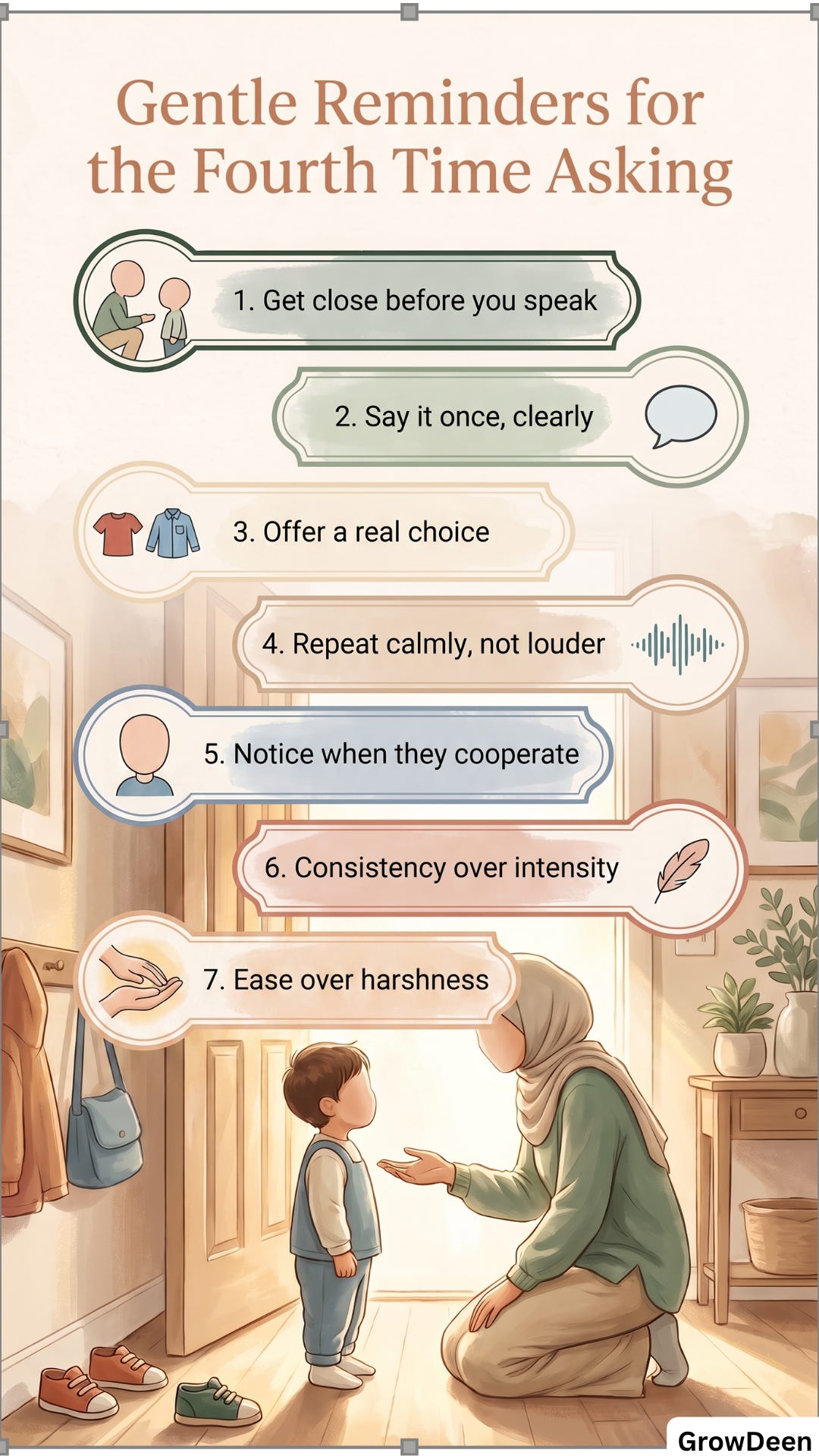
Get their attention first. Half of “my child doesn’t listen” is really “my child never heard me.” Get close, within about two metres. Get down to eye level. Say the child’s name. Keep the voice low. A three-year-old with cartoons on across the room may not have registered a single word.
Keep it simple and age-matched. A toddler can manage “please put the blocks in the box.” A five- or six-year-old can handle “please put the blocks in the box, then put the box on the shelf.” One instruction at a time under age four. Save the two-step version for later.
Say what’s wanted, not what isn’t. “Please chew with your mouth closed” does more work than “stop eating like that.” A positive instruction shows exactly what success looks like. A negative one only shows what failure looked like, and leaves the rest to guesswork.
Build a real choice into it. “Time to get dressed. Red shirt or blue shirt?” The child gets dressed either way. But now there’s a choice inside it. This isn’t a trick, either. Researchers studying command effectiveness found something close to this independently: instructions bundled with a small, genuine choice get followed more reliably than flat commands with none. [3]
Ask for it back, early on. A quick repeat-it-to-me check confirms the child actually understood, not just heard something. Once cooperation is reliable, drop this unless it stops working.
Be ready to say it again. Calmly. If nothing happens the first time, repeat it in the same steady voice. “Shoes on now, please.” A small reason helps: “Shoes on quickly and we’ll have more time at the park.” For a younger child, shorter still: “First shoes. Then park.”
Use consequences once a child is past three. “Please put your other toys away before I get out the paints. If they’re not put away, we won’t be painting today.” Not exciting. Reliable, though, when followed through every time. Parent-training research consistently finds that consistency, not severity, predicts whether behaviour actually improves. [4]
That’s a lot to hold in mind during a rushed morning. Nobody needs all seven at once. Two is a fine place to start.
The Sunnah Already Modeled This
Something worth sitting with here.
Allah says in the Qur’an, “O you who believe, fear Allah and speak qawlan sadidan” — a word that is straight, correct, and hits the mark [Quran 33:70]. According to Tafsir Ibn Kathir, this describes speech that discloses facts accurately: relevant, fitting, and to the point, with no crookedness or distortion. It’s not a verse about politeness in the abstract. It’s a command about the accuracy and directness of what leaves the mouth.
That maps almost exactly onto the difference between “why does nobody listen to me” and “please put your shoes on now.” One is vague and misses the mark entirely. The other is qawlan sadidan: correct, direct, and aimed precisely at what’s needed. This verse asks for the second one, even on the fourth repetition of the morning.
There’s a second thread worth knowing too. Aisha (RA) narrated that whenever the Prophet ﷺ was given a choice between two permissible matters, he chose the easier one [Sahih al-Bukhari 3560]. Centuries before any parenting researcher studied command effectiveness, the Sunnah had already arrived at something close to the same conclusion: build in the easier, gentler path wherever that’s genuinely possible.
This is tarbiyah in its least glamorous form. Not one formative lecture. Just the tone taken, ordinary Tuesday after ordinary Tuesday, asking a three-year-old to put the blocks away.
What’s striking is how directly these line up. The research on wording instructions well and the Prophetic habit of choosing ease are pointing at the same target, just centuries apart.
Building the Habit, Not Just Surviving the Moment
A few things that compound over weeks, not minutes:
Use the same cue words every time. “Listen,” “you need to,” “now please.” Said the same calm way, it becomes a signal a child’s brain learns almost automatically.
Name it out loud when cooperation happens. Skip the generic “good job.” Try “you put your shoes on the first time I asked, that made us so much quicker getting to the masjid.” Specific, descriptive praise has more staying power than vague approval, and it tells a child exactly what worked. [5]
Build routines. A predictable order for wudu, breakfast, getting dressed cuts down on the sheer number of one-off instructions needed at all.
Make it a game where possible. “Beat the buzzer” before the adhan. A race to tidy one side of the room. Movement, no stern word required.
Give a heads-up before the instruction lands. “In five minutes it’ll be time to pack the toys away.” Basic respect for the fact a child is mid-activity. It measurably cuts down on protest.
What This Looks Like at Different Ages
Toddlers, roughly two to three, need one step at a time and concrete language. Repetition here is typical, not a warning sign.
Preschoolers, four to five, can usually manage two-step instructions. This is exactly where offering choices starts to pay off.
By six to eight, most children can hold slightly more complex instructions and genuinely understand the reasoning behind them. A brief “because” is worth adding here.
📌 There’s a printable companion resource built around the exact wording swaps in this guide, ready for the fridge or the diaper bag. More on that shortly.
When Cooperation Just Doesn’t Come
Sometimes it isn’t defiance. It’s capacity. A child who seems unable to do what’s asked may need the skill demonstrated first, not just named.
Tiredness, hunger, and fear all undercut cooperation too. Asking an exhausted, hungry child to tidy a room at the end of a long day was never really a fair test of anything.
There are also stretches, entirely normal ones, where children resist almost everything for a while. That’s development doing its thing, not a parenting failure. Staying consistent and warm, and saving the firmest energy for the instructions that matter most, safety chief among them, tends to matter more than getting every single interaction right.
If poor cooperation is constant, extreme, or shows up alongside very limited language, real difficulty understanding simple requests, or intense meltdowns that don’t ease with any of this, it’s worth a conversation with a doctor or paediatrician. This isn’t a substitute for medical advice. A professional can help tell the difference between what’s typical for a child’s age and what deserves a closer look.
If a child has additional needs, coaching the other adults around them, older siblings, grandparents, anyone who spends regular time with the child, keeps instructions consistent across the people who matter most.
The Parent Checklist
Get close and get eye level before speaking
Decide: is this a request or an instruction, and say it as one, not both
Keep it short, positive, and matched to the child’s age
Offer a real choice where possible
Be ready to repeat calmly, more than once
Use consequences consistently once a child is past three
Notice and name it out loud when cooperation happens
Cooperation isn’t something pulled out of a child through the right combination of words. It’s built, instruction by instruction, across months and years, in a home where the tone leans closer to qawlan sadidan than to a raised voice.
May Allah place barakah in the ordinary, repetitive work of asking gently, and make it lighter than it feels most mornings.
Do This Right Now
Before closing this tab: pick just one thing from the checklist above and use it on the very next instruction given today. Not the whole list. Just that one. Notice what happens.
Introducing: The Cooperation Cue Cards
Reading this far usually means one thing: real interest in how instructions are worded, not just what’s being asked for. That’s worth noticing.
These wording shifts can be a lot to remember mid-morning-rush. That’s exactly why this exists.
Inside the Cooperation Cue Cards (one comprehensive PDF, 3 pages):
Page 1: Ask or Tell? A Quick Fridge Reference — A two-column phrase-swap card pairing common vague or harsh phrasings with clear, kind request and instruction wording straight from this article — designed as a card to stick on the fridge for the moments when the better wording is hard to find in the moment.
Page 2: The 5-Minute Cooperation Routine — A simple sequence card: get close, get down low, say it once, offer a choice, repeat calmly if needed — walkable confidently in under five minutes, even mid-tantrum.
Page 3: Qawlan Sadidan — A Reflection Card — The English translation of Qur’an 33:70 alongside a short reflection on choosing direct, correct, well-aimed words, closing with the narration of the Prophet ﷺ choosing the easier lawful path (Sahih al-Bukhari 3560).
This isn’t just a PDF to download and forget. It’s a tool designed to stay on the fridge or in the phone, ready for the moment it’s actually needed.
The Cooperation Cue Cards pack is what every subscriber receives with each article. The full journey of raising Muslim children is covered here, all backed by research and rooted in wisdom.
Muslim parents who want both evidence-based guidance and Islamic perspective can subscribe free so future resources arrive before they’re needed.
Subscribe free for parenting resources backed by both science and Sunnah, guidance so specific it isn’t found anywhere else. No spam, no clutter, just resources that matter.
Share This With Someone
Think of one person right now: the mother at the masjid who mentioned last week that bedtime has turned into a shouting match, a sister who texted at 9pm asking why her four-year-old “just won’t listen anymore,” a friend whose WhatsApp status is a string of exhausted parenting memes that aren’t really jokes.
This article could ease someone’s morning tomorrow. Sharing it isn’t advice-giving, it’s support. Sometimes the most loving thing to do is pass along what actually helps.
Frequently Asked Questions
Q: Why doesn’t my toddler listen even when I ask nicely?
A: Often it isn’t defiance, it’s that the instruction wasn’t heard, wasn’t clear enough for the child’s age, or their executive function, the part of the brain that holds an instruction and acts on it instead of an impulse, is still developing. [2] Getting to eye level first helps; see “Getting Instructions to Actually Land” above.
Q: What’s the actual difference between a request and an instruction?
A: A request gives a genuine choice to say no. An instruction says what to do and when, no vote involved. Mixing the two, like asking “why won’t anyone help me” when help is actually needed right now, is one of the most common sources of confusion for kids.
Q: At what age should consequences start?
A: Around age three is when most children can reliably connect a consequence to their own choice. Before that, consequences tend to confuse more than teach. [4]
Q: Does giving my child choices spoil them or make them harder to manage?
A: No. A small, real choice inside an instruction (red shirt or blue shirt, not “do you want to get dressed”) actually increases cooperation rather than reducing it. [3] The instruction still happens either way.
Q: How many times is it normal to repeat an instruction?
A: More than once, often. Repetition isn’t a sign of failure; it’s frequently just where a child is developmentally. Staying calm and consistent on each repeat matters more than the number of repeats.
Q: Is there an Islamic basis for using direct, positive wording with kids?
A: Yes. Qur’an 33:70 commands speech that is qawlan sadidan, straight, correct, and to the point, and the Prophet ﷺ is described as consistently choosing the easier of two permissible options (Sahih al-Bukhari 3560). Both point toward clear, ease-focused instructions rather than vague or harsh ones.
Q: When should lack of cooperation be a concern?
A: If it’s constant, extreme, or paired with very limited language, difficulty understanding simple requests, or intense meltdowns that don’t ease with consistent, gentle strategies, it’s worth speaking with a doctor or paediatrician. Not a diagnosis, just a signal worth a closer look.
References
[1] Kaminski, J.W., Valle, L.A., Filene, J.H., & Boyle, C.L. (2008). A meta-analytic review of components associated with parent training program effectiveness. Journal of Abnormal Child Psychology, 36(4), 567–589. https://doi.org/10.1007/s10802-007-9201-9
[2] Zelazo, P.D., & Carlson, S.M. (2012). Hot and cool executive function in childhood and adolescence: Development and plasticity. Child Development Perspectives, 6(4), 354–360. https://doi.org/10.1111/j.1750-8606.2012.00246.x
[3] Roberts, M.W., & Powers, S.W. (1988). The compliance-noncompliance paradigm in child behavior assessment and treatment. Journal of Clinical Child Psychology, 17(4), 302–306.
[4] American Academy of Pediatrics, Sege, R.D., Siegel, B.S., et al. (2018). Effective discipline to raise healthy children. Pediatrics, 142(6), e20183112. https://doi.org/10.1542/peds.2018-3112
[5] Owen, D.J., Slep, A.M.S., & Heyman, R.E. (2012). The effect of praise, positive nonverbal response, reprimand, and negative nonverbal response on child compliance: A systematic review. Clinical Child and Family Psychology Review, 15(4), 364–385.
[6] Qur’an 33:70. Tafsir Ibn Kathir, verified via quran.com/en/33:70/tafsirs and surahquran.com.
[7] Sahih al-Bukhari 3560. Verified via sunnah.com/bukhari:3560.
Insha Allah one day when I have a child I will be looking to you for advice
May Allah swt reward the Muslim parenting team abundantly 🤍