
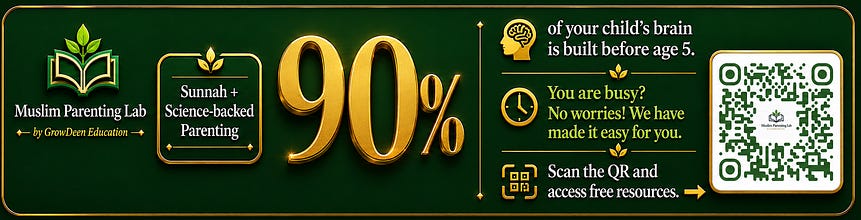

By 12 months, some babies understand only 20 words while others understand more than 150 — a 7-fold gap that research traces directly to early parental language input. [9] This guide shows you what’s actually happening in your baby’s brain right now, and why the Prophet ﷺ’s teaching that “a good word is Sadaqa” [7] is the most precisely timed parenting advice you will ever receive.
It doesn’t happen the way you expect.
You’ve been saying “mama” for months. Then one afternoon your baby looks straight at you — not at the window, not at the thing you’re holding — and says it back. Deliberately. With your face in mind.
You know immediately it was different.
It was.
That moment is not just a word. It’s the beginning of something that researchers at the Hanen Centre identify as joint attention — the ability to share an experience through language, and one of the earliest predictors of long-term vocabulary fluency. [4] Your baby isn’t just producing a sound. They’re inviting you into their experience of the world.
The question is whether you know how to accept the invitation.
Why This Guide Is Different From Generic Milestone Lists
Research-backed and age-specific. Every milestone and recommendation here is grounded in current evidence from peer-reviewed developmental research, the CDC’s 2022 milestone framework, and the Hanen Centre’s language development guidance — not generic parenting advice. [3][4][5]
Islamic and scientific at once. This isn’t a guide with an Islamic note tacked on at the end. The Prophet ﷺ taught that a good word is Sadaqa, and developmental science teaches that every responsive word you speak to your baby right now shapes their language brain. We hold both truths at once — because they are the same truth. [7]
Practical and printable. At the end, you’ll find the free Your Baby’s First Year Companion Pack — a three-page printable PDF with a milestone reference card, a daily word-building planner, and an Islamic tarbiyah card for your fridge.
The Hidden Milestone Most Parents Miss
Here’s something that surprises almost every parent: the most significant milestone at 11–12 months is not the first step.
It’s the pointed finger.
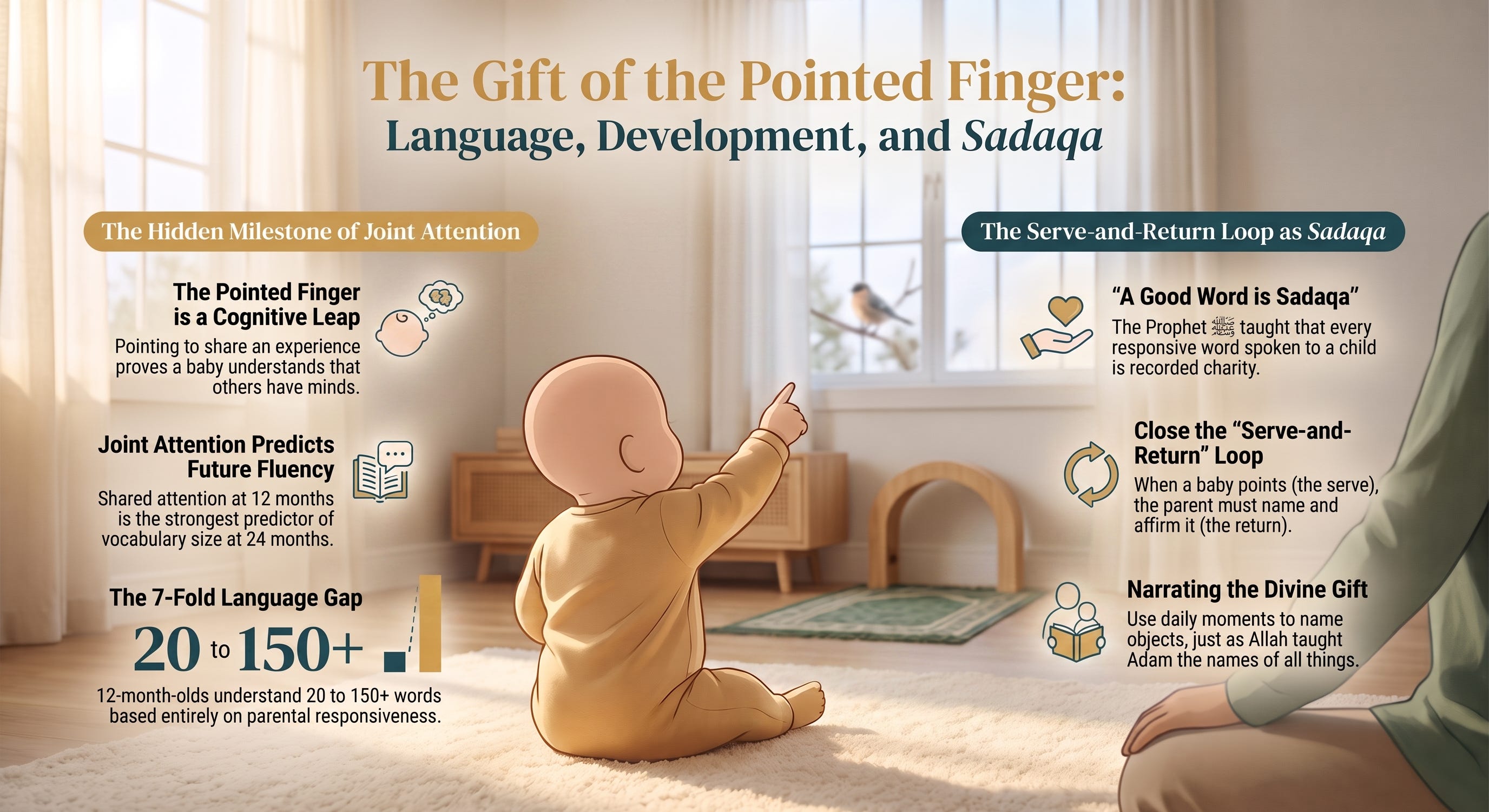
When your baby points at something and looks back at you — not to get it, but just to make sure you see it too — that is joint attention, and it is one of the most profound developmental leaps the infant brain makes. [4] It means your baby now understands that other people have minds. That you can share an experience. That language is for connecting, not just labelling.
Joint attention at 12 months is one of the strongest predictors of vocabulary size at 24 months that researchers have identified. [4] And here is the part that matters for you: it grows through exactly what you’re already doing — looking where your baby looks, naming what they point to, and responding every single time they reach out to you communicatively.
What First Words Actually Mean
First words usually arrive between 10–14 months — one or two sounds your baby uses consistently, deliberately, with meaning attached. [3] By 12 months, many babies say “mama,” “dada,” or another word consistent with their home environment.
But here’s what tends to go unnoticed: receptive language — what your baby understands — already far outpaces what they can say.
When you hold out your hand and say “give me the cup,” and your baby looks at it, pauses, then hands it to you — that is a moment of real cognitive achievement. The word “cup” now exists in their mind with a meaning. They have built a concept.
By 12 months, the range in receptive vocabulary across children is already dramatic: some babies understand around 20 words, while others understand more than 150. [9] That gap doesn’t reflect intelligence. It reflects the density and responsiveness of the language environment around them in the first year.
What you say. How you respond. Whether you reply when they babble. All of it is accumulating, right now, in ways that will show up in their vocabulary at 18 months, at 24 months, and beyond.
Movement: The Wide Range of Normal
Your baby is also working hard in movement. Most babies at 11–12 months are pulling to stand and cruising along furniture using whatever surface they can hold. Many take first independent steps — though the range for healthy walking in typically developing children spans roughly 9 to 15 months. [5] A baby not yet walking at 12 months, in the absence of other concerns, is usually within normal variation. Development is not a race.
Fine motor development is advancing too. The pincer grasp — picking up small objects cleanly between the thumb and index finger — is typically well established now. [5] This is why self-feeding with fingers suddenly goes so much better at this stage. That improved control is not incidental. It reflects the same neurological maturation that’s driving language and thinking.
Play, Thinking, and the Beginning of Symbolic Life
At 11–12 months, your baby is showing something remarkable: the beginning of pretend play.
When they hold a cup to their lips and mime drinking, they are holding in mind that the cup represents the act of drinking even without liquid present. That is symbolic thinking. [6] It is a prerequisite for language itself — the same cognitive capacity that allows a sound to represent a thing, or a word to represent a feeling.
This is also the stage where following simple one-step instructions becomes possible. “Put it in.” “Give me that.” Your baby isn’t just obeying. They are demonstrating that language, memory, and voluntary movement are integrating — that the word has connected to an action in their mind. [3]
Emotionally, something interesting is happening alongside all of this. Your baby is showing growing independence — the head shake that means no, the deliberate preference, the reach toward what they want — while remaining visibly, completely attached to you.
This is not contradiction. It is the exact signature of healthy development. Secure attachment is precisely what makes exploration possible, because the child trusts that the world is safe and you will return. Both things grow from the same root.
I’ve created a free resource to put all of this in one printable place. Keep reading to find the Your Baby’s First Year Companion Pack at the end — it’s designed for the spaces in your home where you actually do this work.
When Allah Taught Adam the Names of Things
When I reflect on what is happening at 11–12 months — this threshold where babble becomes word and gesture becomes invitation — I find myself returning to a verse from early in the Qur’an.
“He taught Adam the names of all things.” [Qur’an 2:31] [2]
According to Tafsir Ibn Kathir, this verse describes the divine gift that elevated Adam ﷺ above all creation: the capacity to name. Ibn ‘Abbas explains it as encompassing the names of everything — sky, earth, animal, plant, every created thing — the full generous gift of knowing what things are and being able to say so.
Your baby is beginning to receive that same gift. Right now. In your kitchen, in your arms, on your floor.
And then there is this:
The Prophet ﷺ said, “A good word is Sadaqa (charity).” [Sahih Muslim 1009] [7]
Every word you speak to your baby — the naming, the narrating, the patient response to the tenth babble of the afternoon — is an act of charity written in your book of deeds. Not once in a while. Every time.
Developmental science says that responsive conversation is the most powerful thing you can do for your baby’s language brain at this stage. The Sunnah says those words are Sadaqa. There is no tension between the two. They are the same truth, arriving from different directions.
How to Actually Support Language Right Now
The thing most language advice misses: it’s not about volume of words. It’s about response.
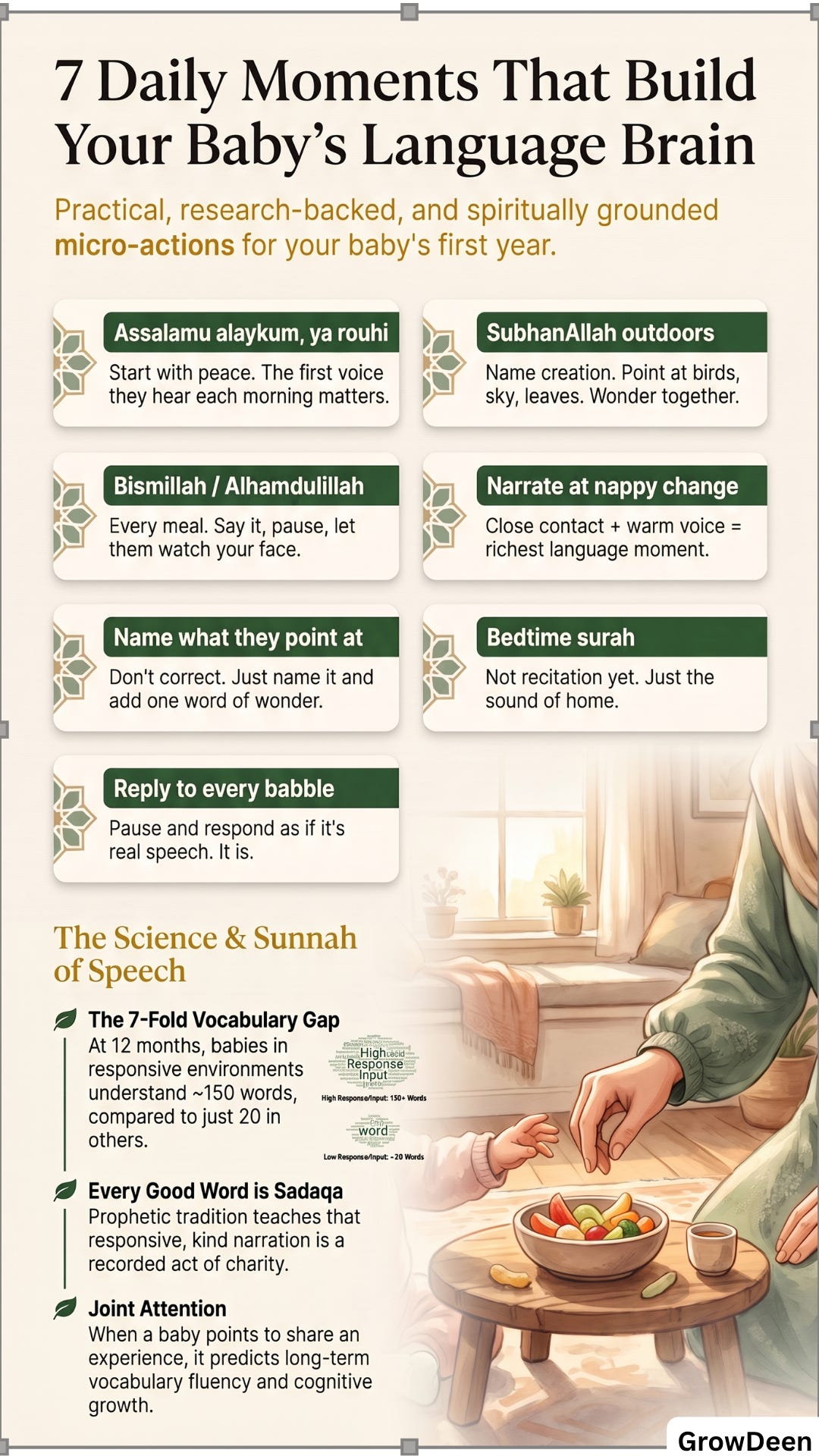
The serve-and-return loop — your baby communicates (babble, point, gesture), you respond (name it, affirm it, build on it), the loop closes — is the foundational mechanism of early language development. [1] You don’t need special toys or apps. You need to be present and reply.
When your baby points — name it. Add a word of wonder if you can. “Bird. SubhanAllah, look at that bird.”
When they babble — pause and reply. Look at them. Respond as if they’ve said something real. They have. You just haven’t decoded it yet.
During meals — say Bismillah before, Alhamdulillah after. They cannot say these yet. But they are listening, always.
During bath or nappy change — narrate warmly. Close physical contact plus calm, responsive speech is one of the richest language environments your baby can be in. [10]
At bedtime — a short surah, a softly spoken du’a, stillness. You are not teaching recitation yet. You are planting the sound of the Qur’an as safety, as home, as the voice of the one who loves them.
Every one of these moments is Sadaqa.
When to Speak With a Paediatrician
By 12 months, it’s worth speaking with a paediatrician if your baby is not babbling or attempting sounds; is not using gesture (pointing, waving) to communicate; does not respond to their name when called; is not attempting any words; does not make consistent eye contact; is not pulling to stand or bearing weight on legs; or has lost skills they previously had in any area. [5][11]
Early is always better. Seeking support is not overreacting. It is the responsible fulfilment of the amanah of parenthood.
A Note for the Parent at the End of Year One
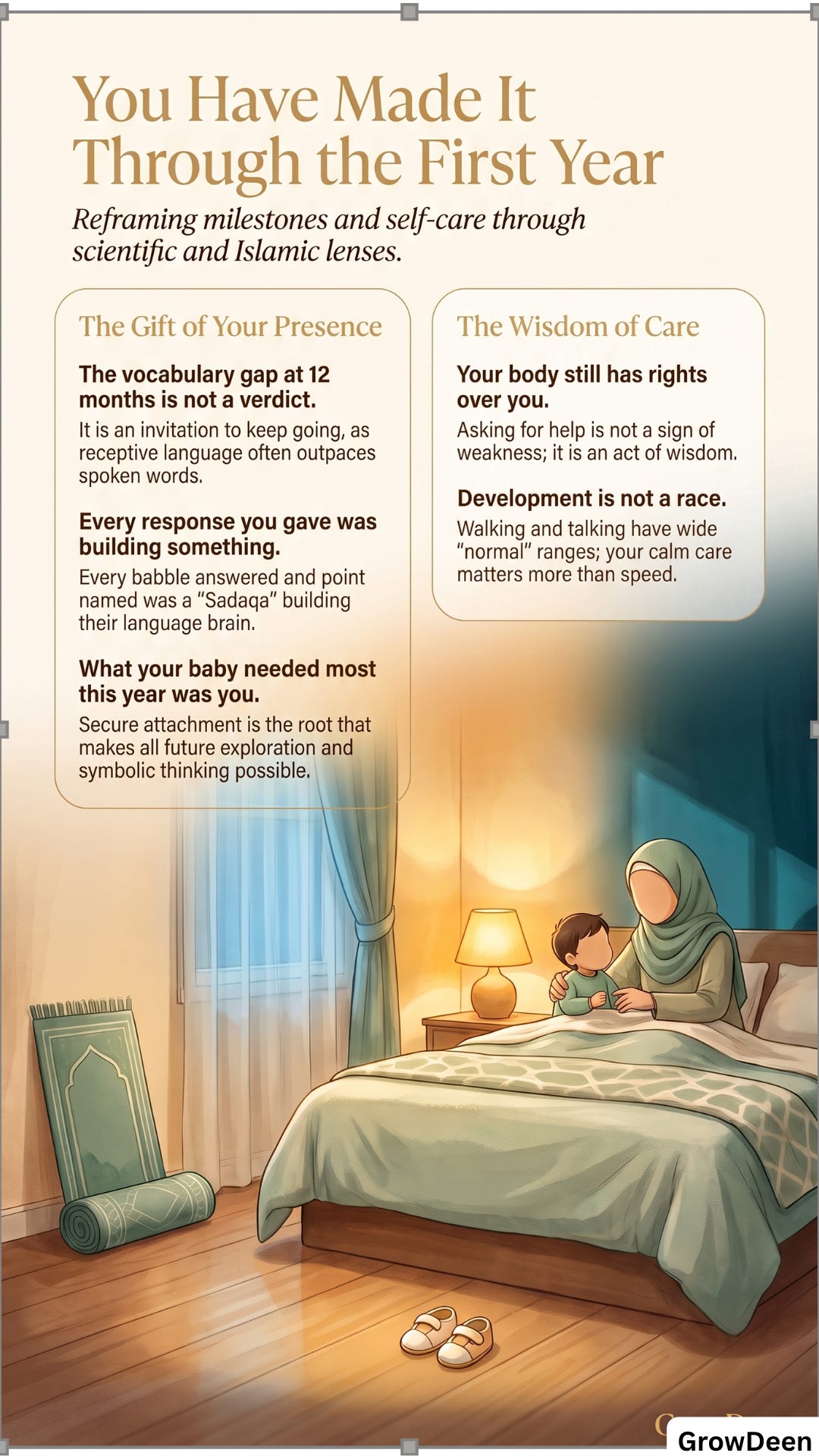
You have done something extraordinary this year.
Twelve months of sustained attention, physical endurance, emotional presence, and love that arrived bigger and more exhausting than anyone told you it would. You showed up, day after day.
Your body still has rights over you. If you are experiencing persistent sadness, anxiety, or anger that feels beyond your reach — tell your doctor. Postnatal mental health concerns do not always resolve in the early months. They are treatable. Asking for help is not weakness; it is what a thoughtful parent does. [8]
Your Micro-Action for Today
The next time your baby points at something — anything — pause. Look at it with them. Name it. Look back at them.
That is the serve-and-return loop. That is the language research and the Sunnah in one gesture.
Do that one thing today. Notice how they respond.
Your Baby’s First Year Companion Pack
If you’ve read this far, you’re the kind of parent who takes your baby’s development seriously — not as performance, but as trust. That says something real about you.
Inside the Your Baby’s First Year Companion Pack (one comprehensive PDF, 3 pages):
Page 1: 12-Month Milestone Reference Card — A complete, domain-by-domain milestone tracker covering communication, motor, play, social, and understanding — formatted as a clean, printable reference card you can keep as a record of your baby’s first year and as a guide for what to watch for in the months ahead.
Page 2: Daily Word-Building Planner — Seven specific daily conversational moments mapped to the language-development principles in this article: morning greeting, mealtime narration, floor play, outdoor walks, book reading, bath time, and bedtime — with a simple prompt for each so you always know what to do.
Page 3: The Language of Love: A Daily Sadaqah Card — Anchored in the Prophet ﷺ’s teaching that “a good word is Sadaqa” [Sahih Muslim 1009] and the Qur’anic gift of names given to Adam ﷺ [Qur’an 2:31], this tarbiyah card features the Arabic text, transliteration, and five specific daily moments when a parent’s kind word becomes an act of recorded worship. Designed for your fridge — to remind you that what you’re doing is not small.
This isn’t just a PDF to download and forget. It’s designed to stay in the place where you do your daily work — where you’ll see it when you need it most.
This Companion Pack is what every subscriber receives with each article. At Muslim Parenting Lab by GrowDeen Education, we cover the full journey of raising Muslim children — from newborn to school age — all backed by current research and rooted in authentic Islamic guidance.
If you want evidence-based parenting resources that take both science and Sunnah seriously, subscribe free so future resources arrive in your inbox before you need them.
Subscribe free — science-backed, Sunnah-rooted parenting guidance you genuinely cannot find anywhere else. No spam. No daily emails. Just resources that matter.
Think of One Person
Think of one person right now: a mother in your family approaching the end of her baby’s first year, exhausted and wondering if she’s done enough. A friend whose WhatsApp messages show the same sleep-deprived, uncertain love you know so well. A sister who would cry with relief to read that every word she speaks to her baby is Sadaqa.
This article could reach them. Share it today — not as advice, but as company. Sometimes the most loving thing we can do is pass along what helped us see clearly.
Frequently Asked Questions
Q: What words should my baby be saying by 12 months?
A: Most babies say one or two meaningful words by 12 months — “mama,” “dada,” or another word they use consistently with meaning attached. [3] But receptive language (what they understand) almost always outpaces expressive language (what they produce) at this stage. If there are no words and no babbling and no gestures by 12 months together, that combination is worth raising with a paediatrician.
Q: What is joint attention and why does it matter for language?
A: Joint attention is when your baby points at something and looks back at you to check you’ve noticed — not to get it, but to share the experience. [4] It’s one of the strongest early predictors of vocabulary development, and it typically emerges between 9 and 14 months. It signals that your baby now understands other people have minds — a genuinely extraordinary milestone that tends to get overshadowed by first steps.
Q: My baby isn’t walking at 12 months. Should I be worried?
A: Not necessarily — independent walking in healthy children spans roughly 9 to 15 months, with 12 months being the average rather than a requirement. [5] What matters more is that your baby is pulling to stand and bearing weight on their legs. If you have concerns, mention them to a paediatrician, but later walking within that range without other concerns is usually not cause for alarm.
Q: How big a difference does talking to my baby really make?
A: Significant — and measurable. By 12 months, babies in richer language environments understand more than 150 words, while those in less responsive environments may understand around 20. [9] That gap is not about intelligence. It reflects the language input they’ve received. And it widens through the second year unless the environment changes. The good news: you don’t need scripts or programmes. Responsive conversation — naming what they point to, replying to their babble, narrating your day — is exactly what the research shows makes the difference. [1]
Q: Is it normal for my baby to understand things before they can say them?
A: Completely normal, and a sign of healthy development. [3] Receptive language (comprehension) always develops ahead of expressive language (production). A baby who can hand you the right object when asked but can only say “ba” is right on track. The expressive gap closes through the second year as vocabulary production accelerates.
Q: What is the Islamic significance of a baby’s first words from a tarbiyah perspective?
A: The Qur’an describes language as one of the most significant divine gifts to humanity — Allah taught Adam ﷺ the names of all things (Qur’an 2:31) as the distinction that elevated him above creation. [2] And the Prophet ﷺ taught that a good word is Sadaqa (Sahih Muslim 1009). [7] From a tarbiyah perspective, a baby’s first intentional words mark the beginning of their entry into this gift — and every warm, Islamically-infused word a parent speaks to them is simultaneously developmental support and a registered act of worship.
References
[1] Center on the Developing Child at Harvard University. (2017, updated 2021). Three principles to improve outcomes for children and families, 2021 update. Harvard University. https://developingchild.harvard.edu/resources/report/three-principles-to-improve-outcomes-for-children-and-families/
[2] Qur’an 2:31. “He taught Adam the names of all things.” Tafsir Ibn Kathir: Allah taught Adam the names of all created things — as reported by Ibn ‘Abbas, encompassing the names of every species and created thing. Verified at https://quran.com/2/31
[3] Onigbanjo, M.T., & Feigelman, S. (2020). The first year. In R. Kliegman & J.W. St Geme III (Eds), Nelson textbook of pediatrics (22nd edn, pp. 151–156). Elsevier.
[4] Lowry, L. (2022). Paying attention to children’s joint attention. The Hanen Centre. https://www.hanen.org/information-tips/paying-attention-to-childrens-joint-attention
[5] Zubler, J.M., Wiggins, L.D., Macias, M.M., Whitaker, T.M., Shaw, J.S., Squires, J.K., Pajek, J.A., Wolf, R.B., Slaughter, K.S., Broughton, A.S., Gerndt, K.L., Mlodoch, B.J., & Lipkin, P.H. (2022). Evidence-informed milestones for developmental surveillance tools. Pediatrics, 149(3), Article e2021052138. https://doi.org/10.1542/peds.2021-052138
[6] Yogman, M., Garner, A., Hutchinson, J., Hirsh-Pasek, K., Michnick Golinkoff, R., Committee on Psychosocial Aspects of Child and Family Health & Council on Communications and Media. (2018). The power of play: A pediatric role in enhancing development in young children. Pediatrics, 142(3), Article e20182058. https://doi.org/10.1542/peds.2018-2058
[7] Sahih Muslim 1009. Narrated by Abu Hurairah ؓ. The Prophet ﷺ said: “A good word is Sadaqa (charity).” Graded: Sahih. https://sunnah.com/muslim:1009
[8] Kliegman, R.M., & Marcdante, K.J. (2019). Nelson essentials of pediatrics (8th edn). Elsevier.
[9] Krueger, A.C., & Tomasello, M. (1996) / Newman, R., Ratner, N.B., Jusczyk, A.M., Jusczyk, P.W., & Dow, K.A. (2006), as reviewed in: Marvin, C.A., et al. (2021). Toddlers’ ability to leverage statistical information to support word learning. PLOS ONE. Peer-reviewed findings: by 12 months, receptive vocabulary ranges from approximately 20 words to more than 150 words, with variability directly linked to quality and responsiveness of early language input. https://pmc.ncbi.nlm.nih.gov/articles/PMC8063043/
[10] Yogman, M., & Garfield, C.F. (2016). Fathers’ roles in the care and development of their children: The role of pediatricians. Pediatrics, 138(1), e20161128. https://doi.org/10.1542/peds.2016-1128
[11] Centers for Disease Control and Prevention (CDC). (2022). Important milestones: Your child by one year. CDC. https://www.cdc.gov/ncbddd/actearly/milestones/milestones-1yr.html