

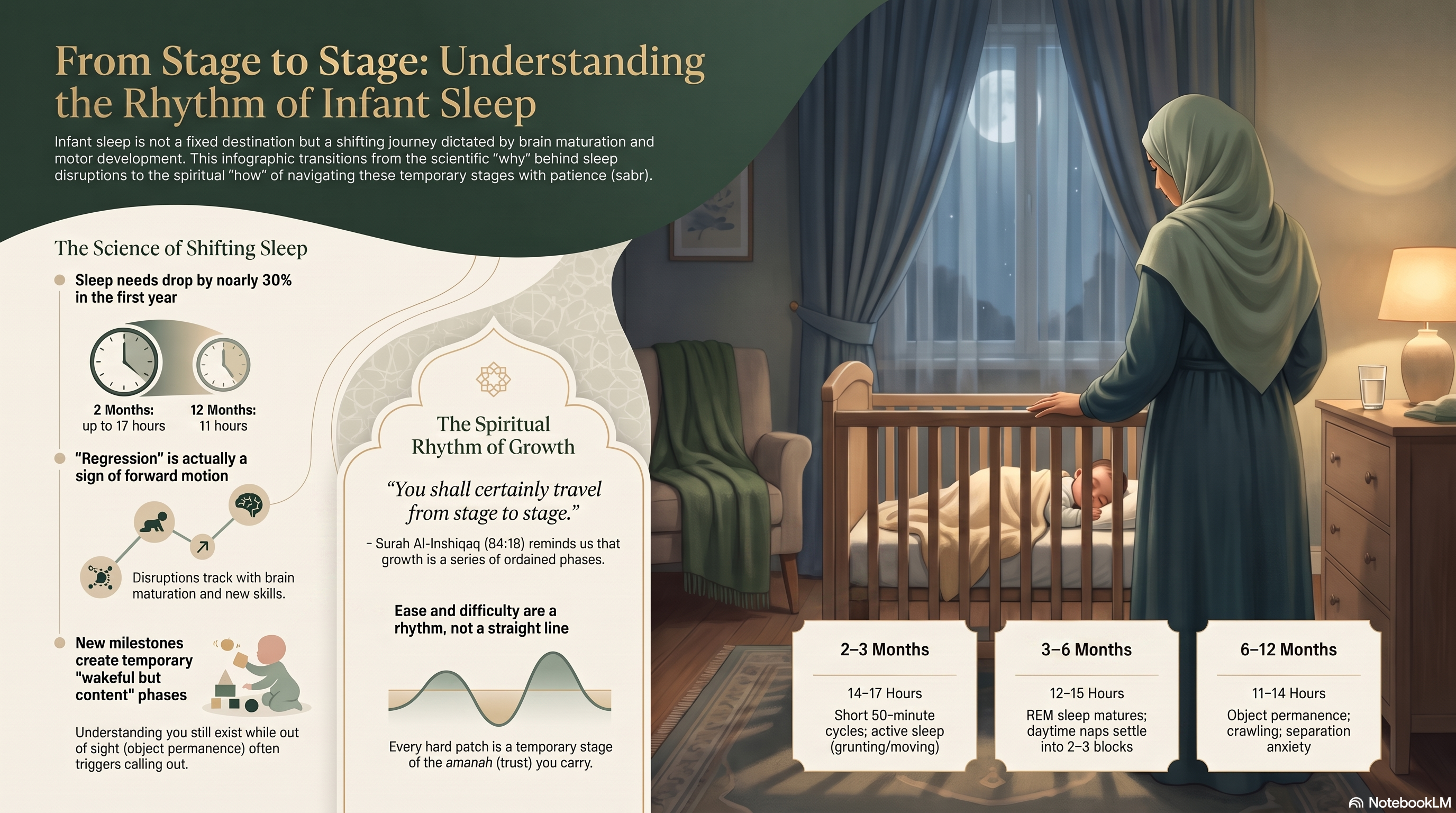
The National Sleep Foundation’s guidelines put infant sleep needs at up to 17 hours a day around 2 months, dropping to as little as 11 hours by the end of the first year [1] — nearly a third less sleep, and a shift researchers link directly to normal brain development, not to anything going wrong.
It’s 2:40 in the morning and you’re standing over the crib again, doing that thing where you try to figure out, half-asleep yourself, whether this cry means hungry or just wants-you-here. Two weeks ago your baby slept five hours straight. Tonight is the third short stretch in a row.
You start doing the math nobody asked you to do: how many hours you got, how many you’ll get, whether this counts as “sleeping through the night” by anyone’s definition. It doesn’t. And somewhere in the back of your mind is a friend’s baby, or a cousin’s baby, who apparently cracked this months ago.
Here’s what would have helped to know three weeks in: your baby’s sleep was never supposed to hold still. It’s built to shift, stall, lengthen, shorten, and shift again — on a timeline that has almost nothing to do with what the baby down the street is doing.
Why This Guide Is Different
It treats “regression” as what it actually is. Most guides talk about disrupted sleep like it’s a malfunction. The research says otherwise — these shifts track directly with brain development, not with something you’ve done or failed to do [1][6][10].
It gives you a week-by-week and month-by-month map, not a single number. Sleep needs at 2 months and sleep needs at 11 months are two different worlds. This guide walks through both, plus everything in between.
It holds the Islamic and the practical together, instead of separating them. The Qur’an’s own language for how humans move through life — stage by stage — turns out to describe your baby’s sleep almost exactly. That’s not a coincidence worth skipping past.
Every Baby’s Sleep Is Genuinely Different
Adults don’t all need the same amount of sleep. Neither do babies [2][4]. Some babies function well on less than the “average” for their age. Some need more. None of it is a referendum on your parenting.
A better gauge than any chart is your baby, right in front of you. Wakeful and grizzly, most days? They may need more sleep opportunities built into the day. Wakeful but genuinely content? They’re probably fine — even if the number of hours doesn’t match what a chart says it should [2].
How Sleep Actually Shifts, Month by Month
2–3 months. Most babies sleep 14–17 hours across a full day, in short cycles of about 50–60 minutes — active sleep (twitching, grunting, moving) alternating with quiet sleep (deep and still) [1][6]. At the end of each cycle there’s usually a stir, sometimes a grizzle, occasionally a full cry, and a baby often needs a hand getting into the next cycle. This is the architecture newborn sleep is built on, not a sign something needs fixing. Day-night rhythms start forming around here too.
Around 3 months. Total sleep holds near 14–17 hours, but the structure matures — light, deep, and dream (REM) sleep separate into more distinct phases [3][6]. Some babies string together 4–5 hour night stretches at this point. Others don’t yet. Both are within range.
3–6 months. Sleep drops to roughly 12–15 hours a day [5]. Daytime naps often settle into two or three sleeps, up to two hours each. Night sleep lengthens — six-hour stretches by six months aren’t unusual — but a night waking or two is still completely typical here [1][9].
6 months to the end of the first year. By the time the first year is complete, most babies sleep 11–14 hours across 24 hours [5]. Bedtime usually lands somewhere between 6 and 10 p.m., and most babies settle in under 40 minutes — some take longer. Sleep cycles start resembling adult architecture more closely, which for some babies means fewer wake-ups. Plenty of others still wake 3–4 times a night and need a parent to help them back down [1][9]. Daytime sleep is usually two to three naps of 30 minutes to two hours.
Why the Second Half of the Year Gets Harder Before It Gets Easier
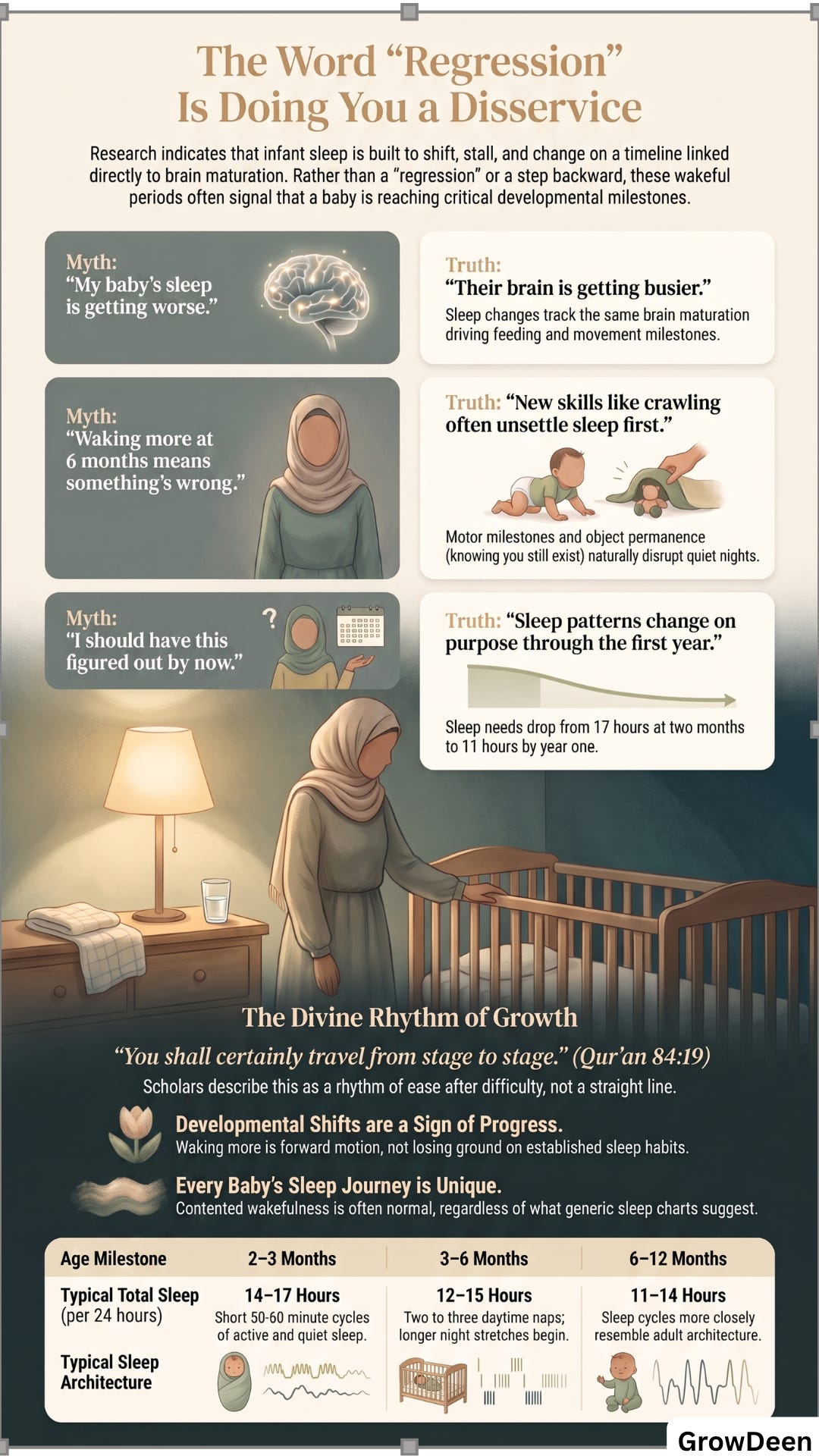
Something happens developmentally from about six months on, and it lands squarely on sleep.
Babies develop object permanence — understanding that people and things keep existing even out of sight [7]. A baby who slept peacefully alone at four months might start calling out at eight months, not because anything’s wrong, but because they now know, with total certainty, that you still exist somewhere in the house.
New motor skills add to it. Learning to crawl or pull to stand can genuinely disrupt sleep — sometimes literally, when a baby gets stuck standing in the cot and hasn’t learned how to get back down yet [1]. Then there’s separation anxiety: real distress at being apart from a parent, which can make bedtime and night waking harder for a stretch. It isn’t manipulation. It’s a normal phase that eases as trust builds that you’ll come back [8]. Temperament plays into all of it too — some babies settle more easily than others, and that’s simply who they are.
Night Feeds Don’t Have a Deadline
Around six months, if your baby is healthy and growing well, it becomes reasonable to think about reducing night feeds. It isn’t required. If overnight feeding is still working for your family, there’s no clock forcing a stop [9].
Some parents use a “rollover feed” — a gentle feed between 10 p.m. and midnight, right before the parent goes to bed — to help stretch the following sleep window [1]. Works for some babies. Does nothing for others. Neither outcome means you’re doing it wrong.
“Sleep Regression” Is a Misleading Name for a Good Sign
You’ve likely heard the phrase — sleep that was going well suddenly isn’t, and someone calls it a regression, like the baby’s sliding backward.
The research doesn’t really back that framing. Sleep changes across the first year track the same brain maturation that drives changes in feeding and movement [1][6][10]. A baby who slept long newborn stretches and is waking more now isn’t losing ground. Their brain is doing exactly what it’s meant to do at that stage, and sleep temporarily takes the hit for it.
What the Qur’an Teaches Us About Stages That Pass
Somewhere in one of those hard stretches, I keep coming back to a verse from Surah Al-Inshiqaq. Allah says:
“You shall certainly travel from stage to stage.” [Qur’an 84:19]
According to Tafsir Ibn Kathir, the companion Ibn ‘Abbas explained this phrase simply as “stage after stage.” The tabi’i Ikrimah went further, describing it as weaned after he was breastfeeding, and an old man after he was a young man — a direct picture of a child’s growth. Al-Hasan al-Basri added his own reading of the same phrase: ease after difficulty, difficulty after ease. Not a straight line. A rhythm.
That’s more or less exactly what a baby’s first year of sleep looks like. Long easy stretches. A hard patch when a new skill lands. Ease again. Another hard patch when separation anxiety peaks. None of these stages is the “real” baby who’s gone missing, and none of them is permanent. Allah built human development to move through stages, not to arrive somewhere fixed and stop moving.
That reframes the exhausting weeks. You aren’t managing a failure. You’re walking beside your baby through an ordained, temporary stage — and the same wisdom that decreed the hard stage decreed that it passes. A quiet du’a for sabr at 2 a.m., the decision to keep going when you’re running on nothing, is itself part of carrying the amanah of this particular child, at this particular stage, with mercy.
If you’re tracking sleep concerns and trying to figure out whether what you’re seeing is typical, this is exactly where the tracker in this week’s companion pack becomes useful — more on that in a moment.
Support Muslim Parenting Lab ❤️
Worried that giving will leave you with less? Give an amount you will not feel, with the button below.
The Prophet ﷺ said charity does not decrease wealth. (Sahih Muslim 2588)
If You’re Worried, Track It Before You Troubleshoot It
When sleep concerns start to feel like they’re spiraling, a simple 5–7 day tracking chart brings more clarity than another late-night search. Mark hourly blocks across day and night, shade in when your baby’s asleep, note wake-ups and how long resettling takes.
Compare a week’s worth of data honestly against what’s typical for your baby’s age. Wakeful and distressed, sleeping noticeably less than peers? More sleep opportunities during the day may help. Over six months, waking 3–4+ times a night? Common — but if it’s leaving you unable to function, that’s worth raising with a professional, chart in hand.
Your Sleep Matters Here Too
I know this is a lot to hold, especially when you’re already running on fumes most nights. That’s exactly why this week’s companion pack includes a 7-day tracker built to fit in a diaper bag or nightstand drawer — not just information, but a tool you’ll actually reach for at 3 a.m.
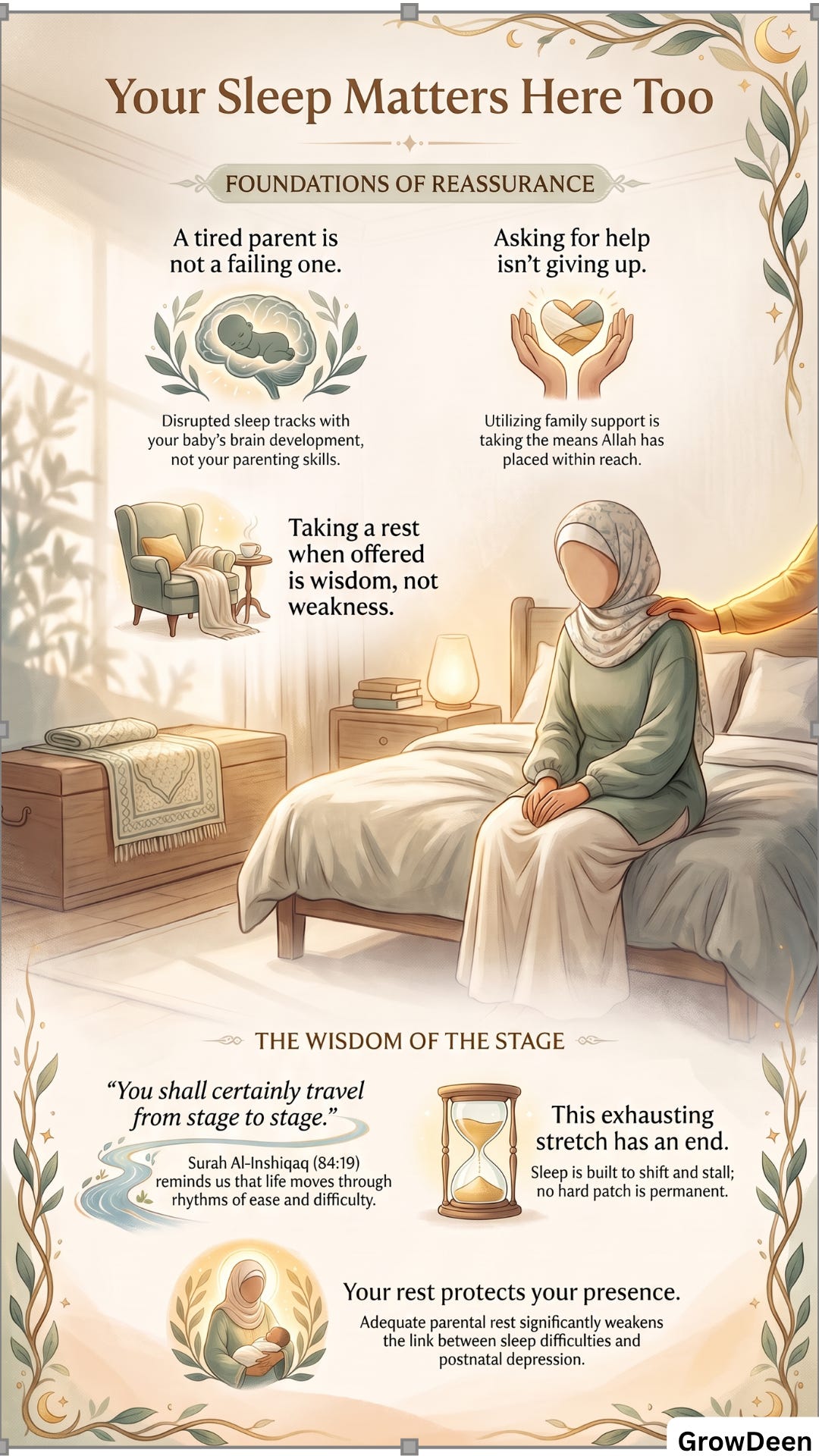
Most parents of babies under six months are woken overnight, often repeatedly, and for many that continues well past the first year. Chronic sleep loss isn’t a minor inconvenience — it touches mood, patience, and how present you can be with your baby during the day [1][9].
Asking for help isn’t a failure. A partner taking a night shift, a family member sitting with the baby for two hours so you can sleep uninterrupted — these aren’t signs you couldn’t manage. They’re taking the means Allah has placed within reach.
There’s a documented link between infant sleep difficulty and symptoms of postnatal depression, in birthing and non-birthing parents alike — though that link weakens considerably when parents themselves are getting adequate rest [1][9]. If exhaustion is affecting your mood or your ability to cope, that’s worth a conversation with a doctor. It isn’t a sign of weak trust in Allah. It’s wisdom.
When to Speak With a Professional
Reach out to a doctor or child health professional if your baby seems consistently unsettled well beyond what feels manageable, if sleep concerns come alongside worries about growth or feeding, or if the exhaustion is affecting your own mental or emotional health. This article is guidance, not a diagnosis — always follow your own doctor’s advice for your baby specifically.
Download Your Track the Stages: Baby Sleep Companion Pack
If you’ve read this far, you’re the kind of parent who wants to understand what’s happening with your baby’s sleep, not just make it stop being inconvenient. That tells me something good about how you’re doing this.
I know it’s hard to tell, in the middle of an exhausting stretch, whether what you’re seeing is normal or worth flagging to a doctor. That’s why I put together the Track the Stages: Baby Sleep Companion Pack — a printable guide with a week-by-week tracker and quick answers about what’s typical at each age. Keep reading to download it at the end of this article.
Inside the Track the Stages: Baby Sleep Companion Pack (one comprehensive PDF, 3 pages):
Page 1: 7-Day Sleep Tracker — an hourly-block grid across seven days, with a short “what I noticed” line for each day, designed as a printable sheet you can keep on the nightstand and shade in as you go — something to bring straight to a doctor’s visit if concerns come up.
Page 2: Age-by-Stage Sleep Reference Card — the 2–3, 3–6, and 6–12 month sleep-hour ranges and common developmental disruptors (crawling, separation anxiety) in one quick-glance card for the fridge or nursery wall — so you can check what’s typical in under a minute, even at 3 a.m.
Page 3: The “Stage to Stage” Islamic Reflection Card — Qur’an 84:19 in Arabic, transliteration, and English, alongside Ikrimah’s and Al-Hasan al-Basri’s tafsir points reframed as two short lines of reassurance for a hard night.
This isn’t just a PDF to download and forget. It’s a tool designed to stay on your nightstand or in your phone — where you’ll actually reach for it when you need it most.
This companion pack is what every subscriber receives with each article. We cover the full journey of raising Muslim children, all backed by research and rooted in Islamic wisdom.
Before you close this tab: pull up your notes app right now and jot down what time your baby actually fell asleep and woke up last night. Just that. One data point. Do it again tomorrow, and by the end of the week you’ll have exactly what the tracker in the companion pack is built to hold.
May Allah place barakah in your effort, accept your intention, and make the care you give more protective, more merciful, and more rewarded than it feels in the moment.
Share This With Someone Who Needs It
Think of one person right now: the friend who texted you at midnight asking if it’s normal that her baby “was sleeping so well and now isn’t,” your sister who keeps apologizing for how tired she sounds on the phone, someone at the masjid who mentioned in passing that bedtime has become a battle again out of nowhere.
This article could ease their worry tonight. Share it with them — not as advice-giving, but as the kind of thing you’d want someone to send you at 2 a.m.
Frequently Asked Questions
Q: Is it normal for a baby to wake up more at 6 months than they did at 3 months?
A: Yes — this is one of the most common patterns parents notice, and it usually tracks with new developmental skills like crawling, pulling to stand, or separation anxiety rather than anything going wrong [1][7][8]. See “Why the Second Half of the Year Gets Harder Before It Gets Easier” above for the full picture.
Q: How many hours of sleep does a 2-month-old need compared to a baby at the end of the first year?
A: A 2-month-old typically needs 14–17 hours across 24 hours, while a baby who has just completed the first year usually needs 11–14 hours [5]. That drop happens gradually, not all at once.
Q: What is “sleep regression” and is it actually a real thing?
A: The term describes a baby whose sleep suddenly gets harder after a period of going well, but research shows these shifts are tied to normal brain development, not a step backward [1][6][10]. “Regression” is honestly a misleading word for what’s really forward motion.
Q: When should I stop night feeds?
A: Around six months, if your baby is healthy and growing well, it’s reasonable to consider reducing night feeds — but there’s no deadline, and continuing overnight feeds past that point is completely fine if it’s working for your family [9].
Q: How many times is it normal for a baby over 6 months to wake at night?
A: Waking 3–4 times a night is common even past six months [1][9]. If that frequency is leaving you unable to function during the day, it’s worth discussing with a doctor rather than assuming it should have stopped by now.
Q: Can lack of sleep actually affect a parent’s mental health, not just the baby’s?
A: Yes — there’s a documented link between infant sleep difficulties and symptoms of postnatal depression in both birthing and non-birthing parents, though the link weakens significantly when parents are getting adequate rest themselves [1][9]. If exhaustion is affecting your mood, that’s worth raising with a doctor.
Q: Should I track my baby’s sleep if I’m worried, or just go straight to a doctor?
A: A short 5–7 day tracking chart before your appointment tends to give a doctor much more to work with than a general “sleep isn’t great” description [1][2]. See “If You’re Worried, Track It Before You Troubleshoot It” above for exactly how to build one.
References
[1] Centre for Community Child Health. (2005). Settling and sleep problems – Practice resource. Royal Children’s Hospital.
[2] Centre for Community Child Health. (2015). Sleep and the early years. Community Paediatric Review, 23(4), 1-3.
[3] Paavonen, E.J., Saarenpää-Heikkilä, O., Morales-Muñoz, I., Virta, M., Hakala, N., Pölkki, P., Kylliäinen, A., Karlsson, H., Paunio, T., & Karlsson, L. (2020). Normal sleep development in infants: Findings from two large birth cohorts. Sleep Medicine, 69, 145-154.
[4] St James-Roberts, I., Roberts, M., Hovish, K., & Owen, C. (2015). Video evidence that London infants can resettle themselves back to sleep after waking in the night, as well as sleep for long periods, by 3 months of age. Journal of Developmental & Behavioral Pediatrics, 36(5), 324-329.
[5] Hirshkowitz, M., Whiton, K., Albert, S.M., et al. (2015). National Sleep Foundation’s sleep time duration recommendations. Sleep Health, 1(1), 40-43.
[6] Davis, K.F., Parker, K.P., & Montgomery, G.L. (2004). Sleep in infants and young children: Part One: Normal sleep. Journal of Pediatric Health Care, 18(2), 65-71.
[7] Joseph, D., Chong, N.W., Shanks, M.E., et al. (2015). Getting rhythm: How do babies do it? Archives of Disease in Childhood: Fetal and Neonatal Edition, 100(1), F50-54.
[8] Nevšímalová, S., & Bruni, O. (Eds.). (2017). Sleep disorders in children. Springer.
[9] Hiscock, H., Cook, F., Bayer, J., et al. (2014). Preventing early infant sleep and crying problems and postnatal depression. Pediatrics, 133(2), 346-354.
[10] Zhang, Z., Sousa-Sá, E., Pereira, J., et al. (2019). Correlates of nocturnal sleep duration, nocturnal sleep variability, and nocturnal sleep problems in toddlers. Sleep Medicine, 53, 124-132.
[11] Qur’an 84:19 (Surah Al-Inshiqaq), with Tafsir Ibn Kathir (Ibn ‘Abbas, Ikrimah, Al-Hasan al-Basri commentary), via quran.com and alim.org.
We combine scientific research with Qur’an and authentic Sunnah, and we cite our sources. Even so, this is general guidance and no substitute for a doctor who can examine your child.