


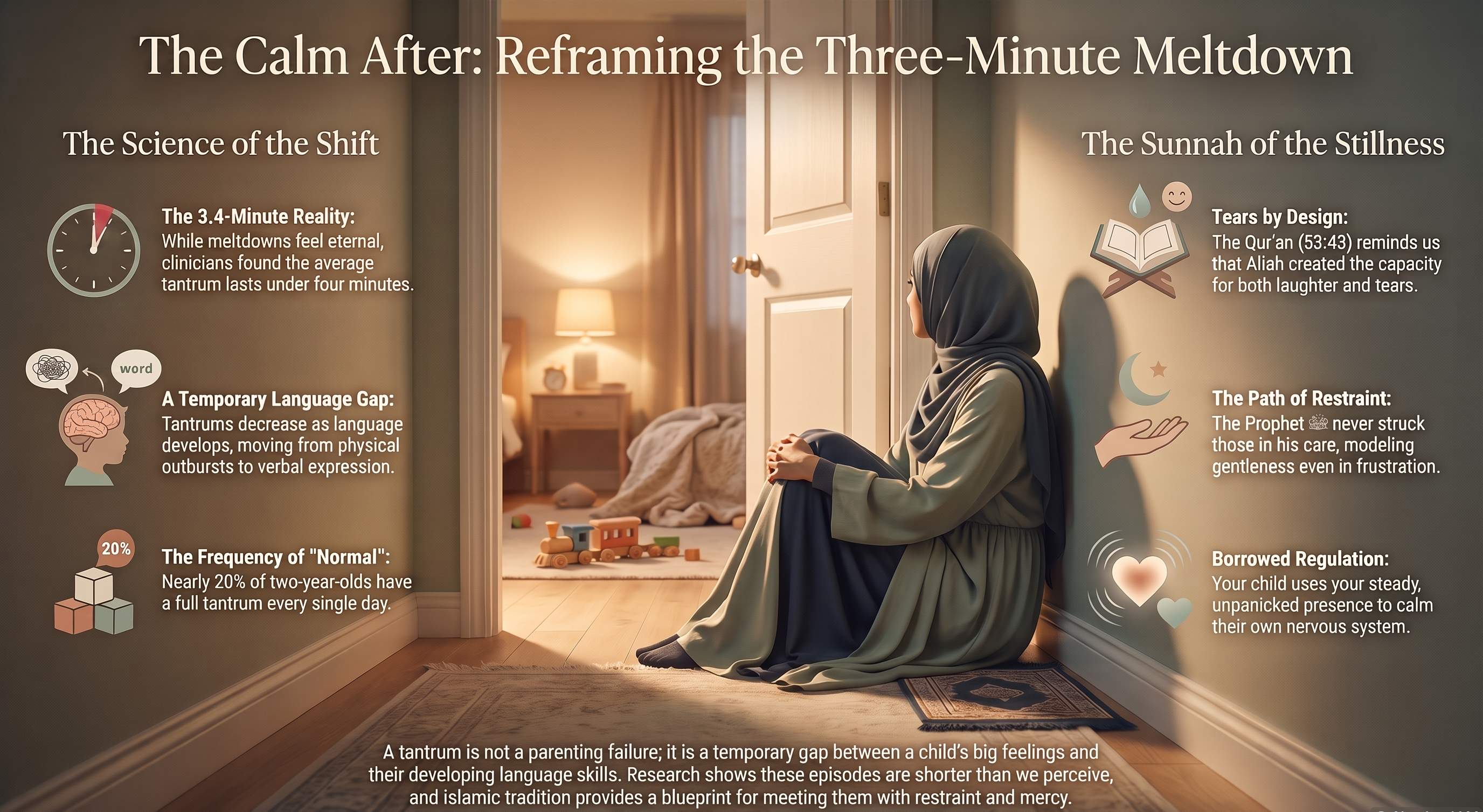
A peer-reviewed nursing journal found that 18–20% of two-year-olds have a full tantrum every single day, and when clinicians actually timed 330 real ones, most were over in under four minutes [2][3]. This guide walks you through what’s happening in those minutes, from toddlerhood through age eight, and how to respond in a way both the research and the Prophet ﷺ point toward.
The Three-Minute Meltdown: What 330 Real Tantrums Taught Researchers About Your Crying Child
Here’s a number that changed how I look at my own child mid-meltdown: 3.4 minutes. That’s the average length of a tantrum, timed by clinicians who sat and watched 330 of them happen in real time [3].
Three point four minutes. Shorter than it takes to reheat leftovers. And yet in the moment, on the kitchen floor, with a screaming four-year-old and a growing audience at the grocery store, it feels like it will never end.
That gap, between how long a meltdown actually lasts and how long it feels like it lasts, is where most of the parenting stress lives. You’re not imagining the intensity. You’re just miscalculating the clock.
When I first read the research on this, what struck me wasn’t the tantrums themselves. It was how ordinary they are. Somewhere between 18% and 20% of two-year-olds have one every day [2]. This isn’t a parenting failure showing up on your watch. It’s what the early years of being human look like, in nearly every household, in nearly every culture, including the one the Prophet ﷺ raised children in fourteen centuries ago.
Why This Guide Is Different
Built on the actual data, not just advice columns. The tantrum-length numbers here come from clinicians who timed real episodes rather than relying on parents’ memory of “forever” [3].
Grounded in the Sunnah, not just sentiment. This isn’t a vague “be patient” message — it’s anchored in a verified Qur’anic verse and an authenticated hadith about how the Prophet ﷺ himself handled frustration and restraint.
You’ll get the free Crying Compass Companion Pack to keep on your fridge or in your bag — a tool, not just more information to remember mid-meltdown.
What’s Actually Happening in Those Three Minutes
Let’s start with what a tantrum, or any bout of crying, actually is under the hood, because knowing this changes how you respond to it.
Emotion regulation, the skill of managing a big feeling without it managing you, is not something a toddler is born with. It’s assembled slowly, out of attention, planning, and language, three systems that are all still under construction in early childhood [1]. A two-year-old who wants the red cup and can’t say “the red cup” has real, physical frustration with nowhere to go except through the body: crying, screaming, going limp, flailing.
Here’s what surprised me most in the research: noncompliance, being told “no” or asked to stop something, triggers over half of all observed tantrums [3]. Not injury. Not hunger. Just the friction of wanting something and not getting it, colliding with a brain that hasn’t yet built the machinery to sit with that feeling calmly.
But here’s the thing. Age changes almost everything about this picture. Around 20% of two-year-olds have a daily tantrum. By age four, that number drops to roughly 10% [2]. The tantrums don’t disappear because children become better behaved. They disappear because language catches up, and a five-year-old can finally just tell you what a two-year-old could only cry about.
That reframes the whole situation. You are not managing a discipline problem. You are managing a temporary gap between feeling and language, one that closes on its own as your child grows, provided you meet it with steadiness rather than a fight.
Riding Out the Toddler Years (1 to 3)
Once you’ve ruled out anything physical, hunger, tiredness, illness, pain, a few things reliably help with a toddler in the middle of it.
If they’re overtired, offer rest, or a few quiet minutes with a story or gentle Qur’an recitation playing low in the background. If bedtime is when it usually happens, keep the wind-down identical every single night, wudu, a short bedtime dua, lights down, so your toddler’s body learns the sequence before their brain has to think about it.
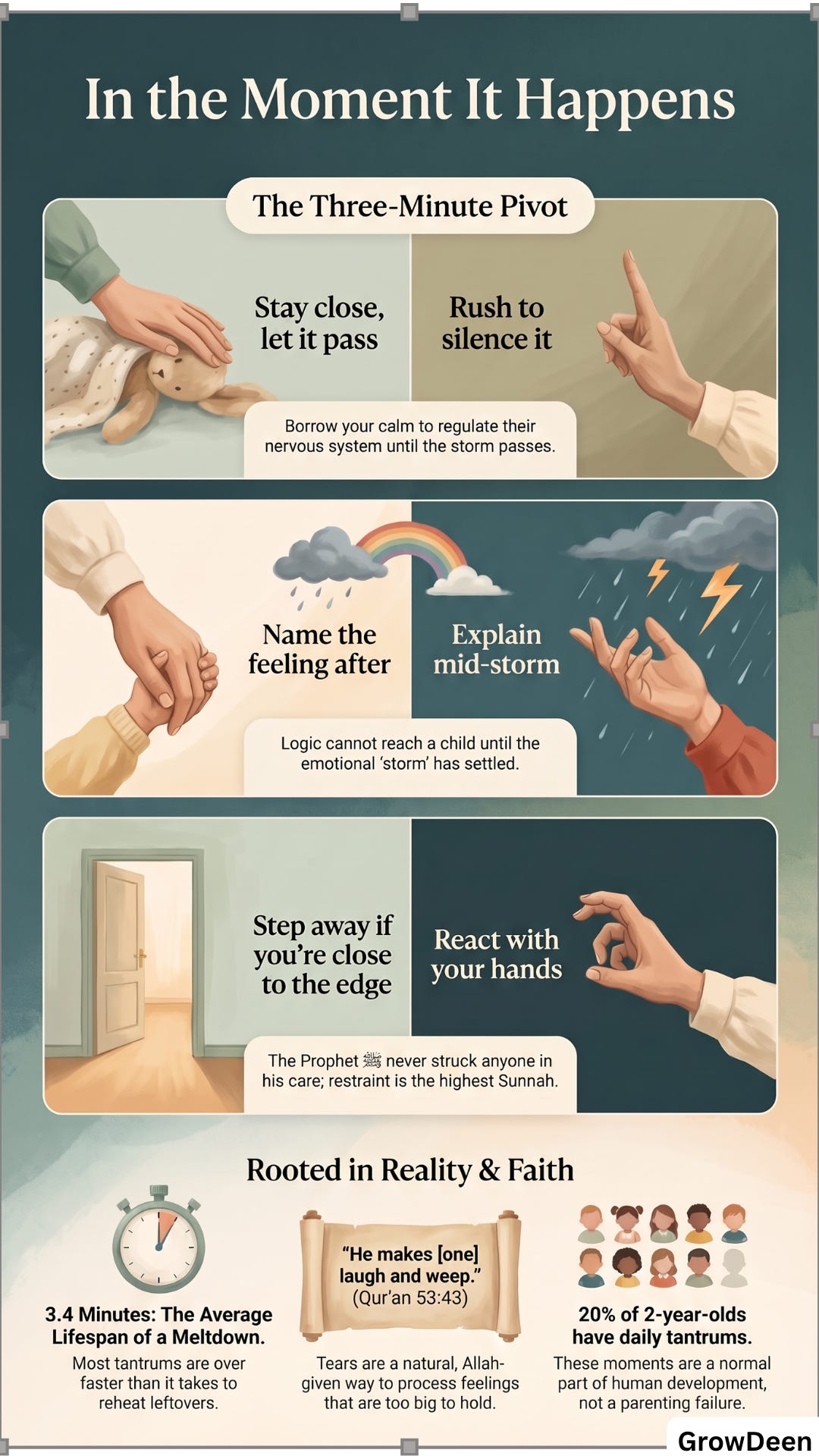
If it’s a full-blown tantrum, move them somewhere safe and stay close while it runs its course. This matters more than anything you say. Your steady, unpanicked presence is doing the actual regulating, your toddler is essentially borrowing your calm nervous system until they can grow their own [4].
Name the feeling and its cause, together, once things settle. “You were upset because the tower kept falling. Let’s try again, together.” This single move, naming a feeling and its trigger, is one of the most reliably effective tools researchers have found for building a toddler’s own self-regulation over time [4].
And if someone else in your circle, a grandmother, an aunt, a friend from the masjid, can step in and soothe your toddler when you’re depleted, let them. You are not required to be the only source of comfort in the house.
Once the Words Arrive (3 to 8)
You might be wondering: does any of this actually get easier? It does, and mostly because of language.
Crying thins out with age largely because a child finally has words for what used to have to come out as tears alone. The shift here is toward conversation rather than management. Help your child calm down first, before trying to talk anything through, then reflect the feeling back once they’re settled: “You’re sad because Sam wouldn’t play with you.” Being heard, before being redirected, is what actually lands at this age [1] [5]. Only after that, offer a next step rather than dictate one: “What if you asked to join Amina’s game instead?”
Let your child know, plainly, that crying is allowed. That feelings aren’t something to hide from you. “Ouch, I’d cry too if I hit my head that hard” does more for a child’s emotional world than any amount of “you’re fine, stop crying.”
What the Prophet ﷺ Showed Us About Meeting Tears
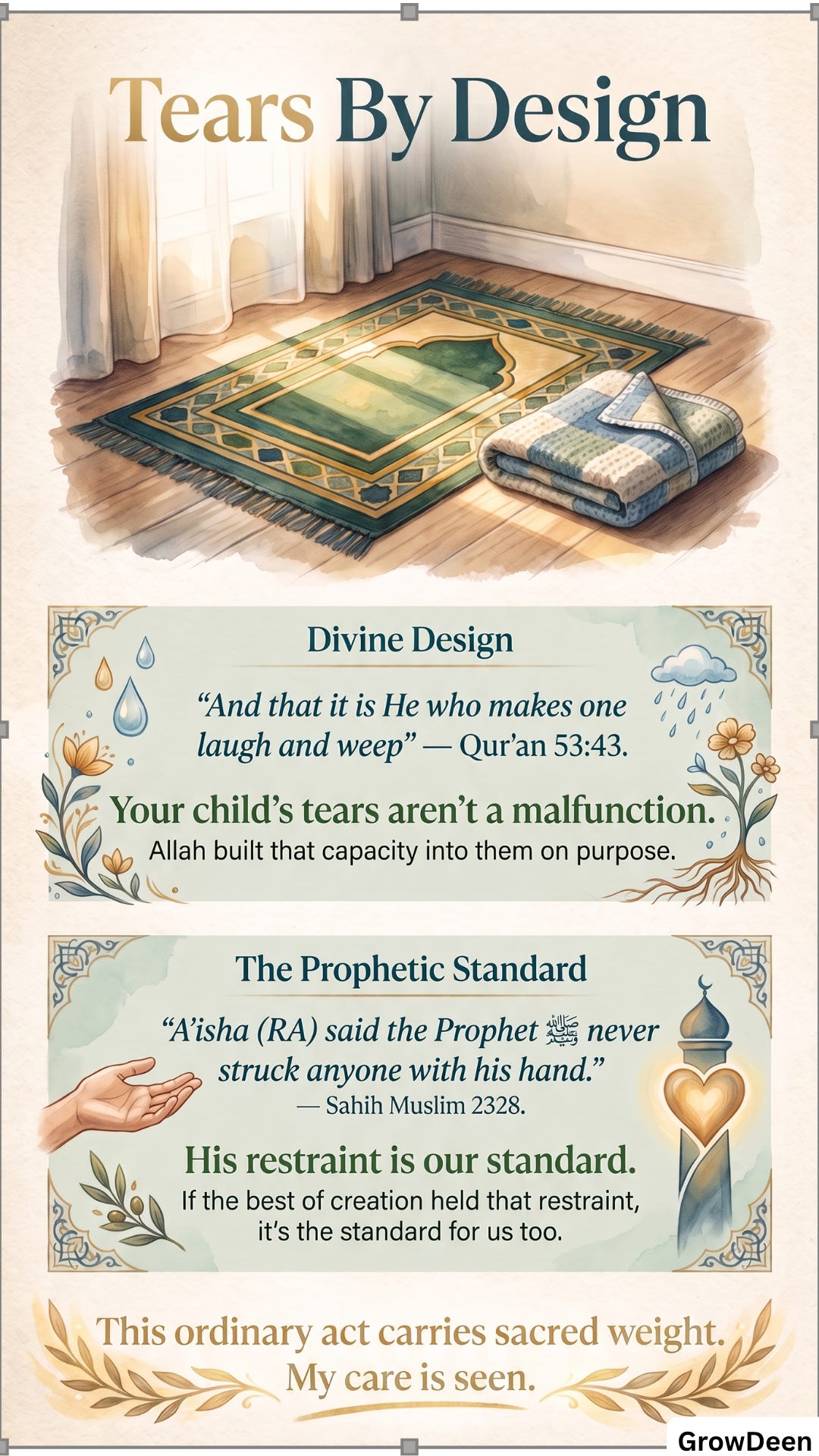
When I sit with this topic, what strikes me is how directly the Qur’an addresses something we usually treat as pure biology. Allah says: “And that it is He who makes [one] laugh and weep” [Qur’an 53:43] [6]. According to Tafsir Ibn Kathir, this verse means Allah created within us the very ability to laugh and to cry, along with the circumstances that bring each one about. That single line reframes an entire evening of tears: your child isn’t malfunctioning. They’re doing exactly what Allah built them to do when something feels too big to hold quietly.
What grounds me even more is how the Prophet ﷺ carried himself toward the people he had power over. ‘A’isha (RA) reported that he never struck anyone with his hand, not a woman, not a servant, in any personal matter [Sahih Muslim 2328] [7]. He held that restraint in a household and community where physical discipline was common practice all around him. If the best of creation drew that line for the adults in his care, it isn’t a stretch, it’s a direct instruction, for how we’re meant to meet a crying toddler who has far less power in the room than anyone he ever encountered.
One line should never move, whatever the trigger: never shake, hit, or otherwise hurt a crying child. If you feel yourself getting close to that edge, put your child down somewhere safe, leave the room, breathe, and call someone.
What’s beautiful is that Islam and the developmental research are describing the same parent from two different directions: the one who stays regulated long enough for the child to borrow that regulation, until they can grow their own. May Allah make our patience with our children’s tears a source of ease for all of us, not only for them.
When to Actually Worry
Most tantrums don’t come anywhere close to needing medical attention. But it helps to know where the line actually sits, so you’re not left guessing at 6pm on a hard day.
Speak to your doctor if tantrums regularly last longer than 15 minutes, happen more than several times a day as a consistent pattern, involve frequent hitting or injurious behaviour, or include breath-holding episodes that recur or end in a loss of consciousness [2] [3]. The same goes if your older child seems to sit in sadness for stretches that don’t lift, or the crying pattern isn’t resolving with time and connection. None of these are common. Knowing them just means you’re not left wondering.
Your Own Tears Count Too
If your child cries often, or won’t stop, looking after yourself stops being optional. It’s part of how you stay able to show up at all.
If you notice your own stress or anger climbing, hand things off, even for a few minutes. Ask a partner, relative, or friend to take over. A short walk, a few minutes of dhikr, or simply stepping outside can be enough to reset.
This isn’t weakness. It’s part of the amanah, the trust, that raising a child represents. Muslim households have long leaned on exactly this kind of shared care, a grandmother, a sister, an aunt, stepping in the moment a mother reached her limit. If that support isn’t close by for you, build it on purpose: ask directly, accept help when it’s offered, say plainly, “I need someone to take this for an hour.”
See your doctor if you notice yourself crying often, or crying without knowing why. This can be a sign of something worth proper care, including postnatal depression in either a birthing or non-birthing parent. There’s no shame in naming that and getting help.
I know remembering all of this in the actual moment feels like a lot, especially when you’re managing a screaming toddler and a to-do list and everything else. That’s why I built something to keep nearby for exactly those minutes.
I know this is a lot to hold in your head while a three-minute meltdown feels like thirty. That’s why I’ve created a free Crying Compass Companion Pack, a printable guide with an age-by-age script and a quick-reference card for what’s actually going on underneath the tears. Keep reading to download it at the end of this article. It’s designed to live on your fridge, in the exact spot where these moments actually happen.
The Companion Pack Offer
If you’ve read this far, you’re the kind of parent who wants to understand what’s happening before reacting to it. That already says something beautiful about you.
Inside the Crying Compass Companion Pack (one comprehensive PDF, 3 pages):
Page 1: The Tears Translator — A quick-reference card mapping the most common causes of crying (hunger, tiredness, pain, frustration, fear, sadness) to one calm first response for each, designed as a fridge-ready card you can glance at in the middle of a hard moment.
Page 2: The Three-Minute Reset — An age-by-age script card (1–3 years / 3–8 years) with the exact words to use and one physical co-regulation move for each stage, so you’re not inventing language while a meltdown is already happening.
Page 3: Tears By Design — An Islamic reflection card anchored by Qur’an 53:43 and the Prophet ﷺ’s own documented gentleness (Sahih Muslim 2328), something you can read to steady yourself before you walk back into the room.
This isn’t just a PDF to download and forget. It’s a tool designed to stay on your fridge, where you’ll actually reach for it the next time three minutes feels like thirty.
This Crying Compass Companion Pack is what every subscriber receives with each article. We cover the full journey of raising Muslim children, all backed by scientific research and rooted in Islamic wisdom.
If you’re a Muslim parent who wants both evidence-based guidance and Islamic perspective, subscribe for free so future resources arrive in your inbox before you need them.
Subscribe free for parenting resources backed by both science and Sunnah, guidance so specific you won’t find it anywhere else. No spam, no clutter, just resources that matter.
Micro-Action
The next time your child starts crying, before you do anything else: look at a clock. Just note the time. You’ll likely find the whole thing is over faster than you thought, and that alone can be enough to help you stay steady through it.
May Allah place barakah in your patience, accept your intention, and make the mercy you show your children more protective and more rewarded than it ever feels in the moment.
Sharing Is Caring
Think of one person right now: the friend at the masjid who texted you last week saying her toddler’s tantrums are wearing her down, your sister who apologized for “losing it” during a meltdown, someone whose child just started crying more and who’s quietly wondering if something’s wrong.
This article could ease their evening. Share it with them today, not as advice-giving, but as support. Sometimes the most loving thing we can do is pass along what actually helped us stay calm.
Frequently Asked Questions
Q: How long does a normal tantrum actually last?
A: In one clinical study that timed 330 real tantrums, the average lasted 3.4 minutes, with most rated low in intensity [3]. If tantrums in your house regularly run past 15 minutes, that’s worth mentioning to your doctor.
Q: Is it normal for a two-year-old to have a tantrum every day?
A: Yes. Research shows roughly 18–20% of two-year-olds have at least one tantrum daily, dropping to about 10% by age four [2]. Daily tantrums at this age are common, not a red flag on their own.
Q: What usually triggers a tantrum?
A: Being told “no” or asked to stop something accounts for over half of observed tantrums [3]. It’s rarely about the specific request. It’s the gap between wanting something and having the language or self-control to handle not getting it.
Q: Is it okay to let my child see me cry?
A: Yes, more than okay. Tears are a healthy way adults process real loss, frustration, or grief, same as for children. Watching you cry and recover teaches your child that feelings are survivable. For more on this, see “Your Own Tears Count Too” above.
Q: Should I ever physically discipline a child for crying or a tantrum?
A: No. ‘A’isha (RA) reported that the Prophet ﷺ never struck anyone with his hand in a personal matter [Sahih Muslim 2328] [7]. If you feel close to that edge, put your child down safely, step away, and call someone.
Q: When should I take my child’s crying or tantrums to a doctor?
A: If tantrums regularly last over 15 minutes, happen many times a day as a pattern, involve frequent injury, or include recurring breath-holding episodes, speak to your doctor [2] [3]. Most tantrums never come close to this.
Q: Does frequent crying mean something is wrong with my child’s development?
A: Not on its own. Emotion regulation is a skill still being built in early childhood, drawing on attention, language, and planning systems that mature at different rates in different children [1]. Frequency alone isn’t the concern; duration, intensity, and whether it’s easing with age and language are what matter more.
References
[1] American Psychological Association. Cole, P. (cited in) How to help kids understand and manage their emotions. apa.org.
[2] Daniels, E., Mandleco, B., & Luthy, K.E. (2012). Assessment, management, and prevention of childhood temper tantrums. Journal of the American Academy of Nurse Practitioners, 24, 569-573.
[3] Eisbach, S.S., Cluxton-Keller, F., Harrison, J., Krall, J.R., Hayat, M., & Gross, D. (2014). Characteristics of temper tantrums in preschoolers with disruptive behavior in a clinical setting. Journal of Psychosocial Nursing and Mental Health Services, 52(5), 32-40.
[4] Lauw, M.S.M., Havighurst, S.S., Wilson, K.R., Harley, A.E., & Northam, E.A. (2014). Improving parenting of toddlers’ emotions using an emotion coaching parenting program: A pilot study of Tuning in to Toddlers. Journal of Community Psychology, 42(2), 169-175.
[5] Biringen, Z. (2010). Raising a secure child: Creating emotional availability between you and your child. Penguin.
[6] Qur’an 53:43, with Tafsir Ibn Kathir (verified via alim.org and quran.com).
[7] Sahih Muslim 2328, narrated by ‘A’isha (RA). Graded Sahih (verified live on sunnah.com).