

Research from the Harvard Center on the Developing Child confirms that the brain builds more neural connections in the first five years of life than at any other time — with the 7–8 month window being among the most significant for language, cognition, and attachment. [1] This guide tells you exactly what’s happening in your baby’s mind right now, what to do about it, and what the Sunnah shows us about meeting children in these moments.
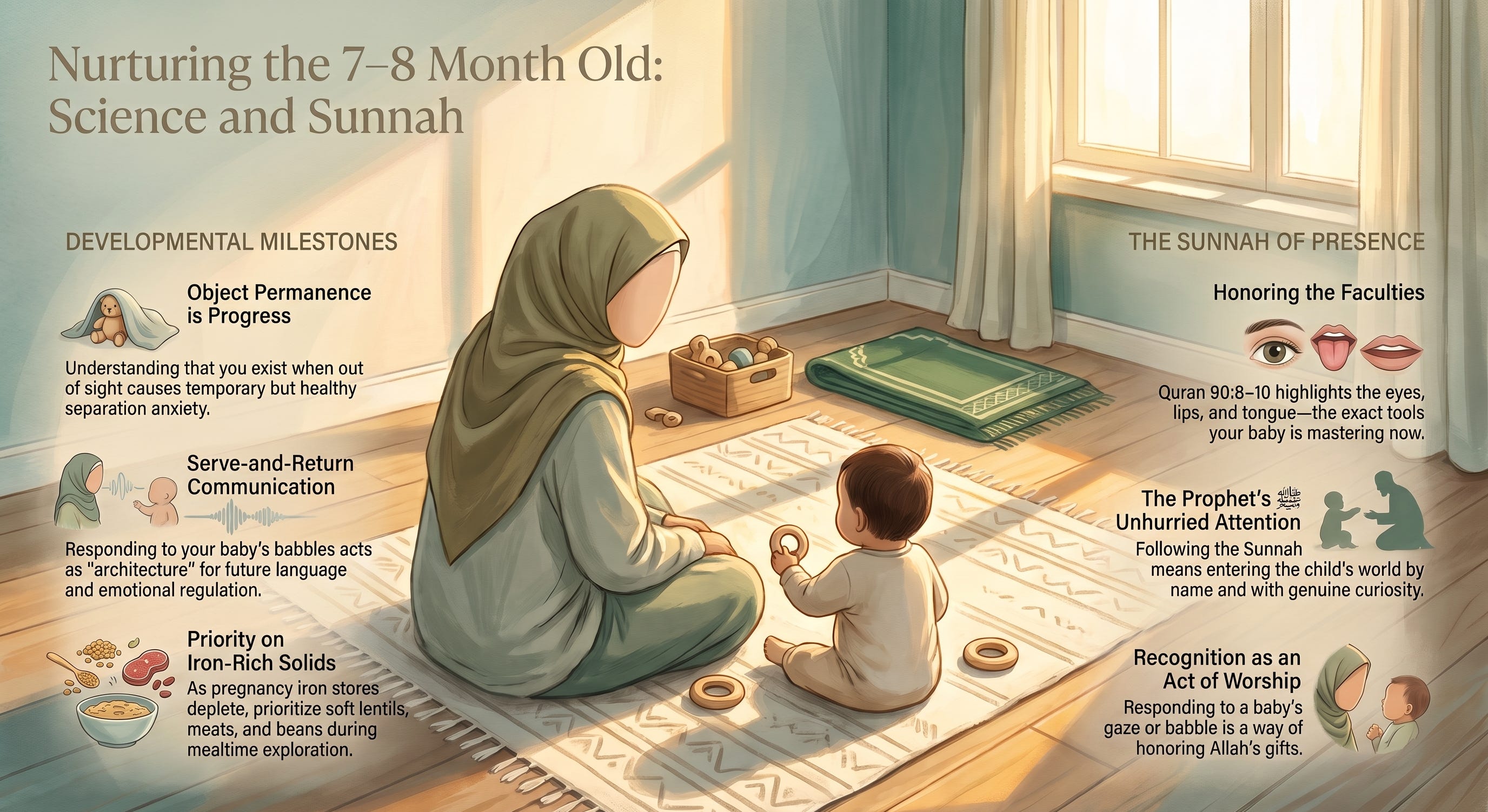
Seven months ago, you brought home someone who slept, cried, and stared.
Now? They are moving. Calling your name. Opening their mouth for banana. Following you with their eyes when you leave the room — and making sure you know they noticed.
Something has shifted. And it’s happening fast.
I know how this stage feels from both inside and outside: it’s exhausting and wonderful in ways that don’t cancel each other out. Your baby’s world has gotten bigger, which means your job has too.
Here’s what’s actually going on — and what it asks of you.
Why This Guide Is Different From Generic Milestone Lists
It’s grounded in current research. Every recommendation draws from peer-reviewed developmental science — from the AAP’s 2022 milestone evidence to Harvard’s research on serve-and-return communication. [1,3]
It’s rooted in Islamic wisdom. This isn’t just developmental tips. We look at what Allah says about the faculties your baby is learning to use right now, and what the Prophet ﷺ modelled for parents of young children.
You’ll get a free printable resource. The Your Baby’s 7–8 Month Development Pack — a 3-page companion with a milestone checklist, daily play prompts, and an Islamic reflection card — is waiting for you at the end.
What “Object Permanence” Really Means (And Why Your Baby Is Crying When You Leave)
This is the cognitive leap no one warns you about clearly enough.
Before now, your baby lived in a world where “out of sight” quite literally meant “out of mind.” Hide a toy under a cloth — it ceased to exist for them. That’s changed.
Object permanence — the understanding that things continue to exist even when you can’t see them — is one of the most significant milestones of the entire first year. [3] Your baby now holds a mental image of the world. Of objects. Of you. They know you exist when you leave the room. And that knowledge is precisely what makes leaving distressing.
Separation anxiety and stranger wariness intensifying at 7–9 months isn’t regression. It’s progress. It’s evidence of a developing mind that is learning to hold onto what matters. [3]
And here’s what the research actually shows: babies with secure attachments — the ones whose caregivers showed up consistently and warmly — go on to have better emotional regulation, stronger relationships, and greater resilience across their entire lives. [6] Your baby’s clinginess right now is not a problem. It’s an investment paying forward.
The Language Before Language: What Your Baby’s Babbling Is Actually Doing
“Bababa.” “Mamama.” “Dadada.”
These are not random sounds. They are a brain practising how mouths and voices work. [4]
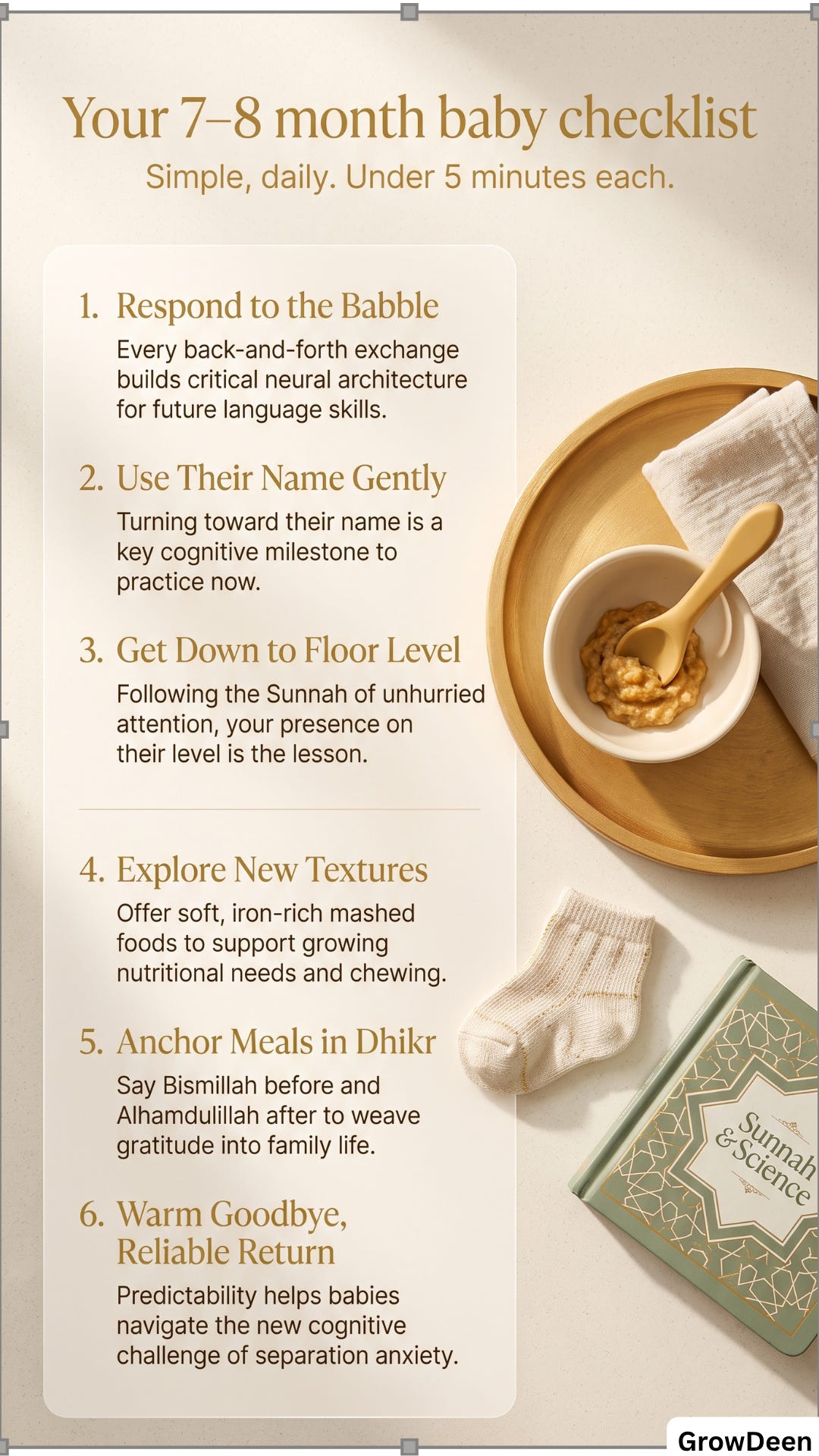
Research published in Child Development Perspectives found that babies who experience more frequent back-and-forth exchanges with caregivers — what developmental scientists call serve-and-return — showed significantly stronger language outcomes at age two. [4] The caregiver’s response is not background music. It is architecture. Every time you respond to a babble as if it’s a sentence, you are building something in your baby’s brain that no screen or speaker can replicate.
Your baby at this stage is also already responding to their name. They turn toward it, pause their play, look up to find your face. [3] If your baby is consistently not responding to their name by eight months, mention it to your doctor or paediatrician — early is always better when it comes to developmental concerns.
But here’s what changed my perspective on this:
Sahih al-Bukhari 6129 records Anas ibn Malik saying: “The Prophet ﷺ used to mix with us to the extent that he would say to a younger brother of mine, ‘O Aba ʿUmair! What did the Nughair (a little bird) do?’” [7]
Read that carefully. The Prophet ﷺ knew the child’s name. He knew about the child’s pet bird. He asked the child directly — not into the general air of the room, but to this specific small boy, about the specific thing that mattered to him.
Child-directed speech. Unhurried attention. An adult who entered a child’s world rather than waiting for the child to grow into theirs.
This is what developmental science says matters most at 7–8 months. And the Prophet ﷺ demonstrated it fourteen centuries ago.
Eating at 7–8 Months: Soft Foods, Self-Feeding, and the Table as a Sacred Space
By now, your baby is ready for thicker textures — mashed, minced, or finely chopped soft foods, and appropriate finger foods that encourage chewing practice. [5] Breastmilk or formula remains the primary source of nutrition; solids are complementary, not replacement.
Iron matters at this stage. Stored iron from pregnancy begins to deplete around six months, and inadequate dietary iron is one of the most common nutritional concerns in this age group. [5] Soft iron-rich foods — lentils, minced meat, mashed beans, egg yolk — are worth prioritising alongside whatever your baby will accept.
Choking safety: pieces should be soft enough to squash between your thumb and index finger. Supervision is non-negotiable.
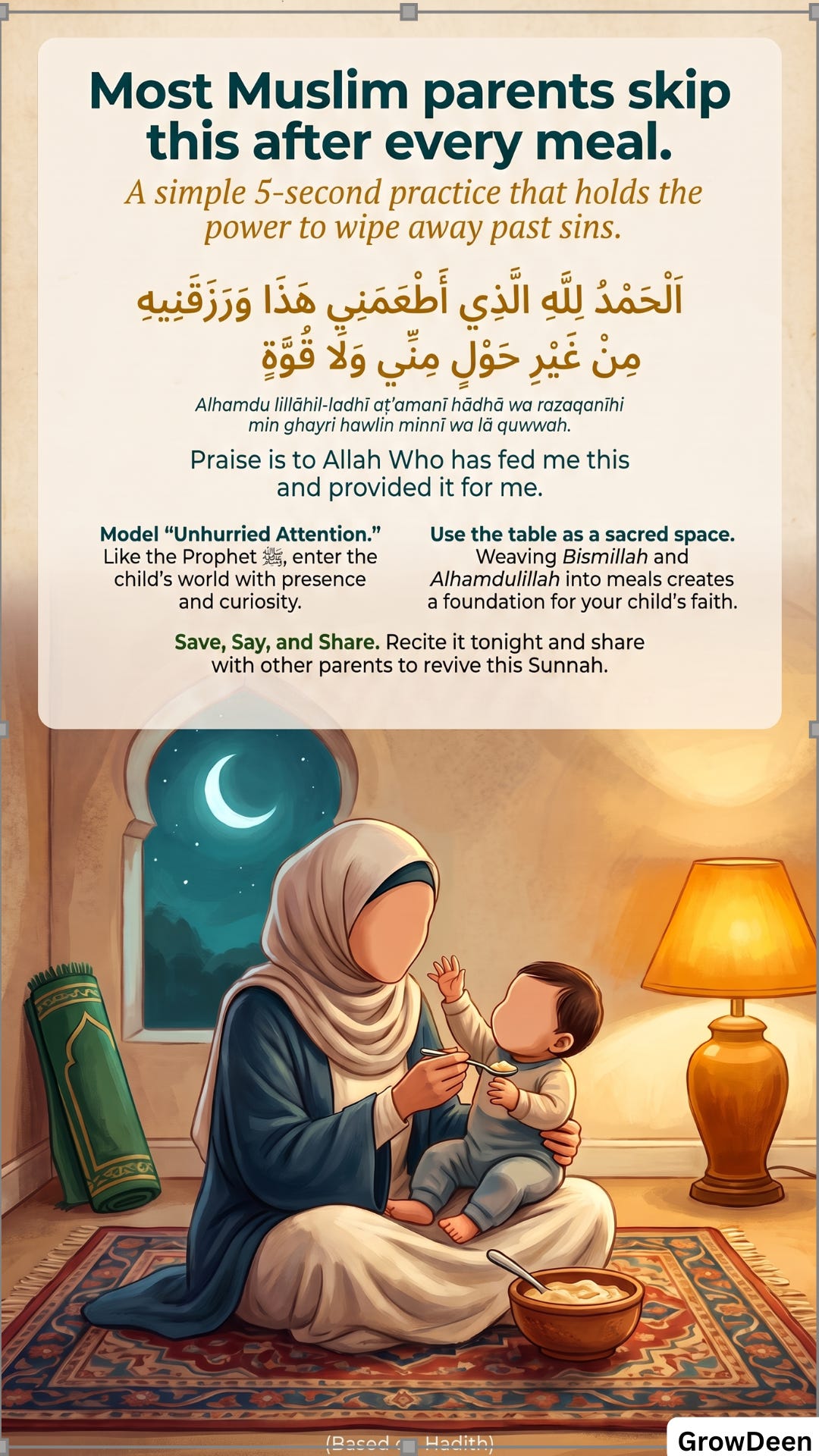
And even at seven months, the table can carry meaning beyond nutrition. Saying Bismillah before your baby’s meal and Alhamdulillah after isn’t a ritual over someone who doesn’t understand. It’s a practice being woven into the texture of your family — something your child will one day recognise as the sound of how your home begins and ends a meal.
Before I share the Islamic dimension of this stage, I want to tell you about something I created for this exact moment in parenting.
I know how much is happening right now — your baby’s communication, movement, emotions, and eating are all changing simultaneously. Keeping track of what’s normal versus what needs attention, and what to actually do each day, can feel like a full-time job on top of an already full-time job.
That’s why I put together the free Your Baby’s 7–8 Month Development Pack — a printable 3-page guide with a milestone checklist, daily serve-and-return play prompts, and an Islamic reflection card for parents. Keep reading to download it at the end. It’s designed to stay somewhere you’ll actually use it.
The Gifts Allah Placed in Your Baby — and What the Sunnah Shows Us About Honouring Them
When I came across Qur’an 90:8–10 while preparing this article, I had to stop.
Allah says: “Have We not made for him two eyes, and a tongue and two lips, and shown him the two ways?” [2]
According to Tafsir Ibn Kathir, the tongue and lips were given for two specific purposes: to speak — so the human being can express what is within — and to eat food. The two eyes, for seeing. [2] These are the exact faculties your baby is actively learning to use right now, in these exact months. Their eyes tracking your face. Their lips forming sounds. Their tongue meeting new textures for the first time.
The verse is not distant or abstract. It is describing what you are watching every day.
And Sahih al-Bukhari 6129 — the Prophet ﷺ crouching to speak to a child by name, asking about his little bird — shows us what it looks like when an adult takes those emerging gifts seriously. [7]
To respond when your baby babbles. To follow their gaze. To say their name with warmth. To get down to floor level. These aren’t parenting “techniques.” In the light of the Sunnah, they are acts of recognition — a way of saying to your child: the gifts Allah placed in you are worth paying attention to.
May Allah make us parents who see our children the way the Prophet ﷺ saw children: with full presence, unhurried attention, and a heart that is genuinely curious about their small world.
If You’ve Read This Far
You’re the kind of parent who takes these months seriously — not as a checklist to complete, but as a relationship to tend.
Inside the Your Baby’s 7–8 Month Development Pack (one printable PDF, 3 pages):
Page 1: 7–8 Month Milestone Snapshot — A clean reference card across five developmental areas: movement, communication, cognition, social/emotional, and feeding. Designed to sit on your fridge so you know at a glance what’s expected, what’s a range, and what warrants a conversation with your doctor.
Page 2: Six Daily Serve-and-Return Play Prompts — Short, specific prompts — The Name Game, Copy That, The Hide-and-Peek, Floor Time Together, and more — each taking under five minutes. These are built around the serve-and-return research showing that back-and-forth exchanges between parent and baby are among the strongest predictors of language at age two. [4]
Page 3: The Sunnah of Noticing — An Islamic Reflection Card for Parents — Built around Qur’an 90:8–10 and Sahih al-Bukhari 6129. A gentle reminder that responding to your baby’s babbles, following their gaze, and being present on the floor with them isn’t just good parenting — it’s following in the footsteps of the Prophet ﷺ, who modelled this exact approach with the children around him.
This isn’t a PDF to download and forget. It’s designed to stay in the spaces where parenting actually happens — on the fridge, beside the play mat, near the feeding chair.
Every subscriber receives a companion pack like this with each article. We cover the full journey of raising Muslim children backed by peer-reviewed research and rooted in Islamic wisdom.
If you’re a Muslim parent who wants both evidence-based guidance and Islamic perspective, subscribe free so future resources reach you before you need them.
Subscribe free for parenting resources backed by both science and Sunnah — guidance so unique, you rarely get it anywhere else. No spam, no clutter, just resources that matter.
Your Micro-Action for Today
Pick one meal or nappy change. For the whole time, speak only to your baby — describe what you’re doing, name what you see, and when they babble back, pause and wait before you respond.
No phone. No background noise. Just that.
That’s it. That’s the practice.
Share This With Someone
Think of one person right now: the friend in your new mothers’ group who keeps saying “is this normal?” about everything her baby is doing, your sister whose WhatsApp messages describe exactly the 3 AM separation anxiety spiral, or a cousin who just reached this stage and is feeling both the wonder and the exhaustion at once.
This article could ease their worry. Share it today — not as advice, but as company on the road. Sometimes the most loving thing we can do is say: I was just reading about this and thought of you.
Frequently Asked Questions
Q: My baby is 8 months and still not crawling — should I be worried?
A: Not necessarily. Crawling style and timing vary enormously — some babies skip classic hands-and-knees crawling entirely and move straight to pulling to stand. What matters more is that your baby is motivated to move and is reaching other milestones across communication, cognition, and emotional development. [3] If you have concerns, mention it to your paediatrician — earlier is always better.
Q: How do I know if my baby’s babbling is progressing normally at 7–8 months?
A: At this age, you’re looking for repetitive consonant-vowel combinations — “bababa,” “mamama,” “dadada” — and for your baby to respond consistently when their name is called. [3] If your baby isn’t babbling at all or doesn’t turn toward their name by 8 months, that’s worth a conversation with your doctor. The speech-language research is clear that early support, when needed, makes a meaningful difference. [4]
Q: My baby only wants me — they cry every time someone else holds them. Is this a problem?
A: No — this is object permanence and attachment doing exactly what they’re supposed to do. Strong preference for primary caregivers and wariness of strangers is developmentally expected between 6 and 12 months. [3] It signals healthy attachment, not a social problem. You don’t need to “fix” it or train your baby to go to others. It eases naturally as their language and confidence develop.
Q: What finger foods are safe for a 7–8 month old?
A: At this age, foods should be soft enough to squash between your thumb and index finger — think soft-cooked vegetables cut into small pieces, well-mashed banana or avocado, small pieces of soft bread, and well-cooked lentils or beans. [5] Avoid anything round, hard, or sticky. Always supervise mealtimes and position your baby upright. If you’re unsure about a specific food, your paediatrician or a registered dietitian can advise.
Q: My baby wakes up more at night at this age than they did at 4 months. Is that normal?
A: Yes, unfortunately. Developmental changes — including the cognitive leap around object permanence — can temporarily disrupt sleep patterns that had been more settled. [8] This is common between 7 and 10 months and tends to ease as the developmental surge settles. Maintaining consistent sleep cues and a calm bedtime environment helps, but expect some nights to be harder than others during this window.
Q: How much should my baby be eating in solids at 7–8 months?
A: Breastmilk or formula remains the primary nutrition source, and solid foods are complementary at this stage. [5] Most babies at 7–8 months eat 2–3 small meals of solid food per day alongside regular milk feeds — but amounts vary significantly between babies. Let your baby’s hunger cues guide you rather than fixed quantities. If you’re worried about intake or growth, your paediatrician is the right person to check in with.
Q: When should I worry about separation anxiety vs. seek help?
A: Separation anxiety at 7–9 months is developmentally typical and expected. [3] It becomes worth discussing with a doctor if it is so severe that it’s significantly disrupting feeding, sleep, or your baby’s ability to settle at all — or if it’s emerging alongside other concerning changes like loss of previously achieved skills. In the vast majority of cases, it’s healthy and will ease with time and consistent, warm responsiveness from you.
References
[1] Center on the Developing Child at Harvard University. (2021). Three principles to improve outcomes for children and families. https://developingchild.harvard.edu/resources/report/three-principles-to-improve-outcomes-for-children-and-families/
[2] Qur’an, Surah Al-Balad, 90:8–10. Tafsir Ibn Kathir. https://quran.com/90/8 | Tafsir: https://quran.com/en/90:8/tafsirs/en-tafisr-ibn-kathir
[3] Zubler, J.M., Wiggins, L.D., Macias, M.M., Whitaker, T.M., Shaw, J.S., Squires, J.K., Pajek, J.A., Wolf, R.B., Slaughter, K.S., Broughton, A.S., Gerndt, K.L., Mlodoch, B.J., & Lipkin, P.H. (2022). Evidence-informed milestones for developmental surveillance tools. Pediatrics, 149(3), Article e2021052138. https://doi.org/10.1542/peds.2021-052138
[4] Morris, A.J., Filippetti, M.L., & Rigato, S. (2022). The impact of parents’ smartphone use on language development in young children. Child Development Perspectives, 16(2), 103–109. https://doi.org/10.1111/cdep.12449
[5] Onigbanjo, M.T., & Feigelman, S. (2024). The first year. In R. Kliegman & J.W. St Geme III (Eds), Nelson Textbook of Pediatrics (22nd edn, pp. 151–156). Elsevier.
[6] Kliegman, R.M., & Marcdante, K.J. (2019). Nelson Essentials of Pediatrics (8th edn). Elsevier.
[7] Sahih al-Bukhari 6129. Narrated Anas ibn Malik: The Prophet ﷺ used to mix with us to the extent that he would say to a younger brother of mine, “O Aba ʿUmair! What did the Nughair (a little bird) do?” Graded: Sahih. https://sunnah.com/bukhari:6129
[8] Royal Children’s Hospital. (2025). Sleep problems — babies and toddlers. https://www.rch.org.au/kidsinfo/fact_sheets/Sleep_problems_babies_and_toddlers/
[9] Sharma, A., Cockerill, H., & Sanctuary, L. (2022). Mary Sheridan’s From Birth to Five Years: Children’s Developmental Progress (5th edn). Routledge.
[10] American Academy of Pediatrics. (2024). Infant feeding and nutrition.
https://www.aap.org
Companion Pack Design Recommendations
Pack Title: Your Baby’s 7–8 Month Development Pack
Format: Three pages, portrait orientation (A4 or US Letter). Print-friendly throughout — all backgrounds use brand colours at 10–15% opacity maximum. No deep or solid colour fills anywhere. Body text in deep dark colours for legibility on any printer including black-and-white. Border/accent strokes may use full brand colours as thin linear elements only.
Brand palette: Forest Green #2C5F2D | Sage Green #6B8E6F | Warm Gold #B8860B | Deep Teal #1E4D4D | Soft Cream #F5F1E8
All pages: GrowDeen Education logo and QR code header strip at the top of each page.
Page 1: 7–8 Month Milestone Snapshot Card
Type: Printable reference card for the fridge or changing table.
Layout: Portrait page. Header strip (logo + QR code). Title: Your Baby at 7–8 Months: Milestone Snapshot. Five sections, each with a thin Warm Gold (#B8860B) left border accent and Soft Cream interior background at 10% opacity.
Fully written copy — all five sections:
🟢 Movement & Body
☐ Sits independently without support
☐ Rolls in both directions
☐ Reaches and grasps objects with deliberate coordination
☐ May be crawling, shuffling, or pulling to stand with support
☐ Develops coordinated eye-hand movement to drag or catch objects
🗣 Communication & Language
☐ Babbles with repeated syllables: “bababa,” “mamama,” “dadada”
☐ Responds consistently when their name is called
☐ Uses body language to communicate (reaching arms up, turning away)
☐ Vocalises with varied pitch and rhythm
🧠 Thinking & Learning
☐ Looks for objects that have dropped or been hidden
☐ Bangs objects together intentionally
☐ Explores objects visually before reaching
☐ Begins following your gaze or pointing
💛 Social & Emotional
☐ Shows strong preference for familiar caregivers
☐ May show wariness around strangers
☐ Expresses happiness, frustration, and distress clearly
☐ Looks to your face for reassurance in unfamiliar situations
🍽 Feeding
☐ Managing soft, textured foods (mashed, minced, or finger foods)
☐ Beginning to attempt self-feeding with fingers
☐ Breastmilk or formula remains the primary nutrition source
Footer: “Development follows a similar sequence in most babies, but timing varies. If you have any concerns, speak with your doctor or paediatrician early. Muslim Parenting Lab | GrowDeen Education”
Page 2: Six Daily Serve-and-Return Play Cards
Type: Daily activity prompt cards — one set of 6 short play ideas, each taking under 5 minutes.
Layout: Portrait page. Header strip (logo + QR code). Title: Six Daily Serves for Your 7–8 Month Baby. Subtitle in smaller type: “Back-and-forth exchanges between you and your baby are among the most powerful drivers of language development. These take under 5 minutes each.”
Six cards in a 2×3 grid. Each card: thin Sage Green (#6B8E6F) border (100% thin stroke, not fill), very light Soft Cream or Sage Green interior background (10–12% opacity). Text in Deep Teal (#1E4D4D) or dark charcoal. No dark fills anywhere.
Card 1 — The Name Game
Call your baby’s name when they’re not looking. When they turn, make warm eye contact and say: “Yes! That’s you — [name]! MashaAllah.” Pause. Repeat 3–4 times.
Why it works: Name-response is a key 7–8 month milestone and the foundation of social communication.
Card 2 — The Running Commentary
During any nappy change or bath, narrate everything aloud: “Now lifting your legs — up! Bismillah — now the warm water...” Keep your voice warm and unhurried.
Why it works: Everyday narration in context is one of the highest-value language inputs for babies.
Card 3 — Copy That
Watch what your baby does — a sound, a tap, a motion. Copy it exactly. When they notice and respond, copy that too. Go back and forth as long as they’re engaged.
Why it works: Imitation is one of the earliest forms of social learning — it shows your baby that their communication gets a response.
Card 4 — The Hide-and-Peek
Take a toy your baby is watching. Slowly place a cloth over it. Say: “Where did it go?” Watch what they do. Then slowly reveal it: “There it is! Subhanallah!”
Why it works: Directly exercises object permanence — the defining cognitive milestone of this stage.
Card 5 — Floor Time Together
Get down on the floor at your baby’s level. Place 1–2 simple objects within reach. Let your baby lead. Narrate what they do: “You picked up the spoon — look at that!” Don’t direct. Just follow.
Why it works: Self-directed floor play with a present (but non-interfering) adult builds problem-solving and motor skills.
Card 6 — A Qur’an Moment
Choose one short Surah you know by heart — Al-Fatiha, Al-Ikhlas, or Al-Kawthar. Recite it softly while your baby is calm — during feeding, after a nap, or during quiet floor time. No pressure. Just let the sound wash over them.
Why it works: Acoustic exposure to Qur’anic Arabic in infancy is a form of tarbiyah that begins long before comprehension arrives.
Footer: “Small moments, done daily, are how language and love are built. Muslim Parenting Lab | GrowDeen Education”
Page 3: The Sunnah of Noticing — Islamic Reflection Card for Parents
Type: Parent reflection and Sunnah reminder card — designed to be placed on the fridge or beside the play area.
Layout: Portrait page. Header strip (logo + QR code). Full-page Sage Green (#6B8E6F) thin border frame at 100% (thin stroke, not fill). Interior: Soft Cream (#F5F1E8) background at 10% opacity. All text in Deep Teal (#1E4D4D) or dark charcoal. No deep background fills.
Section 1 — Qur’anic verse (centred, in clean Arabic script):
أَلَمْ نَجْعَل لَّهُ عَيْنَيْنِ وَلِسَانًا وَشَفَتَيْنِ وَهَدَيْنَاهُ النَّجْدَيْنِ
Transliteration (italicised, below Arabic):
Alam naj’al lahu ‘aynayn, wa lisānan wa shafatayn, wa hadaynāhu al-najdayn
Translation:
“Have We not made for him two eyes, and a tongue and two lips, and shown him the two ways?”
— Qur’an 90:8–10 (Surah Al-Balad)
Brief note (small text):
Ibn Kathir notes that the tongue and lips were given for speech and for eating food. The two eyes, for seeing. These are the exact faculties your baby is learning to use right now. Every babble, every bite, every gaze directed at your face is the design of Allah unfolding.
Thin Warm Gold (#B8860B) dividing line, full width
Section 2 — Hadith (centred, Arabic script first):
كَانَ النَّبِيُّ ﷺ يُخَالِطُنَا حَتَّى يَقُولَ لِأَخٍ لِي صَغِيرٍ: يَا أَبَا عُمَيْرٍ، مَا فَعَلَ النُّغَيْرُ؟
Translation:
“The Prophet ﷺ used to mix with us to the extent that he would say to a younger brother of mine, ‘O Aba ʿUmair! What did the Nughair (a little bird) do?’”
— Sahih al-Bukhari 6129
Section 3 — Parent reflection (warm, brief):
The Prophet ﷺ knew the child’s name. He knew what mattered to the child. He asked — directly, unhurriedly, in the language of the child’s small world.
When you respond to your baby’s babble, follow their gaze, get down to floor level, or say their name with warmth — you are doing exactly this. You are noticing your child. You are entering their world.
This is tarbiyah. This is what it means to be the first person your child’s emerging senses open into.
Footer:
يَا أُمِّي، بَارَكَ اللَّهُ فِيكِ
Yā ummī, bārak Allāhu fīkī
“O mother, may Allah bless you.”
Attribution: Muslim Parenting Lab | GrowDeen Education | muslimparentinglab.com