


A 2020 study tracking over 5,700 infants found that 77.7% were still not sleeping through the night at 8 months old. [1] This guide shows you how to gently reduce night feeds - on your baby’s timeline, not anyone else’s!
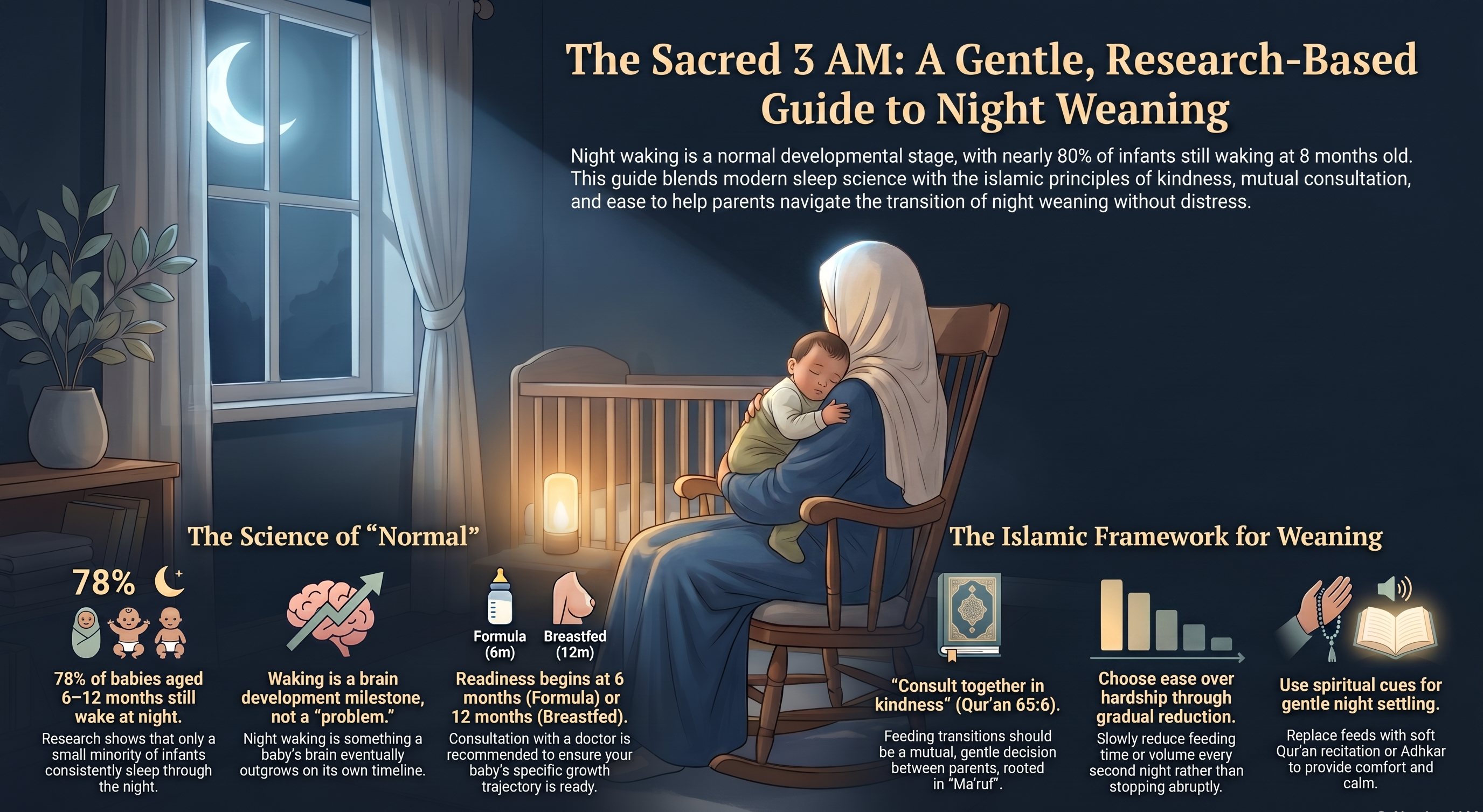
3 AM. The house is dark. You’re sitting up in bed again, baby against your chest, wondering if you’re the only mother still doing this. Everyone else’s baby seems to be sleeping through. Yours isn’t.
Here’s what I wish someone had told me: yours is normal.
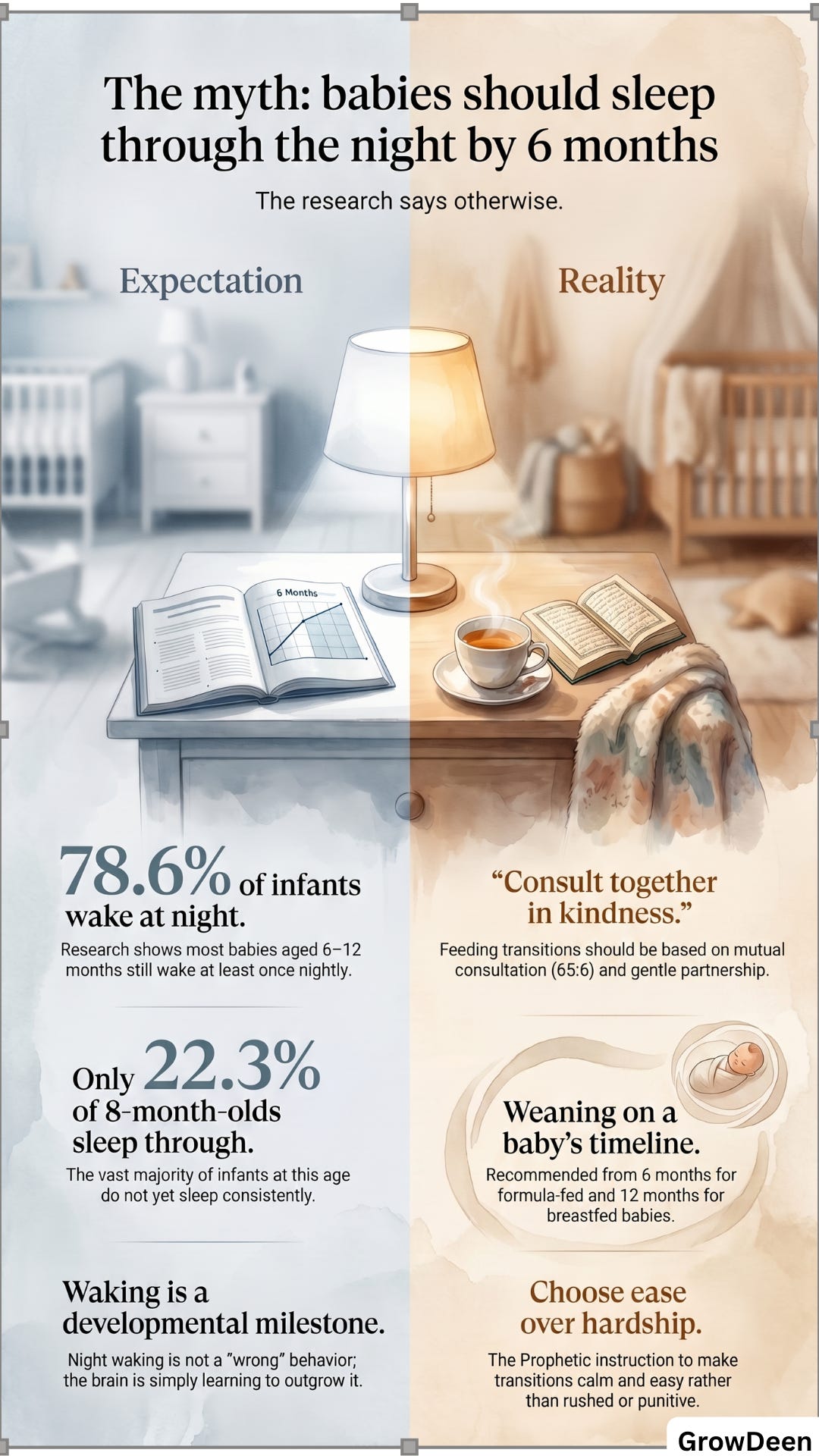
When I studied Paavonen’s 2020 research across two large birth cohorts, the numbers were clear — 78.6% of babies aged 6–12 months still wake at least once at night, and only about 22.3% of 8-month-olds consistently sleep through. [1] Even at two years old, 28.4% of children wake every night or almost every night. [1]
Night waking isn’t something your baby is doing wrong. It’s something their brain is still learning to outgrow. And when you’re ready to start reducing night feeds, there’s a way to do it gently — backed by research and rooted in the mercy of our deen.
Why This Guide Is Different From Generic Sleep Advice
Research-grounded, not opinion-based. Every recommendation here comes from peer-reviewed infant sleep studies and WHO/NHMRC feeding guidelines — not Instagram trends or outdated advice. [1,2,3]
Islamic framework woven in. This isn’t just about sleep science — it’s about the Qur’anic principle of consulting together in kindness (65:6) and the prophetic instruction to choose ease over hardship in every transition. [8,9]
A free Night Weaning Companion Pack included. A 3-page printable PDF with a step-by-step weaning tracker, a settling flowchart for 3 AM, and an Islamic night comfort routine — not just information, but tools you’ll actually use.
When Is the Right Time to Start Night Weaning?
There’s no fixed age. But here’s the general guidance:
Breastfed babies: From around 12 months, once your baby is eating well during the day and your milk supply is established through daytime feeds. [3,4] Before 12 months, night feeds help protect both your supply and your baby’s nutrition. The WHO’s 2023 guideline recommends breastfeeding up to two years or beyond [5] — beautifully aligned with the Qur’anic guidance in Surah Al-Baqarah (2:233).
Formula-fed babies: From around 6 months, since formula is digested more slowly and most babies this age can take in enough during the day. [3,2]
But here’s the thing most guides skip: talk to your doctor first. Not because something is wrong — but because every baby’s growth trajectory is different, and a quick check gives you confidence that the timing is right for yours.
How to Night Wean Gently (The Step-by-Step)
For breastfed children (12 months+):
If the feed is under 5 minutes — you can try dropping it and resettling with comfort instead. Soft Qur’an recitation, gentle patting, a quiet voice. Expect 3–4 adjustment nights.
If the feed is over 5 minutes — reduce gradually. Cut 2–5 minutes every second night. So a 10-minute feed becomes 8 for two nights, then 6, then 4, until you phase it out. Resettle with warmth after each shorter feed. [3]
For formula-fed babies (6 months+):
If the bottle is 60 ml or less — stop the feed and resettle with comfort.
If it’s more than 60 ml — reduce by 20–30 ml every second night. From 180 ml to 150, then 120, then 90. Once you reach 60 ml or less, drop it. [3]
The most important rule? Follow your child. If they become very distressed, pause. Try again in a few days. Night weaning is not a race, and gentleness always wins.
I know this is a lot to hold in your head at 3 AM. That’s exactly why I created the free Night Weaning Companion Pack — a printable guide with a step-by-step weaning tracker and a settling flowchart you can follow half-asleep. Keep reading to download it at the end of this article.
What the Qur’an Teaches About Navigating Feeding Transitions
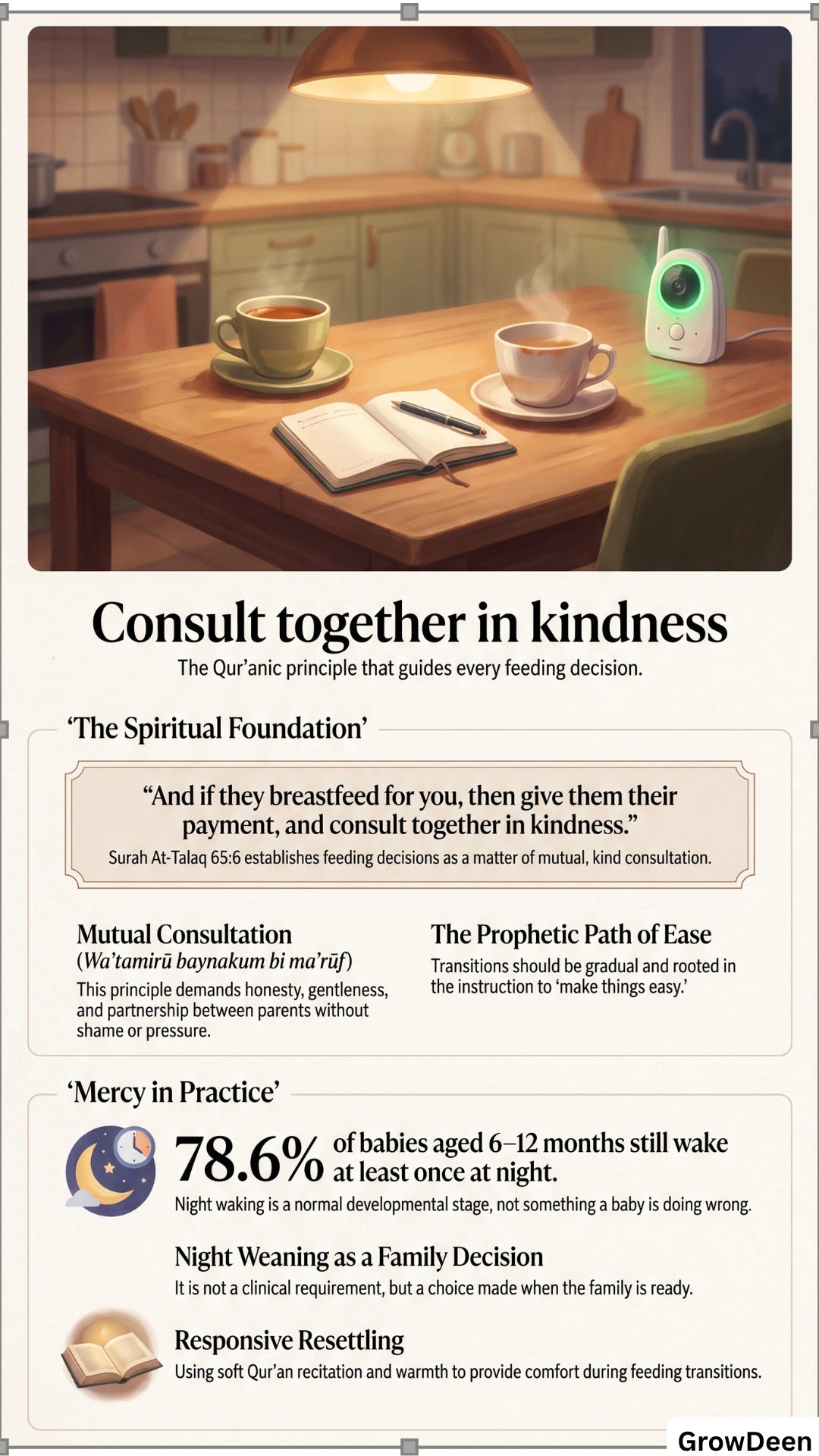
When I reflect on the emotional weight of night weaning, I keep returning to a verse in Surah At-Talaq. Allah ﷻ says:
“And if they breastfeed for you, then give them their payment, and consult together in kindness.” — (Qur’an, 65:6) [8]
According to Tafsir Ibn Kathir, this verse establishes that feeding decisions must be made through mutual consultation in kindness — wa’tamirū baynakum bi ma’rūf. It does not shame the exhausted mother. It does not pressure the uncertain father. It asks for something more: honesty, gentleness, and partnership. [8]
The Prophet ﷺ reinforced this spirit: “Make things easy for the people, and do not make it difficult for them, and make them calm, and do not repulse them.” [Sahih al-Bukhari 6125, Sahih Muslim 1734] [9]
That’s exactly how night weaning should feel. Not rushed. Not punitive. Gradual, consultative, and rooted in ease.
Your Night Weaning Companion Pack
If you’ve read this far, you’re not the kind of parent looking for a shortcut. You want to do this right — gently, knowledgeably, and with your baby’s wellbeing at the centre. That tells me something beautiful about you.
Inside the Night Weaning Companion Pack (one comprehensive PDF, 3 pages):
Page 1: Night Weaning Method Tracker — A visual, step-by-step chart showing exactly how to reduce feeds over 5–7 nights — one column for breastfed babies (time reduction method) and one for formula-fed babies (volume reduction method) — designed as a fridge-door card you can check off each night so you never lose track of where you are in the process.
Page 2: Gentle Night Settling Flowchart — A simple decision tree: “Baby wakes → Is baby distressed or just stirring? → Try this first → Still unsettled? → Try this next → When to offer comfort vs. when to wait” — so you can move through settling confidently at 3 AM without second-guessing yourself.
Page 3: Islamic Night Comfort Routine — The authentic du’as for protecting your child at night, with Arabic text, transliteration, plus a step-by-step Islamic bedtime and night-waking routine incorporating Qur’an recitation and adhkar — something you can start tonight as part of your family’s settling ritual.
This isn’t just a PDF to download and forget. It’s a tool designed to stay on your fridge or bedside table — where you’ll actually reach for it when you need it most.
This Night Weaning Companion Pack is what every subscriber receives with each article. We cover the full journey of raising Muslim children — from newborn sleep to toddler behaviour to building Islamic identity — all backed by research and rooted in Qur’anic and prophetic wisdom.
If you’re a Muslim parent who wants both evidence-based guidance AND Islamic perspective, subscribe for free so future resources arrive in your inbox before you need them.
Subscribe free for parenting resources backed by both science and Sunnah — guidance so unique, you literally can’t get it anywhere else. No spam, no clutter, just resources that matter.
One Small Action for Tonight
Tonight, when you put your baby down, try just one thing: instead of the usual feed-to-sleep, recite Surah Al-Ikhlas softly three times while holding them. Let the recitation become the settling cue. You don’t have to change everything at once. Just this. Just tonight.
May Allah place barakah in your patience, ease in your nights, and reward in every feed you’ve ever given — whether it continues or gently ends.
Think of one person right now: the exhausted mother in your family WhatsApp group who posts at midnight asking if anyone else’s baby is still waking, your sister whose dark circles tell a story she hasn’t said out loud, a friend who’s been Googling “when do babies sleep through the night” for the third month straight.
This article could ease her burden. Share it with her today — not as advice, but as support. Sometimes the most loving thing we can do is send the thing we wish someone had sent us.
Frequently Asked Questions
Q: When should I stop waking my baby up for night feeds? A: If your baby is healthy, gaining weight well, and past the newborn stage, you usually don’t need to wake them to feed. Most paediatricians say once a baby has regained their birth weight and is feeding well during the day, you can let them wake naturally. [3] If you’re unsure, your doctor can confirm based on your baby’s growth.
Q: Will my baby be hungry if I stop night feeds? A: They might want to eat more during the day, which is completely normal and healthy. Research shows that babies naturally shift their caloric intake to daytime once night feeds are reduced. [2] Watch their daytime cues and offer extra feeds or solids as needed.
Q: Can night weaning affect my milk supply? A: Before 12 months, dropping night feeds can reduce supply since prolactin (the milk-making hormone) peaks at night. [4] After 12 months, if you’re feeding well during the day, your supply should adjust. If you’re concerned, speak with a lactation consultant.
Q: Is it OK to let my baby cry during night weaning? A: This guide recommends a gradual, responsive approach — not cry-it-out. You reduce feeds slowly and resettle with comfort each time. If your baby is very distressed, pause and try again later. The goal is ease, not endurance.
Q: What if my partner and I disagree about when to night wean? A: This is actually addressed in the Qur’an — Surah At-Talaq (65:6) tells parents to “consult together in kindness” about feeding decisions. [8] Talk about your reasons, your baby’s readiness, and find a middle ground you both feel good about.
Q: Does night weaning mean my baby will finally sleep through the night? A: Not necessarily. Research shows that over 50% of 12-month-olds still need help falling back asleep after waking — even without hunger. [6] Night weaning removes the feed, but comfort waking may continue for a while. That’s normal.
References
[1] Paavonen, E.J., et al. (2020). Normal sleep development in infants: Findings from two large birth cohorts. Sleep Medicine, 69, 145–154. https://doi.org/10.1016/j.sleep.2020.01.009
[2] Brown, A., & Harries, V. (2015). Infant sleep and night feeding patterns during later infancy. Breastfeeding Medicine, 10(5), 246–252. https://doi.org/10.1089/bfm.2014.0153
[3] National Health and Medical Research Council (NHMRC). (2012, updated 2015). Infant feeding guidelines: Information for health workers. https://www.nhmrc.gov.au/about-us/publications/infant-feeding-guidelines-information-health-workers
[4] Kent, J.C., et al. (2006). Volume and frequency of breastfeedings and fat content of breast milk throughout the day. Pediatrics, 117(3), e387–395. https://doi.org/10.1542/peds.2005-1417
[5] World Health Organization. (2023). WHO Guideline for complementary feeding of infants and young children 6–23 months of age. https://www.who.int/publications/i/item/9789240081864
[6] Goodlin-Jones, B.L., et al. (2001). Night waking, sleep-wake organization, and self-soothing in the first year of life. Journal of Developmental & Behavioral Pediatrics, 22(4), 226–233.
[7] Hysing, M., et al. (2014). Trajectories and predictors of nocturnal awakenings and sleep duration in infants. Journal of Developmental & Behavioral Pediatrics, 35(5), 309–316.
[8] Qur’an, Surah At-Talaq 65:6. Tafsir Ibn Kathir. Also: Surah Al-Baqarah 2:233.
[9] Sahih al-Bukhari 6125; Sahih Muslim 1734. Muttafaqun Alayhi. Narrated by Anas ibn Malik (may Allah be pleased with him).
[10] Pennestri, M.H., et al. (2018). Uninterrupted infant sleep, development, and maternal mood. Pediatrics, 142(6), e20174330.
[11] Barry, E.S. (2021). Sleep consolidation, sleep problems, and co-sleeping. The Journal of Genetic Psychology, 182(4), 183–204.