

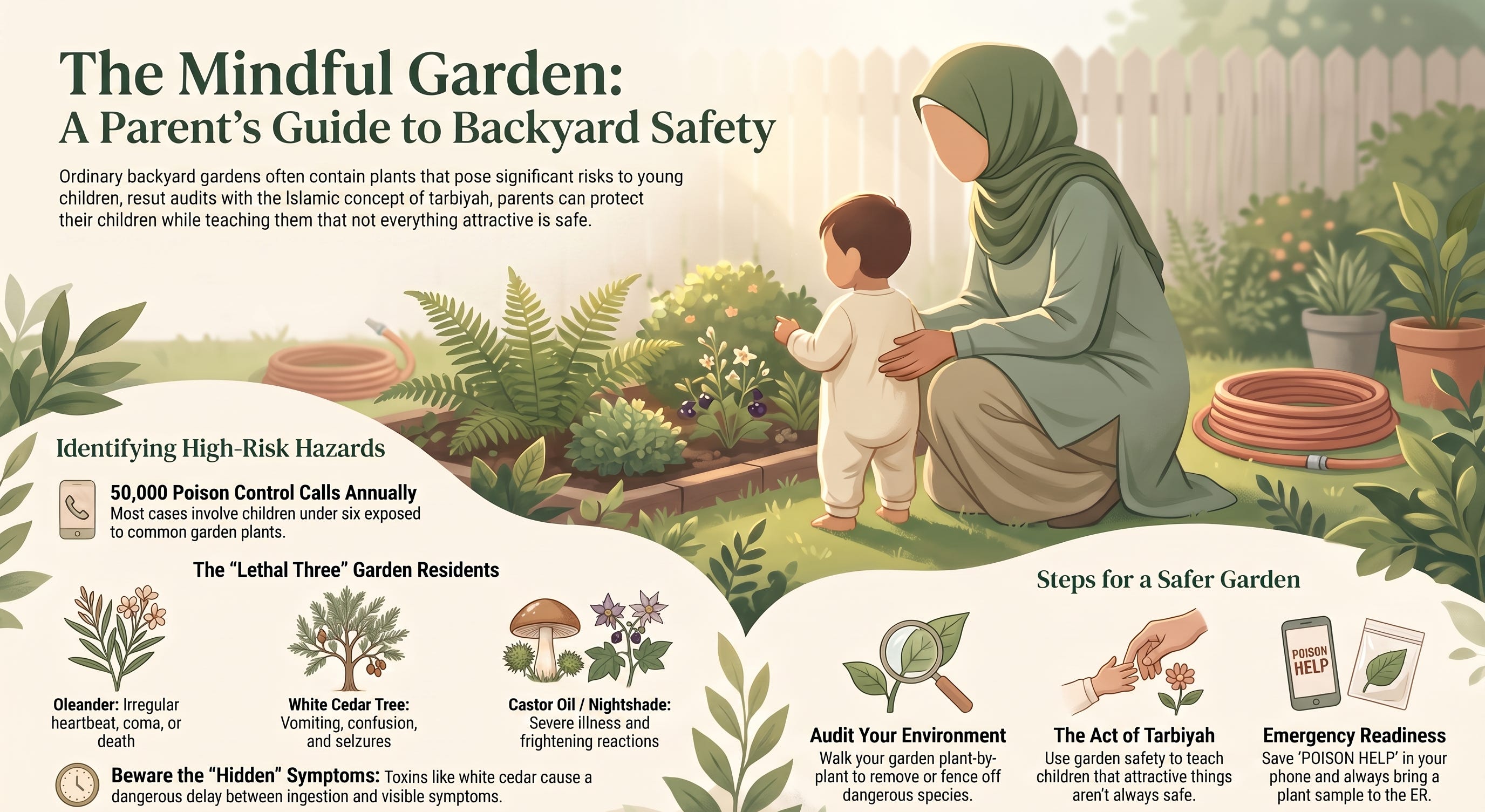
The American Association of Poison Control Centers reports close to 50,000 calls related to plant exposures every year — most involving children under six. [1] This guide shows you exactly which ordinary garden plants are the real risk, and the one afternoon habit that closes most of the gap.
You’ve done the childproofing. Outlet covers. Cabinet locks. The stove guard nobody in your house has ever actually needed — but there, just in case.
Now go stand in your backyard.
Could you name every plant growing in it? Most parents can’t. And that gap — not carelessness, just an honest blind spot — is exactly where a genuinely common cause of childhood poisoning lives. Plant exposures account for somewhere between 5% and 10% of every call made to poison control centres, and the overwhelming majority involve children under six. [2]
Here’s the reassuring part first, because you deserve it before anything else: most of these calls end in nothing worse than an upset stomach. [3][4] But a short list of ordinary garden and houseplants can cause real harm, fast — and most parents wouldn’t guess which ones just by looking at them.
Why This Guide Is Different From a Generic Plant Safety List
Scientific Research + Current Data — Every recommendation here is backed by AAP clinical guidance, a six-year paediatric epidemiology study, and Australia’s Raising Children Network.
Islamic Framework Integrated — This isn’t a safety checklist with a verse tacked on at the end; it’s built around amanah and a Qur’anic story about the exact mechanism that makes garden danger dangerous.
Actionable Resources Included — You’ll get the free Family Garden Safety Companion Pack to keep in your kitchen — a plant reference card and an emergency sequence, not just information.
Why Do Young Children Eat Things They Shouldn’t?
It isn’t misbehaviour. Mouthing objects is one of the main ways babies and young toddlers explore the world — texture, taste, basic properties. It’s a stage, not a red flag. [6]
That instinct doesn’t know the difference between a teething ring and a foxglove leaf.
Older toddlers get into trouble a different way: something looks like food, so it gets treated like food. A bright berry reads as a lolly. A seed pod looks worth cracking open, the way a pea pod would.
This is why environment matters more than instruction in the early years. A two-year-old cannot reliably apply a rule against real curiosity. A four-year-old often can, with repetition. [6][7]
Which Backyard Plants Are Actually Dangerous?
Three plants found in ordinary Western gardens can cause severe illness or death from a small ingestion, and if any of them are growing where your child spends time, they deserve to go straight to the top of your list.
Oleander — every part is poisonous, including the smoke if burned. Can cause an irregular heartbeat, coma, death. [5]
Poisonous mushrooms and toadstools — they can appear overnight after rain, in a lawn that was clear the day before. No wild mushroom should ever be assumed safe. [5]
White cedar tree fruit — the berries can cause vomiting, confusion, seizures. [5]
If you have any of these three, remove them or fence them securely. That single action does more for your child’s safety than almost anything else on this list.
A second group won’t usually kill but can genuinely frighten you: castor oil plant seeds, coral tree seeds, deadly nightshade berries, golden dewdrop, and rhus (the “wax tree”), which causes a poison-ivy-like reaction from nothing more than a brush against the skin. [5]
A longer list rounds things out — angel’s trumpet, arum lily, toxic bulbs like daffodil and tulip, cacti, chillies, cycads, daphne, dumb cane, euphorbia, grevillea, hemlock, lantana, sticky weed. [5] Most of these don’t need to be removed. Many families simply teach children to leave specific plants alone once the child is old enough to actually remember that — usually around age three.
I know this is a lot to hold onto, especially when you’re already tracking a hundred other things about keeping your kids safe. That’s exactly why I built the Family Garden Safety Companion Pack — a printable plant reference card and emergency action guide you can keep in your kitchen. Keep reading, because you’ll get it at the end of this article, and it’s designed to live in the exact spot where a fast decision actually has to happen.
What Actually Helps
Walk your own garden, plant by plant. Most parents genuinely never do this. One unhurried afternoon — a plant ID app, or a photo texted to a local nursery — is one of the highest-value hours you’ll spend on home safety. [5]
Remove or fence the truly dangerous ones. Supervision has gaps. A five-second gap is often all it takes.
Treat the garden like the kitchen. It’s easy to relax outside — more space, more visible activity, less obvious danger. But an unstructured garden is exactly where a young child’s curiosity meets the highest concentration of things built by nature to be picked and tasted. [5][8]
Save your poison control number before you need it — not buried in your contacts, but under a name you’d find in a panic. “POISON HELP” works. A version taped inside a kitchen cabinet works too.
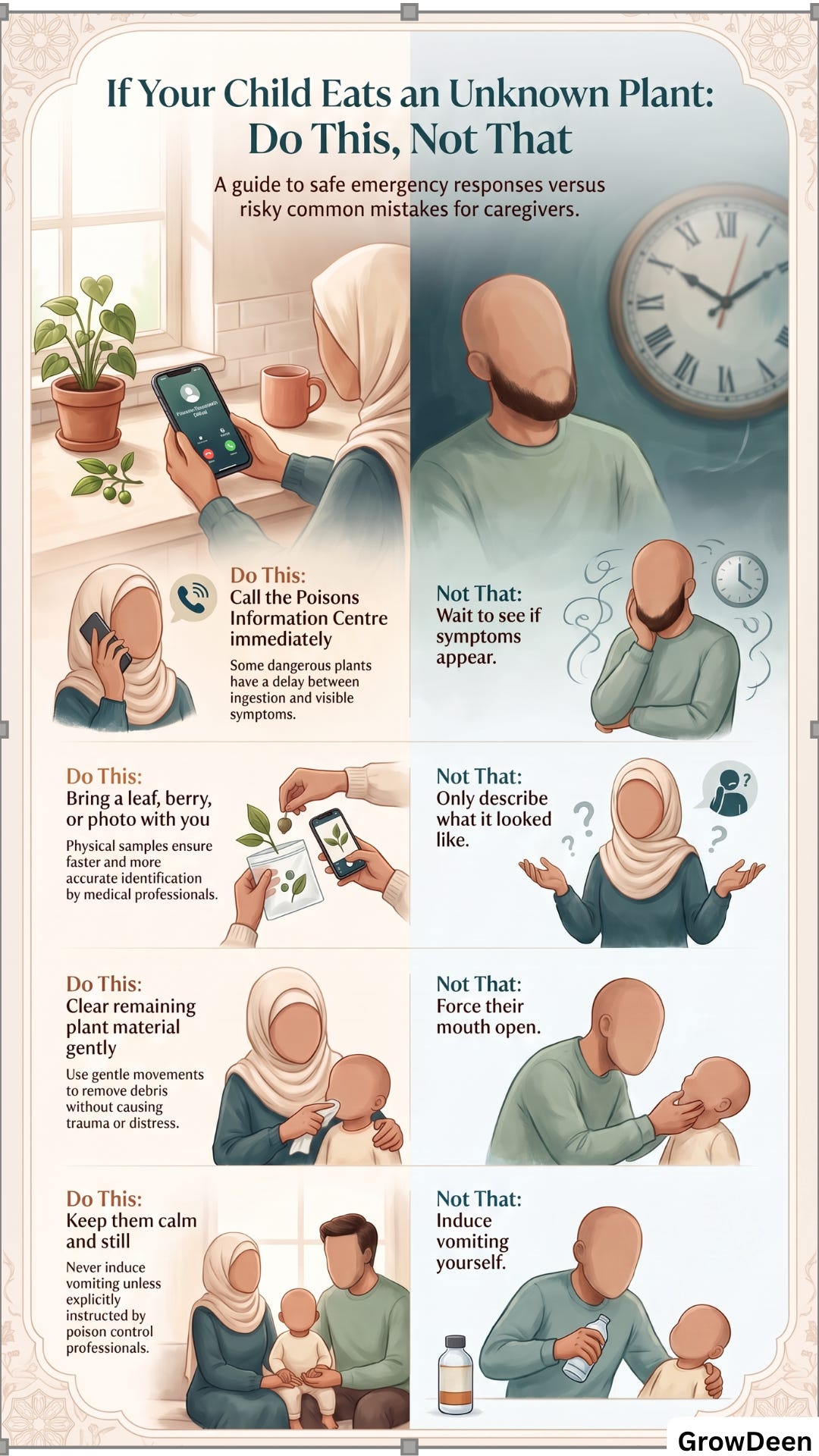
If your child does eat something, bring a sample, not a description. “It had purple berries” tells a doctor very little. A photo or a cutting tells them a lot. [5]
What Not to Do
Don’t assume a plant is safe because a garden centre sells it — plants are chosen for how they look, not for toddler safety. [5] Don’t leave fallen berries or seed pods where a crawling baby can reach them; a large share of infant exposures start with something that dropped, not something that was picked. [2] Don’t induce vomiting unless a poison control professional tells you to. And don’t wait to see if symptoms show up before you call. That judgement call is exactly what poison control exists to take off your hands. [5]
Support Muslim Parenting Lab ❤️
Would you like one parent, somewhere, to be guided because of you? Fund the articles that reach them, with the button below.
The Prophet ﷺ said one person guided through you is better for you than red camels, the greatest wealth of that time. (Sahih al-Bukhari 3701)
What If Your Child Already Ate Something?
Call your local Poisons Information Centre immediately. In Australia, that’s 131 126. Wherever you are, take five minutes today to find and save your own region’s number — “I’ll look it up if I ever need it” rarely survives actual panic.
Seek urgent care for vomiting, unusual drowsiness, difficulty breathing, an irregular heartbeat, seizures, or a widespread skin reaction. Here’s the part that catches people off guard: some dangerous plants, white cedar among them, cause a delay between ingestion and the first visible symptom. [5] “They seem fine right now” is not the same thing as “they’re fine.”
Does This Change By Age?
Crawling to around 18 months, everything goes in the mouth — normal, not a behaviour problem. Keep dangerous plants and fallen matter fully out of reach; instruction can’t compete with that instinct yet. [6]
Eighteen months to three years, kids can start following simple, repeated instructions — “we don’t touch that one” — though supervision still carries more weight than words. Three and up, they can genuinely learn which plants are safe to touch and which aren’t, the same way they learn not to run onto a road.
The Islamic Framework for Watching Over a Garden
As Muslim parents, we tend to picture amanah — the trust Allah has placed in our hands — in the big, obvious moments. It’s worth remembering it also lives in the quiet work of knowing our own backyard.
There’s a scene in the Qur’an I think about every time I consider how danger actually works, and it isn’t a safety verse at all — it’s the story of Adam and Hawwa in Paradise. Allah says: “O Adam, dwell, you and your wife, in Paradise and eat from wherever you will, but do not approach this tree” [Qur’an 7:19]. According to Tafsir Ibn Kathir, Allah gave them free access to everything except one named tree — and Shaytan worked to make that one thing look desirable, not dangerous. [9] Nothing about it looked alarming. That’s exactly the pattern in a garden: danger rarely looks like danger. It looks like a berry that looks like a sweet.
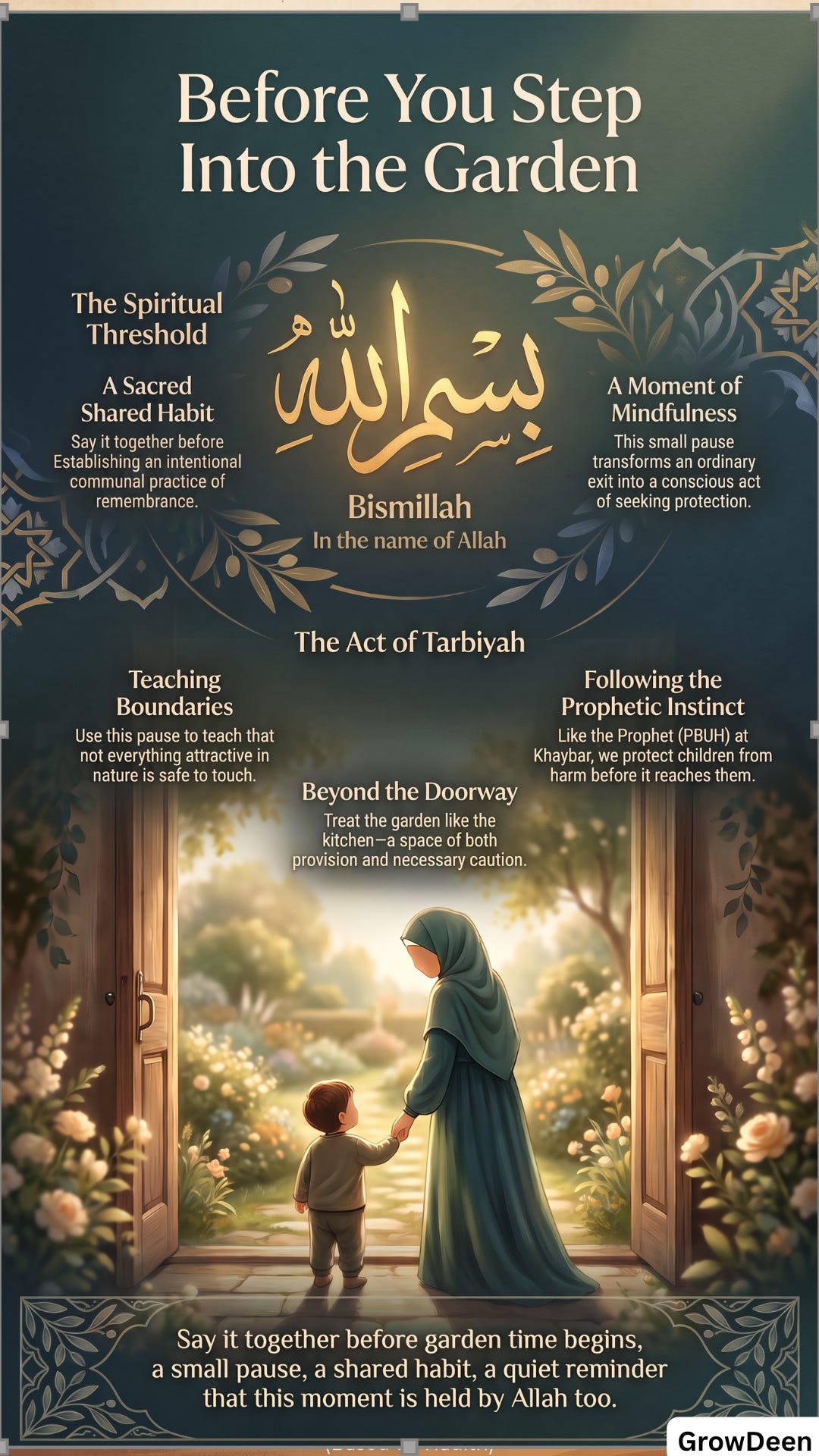
The Prophet ﷺ modelled the flip side of that story. Presented with a roasted sheep at Khaybar, something made him pause — the meat had been deliberately poisoned. He withdrew his hand before harm reached him; a companion who’d already eaten was affected [Sahih al-Bukhari 2617]. [10] He didn’t eat first and hope for the best. That’s the exact instinct we’re building in ourselves every time we stop a toddler’s hand a half-second before it reaches an unfamiliar berry.
What strikes me is how naturally research and reminder line up here: know your environment, remove the real danger, stay present. Teaching a child “we don’t eat this one” is a small act of tarbiyah — but it plants something that outlasts the garden: an early, felt sense that not everything attractive is safe.
Download Your Family Garden Safety Companion Pack
If you’ve read this far, you’re the kind of parent who takes ordinary risks seriously — not out of anxiety, but out of protective love. That says something good about you.
Inside the Family Garden Safety Companion Pack (one comprehensive PDF, 3 pages):
Page 1: Know Your Garden Plant Reference Card — a colour-coded guide to the highly dangerous and toxic plants covered in this article, with a one-line symptom summary for each — designed as a printable card you can keep on the fridge or by the back door.
Page 2: If It Happens — Emergency Action Flowchart — a simple, five-step sequence for exactly what to do the moment a child eats an unknown plant, with a space to write in your own region’s poison control number, so it’s ready before you ever need it.
Page 3: A Garden Boundary, Named Clearly — a short reflection card built around Qur’an 7:19 and a “say with your child” line to use together the next time you’re out in the garden.
This isn’t a PDF to download once and forget. It’s built to live in your kitchen — where the decision, if it ever comes, actually has to happen.
This companion pack is what every subscriber receives with each article. We cover the full journey of raising Muslim children — from newborns to school-age — all backed by research and rooted in Islamic wisdom.
Before you keep scrolling: go to your back door right now and look at the closest plant to it. Do you know its name? If not, that’s exactly where to start.
Think of one person right now: a sister with a toddler who’s just started walking, a friend whose backyard you’ve stood in and noticed a shrub you couldn’t name. This article could protect their child. Share it with them today — not to be preachy, but because sometimes the most loving thing we can do is pass along the thing that prevents the frightening moment altogether.
Frequently Asked Questions
Q: What is the most dangerous plant commonly found in home gardens?
A: Oleander is usually named first — every part of the plant is toxic, including the smoke if it’s burned, and it can cause a dangerous heart rhythm and death. [5] Poisonous mushrooms and white cedar fruit sit right alongside it on the highly dangerous list — see “Which Backyard Plants Are Actually Dangerous?” above.
Q: Are most plant poisonings in children actually serious?
A: No — most exposures, even to genuinely toxic plants, end in nothing worse than an upset stomach. [3][4] That said, a small number of specific plants can cause serious harm quickly, which is why knowing your own garden matters.
Q: Should I make my child throw up if they eat a poisonous plant?
A: No. Don’t induce vomiting unless a poison control professional specifically tells you to — some substances cause more damage coming back up than staying down. [5] Call your local Poisons Information Centre first.
Q: At what age can I start teaching my child which plants are unsafe?
A: Around age three is when most children can reliably remember and follow an instruction like “we don’t touch that one.” [5] Before that, removing or fencing dangerous plants matters more than teaching does.
Q: My child seems fine after eating a plant — do I still need to call poison control?
A: Yes. Some dangerous plants, including white cedar, cause a delay between ingestion and the first symptom. [5] Feeling fine right now isn’t the same as being in the clear.
Q: How can I find out if a specific plant is safe for my garden?
A: A local nursery or council office can usually tell you within minutes whether a plant is appropriate for a garden used by young children. [5] It’s worth asking before you buy, not after.
References
[1] American Association of Poison Control Centers, cited in Diaz, J.H. (2016). Poisoning by Herbs and Plants: Rapid Toxidromic Classification and Diagnosis. Wilderness & Environmental Medicine, 27(1). https://journals.sagepub.com/doi/10.1016/j.wem.2015.11.006
[2] American Academy of Pediatrics. Poisonous Plants: When They Are a Threat to Children. Pediatrics in Review, 18(5), 162. https://publications.aap.org/pediatricsinreview/article/18/5/162/36706/
[3] Poisonous plants: An ongoing problem. Anales de Pediatría. https://analesdepediatria.org/en-poisonous-plants-an-ongoing-problem-articulo-S2341287915000861
[4] Epidemiology and Clinical Characteristics of Acute Plant Exposure in Patients Aged 0–18 Years — A Six-Year Retrospective Study. National Center for Biotechnology Information. https://www.ncbi.nlm.nih.gov/pmc/articles/PMC10969538/
[5] Raising Children Network (Australian Government-supported parenting website, reviewed by Emeritus Professor John Pearn AO, paediatrician, Queensland Children’s Hospital). Dangerous plants: keeping children safe. https://raisingchildren.net.au/babies/safety/poisons/dangerous-plants
[6] American Academy of Pediatrics / HealthyChildren.org. Poison Prevention & Treatment Tips for Parents. https://www.healthychildren.org/English/safety-prevention/all-around/Pages/Poison-Prevention.aspx
[7] Center on the Developing Child, Harvard University. Early self-regulation capacity.
https://developingchild.harvard.edu/
[8] Poison Prevention Manual. Georgia Department of Early Care and Learning. https://www.decal.ga.gov/documents/attachments/PoisonPreventionManual.pdf
[9] Qur’an, Surah Al-A’raf 7:19–22 — https://quran.com/7/19 — Tafsir Ibn Kathir: https://quran.com/en/7:19-22/tafsirs/en-tafisr-ibn-kathir
[10] Sahih al-Bukhari 2617 — Graded: Sahih — https://sunnah.com/bukhari:2617
We combine scientific research with Qur’an and authentic Sunnah, and we cite our sources. Even so, this is general guidance and no substitute for a doctor who can examine your child.