

A 2025 study found that open-ended play boosted young children’s executive-function scores by roughly 16% in just a few weeks [1]. This guide gives you the full stage-by-stage picture of how your baby’s imagination grows, six play ideas that build it, and a verified list of genuinely Islamic-friendly toys, so you have everything in one place, not scattered across a dozen tabs.
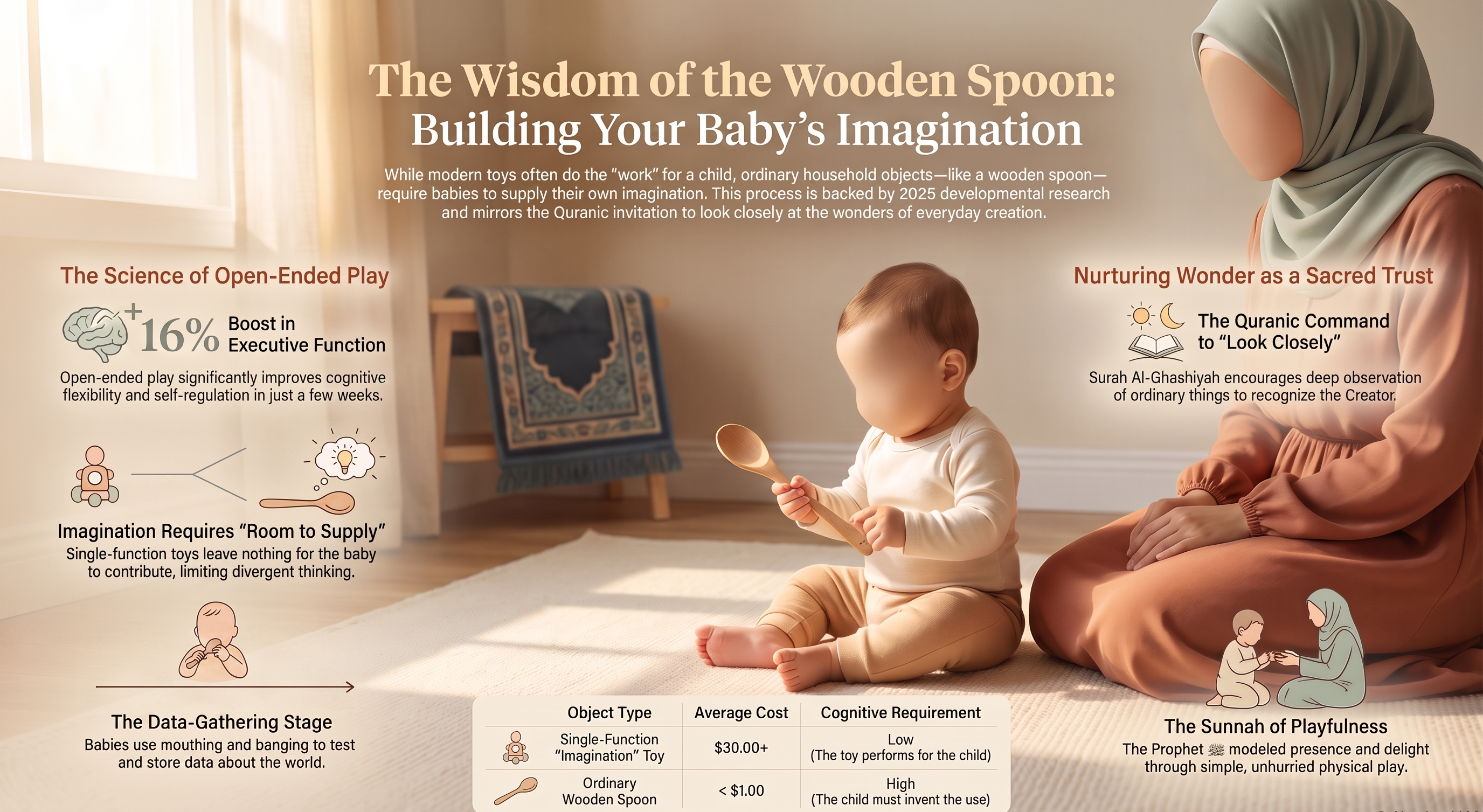
A wooden spoon costs less than a dollar. A store-bought “imagination toy” can run you thirty.
Guess which one your baby is more likely to stare at, transfixed, for a full two minutes.
I know that sounds backwards. You’d think the toy engineered by a team of child-development experts would win every time. But here’s the thing: imagination doesn’t come from what a toy does. It comes from what your baby has to supply themselves — and a single-function toy leaves nothing left to supply.
A 2025 review of children’s play found that open-ended, loosely-structured play was consistently linked to stronger divergent thinking and creativity than play with toys built to do just one job [5]. Your baby doesn’t need more stuff. They need more room to combine what’s already there.
Why This Guide Is Different From Generic Play Lists
Backed by current developmental research, not just tradition. Every recommendation here is grounded in peer-reviewed findings on play, executive function, and early brain architecture — including a 2025 clinical report reaffirming that play “is not frivolous” but actively shapes brain structure [4].
A genuine Islamic framework, not a verse tacked on at the end. This is rooted in the Qur’anic command to look closely at what Allah has made — the same instinct your baby is already practicing every time they stare at a spoon.
Real, actionable resources. You’ll get The Wonder Box Companion Pack free — imagination-specific activity cards, a verified Islamic-friendly toy list, and a reflection card — not just information, but things you’ll actually use this week.
Why Play Builds Imagination
There’s a particular look babies get somewhere around five or six months — eyes wide, hands frozen mid-reach, completely arrested by something as small as a wooden spoon or the way light moves across the ceiling. It isn’t nothing. That look is the beginning of imagination.
Between birth and twelve months, your baby is working out what the world is made of, and play is the method. Every object mouthed, every face studied, every sound tested is data — and as that data accumulates, your baby starts doing something remarkable: combining it. A block becomes a phone. A cushion becomes a hiding place. That combining is imagination in its earliest form [2].
Play isn’t a break from development — it is development. It delivers the sensory, physical, and cognitive experiences that build the brain’s architecture, wiring connections that support thinking, language, emotional regulation, and social understanding all at once [3]. Structured and unstructured play alike have been linked to gains in working memory, self-regulation, and cognitive flexibility — the executive function skills your baby will lean on for the rest of childhood [1,6]. Open-ended play in particular — the kind where a single object can become ten different things — has been associated with stronger divergent thinking and creativity than play with toys that only do one thing [5]. The American Academy of Pediatrics puts it plainly: play is not frivolous. It enhances brain structure and function [4].
How Your Baby’s Imagination Unfolds, Stage by Stage
From birth: Your baby is fascinated by you first. Your face, your voice, the particular way you touch them — these are the original sparks of imagination, long before any toy enters the picture.
Around 5 months: Mirrors become magnetic. Your baby will watch their own hands clap, their own face move, utterly delighted — though they won’t yet understand that the baby in the glass is them. That recognition doesn’t arrive until 18–24 months [2]. Around this time, pictures in books start to mean something too — your baby is beginning to connect a drawing of a cat to the actual cat they’ve met, which is no small cognitive leap.
5–6 months: Touch and taste take over. Everything goes in the mouth, not because your baby lacks manners, but because the mouth is, at this stage, the most sensitive imagination-gathering tool they have. Banging two objects together to hear what happens is the same instinct — testing, discovering, storing the result.
7–8 months: Copying begins in earnest. Your baby starts mimicking your sounds and gestures, and by around 8 months, that copying becomes imaginative reuse — a block held to the ear like a phone, a face hidden behind a cushion in an early, wobbly version of peekaboo [7,8].
9–12 months, and once crawling starts: The whole house becomes an invitation. Cupboards, gaps under furniture, the space behind the sofa — your baby investigates these not out of mischief but because each one holds the question “what’s in there, and what could I do with it?” [9]
The order of these milestones tends to hold steady; the timing varies by child. If your baby seems consistently uninterested in objects or play, it’s worth mentioning to your doctor or paediatrician.
Play Ideas That Grow Imagination
Indoors
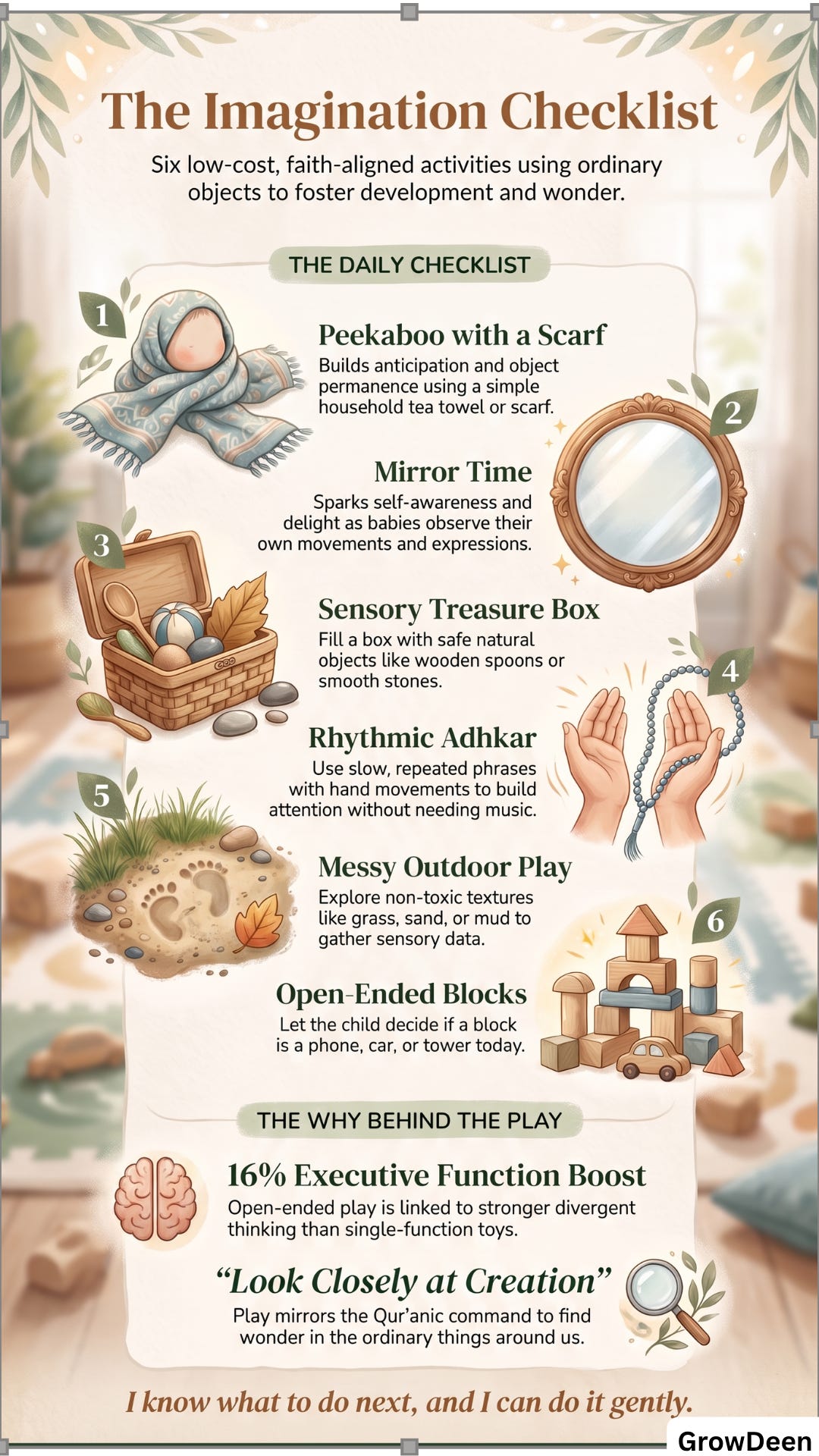
Peekaboo with a scarf or tea towel — one of the oldest games in existence, and still one of the best for building anticipation and object permanence.
Mirror time. Prop your baby in front of a mirror, or lie them on their side or tummy facing one.
Open books and interesting objects placed within reach and view.
Photos of people and places, narrated together — “that’s your khala, that’s the masjid we go to.”
Rhythmic, repeated phrases with actions — reciting short adhkar or Qur’anic phrases slowly while doing simple hand movements builds the same anticipation and joint-attention that rhymes do, without relying on musical instruments or songs.
A treasure box of safe household and natural objects — a wooden spoon, a smooth stone, a scrap of soft fabric, a small tin — for open hands-on exploration.
Outdoors
New natural textures: grass, a seashell, a basil leaf to smell or gently taste.
A nature walk — anywhere with things to see, hear, and touch.
Outdoor tummy time, or lying on the back watching light move through tree branches.
Messy play with sand, mud, clay, or playdough — non-toxic only, since fingers will inevitably end up in mouths.
Open-ended over structured
Blocks are the gold standard of open-ended play precisely because they refuse to be just one thing — a car today, a phone tomorrow, a tower the next. Toys with a single fixed function have their place, but don’t be surprised when your baby finds a more creative use for them anyway. That’s the imagination doing exactly what it’s supposed to do.
Support Muslim Parenting Lab ❤️
Is there someone you have lost who you would still like to send a reward to? Give in their name with the button below.
Asked whether he could give charity for his late mother, the Prophet ﷺ said: yes, give on her behalf. (Sahih al-Bukhari 2760)
Islamic-Friendly Toys and Resources for This Age
I know this is a lot to keep in your head, especially when you’re already juggling feeds, naps, and everything else this stage throws at you. That’s why I put together a free Wonder Box Companion Pack with this full list printed and ready — but here’s the research in full, right now, if you want to start looking today:
Lala + Mo — a Montessori-and-Islamic-themed collection with pieces designed for babies through preschoolers, including sensory and screen-free options.
Desi Doll Company — cot mobiles, teething toys, and soft Islamic sound books built around Qur’anic themes.
Muslim Memories and Anafiya Gifts — moon-and-star mobiles with light projection and recorded Qur’an recitation.
QuranCube — a Kaaba/moon/star mobile explicitly marketed as recitation-only, without musical instruments.
Crescent Moon Store and Four Kids Toys — broader Islamic and Arabic-Montessori toy collections spanning sensory play, puzzles, and early learning.
A genuine caution worth passing on: several of these products use the word “nasheed” in their marketing, and not every nasheed is instrument-free. It’s worth checking each product’s specific description for “Qur’an recitation only, no music or instruments” rather than assuming based on branding alone. Beyond dedicated Islamic shops, ordinary Montessori-style silicone teething blocks, stacking rings, and treasure-basket items — paired at home with a simple Bismillah before play or counting in Arabic — work just as well and are far easier to find.
The Sacred Trust of Wonder: What the Qur’an and the Prophet ﷺ Show Us About a Child’s Curiosity
As Muslim parents, it’s easy to see our baby’s fascination with a scarf, a mirror, or a wooden spoon as simply cute — a phase to get through on the way to “real” learning. But there’s something deeper here. When Allah says, “Do they not look at the camels, how they are created? And at the heaven, how it is raised, and at the mountains, how they are rooted, and at the earth, how it is outspread?” [11], He is commanding a very particular kind of attention: not a glance, but a close, wondering look at ordinary things until their extraordinariness becomes visible. According to Tafsir Ibn Kathir, this verse points the reader toward what is right in front of them — the camel they ride, the sky over their head, the ground under their feet — as proof of the Creator’s power, precisely because these are things people had stopped truly seeing. I think about that whenever I watch my baby stare, transfixed, at a spoon they’ve seen a hundred times before. In miniature, and long before they have the words for it, that’s the same instinct the ayah is calling us back to — looking closely at the ordinary until it opens up.
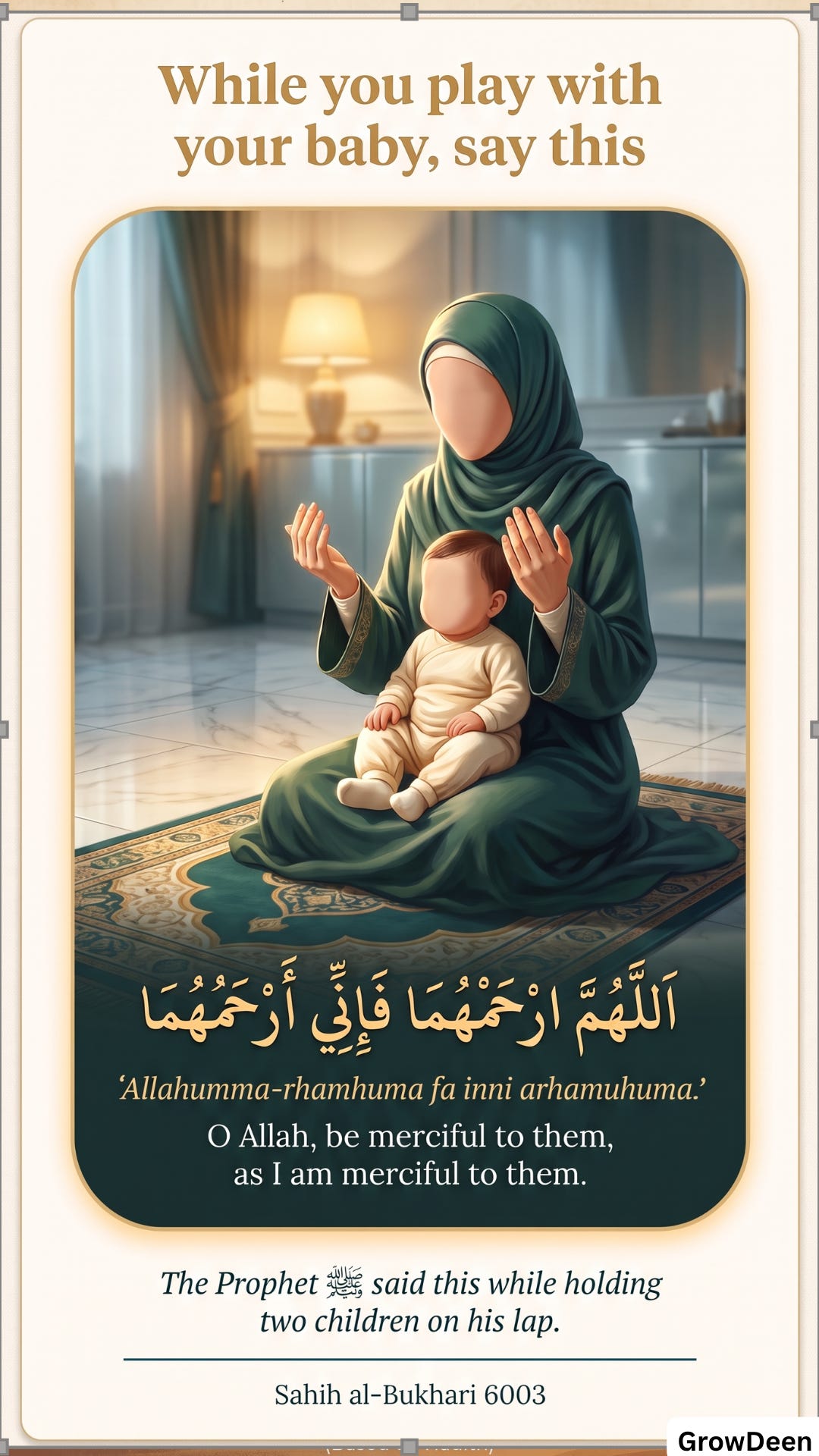
The Prophet ﷺ modeled the playful, present side of this beautifully. Mahmud ibn Rabi’ah recalled that when he was a young boy, “the Prophet ﷺ took water from a bucket with his mouth and threw it on my face” [12] — a small, unhurried, delighted moment that stayed with him his whole life, vivid enough to narrate decades later. That’s worth sitting with. The Prophet ﷺ, occupied with the weight of prophethood, still made room for a moment of pure, physical playfulness with a child — and that moment became a lifelong memory. Our baby’s mirror games and peekaboo rounds are doing the same quiet work: building the sensory, joyful memories that a growing mind returns to again and again.
What’s striking is how naturally the Islamic view and the research point the same direction. Allah’s command to look closely at creation, and the science showing that open-ended, wondering play builds a sharper, more flexible mind, aren’t two separate conversations — they’re the same insight in two languages. Every scarf hidden behind a face, every stone turned over in a treasure box, is a small rehearsal of the attentive looking the Qur’an asks of us as adults. May Allah make our homes places where that wonder is nurtured, not rushed past.
Your Wonder Box Companion Pack
If you’ve read this far, you’re the kind of parent who wants your baby’s play to actually mean something — not just fill time. That tells me something beautiful about you.
Inside the Wonder Box Companion Pack (one comprehensive PDF, 3 pages):
Page 1: The Imagination Sparks Activity Cards — Six printable prompt cards, one per play idea above, each naming exactly what skill it builds — designed as cut-apart cards you can keep in a kitchen drawer or diaper bag for instant no-prep play ideas.
Page 2: The Islamic-Friendly Wonder Toy & Resource Guide — The full verified list above (all 7 stores, plus the nasheed caution), formatted as a printable reference — so you can decide in minutes what’s worth buying versus what your kitchen drawer already has.
Page 3: The Wonder & Reflection Card — The Qur’an 88:17–20 verse and the Prophet ﷺ’s playful water-splash moment with Mahmud ibn Rabi’ah, formatted as a short reflection you can read while your baby plays nearby.
This isn’t just a PDF to download and forget. It’s a tool designed to stay in your diaper bag or on your fridge — where you’ll actually reach for it.
This Wonder Box Companion Pack is what every subscriber receives with each article. We cover the full journey of raising Muslim children, all backed by research and rooted in Islamic wisdom.
Before you keep reading: go find one ordinary object near you right now — a spoon, a scarf, a sock. Hand it to your baby today. That’s it. That’s the whole practice.
May Allah make your home a place where wonder is nurtured, not rushed past.
Think of one person right now: a tired mother in your family whose baby seems bored of every toy she’s bought, a friend who just asked in the group chat what to get for a first birthday, a sister who feels guilty every time she hands her baby a phone instead of a toy.
This article could ease that guilt and save her money. Share it with her today — not as advice-giving, but as support.
Frequently Asked Questions
Q: When does imagination actually start developing in babies?
A: Earlier than most parents expect — even newborns are captivated by faces and voices, the earliest spark of imagination. By 7–8 months, true imaginative reuse of objects (a block as a phone) typically appears [7,8]. See “How Your Baby’s Imagination Unfolds” above for the full stage-by-stage picture.
Q: Is screen time bad for building imagination?
A: Screens do the imagining for your baby instead of asking them to supply it themselves, which is the opposite of what open-ended play does [5]. A wooden spoon or scarf asks far more of your baby’s brain than a video ever will.
Q: What are the best toys for imaginative play at 3–12 months?
A: Open-ended objects — blocks, scarves, treasure-box items — outperform single-function toys for creativity and divergent thinking [5]. See the full Islamic-friendly toy list above, or grab it printed in the Wonder Box Companion Pack.
Q: Do toys with Qur’an recitation count as screen-free imaginative play?
A: Yes, as long as they’re recitation- or adhkar-based rather than music or nasheeds with instruments. Always check the product description directly — “nasheed” branding doesn’t guarantee instrument-free audio.
Q: How much unstructured play does my baby actually need each day?
A: There’s no single magic number, but frequent short bursts throughout the day matter more than one long scheduled session [3,6]. Floor time, treasure-box exploration, and peekaboo all count.
Q: What if my baby seems uninterested in toys or play altogether?
A: A little pickiness is normal — babies often prefer people to objects at this age [9]. But if your baby is consistently disinterested in engaging with objects, faces, or sounds over several months, mention it to your doctor or paediatrician.
References
[1] Baten, E., et al. (2020), as cited in TPM Vol. 32, No. S2 (2025). Structured symbolic play and executive function outcomes in early childhood education.
[2] Howard, J. (2017). Mary D. Sheridan’s play in early childhood: From birth to six years. Routledge.
[3] Fett, R. (2019). Brain health from birth: Nurturing brain development during pregnancy and the first year. Franklin Fox Publishing.
[4] American Academy of Pediatrics. The Power of Play: A Pediatric Role in Enhancing Development in Young Children. Clinical Report, reaffirmed January 2025.
[5] Systematic review, PMC12112344 (2025). The relationship between children’s indoor loose parts play and cognitive development, including divergent thinking and creativity.
[6] Escolano-Pérez, E., & Martín-Bozas, F. (2025). Construction and validation of an observational instrument to assess infant executive functions through playing. Humanities and Social Sciences Communications, 12, Article 1625.
[7] Fleer, M. (2021). Conceptual PlayWorlds: The role of imagination in play and learning. Early Years, 41(4), 353–364.
[8] Markodimitraki, M., & Kalpidou, M. (2021). Developmental changes in imitation during mother-infant interactions. Early Child Development and Care, 191(10), 1602–1612.
[9] Thiele, M., Hepach, R., Michel, C., & Haun, D. (2021). Infants’ preference for social interactions increases from 7 to 13 months of age. Child Development, 92(6), 2577–2594.
[10] Lala + Mo, Desi Doll Company, Muslim Memories, Anafiya Gifts, QuranCube, Crescent Moon Store, Four Kids Toys — Islamic/Montessori toy retailers (illustrative resources, not paid endorsements — verify materials, safety certification, and audio content independently before purchasing).
[11] Qur’an 88:17–20, with Tafsir Ibn Kathir (via Quran.com and Alim.org).
[12] Sahih al-Bukhari 77.
We combine scientific research with Qur’an and authentic Sunnah, and we cite our sources. Even so, this is general guidance and no substitute for a doctor who can examine your child.