

Researchers at the University of Chicago tracked 53 families for five years and found that the type of praise a parent uses with a toddler, not just how much, predicts how that child faces challenges years later. [1] This guide shows you the difference, and the exact prophetic guidance that got there first.
It’s 3:40 in the afternoon. The car door slams, a backpack lands in the footwell, and your daughter holds up a spelling test with a bright red 100 across the top.
“You’re SO smart!” comes out of you before you’ve even taken the paper from her hands.
She beams. You feel good. It’s a small, ordinary moment, the kind that plays out in a dozen variations every single day, at the dinner table, on the prayer mat, over a drawing taped to the fridge.
Here’s what stopped me in my tracks when I looked into the research on this: the exact sentence you choose in that moment may matter more than almost anything else you say to your child all year.
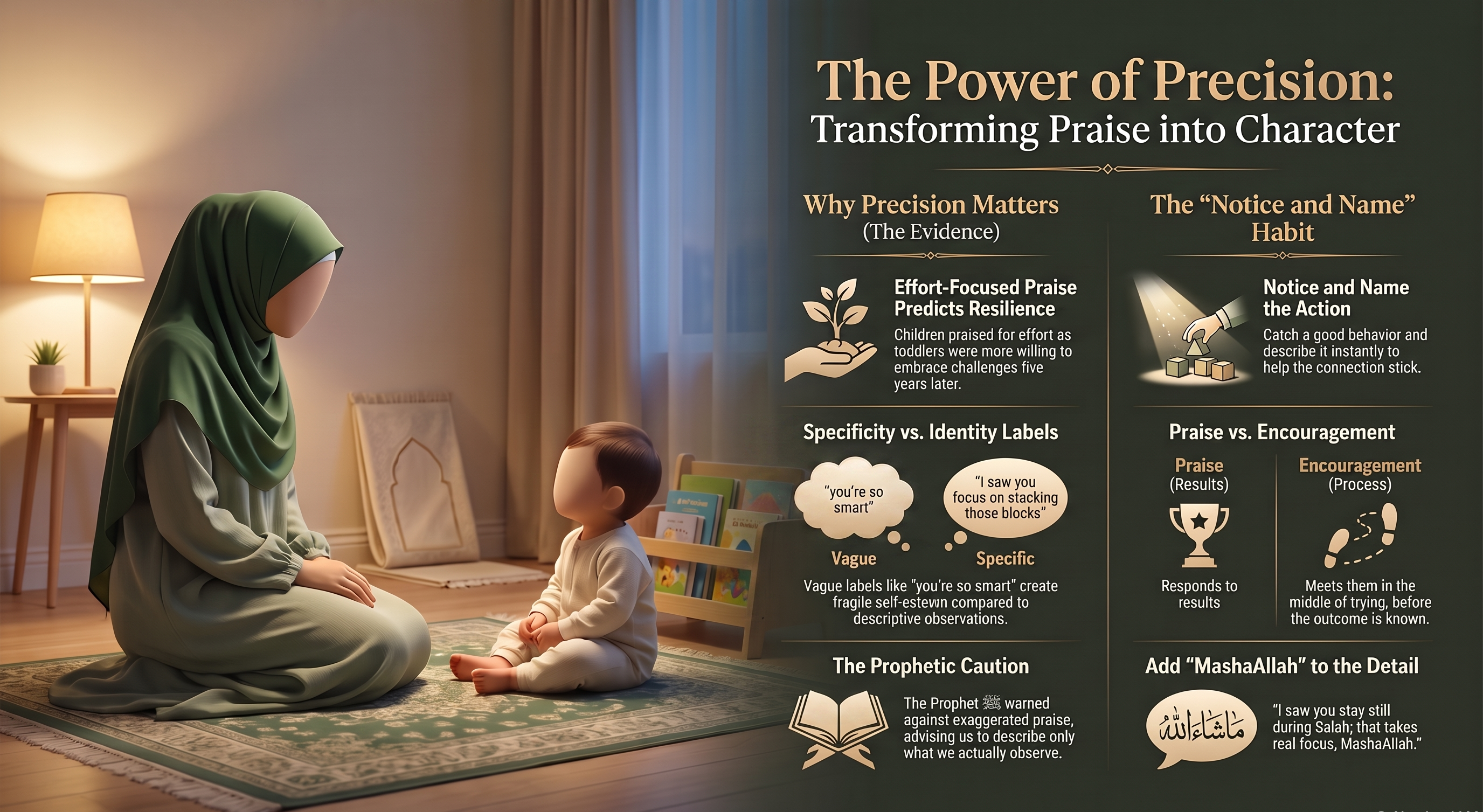
In 2013, a team led by Elizabeth Gunderson filmed 53 families at home, watching how parents naturally praised their toddlers during ordinary play. [1] Five years later, they came back and tested those same children on how they approached difficult tasks. The children whose parents had leaned toward specific, effort-focused praise as toddlers were noticeably more willing to embrace challenge at age seven and eight. The ones who’d mostly heard “you’re so smart” and “good boy” were more likely to give up when things got hard.
Same love. Same intention behind it. Different words. A measurably different child, five years on.
Why This Guide Is Different
It’s built on a study that followed real children for five years, not a hunch. Most parenting advice about praise is intuitive guesswork dressed up as expertise. This guide draws on a longitudinal study that tracked 53 families from toddlerhood into early school age, plus a 2019 meta-analysis of 77 separate parent-training programs, so what you’re reading has actually been tested against what happens to children over time, not just what sounds nice in the moment. [1, 3]
It shows you where the Sunnah already solved this. Long before Gunderson’s cameras were rolling, the Prophet ﷺ was teaching companions the precise difference between honest, specific praise and dangerous, sweeping exaggeration. You’ll see the hadith itself, and how closely it lines up with what researchers only recently proved.
You walk away with something to use tonight, not just something to think about. The free Descriptive Praise Companion Pack included below gives you a printable phrase card, a simple tracking tool, and two short reflection cards, built to live on your fridge or in a drawer, not in a folder you never open again.
The Trouble With “Good Job”
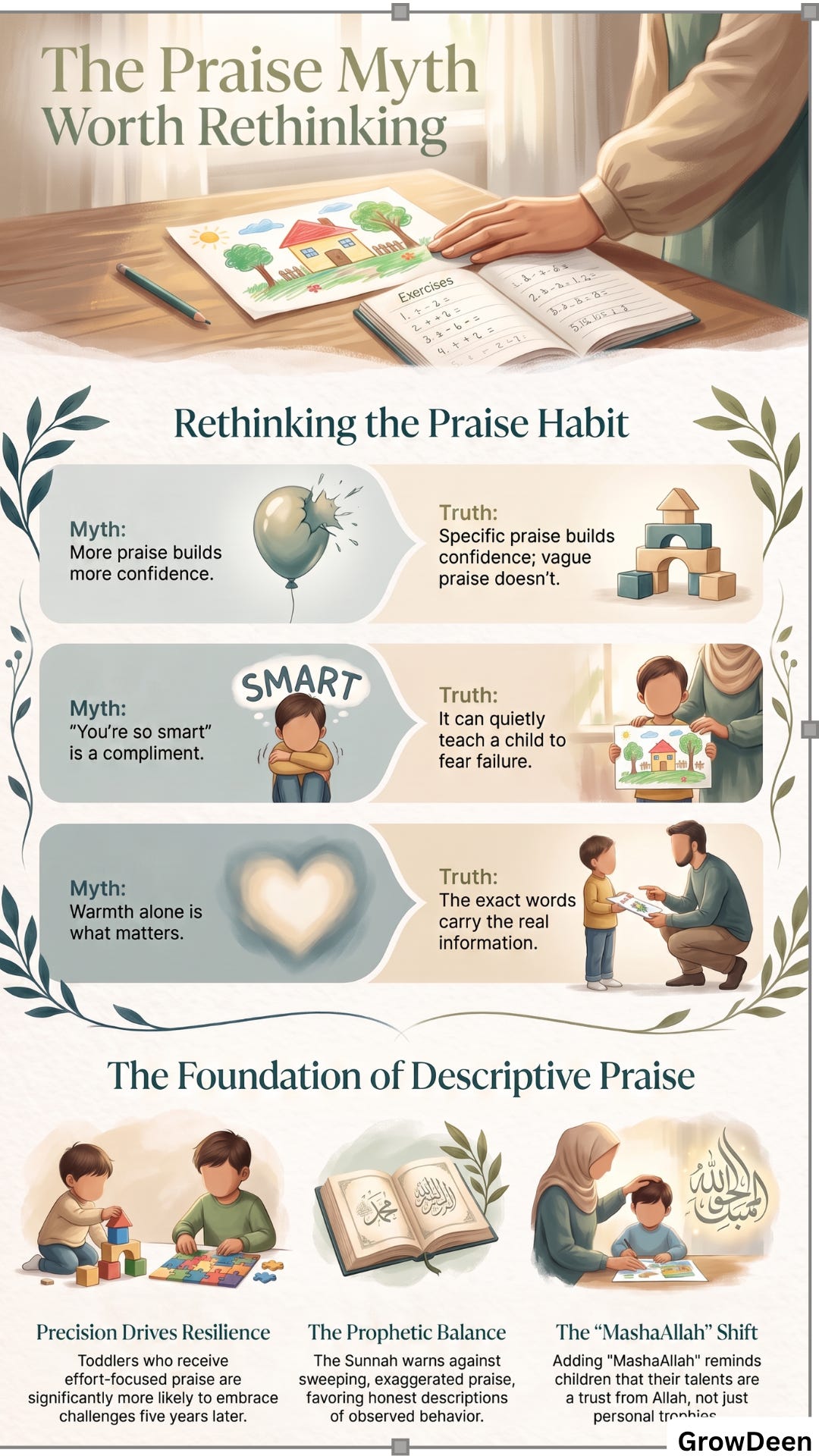
Here’s the uncomfortable part: “good job” and “you’re so smart” aren’t wrong, exactly. They’re just empty.
A child who hears “I noticed you waited your turn with the ball, even though you really wanted to go first” learns something true about their own behaviour. A child who hears “good boy” learns only that a parent is pleased. They don’t know why. And a child who hears “you’re so smart” over and over starts to build an entire identity around never being seen as anything else, which becomes a fragile place to stand the first time something goes wrong.
A 2024 multiphase study out of the University of Montreal, led by Robichaud and colleagues, found that descriptive praise supported healthy self-esteem in children, while vague, outcome-focused praise did not carry the same benefit. [6] It’s the flip side of what Gunderson found: specificity is doing real psychological work that a warm tone alone can’t replace.
The American Academy of Pediatrics puts this in a wider frame that surprised me. Its 2018 policy statement on effective discipline names positive reinforcement, delivered specifically, as one of only three components essential to discipline that actually works, alongside a warm relationship and consistent limits. [12] Praise isn’t the soft, optional part of parenting. It’s core technique. And precision is what makes it function.
What Encouragement Adds That Praise Alone Doesn’t
There’s a second tool worth separating out here: encouragement. Where praise responds to something your child has already done, encouragement meets them in the middle of trying, before the outcome is even known.
“You kept going even when that maths problem was hard” tells a child that effort itself counts, independent of whether they got the answer right. This lands hardest for children who already doubt themselves. When a child hears their effort noticed by name, they’re more likely to push through the next hard thing rather than quit at the first sign of difficulty. [3] You can offer this before a task even starts: “I know this recitation is new, but you’ve been practising all week. Whatever happens today, that effort already counted for something.”
A Different Way to Build the Habit
Rather than a checklist, think of this as a rhythm with four beats, one that gets quieter and quieter the more it becomes second nature.
Notice. Decide, ahead of time, what you actually want to see more of. Not “stop grabbing toys,” but “taking turns.” The mental shift from stopping a bad thing to naming a good one changes what you’re listening for all day.
Name it, on the spot. The instant you catch the behaviour, describe exactly what happened, out loud, right then. “Yusuf, I saw you hand your sister the toy and wait for your turn. That was kind, MashaAllah.” Young children especially need the words to land close to the action, or the connection doesn’t stick.
Let it fade, on purpose. Praise every instance at first. As the behaviour becomes routine, deliberately say less about it. This isn’t neglect, it’s making room. A quieter response to an established habit frees up your attention to catch the next thing worth naming.
Mark it occasionally, without turning it into currency. Every so often, not every time, let a genuinely earned moment come with something extra: staying up ten minutes later together, choosing the next family outing, an unhurried conversation. A 2019 meta-analysis of 77 parent-training programs found that consistent, specific praise paired with occasional, well-placed rewards was one of the elements most strongly linked to real reductions in disruptive behaviour over time. [3] The moment a reward becomes expected, though, it stops reinforcing anything and starts becoming a transaction. If you notice yourself negotiating rewards constantly, that’s usually a sign the underlying expectation needs adjusting, not that the reward needs to get bigger.
Where This Shows Up in an Ordinary Muslim Household
Picture the version of this that actually happens in your week, not a curated version, the real one.
Maghrib just ended, and your seven-year-old stayed still through the whole thing without being reminded once. Instead of a passing “good job praying,” try: “I watched you stay so still through that whole rak’ah tonight. That takes real focus, MashaAllah.”
Your children are splitting a plate of fruit and, unprompted, the older one hands over the bigger piece. Name it plainly: “You gave your brother the bigger piece without anyone asking you to. That’s generosity, and Allah loves that in you.”
Your daughter has been stuck on the same ayah for a week and it still isn’t perfect. Encourage the effort before the result arrives: “You’ve been going over that verse every single day. That patience is going to pay off, in sha Allah.”
Your teenager walks in from a rough day and, without being told, goes straight to their homework. This is easy to miss entirely. Say it anyway, quietly: “I noticed you got straight to your homework tonight. I know today wasn’t easy.”
The Traps Worth Watching For
A few patterns are worth catching in yourself before they become habit:
Leaning on identity labels (”you’re so smart,” “you’re the best”) on repeat, with nothing describing what actually happened underneath them. Using praise as a comparison tool between siblings, which breeds resentment far more often than it builds confidence. Praising your teenager in front of others when a private word would land better, since public praise at that age often reads as pressure, not warmth. Reserving praise only for outcomes, the winning score, the perfect grade, while the effort behind it goes unnoticed, a pattern research ties to children becoming more fragile in the face of failure. [2] And finally, handing out a reward so often that it becomes the expected price of good behaviour rather than an occasional bonus.
The Shift as They Grow
The words stay similar. The delivery has to change.
With young children, roughly toddler through age six, keep it simple, immediate, and physical, a hug, a hand on the shoulder, a smile that arrives in the same second as the words. They’re still learning to name their own actions, so descriptive praise does double duty here.
Through the middle years, seven to eleven, this is a good stretch to lean more heavily on encouragement offered before a task rather than only praise offered after. Children this age can genuinely separate effort from talent when you help them see it.
By the teenage years, praise still matters, arguably more than most parents assume, but the packaging changes completely. A specific, low-key comment delivered privately tends to land far better than anything said with an audience. Teenagers are also unusually good at detecting insincerity, which is precisely why the prophetic caution against exaggerated praise becomes most relevant right at this age.
If Something Feels Off
If your child seems unusually dependent on praise, falls apart at any hint of criticism, or if none of this seems to shift behaviour after weeks of consistent effort, it’s worth a conversation with a doctor, paediatrician, or qualified child psychologist, particularly if it’s affecting friendships, schoolwork, or safety. Reaching out for that kind of support isn’t a failure. It’s simply making use of the means Allah has placed within reach.
I know all of this is a lot to hold onto in the middle of an ordinary, exhausting day. That’s exactly why I built the free Descriptive Praise Companion Pack, a printable phrase card, a tracker to help the habit stick, and two short reflection cards you can keep somewhere you’ll actually see them. Keep reading, it’s waiting for you at the end.
The Sacred Trust of How We Speak to Our Children
When I sit with this topic, I keep coming back to the idea that the words we hand our children are never neutral. They land somewhere, and they stay there.
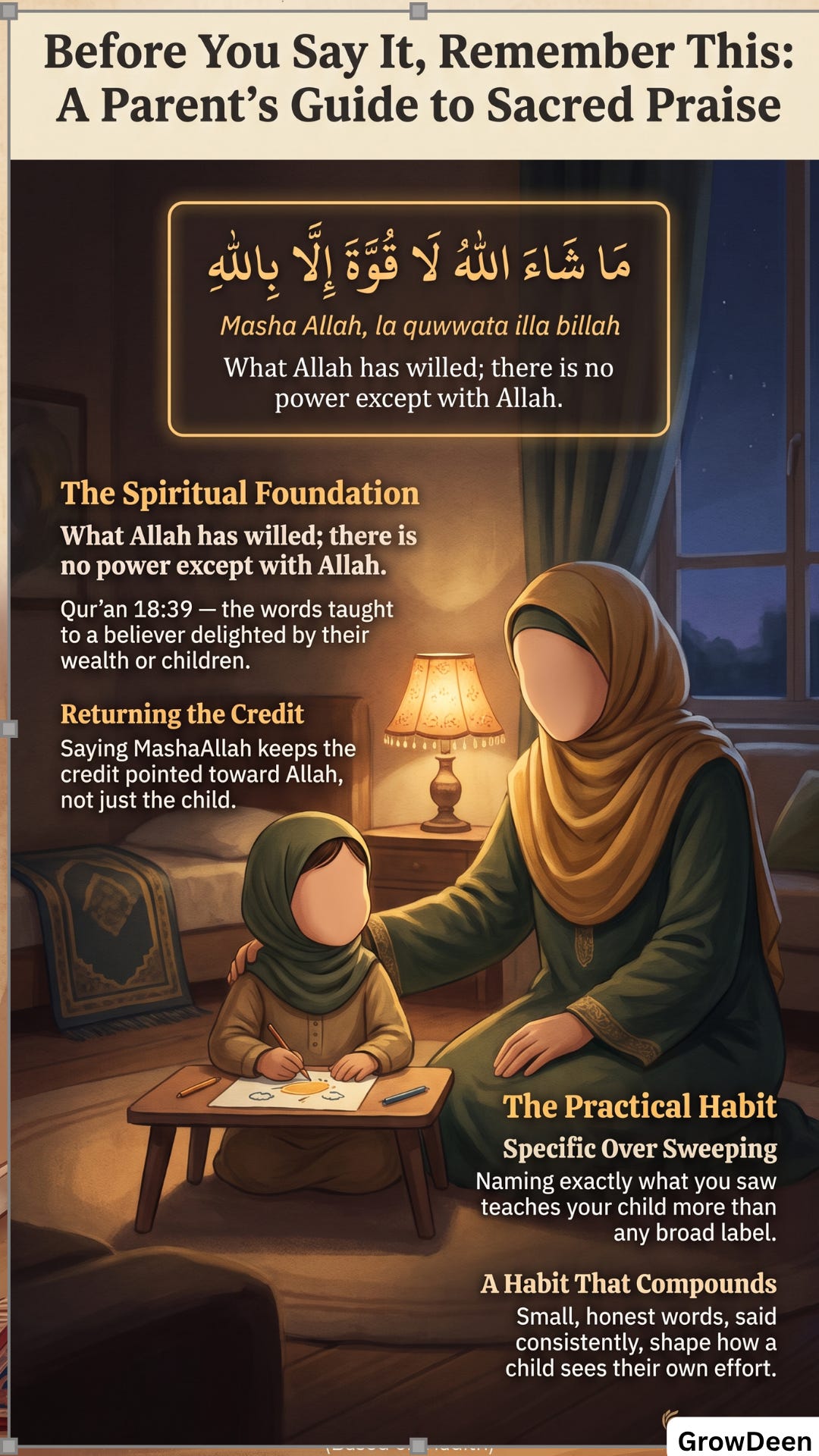
Allah tells us the story of two garden owners in Surah Al-Kahf. One boasts about his wealth with no acknowledgment of where it came from. His companion tells him what he should have said upon entering his garden instead: “What Allah has willed; there is no power except with Allah” [Qur’an 18:39]. According to Tafsir Ibn Kathir, this is the phrase that belongs on the tongue of anyone delighted by something in their circumstances, wealth, or children. For a parent, this quietly reshapes what praise is for. Your child’s talent or kindness is still worth noticing. It’s simply understood as something they’re stewarding well, not a trophy that’s theirs alone.
The Prophet ﷺ went a step further. When a companion once praised another man in sweeping, unqualified terms, he responded, “Woe to you, you have cut the neck of your friend,” repeated twice, and then taught the better way: describe only what you’ve actually observed, and leave the rest of the judgment to Allah [Sahih al-Bukhari 6162 / Sahih Muslim]. Strip away the centuries between then and now, and this hadith is teaching the exact distinction between descriptive and non-specific praise that a Chicago research team would later confirm with cameras and coding sheets.
What strikes me most is how directly the prophetic caution and the modern research end up in the same place. Both are saying: notice what’s real, name it precisely, be careful with big, sweeping words. Parent this way, and you’re not just managing behaviour. You’re teaching your child, through the exact words you choose, that everything good in them traces back to Allah.
The Descriptive Praise Companion Pack
If you’ve read this far, you’re the kind of parent who wants to get the small, daily moments right, not out of anxiety, but because you know they add up. That already says something good about you.
Inside the Descriptive Praise Companion Pack (one comprehensive PDF, 3 pages):
Page 1: “Say This, Not That” Phrase-Swap Card — A two-column reference card pairing common vague phrases with descriptive alternatives for the moments that come up constantly: salah, sharing, homework, Qur’an practice, sibling conflict, designed to laminate and stick on the fridge or keep in a kitchen drawer.
Page 2: The 7-Day “Catch It and Name It” Tracker — A simple weekly grid to jot down one specific, descriptive praise moment each day, so the habit becomes automatic within a week instead of staying a good intention.
Page 3: Islamic Reflection Cards — Two short cards, one on the meaning behind saying MashaAllah, one on the prophetic warning against exaggerated praise, so the spiritual reasoning behind this habit stays close at hand.
This isn’t a PDF to download once and forget. It’s built to live somewhere you’ll actually reach for it, mid-afternoon, mid-argument, mid-ordinary-day.
This companion pack is what every subscriber receives with each article. We cover the full journey of raising Muslim children, backed by research and rooted in Islamic wisdom.
If you want both evidence-based guidance and Islamic perspective in your inbox, subscribe for free.
Subscribe free for parenting resources backed by both science and Sunnah, guidance specific enough that you won’t find it anywhere else. No spam, no clutter, just what actually matters.
Try This Right Now
Before you close this tab, think of one thing your child did today that you noticed but never said out loud. Go find them. Describe it back to them in a single sentence. Add “MashaAllah.” That’s the entire practice. Start there tonight.
May Allah place barakah in your words, and make them a means of building your child up long after they’ve forgotten you said them.
Share This With Someone Who Needs It
Think of one person right now: the mother at the masjid who told you she feels like she’s always saying the wrong thing, your sister who keeps calling her son “the smart one” in front of his siblings, a friend whose toddler seems to need constant reassurance before trying anything new.
This could shift how they speak to their child, starting tonight. Share it with them, not as advice-giving, but as something that helped you and might help them too.
Frequently Asked Questions
Q: What’s the actual difference between praise and encouragement?
A: Praise responds to something your child has already done. Encouragement meets them in the middle of effort, before or during a task, not only after it’s finished. Both work best when they describe something specific rather than staying vague.
Q: Is saying “good job” actually harmful?
A: Not harmful on its own, just underpowered. Pair it with a detail: “Good job, you remembered to say Bismillah before you even started.”
Q: Can too much praise backfire?
A: Yes, especially when it’s vague and tied to identity rather than behaviour. Research links heavy, non-specific praise to more fragile self-esteem over time. [2] The fix isn’t less warmth, it’s sharper words.
Q: What does Islam actually say about praising people?
A: The Prophet ﷺ warned strongly against sweeping, exaggerated praise, teaching instead that praise should be specific and honest, with final judgment left to Allah [Sahih al-Bukhari 6162]. Saying “MashaAllah” when something delights you is part of the same tradition, returning credit to Allah. [Qur’an 18:39]
Q: Should praise sound the same for a toddler and a teenager?
A: No. Teenagers generally respond better to quiet, specific, private comments than to enthusiastic public praise, which often reads as pressure at that age.
Q: My child seems to need constant reassurance before trying anything. What do I do?
A: Shift more of your attention toward encouraging effort before a task begins, and resist reassuring at every single step along the way. If the dependence is significant or ongoing, a conversation with a paediatrician or child psychologist is worth having. See “If Something Feels Off” above.
References
[1] Gunderson, E.A., Gripshover, S.J., Romero, C., Dweck, C.S., Goldin-Meadow, S., & Levine, S.C. (2013). Parent praise to 1- to 3-year-olds predicts children’s motivational frameworks 5 years later. Child Development, 84(5), 1526-1541. https://doi.org/10.1111/cdev.12064
[2] Brummelman, E., Nelemans, S.A., Thomaes, S., & Orobio de Castro, B. (2017). When parents’ praise inflates, children’s self-esteem deflates. Child Development, 88(6), 1799-1809. https://doi.org/10.1111/cdev.12936
[3] Leijten, P., Gardner, F., Melendez-Torres, G.J., van Aar, J., Hutchings, J., Schulz, S., Knerr, W., & Overbeek, G. (2019). Meta-analyses: Key parenting program components for disruptive child behavior. Journal of the American Academy of Child & Adolescent Psychiatry, 58(2), 180-190. https://doi.org/10.1016/j.jaac.2018.07.900
[6] Robichaud, J-M., Grenier, F., Joussemet, M., & Mageau, G.A. (2024). The role of descriptive and non-specific outcome-oriented praise in child self-esteem: A multiphase, multimethod investigation. Journal of Child and Family Studies, 33, 1336-1348. https://doi.org/10.1007/s10826-022-02449-0
[9] Qur’an, Surah Al-Kahf 18:39 — https://quran.com/18/39
[10] Sahih al-Bukhari 6162 — Graded: Sahih — https://sunnah.com/bukhari:6162 (also recorded in Sahih Muslim, Book of Zuhd and Softening of Hearts)
[11] Sahih Muslim 3002a — Graded: Sahih — https://sunnah.com/muslim:3002a
[12] Sege, R.D., Siegel, B.S., & AAP Council on Child Abuse and Neglect, Committee on Psychosocial Aspects of Child and Family Health. (2018). Effective discipline to raise healthy children. Pediatrics, 142(6), e20183112. https://doi.org/10.1542/peds.2018-3112