


A 2008 meta-analysis of 77 parent-training programs found that positive parent-child interaction — not stricter discipline — was one of just three components that reliably improved children’s behaviour. [1] This guide shows you exactly how to build that, and the two-line standard for speaking to a child that changed how I talk to mine.
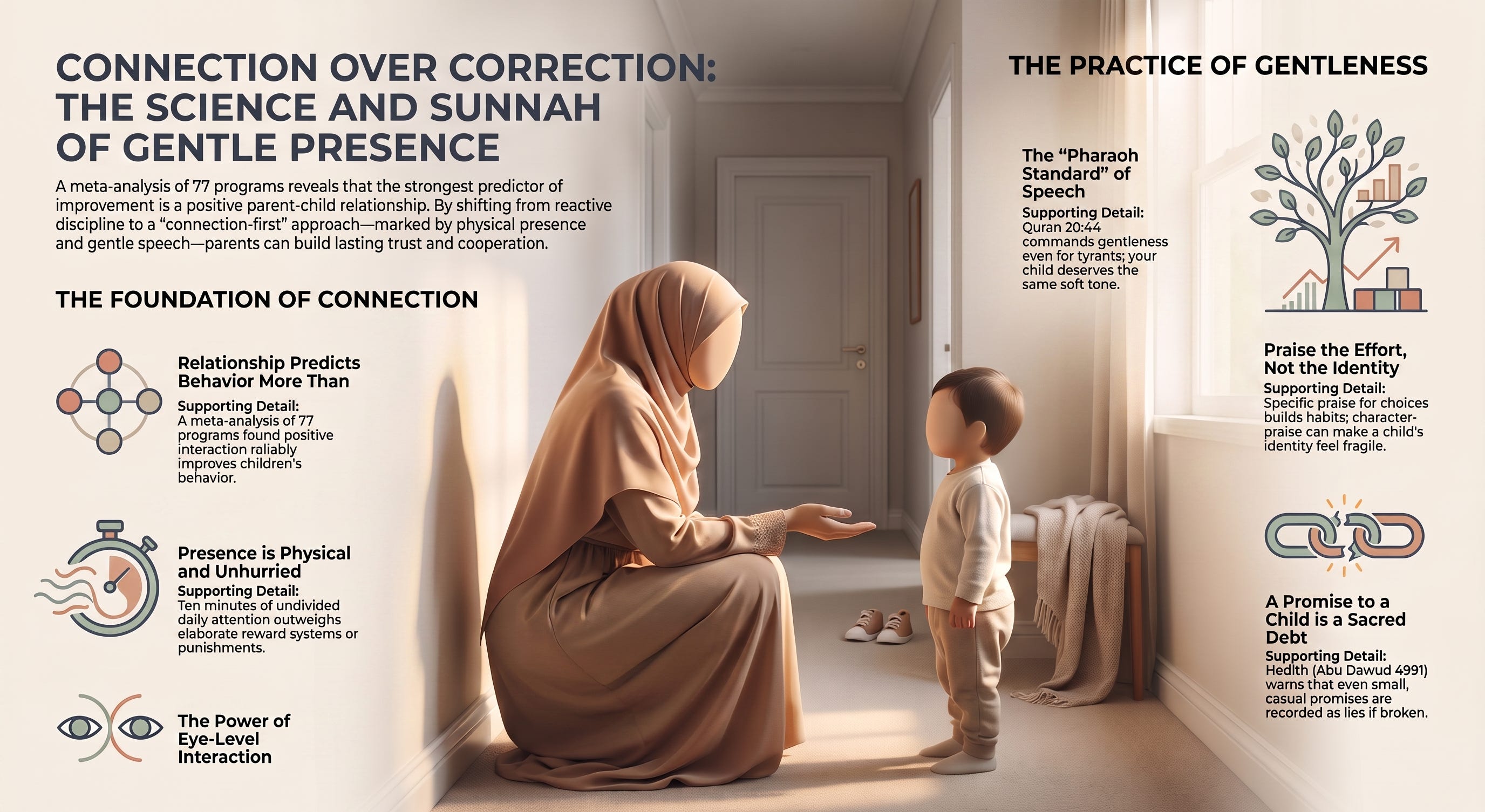
Most of us were raised to think good behaviour comes from firmer rules, faster consequences, a sterner voice when things go wrong. So when researchers actually tested which parts of parent-training programs moved the needle, the answer surprised a lot of people — including me. Out of dozens of techniques studied, it wasn’t consequences that came out on top. It was connection. [1]
That’s not permissive parenting dressed up in research language. It’s the opposite. It asks more of you, not less.
Why This Guide Is Different
Backed by clinical research, not opinion. Every strategy here comes from peer-reviewed parent-training research and the AAP’s own guidance on discipline.
Grounded in the Prophet’s ﷺ example, not just Islamic vocabulary. A striking hadith about a broken promise to a child, and a Qur’anic command that reframes what gentleness actually is.
Comes with a free Gentle Words & Kept Promises Companion Pack — ready-made phrases and a weekly tracker, not just more to remember.
Presence: Give Real Attention, and Get Down to Their Level
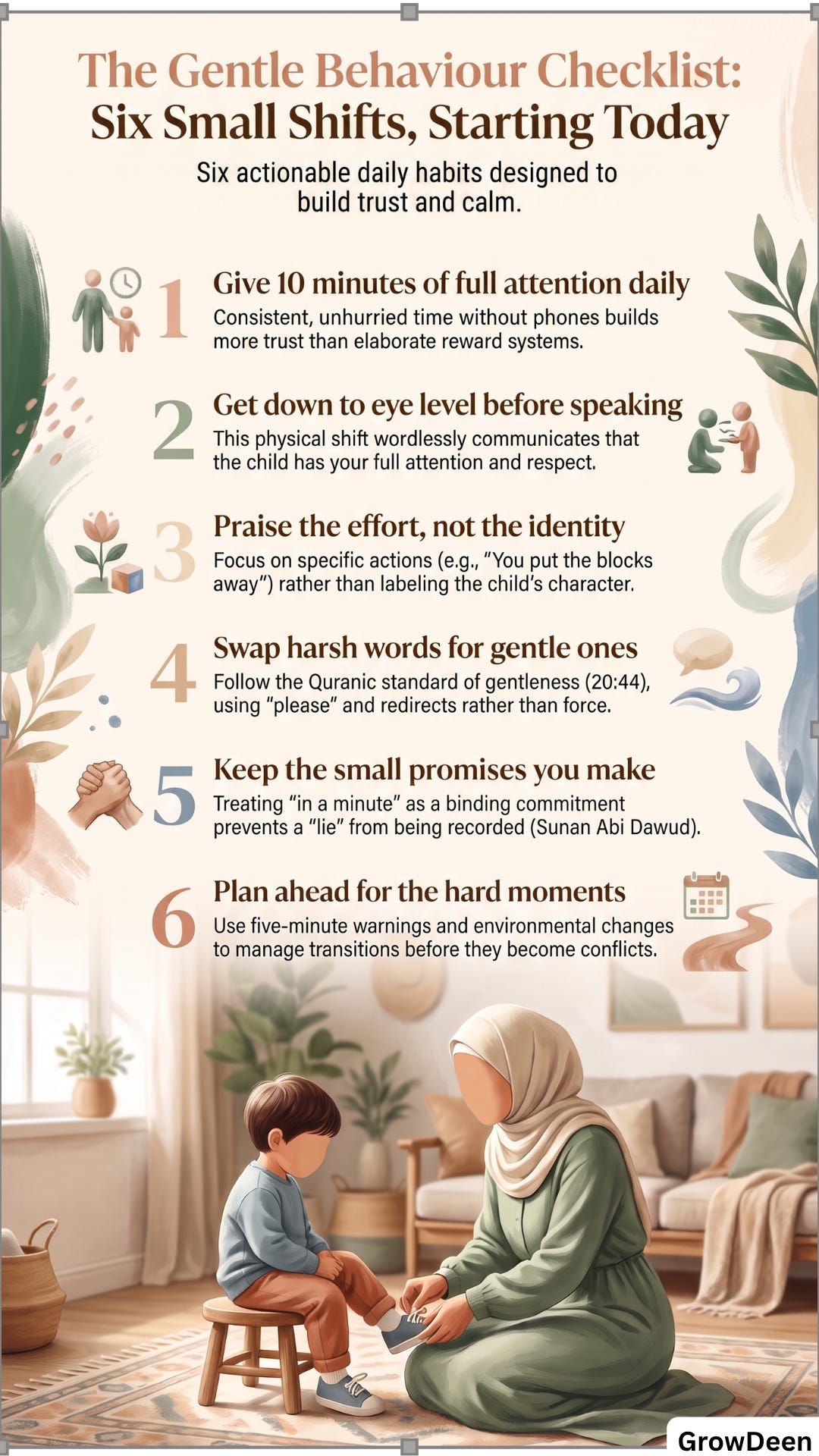
Children build trust in small, boring, repeated moments — being read to, played with, spoken to without a phone competing for attention. Ten unhurried minutes a day, given consistently, does more for behaviour over time than an elaborate system of rewards and punishments layered on top of a distracted relationship. [2]
Part of that presence is physical. Crouching to your child’s eye level before speaking changes how much they actually take in — it tells them, wordlessly, that this moment is worth your full body, not just your voice from across the room.
Model and Speak: Be the Example, and Say It Gently
Children imitate before they obey. A parent who says “please” without being asked raises a child who eventually says it too, without being told. [2] Tone carries as much weight as the words themselves — maybe more.
This is where the clearest Islamic thread in this guide runs, and it’s the one that changed something for me personally. When Allah sent Musa and Harun to Pharaoh — a man who claimed divinity, who had spent a lifetime in tyranny — the instruction wasn’t to go in hard. It was: “Speak to him with gentle speech, that perhaps he may take heed or fear [Allah]” [Qur’an 20:44]. According to Tafsir Ibn Kathir, Musa was chosen specifically for his softness, told to approach even Pharaoh with gentleness rather than force.
I think about that verse constantly, honestly, because it reframes what gentleness is. It isn’t weakness. It’s a strategy, commanded for the hardest audience imaginable. If that’s the standard for Pharaoh, a three-year-old refusing to put their shoes on deserves nothing harsher.
That gentleness extends to how you instruct, not just your tone. “Please shut the gate” lands better than “don’t leave it open,” because it hands your child something to do, not just something to avoid. If a behaviour needs to stop immediately, follow the stop with the redirect: “Stop jumping on the bed — come sit here instead.”
Emotional Honesty: Say How You Feel, and Actually Listen
Telling your child plainly how their behaviour affects you — “I can’t hear Grandma when you shout” — teaches them to see past their own view of a moment, without shaming them for having one. Say it calmly, not mid-blowup. [3]
The other half of this is listening, and actually meaning it. Nod. Reflect feelings back: “It sounds like you were really hurt when he wouldn’t share.” A child who feels heard tells you the truth next time instead of hiding it — which, quietly, is the entire foundation everything else on this list depends on.
Reinforcement: Notice What’s Going Right, and Set Them Up to Succeed
Praise works, but only the specific kind. “You put the blocks away carefully” builds a habit. “You’re such a good boy” builds an identity — one that’s fragile the first time your child fails at something. Praise aimed at a child’s character can actually backfire, particularly for children with lower self-esteem, turning ordinary mistakes into threats to who they are. [4] Praise the effort. Praise the choice.
The flip side of noticing is setting your child up to have something good to notice. Give them a small, doable job — setting the table, watering a plant — and say something out loud when it’s done. Repetition builds the skill. The noticing builds the will to keep doing it.
Keep reading — I’ve put the gentle-speech and kept-promises pieces of this, with a week’s worth of practice built around them, into something you can actually use at home.
I know it’s a lot to hold in your head mid-argument — the phrasing, the specific praise, the promise you made twenty minutes ago and half-forgot. That’s exactly why I created the free Gentle Words & Kept Promises Companion Pack — ready-made phrases and a simple weekly tracker for the fridge. Keep reading to download it at the end.
Trust: Keep the Small Promises
Of everything in this guide, this is the one most likely to get treated as minor. It’s probably the least minor of all.
There’s a hadith that treats a small, offhand promise with startling seriousness. Abdullah ibn Amir narrated that his mother once called him over, saying she’d give him something, while the Prophet ﷺ sat in their home. He asked her what she meant to give. She said dates. He told her: “If you were not to give him anything, a lie would have been recorded against you” [Sunan Abi Dawud 4991, graded Hasan].
A casual line to a child, weighed the same as a broken promise between adults. I know I’m not always that careful with what I say I’ll do “in a minute.” That hadith is the reason I’ve started being more careful.
Structure: Shape the Environment, and Decide What Actually Matters
A home arranged with your child’s stage in mind produces fewer conflicts than one where every object is a temptation and every “no” is reactive. Keep what’s breakable or dangerous out of reach, and keep what’s safe and engaging within it. You’ll say “no” less often — which makes the “no”s you do say land harder.
Before stepping in, especially to say “stop,” ask whether the behaviour genuinely warrants it. Reserving your instructions for what actually matters is its own form of sabr — restraint in the small moments, so your attention carries weight when it counts.
Growth: Hand Over Responsibility, and Prepare for the Hard Moments
As children grow, give them real ownership over age-appropriate tasks, and let natural consequences follow their choices. A child responsible for packing their own bag who forgets their pillow learns something a lecture can’t teach as well.
And if you know certain situations reliably go sideways — long errands, transitions, a particular hour of the evening — plan around them instead of reacting inside them. A five-minute warning before a transition, and a clear explanation of what’s expected, goes further than most parents expect.
Warmth: Keep Some Lightness in the House
Daily life with children runs better with a bit of play in it — turning a chore into something more inviting rather than issuing it flatly. The one line not to cross: humour should never be aimed at a child who’s already struggling. Young children take teasing far more personally than adults expect, and laughing at a misbehaving child tends to reward the behaviour with attention rather than defuse it.
What the Research and the Sunnah Are Both Pointing To
None of this is about controlling a child into compliance. The AAP puts it plainly: effective discipline rests on a warm relationship first, positive reinforcement second, and punishment doing very little of the actual work. [2]
What’s striking is how closely that lines up with something Islam described fourteen centuries earlier — gentleness as a deliberate choice, not a soft option; a promise to a child treated with the same weight as a promise to anyone else. The clinical guidance and the prophetic example are describing the same thing from two different directions.
You won’t get all fourteen of these right, every day. What matters is the direction you’re moving in.
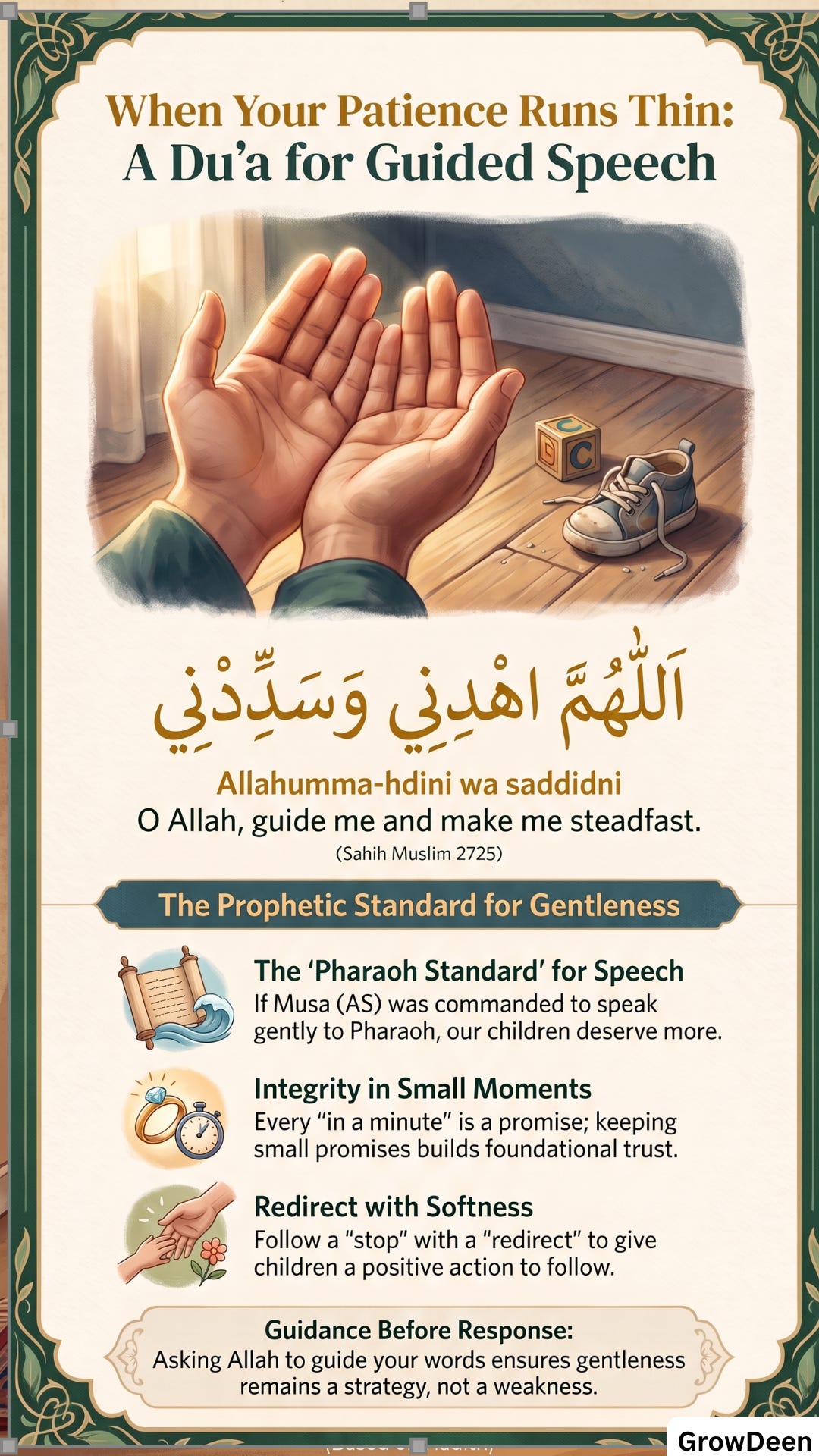
Before you keep reading: pick one small thing you said you’d do for your child today — even something tiny, like “in a minute” — and go do it right now. That’s it. That’s the whole practice.
May Allah place barakah in your effort, soften your tongue in the hard moments, and make you more patient than you feel capable of today.
The Gentle Words & Kept Promises Companion Pack
If you’ve read this far, you’re the kind of parent who takes their child’s trust seriously — not as a nice-to-have, but as something worth protecting.
Inside the Gentle Words & Kept Promises Companion Pack (one comprehensive PDF, 3 pages):
Page 1: The 5-Second Gentle Redirect Card — Ready-made phrase swaps anchored by Qur’an 20:44 — a laminated-style card for your fridge, so the right words are there before frustration picks them for you.
Page 2: The Kept-Promises Tracker — A 7-day tracker for the small promises you make daily, with a gentle prompt for the days you can’t follow through — so the standard from Abu Dawud 4991 becomes a weekly habit, not just something you read once.
Page 3: Two Reflections on Speaking and Keeping Your Word — Both references in full, English translation with source, plus one line of reflection each.
This isn’t a PDF to download and forget. It’s built to live on your fridge, where you’ll actually reach for it mid-argument.
This companion pack is what every subscriber receives with each article. We cover the full journey of raising Muslim children — all backed by research and rooted in the Sunnah.
If you’re a Muslim parent who wants both evidence-based guidance and Islamic grounding, subscribe free so future resources land in your inbox before you need them.
Subscribe free for parenting resources backed by both science and Sunnah — guidance you won’t find bundled together anywhere else. No spam, no clutter, just what actually matters.
Think of one person right now: the exhausted mother at the masjid who told you bedtimes are a nightly battle, or the friend whose WhatsApp messages sound exactly like yours did last year.
This article could ease something for them. Share it today — not as advice-giving, but as one tired parent handing another something that helped.
Frequently Asked Questions
Q: Isn’t being this gentle just permissive parenting?
A: No — gentleness is about tone, not the absence of limits. You can hold a firm boundary while delivering it gently. The AAP’s guidance separates the two clearly: warmth and clear limits work together, not against each other. [2]
Q: With fourteen things to work on, where do I even start?
A: Presence and gentle speech first — everything else on this list gets easier once your child trusts that you’re calm and paying attention. Add the rest gradually, not all at once.
Q: What if I’ve already been harsh with my child — is the damage done?
A: No single hard day undoes a relationship. Research on parent-child interaction shows the overall pattern matters more than any one moment. [1] A simple “I’m sorry I raised my voice” repairs more than most parents expect.
Q: Does praising effort instead of intelligence really make a difference?
A: Yes — praise tied to a child’s identity or intelligence is linked to more fragile self-esteem, especially when a child later struggles. [4] Effort-based praise doesn’t carry that risk.
Q: What if I make a promise I genuinely can’t keep?
A: Say so, honestly, as soon as you know. “I said we’d go to the park, but it’s raining — can we go tomorrow?” still protects trust. Silently letting a promise disappear is what damages it.
Q: How is this different from a general positive-parenting list?
A: Most lists stop at technique. This one keeps the source’s full fourteen concepts and pairs the two most trust-defining ones with the Islamic weight behind them — a Qur’anic command about how to speak, and a hadith that treats a child’s broken promise as seriously as an adult’s.
References
[1] Kaminski, J.W., Valle, L.A., Filene, J.H., & Boyle, C.L. (2008). A meta-analytic review of components associated with parent training program effectiveness. Journal of Abnormal Child Psychology, 36(4), 567–589. https://doi.org/10.1007/s10802-007-9201-9
[2] Sege, R.D., Siegel, B.S., & American Academy of Pediatrics Council on Child Abuse and Neglect, Committee on Psychosocial Aspects of Child and Family Health. (2018). Effective discipline to raise healthy children. Pediatrics, 142(6), e20183112. https://doi.org/10.1542/peds.2018-3112
[3] Dekkers, T.J., Hornstra, R., van der Oord, S., Luman, M., Hoekstra, P.J., Groenman, A.P., & van den Hoofdakker, B.J. (2022). Meta-analysis: Which components of parent training work for children with ADHD? Journal of the American Academy of Child and Adolescent Psychiatry, 61(4), 478–494. https://doi.org/10.1016/j.jaac.2021.06.015
[4] Brummelman, E., Thomaes, S., Overbeek, G., Orobio de Castro, B., van den Hout, M.A., & Bushman, B. (2014). On feeding those hungry for praise: Person praise backfires in children with low self-esteem. Journal of Experimental Psychology, 143(1), 9–14. https://doi.org/10.1037/a0031917
[5] Sabey, C.V., Charlton, C., & Charlton, S.R. (2019). The ‘magic’ positive-to-negative interaction ratio. Journal of Emotional and Behavioral Disorders, 27(3), 154–164. https://doi.org/10.1177/1063426618763106
[6] Quran, Surah Ta-Ha 20:44 — https://quran.com/20/44
[7] Sunan Abi Dawud 4991 — Graded: Hasan — https://sunnah.com/abudawud:4991