

Children who spend more time playing outside log measurably higher levels of physical activity than children who mostly play indoors [1] and the gap between the two groups tends to widen, not shrink, as kids get older. This guide walks you through exactly what outdoor play should look like at every age, what to do when the weather turns against you, and why a scraped knee might be doing your child more good than you think.
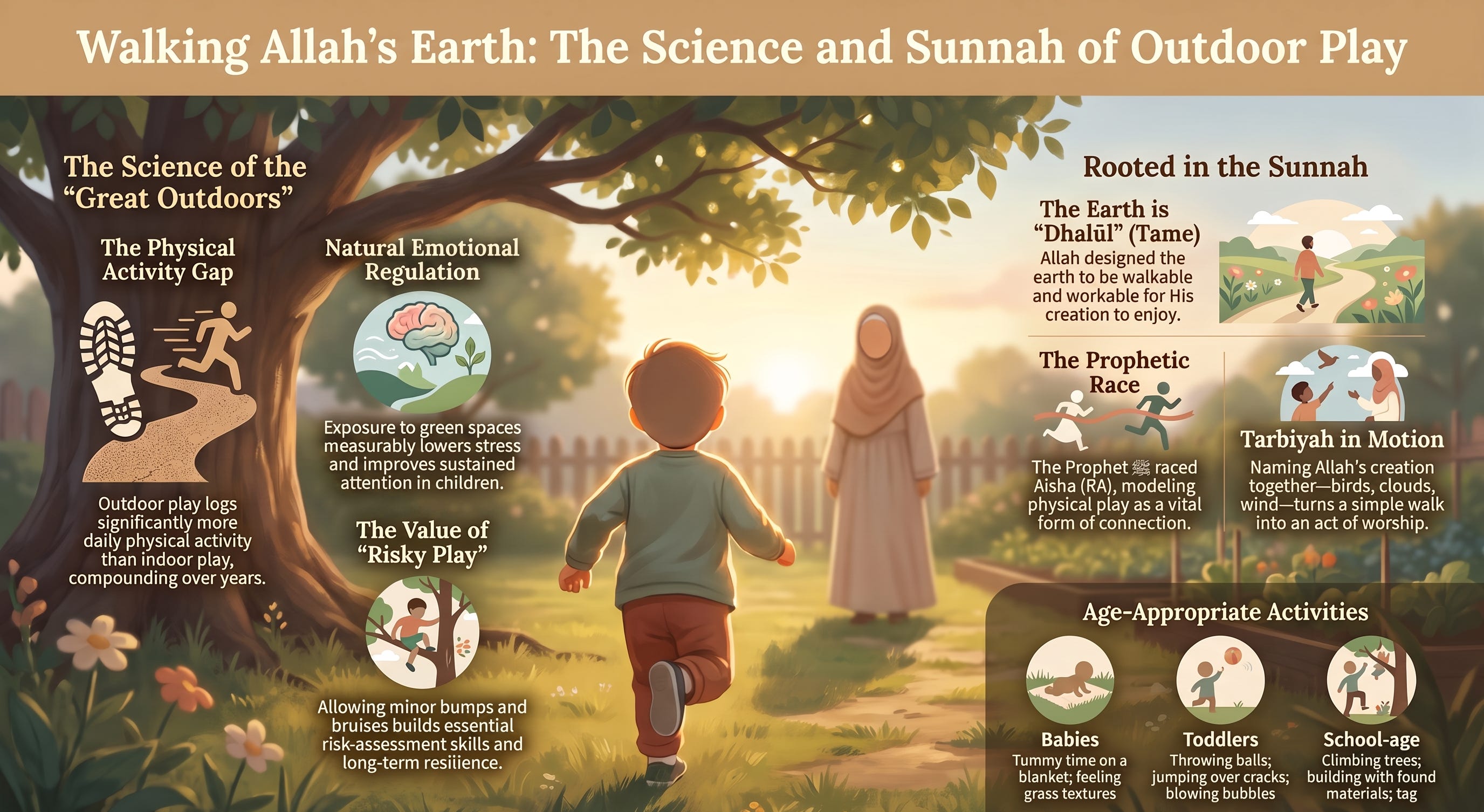
You know that feeling when your child walks out the back door and something in them just… changes? The shoulders drop. The voice gets louder. The legs start moving before the brain has even decided where to go.
I used to think that was just kids being kids. Turns out there’s real science behind it.
Here’s what stopped me in my tracks: children who spend more time outdoors log significantly more daily physical activity than children who spend most of their time indoors [1]. Not a little more. Enough that researchers keep finding the same pattern study after study. And the benefits aren’t only physical — outdoor time in green, natural spaces has a measurable calming effect on children’s stress and emotional regulation [6, 7].
I know what you might be thinking. One more thing to optimize. One more box to check. I felt that way too, honestly, the first time I read through this research. But here’s the thing — this isn’t a new task to add to your day. It’s often just opening a door you were already standing near.
Why This Guide Is Different
It covers every age, not just toddlers. From tummy time on a blanket outside to school-age tree climbing, you’ll find exactly what outdoor play should look like for your child’s stage right now.
It treats bumps and bruises as information, not failure. Instead of vague reassurance, you’ll see what the research on “risky play” actually says about resilience — and why keeping kids from all risk can backfire [11, 12].
It’s rooted in both the research and the Sunnah. You won’t find another guide that pairs pediatric movement science with the Prophet’s ﷺ own example of playful, physical joy.
Why This Matters More Than It Seems
Something changes when a child steps outside. Watch it happen sometime — the shoulders drop, the voice gets louder, the legs start moving before the mind has even decided where to go. Indoors, a child is working within someone else’s walls. Outdoors, the walls disappear.
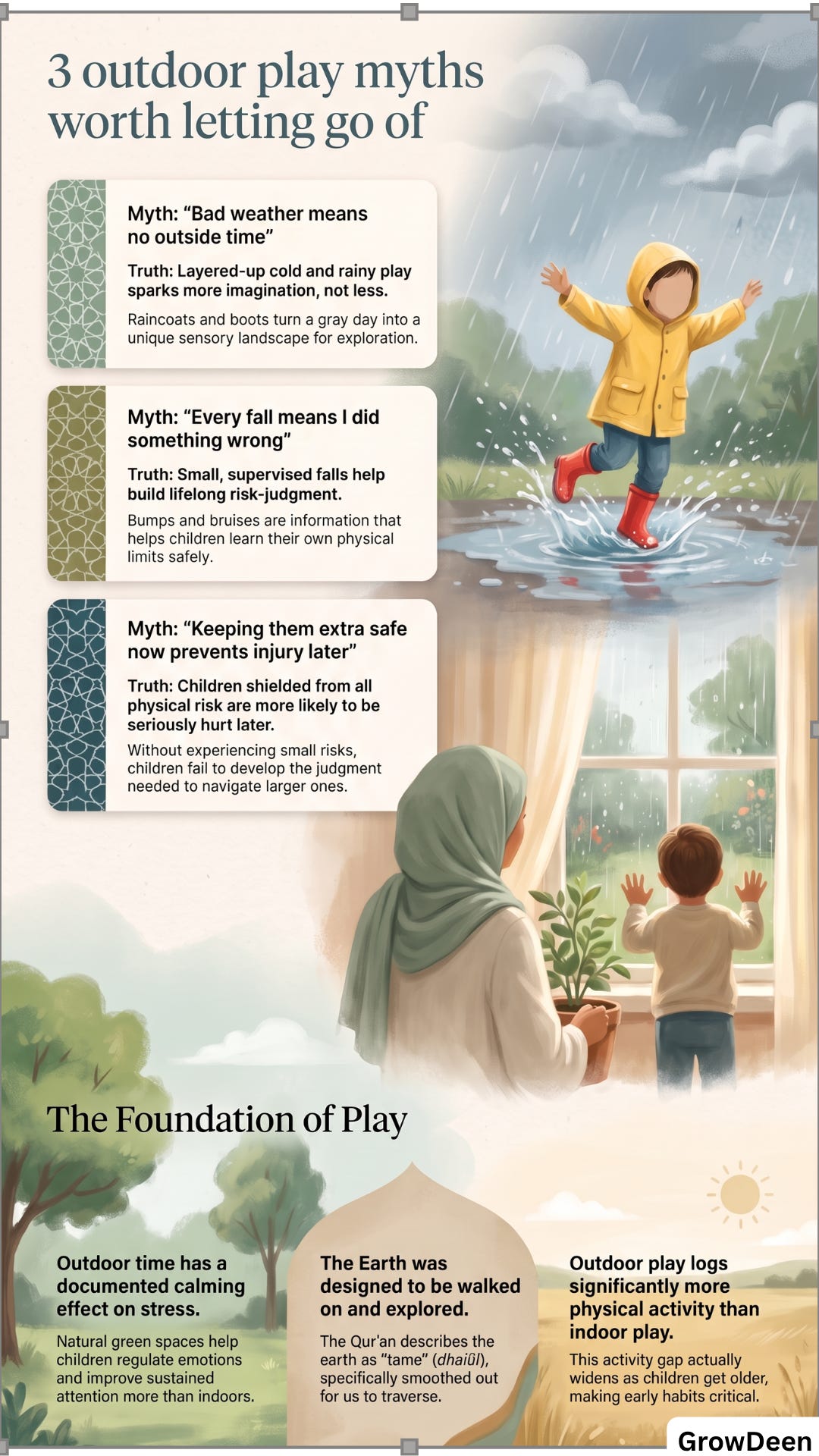
There’s a physical case for this that’s hard to argue with. Outdoor spaces simply offer more room for the big movements — running, climbing, throwing — that indoor play rarely allows [1]. Children who spend more time outside tend to log measurably more physical activity than children who don’t [2], and that gap compounds over years. There’s also a quieter benefit that surprises a lot of parents: kids who get more daylight and distance-vision time outdoors appear less likely to develop short-sightedness as they grow [3, 4]. Add in the modest, sensible sun exposure that supports vitamin D production [5], and the physical argument for going outside writes itself.
But the mind matters just as much here, maybe more. Natural, green spaces have a settling effect on children that’s been documented again and again — lower stress, steadier mood, better emotional regulation after time spent outside than after time spent in [6, 7]. Some of the research on nature exposure even points toward gains in sustained attention and creative problem-solving [8, 9]. And loose, open-ended outdoor materials — sticks, stones, a pile of leaves — seem to do something for cognitive and social development that a shelf of plastic toys just can’t replicate [10].
None of this should feel surprising to a Muslim parent, honestly. Allah did not build children — or any of us — to sit still under fluorescent light all day. The body He gave your child was made for motion.
“So Walk in the Paths Thereof”
There’s a verse in the Qur’an that keeps coming to mind on this topic:
“He it is Who has made the earth subservient to you; so walk in the paths thereof and eat of His provision. And to Him will be the resurrection.” [Qur’an 67:15]
According to Tafsir Ibn Kathir, this verse describes Allah making the earth dhalūl — tame, workable, easy to traverse — placing mountains and springs and pathways in it specifically so His creation could move through it, benefit from it, live on it. The earth wasn’t handed to us sealed shut. It was smoothed out and opened up.
That’s not a stretch to apply here. When you take your toddler onto the grass at the park, or let your eight-year-old run down a gravel path chasing a ball, you’re doing — in miniature — exactly what this ayah describes. You’re letting a small person experience an earth that was designed to be walked on. Say it out loud sometimes, even simply: “Allah made this ground for us.” That sentence, repeated enough times across enough afternoons, becomes part of how a child sees the world.
A Race Worth Remembering
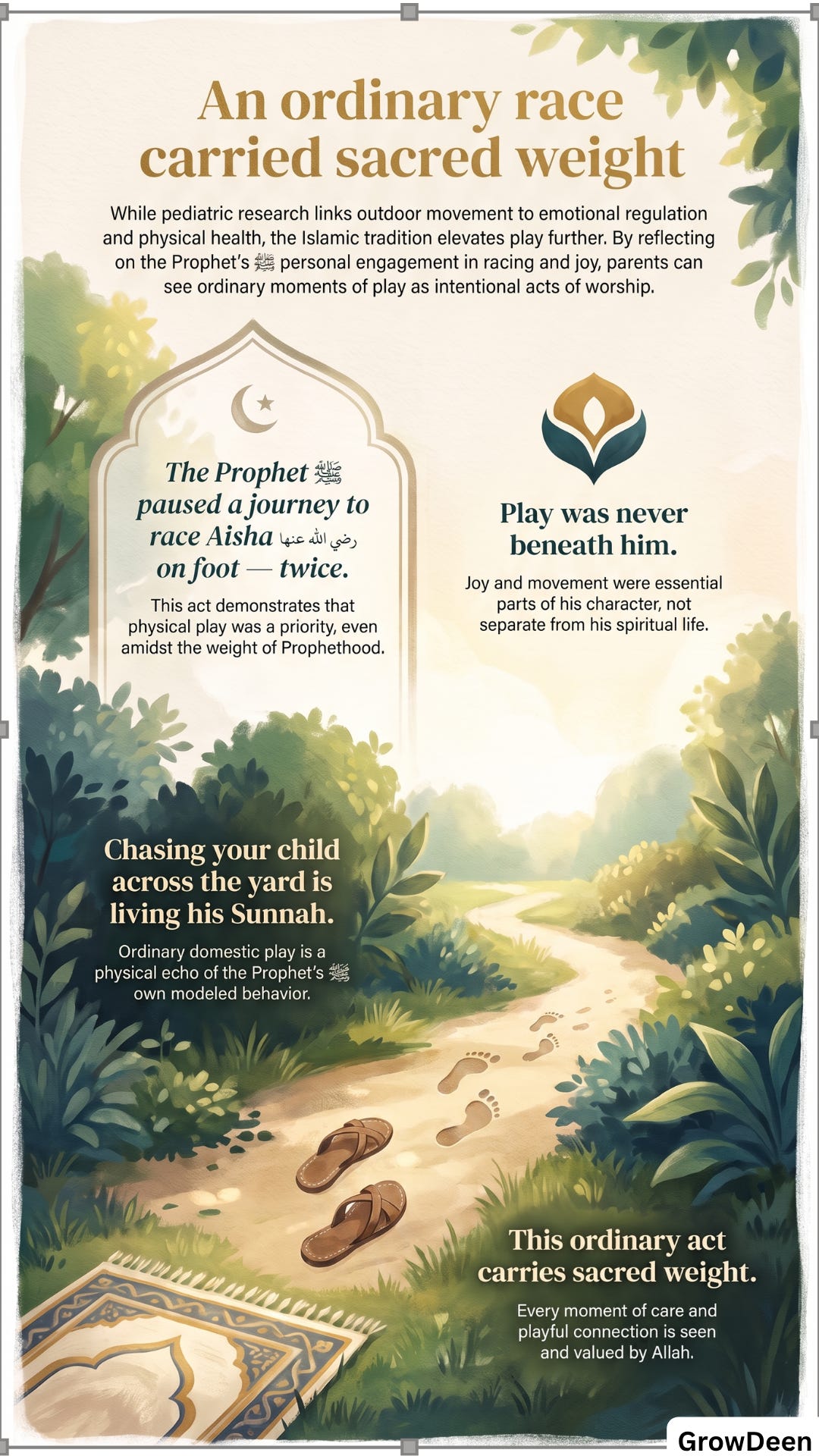
There’s also a hadith that changes how a lot of parents think about “wasting time” playing outside. Aisha (may Allah be pleased with her) narrated:
“I raced him on foot and I outstripped him. When I became fleshy, I raced him again and he outstripped me. He said: ‘This is for that outstripping.’” [Sunan Abi Dawud 2578, graded Sahih by Al-Albani]
This is the Messenger of Allah ﷺ — carrying the weight of prophethood, revelation, a growing ummah — stopping to race his wife on a journey. Twice. He didn’t treat physical play as beneath him or as time stolen from something more serious. It was something serious, in its own quiet way: joy, connection, movement, shared between two people who loved each other.
So when you find yourself racing your child to the mailbox, or chasing them around the swing set until you’re both out of breath, you’re not indulging a distraction from a “real” parenting task. You’re echoing something the Prophet ﷺ himself modeled. What’s beautiful is how the research on active, joyful movement and this prophetic example point in exactly the same direction — our children (and honestly, we ourselves) thrive when play isn’t treated as optional.
Getting Outside Without Overthinking It
You don’t need a big yard. You don’t need equipment. Half the time, all a child needs is the door left open and permission to go figure it out.
If you do have outdoor space at home, let your child invent their own games more often than you’d think to. Stay close enough to manage real hazards — traffic, water, hot surfaces — and otherwise, get out of the way.
Younger children especially love being “helpers,” which turns ordinary outdoor chores into play:
Pulling weeds
Sweeping the porch
Watering the plants
Hanging laundry on the line
No yard? The local park works just as well, often better — more space to run, other children to meet. Walking there is a chance to talk through road safety and model that movement matters to you too, not just to them. A bike or scooter ride does the same job.
As kids get older, structured activity — a sports club, a swim class — becomes a natural next layer. It doesn’t replace free outdoor play. It sits alongside it.
What Outdoor Play Looks Like, Age by Age
Babies are learning the shape of the world outside their own four walls.
Tummy time on a blanket outdoors
Crawling on grass, feeling a different texture under their hands
Watching branches move, listening for birds
Taking in colors, traffic sounds, the ordinary noise of a street
Toddlers are testing everything their bodies can now do.
Throwing a ball, chasing it down
Pushing or pulling a toy across uneven ground
Jumping over cracks, into puddles, toward whatever’s caught their eye
Blowing bubbles and running after them
Supervised time near sand or a shallow puddle — never left alone near water, even for a moment
Preschoolers are figuring out how to play with other people, not just near them.
Tag, hide-and-seek
Crawling through a makeshift tunnel or over a fallen branch
Moving with scarves or leaves, making up a dance no one taught them
Mud pies with old kitchen tools
A slow walk together, naming whatever you both notice — a beetle, a new flower, the sound of wind
Building a “cubby” out of whatever’s lying around
School-age children are drifting toward structured sport, but unstructured time still matters just as much.
Building things with found materials
Tag, tiggy, whatever the current version is called at their school
Climbing trees, with a parent’s eye nearby but not hovering
📥 Before we get to rain, cold, and scraped knees — I’ve put together something for exactly this: a Sunnah Outdoor Play Companion Pack with age-by-age activity cards you can keep on the fridge, and I’ll tell you more about it in just a bit. Keep reading.
Support Muslim Parenting Lab ❤️
Would you like a deed that keeps earning for you after you die? Start one in a few seconds with the button below.
The Prophet ﷺ named ongoing charity and beneficial knowledge among the three things that keep counting after death. (Sahih Muslim 1631)
Rain, Cold, and Grey Skies Are Not a Reason to Stay In
A lot of parents write off outdoor play the second the temperature drops or the sky turns grey. Worth reconsidering — bad weather can actually spark more imagination than a sunny afternoon, not less.
Layer up. Coats, hats, gloves for cold; boots and raincoats for wet. An umbrella, if your child is the type to find opening and closing it endlessly entertaining (most are).
A few ideas for the less obliging days:
Visit a park right after rain, when everything looks washed and glossy
Go looking for the biggest puddle you can find
Bring a torch along on an early evening walk
Gather leaves, stones, sticks — bring them inside for painting or sorting later
On a windy day, fly a kite or just chase the leaves as they blow past
On Bumps, Bruises, and Letting Go a Little
It’s a normal instinct to flinch when your child wants to climb higher than feels comfortable to you. That instinct doesn’t need to win, though.
Outdoor space gives children room to test their own limits — space to fall safely, get up, and try again with slightly better judgment the second time. Researchers studying what’s sometimes called “risky play” have found that children given reasonable room to take physical risks tend to develop stronger risk-assessment skills and better emotional regulation over time [11, 12]. There’s a somewhat counterintuitive finding buried in that research too: children who are consistently kept away from physical risk are more likely to be seriously injured later, precisely because they never built the judgment for it [12].
This lines up with something close to tawakkul, if you think about it. You supervise. You set real boundaries around real dangers. And then you let go of the small stuff — the scraped knee, the bruised shin — trusting that Allah built growth to happen this way, through trial and small failure, not around it. A little sabr with the tears that follow a minor fall does more for a child’s long-term confidence than being kept permanently out of harm’s reach ever could.
What Helps
Getting outside more than once a day, regardless of weather
Letting your child choose the game more often than you’d expect to
Staying close enough to manage real hazards, without hovering over every small one
Naming Allah’s creation together as you go — the sky, a bird, the wind
Letting small falls happen without alarm; comfort, clean up, send them back out
What to Avoid
Keeping a child indoors out of fear of every possible scrape
Filling every outdoor minute with structure, leaving no room for free play
Skipping outdoor time just because the sky looks unpromising
Leaving a young child unsupervised near any water, even briefly
When to Talk to a Doctor
Every child moves at their own pace, and that’s normal. But if your child seems unusually reluctant to move at all, has lingering pain after a minor fall, or shows signs of a more serious injury — significant swelling, inability to bear weight, a head injury followed by vomiting or confusion — speak with a doctor. Nothing here replaces medical advice specific to your child.
One Last Thought
A child running across a yard, laughing too loud, a little muddy — that’s not time wasted. It’s a small, physical act of living the way Allah built bodies and hearts to live: moving, exploring, noticing, grateful. The earth was made walkable. The Prophet ﷺ raced his wife on a journey. Your child’s next afternoon outside is part of the same thread.
If you’ve read this far, you’re the kind of parent who takes your child’s development seriously — not as one more task on a list, but as something worth understanding properly. That tells me something beautiful about you.
Inside the Sunnah Outdoor Play Companion Pack (one comprehensive PDF, 3 pages):
Page 1: Age-by-Age Outdoor Play Idea Cards — A quick-glance card for babies, toddlers, preschoolers, and school-age children, each with 5–6 ready-to-use outdoor activities pulled straight from this guide — designed as a fridge or diaper-bag card so you’re never stuck thinking “what do we even do out there?”
Page 2: The All-Weather & Risky Play Guide — A troubleshooting-style reference for rainy-day play ideas plus a simple “green light / think it through / red line” framework for handling climbing, jumping, and other risky play moments with confidence instead of panic — so you can make a calm call in the moment, not after a meltdown.
Page 3: “Walking Allah’s Earth” — Islamic Tarbiyah Card — The Qur’an 67:15 verse in Arabic with translation and reflection, paired with a “Sunnah Challenge” inviting your family to race together outdoors in the spirit of the Prophet’s ﷺ race with Aisha (RA) — something to actually do together, not just read.
This isn’t just a PDF to download and forget. It’s a tool designed to stay on your fridge or in your bag — where you’ll actually use it when you need it most.
This Sunnah Outdoor Play Companion Pack is what every subscriber receives with each article. We cover the full journey of raising Muslim children, all backed by scientific research and rooted in Islamic wisdom.
Here’s something you can do in the next five minutes: step outside with your child right now — even just to the doorstep — and name one thing Allah made together. A bird, a cloud, the wind on your face. That’s it. That’s the whole action.
Think of one friend right now — maybe the one who mentioned last week that her toddler “just won’t stop climbing everything” or the one who always apologizes for how muddy her kids get. Send her this. She doesn’t need to feel like she’s doing something wrong. She needs to know she’s doing something right.
FAQ
How much outdoor play does my child actually need each day?
There’s no single magic number, but aiming for several outdoor sessions throughout the day — rather than one long block — tends to work well across all ages, from tummy time outside for babies to free play after school for older kids.
Is it safe to take my baby outside in cold weather?
Yes, with sensible layering. Babies and toddlers can absolutely enjoy short outdoor sessions in cold weather dressed appropriately in hats, gloves, and warm layers — just watch for signs of discomfort and keep sessions shorter than you would on a mild day.
What if my child gets hurt during outdoor play?
Minor bumps and scrapes are a normal, even valuable, part of outdoor play [11, 12]. Comfort your child, clean any scrapes, and let them return to play. Speak with a doctor for anything beyond minor injuries — significant swelling, inability to bear weight, or head injuries with vomiting or confusion.
Does outdoor play really help with screen time struggles?
Many parents find that active outdoor play naturally reduces the pull toward screens simply by filling that time and energy differently — though this article focuses specifically on the direct benefits of outdoor play itself rather than screen-time research.
How do I encourage outdoor play if I don’t have a backyard?
The local park, a nearby oval, or even a short walk down the street all work well — often better, since your child may also meet other children to play alongside.
Is “risky play” like climbing trees actually good for kids?
Research on risky play suggests that children given reasonable room to test physical limits tend to build stronger risk-assessment skills and emotional regulation over time [11, 12] — with appropriate supervision, not a hands-off approach.
REFERENCES
[1] Yogman, M., Garner, A., Hutchinson, J., Hirsh-Pasek, K., & Golinkoff, R.M. (2018). The power of play: A pediatric role in enhancing development in young children. Pediatrics, 142(3), e20182058. https://doi.org/10.1542/peds.2018-2058
[2] Burdette, H.L., Whitaker, R.C., & Daniels, S.R. (2004). Parental report of outdoor playtime as a measure of physical activity in preschool-aged children. Archives of Pediatrics and Adolescent Medicine, 158(4), 353–357. https://doi.org/10.1001/archpedi.158.4.353
[3] Ojaimi, E., Rose, K.A., Smith, W., Morgan, I.G., Martin, F.J., & Mitchell, P. (2005). Methods for a population-based study of myopia and other eye conditions in school children: The Sydney Myopia Study. Ophthalmic Epidemiology, 12(1), 59–69. https://doi.org/10.1080/09286580490921296
[4] Sherwin, J.C., Reacher, M.H., Keogh, R.H., Khawaja, A.P., Mackey, D.A., & Foster, P.J. (2012). The association between time spent outdoors and myopia in children and adolescents: A systematic review and meta-analysis. Ophthalmology, 119(10), 2141–2151. https://doi.org/10.1016/j.ophtha.2012.04.020
[5] Munns, C., Zacharin, M.R., Rodda, C.P., et al. (2006). Prevention and treatment of infant and childhood vitamin D deficiency in Australia and New Zealand: A consensus statement. Medical Journal of Australia, 185(5), 268–272. https://doi.org/10.5694/j.1326-5377.2006.tb00558.x
[6] Dopko, R.L., Capaldi, C.A., & Zelenski, J.M. (2019). The psychological and social benefits of a nature experience for children: A preliminary investigation. Journal of Environmental Psychology, 63, 134–138. https://doi.org/10.1016/j.jenvp.2019.05.002
[7] Moll, A., Collado, S., Staats, H., & Corraliza, J. (2022). Restorative effects of exposure to nature on children and adolescents: A systematic review. Journal of Environmental Psychology, 84, 101884. https://doi.org/10.1016/j.jenvp.2022.101884
[8] Kuo, M., Barnes, M., & Jordan, C. (2019). Do experiences with nature promote learning? Converging evidence of a cause-and-effect relationship. Frontiers in Psychology, 10, 305. https://doi.org/10.3389/fpsyg.2019.00305
[9] Whitebread, D., Neale, D., Jensen, H., et al. (2017). The role of play in children’s development: A review of the evidence. The LEGO Foundation.
[10] Gibson, J.L., Cornell, M., & Gill, T. (2017). A systematic review of research into the impact of loose parts play on children’s cognitive, social and emotional development. School Mental Health, 9(4), 295–309. https://doi.org/10.1007/s12310-017-9220-9
[11] Sandseter, E.B., Kleppe, R., & Kennair, L.E.O. (2022). Risky play in children’s emotion regulation, social functioning, and physical health: An evolutionary approach. International Journal of Play, 12(1), 127–139. https://doi.org/10.1080/21594937.2022.2152531
[12] Canadian Public Health Association. (2019). Risk, hazard, and play: What are risks and hazards? https://www.cpha.ca/risk-hazard-and-play-what-are-risks-and-hazards
[13] Qur’an 67:15, with Tafsir Ibn Kathir (via Quran.com/Alim.org)
[14] Sunan Abi Dawud 2578 (graded Sahih by Al-Albani, via sunnah.com)
We combine scientific research with Qur’an and authentic Sunnah, and we cite our sources. Even so, this is general guidance and no substitute for a doctor who can examine your child.