

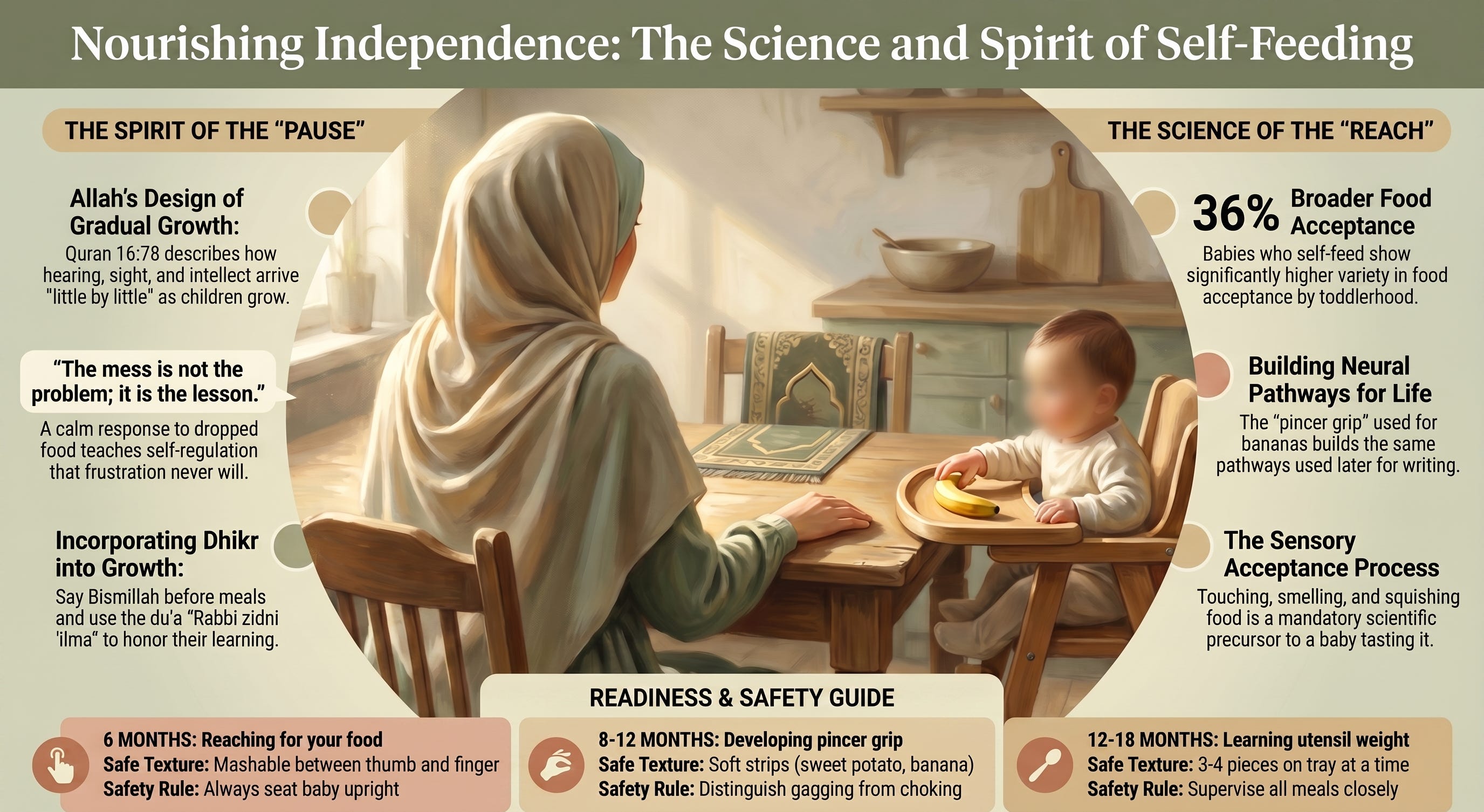
Research from the American Journal of Clinical Nutrition found that babies who actively self-feed from early infancy show 36% broader food acceptance by toddlerhood than those fed entirely by a parent — yet most parenting advice focuses on managing the mess rather than encouraging the process. [1]
Here is something no one told me until I went looking: the yogurt on the forehead is not the problem. The yogurt on the forehead is the lesson.
A mother once shared something with me that I have thought about many times since. She said she used to rush every meal. Spoon in fast, wipe hands fast, redirect every curious reach toward the bowl. She was being efficient. What she didn’t realise until much later was that in trying to manage mealtimes, she was quietly taking away her daughter’s chance to learn how to eat.
You’re probably doing something similar. Most of us are.
Here’s the thing: when I studied the research on infant self-feeding, one number kept coming up. Babies allowed to actively feed themselves show meaningfully better food acceptance and eating behaviour by toddlerhood. [1] Not slightly better. Meaningfully. And the reason comes down to what is actually happening inside your baby’s brain — which is far more interesting than anything happening on the floor.
Why This Guide Is Different From Generic Baby Feeding Advice
Every recommendation is grounded in peer-reviewed developmental science from sources including the American Journal of Clinical Nutrition, WHO 2023 guidelines, and the American Family Physician — with specific numbers, not vague reassurances. [1,2,3]
This isn’t just feeding advice — it connects the messy, ordinary act of your baby grabbing a spoon to what Allah says about how human learning unfolds from birth, through Tafsir Ibn Kathir on Quran 16:78. [7]
You’ll get a free My Baby’s First Independence Guide to keep beside the highchair — a printable reference designed for the exact moments when you need it most.
What Self-Feeding Actually Does to a Developing Brain
Every time your baby reaches for a piece of food, squeezes it, drops it, tries again, and finally gets it to their mouth, something significant is happening. They are not just eating.
Their fine motor system is firing. The pincer grip — that precise thumb-and-forefinger pinch — is one of the most important motor milestones of early childhood. [1] Self-feeding is one of the best ways to practise it. The same neural pathways your baby is building right now trying to pick up a ripe banana piece are the ones they will use later to hold a pencil.
Their mouth muscles are strengthening too. Chewing, mashing, and moving food across the tongue develops the jaw and lip muscles needed for speech. [4] The muscles your baby uses to gnaw on soft bread are the same ones they will use to form their first words.
And here’s what surprised me most: sensory exposure matters enormously for long-term eating. Research from Nicklaus (2011) found that babies need repeated sensory contact — touching, smelling, squeezing, tasting — before they accept a new food reliably. [6] That squishing and examining? That IS the food acceptance process happening in real time.
Their independence is developing too. Every successful bite your baby takes alone sends a message to their nervous system: I can do this. That is worth more than a clean highchair.
When Does Self-Feeding Begin — and What Should You Expect?
From 4–6 months, most babies start reaching for objects and watching every bite you take with intense focus. [5] These are readiness signals. When solid foods are introduced around 6 months, as recommended by the World Health Organization, [2] your baby will begin grabbing for the spoon and reaching toward your plate. This is the beginning.
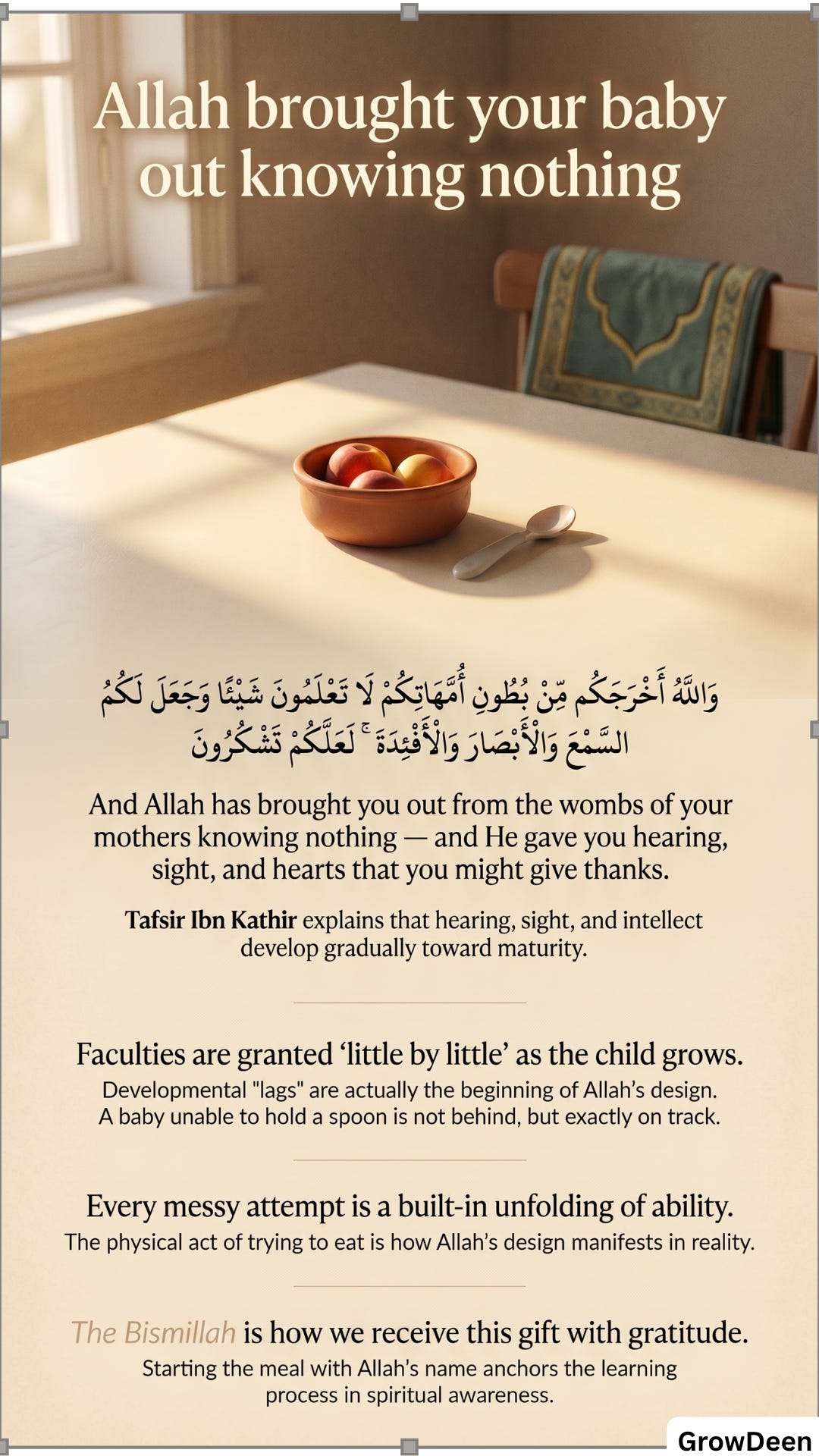
At 6–8 months: They can hold a strip of soft food and bring it toward their mouth. Cut things long — a strip of steamed sweet potato or soft banana is easier to grip in a whole fist than a small cube.
At 8–12 months: The pincer grip develops. They start picking up smaller pieces. This is when finger foods really come into their own.
At 12–18 months: They begin using a spoon with help. Most children cannot manage a spoon independently until around 18 months — but the key word is independently. [3] Let them hold one while you feed them with another from much earlier. Their hands are learning the weight and feel of the tool long before coordination catches up.
I know this is a lot to hold in your head while also managing an actual mealtime with an actual baby who is flinging actual peas. That’s exactly why I created a free guide designed to sit right beside the highchair where you’ll actually use it. Keep reading — the My Baby’s First Independence Guide is waiting for you at the end.
What Allah Designed: The Spiritual Dimension of a Child Learning to Eat
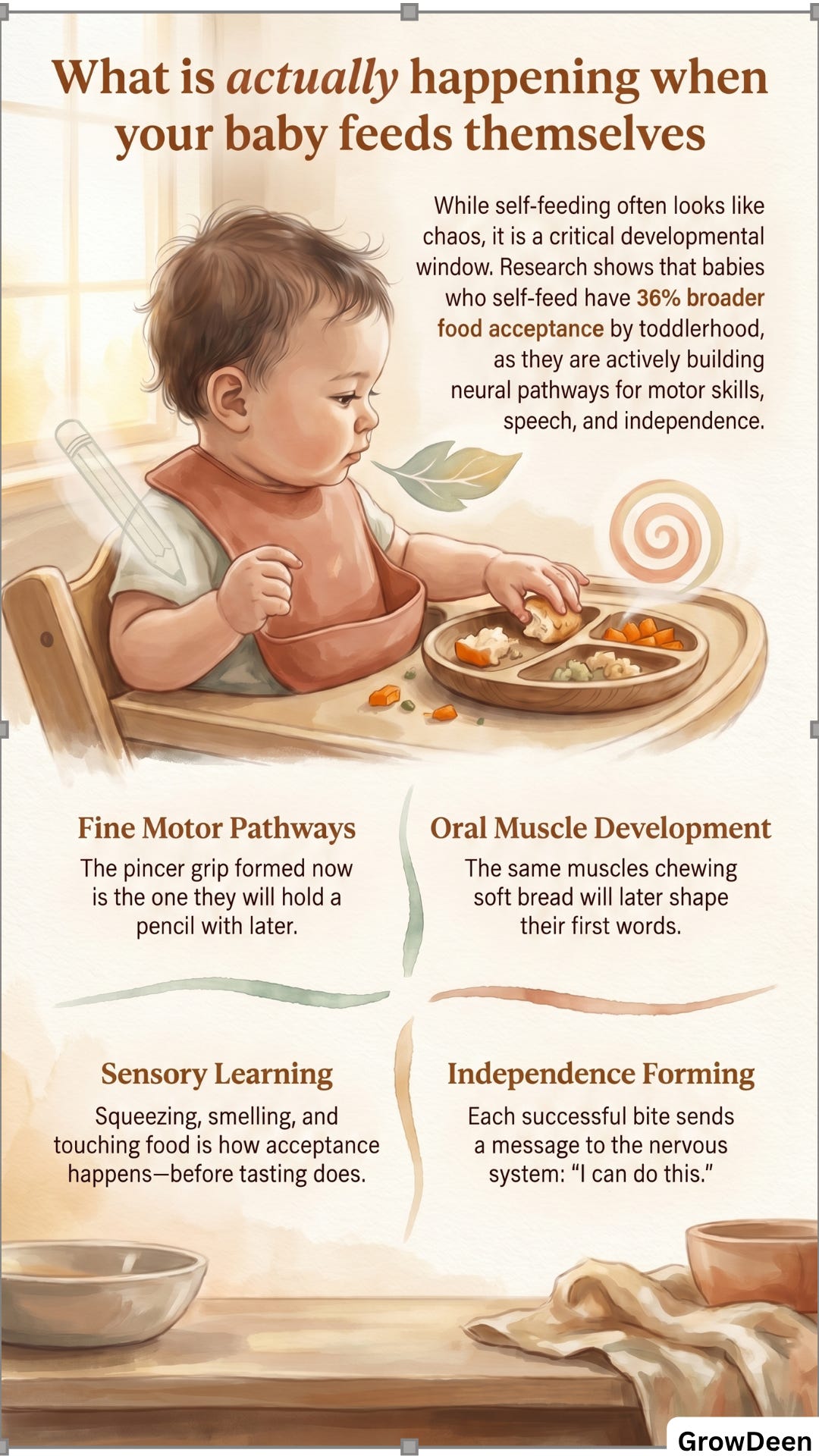
When I reflect on the verse where Allah says, “And Allah has brought you out from the wombs of your mothers knowing nothing — and He gave you hearing, sight, and hearts that you might give thanks” [Quran 16:78], I find something that speaks directly to this season of parenting.
According to Tafsir Ibn Kathir on this verse, the faculties Allah gives us do not arrive all at once. Ibn Kathir explains that hearing, sight, and the heart — meaning intellect and understanding — come gradually, little by little, as the child grows, until they reach full maturity. [7]
This is the truth we watch unfold at every mealtime. The child who cannot yet coordinate a spoon will, in time, learn to use one. The baby who squashes more food than they eat is not failing. They are at the earliest edge of a process that Allah designed and built into them.
Remembering this changed how I feel when the rice hits the wall. The mess isn’t chaos. It’s a child doing exactly what Allah equipped them to do.
Say Bismillah together before every meal. Even now, before they can speak. They are absorbing the rhythms of your family’s life long before they can articulate them.
The Mess: How to Handle It Without Losing Your Mind
Here is something worth knowing: your reaction to the mess matters more than the mess itself. When parents respond to dropped or thrown food with strong emotion, babies quickly discover that the reaction is interesting — and repeat the behaviour to get it again. [3]
A calm response — “that fell on the floor, let’s finish what’s on the tray” — teaches self-regulation in a way that frustration never will.
A few things that genuinely help:
A full-coverage bib with a food-catcher pocket (worth every penny)
A mat or old towel under the highchair — easier than mopping the floor after each piece
A suction plate or bowl your baby cannot launch off the tray
Place only 3–4 pieces of food on the tray at a time; add more when they finish or drop them [3]
Leave the floor food until the meal ends — one clean-up beats ten
The child who plays freely with food at this age tends to become a more adventurous eater later on. [6] The mess is doing real work.
Keeping Your Baby Safe While They Explore
Always supervise closely. Your presence is non-negotiable.
Make sure every piece of food is soft enough to mash between your fingers with gentle pressure. If you can’t mash it, it’s not ready. Avoid whole grapes, whole nuts, hard raw carrot, and large apple chunks. [3]
Always seat your baby upright in a highchair — never eating while lying down or moving around. [3]
Know the difference between gagging (normal — loud, baby resolves it, the reflex is working) and choking (silent, baby is distressed, requires immediate help). Gagging during early self-feeding is expected and usually resolves on its own.
If your baby consistently refuses all textures beyond the first few weeks of introduction, seems distressed at mealtimes, or is not gaining weight as expected — speak with your paediatrician. Early support makes a real difference.
Your Free Resource: My Baby’s First Independence Guide
If you’ve read this far, you’re the kind of parent who takes your baby’s development seriously — not as a checklist to tick, but as something genuinely worth understanding. That tells me something good about you.
Inside the My Baby’s First Independence Guide (one PDF, 3 pages):
Page 1: Self-Feeding Milestones at a Glance — A clean, age-by-age visual reference card tracking what to expect from 4 months to 18 months: grip development, food textures, utensil readiness, and key signs of progress — designed like a laminated card to keep on the fridge or beside the highchair so you can check in without searching.
Page 2: Mealtime Troubleshooting Card — “When your baby does this → try this” — covering the 7 most common mealtime challenges (throwing food, refusing textures, grabbing the spoon, losing interest mid-meal, gagging, refusing the spoon entirely, and mealtimes taking too long). Each challenge gets a calm, evidence-based response in plain language.
Page 3: Du’a for Your Child’s Learning and Growth — The Quranic supplication Rabbi zidni ‘ilma (”My Lord, increase me in knowledge”) [Quran 20:114], with Arabic text, transliteration, and English meaning — together with a short reflection on using this du’a as your child reaches new milestones: saying it over them as they learn to hold a spoon, climb, speak, or take their first steps. A practice for the parents as much as the children.
This isn’t a PDF to download and forget. It’s designed to stay in your kitchen — where you’ll actually use it when you need it most.
This guide is what every subscriber receives with each article. At GrowDeen Education, we cover the full journey — all backed by research and rooted in Islamic wisdom.
If you want evidence-based, Islamically grounded parenting guidance delivered to your inbox, subscribe free below.
Subscribe free — parenting resources backed by both science and Sunnah, guidance you genuinely cannot find anywhere else. No spam. No clutter. Just resources that matter.
Your Micro-Action for Tonight
Tonight at your next mealtime: put down the spoon. Place 3 pieces of soft banana on the tray. Step back. Let your baby reach.
Just watch for two minutes. Don’t redirect, don’t wipe, don’t load the spoon. Watch what your baby does when you trust them.
That’s where the learning is.
May Allah place barakah in the ordinary moments — in the messy mealtimes, the patient wipe-downs, and the quiet Bismillahs before every bite. May He make the care you give your child more rewarding than it feels on the hard days.
Share This With Someone Who Needs It
Think of one person right now: the first-time mother in your family who messages you from the kitchen asking “is it normal that she keeps spitting the food out?” — or the sister whose baby has been on purees for four months because mealtimes keep ending in tears and she doesn’t know if she’s doing something wrong.
This article could shift everything for her. Share it today — not as advice, but as “I found this and thought of you.” Sometimes the most caring thing we can do is pass along the thing that finally made something click.
Frequently Asked Questions
Q: When should babies start self-feeding? A: Most babies begin showing interest in self-feeding around 4–6 months, when they start reaching for objects and watching you eat. Once solid foods begin around 6 months (per WHO guidelines), you can start offering soft finger foods and letting your baby hold a spoon. [2] For more detail, see “When Does Self-Feeding Begin” above.
Q: What finger foods are safe for a 6-month-old? A: Soft, mashable foods work best — ripe banana, steamed sweet potato, soft-cooked broccoli, scrambled egg, and soft bread or chapati torn small. The rule: if you can mash it between your fingers with gentle pressure, it’s appropriate. Cut into strips for younger babies who can grip better in their whole fist than with a pincer grip. [3]
Q: Why does my baby throw food on the floor? A: Mostly because they’re exploring cause and effect — and because your reaction is interesting. [3] The most effective response is a calm, matter-of-fact one: pick it up quietly, or leave it until the meal ends. A strong emotional reaction tends to make it happen more. Placing only a few pieces on the tray at a time also reduces the temptation.
Q: At what age do babies use a spoon independently? A: Most children manage a spoon on their own around 18 months, though this varies. [3] But there’s no need to wait — let your baby hold a spoon from as early as 6 months while you feed them with another. Their hands are learning the weight and feel of the tool long before coordination allows them to use it accurately.
Q: Is gagging normal during baby self-feeding? A: Yes, and it’s important to know the difference between gagging and choking. Gagging is normal — it tends to be loud, the baby looks surprised or uncomfortable, and they typically resolve it on their own. It’s the gag reflex doing its job. Choking is silent, the baby is clearly distressed and cannot resolve it, and requires immediate action. If your baby gags occasionally during self-feeding, this is expected, especially in the early weeks.
Q: How do I encourage a baby who shows no interest in feeding themselves? A: Eat with them as often as you can — babies learn by watching. [3] Keep offering opportunities without pressure. Place a spoon in their hand even if they just wave it around. Offer a variety of textures and colours. Some babies take longer than others to show interest, and that’s normal. If by 9–10 months your baby shows no interest in food at all, or seems distressed at mealtimes consistently, a conversation with your paediatrician is worthwhile.
References
[1] Birch, L.L., & Doub, A.E. (2014). Learning to eat: Birth to age 2y. American Journal of Clinical Nutrition, 99(3), 723S–728S. https://doi.org/10.3945/ajcn.113.069047
[2] World Health Organization. (2023). Complementary feeding. WHO. https://www.who.int/health-topics/complementary-feeding
[3] Riley, L.K., Rupert, J., & Boucher, O. (2018). Nutrition in toddlers. American Family Physician, 98(4), 227–233.
[4] Lutter, C.K., Grummer-Strawn, L., & Rogers, L. (2021). Complementary feeding of infants and young children 6 to 23 months of age. Nutrition Reviews, 79(8), 825–846. https://doi.org/10.1093/nutrit/nuaa143
[5] Mudholkar, A., Korostenski, L., Blackwell, D., & Lane, A.E. (2023). Factors associated with the early emergence of atypical feeding behaviours in infants and young children: A scoping review. Child: Care, Health and Development, 49(1), 1–19. https://doi.org/10.1111/cch.13005
[6] Nicklaus, S. (2011). Children’s acceptance of new foods at weaning: Role of practices of weaning and of food sensory properties. Appetite, 57(3), 812–815. https://doi.org/10.1016/j.appet.2011.05.321
[7] Quran 16:78 (Surah An-Nahl). Tafsir Ibn Kathir on this verse states that Allah brings humans out knowing nothing, then bestows hearing, sight, and intellect gradually (على التدريج), little by little as the child grows. [Tafsir Ibn Kathir, Surah An-Nahl, ayah 78]
[8] Quran 20:114 (Surah Ta-Ha). Rabbi zidni ‘ilma — “My Lord, increase me in knowledge.” A Quranic supplication used across Islamic tradition for the pursuit of learning and understanding.