


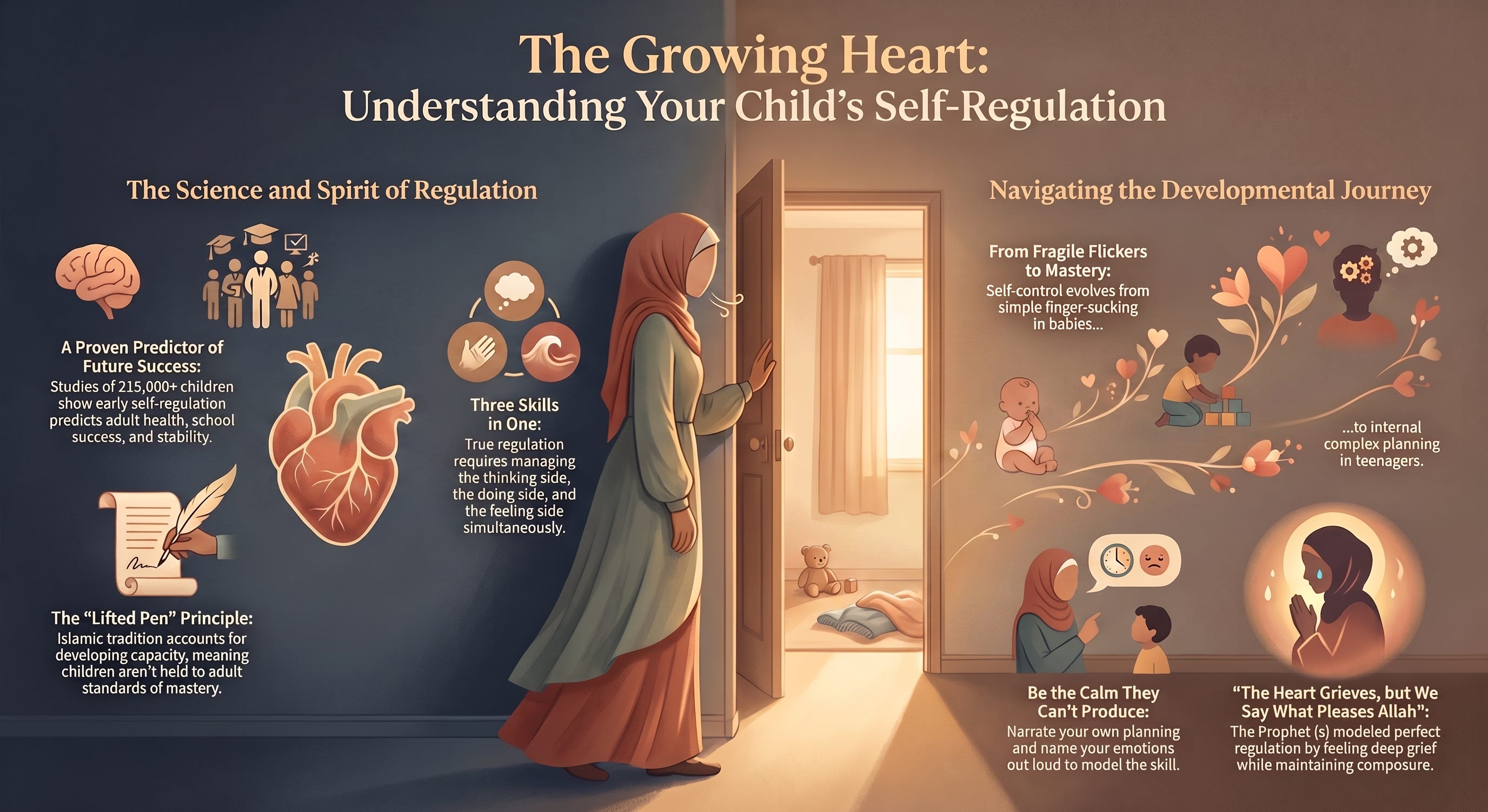
A 2020 meta-analysis tracking over 215,000 children across 150 studies found self-regulation in early childhood predicted 25 separate life outcomes, from school success to adult health. [1] Here’s how it actually develops, and what you can do about it starting tonight.
A four-year-old screams because her sock seam feels wrong. A twelve-year-old slams a door over a cancelled playdate. A sixteen-year-old somehow keeps his composure through an unfair referee call at football practice.
Same underlying skill. Three completely different places on the timeline.
That skill is self-regulation, and researchers have found it might be one of the biggest predictors of how smoothly childhood, and eventually adulthood, goes.
You were careful. You’ve read the books, you’ve tried the calm-down corner, and your child still melts down over things that seem too small to justify the reaction. That’s not a parenting failure on your part.
When I studied the numbers behind this, one detail stopped me: researchers tracked over 215,000 children across 150 separate studies and found that self-regulation measured as early as age four predicted outcomes decades later, everything from academic achievement to unemployment, criminal behaviour, and physical illness in adulthood. [1] Not loosely associated with. Predicted.
WHY THIS GUIDE IS DIFFERENT
Why This Guide Is Different From Generic Parenting Advice
Backed by real research, not opinion. Every claim here traces back to peer-reviewed developmental psychology and pediatric sources, not a parenting influencer’s personal theory.
Islamic framework built in, not bolted on. This isn’t safety tips with a verse tacked on at the end. It’s rooted in tarbiyah, the Islamic understanding that raising a self-regulated child and raising a God-conscious one are the same project.
You’ll walk away with a tool, not just information. You’ll get the free Steady Child Toolkit to print and keep wherever your hardest moments actually happen, not just something to read once and forget.
SELF-REGULATION?
Three Things Hiding Inside One Word
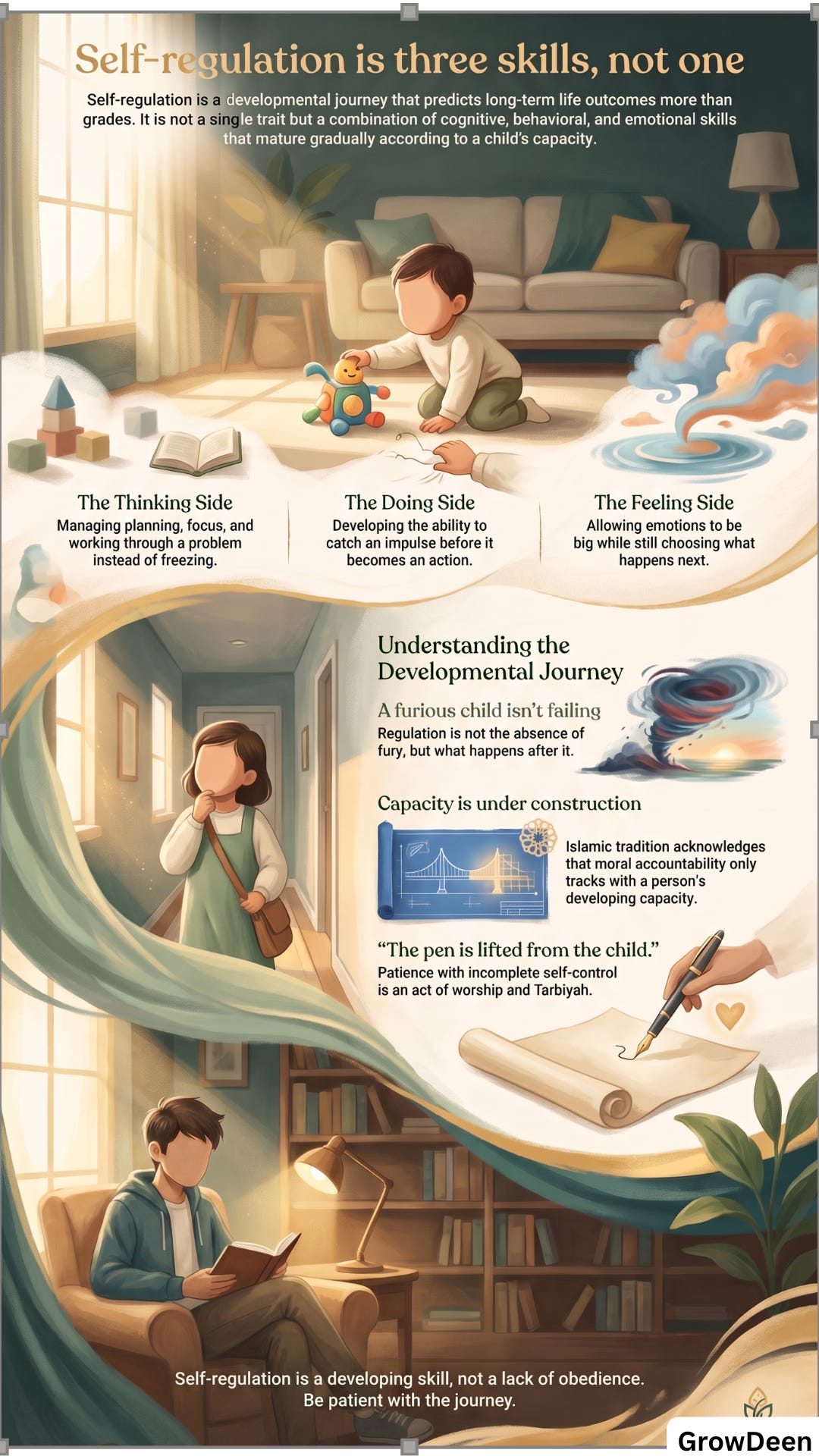
“Self-regulation” sounds like one skill. It’s actually three, running in the background at once: the thinking side (planning, focus, working through a problem instead of freezing), the doing side (catching an impulse before it becomes an action), and the feeling side (letting an emotion be as big as it needs to be while still choosing what comes out of your mouth next). [2]
Here’s what surprised me most in the research: this isn’t obedience with a different name. A well-regulated seven-year-old can still be furious that his sister broke his Lego set. What’s different is what happens next.
Watching It Build, Year by Year
Under 18 months. A baby cannot self-regulate yet. When they turn away or suck their fingers, they’re signalling overload, not managing it. Be the calm they can’t produce yet. There’s no such thing as spoiling a baby by responding to distress.
18 months to 3 years. The first real flickers appear here, a few seconds of waiting for a snack, then a full collapse over a broken cracker in the same afternoon. Research on this window describes it as a genuine shift, moving from simply obeying a rule toward something closer to internal control, even if it’s fragile. [3] It should be fragile. The wiring for sustained impulse control barely exists yet.
4 to 5 years. A child can now hold a simple instruction in mind long enough to act on it. This is also the age Islamic routines start sinking in as felt habit rather than abstract rule.
6 to 12 years. Two kids can disagree strongly and stay friends by lunchtime, because one or both has learned to hold a conflict without it becoming a fight.
13 to 18 years. A teenager who puts their phone in another room before an exam is running a version of self-control that took over a decade to build.
But when was the last time you expected your five-year-old to manage a big feeling the way a fifteen-year-old would?
That mismatch, expecting adult-level control from a child-level brain, is one of the most common and most fixable sources of conflict at home. Islamic tradition built a version of this staged understanding into law itself: a foundational principle holds that moral accountability tracks a person’s developing capacity, meaning a child is never held to the same standard as an adult, because the self-mastery that standard assumes is still under construction. [4]
Building It: What Actually Helps
For the thinking side: narrate your own planning out loud. “I need to finish this now so we’re not late for Maghrib.”
For the doing side: preview a hard moment before you’re in it. “This shop has a lot of things that break. Look, don’t touch,” said calmly at the door.
For the feeling side: name your own emotions honestly. “I’m getting frustrated, I’m going to step outside for a second and come back calmer” teaches more than any lecture on anger ever could. [5]
I know that’s a lot to hold in your head at 6 p.m. with a child mid-meltdown. It’s the reason I built the Steady Child Toolkit, a free download with an age-by-age script for exactly what to say, plus a three-step reset card for the moment a feeling gets too big. You’ll find it waiting at the end of this article, ready for the exact spot where your hardest moments already happen.
THE ISLAMIC FRAMEWORK FOR SELF-CONTROL: WHY ALLAH ASKS THIS OF US GRADUALLY
When I first started studying self-regulation, I expected the research and the Deen to be talking past each other. Instead, I kept finding them saying the same thing from different directions.
There’s a moment from the seerah I keep coming back to. When the Prophet’s ﷺ young son Ibrahim was dying, he wept openly. A companion, startled, asked if even he was crying. He said, “This is mercy,” and then, still weeping, “The eyes shed tears and the heart grieves, but we say nothing except what pleases our Lord.” [7] He didn’t suppress the grief. He let it show completely and still governed every word that left his mouth. That’s emotional self-regulation in its most complete form.
I also think often of Luqman’s advice to his son in the Qur’an, which reads almost like a checklist for this exact topic: bear what befalls you with patience, don’t turn your face from people in arrogance, walk at a measured pace, and lower your voice, for the harshest of all sounds is the braying of a donkey. [6] Four instructions, and every one is about catching an impulse before it runs.
What moves me most is a principle most of us learned as children without realizing its depth: “the pen is lifted from the child until he reaches puberty.” [4] Islam accounted for developing capacity fourteen centuries ago. Your patience with your child’s incomplete self-control isn’t just good parenting technique. It’s tarbiyah, and whether it feels like it on a hard Tuesday or not, it counts as worship.
THE COMPANION PACK
If you’ve read this far, you’re the kind of parent who takes your child’s emotional development seriously, not as something to fix, but as something to nurture with patience. That already says something beautiful about you.
Inside the Steady Child Toolkit (one comprehensive PDF, 3 pages):
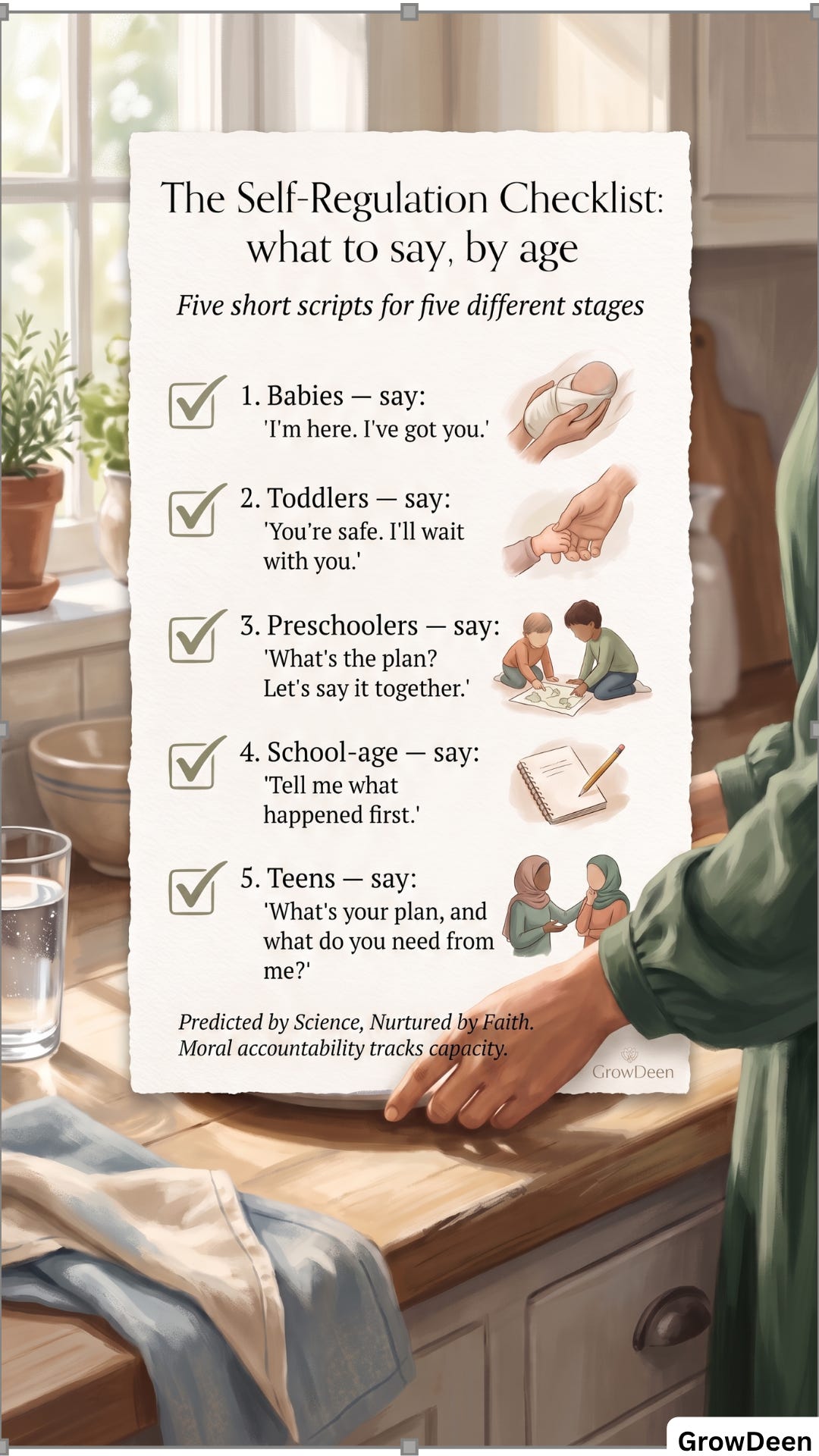
Page 1: Self-Regulation by Age, a Script Card — Exactly what to expect and exactly what to say at your child’s current stage, from babies through teens, so you’re not guessing mid-meltdown, designed as a quick-glance reference card you can keep on your kitchen fridge.
Page 2: The Pause Card, a Three-Step Reset — A shared routine you and your child can use together the moment a feeling gets too big, so nobody has to invent a strategy while already overwhelmed, laminated and kept at your child’s eye level.
Page 3: A Reminder From the Sunnah — An authentic hadith on developing capacity, paired with a short reflection to help you hold onto patience on the hard days, not just the easy ones.
This isn’t just a PDF to download and forget. It’s a tool designed to stay in your kitchen, your car, or your child’s room, where you’ll actually reach for it when you need it most.
This Steady Child Toolkit is what every subscriber receives with each article. We cover the full journey of raising Muslim children, sleep to character to Islamic practices, all backed by scientific research and rooted in Islamic wisdom.
If you’re a Muslim parent who wants both evidence-based guidance and Islamic perspective, subscribe for free so future resources arrive in your inbox before you need them.
Subscribe free for parenting resources backed by both science and Sunnah, guidance so specific you won’t find it anywhere else. No spam, no clutter, just the resources that matter.
MICRO-ACTION
The next time you feel your own patience breaking, pause. Take one breath. Say “Bismillah.” That’s it. That’s the practice, and it’s the same one you’re trying to teach.
May Allah place barakah in your effort, accept your intention, and make your patience with your child more protective and more rewarded than it ever feels in the moment.
SHARE WITH CARE
Think of one person right now: the exhausted mother at the masjid who told you her toddler’s tantrums leave her shaking, your sister whose teenager slammed a door last week and she’s still not sure if she handled it right, a friend whose WhatsApp messages this month have all been some version of “I don’t know what I’m doing wrong.”
This article could ease their burden. Share it with them today, not as advice-giving, but as support. Sometimes the most loving thing we can do is pass along what finally made sense to us.
FREQUENTLY ASKED QUESTIONS
At what age should a child be able to control their emotions?
There’s no single age. Genuine emotional control keeps developing through the teen years and even into the twenties. A toddler melting down isn’t a delay, it’s exactly where they should be.
Is self-regulation the same as good behaviour?
No. Self-regulation is what happens between a feeling and a reaction. A child can feel furious and still be well-regulated if they manage how they express it, that’s covered above in “Three Things Hiding Inside One Word.”
Can self-regulation be taught, or is it just personality?
Both play a role. Temperament affects how intensely a child feels things, but the skill of managing that intensity is built through modelling and practice, not fixed at birth.
What’s the difference between a tantrum and defiance?
A tantrum is usually a capacity problem, a child overwhelmed by a feeling bigger than their current skills can handle. Defiance is a choice. Most early-childhood meltdowns are the former.
How does Islam view a child’s incomplete self-control?
Islamic tradition explicitly accounts for it. The principle that moral accountability follows developing capacity, discussed above, means young children were never expected to self-regulate the way adults do.
What can I do right now if my child is mid-meltdown?
Stay close, stay calm, and narrate rather than lecture: “You’re safe, I’ll wait with you until this passes.” The Pause Card in the Steady Child Toolkit walks through this in more detail.
When should I be concerned about my child’s self-regulation?
If tantrums are noticeably more frequent or intense than peers, getting worse with age, unsafe, or paired with significant social withdrawal, it’s worth a conversation with your doctor or your child’s teacher.
REFERENCES
[1] Robson, D.A., Allen, M.S., & Howard, S.J. (2020). Self-regulation in childhood as a predictor of future outcomes: A meta-analytic review. Psychological Bulletin, 146(4), 324-354. https://doi.org/10.1037/bul0000227
[2] Robson, D.A., Allen, M.S., & Howard, S.J. (2020). Ibid.
[3] Feng, X., Hooper, E.G., & Jia, R. (2017). From compliance to self-regulation: Development during early childhood. Social Development, 26, 981-995. https://doi.org/10.1111/sode.12245
[4] Sunan Abi Dawud 4403; also Jami’ at-Tirmidhi 1423, graded Hasan. “The pen is lifted from three: the sleeper until he wakes, the child until he reaches puberty, and the person of unsound mind until he comes to reason.”
[5] Williams, K.E., & Howard, S.J. (2020). Proximal and distal predictors of self-regulatory change in children aged 4 to 7 years. BMC Pediatrics, 20(1), 226. https://doi.org/10.1186/s12887-020-02133-6
[6] Qur’an, Surah Luqman 31:17-19, via Tafsir Ibn Kathir (alim.org).
[7] Sahih al-Bukhari 1303; Sahih Muslim 2315. Narration of Anas ibn Malik on the death of the Prophet’s ﷺ son Ibrahim.