

Recent clinical guidelines emphasize that approximately 10-33% of breastfeeding mothers will experience mastitis.[1] This guide shows you how to recognize symptoms early, respond with gentle care, and recover safely — before inflammation becomes an abscess.
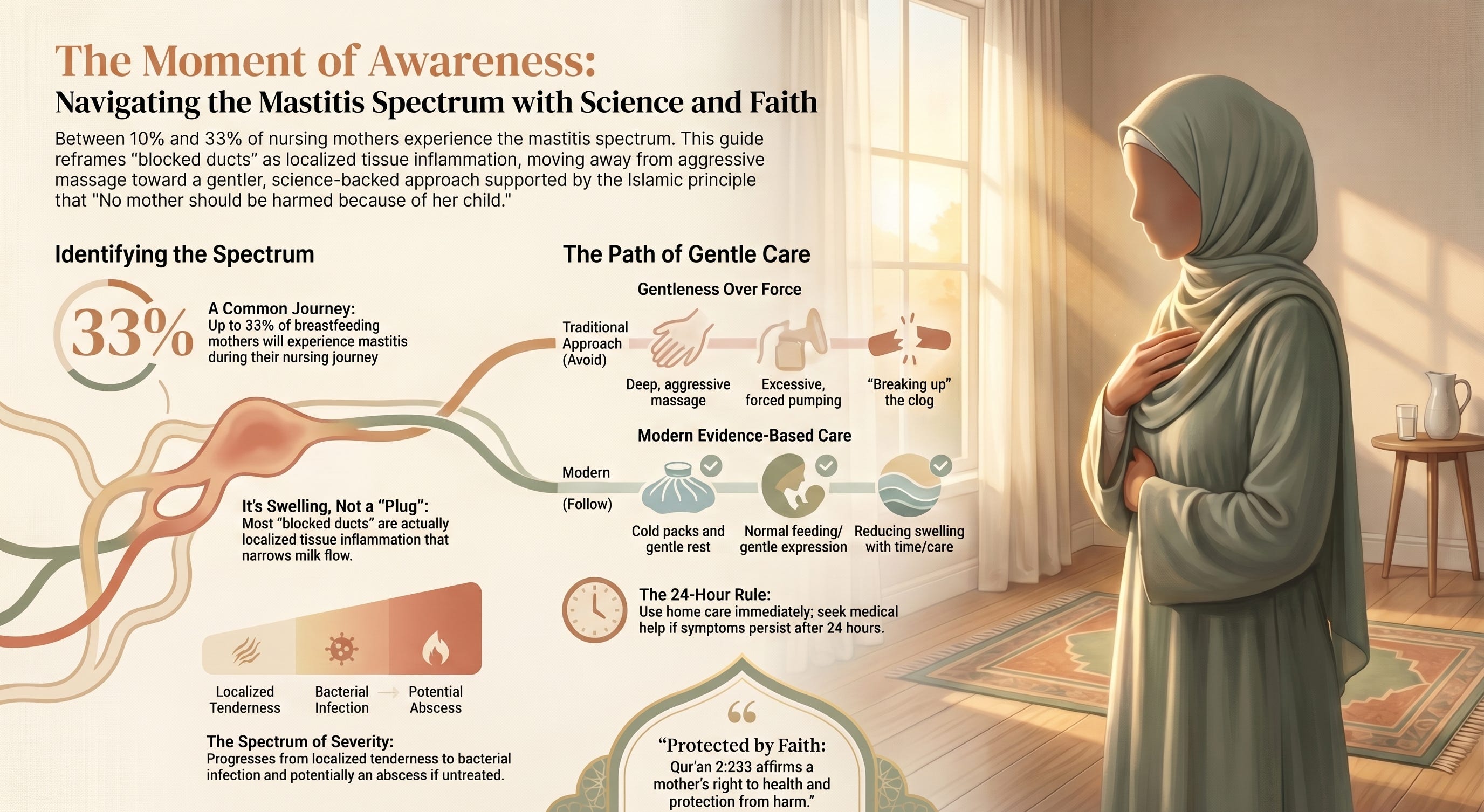
It starts with a tender spot. Maybe during a feed, maybe when you’re trying to sleep.
You press gently and think, “That’s new.” You check your phone: Is this normal? Should I be worried? You’re already tired, already giving everything you have to feed this baby, and now your body is adding one more thing to manage.
Here’s what I want you to know first: breast pain during nursing is common, and most of it resolves with simple, gentle care. But it matters that you understand what you’re dealing with — not to frighten you, but to protect you.
When I studied the Academy of Breastfeeding Medicine’s 2022 mastitis protocol,[1] what struck me wasn’t just the medical detail. It was how much has changed in recent years. The old advice — aggressive massage, excessive pumping, forcing milk out — can actually make inflammation worse. The new guidance is gentler, smarter, and focused on what your body actually needs.
Why This Guide Is Different
Every recommendation comes from current medical research — This follows the Academy of Breastfeeding Medicine’s 2022 mastitis spectrum protocol[1] and integrates recent evidence on gentle breast care.
It’s rooted in Islamic wisdom about maternal wellbeing — The Qur’an specifically states that no mother should be harmed because of her child[9], reminding us that caring for yourself isn’t selfish — it’s part of fulfilling the trust of motherhood.
You get a practical companion resource — The free Mastitis Recovery & Care Companion Pack gives you a 3-page reference guide to keep where you actually need it — not buried in your phone, but printed and ready when symptoms start.
Understanding the Mastitis Spectrum
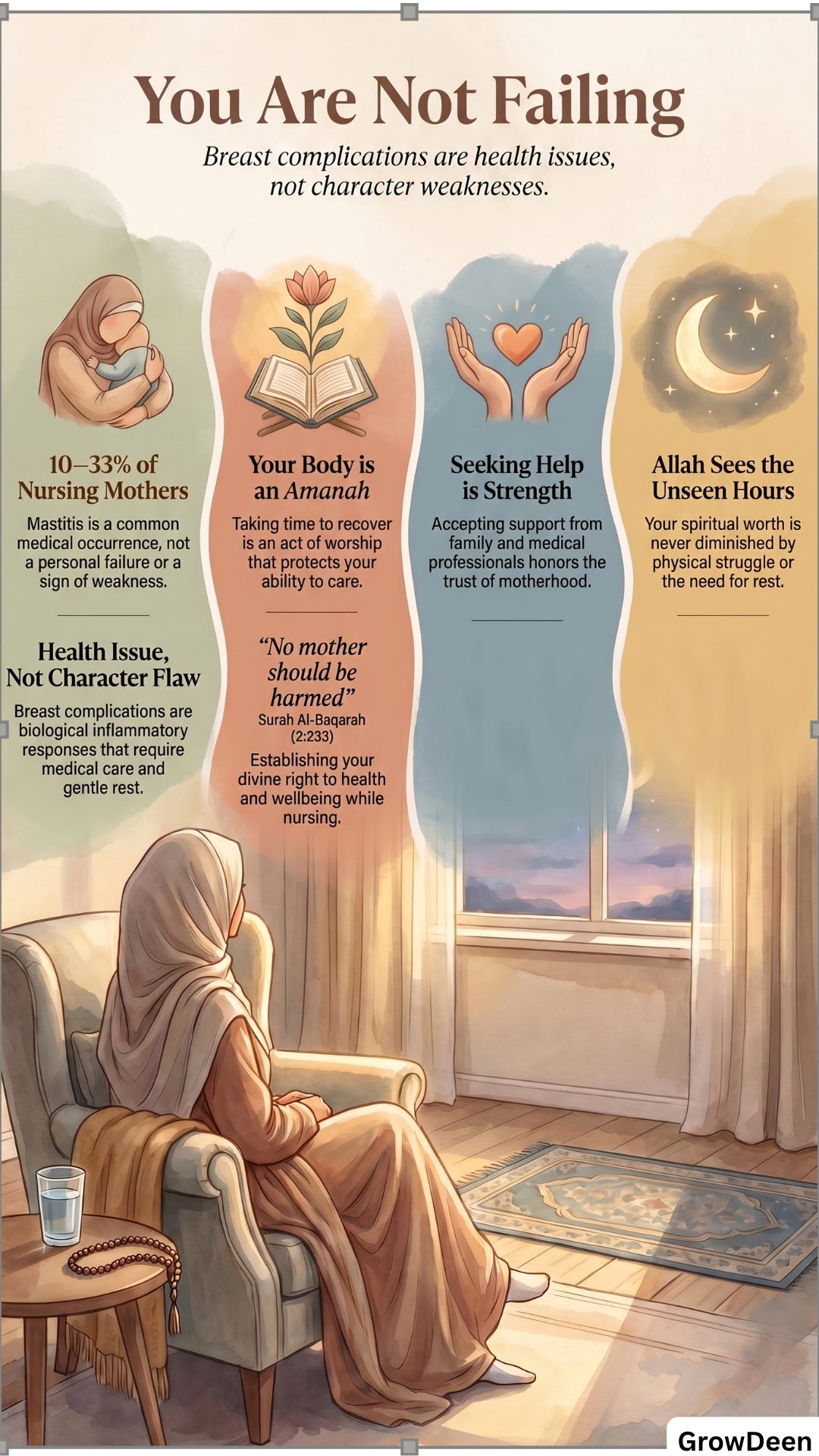
Here’s what newer research has clarified: what we’ve always called a “blocked duct” usually isn’t a solid plug sitting inside your milk duct. It’s localized breast inflammation — swelling in the tissue and ducts that narrows milk flow.[1][2]
This matters because it changes how you should respond.
Older guidance focused on “breaking up the clog” with deep massage and aggressive pumping. Current evidence shows that approach can worsen swelling and inflammation.[1][2] Your breast doesn’t need force. It needs gentleness, time, and sometimes medical support.
The Academy of Breastfeeding Medicine describes mastitis as a spectrum[1] — from mild inflammation in one area, to inflammatory mastitis involving the whole breast, to bacterial mastitis requiring antibiotics, and potentially to abscess if untreated.
Understanding where you are on this spectrum helps you respond appropriately.
What People Call a “Blocked Duct”
When mothers say “I have a blocked duct,” they usually mean:
A sore, tender lump in one spot. Pain when milk lets down. A breast area that stays firm even after feeding. Mild redness or warmth. No fever. Otherwise feeling generally well.
If this describes you, you’re likely dealing with localized breast inflammation. This early stage often improves within 24 hours with gentle home care.
What to do immediately:
Continue feeding normally according to your baby’s needs — don’t force extra feeds or try to “empty” the breast aggressively.[1] If your baby won’t latch on that side, express gently by hand or pump just enough for comfort.
Use cold packs after feeds — wrap an ice pack in a cloth and apply for short periods to reduce pain and swelling.[1][2] Never place ice directly on skin.
Avoid deep massage — pressing hard or trying to “dig out” a lump can increase tissue swelling.[1][2]
Check your baby’s latch — shallow latch reduces milk transfer and can contribute to recurring inflammation.[5]
Remove external pressure — tight bras, underwires, baby carrier straps, seatbelts, or sleeping positions that compress the breast can all reduce drainage.
Rest deliberately — this isn’t optional. Rest is part of treatment.
Use pain relief appropriately — paracetamol or ibuprofen may help for many mothers, but check with your doctor or pharmacist if you have medical conditions or take other medications.[1][3]
Contact a doctor if symptoms don’t improve within 24 hours or if you develop fever, chills, or feel increasingly unwell.
I know this feels overwhelming when you’re already exhausted. That’s why I created something to make this easier — keep reading to download the Mastitis Recovery & Care Companion Pack at the end of this article. It’s a 3-page printable guide designed to stay with you in your home, not buried in your phone.
What Mastitis Actually Feels Like
Mastitis is more than a tender lump. It often feels like sudden flu.
Your breast hurts. It’s swollen, warm, maybe red (though color change is harder to see on darker skin — it may just feel hot and different). You have fever, chills, body aches, headache, and profound fatigue.
Some mastitis is primarily inflammatory and improves with conservative care — continued feeding, cold packs, rest, and appropriate pain relief.[1] But bacterial mastitis may require antibiotics, especially if symptoms are severe, fever is high, or symptoms persist despite home care.[1][3]
Can you continue breastfeeding during mastitis?
Yes, in most cases. Continuing to feed or express actually helps prevent milk stasis and supports recovery.[1][3] Abrupt weaning during mastitis increases the risk of worsening inflammation or abscess formation.[1][4]
If you’re too unwell to breastfeed, express gently enough to stay comfortable and ask for help from family.
When Pain Becomes an Abscess
A breast abscess is a pocket of pus that can form if mastitis progresses without proper treatment. Signs include a painful, hard lump that doesn’t improve, increasing redness or swelling, possible pus drainage, and pain that persists despite treatment.[1][4]
Interestingly, some mothers with abscesses don’t feel as systemically unwell as you’d expect. That’s why any persistent painful lump should be medically evaluated — don’t dismiss it because you’re “not that sick.”
Abscesses typically need medical assessment, often with ultrasound imaging, and treatment usually includes antibiotics plus drainage by needle aspiration or another procedure.[1][4]
Seek urgent care if:
High fever or severe chills
Severe, unmanageable breast pain
Rapidly spreading redness or swelling
Visible pus or open wound
Symptoms worsen despite treatment
You feel faint, confused, or extremely weak
Trust your instinct. If something feels wrong, you deserve to be taken seriously.
Support Muslim Parenting Lab ❤️
Would you like a share in every good thing that comes from what you fund? Support it with the button below, at any level you choose.
The Prophet ﷺ said whoever sets a good precedent earns its reward and the reward of everyone who follows it. (Sahih Muslim 1017a)
What the Qur’an Teaches About Maternal Care
The Qur’an explicitly addresses breastfeeding and maternal wellbeing:
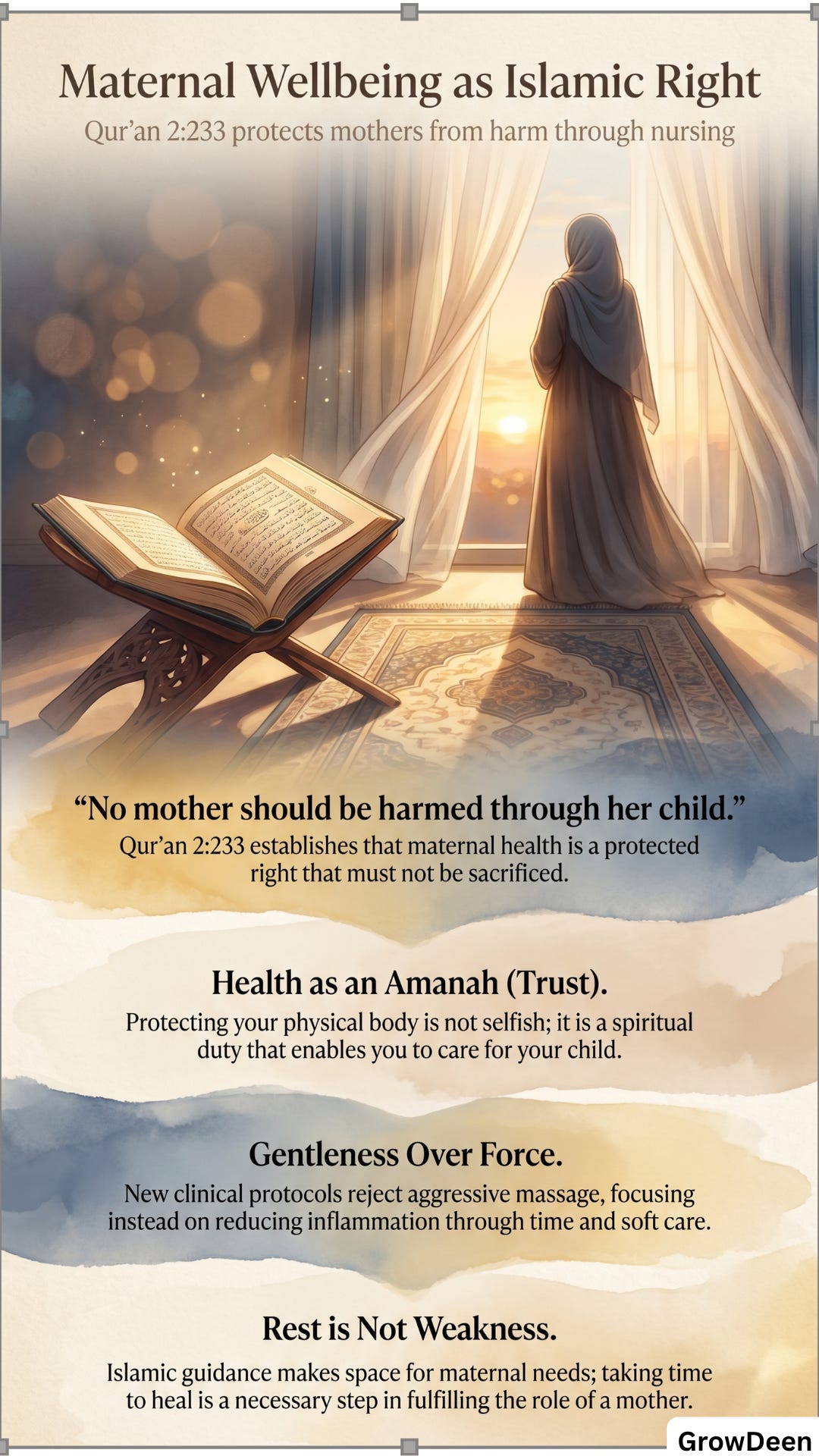
“Mothers may breastfeed their children two complete years for whoever wishes to complete the nursing [period]... No person is charged with more than his capacity. No mother should be harmed through her child, and no father through his child.”[9]
According to Tafsir Ibn Kathir, this verse establishes that neither the mother nor father should suffer harm in the process of caring for their child.[9] The phrase “No mother should be harmed through her child” is particularly powerful for mothers experiencing mastitis.
This isn’t just about the baby’s right to be fed. It’s about the mother’s right to health, rest, and proper care.
When a mother protects her own health — by seeking early medical treatment, resting adequately, taking prescribed antibiotics when necessary, accepting family support — she’s not being selfish. She’s fulfilling the trust responsibly.
The Prophet ﷺ taught clearly about seeking treatment:
“Make use of medical treatment, for Allah has not made a disease without appointing a remedy for it, with the exception of one disease, namely old age.”[10]
Taking antibiotics, using cold packs, seeing a doctor, having an abscess drained if needed — these are all part of taking the means that Allah has provided. You can make dua while also seeking treatment. Both matter.
Preventing Mastitis
Not every case can be prevented, but you can reduce risk:
Feed responsively — follow your baby’s natural hunger cues rather than forcing long gaps that cause excessive fullness.
Avoid unnecessary pumping — over-pumping can create oversupply and increase inflammation risk in some mothers.[1]
Protect latch quality — if feeding hurts or your baby isn’t transferring milk well, get help from a lactation consultant early.[5]
Reduce external pressure — avoid tight clothing, underwire bras, or anything compressing the breast.
Treat early inflammation promptly — a small tender area is easier to manage than full mastitis.
Rest before your body forces you — when you’re exhausted and run down, recovery becomes harder. Rest, hydration, nutrition, and family help all matter.
Emotional Support Matters
Mastitis can make you cry. It can make you feel like you’ve failed. You haven’t.
Breastfeeding complications aren’t signs of weak faith or inadequate motherhood. They’re health issues that deserve compassionate support.
Family members should never say “just tolerate it” or “why is this so hard for you?” Better support sounds like: “Let me bring the baby to you,” “I’ll handle meals today,” “You rest after this feed,” “I’ll call the doctor for you.”
A mother’s recovery is a family responsibility — not hers alone.
The Mastitis Recovery & Care Companion Pack
If you’ve read this far, you’re taking mastitis seriously — not as something to ignore, but as something to respond to with both knowledge and care. That tells me you’re committed to protecting your health while continuing to nourish your baby.
I created the Mastitis Recovery & Care Companion Pack because remembering all of this when you’re feverish, exhausted, and in pain is nearly impossible. This isn’t just information — it’s a tool designed for the moments when you need it most.
Inside this comprehensive 3-page PDF:
Page 1: Mastitis Symptom & Response Flowchart — A clear visual guide showing when to use home care, when to call a doctor, and when to seek urgent medical attention. Includes a quick-reference checklist of warning signs (fever, spreading redness, pus, worsening pain) and gentle care steps (cold packs, rest, normal feeding). Designed as a laminated reference card you can keep on your bedside table or bathroom mirror — somewhere you’ll see it when symptoms start, not buried in a drawer.
Page 2: Gentle Breast Care & Recovery Guide — Step-by-step instructions for what TO do (cold packs, comfortable feeding positions, adequate rest, hydration) and what NOT to do (aggressive massage, over-pumping, ignoring fever). Includes a 48-hour recovery tracker so you can monitor whether symptoms are improving or worsening, helping you decide if medical follow-up is needed. This page gives you confidence that you’re doing the right things.
Page 3: Islamic Du’as for Healing & Patience — Authentic supplications for seeking healing and strength during illness, including the Prophet’s ﷺ du’a for shifa (cure) and du’a for patience during difficulty. With Arabic text, transliteration, and English meaning. Plus a gentle reminder of Qur’an 2:233 about not harming mothers, and how seeking medical treatment is part of Islamic practice. This connects your physical recovery to spiritual awareness and reminds you that taking care of yourself honors the trust of motherhood.
This pack won’t replace your doctor, but it will help you know when to call one. It removes the mental burden of remembering every detail when you’re unwell. It’s the structure that helps you act quickly and calmly when mastitis starts.
Future resources that support your journey:
This Mastitis Recovery & Care Companion Pack is what every subscriber receives with each article I publish. We cover the complete arc of raising healthy Muslim children — from newborn care to postpartum recovery to early childhood health — all backed by current research and grounded in Islamic wisdom.
If you’re a Muslim parent who wants evidence-based health guidance with an Islamic framework, subscribe for free so future resources reach you before you need them. We publish weekly on topics like postpartum recovery, infant feeding, child development, and family wellness — always practical, always rooted in both science and faith.
No spam. No daily emails. Just one well-researched article each week with a companion resource you’ll actually use.
One 5-Minute Action You Can Take Today
Even if you’re not experiencing mastitis right now, prepare your recovery toolkit so it’s ready if symptoms start:
Set up a “Mastitis Care Station” in your kitchen or bedroom (5 minutes):
Gather: A gel ice pack or two, a clean cloth for wrapping it, a water bottle, and pain relief medication you’ve confirmed is safe for breastfeeding. Put them all in one designated spot — a kitchen drawer, bathroom cabinet, or bedside basket.
Print the Companion Pack and keep Page 1 (the symptom flowchart) somewhere visible — taped to your bedroom mirror or fridge.
Save your doctor’s number in your phone under “Call for Mastitis” so you don’t have to search when you’re feverish.
This takes five minutes now and saves you from scrambling when you’re unwell. Having everything ready removes one layer of stress if mastitis starts.
Share This With Someone Who Needs It
Think of a pregnant friend, a new mother, or someone currently breastfeeding. Picture her — the one who’s always giving everything to her baby, the one who might ignore her own pain because she thinks she should just push through.
Send her this article. Tell her: “Keep this for when you need it. I’m thinking of you.”
Because maternal health information like this doesn’t just help one mother — it protects an entire generation of families.
Frequently Asked Questions
Q: How can I tell the difference between a blocked duct and mastitis?
A blocked duct (or localized inflammation) usually involves a tender lump in one spot without fever or feeling unwell. Mastitis includes fever, chills, body aches, and feeling like you have the flu — not just breast pain. If you develop fever or feel systemically ill, contact a doctor.[1][3]
Q: Will deep massage help break up a blocked duct?
Actually, current evidence suggests deep massage can worsen inflammation by increasing tissue swelling.[1][2] Gentle stroking is fine, but avoid pressing hard or trying to “dig out” a lump. The newer approach focuses on reducing inflammation rather than forcing milk out.
Q: Can I still breastfeed if I have mastitis?
Yes, in most cases. Continuing to breastfeed or express milk as needed actually helps prevent milk stasis and supports recovery.[1][3] Abruptly stopping can increase the risk of abscess formation. If you’re taking antibiotics, confirm with your doctor that they’re compatible with breastfeeding.
Q: When should I go to the hospital instead of just calling my doctor?
Seek urgent hospital care if you have high fever with severe chills, feel faint or confused, have rapidly spreading redness, see pus or an open wound, or experience symptoms that worsen despite treatment. These can indicate a developing abscess or severe infection requiring immediate intervention.[1][4]
Q: How long does mastitis usually last?
With appropriate treatment (antibiotics if prescribed, rest, gentle milk removal, cold packs), most mastitis improves within 24-48 hours. If symptoms don’t clearly improve within this timeframe, contact your doctor for reassessment.[1][3]
Q: Is it true that stress or being run down can cause mastitis?
While stress and exhaustion don’t directly “cause” mastitis, they can affect your immune response and make it harder for your body to manage inflammation effectively. Rest, adequate nutrition, hydration, and accepting family support all matter during breastfeeding — not just for mastitis prevention but for your overall wellbeing.
References
[1] Mitchell, K. B., Johnson, H. M., Rodríguez, J. M., Eglash, A., Scherzinger, C., Widmer, K., Berens, P., Miller, B., and the Academy of Breastfeeding Medicine. (2022). Academy of Breastfeeding Medicine Clinical Protocol #36: The Mastitis Spectrum, Revised 2022. Breastfeeding Medicine, 17(5), 360–376. https://doi.org/10.1089/bfm.2022.29207.kbm
[2] Douglas, P. (2022). Re-thinking benign inflammation of the lactating breast: Classification, prevention, and management. Women’s Health, 18. https://doi.org/10.1177/17455057221091349
[3] Louis-Jacques, A. F., Berwick, M., and Mitchell, K. B. (2023). Risk factors, symptoms, and treatment of lactational mastitis. JAMA, 329(7), 588–589. https://doi.org/10.1001/jama.2023.0004
[4] Australian Breastfeeding Association. (2024). Breast abscess. https://www.breastfeeding.asn.au/resources/breast-abscess
[5] Douglas, P. (2022). Re-thinking lactation-related nipple pain and damage. Women’s Health, 18. https://doi.org/10.1177/17455057221087865
[9] Qur’an, Surah Al-Baqarah 2:233. https://quran.com/2/233
[10] Sunan Abi Dawud 3855. The Prophet ﷺ encouraged seeking medical treatment. https://sunnah.com/abudawud:3855
[11] Sunan Abi Dawud 4943, graded Sahih by Al-Arna’ut. The Prophet ﷺ emphasized showing mercy to young children. https://sunnah.com/abudawud:4943
We combine scientific research with Qur’an and authentic Sunnah, and we cite our sources. Even so, this is general guidance and no substitute for a doctor who can examine your child.