

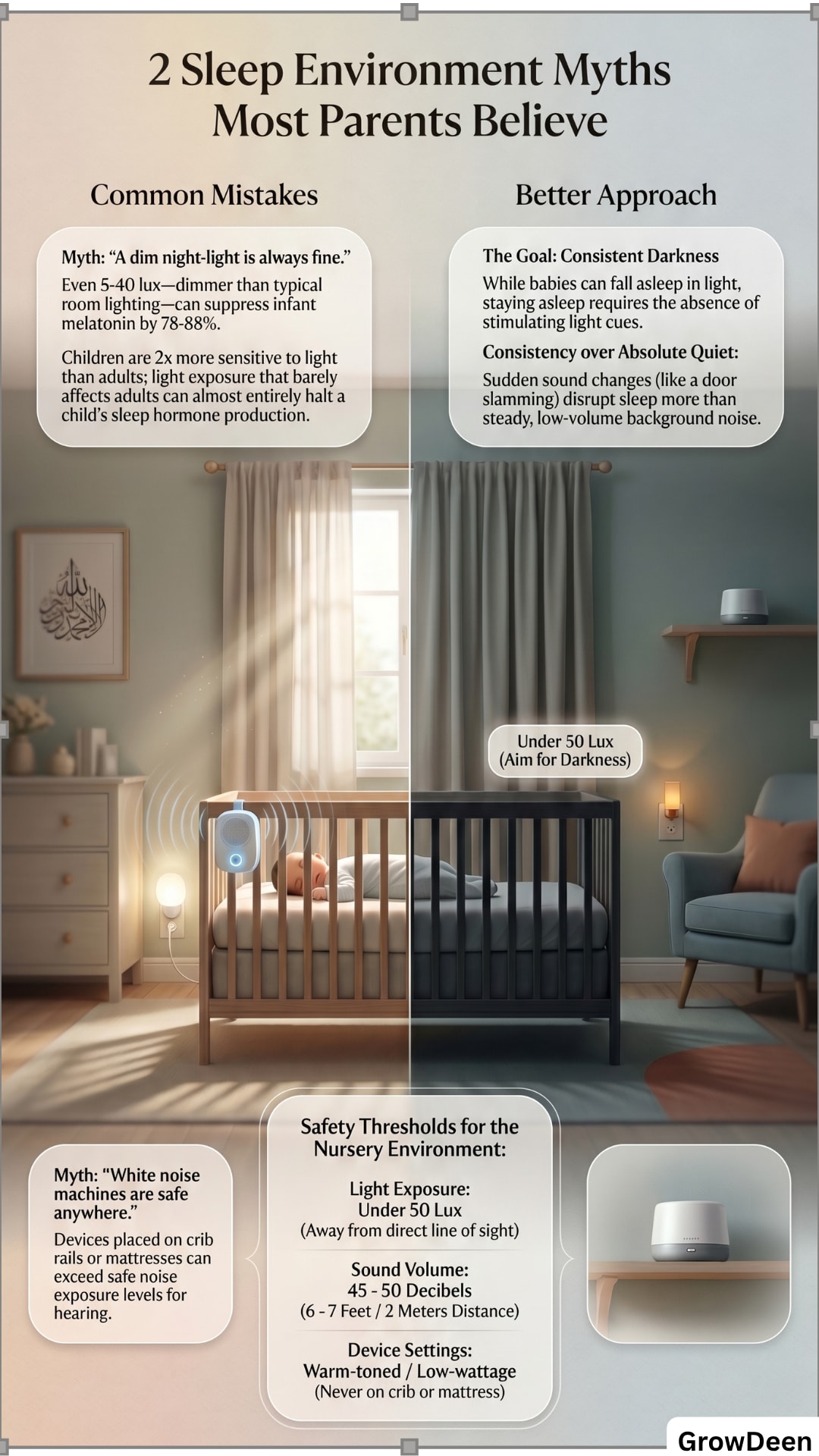
Research shows that even 5-40 lux of light (dimmer than typical room lighting) can suppress infant melatonin by 78%. [1] This guide shows you the specific thresholds for light and sound that protect your baby’s sleep and developing circadian rhythm, with practical fixes you can implement tonight.
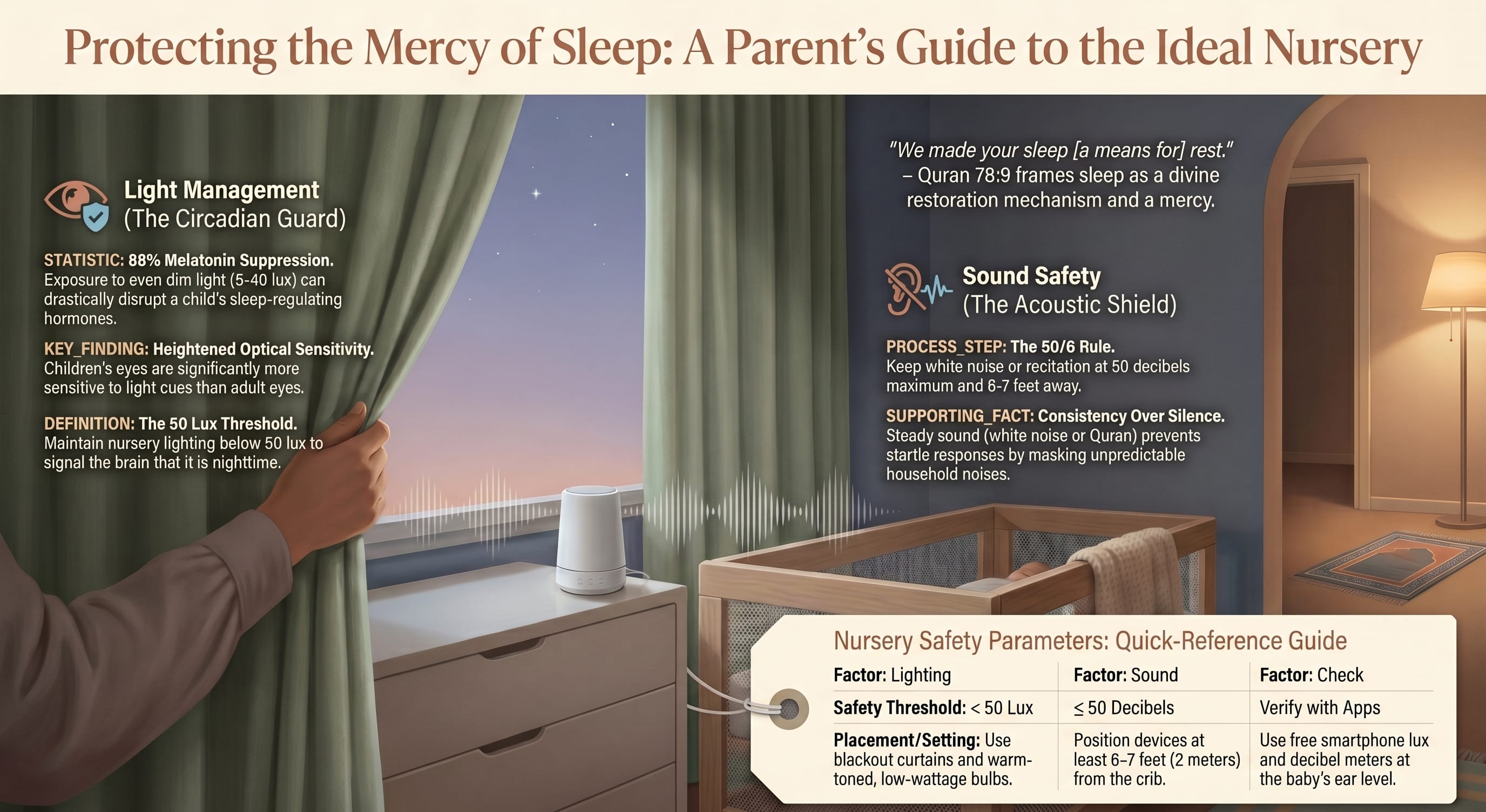
When I studied the latest research on infant sleep environments, one finding stopped me: exposure to even dim light—the kind you’d barely notice—can suppress melatonin production in young children by up to 88%, and the effect persists for nearly an hour after you turn the lights off. [2]
That’s not a small disruption. That’s your baby’s body receiving the wrong signals about when it’s time to sleep.
I’m sharing this because most of us worry about the obvious things—whether the room is quiet enough, whether the blanket is safe—but we miss the invisible factors that genuinely affect how well our babies rest.
Here’s what I mean: your baby’s circadian rhythm is still developing. The mechanisms that tell their body “it’s nighttime, produce melatonin, prepare for sleep” are extraordinarily sensitive to light and sound cues. When we unknowingly introduce the wrong stimuli—a night-light that’s too bright, a white noise machine positioned too close—we’re not just making bedtime harder. We’re working against their biology.
Why This Guide Is Different
This isn’t another list of vague sleep tips. Here’s what makes it different:
It gives you the actual numbers. Not “keep it dark” but “under 50 lux.” Not “use white noise safely” but “50 decibels maximum, positioned 6-7 feet away.” You’ll know exactly where the threshold is.
It explains the biology without overwhelming you. You’ll understand why these specific conditions matter for your baby’s developing circadian system—and why children respond differently than adults.
It integrates Islamic wisdom with the science. When the Quran describes sleep as a divine mercy, that’s not poetic language, it’s a recognition of something we’re still discovering through research. This guide shows you how Islamic principles and pediatric sleep science point in the same direction.
Does Darkness Actually Help Babies Sleep Better?
Yes. But the reason matters more than you might think.
When I researched this, I expected to find general advice about “creating a calm environment.” What I found instead was specific: dim environments support sleep because they trigger melatonin production—the hormone that makes us feel drowsy and regulates our sleep-wake cycle. [3]
Here’s where it gets interesting for parents. Children’s eyes are significantly more sensitive to light than adult eyes. The same evening light exposure that might suppress melatonin in an adult by 30-40% can suppress it by up to 80% in a young child. [4] Their developing circadian systems simply respond more dramatically to light cues.
This means the dim lamp you barely notice might be sending your baby’s brain a clear message: it’s still daytime. Stay awake.
The practical takeaway? As you move through your bedtime routine, gradually reduce lighting. In the daytime, closing blinds or curtains during naps creates the consistent dimness that supports sustained sleep—not because your baby can’t physically fall asleep in light, but because maintaining sleep becomes easier when their melatonin levels aren’t constantly suppressed.
Can Babies Sleep If It’s Too Light?
They can fall asleep. Whether they stay asleep is a different question.
Research demonstrates that once a child has settled for sleep, maintaining consistent light levels throughout their sleep period results in better rest quality. [5] It’s the changes—going from dark to light, or encountering unexpected brightness—that disrupt the cycle most significantly.
If your toddler naps in a lit room and sleeps through it, that’s not a problem. But if they wake frequently or take short naps, adjusting the light might be the variable that changes everything.
Should You Use a Night-Light?
If your child experiences bedtime anxiety or genuine fear of darkness, a night-light can provide emotional reassurance that outweighs the potential biological impact. [6]
The key is keeping it as dim as possible. When I say dim, I mean genuinely minimal—not the glowing orb that lights up the entire room, but the barely-there glow that lets you navigate safely without stimulating melatonin suppression.
A low-intensity warm-toned night-light also serves you when you need to attend to nighttime needs without fully waking your child. You can see enough to help them without introducing the brightness that would reset their circadian clock.
What About Red Light?
You’ve probably seen the claims about red light being “sleep-friendly” for babies.
Here’s what the research actually says: there’s no strong evidence that red-wavelength light offers particular advantages for infant sleep compared to other dim, warm-toned lighting. [7]
What matters more than color is intensity. Keep any light source well below the threshold that triggers melatonin suppression and that threshold is lower than most parents realize.
Managing Morning Brightness
Your baby might naturally extend their morning sleep when you minimize the dawn light entering their room.
The strategies are straightforward: blackout curtains, closed windows, even temporary blackout blinds during seasons with very early sunrise. [8] These light-reduction methods often simultaneously muffle early morning sounds—traffic, birds, household stirring—creating a dual benefit for sleep extension.
I know this feels like adding one more thing to manage. But if you’re already waking at 5:00 AM when you’d prefer 6:30, blocking that early light might be the simplest intervention with the biggest impact.
Can Babies Sleep in Noisy Environments?
Some children sleep through significant background noise. Others wake at the smallest sound. Most fall somewhere in between—they adapt to consistent noise but wake to sudden disruptions.
Here’s what research consistently shows: it’s not absolute quietness that matters most. It’s the absence of unexpected sounds. [9] A baby who falls asleep with gentle rainfall audio playing might sleep through that continuous sound beautifully but wake immediately when a door slams or a dog barks.
This is why acoustic consistency matters as much as volume. When the sound environment remains steady and predictable, children’s nervous systems don’t trigger the startle response that interrupts sleep.
Practical noise management:
Close bedroom windows and doors before sleep time
Hang heavier curtains to dampen external sounds
Use draft stoppers under door thresholds to reduce sound transmission between rooms [9]
Does Quranic Recitation Help Babies Sleep?
Many Muslim parents instinctively play gentle Quranic recitation as their children settle for sleep.
This practice has both spiritual and practical dimensions. Rhythmic, calm sound—whether Quranic recitation, soft humming of adhkar, or rainfall audio—can support sleep initiation for some children. [10] These sounds also provide acoustic masking, reducing the relative impact of sudden environmental noises.
The Quran itself speaks to how hearts find rest through remembrance of Allah. When you choose gentle recitation as part of your baby’s sleep environment, you’re creating space where beneficial spiritual practice intersects with practical infant care.
Safety requirements for audio during sleep: The volume must stay at or below 50 decibels—approximately the sound of a quiet conversation. Position the audio source at least 6 feet away from your baby’s sleep space. [11]
What About White Noise?
White noise machines have become nearly ubiquitous in infant sleep routines.
The continuous, steady sound can help children settle and provides acoustic masking for unpredictable household or environmental sounds. [9,12]
But here’s what you need to know: safety parameters exist, and they’re more specific than most parents realize.
Critical safety requirements:
Volume: Keep the sound level at or below 50 decibels. Some experts recommend staying closer to 45 decibels for infants. [11,13,14] This is approximately the volume of a dishwasher running in the next room—quieter than most parents expect.
Distance: Place the device at least 6-7 feet (approximately 2 meters) away from your baby’s sleep location. [11,13] Never position a white noise machine on the crib rail, on the mattress, or directly beside your infant’s head.
Duration: Use white noise primarily during sleep periods rather than as continuous all-day background sound. [14]
How to verify safe volume: Download a free decibel meter app on your smartphone. Measure the sound level at your child’s ear position while the device is running. Adjust volume and distance until the reading consistently stays at or below 50 decibels. [11,13]
The American Academy of Pediatrics established these guidelines after research found that many infant sleep machines, when used at maximum volume and close proximity, could exceed safe noise exposure levels. [15] The concern isn’t that white noise is inherently dangerous—it’s that improper use can potentially impact hearing development.
Dependency considerations: Children can develop strong associations between specific sounds and sleep initiation. If your child comes to expect white noise every time they sleep, they may struggle to settle in environments where it’s unavailable. You may eventually choose to phase out this aid gradually if dependency becomes inconvenient.
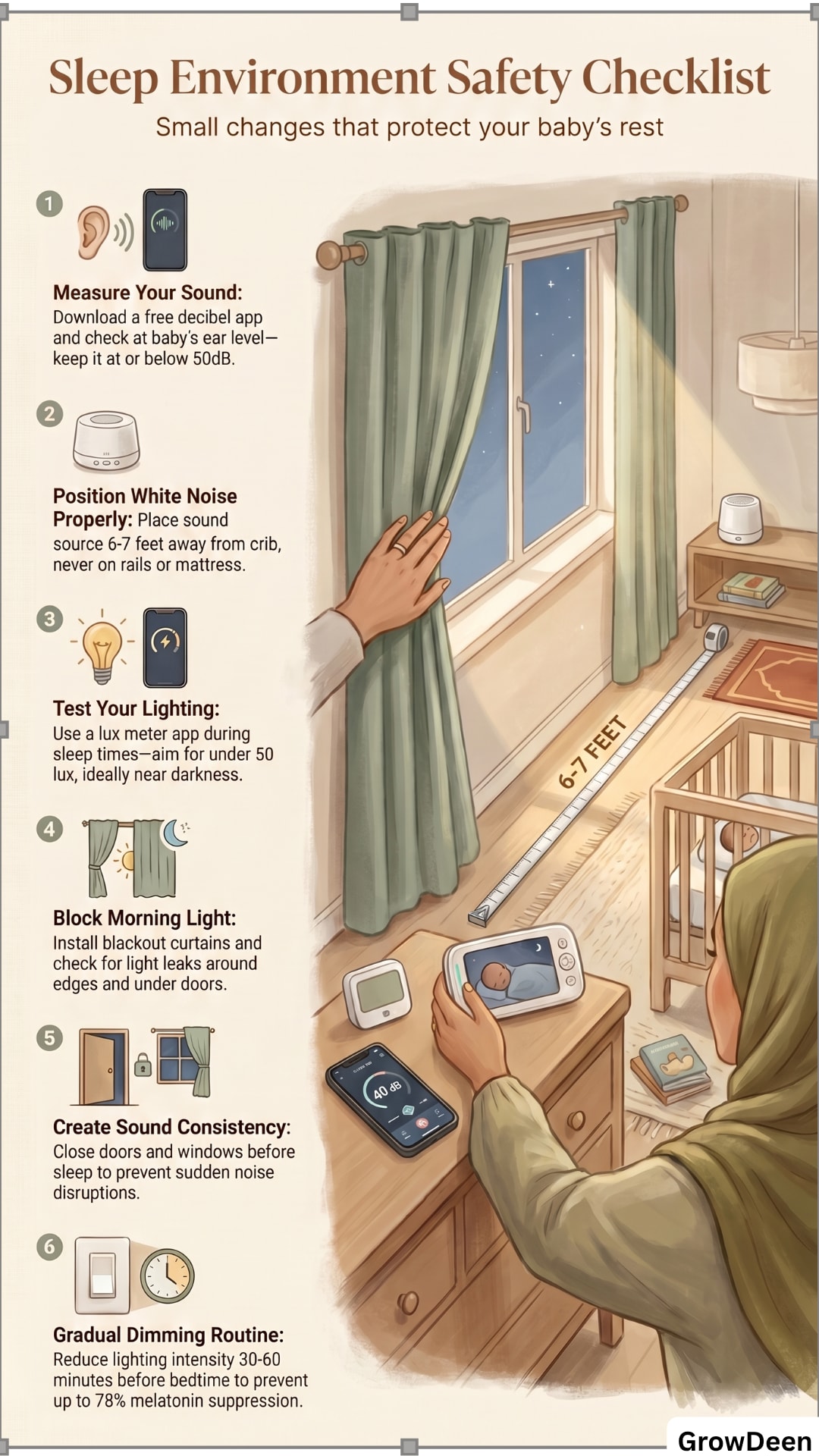
I know this feels like a lot to track—especially when you’re already managing feeds, diapers, and the hundred other details of infant care. That’s why I’ve created a free Sleep Environment Safety Checklist—a printable reference card with the exact decibel limits, distance requirements, and lighting thresholds you need. Keep reading to download it at the end of this article—it’s designed to stay in your nursery where you’ll actually use it.
The Islamic Framework: Sleep as Divine Mercy
When I reflect on how Islam addresses sleep, I’m struck by how the Quran frames it explicitly as a mercy from Allah.
Allah says: “And We made your sleep [a means for] rest” (Quran 78:9). [16]
According to Tafsir Ibn Kathir, this verse appears in a passage where Allah presents various signs of His power and mercy to humanity. Sleep functions as a restoration mechanism—it relieves fatigue and renews energy for what lies ahead. [17] The scholars explain that Allah designed this periodic rest as an essential component of human well-being, protecting us from the deterioration that would result from continuous wakefulness.
As Muslim parents, this transforms how we view our children’s sleep needs. When we create conditions that support healthy rest—managing light exposure, controlling sound environments, establishing peaceful routines—we’re not simply solving a practical challenge. We’re honoring one of Allah’s explicit mercies.
The Prophet Muhammad ﷺ demonstrated extraordinary gentleness toward children. He taught: “The merciful will be shown mercy by the Most Merciful. Be merciful to those on the earth, and the One in the heavens will have mercy upon you” (Sunan al-Tirmidhi 1924, Sahih). [18]
This creates a direct connection: the mercy we extend to our children—including patience when they struggle to sleep, responsiveness to their needs, attention to their sleep environment—positions us to receive Allah’s mercy in return.
When we apply these principles to infant sleep management, the practical applications become clear. Meeting needs with patience and responsiveness, creating environments conducive to rest, balancing mercy with wisdom—these aren’t separate from our spiritual obligations. They’re part of how we fulfill the sacred trust (amanah) that Allah has placed in our care.
Your Free Sleep Environment Safety Checklist
If you’ve read this far, you’re the kind of parent who takes infant sleep seriously—not as paranoia, but as protective care informed by understanding.
Inside the Sleep Environment Safety Checklist (one comprehensive PDF, 3 pages):
Page 1: Light & Sound Safety Thresholds—The exact numbers you need (50 decibels, 50 lux, 6-7 feet) with visual indicators and yes/no checklists—designed like a laminated reference card you can keep in your nursery or on your phone.
Page 2: Quick Troubleshooting Guide—If your baby wakes frequently, short naps, early rising—this flow chart walks you through which environmental factor to adjust first, organized by symptom so you can identify the fix in under 2 minutes.
Page 3: Bedtime Du’a for Protection & Peace—A simple, authentic du’a from the Prophet’s ﷺ Sunnah that parents can recite over their baby each night, or teach older toddlers to say before sleep, combining spiritual protection with the physical sleep environment you’ve carefully prepared.
This isn’t just a PDF to download and forget. It’s a tool designed to stay in your nursery—where you’ll actually reference it when you’re adjusting lighting at 11 PM or positioning a sound machine for a new sleep space.
This checklist is what every subscriber receives with each article. We cover the full journey of raising Muslim children, all backed by scientific research and rooted in Islamic wisdom.
If you’re a Muslim parent who wants both evidence-based guidance AND Islamic perspective, subscribe for free so future resources arrive in your inbox before you need them.
You’ll receive one article when it’s ready—no daily emails, no clutter, just guidance when there’s something worth sharing.
Before you close this tab: Go measure the volume on your white noise machine right now. Download a decibel app (they’re free), hold it at your baby’s ear level, and check the reading. If it’s over 50, adjust it down and move it back. This takes 3 minutes and could genuinely protect your child’s hearing.
May Allah place barakah in your effort and make the care you give more protective, more merciful, and more rewarded than it feels in the moment.
Share This With Someone Who Needs It
Think of one person right now: a new mother in your family who’s struggling with her baby’s sleep, a friend whose infant wakes every hour, a sister who mentioned she plays white noise but doesn’t know about the volume guidelines.
This article could transform their nights. Share it with them today—not as advice-giving, but as support. Sometimes the most loving thing we can do is pass along knowledge that actually helps.
Frequently Asked Questions
Q: How dark should a baby’s room be for naps? A: Dark enough that you’d need a moment for your eyes to adjust, but not pitch black unless your baby prefers it. Think: dim enough that light isn’t stimulating, but not so dark it causes anxiety. During daytime naps, closing curtains to reduce brightness by 70-80% is usually sufficient.
Q: Can white noise cause hearing damage in babies? A: Not when used correctly. White noise becomes a hearing risk only when it exceeds 50 decibels for prolonged periods or sits too close to your baby’s ears. [15] Keep it at 45-50 decibels maximum, position it 6-7 feet away, and verify the volume with a smartphone decibel meter app.
Q: My baby only falls asleep with bright lights on. What should I do? A: This is likely a learned association rather than a biological need. Start by gradually dimming the lights over 1-2 weeks—reduce brightness by small increments each night. You can also try introducing a very dim night-light as you phase out the brighter light. Most babies adapt within 7-10 days when the change is gradual.
Q: Is it better to use white noise or Quranic recitation for baby sleep? A: Both can work safely when kept at the proper volume and distance. Some parents prefer Quranic recitation for the spiritual benefit of surrounding their child with Allah’s words. Others find white noise more effective for masking sudden sounds. Try both and see what helps your baby settle best—the safety guidelines (50 decibels, 6+ feet away) apply to either option.
Q: How long does it take for a baby’s circadian rhythm to develop? A: Most babies begin producing melatonin in response to light-dark cycles around 9-12 weeks of age. [19] Before this, their sleep patterns are more irregular. After 3 months, creating consistent light and dark environments becomes increasingly effective at supporting their natural sleep-wake rhythm.
Q: Can I use a regular lamp as a night-light if I keep it very dim? A: Yes, as long as the bulb is extremely low wattage (7-15 watts maximum) and produces warm-toned light. Position it away from your baby’s direct line of sight. The goal is creating just enough light for safe navigation without triggering melatonin suppression. Purpose-made night-lights with automatic brightness adjustment can be helpful, but a dim lamp works fine.
References
[1] Hartstein, L.E., Deo, R.C., Wright Jr, K.P., & LeBourgeois, M.K. (2022). Even minor exposure to light before bedtime may disrupt preschooler’s sleep. Sleep Health, 8(1), 21-27.
[2] Akacem, L.D., Wright Jr, K.P., & LeBourgeois, M.K. (2018). Sensitivity of the circadian system to evening bright light in preschool-age children. Physiological Reports, 6(5), e13617.
[3] BaHammam, A.S., Almeneessier, A.S., Pandi-Perumal, S.R., & Sharif, M.M. (2011). Sleep from an Islamic perspective. Annals of Thoracic Medicine, 6(4), 187-192.
[4] Lee, S.I., Hida, A., Kitamura, S., et al. (2018). Melatonin suppression and sleepiness in children exposed to blue-enriched white LED lighting at night. Physiological Reports, 6(24), e13942.
[5] Iwata, S., Fujita, F., Kinoshita, M., et al. (2023). Contributions of the light environment and co-sleeping to sleep consolidation into nighttime in early infants. Early Human Development, 186, 105859.
[6] Page, S.D., Clark, L., Souders, M.C., Pinto-Martin, J.A., & Deatrick, J.A. (2025). Family management of common sleep disturbances among children with autism. Journal of Pediatric Nursing, 82, 160-169.
[7] Riedy, S.M., Smith, M.G., Rocha, S., & Basner, M. (2021). Noise as a sleep aid: A systematic review. Sleep Medicine Reviews, 55, Article 101385.
[8] Sezici, E., & Yigit, D. (2018). Comparison between swinging and playing of white noise among colicky babies. Journal of Clinical Nursing, 27(3-4), 593-600.
[9] Hugh, S.H., Wolter, N.E., Propst, E.J., Gordon, K.A., Cushing, S.L., & Papsin, B.C. (2014). Infant sleep machines and hazardous sound pressure levels. Pediatrics, 133(4), 677-681.
[10] France, K.G., McLay, L.K., Hunter, J.E., & France, M.L. (2018). Empirical research evaluating the effects of non-traditional approaches to enhancing sleep in typical and clinical children. Sleep Medicine Reviews, 39, 69-81.
[11] American Academy of Pediatrics (2023). Policy statement on prevention of noise-induced hearing loss. Pediatrics, 152(6), e2023063753.
[12] Spencer, J.A.D., Moran, D.J., Lee, A., & Talbert, D. (1990). White noise and sleep induction. Archives of Disease in Childhood, 65(1), 135-137.
[13] Centers for Disease Control and Prevention (2024). What noises cause hearing loss? Atlanta, GA: National Center for Environmental Health.
[14] Hugh, S.H., Wolter, N.E., Propst, E.J., Gordon, K.A., Cushing, S.L., & Papsin, B.C. (2014). Infant sleep machines and hazardous sound pressure levels. Pediatrics, 133(4), 677-681.
[15] Hugh, S.H., Wolter, N.E., Propst, E.J., Gordon, K.A., Cushing, S.L., & Papsin, B.C. (2014). Infant sleep machines and hazardous sound pressure levels. Pediatrics, 133(4), 677-681.
[16] The Noble Quran, Surah An-Naba (78:9)
[17] Tafsir Ibn Kathir, commentary on Surah An-Naba, verses 1-16
[18] Abdullah ibn Amr reported: The Messenger of Allah ﷺ said: “The merciful will be shown mercy by the Most Merciful. Be merciful to those on the earth, and the One in the heavens will have mercy upon you.” (Sunan al-Tirmidhi 1924, Sahih)
[19] Iwata, S., Fujita, F., Kinoshita, M., et al. (2023). Contributions of the light environment and co-sleeping to sleep consolidation into nighttime in early infants. Early Human Development, 186, 105859.