


The AAP’s 2016 guidelines confirm that room-sharing — keeping your baby on a separate safe sleep surface in your room — reduces the risk of SUDI (including SIDS and fatal sleep accidents) by approximately 50% during the first year of life. [1] This guide shows you exactly how to set it up, why it works, and what to do when your space feels too small.
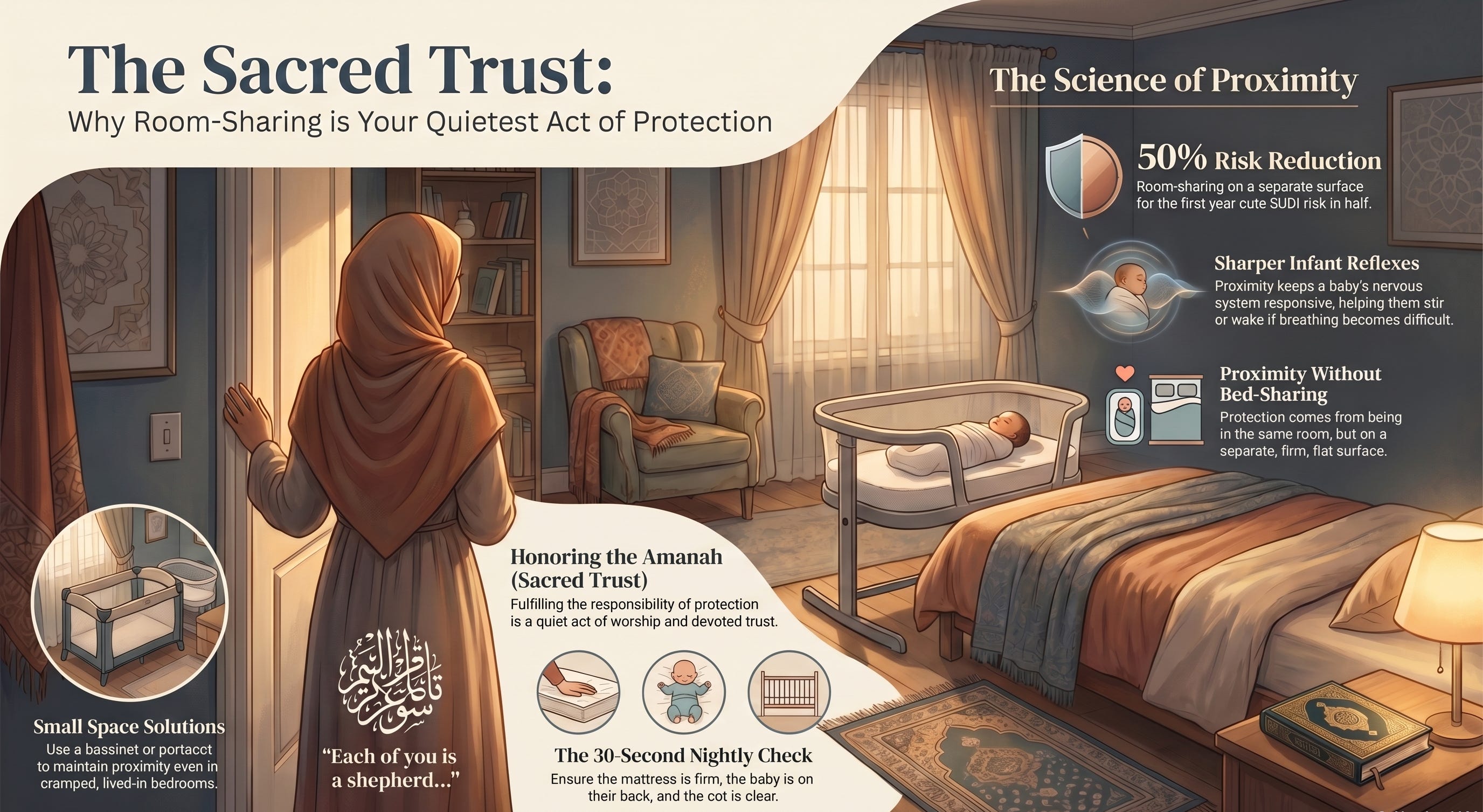
When I studied the American Academy of Pediatrics’ 2016 safe sleep guidelines, one statistic stopped me: room-sharing for the first six to twelve months can reduce the risk of sudden unexpected death in infancy by approximately 50%. [1]
Not 5%. Not 15%. Half.
You were careful during pregnancy. You researched car seats and baby monitors. You baby-proofed before your child could even crawl. But this — where your baby sleeps at night — might be the quietest, most protective decision you’ll make in that entire first year.
Room-sharing is exactly what it sounds like: your baby sleeps on their own safe surface (a cot, bassinet, or portacot) in the same room where you sleep. Not in your bed. Not on your chest. In their own space, within reach. And that proximity — just being near you while they sleep — creates a measurable protective effect that researchers still don’t fully understand but can’t dispute.
Why This Guide Is Different
This isn’t another generic sleep safety list. Here’s what makes this approach different:
Scientific research + current data. Every recommendation is backed by peer-reviewed studies from the AAP, major pediatric journals, and multi-region research spanning over two decades.
Islamic framework integrated. Room-sharing isn’t just medical advice — it’s about honoring the amanah (sacred trust) of your child’s safety while they’re at their most vulnerable, aligning protection with spiritual responsibility.
Practical solutions included. You’ll get a free Room-Sharing Safety Setup Guide at the end — a printable checklist you can keep in your nursery, not just information you’ll forget by tomorrow.
What Is Room-Sharing (And What It’s Not)
Room-sharing means your baby sleeps on a separate, safe sleep surface — a cot, bassinet, portacot, baby box, or pepi-pod — positioned in the same room as you. [2]
It is not bed-sharing. It is not co-sleeping on the same surface. The distinction matters because the protective benefit comes from proximity combined with separation. You’re close enough for your baby’s reflexes to stay sharp, but they’re on a surface firm and clear enough to keep their airways safe.
Here’s what surprised me when I looked at the research: your presence alone seems to help. When your baby sleeps near you, the reflexes that protect their airways — swallowing, stirring, waking if breathing becomes difficult — work better. [3] Scientists aren’t entirely sure why, but one theory is that your baby’s nervous system stays slightly more responsive when it senses you nearby. Your breathing, your movements, even your warmth may keep their body in a lighter, safer sleep state during those vulnerable early months.
Why Room-Sharing Works (The Science You Need to Know)
The research on room-sharing is some of the most consistent in all of pediatric sleep safety.
When researchers studied infant deaths across 20 regions in Europe, they found that babies who slept in a separate room had a significantly higher SUDI risk than babies who slept in the same room as their parents. [4] A major British Medical Journal study confirmed the same pattern: room-sharing, even without breastfeeding, was independently protective. [5]
Why does it work?
Your baby’s reflexes stay sharper. The automatic responses that make them shift position, clear their airway, or wake up when something’s wrong seem to function more effectively when you’re close. [3]
You respond faster. If your baby does struggle — if they spit up, if their face turns into the mattress before they can roll away, if their breathing changes — you’re already there. Seconds matter.
It supports breastfeeding. Breastfeeding itself reduces SUDI risk, and room-sharing makes nighttime feeding easier, which means you’re more likely to keep going even when you’re exhausted. [6]
The AAP recommends room-sharing for at least the first six months — the highest-risk period — and ideally for the full first year. [1] If you can manage a full year, do it. If six months is all your space or sanity allows, those six months still matter.
What About When Space Feels Impossible?
I know you’re thinking: “My bedroom barely fits our bed.”
I’ve been there. You’re not choosing between your baby’s safety and your own sleep. You’re trying to figure out how to fit a bassinet in a room that already feels too small, or whether moving your baby to their own room at four months because the cot won’t fit is going to put them at risk.
Here’s what you can do:
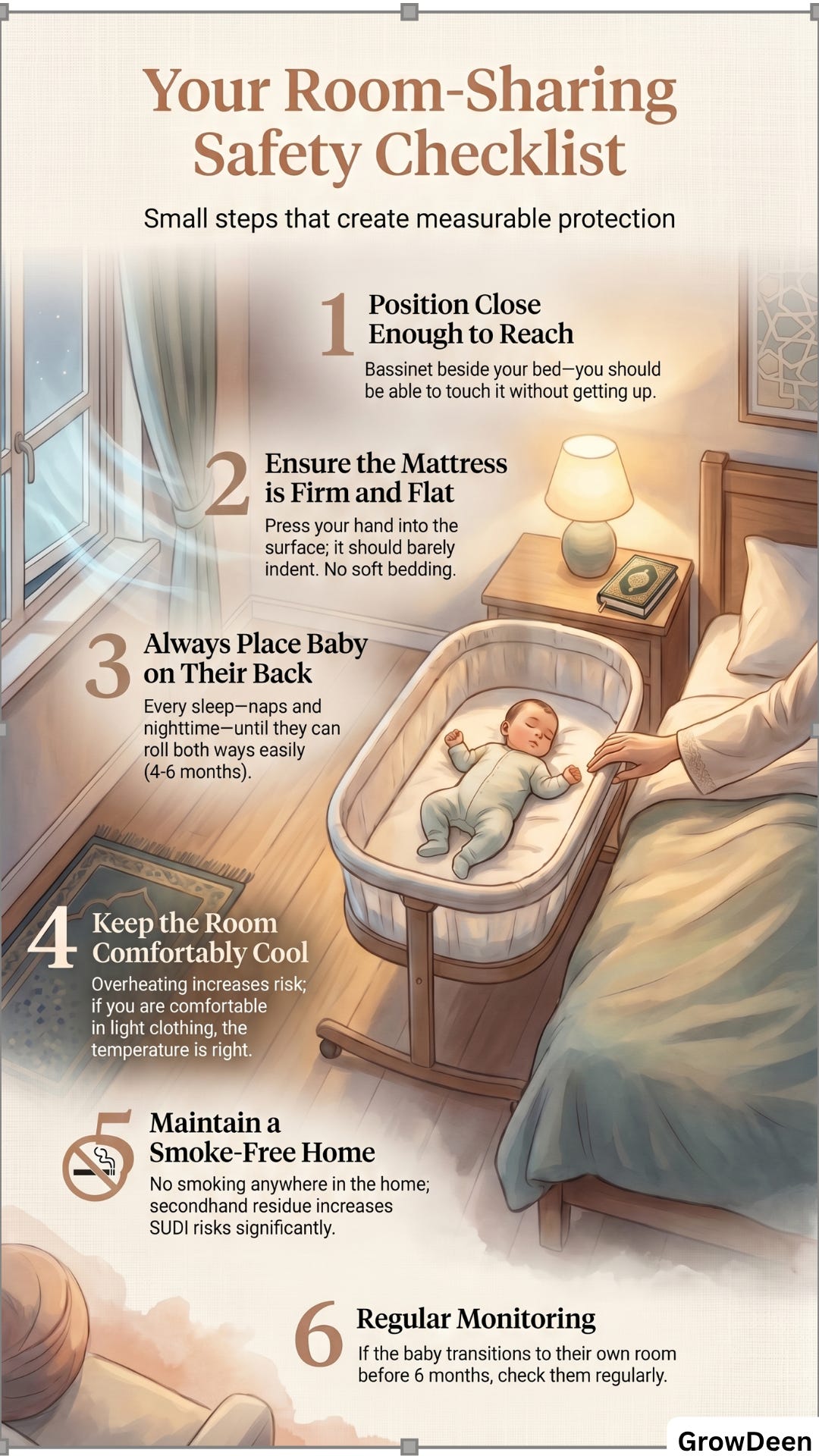
If your room truly can’t fit a cot: Keep your baby in a bassinet or portacot for as long as safely possible (usually up to 5-6 months, depending on the product’s weight limit). Bassinets take up far less space than full-size cots.
If you have to move your baby to their own room earlier than six months: Make that room as safe as possible. Firm, flat mattress. Baby always on their back. Nothing soft or loose in the cot. Room temperature comfortable, not hot. Completely smoke-free. Then check on your baby regularly — when you go to bed, if you wake in the night. Some parents use a video monitor to stay connected across the distance, though it’s not a replacement for proximity.
If you’re sharing your room with older children: You can still keep the baby’s sleep surface in your room. Position the bassinet or cot on your side of the bed, away from where older siblings sleep.
The ideal is room-sharing for six to twelve months. But if the ideal isn’t possible, you make the safest choice you can with what you have.
I know this feels like a lot to hold — another safety rule when you’re already managing a hundred others. That’s why I created a free Room-Sharing Safety Setup Guide — a one-page printable checklist and visual guide you can keep beside your baby’s cot. Keep reading to download it at the end of this article. It’s designed to make this easier, not add to your mental load.
What Changes Once Your Baby Can Roll?
Around four to six months, your baby will start rolling from back to tummy and tummy to back. Once they can do this easily — rolling both ways without getting stuck — they’ve developed enough strength to reposition themselves if their airway becomes compromised, as long as they’re in a safe sleep environment. [7]
You should still place them on their back at the start of every sleep. But you don’t need to flip them back over every time they roll during the night. Their movement is part of their protection now.
What you do need to keep doing: ensuring their sleep space stays clear. No blankets, pillows, stuffed toys, or cot bumpers. A firm, flat surface is still non-negotiable.
What You Should Never Use for Sleep
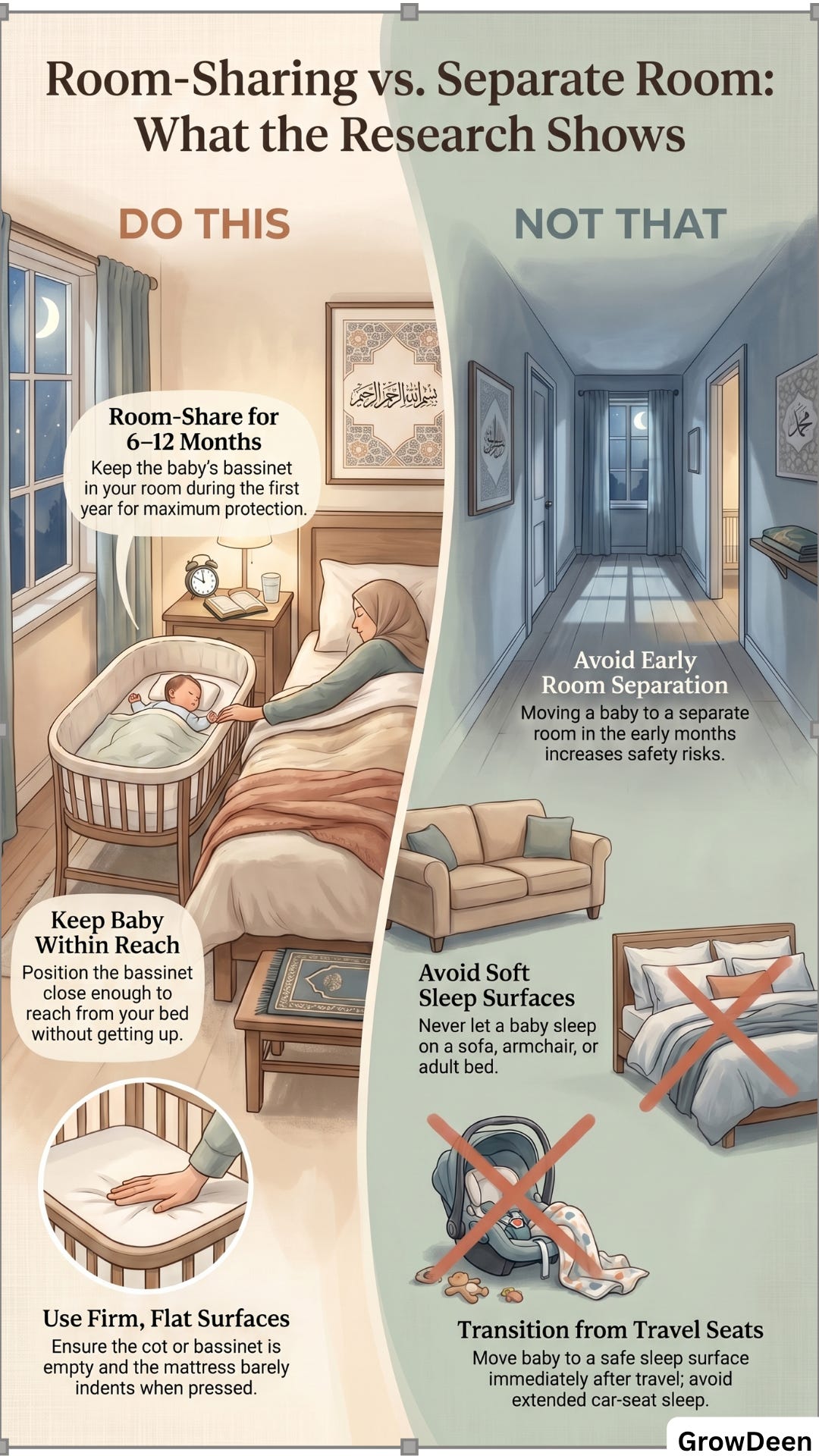
Some surfaces aren’t safe for sleep, even for short naps:
Bouncinettes, hammocks, bean bags. These don’t provide the firm, flat support babies’ airways need.
Sofas, armchairs, pillows. Babies can slip into gaps or get their faces pressed against soft surfaces.
Car seats or prams for extended sleep. If your baby falls asleep during travel, move them to a safe sleep surface as soon as you can. [8] Car seats are angled in a way that can affect breathing if a baby stays in them too long while sleeping.
The Islamic Framework: Amanah in Action
Your baby cannot move themselves to safety. They cannot call for help. The trust placed in you is complete.
The Prophet Muhammad ﷺ said, “Each of you is a shepherd, and each of you is responsible for his flock.” (Sahih al-Bukhari 7138) [09] This applies to the smallest, quietest decisions — where your baby sleeps, how you arrange their space, whether you check one more time before closing your own eyes.
Room-sharing is care made visible. It’s not hypervigilance. It’s not fear. It’s steady, protective presence — the kind of care that honors the trust Allah placed in your hands.
Your Room-Sharing Safety Setup Guide (Free Download)
If you’ve read this far, you’re the kind of parent who takes sleep safety seriously — not as paranoia, but as responsible love.
Inside the Room-Sharing Safety Setup Guide (one comprehensive PDF, 2 pages):
Page 1: Room-Sharing Safety Checklist — A visual checklist covering safe sleep surface setup, positioning, room environment, and what to avoid — designed like a laminated reference card you can keep beside your baby’s cot.
Page 2: Troubleshooting Small Spaces — Practical solutions for fitting a bassinet or portacot in tight bedrooms, and what to do if you need to transition your baby to their own room earlier than planned — organized by scenario so you can find your situation quickly.
This isn’t just a PDF to download and forget. It’s a tool designed to stay in your nursery — where you’ll actually use it at 2 a.m. when you’re second-guessing your setup.
This Room-Sharing Safety Setup Guide is what every GrowDeen subscriber receives with each article. We cover the full journey of raising Muslim children with both medical insight and spiritual grounding.
If you’re a Muslim parent who wants evidence-based guidance rooted in Islamic wisdom, subscribe for free so future resources arrive in your inbox before you need them.
You’ll receive guidance when it’s ready, no spamming, no clutter, just guidance when there’s something worth sharing.
Before you close this tab, do this: Walk into your baby’s room right now and check three things. Is the mattress firm? Is your baby on their back? Is the cot completely clear? That’s it. Those three checks take 30 seconds and they matter more than you think.
May Allah grant you ease during these sleepless months, protect your child from every harm, and accept the care you’re giving as an act of devoted trust.
Share This With Someone Who Needs It
Think of one person right now: a pregnant friend preparing her nursery, a new mother who just brought her baby home, a sister whose bassinet is set up in a way that worries you.
This article could protect their child. Share it with them today — not because you’re being preachy, but because you care. Sometimes the most loving thing we can do is pass along knowledge that prevents tragedy.
Frequently Asked Questions
Q: Can I room-share if I’m a light sleeper and wake up every time my baby moves?
A: Yes, and most parents adjust within 2-3 weeks. Your baby’s small sounds (grunting, stirring) are normal and don’t require intervention. You’ll learn to distinguish between sounds that need a response and sounds that are just part of infant sleep. Consider white noise for both of you — it can mask the small noises while still letting you hear genuine cries.
Q: What if my baby wakes up more often because they can sense I’m nearby?
A: Research shows the opposite is usually true — babies often settle faster when parents are close because they feel secure. [3] If night wakings feel excessive, check wake windows, feeding schedules, and room temperature before assuming proximity is the problem. For more on sleep patterns, see the newborn sleep section above.
Q: Is it safe to have my baby’s cot right against my bed with no gap?
A: No. There should be no gap between your mattress and the baby’s cot that a baby could slip into, but the surfaces must remain separate. Position the cot close enough to reach your baby easily, but ensure it’s a standalone, stable surface — not touching your bed or pushed into a corner where gaps could form.
Q: When should I move my baby to their own room?
A: Ideally after 6 months at minimum, and up to 12 months if possible. The first six months carry the highest SUDI risk, so those months matter most. If you need to transition earlier due to space constraints, follow the safety guidelines in “When You Don’t Share a Room” above.
Q: What’s the difference between room-sharing and bed-sharing?
A: Room-sharing means your baby sleeps on a separate safe surface (cot, bassinet) in your room. Bed-sharing means your baby sleeps on the same surface as you (in your bed). Room-sharing is recommended; bed-sharing significantly increases SUDI risk in most circumstances. [5]
Q: Can I use a bedside sleeper or co-sleeper bassinet?
A: Yes, as long as it meets current safety standards — firm, flat mattress, tight fit against your bed with no gaps, and approved for overnight sleep. Check that the product hasn’t been recalled and follows AAP safe sleep guidelines.
References
[1] American Academy of Pediatrics, Task Force on Sudden Infant Death Syndrome. (2016). SIDS and other sleep-related infant deaths: Updated 2016 recommendation for a safe infant sleeping environment. Pediatrics, 138(5), Article e20162938. https://doi.org/10.1542/peds.2016-2938.
[2] Moon, R.Y. (2016). SIDS and other sleep-related infant deaths: Evidence base for 2016 updated recommendations for safe infant sleeping environment. Pediatrics, 138(5), Article e20162940. https://doi.org/10.1542/peds.2016-2940.
[3] McKenna, J.J., & McDade, T. (2005). Why babies should never sleep alone: A review of the co-sleeping controversy in relation to SIDS, bedsharing and breastfeeding. Paediatric Respiratory Reviews, 6(2), 134-152. https://doi.org/10.1016/j.prrv.2005.03.006.
[4] Carpenter, R.G., Irgens, L.M., Blair, P.S., England, P.D., Fleming, P.J., Huber, J., Jorch, G., & Schreuder, P. (2004). Sudden unexplained infant death in 20 regions in Europe: Case control study. The Lancet, 363(9404), 185-191. https://doi.org/10.1016/s0140-6736(03)15323-8.
[5] Blair, P.S., Fleming, P.J., Smith, I.J., Ward Platt, M., Young, J., Nadin, P., Berry, P.J., Golding, J., & the CESDI SUDI Research Group. (1999). Babies sleeping with parents: Case-control study of factors influencing the risk of the sudden infant death syndrome. British Medical Journal, 319(7223), 1457-1462. http://doi.org/10.1136/bmj.319.7223.1457.
[6] Horne, R.S.C., Hauck, F.R., & Moon, R.Y. (2015). Sudden infant death syndrome and advice for safe sleeping. British Medical Journal, 350, Article h1989. https://doi.org/10.1136/bmj.h1989.
[7] Trachtenberg, F.L., Haas, E.A., Kinney, H.C., Stanley, C., & Krous, H.F. (2012). Risk factor changes for sudden infant death syndrome after initiation of Back-To-Sleep campaign. Pediatrics, 129(4), 630-638. https://doi.org/0.1542/peds.2011-1419.
[8] American Academy of Pediatrics, Task Force on Sudden Infant Death Syndrome. (2011). Policy statement: SIDS and other sleep-related infant deaths: Expansion of recommendations for a safe infant sleeping environment. Pediatrics, 128(5), 1030-1039. https://doi.org/10.1542/peds.2011-2284.
[09] Sahih al-Bukhari 7138